Tuesday of the Thirteenth Week in Ordinary Time – Lectionary: 378
When God Speaks, Will You Listen?
There is something unsettling about a God who refuses to stay quiet. Most people, if they are being honest, would prefer a God who is distant enough to be comfortable, present enough to be reassuring, but never quite demanding enough to disrupt the life they have already built. The readings today destroy that version of God completely.
The liturgy today assembles three texts from across the breadth of salvation history, and they are all saying the same thing in different keys. Amos opens with a thunderclap. Psalm 5 responds with a whisper of trust. And the Gospel of Matthew lands the whole argument in a fishing boat on a lake that is trying to swallow everyone aboard. The thread running through all three is this: God is sovereign, God speaks, and the only question that matters is what His people do when He does.
The historical backdrop sharpens everything. When Amos delivered his oracle, Israel was riding high. Under Jeroboam II, the Northern Kingdom was wealthier than it had been in generations. The temples were full, the festivals were celebrated, and the people of God were doing exactly what religious people do when things are going well: they confused prosperity with faithfulness. They assumed that because God had chosen them, He would never hold them accountable. Amos walked in from the countryside and told them, with devastating directness, that they had it exactly backwards. Election is not a shield from judgment. It is the very reason judgment comes.
The psalmist understands this and brings it into the interior life. He does not argue with God’s justice. He simply shows up in the morning, plants himself before God, and waits. He knows the wicked find no refuge with the Lord. He also knows that mercy is the only door through which any honest soul can enter. So he walks through it, humbly, and asks to be shown the straight path.
Then the Gospel arrives and makes it personal. The disciples are not reading about storms. They are inside one. And the Lord they have chosen to follow is asleep in the stern of the boat while the waves threaten to end everything. Their fear is completely understandable. Their faith, Jesus tells them gently but firmly, is too small for the moment they are in.
That is the invitation today’s readings extend to every person sitting in the pew or reading along at home. Are you willing to hear what God is actually saying, not just what you hoped He would say? And when the storm hits, and it will hit, do you know who is in the boat with you? The God of Amos, the God of the Psalm, and the God asleep in that fishing boat are the same God. He is not distant. He is not indifferent. He is simply waiting to see if His people will cry out to Him before the waves get too high.
First Reading – Amos 3:1-8; 4:11-12
When God Calls You Out, It Means He Still Cares
There is a reason the Church does not open today’s liturgy with a gentle, encouraging word. The reading from Amos is not designed to make anyone feel comfortable. It is designed to wake people up. And considering the world most Catholics are navigating right now, that wake-up call lands with remarkable precision.
Amos was not a professional prophet. He was a shepherd and a dresser of sycamore trees from Tekoa, a small town in Judah, and God pulled him out of his ordinary life and sent him north to deliver a message that nobody in Israel wanted to hear. The Northern Kingdom under Jeroboam II was prosperous, powerful, and deeply religious on the surface. The temples were busy. The festivals were packed. And the people had quietly convinced themselves that God’s choice of Israel meant God’s unconditional approval of Israel. Amos arrived to dismantle that assumption verse by verse.
Amos 3:1-8; 4:11-12 – New American Bible (Revised Edition)
First Summons
1 Hear this word, Israelites, that the Lord speaks concerning you,
concerning the whole family I brought up from the land of Egypt:
2 You alone I have known,
among all the families of the earth;
Therefore I will punish you
for all your iniquities.3 Do two journey together
unless they have agreed?
4 Does a lion roar in the forest
when it has no prey?
Does a young lion cry out from its den
unless it has seized something?
5 Does a bird swoop down on a trap on the ground
when there is no lure for it?
Does a snare spring up from the ground
without catching anything?
6 Does the ram’s horn sound in a city
without the people becoming frightened?
Does disaster befall a city
unless the Lord has caused it?7 (Indeed, the Lord God does nothing without revealing his plan to his servants the prophets.)
8 The lion has roared,
who would not fear?
The Lord God has spoken,
who would not prophesy?11 I overthrew you
as when God overthrew Sodom and Gomorrah;
you were like a brand plucked from the fire,
Yet you did not return to me—
oracle of the Lord.
12 Therefore thus I will do to you, Israel:
and since I will deal thus with you,
prepare to meet your God, O Israel!
Detailed Exegesis
Verse 1: “Hear this word, Israelites, that the Lord speaks concerning you, concerning the whole family I brought up from the land of Egypt.”
The opening command, “hear,” is not a polite invitation. In Hebrew prophetic literature, it is a legal summons. God is calling His people to stand before Him and answer for themselves. The reference to Egypt is deliberate. God is reminding Israel not of a distant theological abstraction but of an act of concrete, costly deliverance. He rescued them. He carried them. And now He is holding them to account.
Verse 2: “You alone I have known among all the families of the earth; therefore I will punish you for all your iniquities.”
The Hebrew word for “known” here is yada, the same word used for the deepest kind of intimate relationship. God is not saying He was aware of Israel’s existence the way He is aware of every nation. He is saying He chose Israel for a singular covenantal closeness, the kind that comes with obligations on both sides. The word “therefore” is the hinge on which the entire reading turns. Most people assume that being chosen by God means being protected from consequences. Amos says the opposite. Greater intimacy means greater accountability.
Verses 3-6: “Do two journey together unless they have agreed? Does a lion roar in the forest when it has no prey?…”
Amos deploys a rapid chain of rhetorical questions, each one drawing on the common-sense logic of everyday life. Every effect has a cause. Every alarm signals a real danger. If a bird falls into a trap, there was a lure. If a trumpet sounds in a city, something has happened. He is training his audience to think causally before he delivers the theological conclusion: nothing in history, including disaster, happens outside the scope of divine providence.
Verse 7: “Indeed, the Lord God does nothing without revealing his plan to his servants the prophets.”
This verse is parenthetical in structure but enormous in theological weight. God does not act without warning. He always speaks first. He always sends the prophet before He sends the consequence. This is not the behavior of a capricious or vindictive deity. It is the behavior of a God who is giving His people every possible opportunity to turn around before things get worse.
Verse 8: “The lion has roared; who would not fear? The Lord God has spoken; who would not prophesy?”
The parallel structure here is stunning. A roaring lion produces an involuntary response of fear in every creature within earshot. In the same way, when God speaks, the authentic response is not indifference but reverent awe. And the prophet cannot stay silent once that word has been received. He must speak, because the word of God is not a private experience to be kept to oneself.
Verses 4:11-12: “I overthrew you as when God overthrew Sodom and Gomorrah; you were like a brand plucked from the fire, yet you did not return to me… prepare to meet your God, O Israel!”
God recounts the disciplines He has already sent: drought, blight, pestilence, military defeat. Israel survived all of them. They were like a burning stick snatched from the flames, and that survival was itself an act of mercy. But five times across the wider chapter, God repeats the same devastating verdict: “Yet you did not return to me.” The final summons, “prepare to meet your God,” is not a threat designed to terrify. It is the last mercy of a God who still believes His people can choose differently.
Teachings
Saint John Chrysostom preached that the prophet who softens the word of God out of fear of human reaction is betraying the very word he was called to transmit. Amos exemplifies the opposite. He speaks with what Chrysostom called parresia, a bold and fearless proclamation that puts the truth ahead of the audience’s comfort. The message he carries is not his own, and that is precisely why he cannot dilute it.
The Catechism of the Catholic Church connects this prophetic tradition to its ultimate fulfillment. CCC 65 teaches: “In many and various ways God spoke of old to our fathers by the prophets, but in these last days he has spoken to us by a Son.” The entire prophetic tradition, including Amos’s thunder, is ordered toward Christ. Every warning, every call to return, every oracle of judgment is a preparation for the definitive Word that the Father would speak in the flesh.
Saint Thomas Aquinas, in the Summa Theologiae, distinguishes between God as the primary cause of all things and the secondary causes through which history unfolds. What Amos is asserting is that God governs all of it. Nothing falls outside His providential order, not prosperity, not disaster, and not the silence that follows a warning ignored. Aquinas writes that “divine providence extends to all things, not only in general but in particular, and this is why nothing happens by chance with respect to God.”
The Church also teaches through CCC 1021-1022 that every human being will face a particular judgment at the moment of death, a personal encounter with God that Amos’s phrase “prepare to meet your God” anticipates with striking clarity. The question is not whether that meeting will happen. The question is the condition of the soul when it does.
Reflection
The hardest part of this reading for a modern Catholic to sit with is not the anger of God. It is the patience of God. He warned Israel again and again. He disciplined them with increasing urgency. He snatched them from the fire more than once. And still they did not return. The tragedy is not that God gave up on them. It is that they kept choosing the life they had built over the relationship they were made for.
What is the area of your life where God has been sending warnings that you have been explaining away? It is worth sitting with that question honestly. Maybe it is a relationship that has become an idol. Maybe it is a habit that you know is pulling you away from Him. Maybe it is simply the comfortable spiritual numbness that settles in when life is going well enough that prayer starts to feel optional.
Amos reminds every believer that the sacramental life is not a membership card. Baptism, Confession, the Eucharist: these are not protections against accountability. They are the very means through which God deepens His relationship with His people, which means they are also the very reason He holds His people to a higher standard. The disciple who has received more has more to answer for.
The practical invitation of this reading is straightforward even if it is not easy. Return before you are called to meet Him under circumstances you did not choose. Show up at Mass not because it is Sunday but because the lion has roared. Go to Confession not as a spiritual errand to check off a list but as the act of returning that God has been waiting for. The Lord God has spoken. What will you do with what you have heard?
Responsorial Psalm – Psalm 5:4-9
The Morning Prayer of a Soul That Knows Where to Run
If Amos is the thunderclap, the Responsorial Psalm is the soul that hears it and knows exactly what to do. Psalm 5 does not argue with God’s justice, does not negotiate with it, and does not try to soften it. It simply shows what a person looks like when they have heard the warning and chosen, wisely and humbly, to run straight toward God rather than away from Him.
This psalm is attributed to David, and it belongs to a category of prayers the Church calls individual laments or morning prayers. David wrote from a position of genuine danger. He was surrounded by enemies, by people who lied about him, plotted against him, and wished him harm. But what makes Psalm 5 extraordinary is that David does not open with a description of his enemies. He opens with a description of God. Before he says a single word about what is threatening him, he plants himself in the presence of the One he trusts to handle it. That ordering is not accidental. It is the entire lesson.
The liturgy places this psalm between Amos and the Gospel with precise theological intention. Amos has just told Israel to prepare to meet their God. The psalm shows what it looks like to actually do that, not in the moment of judgment, but in the quiet of the morning, day after day, with whatever faith and honesty a person can bring to the altar.
Psalm 5:4-9 – New American Bible (Revised Edition)
4 in the morning you will hear my voice;
in the morning I will plead before you and wait.5 You are not a god who delights in evil;
no wicked person finds refuge with you;
6 the arrogant cannot stand before your eyes.
You hate all who do evil;
7 you destroy those who speak falsely.
A bloody and fraudulent man
the Lord abhors.8 But I, through the abundance of your mercy,
will enter into your house.
I will bow down toward your holy sanctuary
out of fear of you.
9 Lord, guide me in your justice because of my foes;
make straight your way before me.
Detailed Exegesis
Verse 4: “In the morning you will hear my voice; in the morning I will plead before you and wait.”
The repetition of “in the morning” is not poetic filler. In ancient Israel, morning corresponded to the time of the daily Temple sacrifice, the tamid offering that consecrated the first hours of the day to God. To pray in the morning was to unite one’s voice with the liturgical action of the whole people. The verb translated as “wait” carries the connotation not of passive sitting but of watchful expectation, like a sentinel scanning the horizon for something he fully expects to arrive. The psalmist is not just talking to God and moving on. He is positioning himself to receive a response.
Verse 5: “You are not a god who delights in evil; no wicked person finds refuge with you.”
This is a statement of divine character before it is anything else. The psalmist is not threatening the wicked. He is declaring who God is. A God who delighted in evil would be no God at all. He would simply be a more powerful version of the corrupt world the psalmist is trying to navigate. The comfort here is real: the God to whom the psalmist runs is categorically different from the forces that threaten him.
Verse 6: “The arrogant cannot stand before your eyes. You hate all who do evil.”
The language of divine hatred here has troubled readers across centuries, and it is worth slowing down for it. Saint Augustine, in his Expositions on the Psalms, was careful to clarify that this is not emotional volatility on God’s part. It is the absolute incompatibility between divine holiness and moral corruption. God cannot be indifferent to evil without ceasing to be holy. The arrogant, those who have placed themselves at the center of their own universe, find no foothold in His presence because His presence is the very thing that exposes the lie they have been living.
Verse 7: “You destroy those who speak falsely. A bloody and fraudulent man the Lord abhors.”
These categories connect directly back to Amos. The prophet indicted Israel’s leaders and wealthy elites for fraud, oppression, and the shedding of innocent blood. The psalmist is naming the same sins as the ones most fundamentally contrary to God’s nature. Falsehood and violence are not merely social problems. They are theological offenses against a God who is truth and life.
Verse 8: “But I, through the abundance of your mercy, will enter into your house. I will bow down toward your holy sanctuary out of fear of you.”
The word “but” at the opening of this verse is one of the most beautiful pivots in all of Scripture. Everything before it has established that the wicked find no refuge with God. Now the psalmist steps forward and says: but I am coming in anyway, and here is how. Not on the basis of his own righteousness. Not because he has earned access. He enters through the abundance of God’s hesed, the Hebrew word for covenantal lovingkindness that is one of the richest theological terms in the entire Old Testament. Hesed is not sentiment. It is the active, loyal, committed love of a God who keeps His covenant even when His people do not.
Verse 9: “Lord, guide me in your justice because of my foes; make straight your way before me.”
The psalm closes not with a request for victory over enemies but for guidance along the right path. The Hebrew word for “way” here is derekh, meaning road or path, and it will echo forward all the way into the New Testament when Jesus declares, “I am the way, the truth, and the life” (John 14:6). The psalmist is asking to be shown the straight road because he knows his own instincts will bend toward the crooked one if left unguided. It is an act of extraordinary spiritual self-awareness.
Teachings
Saint Basil the Great, in his Ascetical Works, taught that morning prayer “consecrates the first fruits of the day to God, so that all that follows may be ordered toward Him.” The Catholic tradition has preserved this instinct through the Liturgy of the Hours, specifically the Office of Lauds celebrated at dawn. The Church’s morning prayer is not a warm-up exercise. It is an act of sovereignty over the day, a declaration that the hours ahead belong to God before they belong to anyone or anything else.
CCC 2559 defines prayer itself in terms that resonate deeply with the psalmist’s posture: “Prayer is the raising of one’s mind and heart to God or the requesting of good things from God.” The prerequisite is not moral perfection. It is the humility of a creature approaching its Creator with open hands. The psalmist models this with remarkable precision. He does not come before God with a resume. He comes with a plea and a willingness to wait.
CCC 218 speaks to the nature of the God the psalmist is addressing: “Throughout history, Israel’s faith has been tried by its kings, by foreign nations, and by its own infidelities; nonetheless God’s love has never wavered.” The hesed that the psalmist claims as his entry point into God’s presence is not a loophole in divine justice. It is the very nature of the God who established the covenant in the first place. His mercy is not in tension with His holiness. It is the expression of it.
Saint John Chrysostom, commenting on the psalms, observed that the person who brings even an imperfect prayer to God in the morning has already made the most important decision of the day. He has decided that God is more real than the threats surrounding him. That decision, repeated daily, is what forms the kind of soul that does not panic when the storm hits.
Reflection
The psalm is doing something quietly radical that is easy to miss. It is teaching the reader how to pray when the world is hostile and God seems to be the only stable thing in it. And that is an extremely relevant skill for anyone trying to live the Catholic faith in the current cultural moment.
The morning offering is one of the oldest and most underrated practices in Catholic spiritual life. Before the phone is checked, before the news is consumed, before the day’s demands start piling up, there is an invitation to do exactly what the psalmist does: show up, speak, and wait. Not because the morning prayer will fix everything, but because it establishes who is in charge of the day before the day tries to answer that question on its own terms.
Is there a morning prayer practice in your life right now, and if not, what is standing in the way of building one? The psalmist does not wait until he feels spiritually ready. He does not wait until his enemies have backed off. He prays in the morning precisely because the enemies are still there and he needs God before he faces them.
When you approach God in prayer, are you coming on the basis of your own track record, or are you coming through the door of His mercy? That distinction is everything. The wicked find no refuge with God not because God is cruel but because they insist on approaching Him on their own terms. The psalmist enters through the only door that actually opens: the abundance of divine mercy, received with a bowed head and a straight intention.
Holy Gospel – Matthew 8:23-27
The Man in the Boat Who Controls the Storm
There is a moment in every person’s life when the thing they were most afraid of actually happens. The diagnosis comes back. The relationship falls apart. The financial floor gives way. The storm that was always a distant possibility is suddenly right on top of them, and everything they thought they could count on is being swamped by waves. Today’s Gospel was written for exactly that moment.
The Gospel of Matthew places the Calming of the Storm immediately after a remarkable stretch of miracles. Jesus has just cleansed a leper, healed the centurion’s servant, and restored Peter’s mother-in-law. He has demonstrated authority over disease, distance, and fever. And then, before the crowd can settle into comfortable admiration, He gets into a boat and the sky tears open. The sequence is not accidental. Matthew is a precise and deliberate storyteller, and he wants his readers to understand that following Jesus does not lead away from storms. It leads through them.
The Sea of Galilee is notorious for exactly this kind of weather. Sitting roughly seven hundred feet below sea level and ringed by hills, the lake creates conditions for sudden, violent wind events that descend without warning. The disciples who were fishermen by trade had navigated these waters their entire lives. For them to be genuinely terrified means this storm was exceptional even by their experienced judgment. And yet the One who could do something about it was asleep in the stern.
Matthew 8:23-27 – New American Bible (Revised Edition)
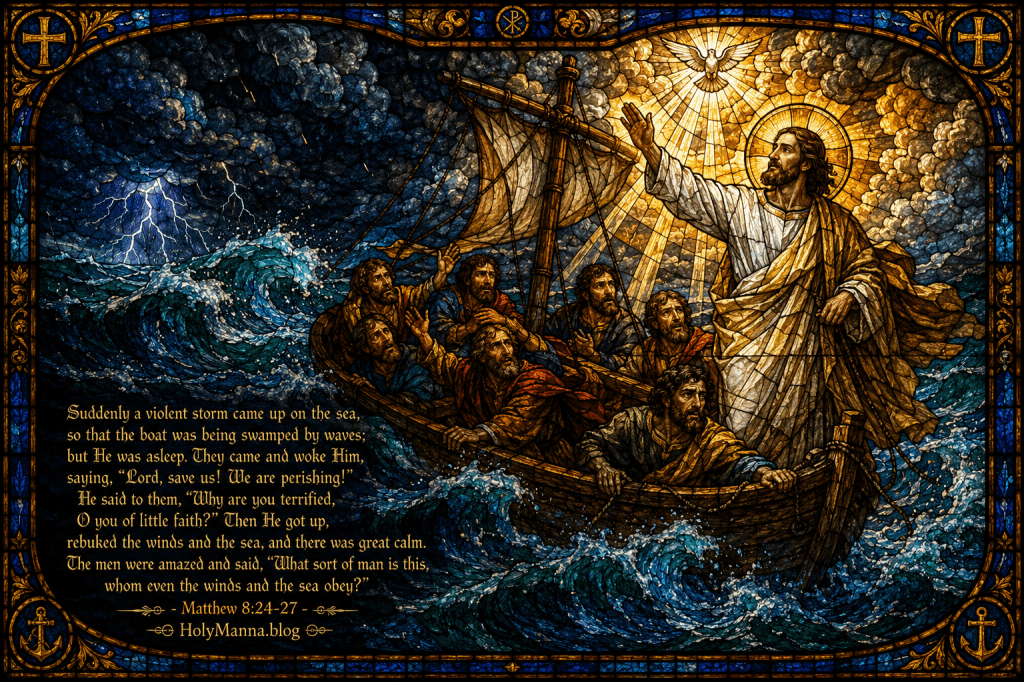
The Calming of the Storm at Sea. 23 He got into a boat and his disciples followed him. 24 Suddenly a violent storm came up on the sea, so that the boat was being swamped by waves; but he was asleep. 25 They came and woke him, saying, “Lord, save us! We are perishing!” 26 He said to them, “Why are you terrified, O you of little faith?” Then he got up, rebuked the winds and the sea, and there was great calm. 27 The men were amazed and said, “What sort of man is this, whom even the winds and the sea obey?”
Detailed Exegesis
Verse 23: “He got into a boat and his disciples followed him.”
This single sentence carries more theological weight than it appears to at first glance. The disciples do not reluctantly agree to accompany Jesus. They follow Him. That word, in Matthew’s Gospel, is the word of discipleship. It is the same word used when Jesus called Peter and Andrew from their nets. Getting into the boat is an act of commitment, and Matthew wants the reader to understand that the storm is not a contradiction of that commitment. It is the next chapter of it.
Verse 24: “Suddenly a violent storm came up on the sea, so that the boat was being swamped by waves; but he was asleep.”
The detail that Jesus was asleep is one of the most profoundly human moments in all of the Gospels. Saint Ambrose of Milan noted that the sleep of Jesus in the boat is not a sign of indifference but an image of the way Christ permits the waves of trial to reach His disciples in order to call forth from them the cry of faith. The storm is not evidence of His absence. It is the occasion for the manifestation of His power. He is not oblivious to what is happening. He is waiting for His disciples to do the one thing that will change everything.
Verse 25: “They came and woke him, saying, ‘Lord, save us! We are perishing!’”
Matthew’s disciples address Jesus as Kyrios, Lord, the same title used in the Greek translation of the Old Testament for the divine name YHWH. Whether they fully understood the weight of that title in this moment is debatable, but Matthew’s theological precision is not accidental. They are crying out to the One who bears divine authority over creation, and they are doing so with the most honest prayer anyone has ever prayed: save us, we are dying. Saint John Chrysostom observed that the disciples did not attempt to handle the storm themselves. They went immediately to Christ, and even their fear-laden, imperfect prayer was sufficient to move the Lord to action.
Verse 26: “He said to them, ‘Why are you terrified, O you of little faith?’ Then he got up, rebuked the winds and the sea, and there was great calm.”
Two things happen in this verse that deserve careful attention. The first is that Jesus addresses the disciples’ interior condition before He does anything about the exterior storm. The Greek word translated as “terrified” is deiloi, meaning cowards or those seized by fearful anxiety. And the phrase “little faith” in Greek is oligopistoi, one of Matthew’s signature descriptions for disciples who are genuine believers but whose faith has not yet been stretched to its full capacity. He is not calling them unbelievers. He is calling them underdeveloped believers, and the distinction is enormous. The second thing to notice is the word “rebuked.” Jesus does not calm the storm by adjusting the atmospheric conditions. He rebukes it, the same verb used when He casts out demons. The storm is treated as a hostile force to be commanded, and it obeys instantly.
Verse 27: “The men were amazed and said, ‘What sort of man is this, whom even the winds and the sea obey?’”
This is the question Matthew wants every reader to carry out of the passage. The disciples have just witnessed something that rewrites every category they have for understanding who Jesus is. Psalm 89:9 declares of God: “You rule the raging sea; when its waves rise, you still them.” The disciples have just watched a man do what only God can do, and they do not yet have the theological vocabulary to process it. Their amazement is the beginning of an answer they will spend the rest of their lives arriving at.
Teachings
The image of the boat on the stormy sea became one of the most enduring symbols in early Christian art and theology. Tertullian, writing in the second century, identified the boat explicitly with the Church, tossed by the waves of persecution and heresy, with Christ present within her and the disciples representing the faithful who cry out in the storms of history. The navis ecclesiae, the ship of the Church, became standard in patristic thought precisely because this passage captures something essential about what it means to belong to the Body of Christ. The Church is not promised smooth sailing. She is promised a captain who controls the weather.
Origen, in his Commentary on Matthew, took the interpretation inward and proposed that the storm also represents the interior storms of the soul: passions, temptations, spiritual dryness, and the dark night of the senses. The Christ who appears to sleep in the boat is the Lord who seems hidden during such periods of interior trial. The call to wake Him is the call of contemplative prayer, the persistent cry of a heart that refuses to accept divine silence as divine abandonment.
CCC 2719 speaks of contemplative prayer in ways that resonate with this reading: “Contemplative prayer is a communion in which the Holy Trinity conforms man, the image of God, ‘to his likeness.’” The peace that Christ brings to the storm is not merely meteorological. It is the deep interior peace of a soul that has been conformed to the divine will, what the tradition calls pax, the peace that Philippians 4:7 describes as surpassing all understanding.
Saint Hilary of Poitiers observed that the reproach Christ delivers to His disciples is itself an act of love. He does not rebuke them because He is disappointed in them. He rebukes them because He is teaching them. The storm is the classroom. The fear is the starting point. And the great calm that follows is not just the absence of wind; it is the beginning of a deeper faith that could not have been formed any other way. CCC 305 captures this dynamic precisely: “Jesus asks for childlike abandonment to the providence of our heavenly Father who takes care of his children’s smallest needs: ‘Therefore do not be anxious… your heavenly Father knows what you need.’”
Reflection
Saint Peter Chrysologus preached that this scene is a microcosm of the entire Christian life. Every believer is in the boat. The waves are real. The Lord appears to sleep. And the invitation is always the same: cry out to Him with whatever faith is available, even if that faith is small and frightened and soaking wet. He will rise. He will rebuke the storm. And the calm that follows will be greater than anything the disciples could have produced on their own.
What is the storm in your life right now that is making you question whether God is paying attention? It is worth naming it honestly, because the Gospel does not pretend the waves are not real. It simply insists that the One asleep in the boat is not indifferent to them.
The practical movement this passage invites is not the elimination of fear but the redirection of it. When the storm hits, the disciples did not freeze. They did not try to manage the situation with their own expertise. They went to Jesus. That movement, from panic to prayer, from self-reliance to surrender, is the whole of the spiritual life compressed into a single scene on a stormy lake.
When the waves rise in your life, what is your first instinct, and is Jesus the first place you run or the last resort you turn to when everything else has failed? The disciples got into the boat with Him. They just forgot, for a terrifying moment, who was in the boat with them. The invitation today is to remember, before the storm comes, exactly who is making the crossing with you.
The Lion Has Roared, the Storm Has Stilled, and God Is Still Waiting
The three readings today form a complete story, and it is worth stepping back to see the whole arc before walking away from it.
Amos opened with a courtroom. God summoned His people, reminded them of everything He had done for them, and laid out the case with devastating logical precision. Nothing in history happens outside His knowledge or His governance. He warned Israel before He acted. He disciplined them with mercy before He raised His voice in judgment. And after all of it, after every drought and defeat and fire from which they were snatched, the verdict was always the same: “Yet you did not return to me.” The reading closed not with a sentence but with an invitation disguised as a warning: “Prepare to meet your God, O Israel.” That is not the language of a God who has given up. That is the language of a God who is still, even now, holding the door open.
The psalmist heard that summons and responded the only way a wise soul can. He showed up in the morning, before the enemies had made their next move, before the day had a chance to bury him in noise, and he planted himself in the presence of God. He did not come with credentials. He came with hesed, with the mercy of God claimed as his only right of entry. He asked to be guided in the straight way, and he waited. That posture, humble, honest, expectant, is the answer to everything Amos demanded.
And then the Gospel put flesh on all of it. The disciples got into the boat with Jesus and discovered that following Him does not mean avoiding storms. It means having the right person in the boat when the storm arrives. Their faith was small. Their fear was real. And Jesus met them exactly where they were, rebuked them gently for their anxiety, rebuked the storm with absolute authority, and brought them to the great calm on the other side.
That is the shape of the Christian life. God speaks through the prophet and says: return to me. The faithful soul responds through the psalm and says: I am coming, through your mercy, and I will wait. And Jesus in the Gospel shows what the return actually looks like in practice: getting into the boat with Him, crying out when the waves get too high, and trusting that the calm He brings is deeper and more durable than any storm the world can produce.
What would it look like to take one concrete step today toward returning to God in the area of your life where you have been drifting? The lion has roared. The storm has stilled. The door is still open. The God of Amos and the God of the psalm and the God asleep in that fishing boat is the same God, and He is patient enough to wait for the cry that says, with whatever faith can be mustered: Lord, save us.
Engage With Us!
Every reading at Mass is an invitation to something deeper than information. It is an invitation to transformation. Take a moment to sit with what God has been saying today, and share your reflections in the comments below. This community grows stronger when the faithful share how the Word of God is moving in their lives, and your reflection might be exactly what someone else needs to hear today.
- Amos 3:1-8; 4:11-12 asks one of the most uncomfortable questions a believer can face: God reminded Israel that being chosen comes with greater accountability, not less. Where in your life have you been treating your faith as a safety net rather than a relationship that makes real demands on how you live?
- Psalm 5:4-9 paints a picture of a soul that shows up before God in the morning, on the basis of mercy alone, and waits with expectant faith. What would it look like for you to build or strengthen a morning prayer practice this week, even if it starts with just five quiet minutes before the day takes over?
- Matthew 8:23-27 places the disciples in a boat with Jesus during a storm that terrified even the experienced fishermen among them. Think about the storm you are currently navigating in your own life. When the waves started rising, was Jesus the first place you ran, or did you exhaust every other option first?
- All three readings together deliver a single unified message: God speaks, God acts, and He calls His people to trust Him even when the waters are rising. What is the one thing you can do differently this week to respond to His voice instead of waiting for the storm to get worse before you cry out to Him?
Go live this week with the confidence of someone who knows who is in the boat. Love boldly, pray persistently, and return to Him quickly when you drift. The Lord is patient, His mercy is real, and He is worth every act of trust it takes to follow Him through the storm and into the calm on the other side.
Sacred Heart of Jesus, we trust in You!
Immaculate Heart of Mary, pray for us!
Saint Michael the Archangel, defend us in battle!
Follow us on YouTube, TikTok, Instagram and Facebook for more insights and reflections on living a faith-filled life.


Leave a comment