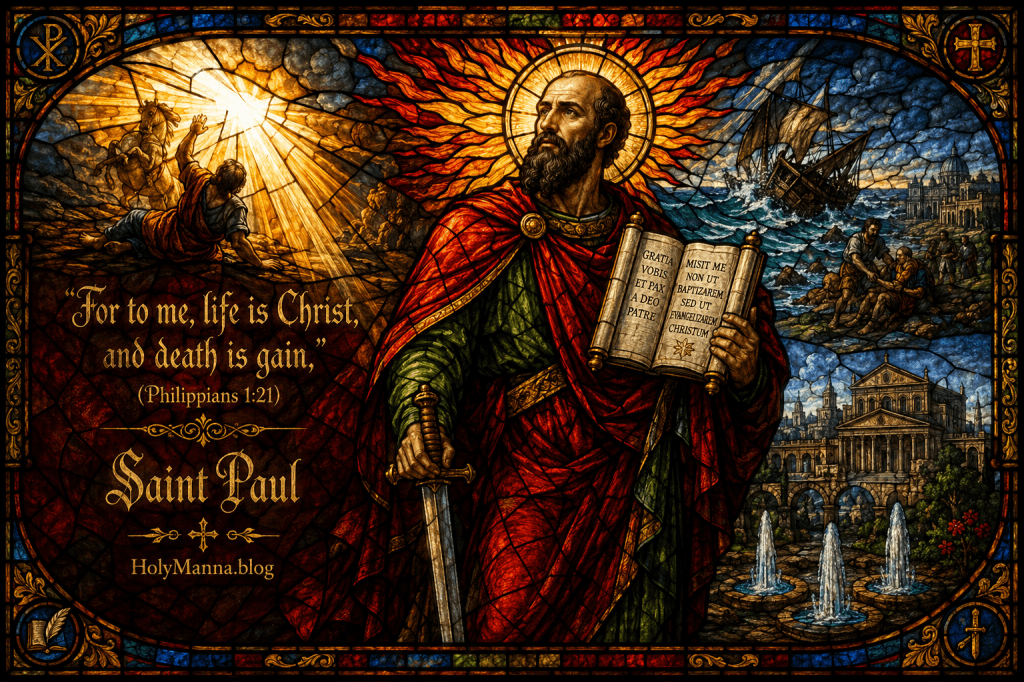
The Man Who Changed Everything
There are conversion stories, and then there is the conversion of Saint Paul. No other story in the history of the Church captures quite so vividly what divine grace can do with a human life. Here was a man actively hunting down Christians, dragging them from their homes, approving their executions, when the Risen Christ appeared to him in blazing light on the road to Damascus and asked a question that shattered him completely: “Saul, Saul, why do you persecute me?” (Acts 9:4). That single encounter turned the greatest enemy of the early Church into its most relentless missionary, and the world has never been the same since.
Saint Paul is remembered on June 29 in the great Solemnity shared with Saint Peter, the two men the Church holds up as the twin pillars upon which the faith in Rome was built. Pope Benedict XVI observed that the early Christian community of Rome considered Peter and Paul a kind of counterbalance to the mythical Romulus and Remus, the legendary brothers said to be the founders of the city. Paul is also honored on January 25, the feast celebrating his conversion, one of the most significant moments in all of Christian history.
He is the patron saint of missionaries, evangelists, writers, journalists, authors, public workers, tent makers, and rope makers. Together with Saint Peter, he is a patron of the city of Rome itself.
But titles and feast days barely begin to capture what this man accomplished. He authored nearly half the New Testament. He founded dozens of Christian communities across the ancient world. He endured beatings, shipwrecks, stonings, imprisonments, and snakebites in service of a Gospel he had once despised. And in the end he gave his life for it, becoming the martyr his enemies had always intended to make of him. The difference was that by then, he was more than ready. “For to me, life is Christ, and death is gain,” he wrote from prison (Philippians 1:21). Paul meant every single word.
The Making of a Most Unlikely Apostle
To understand Saint Paul, one has to understand where he came from, because his background makes his transformation all the more astonishing. He was born in Tarsus, a significant city in the region of Cilicia in modern-day Turkey, into a well-established Jewish family of the tribe of Benjamin. His Hebrew name was Saul, a name carrying deep tribal pride. His Roman name was Paul, the name by which the Gentile world would come to know him, which he adopted naturally once his mission to the nations began. His father was a Roman citizen, which meant Paul inherited that citizenship at birth, a legal privilege that would save his life more than once.
He was sent to Jerusalem as a young man to study at the famous rabbinical school of Gamaliel the Elder, one of the most respected teachers in all of Judaism. Under Gamaliel, Saul became a learned, passionate, and intensely zealous Pharisee. He was disciplined, sharp, fluent in both Greek and Aramaic, trained in Jewish law and Hellenistic philosophy, and absolutely convinced that the Way of Jesus of Nazareth was a dangerous heresy that had to be stamped out. His trade, learned from his father, was tent making, a craft he would continue to practice throughout his entire missionary career, refusing to be a financial burden on the communities he served, working with his hands even as he changed the world around him.
It was Saul who stood at the edge of the crowd and held the cloaks of those who stoned Saint Stephen, the first Christian martyr, approving the execution with everything in him (Acts 7:58). He then went house to house in Jerusalem, dragging men and women off to prison, tearing apart the young Church with his bare hands.
And then came Damascus.
Saul was on his way to that city, carrying letters authorizing him to arrest the followers of Jesus he found there, when everything changed. A blinding light surrounded him. He fell to the ground. And a voice spoke: “Saul, Saul, why do you persecute me?” (Acts 9:4). Shaking, Saul asked who was speaking. The answer came back: “I am Jesus, whom you are persecuting” (Acts 9:5).
Saul was left blind. His companions led him by the hand into Damascus, where he spent three days without eating or drinking, sitting in total darkness with everything he thought he knew about God collapsing and being rebuilt from the ground up. Then the Lord sent a disciple named Ananias to him. Ananias, though terrified of this notorious persecutor, obeyed the Lord without hesitation. He laid his hands on Saul, the scales fell from his eyes, and Saul was baptized and filled with the Holy Spirit.
He emerged from those three days as a completely different man, not because he changed his mind about who God is, but because he finally understood who God is. The man who had been hunting the followers of Jesus now began preaching in the synagogues that Jesus is the Son of God, and everyone who knew him was absolutely stunned.
Signs, Wonders, and a Man on Fire for Christ
From the moment of his baptism, Paul’s life became one long act of missionary courage. He eventually set out on three great missionary journeys that carried the Gospel across the ancient world, founding communities of believers in cities from Cyprus to Corinth to Ephesus, leaving behind not just converts but organized churches with leadership structures, liturgical practices, and written pastoral guidance in the form of letters that would become Sacred Scripture.
And along the way, God worked through him in extraordinary ways.
In Lystra, during his first missionary journey, Paul and Barnabas encountered a man who had been lame from birth, a man who had never walked a single day of his life. Paul looked at him, saw the faith burning in his eyes, and cried out with a loud voice: “Stand upright on your feet” (Acts 14:10). The man leapt up and walked for the very first time.
In Philippi, a young slave girl possessed by a spirit of divination followed Paul and his companions day after day, crying out after them in the streets. Paul turned, moved by the Holy Spirit, and commanded the spirit to leave her in the name of Jesus Christ. It left her immediately (Acts 16:18). Her owners, furious that their source of income had vanished overnight, had Paul and Silas dragged before the authorities, stripped, and thrown into prison with their feet fastened in the stocks.
What happened next is one of the most luminous scenes in all of Scripture. Paul and Silas, shackled in the inner cell of a Roman prison, their backs raw from a recent flogging, were praying and singing hymns to God at midnight. The other prisoners were listening in the darkness. And then the earth shook. The foundations of the prison trembled, every door flew open, and every chain fell free. The jailer woke in terror, drew his sword to kill himself, certain all the prisoners had escaped. Paul called out from the darkness: “Do not harm yourself; we are all here” (Acts 16:28). The jailer fell trembling before Paul and Silas and asked the question that every person eventually comes to when they encounter the living God: “What must I do to be saved?” (Acts 16:30). That same night, his entire household was baptized.
In Troas, a young man named Eutychus was sitting in a third-floor window while Paul preached late into the night. The young man fell asleep, as young men have a way of doing when the hour grows late and the room is warm, and fell to the ground far below, where he was picked up dead. Paul went down, stretched himself over the young man, embraced him, and said: “Do not be alarmed, for his life is in him” (Acts 20:10). Eutychus walked back upstairs, and Paul went back to preaching until dawn.
In Ephesus, handkerchiefs and aprons that had made contact with Paul’s skin were brought to the sick, diseases left them, and evil spirits departed (Acts 19:12). Paul never drew attention to any of these works as personal achievements. He was always pointing somewhere else entirely, to the One who actually worked through him.
Chains, Stonings, and the Ultimate Witness
What is extraordinary about Saint Paul is not only the miracles. It is the suffering he embraced in pursuit of his mission, suffering he documented with startling candor in his own letters. In 2 Corinthians 11, he lists what his apostolic life had actually cost him: “Five times I received from the Jews the forty lashes minus one. Three times I was beaten with rods, once I was pelted with stones, three times I was shipwrecked, I spent a night and a day in the open sea, I have been constantly on the move. I have been in danger from rivers, in danger from bandits, in danger from my fellow Jews, in danger from Gentiles; in danger in the city, in danger in the country, in danger at sea; and in danger from false believers. I have labored and toiled and have often gone without sleep; I have known hunger and thirst and have often gone without food; I have been cold and naked” (2 Corinthians 11:24-27).
That is not a complaint. That is a résumé.
In Lystra, the very city where he had healed the lame man, a mob stirred up the crowd against him, stoned him, and dragged his body outside the city walls, leaving him for dead. Paul stood up and walked back into the city the very next day (Acts 14:19-20), and then continued his journey without breaking stride.
He was imprisoned in Caesarea for two full years while Roman governors kept him there, unwilling to convict him and unwilling to release him. Finally, Paul invoked his right as a Roman citizen and appealed directly to Caesar. This set in motion his sea voyage toward Rome, during which his ship was caught in a catastrophic storm that raged for fourteen brutal days across the open Mediterranean. An angel appeared to Paul in the night and promised him that all 276 souls on board would survive. When the ship finally struck a reef near the island of Malta and began to break apart, every single person made it to shore alive, exactly as promised.
On Malta, as Paul was gathering firewood and placing it on a fire, a viper escaped from the heat and fastened onto his hand. The people of the island watched, fully expecting him to swell up and die. Paul simply shook the snake off into the fire and suffered no harm whatsoever (Acts 28:3-6). He then spent three months on Malta healing the sick, including the father of the island’s leading official who suffered from fever and dysentery, and many others who came to him, preaching the Gospel to a people who had never heard it.
When Paul finally arrived in Rome, he was placed under house arrest but free to receive visitors, which he did constantly, preaching the kingdom of God to anyone who came through his door. Ancient tradition holds that he was eventually released and continued his missionary work, before being arrested a second time under Nero.
That second imprisonment was the end, and Paul knew it. Writing to his beloved disciple Timothy from his Roman cell, he did not plead or bargain or grieve. He simply declared what he knew: “For I am already being poured out like a libation, and the time of my departure is at hand. I have competed well; I have finished the race; I have kept the faith. From now on the crown of righteousness awaits me, which the Lord, the just judge, will award to me on that day” (2 Timothy 4:6-8).
Because he was a Roman citizen, Paul was not crucified. He was beheaded. The execution took place at a site outside Rome called Aquae Salviae, on the Ostian Way, around the years 64 to 67 AD during the reign of Nero. His body was claimed by faithful Christians and buried along that same road, at the very spot where a great basilica would one day rise in his honor.
There is a beloved story, handed down through Christian tradition for well over a thousand years, about the moment of Paul’s martyrdom. When the executioner’s sword fell, Paul’s head struck the ground three times, and at each spot where it touched the earth, a spring of water miraculously burst forth. The place came to be known as Tre Fontane, meaning Three Fountains in Italian, and the Abbey of the Three Fountains still stands there today as a living memorial to the Apostle to the Gentiles. Whether this story can be historically verified is not certain, but Christians have treasured it since the earliest centuries of the faith, and the site remains a place of pilgrimage to this very day.
A Legacy Carved in Stone, Spirit, and Scripture
The miracle of Saint Paul did not end with his death. In many ways, it was only beginning.
His letters began circulating through Christian communities almost immediately after he wrote them, read aloud at the liturgy, copied by hand, passed from city to city, treasured and prayed over and argued about. They still are, in every language on earth, every Sunday of the year.
One of the most remarkable aftershocks of Paul’s life came centuries later in the garden of a house in Milan. A brilliant but restless young man named Augustine sat under a fig tree, torn between his intellectual pride and a deep longing for God that he could not shake, weeping. He heard what seemed like a child’s voice repeating, “Take up and read, take up and read.” He picked up a copy of Paul’s Letter to the Romans and read: “Not in reveling and drunkenness, not in debauchery and licentiousness, not in quarreling and jealousy. But put on the Lord Jesus Christ, and make no provision for the flesh, to gratify its desires” (Romans 13:13-14). Augustine would later write in his Confessions that a light of certainty flooded his heart the moment he finished that sentence, and all his resistance melted away. The man who became the greatest theologian in the Latin Church was converted, in part, by reading the letters of Paul.
Saint John Chrysostom, the Doctor of the Church known as “the golden-mouthed” for the extraordinary power of his preaching, wrote more extensively on Paul than on any other biblical author and held him up as the model of the Christian life. Chrysostom wrote of Paul that unlike Noah, who built an ark of wood to save a small number of family members from a flood, Paul “instead of joining planks of wood, wrote Letters and thus rescues from the billows not two, three or five members of his own family but the entire ecumene that was on the point of perishing.” For Chrysostom, Paul was not a distant historical figure but the quintessential Christian disciple: a man found by Christ, beset with weakness, who spent the rest of his life helping others find Him.
The great Basilica of Saint Paul Outside the Walls on Rome’s Via Ostiense stands over the spot where Paul’s Christian brothers and sisters buried him after his execution. Emperor Constantine built the first church there in the fourth century. The basilica was destroyed by fire in 1823, rebuilt, and consecrated again in 1854. At the close of the Pauline Year he had proclaimed in 2008, Pope Benedict XVI announced that scientific testing of the ancient sarcophagus beneath the basilica’s altar had confirmed that the bones inside dated to the first or second century, powerfully supporting the ancient tradition that Paul truly rests in that place. Pilgrims still come from every corner of the earth to be near him.
The island of Malta honors Saint Paul as one of its patrons, a living memory of the three months he spent there after the shipwreck, healing the sick and proclaiming the Gospel to a people who welcomed him with extraordinary kindness. The Maltese trace their Catholic identity directly back to that winter season when a shipwrecked prisoner waded ashore and brought the faith with him.
Paul’s name reaches across the modern world in ways that would have astonished even him. São Paulo in Brazil, one of the largest cities on earth, bears his name. The Society of Saint Paul, founded by Blessed James Alberione to evangelize through the written word and all forms of media, carries his apostolic fire into every new age of communication. His letters are proclaimed at Mass every single Sunday of the year, all over the world, to people who live two thousand years after he wrote them and still find those words speaking directly into their lives.
“The word of God is not imprisoned,” Paul wrote defiantly from his Roman prison cell (2 Timothy 2:9). He was absolutely right, and he already knew it when he wrote it.
What Saint Paul Is Still Saying to You Today
It is worth sitting quietly for a moment with the sheer improbability of this saint. Here was a man who dragged Christians from their homes and handed them over to be killed. And then God chose him, of all people, to be the apostle to the world. Not in spite of who he was, but perhaps in some deep way because of it. A man who knew what it felt like to be completely wrong about everything, and then to be found by grace, is exactly the kind of person who can speak honestly about what grace costs and what it gives back in return.
Paul’s life speaks directly to anyone who has ever wondered whether the past disqualifies them from God’s purposes, who has ever struggled to persevere under relentless difficulty, who has ever begged God to remove a suffering that simply will not go away. Paul knew all of it firsthand.
He described his own persistent suffering as “a thorn in the flesh, a messenger of Satan to buffet me” (2 Corinthians 12:7), and he prayed three times for God to take it away. God did not take it away. What God said instead was: “My grace is sufficient for you, for power is made perfect in weakness” (2 Corinthians 12:9). Rather than raging against that answer, Paul transformed it into one of the most powerful spiritual insights in the entire New Testament: human weakness is not an obstacle to God’s power. It is the very condition in which God’s power is most fully displayed.
What would it mean to receive your own sufferings and limitations with that kind of radical trust?
Paul also wrote with breathtaking tenderness about the people he loved. He called the Philippians his “joy and crown” (Philippians 4:1). He wept openly with the elders of Ephesus when he knew he would never see them again. He fought for the communities he had founded, writing to them through the night from prison cells when he could not be there in person. His love for the Church was never abstract or theoretical. It was costly, deeply personal, and completely given away.
And through all of it, he maintained a peace that can only come from one source. “I have learned, in whatever state I am, to be content. I know how to be abased, and I know how to abound; in any and all circumstances I have learned the secret of facing plenty and hunger, abundance and want. I can do all things through Christ who strengthens me” (Philippians 4:11-13).
That last verse appears on stadium banners and phone cases and coffee mugs, often stripped of its context. But Paul wrote it from a prison cell, facing execution. He wrote it not as a self-help affirmation but as a hard-won declaration of faith from a man who had been tested by absolutely everything life could throw at him and found Christ sufficient through every single moment of it.
What situation right now feels too heavy to carry alone, and what would it look like to place it in the hands of the same Christ who was sufficient for Paul?
The life of Saint Paul is ultimately a story about what happens when a person stops running from God and starts running with God. It is a story about how completely grace can remake a human life when that life is fully surrendered. And it is a standing invitation to every person reading this, no matter where they are starting from or what they carry from their past.
What part of your own story do you believe God could not possibly use?
Because if Saint Paul is any indication, that is exactly the part God is most interested in.
Engage With Us!
This is a space to reflect, share, and grow together as a community of faith. The story of Saint Paul is one of the most dramatic and encouraging stories in all of Christian history, and there is something in it for every single person, no matter where you are on your journey right now. Share your thoughts, reactions, and reflections in the comments below.
- Saint Paul was radically transformed by his encounter with the Risen Christ on the road to Damascus. Has there been a moment in your own life when God interrupted your plans and redirected your path entirely, and what did that look like?
- Paul endured imprisonment, beatings, shipwrecks, and relentless opposition, yet remained filled with joy and gratitude throughout. What gives you strength and steadiness when life becomes genuinely difficult?
- The thorn in the flesh that Paul prayed to have removed was never taken away, and God’s answer was simply that His grace was sufficient. Is there a suffering or limitation in your own life that you have been asking God to remove, and how does Paul’s experience and God’s response to him speak to that prayer?
- Paul called himself “the foremost of sinners” and yet trusted completely in God’s mercy, going on to change the entire world. Does your past ever make you feel like you are beyond God’s reach or beyond His ability to use you for something good, and what does Paul’s story say to that feeling?
- Paul wrote that he could do all things through Christ who strengthened him, and he wrote those words from a prison cell while facing death. What is one specific situation in your life right now where you need to lean into that truth more deeply and more honestly?
May the example of Saint Paul, the most improbable convert and the most courageous apostle in the history of the Church, inspire every reader to run the race well, keep the faith with joy, love the people in front of them with everything they have, and trust in every single circumstance in the grace that is always, always sufficient. Go and do everything with the love and mercy that Jesus taught us.
Saint Paul, pray for us!
Follow us on YouTube, TikTok, Instagram and Facebook for more insights and reflections on living a faith-filled life.


Leave a comment