The Man Who Stood Between the Church and the Abyss
Saint Irenaeus of Lyon is one of those figures in Catholic history who did not simply live a holy life and move on. He stood at a crossroads in the life of the early Church, looked into the face of one of the most dangerous intellectual threats Christianity had ever encountered, and chose to fight back with clarity, charity, and the full force of apostolic Tradition. He is a bishop, a theologian, a shepherd, and, according to the ancient tradition of the Church, a martyr. Pope Francis named him the 37th Doctor of the Church on January 21, 2022, conferring upon him the extraordinary title of Doctor Unitatis, Doctor of Unity, recognizing him as a spiritual and theological bridge between the Christian East and West. His feast day is June 28, and he is the Patron Saint of those who work for the unity of the Eastern and Western Churches, as well as the patron invoked by apologists and catechists who labor to defend and explain the faith.
What makes Irenaeus so compelling is not only what he wrote, but who he was and where he stood in the great chain of Christian memory. He heard the preaching of a man who had known the Apostle John personally. He carried inside him living memories of a living tradition that stretched back to the very Upper Room. And he refused to let that tradition be swallowed up by a fog of esoteric spiritualism that had no roots in the Incarnation of Jesus Christ. To understand Irenaeus is to understand why the faith Catholics profess today looks the way it does.
A Boy Who Sat at the Feet of a Saint
The story of Irenaeus begins in the ancient Greek coastal city of Smyrna, located in what is now modern-day Izmir, Turkey, sometime between the years 120 and 140 AD. He was born into a Christian family, which in the second century was far from common. Many of his contemporaries came to the faith as adult converts, navigating the intellectual marketplace of the Roman Empire, where every philosophical school and mystery religion competed for devotees. Irenaeus, however, grew up breathing the air of the faith from the very beginning. He was not a convert discovering something new. He was a child being formed in something ancient and alive.
And the man who formed him was no ordinary teacher.
Saint Polycarp of Smyrna was one of the last living links to the Apostolic Age. He had known the Apostle John personally. He had learned the faith from the very man who had leaned against the chest of Jesus at the Last Supper, who had stood at the foot of the Cross, who had run to the empty tomb on Easter morning. Polycarp governed the Church in Smyrna for approximately sixty-five years, and it was in his orbit that the young Irenaeus received the most formative education of his life.
Irenaeus never forgot it. Decades later, writing a letter of remonstrance to a former companion named Florinus who had slipped into heresy, Irenaeus called upon those shared memories with remarkable emotional weight. He wrote that he could recall those days in Smyrna better than recent events, explaining that what is learned in childhood grows together with the soul and is united to it. He wrote that he could still describe the very place where the blessed Polycarp used to sit as he dialogued, and his exits and entries, and the character of his life and the form of his body, and the discourses he held before the people, and how he would describe his intercourse with John and with the rest who had seen the Lord, and how he would relate their words.
This is not simply nostalgia. This is a man bearing witness. Irenaeus understood himself as a living vessel of a Tradition that had passed from Christ to the Apostles to Polycarp and then to him. Every word he wrote was shaped by that awareness.
Before arriving in Gaul, Irenaeus apparently also spent time in Rome, where he came under the influence of Saint Justin Martyr, one of the great early Christian apologists. This education in both the Eastern tradition of Polycarp and the Western intellectual milieu of Rome would mark him uniquely as a bridge between two worlds, a role that would define his entire life and earn him his title as Doctor of Unity eighteen centuries after his death.
A Shepherd Forged in the Fires of Persecution
Eventually Irenaeus made his way west, settling in Lugdunum, the Roman city that would one day become Lyon, France. He came to serve as a priest under the first bishop of Lyon, Saint Pothinus, himself an Eastern Christian like Irenaeus. The Church in Lyon was young, energetic, and deeply cosmopolitan, shaped by missionaries who had come from Asia Minor and by merchants and travelers who moved freely through the Roman trade routes.
But in 177 AD, the world of that community shattered.
A brutal persecution erupted in Lyon under the Emperor Marcus Aurelius. Christians were arrested, abused, tortured, and executed. Among those killed for their faith were approximately fifty believers, including the aged Bishop Pothinus himself, and a slave woman named Blandine, who became one of the most celebrated martyrs of the early Church. Pothinus was around ninety years old when he was seized. His mutilated remains were later tossed into the river.
At the very moment the persecution began, Irenaeus was not in Lyon. The imprisoned clergy of the city had chosen him to carry a letter to Pope Eleutherius in Rome concerning the heresy of Montanism, a movement that claimed certain individuals possessed superior prophetic insights directly inspired by the Holy Spirit, bypassing the Church’s apostolic structure. The letter praising Irenaeus described him as a man “zealous for the covenant of Christ.” The commission to Rome almost certainly saved his life.
When Irenaeus returned to Lyon, he found a community soaked in the blood of martyrdom and a vacant bishop’s chair. The people chose him as their second bishop. He had not sought the office. It had found him in the wreckage of a massacre.
As bishop, Irenaeus was everything his flock needed. He was gentle, pastorally wise, and unwaveringly orthodox. He sent missionaries into the surrounding pagan territories. He guided communities still raw from grief and persecution. He knew that many of his people were recent converts from paganism, and he understood that the work of forming them in the faith was not simply an intellectual exercise but a lifelong pastoral commitment. He was not a remote scholar writing for other scholars. He was a bishop who loved his people and wrote to protect them.
One of the most beautiful examples of this character came not in the form of a condemnation but in a restraint. Around 190 AD, Pope Victor I of Rome moved to excommunicate the Christian communities of Asia Minor who continued to observe the paschal feast on the Jewish date of Passover rather than on Sunday. It was a major dispute, and the Pope’s response was severe. Irenaeus, though he himself observed the Roman practice, wrote a letter to Pope Victor respectfully urging him not to excommunicate those communities. He appealed to the precedent of earlier bishops who had disagreed on the practice while remaining in communion, and he invoked the value of unity itself as a theological argument for restraint. The word at the root of his own name, from the Greek eirene, meaning peace, described the man perfectly.
The Battle Against the Great Darkness: Against Heresies
The work for which Saint Irenaeus is most celebrated is his monumental Adversus Haereses, known in English as Against Heresies, written around 180 AD. To understand why this book matters, it helps to understand what Gnosticism actually was and why the early Church considered it so dangerous.
Gnosticism was not simply one heresy. It was a sprawling family of esoteric movements that shared a few central convictions. The material world, they taught, was not created by the good God but by a lesser, ignorant, or even evil divine being called the Demiurge. The human body was a trap. Salvation came not through the Incarnation, death, and Resurrection of Jesus Christ, but through acquiring secret spiritual knowledge, called gnosis, that was available only to a spiritual elite. Christ, in many Gnostic systems, was not truly human at all but a purely spiritual being who only appeared to have a body. The ordinary members of the Church, who believed in a real Incarnation, a real Cross, and a real Resurrection, were considered lower-level believers, spiritually inferior to the initiated few.
This was not a fringe movement. Gnosticism was spreading rapidly through the Roman Empire, and it was particularly insidious because it cloaked itself in the language of Christianity. Gnostic teachers quoted Scripture, used Christian terminology, and gathered Christian audiences. They even had their own gospels.
Irenaeus had read their writings. He had held conversations with Gnostics. He knew their systems from the inside. And in Against Heresies, he took them apart with extraordinary thoroughness. The work runs to five books and represents the first somewhat systematic exposition of the Catholic faith ever written. It is also the first work to cite virtually every book of the Christian writings now called the New Testament.
His argument was elegant in its simplicity. The Gnostics claimed to possess a secret tradition handed down from the Apostles. Irenaeus’s response was direct: look at the churches the Apostles actually founded. Look at their bishops. Look at the unbroken line of succession from the Apostles to the present. There is no secret tradition there. There is only the public faith preached openly to everyone, rich and poor, learned and simple. And the surest anchor of that tradition, he argued, is the Church of Rome, which was founded by the two greatest Apostles, Peter and Paul. He wrote that it is a matter of necessity that every Church should agree with this Church, on account of its preeminent authority.
The implications of this argument for Catholic ecclesiology, for the theology of apostolic succession, for the authority of the Roman Pontiff, and for the structure of the Church itself, can hardly be overstated. Irenaeus was not inventing a new theology. He was articulating what had been believed from the beginning.
Against Heresies was not a dry academic text. Irenaeus wrote with energy and sometimes with sharp wit, exposing the internal contradictions of Gnostic systems and holding them up to ridicule while simultaneously offering his readers a positive and beautiful account of what the Church actually believes. He was not merely tearing down. He was building up.
His second major surviving work, The Demonstration of the Apostolic Preaching, was preserved in an Armenian translation and was not rediscovered until 1907. It is aimed not at refuting heretics but at confirming the faithful, demonstrating the truth of the Gospel through the fulfillment of Old Testament prophecy. Together, these two writings constitute what is considered the first catechism of the Catholic faith.
The Three Great Theological Gifts of Irenaeus
Three theological contributions from Irenaeus deserve particular attention because they continue to shape Catholic belief and practice today.
The first is his theology of recapitulation, from the Greek word anakephalaiosis. The core idea is that Christ, as the New Adam, retraces and heals every step of the fallen Adam’s journey. Where Adam disobeyed in a garden, Christ obeys in another garden, Gethsemane. Where humanity fell through a tree, humanity is redeemed through a tree, the Cross. Where Adam’s disobedience brought death, Christ’s obedience restores life. This is not merely a literary parallel. For Irenaeus, it is the very structure of salvation history, the pattern by which God undoes the damage of the Fall from the inside.
This recapitulation theology also becomes Irenaeus’s most powerful argument against the Gnostics. If Christ truly recapitulated human nature, then he truly took on human nature. He was not a spiritual apparition masquerading as a man. He was truly born, truly lived, truly died, and truly rose. The bodily Resurrection was not a problem for Irenaeus; it was the entire point.
The second great gift is his development of Mary as the New Eve. Building on a parallel first sketched by Saint Justin Martyr, Irenaeus drew the contrast between Eve and Mary with extraordinary clarity. In Against Heresies, he wrote that just as Eve, being disobedient, became the cause of death for herself and the whole human race, so also Mary, being obedient, became the cause of salvation for herself and the whole human race, and that the knot of Eve’s disobedience was untied by Mary’s obedience, and what Eve bound through her unbelief, Mary loosed by her faith. Cardinal John Henry Newman, writing in the nineteenth century, considered this passage the first true meditation on Mary’s mission in the Church given to us by the Church Fathers. The theological depth of what Irenaeus articulated here continues to flow through Catholic Mariology to this day.
The third gift is his clarification of the New Testament canon. At a time when different Christian communities favored different Gospels, and Gnostic groups had constructed their own alternative gospels, Irenaeus was the first to insist on all four Gospels, Matthew, Mark, Luke, and John, as the canonical four. His argument was creative and multifaceted. He pointed out that there are four regions of the world, four principal winds, and four living creatures in the vision of Ezekiel and the Book of Revelation. There are four Gospels and four Gospels only. This reasoning may sound unusual to modern ears, but the conclusion was decisive: the four-Gospel canon that Catholics hold today owes much of its early articulation to this second-century bishop in France.
The Tradition That Came Back from the Dead
Here is one of the most striking facts in the entire story of Irenaeus, and it deserves to be told plainly. After his death around 202 AD, he was buried in a crypt beneath the Church of Saint John in Lyon, which was later renamed the Church of Saint Irenaeus in his honor. His tomb became a place of veneration for generations of faithful Christians. But in 1562, during the violent upheavals of the French Wars of Religion, Calvinist forces destroyed the tomb and his relics along with it. All trace of his physical remains seemed to have perished.
Irenaeus, the man who had devoted his entire life to arguing for the unity of the Church and the continuity of the apostolic tradition, saw his physical remains destroyed as a direct consequence of the greatest rupture to that unity in Christian history. The bitter irony of that fact cannot be missed.
And yet the tradition survived. Much of his writing had also been lost for centuries, and it was Erasmus who brought him back to the attention of the Church in 1526, just after the start of the Protestant Reformation. The timing could not have been more significant. At the very moment the Church was facing its most severe institutional crisis since the Arian controversy, the great defender of apostolic Tradition re-emerged to speak again to the faithful. God’s providence writes straight with crooked lines.
Several relics reportedly belonging to Irenaeus are held in various churches in Lyon to this day. Scientists have examined some of them. Two crania from different Lyon churches were dated by carbon-14 testing to the Middle Ages, suggesting they are not authentic. But a piece of heelbone kept in the Lyon Cathedral was dated to the correct time period, offering at least a fragment of physical continuity with the man himself.
The Death of a Shepherd and the Question of Martyrdom
The question of whether Irenaeus died as a martyr is one that Catholic scholarship approaches with honesty and care. The Roman Martyrology and the General Roman Calendar have long listed him among the martyrs, following an ancient tradition recorded by Saint Jerome and later by Gregory of Tours. According to this tradition, Irenaeus suffered martyrdom in Lyon under the Emperor Septimius Severus around the year 202 AD, the same emperor whose persecution claimed the lives of Saints Perpetua and Felicity in Carthage.
However, the historical evidence for his martyrdom is thin. Modern historians point out that no eyewitness account or early contemporaneous source confirms it. The earliest to mention it lived well over a century after Irenaeus’s death. The Church’s inclusion of him among the martyrs reflects the ancient and venerable tradition of the local Church of Lyon, and the Roman Calendar continues to honor him with the title of martyr, but Catholic scholars are candid that this tradition cannot be confirmed with certainty.
What is certain is that Irenaeus gave his entire life to the Church. Whether or not he shed his blood at the end, he poured himself out completely in service to the flock entrusted to him. That totality of gift is its own form of martyrdom.
A Voice That Never Stopped Speaking
The legacy of Irenaeus after his death is almost impossible to measure in full. Every time the Church affirms the four Gospels, the voice of Irenaeus echoes. Every time a theologian invokes the authority of apostolic succession to settle a question of doctrine, Irenaeus is present. Every time a Catholic prays the Rosary and meditates on Mary as the one whose obedience undid the knot of Eve’s disobedience, Irenaeus is there. Every time a pope speaks about the dignity of the human person as a being made to behold the face of God, the foundational thought is Irenaeus.
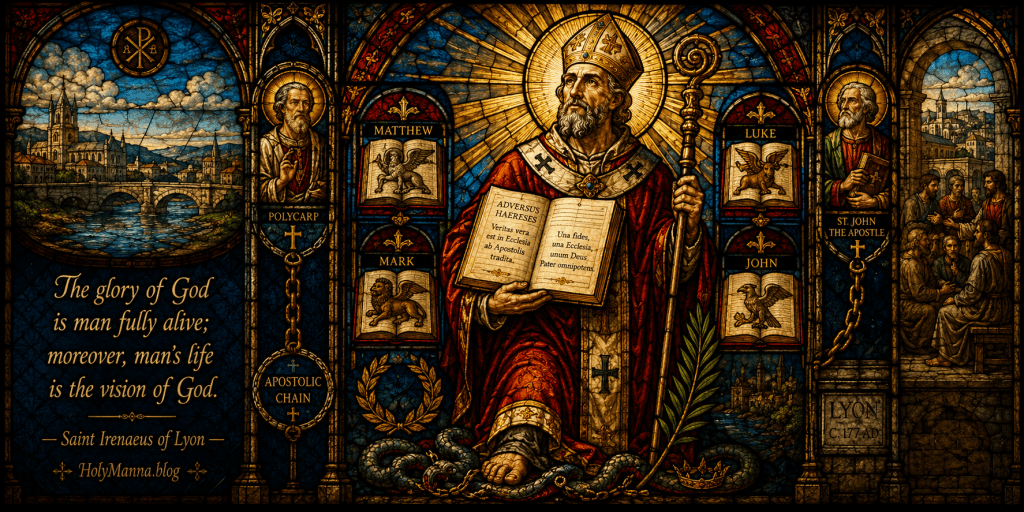
His most quoted line remains one of the most beautiful sentences in the entire patristic tradition. In Against Heresies IV, 20, 7, he wrote: “The glory of God is man fully alive; moreover, man’s life is the vision of God.” Saint John Paul II returned to this phrase repeatedly in his writings on the dignity of the human person. It is cited in discussions of Catholic anthropology, bioethics, evangelization, and the theology of grace. It is not a slogan. It is a complete theological vision of what human beings are for.
His line on the Incarnation carries equal weight: “He who was the Son of God became the Son of man, that man might become the son of God.” This formulation of the ancient doctrine of theosis, or divinization, which holds that the purpose of the Incarnation is to make human beings sharers in the divine life, is one of the most concise expressions of the Gospel ever written.
On the Eucharist, Irenaeus wrote something the Gnostics could never accept: “For since we are his members, and are nourished by his creation, he declares that the cup, taken from the creation, is his own blood, by which he strengthens our blood, and he has firmly assured us that the bread, taken from the creation, is his own body, by which our bodies grow.” The material world matters. The bread and wine matter. The body matters. These are not embarrassing concessions to physical existence. They are the very means of salvation.
On apostolic succession and the authority of the Church’s teaching office, he wrote: “In order that the full and living Gospel might always be preserved in the Church, the apostles left bishops as their successors. They gave them their own position of teaching authority.”
Today, the Church of Saint Irenaeus stands in Lyon in the neighborhood that bears his name. It is a modest nineteenth-century building marking the site of his ancient burial. Pilgrims visit it on his feast day and throughout the year, drawn by the memory of a man who spent his life insisting that the faith is not a secret available to the spiritually elite but a living inheritance belonging to every baptized soul.
The Vatican itself celebrated his declaration as Doctor of the Church by timing the announcement of Pope Francis’s decree to fall during the Week of Prayer for Christian Unity in January 2022. The symbolism was unmistakable. The man who had spent the second century arguing for unity was being held up in the twenty-first century as a model for a Church still laboring toward the same goal.
What Irenaeus Still Has to Say to Us
There is something almost startling about how relevant Irenaeus is today. The world of the second century and the world of the twenty-first century share more in common than most people realize. Both are awash in competing spiritual systems that promise hidden knowledge, exclusive enlightenment, and personal transformation untethered from any institutional authority or communal accountability. Both have seen Christianity redefined from the outside by people who claim to be insiders. Both have heard the argument that the “real” Jesus was different from the one the Church teaches, that the Gospels are incomplete or distorted, that salvation is a private spiritual achievement rather than a gift received through the sacramental life of the Church.
Irenaeus faced all of this. And his answer was not to panic, not to abandon the tradition, and not to accommodate the culture by softening the Gospel’s hard edges. His answer was to point, clearly and confidently, to the living community of faith that had existed from the beginning, to the bishops who traced their authority back to the Apostles, to the Scriptures that the Church had recognized and interpreted from the start, and to the simple, public, universally accessible faith that every baptized Catholic shares.
He also had something to say about what it means to be human. In a culture that often defines human flourishing in terms of personal achievement, emotional experience, or physical wellbeing, Irenaeus’s great proclamation cuts through the noise: the glory of God is a human being fully alive, and the life of the human being is the vision of God. True human flourishing is not self-actualization. It is beholding the face of God. It is the beatific vision. It is what every Mass, every prayer, every act of charity, and every sacrament is ordered toward.
What would it look like to live each day as someone oriented toward the vision of God? That is the question Irenaeus places before every Catholic who reads him. It is not a comfortable question, but it is the right one.
There is also the matter of his peacemaking. He was willing to call out heresy clearly and without apology, but he was also willing to write a letter to a pope asking for restraint in the face of a pastoral crisis. He understood that truth and charity are not enemies. They are the two lungs of the Christian life. He did not use charity as an excuse to water down the truth, and he did not use truth as an excuse to abandon charity. He held both, and in holding both, he earned his title as Doctor of Unity.
Is there a place in life right now where truth and charity feel like they are in tension? The example of Irenaeus suggests that the tension is not a sign that one of them must give way. It is an invitation to hold them together more skillfully.
Finally, there is the witness of his formation. Everything Irenaeus became, he became because as a boy he sat and listened. He listened to Polycarp. He absorbed the words of a man who had known the Apostle John. He carried those memories inside him for decades, and they shaped every page he ever wrote. In an age of instant information, where the faith is often encountered in short videos and social media posts, the example of Irenaeus is a quiet rebuke and a gentle invitation. The faith is learned slowly, in community, from people who have lived it. Who are the Polycarps in life right now? Whose feet is it possible to sit at? Whose faith is worth absorbing?
Engage With Us!
The life of Saint Irenaeus of Lyon is not just a chapter in a history book. It is a living challenge and a living invitation. His story is the story of a Church that has always faced pressure to compromise, to accommodate, to water down the truth handed on from the Apostles, and that has always, by the grace of God, found voices willing to stand firm and speak clearly. His example is for every Catholic who has ever wondered whether the faith is worth defending, whether tradition matters, whether the Church’s ancient teaching has anything to say to a complicated modern world. The answer Irenaeus gives with his whole life is a resounding yes.
Please share thoughts and reflections in the comments below. This community grows stronger when everyone engages, asks questions, and shares how the faith is touching their lives. Here are a few questions to sit with this week:
- Saint Irenaeus insisted that the faith is not a secret for the spiritually elite but a living inheritance for every baptized Christian. How does that truth change the way you think about your own place in the Church?
- Irenaeus carried vivid memories of his time with Saint Polycarp throughout his entire life. Who in your own life has handed on the faith to you, and have you ever thanked them for it?
- The doctrine of recapitulation teaches that Christ retraced and healed every step of humanity’s fall. How does it feel to know that Jesus entered into every corner of human experience specifically in order to redeem it?
- Irenaeus wrote that the glory of God is a human being fully alive, and that the life of the human being is the vision of God. What would your daily life look like if you truly believed that beholding God was the purpose of every moment?
- He fought for truth and for unity at the same time. Where in your own life is it tempting to sacrifice one for the other, and what might it look like to hold both?
Go out this week and be fully alive to the glory of God. The faith handed down from the Apostles to Polycarp to Irenaeus and all the way to this present moment is not a museum piece. It is a living flame, and it has been placed in every Catholic’s hands to carry forward. Saint Irenaeus of Lyon, Doctor of Unity, pray for us.
Saint Irenaeus of Lyon, pray for us!
Follow us on YouTube, TikTok, Instagram and Facebook for more insights and reflections on living a faith-filled life.


Leave a comment