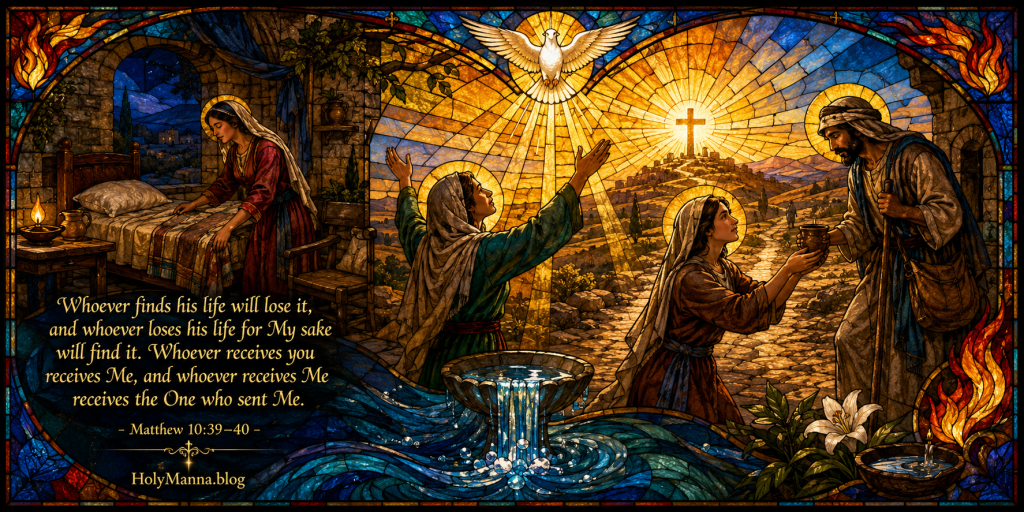
Thirteenth Sunday in Ordinary Time – Lectionary: 97
Make Room
There is something quietly radical about opening a door.
It does not take much, really. A meal offered to a traveler. A room built on a rooftop for a holy man passing through. A cup of cold water pressed into the hands of someone walking in the name of Christ. These are not dramatic gestures. They do not make headlines. And yet, if the readings for this Thirteenth Sunday in Ordinary Time are telling the truth, they are among the most consequential things a human being can do.
Today’s readings form a single, unified story told across four voices, and the story goes something like this: when a person genuinely makes room for God, God makes room for new life in them. And that new life, once it takes root, changes everything, including how they see the stranger at the door.
The Shunammite woman in 2 Kings did not set out to receive a miracle. She set out to feed a prophet. She noticed something sacred in Elisha as he passed through her village, and she acted on what she noticed, pressing him to come in, eat, rest, and stay. She and her husband built him a small upper room furnished with a bed, a table, a chair, and a lamp. Nothing extravagant. Just enough to say: you are welcome here, and we mean it. God saw it. And into a life that had quietly accepted the sorrow of childlessness, He sent something she had stopped daring to ask for.
Psalm 89 opens in the same key, celebrating a people whose entire strength flows from walking in the radiance of God’s face. The psalmist is not describing spiritual superheroes. He is describing ordinary men and women who know, in the bones of their daily lives, that every good thing comes from the Lord, and who live accordingly, singing His faithfulness from morning to evening.
Then Paul arrives in Romans 6 and pulls back the curtain on what makes any of this possible. Baptism, he explains, was not a ritual that happened once and then faded into memory. It was a death and a resurrection. Every baptized person has already been buried with Christ and raised with Him into a radically new kind of life, a life that is no longer governed by sin, fear, or the desperate grasping for self-preservation.
And that is precisely where Jesus enters in Matthew 10, making demands that would be completely unreasonable from anyone other than God Himself. Love Him above father and mother. Take up the cross. Lose the life that keeps trying to save itself. And then, almost tenderly, He pivots to the promises: welcome His disciples and welcome Him. Welcome Him and welcome the Father. Give a single cup of cold water to the smallest of His followers, and not one drop of that faithfulness will be forgotten.
Today’s readings are an invitation to examine what is actually sitting at the center of life. Is there room there for God, or has something else taken up the space?
First Reading – 2 Kings 4:8–11, 14–16
The Woman Who Made Room for the Holy
There is a woman in the Old Testament who never gets enough credit. She has no name in Scripture, only a hometown. She is called the Shunammite woman, and in the span of just a few verses, she manages to model something that most people spend a lifetime trying to learn: how to recognize the sacred in the ordinary, and how to act on that recognition with generosity rather than hesitation. Her story opens today’s Mass, and it opens it perfectly, because everything that follows in Romans and Matthew is, in a sense, a deeper unpacking of what she already understood.
Shunem was a village in the territory of Issachar, nestled in the fertile Jezreel Valley of northern Israel. The events described in 2 Kings 4 took place during the prophetic ministry of Elisha, successor to the great prophet Elijah, somewhere around 850 BCE. It was a spiritually turbulent era in the Northern Kingdom. Baal worship had taken root. Faithfulness to the God of Israel was not the cultural default. Against that backdrop, a woman of means and influence quietly kept her household ordered toward the Lord, and that fidelity changed everything.
2 Kings 4:8-11, 14-16 – New American Bible (Revised Edition)
Elisha Raises the Shunammite’s Son. 8 One day Elisha came to Shunem, where there was a woman of influence, who pressed him to dine with her. Afterward, whenever he passed by, he would stop there to dine. 9 So she said to her husband, “I know that he is a holy man of God. Since he visits us often, 10 let us arrange a little room on the roof and furnish it for him with a bed, table, chair, and lamp, so that when he comes to us he can stay there.”
11 One day Elisha arrived and stayed in the room overnight.
14 Later Elisha asked, “What can we do for her?” Gehazi answered, “She has no son, and her husband is old.” 15 Elisha said, “Call her.” He did so, and when she stood at the door, 16 Elisha promised, “This time next year you will be cradling a baby son.” She said, “My lord, you are a man of God; do not deceive your servant.”
Detailed Exegesis
Verse 8: “One day Elisha came to Shunem, where there was a woman of influence, who pressed him to dine with her. Afterward, whenever he passed by, he would stop there to dine.”
The Hebrew word used to describe this woman is gedolah, which can mean great, notable, wealthy, or prominent. Scripture scholars note that it carries all of these senses at once. She is a woman of substance, and she uses that substance well. The word translated as “pressed” is the same forceful, insistent verb used in Acts 16:15 when Lydia urges Paul to stay in her home. This woman is not passively generous. She pursues hospitality the way other people pursue ambition. She sees Elisha passing through and she does not wait for an invitation to help. She extends one.
Verses 9–10: “So she said to her husband, ‘I know that he is a holy man of God. Since he visits us often, let us arrange a little room on the roof and furnish it for him with a bed, table, chair, and lamp, so that when he comes to us he can stay there.’”
This is the verse that unlocks the entire story. She perceives the sacred in the man before her. She does not know exactly what Elisha will do for her, and she does not ask for anything. She simply recognizes that God is somehow present in this traveler, and she responds with concrete, thoughtful action. The room she describes is modest: a bed, a table, a chair, and a lamp. The basic dignities of human rest. What makes it extraordinary is not its furnishings but its motive. She builds it because she knows, with a certainty that comes from faith, that she is making room for the holy.
Verse 11: “One day Elisha arrived and stayed in the room overnight.”
This brief verse is a pivot. The room has been prepared, the welcome has been extended, and Elisha accepts it. The hospitality is received. What the Shunammite has given freely is now fully embraced, and the stage is set for everything that follows.
Verses 14–15: “Later Elisha asked, ‘What can we do for her?’ Gehazi answered, ‘She has no son, and her husband is old.’ Elisha said, ‘Call her.’ He did so, and when she stood at the door…”
Elisha’s question to Gehazi is tenderly revealing: what can we do for her? He is not asking what she has requested, because she has requested nothing. He is asking what she genuinely needs, what hidden sorrow she carries beneath the gracious surface of her life. Gehazi, with quiet perception, identifies it: she is childless, and her husband is old. In the ancient Near East, childlessness was not merely a personal grief but a social vulnerability. A woman without a son had no heir to care for her after her husband’s death. Gehazi sees the wound, and Elisha prepares to speak into it.
Verse 16: “Elisha promised, ‘This time next year you will be cradling a baby son.’ She said, ‘My lord, you are a man of God; do not deceive your servant.’”
Her response is heartbreaking in its honesty. She has made peace with her barrenness. Unlike Hannah, who wept and pleaded, or Sarah, who laughed in disbelief, this woman has quietly accepted her sorrow and built a full life around it anyway. She did not build that guest room in hopes of a reward. She built it because it was the right thing to do. And now, precisely because she asked for nothing, she is about to receive everything she had stopped daring to want.
Teachings
The Church’s tradition of reading 2 Kings 4 through a typological lens is rich and ancient. Cardinal John Henry Newman, in his Parochial and Plain Sermons, argued explicitly that Elisha is a type of Christ. The miracles worked by Elisha point toward the sacraments: the cleansing of Naaman the Syrian anticipates Baptism, and the multiplication of loaves anticipates the Eucharist. The resurrection of the Shunammite’s son, which follows later in the same chapter, prefigures Christ’s power over death itself, something that Scripture scholar Bruce Waltke documents in a striking list of parallels between Elisha and Jesus, including that both raise dead sons and restore them to their mothers.
This typological reading matters for understanding why the Lectionary pairs this passage with the Gospel today. The Christian Community Bible, a Catholic commentary, draws the connection directly, noting that Matthew 10:41 reflects the reward received by the Shunammite for hosting Elisha. The Shunammite is not incidental to the Gospel; she is its living illustration, placed here by the Church to show exactly what Jesus means.
The Catechism of the Catholic Church reminds Catholics at paragraph 2449 that love for the poor and the vulnerable is not optional charity but a demand of justice rooted in the very character of God. The Shunammite did not turn toward God with requests or demands. She turned toward Him with open hands and an open door.
St. John Chrysostom, preaching on Matthew 10, made an observation that applies equally to this First Reading: “He signified that as many as welcome them are receiving both Himself and the Father.” The Shunammite did not know she was building a room for God. She thought she was building a room for a prophet. But faith operates this way: it acts on what it perceives, and God honors the perception.
Reflection
The Shunammite woman’s story raises a question worth sitting with this week: What does it actually look like to recognize the sacred in the people who pass through daily life? She did not wait for a dramatic sign. She paid attention. She noticed something in Elisha, named it to her husband, and then did something about it with the resources she already had.
This is not a story about wealth, because the principle scales down to a cup of cold water as easily as it scales up to a rooftop guest room. The invitation here is simpler and more demanding than a financial calculation. It is an invitation to reorder the gaze, to look at the people in ordinary daily life, the colleague who is struggling, the neighbor who is lonely, the traveler who needs a meal, and ask the question Elisha’s servant asked on the prophet’s behalf: What can we do for them?
The practical step this reading offers is small enough to actually do: identify one person in the coming week who passes through the edges of daily life and could use a concrete gesture of welcome. Not a grand gesture. A bed, a table, a chair, and a lamp. The basics of human dignity, offered in faith, seen by God, and never, ever forgotten.
Responsorial Psalm – Psalm 89:2–3, 16–19
Singing the Faithfulness of God When Life Feels Fragile
If the Shunammite woman is the story, Psalm 89 is the song underneath it. It is the melody that gives the whole Liturgy of the Word its emotional key, the key of wonder, of trust, and of a love that refuses to quit. The psalmist, identified in the superscription as Ethan the Ezrahite, composed what is one of the most theologically layered psalms in the entire Psalter. In its full form, Psalm 89 moves from soaring praise through agonizing lament and back to a quiet, bruised doxology. The Lectionary, with characteristic wisdom, draws only from the opening movement today, the part where the singer is still standing in the light, voice full, heart lifted, proclaiming that the mercy of God is not a temporary arrangement but an eternal reality.
This psalm belongs to the tradition of Davidic covenant theology. It celebrates the promise God made to King David in 2 Samuel 7, the promise that his throne and his lineage would endure forever. For the original singers of this psalm, that promise was the anchor of national and personal hope. For the Catholic reader today, it points beyond David to the One who sits on David’s throne forever, Jesus Christ, the Son of God, whose kingdom has no end. The mercy and faithfulness the psalmist celebrates are not abstract virtues. They are the very character of a God who keeps His word across every generation.
Psalm 89:2-3, 16-19 – New American Bible (Revised Edition)
2 I will sing of your mercy forever, Lord
proclaim your faithfulness through all ages.
3 For I said, “My mercy is established forever;
my faithfulness will stand as long as the heavens.16 Blessed the people who know the war cry,
who walk in the radiance of your face, Lord.
17 In your name they sing joyfully all the day;
they rejoice in your righteousness.
18 You are their majestic strength;
by your favor our horn is exalted.
19 Truly the Lord is our shield,
the Holy One of Israel, our king!
Detailed Exegesis
Verse 2: “I will sing of your mercy forever, Lord; proclaim your faithfulness through all ages.”
The opening line sets the entire posture of the psalm. The Hebrew word translated as “mercy” here is khesed, one of the richest and most theologically loaded words in the entire Old Testament. Khesed is covenant love, the love that binds itself to another and refuses to let go regardless of circumstances. It is not sentiment. It is commitment. The psalmist does not say he will sing of God’s mercy when things are going well, or when it feels warranted. He says he will sing of it forever, which implies that this praise is not conditional on comfort. It is the permanent disposition of a soul that has learned where its life actually comes from. This single verse reframes the entire spiritual life as an act of perpetual, grateful witness.
Verse 3: “For I said, ‘My mercy is established forever; my faithfulness will stand as long as the heavens.’”
Here the psalmist quotes God Himself, and the shift in speaker is significant. The previous verse was the human voice pledging to sing. This verse is God’s own voice pledging to remain. The parallelism is intentional and beautiful: the human singer commits to proclaiming God’s faithfulness, and God responds by declaring that His faithfulness is already established, already standing, already as permanent as the sky above. This is the theological foundation on which the Shunammite woman built her guest room without knowing it, and on which Paul will build his teaching on baptism in Romans 6. God’s khesed is not earned. It is simply, stubbornly, eternally there.
Verse 16: “Blessed the people who know the war cry, who walk in the radiance of your face, Lord.”
The “war cry” referenced here is the Hebrew teru’ah, a shout of acclamation and joyful praise directed toward God, often associated with liturgical celebration and the presence of the Ark of the Covenant. To “know the war cry” is to be a people who have learned the practice of joyful, communal praise, who understand that the proper response to God’s presence is not polite acknowledgment but exuberant proclamation. To “walk in the radiance of your face” is an image of intimate, sustained communion with God, the kind of ongoing orientation toward the Lord that shapes every decision, every relationship, every act of hospitality. The Shunammite woman walked in this radiance. She saw Elisha and recognized a holy man of God because her eyes had been trained by a life lived in God’s presence.
Verse 17: “In your name they sing joyfully all the day; they rejoice in your righteousness.”
This verse expands the image from a single cry to an all-day posture of joy. The people who walk in God’s light do not reserve their praise for Sunday morning. Their joy in God’s righteousness, in His right ordering of all things, is the atmosphere they live in. This connects directly to Paul’s teaching in Romans 6: the baptized person has been raised to new life in Christ, and that new life is not a grim duty but a joyful identity. To be dead to sin and alive to God is, ultimately, a reason to sing all day.
Verse 18: “You are their majestic strength; by your favor our horn is exalted.”
The image of the “horn” in Hebrew poetry consistently represents power, dignity, and the capacity to stand upright in the world. To have one’s horn exalted by God is to receive from Him the strength that no human effort can manufacture. This is not triumphalism. It is the recognition that whatever dignity, capability, or fruitfulness a person carries has its source in God’s favor, not in their own achievement. The Shunammite woman’s greatness, her gedolah, was real, but this verse reminds the reader where greatness ultimately originates.
Verse 19: “Truly the Lord is our shield, the Holy One of Israel, our king!”
The psalm closes its celebratory movement with a double declaration of God’s identity: He is shield and He is king. As shield, He is the one who absorbs the blows that would otherwise destroy His people. As king, He is the one whose authority orders all other authorities. This final verse is a creed compressed into a single breath, the kind of thing that can be prayed in a moment of fear, repeated in a moment of joy, and returned to in every ordinary moment in between.
Teachings
The Catechism of the Catholic Church, at paragraph 2589, teaches that the Psalms are both the prayer of the individual and the prayer of the whole People of God, nourishing and expressing the faith of those who pray them across every age of the Church. When Catholics pray Psalm 89 at Mass, they are not merely reciting ancient poetry. They are joining their voices to a chorus that stretches back through David, through the Shunammite woman’s silent faith, through the early martyrs, and into the eternal liturgy of heaven itself.
St. Augustine, in his Expositions on the Psalms, understood the Davidic covenant celebrated in Psalm 89 as finding its ultimate fulfillment in Christ, writing: “The mercy promised to David in truth is the Lord Jesus Christ Himself, born of the seed of David according to the flesh.” This is the Catholic reading of every Davidic psalm: David points to Jesus, and the mercy sung about in Psalm 89 is ultimately the mercy made flesh in the Incarnation. When the psalmist sings of God’s khesed, he is, without fully knowing it, singing of Calvary.
St. John Paul II, in his Theology of the Body audiences, frequently returned to the image of the human person as one made to live in the radiant presence of God, not as a distant aspiration but as a present reality available through prayer and sacrament. The “walking in the radiance of your face” that Psalm 89 describes is not reserved for mystics in monasteries. It is the ordinary vocation of every baptized person.
Reflection
Psalm 89 is both a gift and a challenge. The gift is the reminder that God’s faithfulness does not fluctuate with circumstances, with feelings, or with the news cycle. The khesed of God, His covenant love, was established before the psalmist was born and will stand long after every human voice has gone quiet. That is not a small thing to know on a hard day.
The challenge is the invitation to actually live in that knowledge, to walk in the radiance of God’s face not just on Sunday but throughout the week, in the ordinary decisions, the moments of frustration, the conversations that could go either way. Is the daily experience of life shaped by the awareness that God’s faithfulness is already established, already standing, already enough? That is the question Psalm 89 leaves on the table.
A practical way to receive this psalm this week is to pray it slowly, one verse at a time, in a quiet moment each morning, letting it reorient the day before the noise of the world sets the agenda. The psalmist’s pledge, “I will sing of your mercy forever, Lord,” is not a performance. It is a decision. And it is one that anyone, in any circumstance, can make today.
Second Reading – Romans 6:3–4, 8–11
You Are Not Who You Used to Be
Most people think of their baptism, if they think of it at all, as something that happened to them once, usually as an infant, in a church, while they wore a white outfit they cannot remember. It is filed away somewhere between family photographs and childhood memories, meaningful in a sentimental way but not exactly the kind of thing that shapes how a Tuesday afternoon feels. Paul would like a word about that.
In Romans 6, the Apostle pulls back the curtain on what actually happened at the baptismal font, and what he reveals is not a ceremony but a catastrophe in the best possible sense. Something died there. Something was buried. And something entirely new came up out of the water in its place. Understanding that, really understanding it, changes everything about how a baptized person is supposed to live, relate, love, and choose. This is not religious sentiment. It is Paul’s most concentrated theological argument about Christian identity, and it lands today like a second key turning in a lock that the First Reading and the Psalm already began to open.
Paul wrote Romans around 57 CE, addressing a community in the imperial capital that was navigating the complex terrain of Jewish and Gentile believers learning to live as one body in Christ. In Romans 5, he had argued that where sin abounded, grace abounded all the more. The logical question that provoked was obvious: should Christians then keep sinning so that grace keeps multiplying? Romans 6 is his answer, and the answer is not a moral lecture. It is a revelation about identity.
Romans 6:3-4, 8-11 – New American Bible (Revised Edition)
3 Or are you unaware that we who were baptized into Christ Jesus were baptized into his death? 4 We were indeed buried with him through baptism into death, so that, just as Christ was raised from the dead by the glory of the Father, we too might live in newness of life.
8 If, then, we have died with Christ, we believe that we shall also live with him. 9 We know that Christ, raised from the dead, dies no more; death no longer has power over him. 10 As to his death, he died to sin once and for all; as to his life, he lives for God. 11 Consequently, you too must think of yourselves as [being] dead to sin and living for God in Christ Jesus.
Detailed Exegesis
Verse 3: “Or are you unaware that we who were baptized into Christ Jesus were baptized into his death?”
Paul opens with a rhetorical question that carries a mild note of astonishment, as if to say: did nobody tell you this? The phrase “baptized into Christ Jesus” is not metaphorical language. It describes a real incorporation, a genuine union with the person of Jesus Christ. And that union is specifically oriented toward His death. The Greek word baptizein means to plunge or immerse, and Paul is using its full physical force: the descent into the water is a descent into death, the death of the old self, the death of the life governed by sin. This verse alone dismantles the idea that baptism is merely symbolic. It is participatory. It joins the baptized person to the central event of human history.
Verse 4: “We were indeed buried with him through baptism into death, so that, just as Christ was raised from the dead by the glory of the Father, we too might live in newness of life.”
The word Paul uses for “buried with him,” synethaphemen in Greek, is emphatic and communal. It does not say the baptized person merely witnessed Christ’s burial or contemplated it. It says they were co-buried with Him. The descent into the water is a grave. The rising from the water is a resurrection. And the purpose of this entire movement is stated with beautiful clarity: so that we might live in newness of life. Not improved life. Not reformed life. New life, of a fundamentally different quality than what came before.
Verse 8: “If, then, we have died with Christ, we believe that we shall also live with him.”
Paul now draws out the logical consequence of the baptismal reality. The connection between dying with Christ and living with Him is not aspirational. It is structural. Because the death already happened in baptism, the life is already underway. The future dimension, “we shall also live with him,” refers both to the ongoing daily life of grace and to the final resurrection. The baptized person is already living in the overlap between the old age and the new, already tasting the life of the world to come.
Verse 9: “We know that Christ, raised from the dead, dies no more; death no longer has power over him.”
This verse is the foundation of Christian hope stated in its most compressed form. Christ’s resurrection was not a resuscitation. He did not return to the mortal life He had before. He passed through death into a life that death cannot touch again. This matters for the baptized person because it means union with Christ is union with One who has permanently defeated the only enemy that ultimately terrifies. Death no longer has the last word, not for Christ, and therefore not for those who have been buried and raised with Him.
Verse 10: “As to his death, he died to sin once and for all; as to his life, he lives for God.”
The phrase “once and for all” in Greek is ephapax, a word of absolute finality. Christ’s death was not a down payment on sin’s defeat. It was the complete, unrepeatable, sufficient settlement of the entire debt. And His life, the life He now lives in resurrection, is entirely and exclusively oriented toward the Father. This is the pattern the baptized person is called to mirror: a life that has died to sin’s claim and now lives entirely for God.
Verse 11: “Consequently, you too must think of yourselves as dead to sin and living for God in Christ Jesus.”
The verb Paul uses here, logizesthe, is a deliberate, active reckoning. It is the same word used in accounting and in legal reasoning. Paul is not asking for a feeling. He is asking for a decision of faith, a daily choice to operate from the truth of what baptism accomplished rather than from the habits and fears of the old self. This verse is the practical hinge of the entire passage: know what you are, and live accordingly.
Teachings
The Catechism of the Catholic Church at paragraph 1213 teaches that “Holy Baptism is the basis of the whole Christian life, the gateway to life in the Spirit, and the door which gives access to the other sacraments. Through Baptism we are freed from sin and reborn as sons of God; we become members of Christ, are incorporated into the Church and made sharers in her mission.” This is not a minor sacrament. It is the foundation of everything else.
At CCC 1227, the Church quotes Romans 6:3–4 directly, teaching that the believer enters through baptism into communion with Christ’s death and resurrection, and that “the baptized have ‘put on Christ.’ Through the Holy Spirit, Baptism is a bath that purifies, justifies, and sanctifies.”
St. Ambrose of Milan, writing in On the Mysteries, expressed the death-and-resurrection movement of baptism with striking directness: “You were asked, ‘Do you believe in Christ?’ and you answered, ‘I believe,’ then you were plunged, that is, buried with Christ, that you might rise with Him.” Baptism is not the beginning of a self-improvement program. It is the beginning of a resurrection.
St. John Chrysostom, in his Homilies on Romans, drew out the moral consequence with equal clarity: “He that has come up from baptism, since he has died there once for all, must remain ever dead to sin.” The life that rises from the baptismal water is not supposed to drift back into the patterns of the life that went under. It is supposed to live from its new identity, consistently, stubbornly, and joyfully.
St. Augustine, summarizing the entire sacramental logic in a single sentence that CCC 1228 preserves, wrote: “The word is brought to the material element, and it becomes a sacrament.” Water alone accomplishes nothing. Water and the Word of God together accomplish everything.
Reflection
The invitation of Romans 6 is both humbling and electrifying. Humbling because it confronts the very common tendency to live as though baptism were a past event with no present consequences. Electrifying because it insists that every baptized person is already, right now, a participant in the resurrection of Jesus Christ.
What would change about this week if the truth of baptism were taken seriously, not just believed in theory but actually reckoned with, the way Paul uses that accounting word, as the operating reality of every decision, every relationship, and every moment of temptation?
A practical step worth considering is returning to the baptismal promises, the ones renewed every Easter, and praying through them slowly, one by one, not as a formality but as a re-declaration of identity. I renounce sin. I renounce the glamour of evil. I believe in God the Father, the Son, and the Holy Spirit. These are not words from the past. They are the vocabulary of the new life that came up out of the water, and they belong in the present tense, every single day.
Holy Gospel – Matthew 10:37–42
The Most Demanding and Most Generous Thing Jesus Ever Said
By the time a reader reaches the end of Matthew 10, Jesus has been speaking to His disciples for a while, and He has not been making things easier. He has warned them about persecution, about family division, about being dragged before councils and governors. He has told them that He came not to bring peace but a sword. And now, in the final six verses of the chapter, He brings the entire discourse to a double climax that is simultaneously the most demanding thing He has ever asked and the most generous promise He has ever made. These are not comfortable verses. They are clarifying ones, and the Church places them before the faithful today because they name, with surgical precision, exactly what it costs to follow Christ and exactly what that following is worth.
Matthew 10 is the second of five major discourses in Matthew’s Gospel, known to Scripture scholars as the Mission Discourse. Jesus has commissioned the Twelve, given them authority, sent them out, and prepared them for the resistance they will face. The final movement of the chapter, beginning at verse 34, addresses the deepest possible obstacle to discipleship: not the hostility of strangers, but the pull of the people a person loves most. In the ancient Mediterranean world, family loyalty was not merely a sentiment. It was the primary social, economic, and religious unit of life. To relativize it in the way Jesus does here was not impolite. It was revolutionary.
Matthew 10:37-42 – New American Bible (Revised Edition)
The Conditions of Discipleship. 37 “Whoever loves father or mother more than me is not worthy of me, and whoever loves son or daughter more than me is not worthy of me; 38 and whoever does not take up his cross and follow after me is not worthy of me. 39 Whoever finds his life will lose it, and whoever loses his life for my sake will find it.
Rewards. 40 “Whoever receives you receives me, and whoever receives me receives the one who sent me. 41 Whoever receives a prophet because he is a prophet will receive a prophet’s reward, and whoever receives a righteous man because he is righteous will receive a righteous man’s reward. 42 And whoever gives only a cup of cold water to one of these little ones to drink because he is a disciple—amen, I say to you, he will surely not lose his reward.”
Detailed Exegesis
Verse 37: “Whoever loves father or mother more than me is not worthy of me, and whoever loves son or daughter more than me is not worthy of me.”
This is one of the hard sayings of Jesus, and the Church has never softened it. The key word is “more than.” Jesus is not commanding His disciples to stop loving their families. He is commanding them to love Him first, above all else, with a love that reorders every other love rather than extinguishing it. St. Jerome, commenting on this verse in the Catena tradition, explained the proper ordering plainly: after God, love your father, your mother, and your children, but if a moment ever comes when those loves compete with the love of God, God must win. What makes this verse theologically explosive is its implicit claim: only God can legitimately demand this kind of primacy. No prophet, no rabbi, no teacher makes this demand. Only the divine Son of God can place Himself above a person’s love for their own parents and children and be entirely right to do so.
Verse 38: “And whoever does not take up his cross and follow after me is not worthy of me.”
Jesus speaks of the cross before He has been crucified, which means He is not referring to a historical event His disciples could yet anticipate. He is describing a posture of life: the willingness to carry the weight of self-denial, suffering, and surrender that discipleship inevitably brings. Taking up the cross is not a single dramatic moment. It is a daily orientation, a daily choice to put Christ’s will above comfort, reputation, and self-preservation. The cross is not an accident that happens to the disciple. It is something the disciple deliberately picks up and carries.
Verse 39: “Whoever finds his life will lose it, and whoever loses his life for my sake will find it.”
This single verse is among the most concentrated expressions of the entire Gospel. It describes a paradox that is not a riddle but a law of the spiritual universe. The life that grasps and protects itself, that makes itself the center of its own story, is the life that slowly empties out. The life that releases itself into love of Christ, that surrenders its own agenda to His, is the life that discovers what life actually is. This verse is the Gospel equivalent of what Paul announces in Romans 6: dying with Christ is the only path to rising with Him.
Verse 40: “Whoever receives you receives me, and whoever receives me receives the one who sent me.”
With this verse the entire tone of the passage shifts. Jesus pivots from demand to promise, from cost to consolation. He establishes a chain of reception that is theologically staggering: to welcome a disciple of Christ is to welcome Christ Himself, and to welcome Christ is to welcome the Father who sent Him. This is not a metaphor. It is a sacramental logic, the same logic that underlies the Church’s teaching on the Eucharist and the sacraments: Christ is genuinely present in His Body, the Church, and what is done to the least of His members is done to Him.
Verse 41: “Whoever receives a prophet because he is a prophet will receive a prophet’s reward, and whoever receives a righteous man because he is righteous will receive a righteous man’s reward.”
The USCCB footnote on this verse clarifies that “prophet,” “righteous man,” and “little one” in the following verse likely all refer to Christian missionaries, described from different angles: their proclamation, their moral character, and their social vulnerability. The key phrase is “because he is a prophet” and “because he is righteous.” The motive of the welcome matters. Receiving a disciple for social benefit or personal advantage is one thing. Receiving a disciple because of who he represents is another thing entirely, and it is the latter that draws the divine reward.
Verse 42: “And whoever gives only a cup of cold water to one of these little ones to drink because he is a disciple, amen, I say to you, he will surely not lose his reward.”
This is the most quietly astonishing verse in the entire passage. After everything Jesus has said about crosses and swords and family division, He ends with a cup of cold water. Not a heroic act. Not a sacrifice that costs everything. A cup of water, the most basic gesture of human hospitality in the arid climate of first-century Palestine, offered to someone simply because that person belongs to Christ. And Jesus says: that will not be forgotten. Not one drop of that faithfulness will go unnoticed or unrewarded. The Lectionary’s pairing of this verse with the Shunammite woman’s story is no accident. She gave Elisha bread and a room. Today’s disciple might give nothing more than water. Both are seen by God. Both receive a prophet’s reward.
Teachings
St. John Chrysostom, in Homily 35 on Matthew, recognized the implicit claim to divinity in verse 37 with characteristic directness: “Do you see a teacher’s dignity? Do you see, how He signifies himself a true Son of Him that begot Him, commanding us to let go all things beneath, and to take in preference the love of Him?” Chrysostom understood that no mere human teacher could make this demand and be anything other than deluded or dangerous. The fact that Jesus makes it and is right to make it is itself a declaration of who He is.
Cornelius à Lapide, the great Jesuit Scripture commentator, summarized the meaning of “not worthy of me” in verse 37 with precision: “Christ is our God, Lord and Saviour, and so he must be far preferred to all else.” The demand is not arbitrary. It flows from who Christ actually is.
St. Augustine, in a sermon preserved in the Catena tradition on Matthew 10, captured the proper ordering of love with remarkable beauty: “Let us answer our father and mother when they justly say ‘love us.’ Let us answer, ‘I will love you in Christ, not instead of Christ. You will be with me in him, but I will not be with you without him.’” This is not cold. It is the deepest possible love, one that reorders all earthly love without destroying it.
The Catechism of the Catholic Church at paragraph 1816 teaches that “the disciple of Christ must not only keep the faith and live on it, but also profess it, confidently bear witness to it, and spread it.” The cross-bearing of Matthew 10 is not optional spiritual heroism reserved for saints. It is the ordinary vocation of every baptized person.
Reflection
Matthew 10:37–42 does not leave much room to hide. It asks, with quiet insistence, what is actually sitting at the center of daily life. Is it Christ, or is it something else, something good, perhaps even something beautiful, but something that has quietly displaced Him?
The good news is that Jesus does not only raise the bar. He also lowers the threshold of what counts as faithfulness. A cup of cold water. One small act of welcome done in His name, offered with the awareness that the person before you belongs to Christ, and therefore matters to God. That is enough to begin. What would it look like this week to give someone that cup, not out of social obligation or habit, but because they are a disciple of Christ and that makes them worth everything?
The cross is real. The cost is real. And the promise is equally real: not one act of faithful love, however small, will ever be lost.
The Door Is Already Open
There is a thread running through everything the Church has placed before the faithful today, and it is worth pausing at the end to name it clearly. A woman in Shunem opened her home to a stranger she recognized as holy. A psalmist declared, without condition or qualification, that the mercy of God is established forever. An apostle announced that everyone who has been baptized has already died and already risen. And the Son of God Himself said that a cup of cold water given in His name will never, ever be forgotten.
The thread is this: God is not distant. He is not waiting to be impressed. He is already here, already faithful, already present in the prophet passing through, in the disciple who needs water, in the cross that appears uninvited on an ordinary Tuesday. The only question today’s readings leave open is whether there is room for Him, room in the schedule, room in the heart, room in the life that has already been claimed by so many other things.
The Shunammite woman answered that question with a bed, a table, a chair, and a lamp. Paul answered it by pointing back to the baptismal font and saying: the room was made there, whether it was remembered or not. The psalmist answered it with a song that refused to stop. And Jesus answered it by making the threshold as low as it possibly could be: not a grand heroic gesture, not a life free of struggle, not a perfection that nobody has managed to achieve. Just a cup of cold water. Just a willingness to pick up the cross and keep walking. Just a love for Him that comes first, before everything else, and then flows outward into every other love, purifying and deepening them rather than replacing them.
This is the Catholic life. Not a program of self-improvement. Not a checklist of religious obligations. A death and a resurrection, lived out in the ordinary texture of every day, in the hospitality extended to the colleague nobody else notices, in the prayer offered when the feelings are not there, in the faithfulness maintained when the cost becomes real. “Whoever loses his life for my sake will find it.” That is not a threat. That is the most hopeful sentence in the history of the world.
The door is already open. The guest room is already furnished. The mercy of God is already established, singing itself across every generation, waiting to be welcomed and passed on.
What small act of faithful love is waiting to be offered today, not because it is dramatic, but because it is real, and because the God who notices every sparrow that falls will certainly notice that too?
Make room. Sing the mercy. Live the baptism. Give the water. The rest belongs to God, and God, as this Sunday’s readings make unmistakably clear, is very, very good at His part.
Engage With Us!
The readings for this Thirteenth Sunday in Ordinary Time are too rich to sit with alone. Share your reflections in the comments below, because this community grows stronger when the faithful think out loud together, ask the hard questions, and encourage one another to keep going.
- In 2 Kings 4:8–11, 14–16, the Shunammite woman recognized the sacred in Elisha before she received anything from him, and she acted on that recognition with concrete generosity. Who in your life right now might be a “holy man of God” passing through, someone carrying grace that deserves to be welcomed rather than overlooked?
- Psalm 89:2–3, 16–19 describes a people who walk in the radiance of God’s face and sing of His mercy all the day long, not just on Sunday mornings. What would it look like in a practical, daily way to let the awareness of God’s faithfulness shape the ordinary hours of the week rather than only the sacred ones?
- Romans 6:3–4, 8–11 insists that baptism was not a one-time event but a permanent transformation, a death to the old self and a resurrection to new life in Christ. Is there an area of daily life where the old self is still running the show, a habit, a fear, or a pattern that baptismal identity could actually displace if taken seriously?
- Matthew 10:37–42 moves from the hardest demand Jesus ever made to the smallest possible act of faithfulness He ever honored. Where is the cup of cold water in this particular season of life, the small, hidden, unglamorous act of love done in Christ’s name that nobody else might notice but God?
- Across all four readings, the unifying invitation is to make room for God and then watch what He does with the space. What is one thing that could be moved, loosened, or surrendered this week to create a little more room for Him?
Go forward this week as people who have been buried with Christ and raised to something better. Love extravagantly. Welcome generously. Carry the cross without apology. And never, ever underestimate what God can do with a cup of cold water offered in faith.
Sacred Heart of Jesus, we trust in You!
Immaculate Heart of Mary, pray for us!
Saint Michael the Archangel, defend us in battle!
Follow us on YouTube, TikTok, Instagram and Facebook for more insights and reflections on living a faith-filled life.

 Holy Manna!
Leave a comment