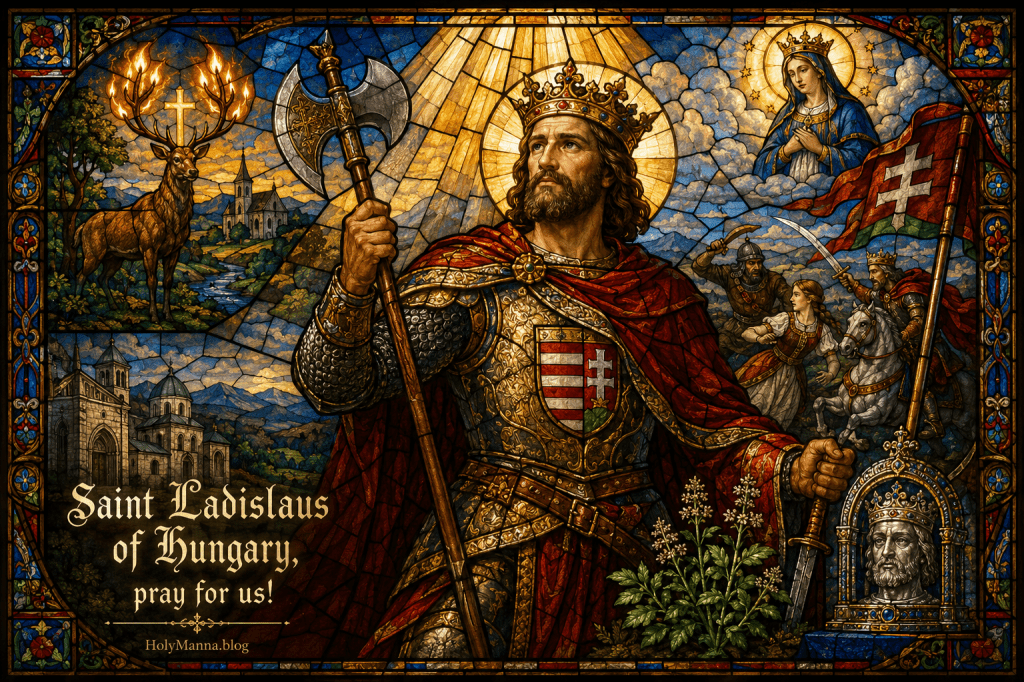
Saint of the Day: Saint Ladislaus of Hungary
The Knight Who Knelt Before God
There is something almost too good to be true about Saint Ladislaus of Hungary. He was tall, powerfully built, and ferocious in battle, a king who rode into combat against pagan invaders and won. He was also a man who reportedly levitated during private prayer, who wept before the Blessed Sacrament, who refused the throne until the people practically dragged him onto it, and who admitted in a letter to a monastery abbot that he could not govern without committing grave sins. He is the patron saint of soldiers and border guards, and he is invoked during times of pestilence. He founded dioceses, canonized saints, reformed the Church, and extended Hungary’s borders across Croatia. And when he died in 1095, the entire nation mourned him for three years.
This is not a man the Church stumbled upon by accident. This is a man whom God clearly set apart, shaped through exile and civil war and pagan invasion, and placed on a throne so that an entire people could see what it looks like when a Christian king actually tries to live like one. His feast day falls on June 27, the very date on which he was both born around 1040 and canonized in 1192 by Pope Celestine III, a coincidence so poetic it feels less like coincidence and more like Providence having a sense of humor.
Saint Ladislaus is one of the patron saints of Hungary alongside Saints Stephen and Elisabeth of Hungary. He is also the patron of soldiers, infantry, border guards, and the Székely people of Transylvania, and he is invoked as an intercessor during times of plague and pestilence.
Born in Exile, Formed in Faith
The story of Ladislaus begins not in a Hungarian palace but in Poland, and that detail matters enormously for understanding who he became. His father, Béla, was a prince of the Hungarian royal house of Árpád who had been banished from Hungary in the 1030s and took refuge at the Polish court. It was there, around 1040, that Ladislaus was born, the second son of Béla and his wife Richeza, a daughter of the Polish King Mieszko II Lambert.
Growing up in Poland meant growing up in a world where Christianity had already sunk deep roots. The Polish chronicler Gallus Anonymus, writing in the early 12th century, observed that Ladislaus was raised from childhood in Poland and had nearly become a Pole in his ways and life. That was not a criticism. It was a description of a young man formed by a culture where the faith was not new and fragile but settled and serious, where the rhythms of the liturgy and the demands of the Gospel had been shaping daily life for generations.
When Béla eventually returned to Hungary, reclaimed his place in the royal succession, and was crowned king in 1060, the family returned with him. But the Hungarian landscape that young Ladislaus inherited was turbulent and contested. His father died in 1063, and the brothers Géza and Ladislaus found themselves navigating a kingdom still wrestling with the aftermath of its conversion to Christianity, where pagan customs lingered, where civil wars over the throne were a recurring disaster, and where nomadic peoples from the eastern steppes, the Pechenegs and the Cumans, were a constant military threat along the borders.
None of that extinguished the faith that had been planted in him during his Polish years. Chastity, meekness, gravity, charity, and piety were from his infancy the distinguishing parts of his character. Avarice and ambition were his sovereign aversion, so perfectly had the maxims of the Gospel extinguished in him all propensity to those base passions. His life in the palace was most austere; he was frugal and abstemious but most liberal to the Church and the poor. Vanity, pleasure, or idle amusements had no share in his actions or time, because all his moments were consecrated to the exercises of religion and the duties of his station, in which he had only the divine will in view and sought only God’s greater honor.
That is a remarkable portrait for a man who was also, by every account, physically imposing, exceptionally skilled in combat, and one of the most effective military commanders of medieval Europe. The point the chroniclers are making, and the point worth sitting with, is that none of those exterior gifts belonged to him. He held them in trust for God and for the people God had given him to serve.
The Reluctant King Who Became a Great One
When his brother Géza died in 1077, Ladislaus became king, but not in the way ambitious men seek power. Entirely devoid of personal ambition, he accepted the dignity thrust upon him from a sense of duty. The people wanted him. The nobles rallied to him. He said yes because he understood that a Christian does not refuse the cross God lays before him, even when that cross is a crown.
What followed was eighteen years of governance so remarkable that a later chronicler simply noted that no other Hungarian king was so generally beloved by the people.
His first major challenge was consolidating order after decades of civil war. He introduced a legal code rooted in Christian principles, protecting property, defending the weak, and punishing violations with a severity that, while it shocks modern sensibilities, brought a fractured kingdom to heel and gave ordinary people the safety they had long been denied. He understood, as the Catechism of the Catholic Church teaches in its reflection on the duties of civil authority in CCC 1897 through 1904, that legitimate authority ordered toward the common good is itself a participation in God’s governance of creation.
At the same time, he made it his personal mission to complete the Christianization of Hungary that Saint Stephen I had begun. He suppressed lingering pagan customs with determination. He promoted the Roman rite over the Greek rite, firmly anchoring Hungary within the Western Church. He founded the Diocese of Nagyvárad in 1092 and the Diocese of Zagreb in 1091, the latter after entering Croatia at the request of his widowed sister Queen Helena. He established monasteries, including the Benedictine abbey at Somogyvár in 1083. He governed the religious and civil affairs of the kingdom through the Synod of Szabolcs in 1092, which functioned almost like a council, addressing matters of discipline, doctrine, and Church order simultaneously.
And then he did something breathtaking. In 1085, he convened the canonization of Hungary’s first saints, including his own distant relative, King Stephen I, and Duke Emeric, Stephen’s son. On that same occasion, in an act of startling Christian magnanimity, he released from prison his longtime rival Solomon, the man who had contested his throne, made alliances against him, and caused years of bloodshed. Ladislaus freed him on the day Hungary celebrated the elevation of its first saints to the altar. It is the kind of moment that makes you put the book down for a second and just think about what that means.
He also sided with Pope Gregory VII in the Investiture Controversy against the German Emperor Henry IV, married Adelaide of Rheinfelden, whose father was one of the emperor’s chief opponents, and made clear that in the conflict between papal authority and imperial power, he stood with Rome. This was not a politically safe position. It was a theologically principled one.
Ladislaus fought a series of military campaigns that secured Hungary’s eastern borders against the Pechenegs and Cumans, whose raids had terrorized the kingdom for years. His victories were so complete that the eastern borders remained secure for approximately 150 years afterward. Those who survived the battles were often offered Christianity, and many accepted. He understood warfare not as conquest for its own sake but as the defense of a Christian people and, where possible, as an opportunity for evangelization.
The Story of the Stag with Wings of Fire
Before getting to the most famous story associated with Saint Ladislaus, it is worth pausing on a gentler one that reveals something essential about his spiritual character. The story is preserved in The Hungarian Illuminated Chronicle and takes place near the city of Vác.
According to the account, Ladislaus and his brother Géza were standing near a spot that would later become a great church when a stag appeared to them with many candles burning upon his horns. It began to run swiftly before them toward the wood and halted at a spot near the riverbank. When the soldiers shot their arrows at it, it leapt into the Danube and disappeared. At this sight, Ladislaus said to his brother: “Truly that was no stag but an angel from God.” And Géza asked him: “Tell me, beloved brother, what may all the candles signify which we saw burning on the stag’s horns?” The blessed Ladislaus answered: “They are not horns but wings, they are not burning candles but shining feathers. It has shown to us that we are to build the church of the Blessed Virgin on the place where it planted its feet and not elsewhere.”
The image is extraordinary. A warrior prince sees what his soldiers see as prey and recognizes it instead as a messenger. Where others reach for arrows, he reaches for interpretation. Where others see something to be conquered, he sees something to be followed. That capacity to read the world through the eyes of faith, to see the angel in the stag, is one of the defining interior qualities of a saint.
The Cuman Warrior and the Abducted Girl
No story associated with Saint Ladislaus has captured the imagination of the Hungarian Catholic world more completely than the story of the Cuman warrior and the abducted girl. It is worth noting from the outset that historians classify this as a legendary narrative rather than a verified historical event. The textual sources for it date to 14th-century chronicles, most notably the Illuminated Chronicle of around 1358. Nevertheless, the story became so central to Hungarian Catholic identity that it was painted in over sixty surviving medieval church frescoes across Hungary, Slovakia, Romania, and Slovenia, making it one of the most widely depicted narrative cycles in medieval Central European art.
The story unfolds during a period of Cuman raids into Hungarian territory. Ladislaus, then a duke rather than a king, is on the battlefield at Kerlés when he catches sight of a pagan Cuman warrior who has seized a Hungarian girl and slung her across his saddle, intending to carry her off into captivity. Ladislaus immediately gives chase on horseback. The Cuman is fast. Ladislaus cannot close the gap. At the last moment, he shouts to the girl: “Catch hold of the pagan at his belt and jump to the ground!” She does so. The two men dismount and a ferocious hand-to-hand battle begins. Ladislaus struggles to subdue his opponent. The girl, rather than collapsing in helplessness, takes an active role: she cuts the Cuman warrior’s Achilles tendon. Ladislaus then beheads him. The story ends with both of them resting under a tree, the girl attending to the exhausted king.
The story is layered with theological meaning regardless of its historical status. The battle of the Christian king against the pagan who has seized an innocent woman is a symbol of the eternal conflict between the Kingdom of God and the forces that prey upon the vulnerable. That Ladislaus could not do it alone, that the girl’s courage and action were necessary for the victory, is a detail that has fascinated historians and theologians alike. It is also, perhaps, a reminder that the work of defending the faith is never the job of the powerful alone.
The battle cry of the Székely people, when going into combat, invoked his name. The legendary cycle is nothing less than the visual theology of a medieval Catholic people, painted on church walls so that every time a Hungarian entered a house of worship, they were reminded of what it looks like when a Christian king fights for the innocent.
The Miracle of the Herb and the Mercy of God
Among the miracles attributed to Ladislaus during his lifetime, one has left its mark on the very landscape of Hungary. According to his official story, which was compiled after 1204, a pestilence spread throughout the kingdom during his reign. The king prayed for God’s intervention. Then, in an act of complete surrender to Providence, he drew his bow and shot an arrow into the air at random, trusting that God would guide it where He willed. The arrow struck a particular herb. That herb, when used, cured the illness.
The plant has been known ever since in Hungary as the herb of Saint Ladislaus, identified as Gentiana cruciata. This miracle deserves reflection precisely because of its method. Ladislaus did not calculate. He did not consult physicians. He prayed, surrendered his own judgment entirely, and let God direct the arrow. It is a parable of faith enacted in the most literal possible way.
The Miracle of Water from the Rock
There is also a story, consistent with the ancient biblical tradition of God providing for His people in the wilderness, that during military campaigns against the Cumans, the Hungarian army found itself in desperate straits, without food or water in desolate territory. Ladislaus prayed. According to the account, water sprang from a rock when he struck it with his spear, echoing the great miracle of Moses described in Numbers 20. Shortly afterward, a herd of deer and bison appeared, and the men hunted and ate. The oldest Latin manuscript of the story of Saint Ladislaus lists six miracles, including the feeding of the army in the wilderness, the drawing of water from the rock, and the remarkable account of the king himself being seen to rise off the ground during prayer, his body lifted into the air by the intensity of his communion with God. These accounts belong to the legendary tradition and cannot be independently verified, but they reflect what those who knew him, and those who venerated him afterward, believed they understood about his intimacy with God.
The Hardships of Power and the Burden of the Crown
It would be a mistake to imagine that Ladislaus’s reign was a triumphant march from one success to another. Civil war, rival claimants to the throne, repeated military invasions, and finally a deteriorating relationship with the Holy See over the question of Croatia marked his years as king. The popes claimed Croatia as a papal fief; Ladislaus denied that claim and held the territory anyway. His relationship with the papacy grew strained during the final years of his reign.
It is in this context that the single surviving personal statement from Ladislaus carries its full weight. In a letter written to Abbot Oderizius of Monte Cassino in 1091, Ladislaus admitted with a directness that is almost startling: “I could not promote the cause of earthly dignities without committing grave sins.” There is no self-congratulation there, no royal triumphalism. There is only an honest man looking at his own soul and telling the truth about what he sees. That kind of moral clarity is itself a form of holiness. It reflects the spirit of Psalm 51, the great psalm of contrition, and the teaching of the Catechism in CCC 1430 that interior penance involves a radical reorientation of the whole life, a return to God with all one’s heart.
He died on July 29, 1095, at the age of approximately fifty-five, near Nitra in what is now Slovakia, under circumstances that remain somewhat unclear. Medieval chronicles record that he had been chosen by the kings of France, Spain, and England to lead the armies of the First Crusade, but historians note that he died several months before Pope Urban II officially called the Crusade at the Council of Clermont in November 1095. The story of his crusader election belongs to the pious tradition of medieval Hungary, not to verified history. What is certain is that he died preparing for something larger than himself, still in motion, still oriented outward toward the defense of Christendom. The whole nation mourned him for three years.
Miracles After Death and the Power of His Intercession
The moment Ladislaus died, the miracles began.
His followers, faced with the summer heat and the long journey to Nagyvárad where he had wished to be buried, debated whether to simply inter him at the more convenient location of Székesfehérvár. According to one of the most celebrated accounts of his posthumous miracles, the matter was resolved without human decision: while the entourage slept at an inn, the king’s funeral carriage began to move on its own, without any animal or human traction, and set off in the direction of Nagyvárad. When the servants woke and discovered what had happened, they understood that the king himself, or rather God through the king, had settled the question. This account, known as the post-mortem chariot miracle, cannot be independently verified, but it has been part of the devotional tradition surrounding Saint Ladislaus since the earliest years of his veneration.
When his tomb was opened at the time of his canonization in 1192, those present reported that a wonderful fragrance filled the air and that the body was found to be incorrupt, bearing the signs the Church has long recognized as consistent with sanctity. Early accounts from the late 11th and early 12th centuries describe miracles at his sepulcher, including the spontaneous recovery of the blind and lame who came to pray there. Nagyvárad, the city and cathedral he had founded, became a major pilgrimage center, and the tomb of Saint Ladislaus became one of the most venerated sites in medieval Central Europe. From the end of the 13th century, it became the custom of the Hungarian kings themselves to make pilgrimage to his tomb.
The story associated with his posthumous intervention in battle is one of the most vivid in the entire tradition of Central European Catholic piety. In 1345, during a Tatar raid into Szeklerland, the Székely people found themselves overwhelmed and prayed desperately for divine assistance. According to the account, a tall, fearsome soldier suddenly appeared fighting in their ranks and turned the tide of battle. A Tatar prisoner, interrogated afterward, testified that he had seen a warrior the Hungarians called upon for help. At the same moment, the guardian of the cathedral at Nagyvárad discovered that the skull of Saint Ladislaus had disappeared from its reliquary. After the battle, it was found returned to its place, reportedly damp with the exertion of combat. Above the mysterious soldier, witnesses said, floated a crowned female figure, understood by the faithful to be the Blessed Virgin Mary herself. The Tatar commander reportedly said: “Not the Székely, not the Hungarian beat us, but the László they called for help!” This account belongs to the legendary tradition and cannot be independently verified, but it has shaped Hungarian Catholic devotion to this saint for nearly seven centuries.
His right hand is preserved as a relic in the Franciscan monastery in Dubrovnik, Croatia. His skull has a history almost too dramatic for fiction.
After his canonization, his head was separated from the rest of his body and placed in a wooden reliquary, which was used during Masses. That reliquary was destroyed in a fire in 1406, but the skull relic miraculously survived the flames intact. A new reliquary was commissioned, the magnificent silver herm now known as the Herm of Saint Ladislaus, recognized as the most valuable piece of medieval Hungarian metalsmithing, its head crafted from gilded embossed silver and its chest and shoulders worked in Byzantine wire enamel technique. The herm survived a collapsing cathedral tower in 1443. It survived the ransacking of Protestants in the 16th century, when the royal tomb was desecrated and the bones were scattered. A bishop retrieved the herm and carried it first to Gyulafehérvár, then to Prague, then to Pozsony, and finally in 1607 to the Cathedral Basilica of Győr in Hungary, where it has remained ever since, housed in the Héderváry Chapel.
In 1762, a massive earthquake struck Győr. The people prayed to Saint Ladislaus, carried his herm in procession through the streets, and the city was spared significant destruction. Bishop Ferenc Zichy declared that a procession with the herm would be held in honor of Saint Ladislaus on June 27 every year. That procession continues to this day, paused only during the Communist suppression of religion between 1950 and 1989.
In 2021, the Institute of Hungarian Research performed DNA analysis on a fragment of the skull inside the herm, comparing it against the already-identified genome of King Béla III, a member of the same Árpád dynasty. The results confirmed beyond reasonable doubt that the skull belongs to Saint Ladislaus. After nine centuries of fire, theft, earthquake, and Reformation violence, science confirmed what faith had never doubted.
What This Knight-King Has to Teach the Modern Catholic
So what does a medieval Hungarian warrior-saint have to say to someone scrolling through their phone in the 21st century? Probably more than comfortable.
Saint Ladislaus lived at the intersection of two demands that most people assume are mutually exclusive: the demand of power and the demand of holiness. He was a king who had to make hard decisions, wage wars, enact harsh laws, navigate political rivalries, and govern a fractious kingdom. He did all of it. He did not retreat to a monastery. He did not abdicate in favor of a quieter, holier life. He stayed in the arena and fought, and he prayed while he fought, and he wept before God when he failed, and he kept going.
That is actually the vocation of most Catholic adults. Not the monastery but the arena. The office, the classroom, the hospital, the courtroom, the kitchen, the battlefield of ordinary life. The question Ladislaus poses to the modern reader is not: Are you willing to become a monk? The question is: Are you willing to be holy in the place where God has actually put you?
His extraordinary humility is the key to everything else. He did not want the throne. He accepted it as a cross. He admitted, in writing, that he could not govern without sinning. He asked for forgiveness. He kept going. That pattern, of accepting the vocation one has been given, acknowledging one’s own failures honestly before God, and continuing to serve anyway, is the pattern of Christian discipleship that the Catechism describes in CCC 2013 when it speaks of the universal call to holiness. It is not a call reserved for clergy or religious. It is the call addressed to every baptized person, in whatever station of life they occupy.
His mercy toward Solomon, releasing his enemy on the very day Hungary canonized its first saints, is a rebuke to the modern habit of keeping careful accounts of grievances. Matthew 18:21-22 records Jesus telling Peter to forgive not seven times but seventy times seven. Ladislaus apparently took that seriously enough to act on it at a moment when keeping Solomon imprisoned would have been completely politically rational.
And the image of Ladislaus shooting an arrow into the air during a plague, trusting God to guide it, is perhaps the most personally challenging image in his entire story. It is an image of a man who has genuinely run out of his own resources and has placed the outcome entirely in God’s hands. Proverbs 3:5-6 says: “Trust in the Lord with all your heart and lean not on your own understanding; in all your ways submit to him, and he will make your paths straight.” Ladislaus drew the bow and let God aim. How often does that kind of surrender come naturally in a crisis?
The challenge his life poses is not primarily about military virtue or medieval kingship. It is about whether the faith that a person professes on Sunday actually shapes what they do on Monday, Tuesday, and every other day of the week when the stakes are real and the temptations to compromise are genuine.
Engage With Us!
Readers are warmly invited to share their thoughts and reflections in the comments below. The life of Saint Ladislaus is rich with moments that speak to the daily challenges of living the Catholic faith in a complicated world, and there is no shortage of things to reflect on together.
- Saint Ladislaus accepted a responsibility he did not want, governing a kingdom as an act of duty rather than ambition. Is there a role or responsibility in your own life that you have been avoiding because it feels too heavy, and could the example of Ladislaus offer you a different way of seeing it?
- He admitted openly in writing that he could not exercise power without committing grave sins, and he kept returning to God in contrition. How comfortable are you with that kind of honest self-examination before God, and what would change in your prayer life if you practiced it more regularly?
- The miracle of the herb tells the story of a man who prayed and then surrendered the outcome entirely to God, shooting an arrow at random and trusting God to guide it. Where in your life right now are you holding on too tightly to the outcome, and what would it look like to genuinely release it to God?
- Ladislaus freed his enemy Solomon on the day of Hungary’s great celebration of its first saints. Is there someone in your life whom you have kept imprisoned in your heart through unforgiveness, and what would it take to offer them the kind of freedom Ladislaus offered Solomon?
- His story connects Poland, Hungary, Croatia, and even Russia, crossing every cultural and religious boundary of his era. How does the universality of the Catholic Church, expressed through the lives of saints from so many different nations and cultures, deepen your own sense of belonging to something larger than yourself?
The life of a saint is never just history. It is an invitation. Saint Ladislaus of Hungary was not a perfect man. He said so himself. But he was a man who gave everything he had to God, fought for the people entrusted to his care, wept when he failed, and kept going until his last breath. That is not a medieval story. That is the story of every Christian who has ever decided to take the faith seriously in the middle of a difficult and complicated life. Go and do likewise. Live with courage, pray with humility, love with generosity, and trust that God can guide even the arrows that feel like they are flying blind.
Saint Ladislaus of Hungary, pray for us!
Follow us on YouTube, TikTok, Instagram and Facebook for more insights and reflections on living a faith-filled life.


Leave a comment