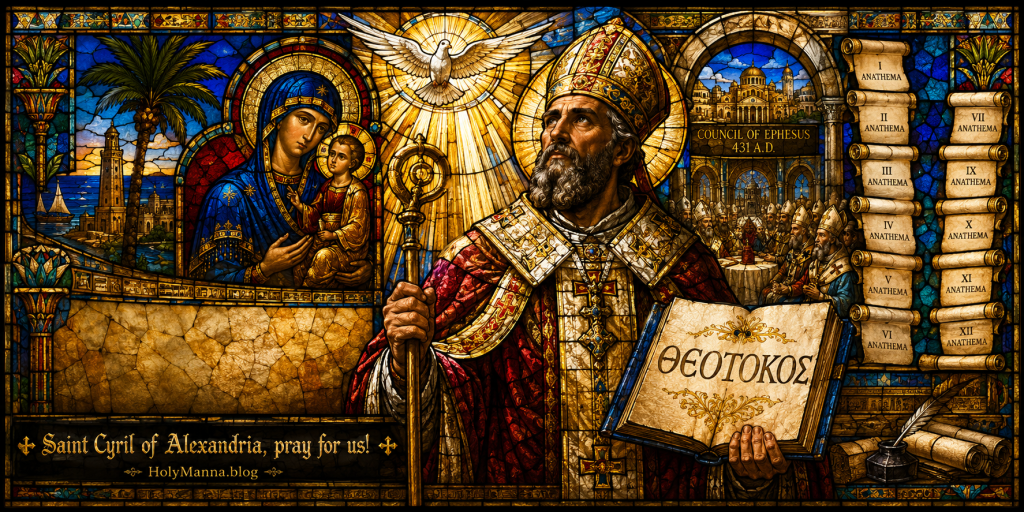
The Man Who Saved the Title “Mother of God”
There is a moment in the history of the Church where everything hangs by a thread. The year is 431. The city is Ephesus. The question on the table is not some obscure theological footnote. The question is whether the woman who carried God in her womb can be called the Mother of God. And standing in the middle of that storm, refusing to budge even an inch, is a fierce, complicated, brilliant, sometimes maddening bishop from Egypt named Cyril of Alexandria.
He is not the kind of saint who makes it easy. He was impulsive. He was politically ruthless. He inherited grudges from his uncle and held them for years. He made enemies as fast as he made arguments. And yet the Church calls him the Pillar of Faith, the Seal of All the Fathers, and the Doctor of the Incarnation. Pope Leo XIII declared him a Doctor of the Church in 1882. His feast day is celebrated on June 27. He is the patron saint of Alexandria and of theologians, and he is invoked against Christological heresies.
So how does a man like that become a saint? The answer, it turns out, is the most Catholic answer imaginable. He grew. He repented. He allowed God to use even his flaws and his fire in the service of something that would protect the faith for every generation that followed. And what he protected in Ephesus on that summer day in 431 is something every Catholic still prays today, every time the Rosary passes through their hands. Hail Mary, full of grace. The Lord is with thee. Blessed art thou among women. The woman at the center of that prayer is the Mother of God because Cyril of Alexandria refused to let anyone say otherwise.
The Making of a Patriarch
Cyril was born around 376 in the town of Didouseya, in Egypt, in the region of what is today El-Mahalla El-Kubra. He came from a prominent Alexandrian family, and his background placed him at the very center of Christian intellectual life in the ancient world. Alexandria was not just a city. It was the city. It was the beating heart of Christian scholarship, a place where the great debates over Scripture and doctrine played out with an intensity that makes modern theological disagreements look like polite dinner conversation.
A few years after Cyril’s birth, his maternal uncle Theophilus rose to the powerful position of Patriarch of Alexandria. His mother remained close to her brother, and under his guidance, Cyril received a thorough classical and theological education. He was shaped by the Alexandrian tradition, which meant he was steeped in the writings of Athanasius, in the allegorical reading of Scripture, in a theological vision that saw the Incarnation not merely as a historical event but as the very engine of human salvation and divinization.
There is also evidence that Cyril spent time as a monk before taking up his episcopal responsibilities, and he accompanied his uncle Theophilus to Constantinople in 402, where he witnessed the “Synod of the Oak,” a contentious gathering that resulted in the deposition of Saint John Chrysostom. That moment would cast a long shadow over Cyril’s own story, as it planted in him an inherited animosity toward Chrysostom that he would carry for years before grace finally broke it open.
When Theophilus died on October 15, 412, Cyril was consecrated his uncle’s successor just three days later. It happened only after riots broke out between his supporters and those of his rival Timotheus. The new Patriarch of Alexandria had arrived. And he arrived swinging.
A Saint Who Did Not Start Out Acting Like One
Here is the thing about Saint Cyril of Alexandria that tends to get glossed over in the sanitized versions: he was not a gentle man, especially not at the beginning. He was educated, brilliant, and erudite. He was also impulsive, politically aggressive, and prone to overreach. And the Church, to its credit, does not hide any of this.
One of the first things Cyril did as patriarch was to pillage and close the churches of the Novatian heretics. The Novatianists were a schismatic sect that denied the Church’s power to absolve those who had lapsed during persecution. They were wrong in their theology, but Cyril’s methods were heavy-handed. He also moved against the Jewish community in Alexandria, expelling them from the city in retaliation for violent attacks they had perpetrated against Christians. Riots followed. The Roman prefect Orestes, who was himself a Christian, was furious, and the two men became bitter adversaries. The situation between the Church and the civil authorities in Alexandria deteriorated badly.
Then there is the darkest shadow associated with Cyril’s early years. In 415, a Christian mob murdered Hypatia, a highly respected pagan philosopher and teacher of Neoplatonism who was a friend of the prefect Orestes. Many people at the time believed that Hypatia’s influence over Orestes was preventing a reconciliation between him and Cyril. A mob led by a lector named Peter dragged her from her chariot, brought her to a church, and killed her in a brutal fashion. This brought enormous disgrace upon the Church of Alexandria and upon its patriarch.
The question of Cyril’s personal responsibility for this atrocity has been debated by historians ever since. The most objective contemporary source on the matter, a historian named Socrates Scholasticus who was no particular friend of Cyril, does not directly implicate Cyril as having ordered the attack. The mob was led by a lector, not a cleric under Cyril’s command. A later source named Damascius does accuse Cyril directly, but he is a late authority writing well after the fact, and he was openly hostile to Christians. Catholic scholarship has consistently maintained that direct personal guilt was not established by the earliest credible contemporary sources, though the disgrace the incident brought upon the Church in Alexandria was real, and Cyril bore some moral responsibility for the climate of hostility he had helped create.
None of this is presented here to tear down a saint. It is presented because the Church presents it. The lives of the saints are valuable not only for the virtues they reveal but also for the less admirable qualities that also appear. Holiness is a gift of God to human beings. And human beings are complicated. Life is a process. Saints must grow out of immaturity, narrowness, and selfishness. It is because they do grow that they are truly saints. And Cyril of Alexandria grew. Dramatically. Magnificently. Under the pressure of one of the greatest theological battles in the history of Christianity.
The Storm Gathers
In the winter of 427 to 428, a monk from Antioch named Nestorius became Patriarch of Constantinople. He was intelligent, learned, and deeply convinced of his own theological positions. Almost immediately, he began to preach against the use of the term Theotokos, a Greek word meaning “God-bearer” or “Mother of God,” as a title for the Blessed Virgin Mary. Nestorius preferred the term Christotokos, meaning “Christ-bearer.” His argument was essentially this: Mary gave birth to the human person of Jesus. Since the divine nature cannot be born of a woman, Mary is the mother of the human Christ, not the mother of God.
This might sound like splitting hairs. It is not. Cyril of Alexandria understood with absolute theological clarity what was at stake. If Nestorius was right, then in Christ there were two distinct persons, one human and one divine, joined together by a kind of moral bond, almost like a man and his very close companion. The divine Logos would dwell in the man Jesus the way a person might live in a house. And if that were true, then what the Christian receives at Mass is not God but a man. What died on the Cross was not God but a man. What rose from the dead was not God but a man. And a man, however holy, cannot save humanity. Only God can do that.
Can you see why this matters? The entire architecture of salvation depends on the answer to this question.
Cyril wrote to Nestorius. He wrote with extraordinary theological precision, and with a patience that, frankly, surprised even some of his contemporaries given his reputation for impulsiveness. He laid out the orthodox position: that in Jesus Christ there is one single person, the eternal Son of God, the Second Person of the Trinity, who took on human nature in the womb of the Virgin Mary. She did not give birth to a human person who was then adopted by God or closely associated with God. She gave birth to the Person who is God the Son, now made flesh. Therefore she is, rightly and necessarily, the Theotokos, the Mother of God.
Nestorius refused to be corrected.
Cyril escalated. Beginning in 429, he wrote a series of letters to various ecclesiastical authorities espousing the orthodoxy of Theotokos, appealing to earlier theologians who had used the term, including Athanasius, the Cappadocians, and Atticus. He wrote his famous Paschal letter for 429 and a letter to the monks of Egypt, bringing the term directly to the people of his flock. He wrote to Pope Celestine I in Rome, laying out the full picture of Nestorius’s teachings. The pope studied the question and had the matter examined by a Roman synod. On August 11, 430, Nestorius’s teaching was formally condemned as heretical by Pope Celestine I and the Italian bishops. The pope wrote to Saint Cyril informing him of the decision and asking him to execute the decree of the Roman Synod on their behalf.
In November of 430, Cyril wrote his famous Twelve Anathemas, a theological document of extraordinary precision and force, in which anyone who refused to call Mary Theotokos was formally condemned. The confrontation was now fully joined. And in November of 430, Emperor Theodosius II formally announced his approval to call for an ecumenical council to consider the whole issue of the Nestorian controversy.
The Council That Defined Mary for All of Eternity
The Council of Ephesus opened on June 22, 431. Cyril presided as the representative of Pope Celestine I. Two hundred bishops were present. There is a beautiful irony in the location: Ephesus was the very city where, according to ancient tradition, the Blessed Virgin Mary had lived out her final years under the care of Saint John the Apostle. The city itself seemed to know what was at stake.
Cyril did not wait for the arrival of the bishops from Antioch, who were late in coming and who were broadly sympathetic to Nestorius. This decision drew enormous criticism. When John of Antioch and his delegation of forty-two bishops finally arrived, they were furious at having been excluded, and they convened their own rival assembly, condemned Cyril for heresy, deposed him from his see, and labeled him, in a phrase that has echoed through history, as “a monster, born and educated for the destruction of the church.”
History has a dark sense of humor. The man they called a monster is now called the Pillar of Faith.
At the main council, Cyril and the assembled bishops formally condemned all the tenets of Nestorianism. Nestorius was deposed as Patriarch of Constantinople. The council declared Mary the Theotokos, the Mother of God, definitively and dogmatically, for the entire Church and for all of history. When the verdict was announced, the reaction of the people of Ephesus was one of the most extraordinary recorded in Church history.
Cyril himself described it in a letter: “The entire population of the city stood from dawn to dusk, waiting for the decision of the holy council. When they heard that the wretched man was deposed, they all began to cry out with one voice in praise of the holy council, glorifying God because the enemy of the faith had fallen. When we came out of the church, they made a procession ahead of us to the lodging house, for it was getting dark by this time, and even the women came out with incense to perfume the path before us.”
The emperor, caught between the two councils, arrested both Cyril and Nestorius. Papal legates who had been delayed by bad weather finally arrived and confirmed the actions of Cyril’s council, declaring Cyril innocent of all charges. Theodosius eventually released Cyril and sent Nestorius into exile. Cyril was welcomed back to Alexandria like a hero.
The battle was not entirely over. Theological reconciliation with the moderate Antiochene bishops took additional years. In 433, Cyril accepted a doctrinal statement that represented a genuine and carefully worded compromise, affirming both the unity of Christ’s person and the distinctness of His two natures. Some of his own allies felt he had gone too far in compromising. Cyril held firm in his policy of moderation, keeping his most extreme partisans under control until his death. Even on his deathbed, under intense pressure, he refused to condemn the teacher of Nestorius. That final act of restraint speaks to how much he had grown.
The Vision in the Temple
Perhaps the most beloved story associated with Saint Cyril of Alexandria involves not a council chamber or a theological treatise, but a dream. It is worth noting upfront that this story comes from hagiographic tradition and cannot be verified as a historical fact in the modern sense. But it has been treasured by the Church, East and West, for fifteen centuries, and it speaks a truth that goes far beyond what can be documented.
For years after becoming patriarch, Cyril harbored a deep personal animosity toward Saint John Chrysostom. He had inherited this animosity from his uncle Theophilus, who had engineered Chrysostom’s unjust deposition and exile. Saint Isidore of Pelusium wrote repeatedly to Cyril, urging him to include the name of this great Father of the Church in the diptychs, the lists of honored saints prayed for during the liturgy. Cyril refused.
Then one night, Cyril had a dream. He saw a wondrous temple, radiant and vast. In the temple, the Mother of God stood surrounded by a host of angels and saints. Among those saints was John Chrysostom, standing in great glory. Cyril moved toward Our Lady to venerate her, but John Chrysostom stepped forward and blocked his path.
The Theotokos turned to Chrysostom and asked him to forgive Cyril for having sinned against him through ignorance. Chrysostom hesitated. Then Our Lady said to him: “Forgive him for my sake, since he has labored much for my honor, and has glorified me among the people calling me Theotokos.”
And Chrysostom answered: “By your intercession, Lady, I do forgive him.”
And then the golden-mouthed saint embraced Cyril with love.
Cyril woke up a changed man. He repented of the anger he had nursed for so long against one of the Church’s greatest lights. He convened all the Egyptian bishops and celebrated a solemn feast in honor of John Chrysostom.
Is it not just like Our Lady to be the one who brings reconciliation? The woman whose motherhood Cyril had defended before emperors and councils used her intercession to heal the wound in her defender’s own heart. This is the God who wastes nothing. Not even a grudge, when it is finally surrendered, goes to waste.
The Theologian of the Incarnation
It would be a mistake to walk away from Saint Cyril knowing only the drama of Ephesus without spending a moment in his actual theology, because what he taught is still the living heart of Catholic faith.
Cyril regarded the embodiment of God in the person of Jesus Christ to be so mystically powerful that it spread out from the body of the God-man into the rest of the human race, reconstituting human nature into a graced and divinized condition, one that promised immortality and transfiguration to believers. In other words, the Incarnation is not a one-time event that happened and then stopped. It is an ongoing reality. Because God became flesh, flesh can become like God. This is what the Church calls theosis or divinization, and Cyril is one of its greatest teachers.
He was also one of the most eloquent defenders of the Real Presence of Christ in the Eucharist. His famous words on the subject resonate across fifteen centuries: “As two pieces of wax fused together make one, so he who receives Holy Communion is so united with Christ that Christ is in him and he is in Christ.”
And in what is perhaps his most beloved extended reflection on the Eucharist, he wrote: “If the poison of pride is swelling up in you, turn to the Eucharist; and that Bread, Which is your God humbling and disguising Himself, will teach you humility. If the fever of selfish greed rages in you, feed on this Bread; and you will learn generosity. If the cold wind of coveting withers you, hasten to the Bread of Angels; and charity will come to blossom in your heart. If you feel the itch of intemperance, nourish yourself with the Flesh and Blood of Christ, Who practiced heroic self-control during His earthly life; and you will become temperate. If you are lazy and sluggish about spiritual things, strengthen yourself with this heavenly Food; and you will grow fervent.”
He wrote prolifically throughout his life. Pope Benedict XVI described Cyril’s writings as “truly numerous” and an “instant success,” noting that they were widely translated and disseminated in various Latin and Eastern translations even during Cyril’s own lifetime, attested to by their remarkable reach. To this day, the Holy Father said, they “are of the utmost importance for the history of Christianity.” His commentaries cover the entire Pentateuch, the Book of Isaiah, the Psalms, and the Gospels of John and Luke. He wrote 17 books titled “On Adoration in Spirit and in Truth,” 20 books against Julian the Apostate who had tried to roll back Christianity across the Empire, treatises on the Trinity, and a massive body of doctrinal letters and sermons. The full text of his Commentary on the Letter to the Hebrews was discovered in Armenia as recently as 2020 and published in multiple languages during the COVID-19 pandemic. Fifteen centuries after his death, Saint Cyril of Alexandria still had something new to say to the world.
Pope Benedict XVI also praised Cyril’s constant habit of grounding every theological argument in the writings of earlier Church Fathers, particularly his predecessor Athanasius the Great. Cyril deliberately situated himself within the stream of tradition, recognizing that continuity with the Apostles and with Christ Himself was the very guarantee of theological truth. This is why later generations gave him the title “Seal of the Fathers.” He did not invent new doctrine. He synthesized, clarified, and defended the doctrine that had been handed down from the beginning.
The Weight of the Cross He Carried
Cyril’s hardships were not the hardships of the martyrdom that earlier generations of Christians endured. He was not thrown to lions. He was not beheaded. His cross was the particular and grinding kind that comes with wielding authority in a fallen world, in a Church that was still figuring out how to be the Church in the middle of a collapsing empire and a sea of competing theological visions.
He was arrested. He was declared a heretic by his enemies. He was deposed and imprisoned for three months at the height of the Council of Ephesus crisis. He was labeled a monster. He weathered accusations and counter-accusations for years. His own allies at various points thought he had either gone too far or conceded too much. He was a man perpetually in the crossfire, and he bore it.
On his deathbed, he was pressured one final time to condemn the teacher of Nestorius, Nestorius’s mentor, in what would have been an act of theological revenge dressed up as justice. He refused. That final refusal, quiet and firm, after a lifetime of battles, reveals the depth of his growth in holiness. The man who began his episcopate by aggressively expelling his enemies ended it by refusing to condemn even the teacher of his greatest theological adversary.
He died on June 27, 444, having served as Patriarch of Alexandria for nearly thirty-two years.
A Legacy That Is Still Alive
The impact of Cyril of Alexandria on the history of Christianity is difficult to overstate. His theological influence shaped not one but three separate ecumenical councils. The Council of Ephesus in 431 used his theology to define the unity of Christ’s person and the Motherhood of Mary. The Council of Chalcedon in 451, seven years after his death, affirmed two of his letters to Nestorius as authoritative expressions of the Church’s teaching. Even the opposing sides at Chalcedon both claimed Cyril as their champion.
The teachings of the Council of Ephesus, and the related Council of Chalcedon in 451, dogmatically defined the Church’s Christology for posterity. Every Marian dogma that followed — the Immaculate Conception, the Assumption, the veneration of Mary as Mediatrix and Advocate — rests on the bedrock that Cyril hammered into place: that the woman born in Galilee who said “Let it be done to me according to your word” in Luke 1:38 is truly, properly, and fully the Mother of God.
The Catholic Church did not include Saint Cyril in the Tridentine calendar for centuries. When Pope Leo XIII finally declared him a Doctor of the Church in 1882 and added his feast to the Roman calendar, he was correcting a long oversight. The 1969 revision of the Catholic calendar moved his feast day to June 27, the date of his death, which is also the date celebrated by the Coptic Orthodox Church in Egypt. Today his relics are venerated at the Coptic Orthodox Cathedral of Saint Mark in Alexandria, where pilgrims still come to honor the man who stood between the Bride of Christ and one of the most dangerous heresies she has ever faced.
Pope Benedict XVI dedicated an entire General Audience to Saint Cyril of Alexandria on October 3, 2007, highlighting his habit of referring constantly to earlier Church writers in order to show the continuity of Tradition, and describing him as a “tireless and steadfast witness” of Jesus Christ, the Incarnate Word of God. That description says everything. Tireless. Steadfast. A witness. That is what Cyril of Alexandria was.
What This Saint Has to Say to You Right Now
Here is the honest and direct reflection this saint demands: most people who love the faith will never face an ecumenical council. Nobody reading this post is likely to be called to debate Christology before a Roman emperor. But every single person reading this faces something that Cyril of Alexandria also faced, which is the challenge of letting God use them even when they are imperfect, even when they are carrying inherited wounds and personal grudges and a temper that gets them into trouble.
Cyril did not become the Pillar of Faith by being born perfect. He became the Pillar of Faith by being willing to be corrected, to grow, to surrender even his most personal and deeply held animosities when Our Lady showed him what he needed to let go. He became the Seal of All the Fathers by doing the unglamorous work of reading, studying, writing, arguing, reconciling, and staying in the fight even when both his enemies and his allies were criticizing him from both directions.
What is the theological truth you are being called to defend in your own corner of the world? It might not be the hypostatic union. It might be the dignity of human life at every stage. It might be the Real Presence at Mass. It might be the Church’s teaching on marriage, or confession, or the authority of the pope. Whatever it is, Cyril of Alexandria is a companion and a patron for that work. He knows what it is to be the one person in the room who refuses to give an inch on something that actually matters.
And here is the other lesson, the one that is perhaps even harder than theological courage: the lesson of the vision. Is there a John Chrysostom in your life? Someone whose name you will not add to your personal diptych of the honored? Someone whose memory you carry not with gratitude but with resentment, or contempt, or quiet cold anger? The Mother of God came to Cyril in a dream and said to the person Cyril had wronged: forgive him for my sake, because he has labored for my honor. What would it take for you to receive that kind of grace?
The Eucharist is the answer. Cyril himself said so. Every vice, every hardness of heart, every poison, every fever, every cold wind of envy and coveting, every sluggishness of soul. The remedy is the same. Come to the altar. Receive the Bread of Angels. Let the God who humbled Himself beyond all imagination teach the soul what it cannot teach itself. “As two pieces of wax fused together make one, so he who receives Holy Communion is so united with Christ that Christ is in him and he is in Christ.”
That is the Pillar of Faith speaking. Listen to him.
Engage With Us!
There is so much richness in the life of Saint Cyril of Alexandria that it would take years of reading and praying to fully absorb everything this magnificent and complicated saint has to offer. The invitation here is to sit with what moved you most in his story and to bring it into your prayer today. Share your thoughts and reflections in the comments below, because this community grows stronger when it thinks and prays together.
- Saint Cyril began his time as patriarch with some genuinely troubling actions, yet the Church calls him a Pillar of Faith. What does his story say about God’s ability to work through imperfect and even difficult people, and how does that challenge or encourage you in your own walk with God?
- The term Theotokos, Mother of God, was worth a fight to Cyril because getting Jesus wrong means getting salvation wrong. How often do you think about the theological meaning behind the words you pray, and is there a teaching of the Church that you feel called to understand more deeply?
- The vision of Our Lady reconciling Cyril with John Chrysostom is one of the most moving stories in all of hagiography, verified or not, because it rings so profoundly true. Is there someone in your life whose name you would struggle to add to your own list of the honored, and what would it look like to bring that wound to Our Lady and ask for her intercession?
- Cyril wrote that the Eucharist is the remedy for pride, greed, envy, intemperance, and spiritual laziness. When you receive Holy Communion, do you approach it as the transforming medicine he describes, and what would change in your daily life if you did?
- Saint Cyril is the patron of theologians and of Alexandria, and he is invoked against Christological heresies. How can his example of grounding every argument in the tradition of the Church Fathers inspire you to root your own faith more deeply in the fullness of Catholic teaching rather than in personal opinion or current cultural trends?
Go out and live the faith with courage, with charity, and with the confidence that the same God who used a fierce and imperfect bishop from ancient Egypt to protect the truth about His own Mother is more than capable of using you, exactly as you are, for something beautiful. Do everything with the love and mercy that Jesus taught, and trust that Our Lady is interceding for you, just as she interceded for Cyril, in ways you may not even see until the day you stand in that wondrous temple yourself.
Saint Cyril of Alexandria, pray for us!
Follow us on YouTube, TikTok, Instagram and Facebook for more insights and reflections on living a faith-filled life.


Leave a comment