Saturday of the Twelfth Week in Ordinary Time – Lectionary: 376
A Destroyed City and the Faith That Amazed Jesus
Some of the most powerful prayers ever recorded begin in ashes.
Saturday’s Mass brings together three texts that belong in the same conversation: Lamentations 2, Psalm 74, and Matthew 8. One is the documented grief of a nation watching its holiest city burn. One is a community of worshipers crying out from the ruins of a desecrated sanctuary. And one is the story of a Roman soldier who walks up to Jesus of Nazareth with a desperate request and ends up receiving the most stunning compliment in the entire Gospel of Matthew. Running beneath all three is a single, unbroken current: the God who honors honest prayer with the healing authority of His word.
To understand how radical that is, it helps to know what 586 BC looked like for the Jewish world. When Nebuchadnezzar’s Babylonian armies broke through the walls of Jerusalem and burned Solomon’s Temple to ash, this was not simply a military or political catastrophe. The Temple was the center of everything. It was the place where heaven touched earth, where the presence of God dwelt in the inner sanctuary, where the sacrifices that sustained Israel’s covenant relationship with God were offered. When the Temple fell, the theological world of Israel fractured alongside the physical one. The prophet writing Lamentations, traditionally understood to be Jeremiah, sat in those ruins and produced one of the most raw, unflinching texts in all of Scripture. The Church later recognized something deeply familiar in that grief: a preview of Good Friday, when another Temple, the Body of Christ, would be torn down by another set of enemies. It is no accident that Lamentations has been prayed during Holy Week’s ancient Tenebrae service for centuries.
Psalm 74 rises from the same wreckage, a congregation of believers clutching the covenant when everything visible has been destroyed, praying “Why, God, have you cast us off forever?” without apology and without pretense. And Matthew 8 arrives as the answer: Jesus healing through a single spoken word, praised by a Roman centurion who understood the nature of Christ’s authority before most of Israel did.
What unites these three passages is not suffering. It is what suffering can produce in a soul willing to bring its actual self before God. What would it look like to pray today with that kind of radical honesty, to put the real state of the heart before God rather than the polished version? Because the God in these readings is not waiting for the composed draft. He is listening for the real thing.
First Reading: Lamentations 2:2, 10-14, 18-19
When the City Burns, God Is Still Listening
There is a kind of grief that runs so deep it stops making sense to anyone on the outside. The Book of Lamentations lives in that grief. Written in the smoldering aftermath of one of the most devastating moments in Jewish history, the fall of Jerusalem to Babylon in 586 BC, Lamentations is not a theological argument or a doctrinal treatise. It is a wound put into words. The city is rubble. The Temple is ash. Children are dying in the streets. And the prophet, traditionally understood to be Jeremiah, sits down in the ruins and writes. The Church has never tried to soften this text. In fact, for centuries it placed Lamentations at the very heart of Holy Week, sung during the ancient Tenebrae service over the Passion of Christ, because the Church recognized that the destruction of Jerusalem was a preview of Good Friday: another holy city, another torn-down Temple, the Body of Christ broken by His enemies. Knowing that background changes everything about how this reading lands in today’s Mass. This is not ancient misery with no relevance to the present. This is the sound of a people who lost everything, learning to pray honestly for the first time.
Lamentations 2:2, 10-14, 18-19 – New American Bible (Revised Edition)
2 The Lord has devoured without pity
all of Jacob’s dwellings;
In his fury he has razed
daughter Judah’s defenses,
Has brought to the ground in dishonor
a kingdom and its princes.10 The elders of daughter Zion
sit silently on the ground;
They cast dust on their heads
and dress in sackcloth;
The young women of Jerusalem
bow their heads to the ground.11 My eyes are spent with tears,
my stomach churns;
My bile is poured out on the ground
at the brokenness of the daughter of my people,
As children and infants collapse
in the streets of the town.12 They cry out to their mothers,
“Where is bread and wine?”
As they faint away like the wounded
in the streets of the city,
As their life is poured out
in their mothers’ arms.13 To what can I compare you—to what can I liken you—
O daughter Jerusalem?
What example can I give in order to comfort you,
virgin daughter Zion?
For your breach is vast as the sea;
who could heal you?14 Your prophets provided you visions
of whitewashed illusion;
They did not lay bare your guilt,
in order to restore your fortunes;
They saw for you only oracles
of empty deceit.18 Cry out to the Lord from your heart,
wall of daughter Zion!
Let your tears flow like a torrent
day and night;
Give yourself no rest,
no relief for your eyes.19 Rise up! Wail in the night,
at the start of every watch;
Pour out your heart like water
before the Lord;
Lift up your hands to him
for the lives of your children,
Who collapse from hunger
at the corner of every street.
Detailed Exegesis
Verse 2: “The Lord has devoured without pity all of Jacob’s dwellings; in his fury he has razed daughter Judah’s defenses, has brought to the ground in dishonor a kingdom and its princes.”
The Hebrew word for “pity” here is racham, which shares its root with rechem, meaning womb, the most intimate image of maternal tenderness in the entire Hebrew language. When the text says God acted without racham, it is using the strongest possible word for compassion to describe its absence. This is not cruelty for its own sake. This is the suspension of tenderness as a consequence of a covenant shattered by generations of infidelity. The destruction is real, and it is understood by the prophet not as abandonment but as justice. The kingdom has been brought low not because God stopped caring but because Israel stopped listening.
Verses 10-11: “The elders of daughter Zion sit silently on the ground; they cast dust on their heads and dress in sackcloth; the young women of Jerusalem bow their heads to the ground. My eyes are spent with tears, my stomach churns; my bile is poured out on the ground at the brokenness of the daughter of my people.”
Sitting on the ground, casting dust, wearing sackcloth: these are the prescribed Hebrew postures of repentance and grief, familiar from Job 2:12 and Jonah 3:6. But the second half of verse 11 does something the first half does not. The prophet stops reporting and enters the scene himself. His body is breaking down under the weight of the sorrow. This matters because it signals that this is not detached observation. The grief belongs to him. Authentic lament is never spectator sport.
Verse 12: “They cry out to their mothers, ‘Where is bread and wine?’ As they faint away like the wounded in the streets of the city, as their life is poured out in their mothers’ arms.”
Children are dying of hunger in the streets calling out for bread and wine. The specific pairing of bread and wine is not accidental to the Catholic reader. Where Lamentations can only ask where the bread and wine have gone, the Mass answers that question every single day. The absence described in this verse and the fullness offered at the altar are meant to be felt in contrast with each other.
Verse 13: “To what can I compare you, to what can I liken you, O daughter Jerusalem? For your breach is vast as the sea; who could heal you?”
This is the theological hinge of the entire passage. The destruction is humanly irreparable. No political recovery, no community rebuilding effort, no human strategy can close a breach described as vast as the sea. The question “who could heal you?” is left deliberately unanswered here, suspended in the text, because the answer does not come through more counsel. It comes through honest prayer. Matthew 8 answers this question directly.
Verse 14: “Your prophets provided you visions of whitewashed illusion; they did not lay bare your guilt, in order to restore your fortunes; they saw for you only oracles of empty deceit.”
This verse is one of the most sobering in all of Scripture and one of the most relevant to the present moment. The false prophets did not oppose Israel; they comforted Israel without calling Israel to conversion. They said what people wanted to hear. They smoothed over what needed to be broken open. Ezekiel 13 and Jeremiah 23 both address the same failure in nearly identical terms. A religion that only affirms and never challenges is not prophecy. It is flattery dressed in sacred language, and according to Lamentations, it is catastrophically dangerous.
Verses 18-19: “Cry out to the Lord from your heart, wall of daughter Zion! Let your tears flow like a torrent day and night. Rise up! Wail in the night, at the start of every watch; pour out your heart like water before the Lord; lift up your hands to him for the lives of your children, who collapse from hunger at the corner of every street.”
After everything that has come before, this is the only pastoral response the text offers. Not a recovery plan. Not a political strategy. Not a theological explanation. Just prayer, and specifically the rawest, most unmanaged kind of prayer imaginable: nighttime wailing, heart-poured-out-like-water prayer, hands lifted for children who are dying. The instruction is not to compose the most dignified possible petition. The instruction is to stop pretending and cry out.
Teachings
The question Lamentations raises about false prophecy deserves to be taken seriously as a teaching point. CCC 2584 describes the mission of the true prophet as building up the people of God by pointing them toward God’s truth. The false prophets in Lamentations 2:14 failed this mission catastrophically because they substituted comfort for truth. St. Jerome, who translated Lamentations into the Vulgate and wrote about it extensively, put the point bluntly: religious leaders who refuse to name sin cause deeper long-term damage than open enemies do. The enemies who burned the Temple were the instrument of judgment; the false prophets were the enablers of the spiritual rot that made that judgment necessary.
Theodoret of Cyrrhus, in his commentary on Lamentations, offered an equally important perspective on the suffering itself. He argued that God does not permit devastation out of cruelty but as a severe form of mercy, the kind that breaks through every lesser remedy. CCC 1472 supports this reading: temporal punishment, even after a sin has been forgiven, serves a purifying and corrective purpose. The destruction described in Lamentations is designed to produce a cry, and the cry is designed to reach God. The suffering is not the final word; it is the condition that makes honest prayer possible.
On the nature of that honest prayer, the opening line of the CCC‘s section on prayer speaks through the monk Evagrius: prayer is the raising of one’s mind and heart to God. Lamentations 2:18-19 adds its own commentary: that raising can happen in anguish, in tears, in the middle of the night, with nothing composed or polished about it. The heart poured out like water is still a heart lifted toward God.
Reflection
It is worth sitting with the false prophet problem for a moment, not just as a sixth-century BC phenomenon but as a present-day temptation. Spiritual content that only affirms, only encourages, only tells people they are enough exactly as they are without any call to conversion, is doing what the prophets in Lamentations did. The Catholic tradition offers something harder and more valuable: honest diagnosis followed by genuine mercy. The readings today are not interested in comfort for its own sake. They are interested in honest encounter with God, which is the only thing that actually heals.
Is there an area of life right now where false comfort has replaced honest prayer, where the easier thing has been to tell a soothing story instead of bringing the real situation before God? The invitation in verses 18-19 is not complicated. It is to stop managing the presentation and simply pour it out. What would it look like tonight, or this week, to pray with that kind of unguarded honesty, even if the only words available are tears? The God who heard the walls of daughter Zion cry out in 586 BC has not changed. He is still listening for the real thing.
Responsorial Psalm: Psalm 74:1-7, 19-21
Praying Honestly From the Ruins
There is something quietly courageous about a person who has lost nearly everything and still turns toward God to ask why. Psalm 74 is that kind of prayer. It does not arrive polished or composed. It arrives from the wreckage, from a community of believers standing in the charred remains of the holiest place they knew, looking at what the enemies of Israel have done to the sanctuary of God, and refusing to simply go silent. The psalm is classified as a community lament, meaning it is not one person’s private grief but the collective cry of an entire people. The heading identifies it as a maskil of Asaph, a contemplative or instructional psalm attributed to the guild of Levitical musicians founded by Asaph, the worship leader appointed by King David in 1 Chronicles 15:17. The most likely historical occasion is the Babylonian destruction of the Temple in 586 BC, placing Psalm 74 in direct conversation with Lamentations as a companion text born from the same catastrophe.
What makes Psalm 74 significant in today’s liturgy is not just the suffering it describes but the posture it models. This psalm does not theologize from a safe distance. It prays from inside the disaster. And because the Church has always understood the destruction of the Temple as a type of the Passion of Christ, every verse of this psalm carries a double resonance: it is Israel’s prayer in exile, and it is the Church’s prayer in every season of darkness, persecution, or spiritual desolation. It holds the raw honesty of Lamentations and carries it directly toward the healing authority that Matthew 8 will reveal.
Psalm 74:1-7, 19-21 – New American Bible (Revised Edition)
Prayer at the Destruction of the Temple
1 A maskil of Asaph.
Why, God, have you cast us off forever?
Why does your anger burn against the sheep of your pasture?
2 Remember your people, whom you acquired of old,
the tribe you redeemed as your own heritage,
Mount Zion where you dwell.
3 Direct your steps toward the utter destruction,
everything the enemy laid waste in the sanctuary.
4 Your foes roared triumphantly in the place of your assembly;
they set up their own tokens of victory.
5 They hacked away like a forester gathering boughs,
swinging his ax in a thicket of trees.
6 They smashed all its engraved work,
struck it with ax and pick.
7 They set your sanctuary on fire,
profaned your name’s abode by razing it to the ground.19 Do not surrender to wild animals those who praise you;
do not forget forever the life of your afflicted.
20 Look to your covenant,
for the recesses of the land
are full of the haunts of violence.
21 Let not the oppressed turn back in shame;
may the poor and needy praise your name.
Detailed Exegesis
Verse 1: “Why, God, have you cast us off forever? Why does your anger burn against the sheep of your pasture?”
This opening line does not ease into prayer. It begins mid-anguish, with a question that would make many modern churchgoers uncomfortable. The Catholic tradition, however, has never been embarrassed by it. Asking God “why” is not a failure of faith; it is faith under pressure, still oriented toward God rather than away from Him. The image of the sheep and the pasture grounds the relationship: God is the shepherd, and the community is not asking a stranger why this has happened. They are asking the one who claimed them as His own.
Verse 2: “Remember your people, whom you acquired of old, the tribe you redeemed as your own heritage, Mount Zion where you dwell.”
The pivot from “why” to “remember” is the structural heart of biblical intercession. The psalmist appeals not to the community’s own merit but to God’s prior action and prior promise. This is the same prayer strategy Moses employed at Sinai when he interceded for Israel after the golden calf (Exodus 32:11-13), reminding God of His own covenant commitments. CCC 2574 identifies Moses as a model of intercessory prayer precisely because he prayed with bold confidence rooted in what God had already promised, and the psalmist here follows that same tradition.
Verses 3-5: “Direct your steps toward the utter destruction, everything the enemy laid waste in the sanctuary. Your foes roared triumphantly in the place of your assembly; they set up their own tokens of victory. They hacked away like a forester gathering boughs, swinging his ax in a thicket of trees.”
The psalmist asks God to look, to come and see what has been done. The enemies have taken ownership of the place where God’s people once gathered for worship, replacing sacred symbols with their own banners of conquest. The image of an ax swinging through a forest strips away any abstraction: this is visceral, methodical destruction. The sanctuary that took generations to build is being disassembled like timber.
Verse 6: “They smashed all its engraved work, struck it with ax and pick.”
The engraved work of the Temple, the carved cherubim, the ornamental details described in 1 Kings 6, represented centuries of devotion and craftsmanship offered to God. Their destruction is not merely architectural loss. It is the erasure of beauty consecrated to the divine, and the psalmist records it with the precision of a witness who wants God to know exactly what has been taken.
Verse 7: “They set your sanctuary on fire, profaned your name’s abode by razing it to the ground.”
The Temple was the earthly dwelling of the divine Presence, the Shekinah glory that filled the inner sanctuary. Its burning is the climax of the description. For the New Testament reader, this verse resonates as a type of the Passion: the Body of Christ, the true Temple (John 2:19-21), was also handed over to enemies and destroyed. The Church’s decision to pray Psalm 74 during Holy Week in the ancient Tenebrae service reflects exactly this Christological reading.
Verse 19: “Do not surrender to wild animals those who praise you; do not forget forever the life of your afflicted.”
After the extended description of destruction, the psalm shifts to petition. The community does not ask for vengeance. They ask not to be forgotten. The image of the afflicted being surrendered to wild animals speaks to the vulnerability of a people who have lost every visible protection. Their only remaining argument is that they belong to God, and they make it.
Verse 20: “Look to your covenant.”
Four words that carry the entire theological weight of the psalm. Everything visible has been destroyed. The Temple is ash. The enemies are in control. But the covenant was never housed in the Temple; it was established between God and His people before the Temple existed. No army can burn a covenant. The psalmist anchors all remaining hope not in circumstances but in the character and promise of God.
Verse 21: “Let not the oppressed turn back in shame; may the poor and needy praise your name.”
The psalm does not resolve into triumph. It ends in petition, trusting that the God of the covenant will not let His people be permanently silenced. The closing hope is expressed as an act of praise: not “may we be vindicated” but “may the poor and needy praise your name.” Even the desired outcome is oriented toward God’s glory rather than Israel’s satisfaction.
Teachings
St. Augustine, in his Enarrationes in Psalmos, one of the most comprehensive patristic engagements with the Psalter, interpreted Psalm 74 through the lens of the Mystical Body of Christ. For Augustine, the enemies who profane the sanctuary are not only the Babylonians of history but all forces, including heresy, schism, and serious sin, that threaten the Church in every age. He taught that the opening question, “why have you cast us off forever?” becomes the legitimate prayer of the Church in any period of suffering or apparent abandonment, and that the psalm’s movement from anguished questioning to covenant appeal is itself a model of authentic prayer: start with the honest state of the heart, then anchor in what God has promised, and hold on.
Pope Benedict XVI, in his General Audiences on the Psalms delivered between 2011 and 2012, addressed the community lament psalms as a school of prayer that the Church urgently needs. He observed that these psalms give believers explicit permission to bring their most disorienting questions to God without cleaning them up first. “The Psalms teach us to pray,” he said, noting that the full range of human experience, including devastation and the feeling of divine absence, belongs in the Church’s conversation with God. The critical distinction Pope Benedict drew was between lament and despair: lament prays in darkness; despair stops praying altogether. Psalm 74 is firmly in the category of lament because it never stops speaking to God.
CCC 2742 offers a companion teaching: “It is always possible to pray.” The Catechism goes on to acknowledge that prayer can feel impossible in certain seasons, that the perception of divine silence can be suffocating, but that the very act of crying out, even in confusion and pain, is itself a form of communion with God. Psalm 74 lives inside that teaching.
Reflection
The community that prayed Psalm 74 had every human reason to go silent. The Temple was gone. The worship system they had known their entire lives had been violently dismantled. And yet they prayed. Not because they had answers, but because they knew whom to ask. That posture, bringing honest questions to God rather than burying them, is one of the most underappreciated spiritual disciplines in Catholic life today.
Many Catholics carry unspoken questions about suffering, about unanswered prayers, about seasons that feel like God has gone quiet. Psalm 74 suggests that the right response to those seasons is not to perform spiritual composure but to do exactly what the community did: turn toward God, describe what is broken, appeal to the covenant, and ask Him to look. Is there a question that has been kept from God because it felt too raw or too honest to bring into prayer? The psalm is an invitation to bring it anyway. What would it look like to close this week not by asking God for what feels manageable, but by laying before Him the thing that feels most impossible to say? The God who heard this psalm from a community standing in the ruins of everything they held sacred is the same God listening today. He can handle the real version of the prayer.
Holy Gospel: Matthew 8:5-17
The Word That Heals Everything
There is a moment in Matthew 8 that stops the reader cold, and it is not one of the miracles. It is Jesus of Nazareth, surrounded by the people of Israel who have followed Him, heard Him teach, and watched Him heal, turning to the crowd and telling them that a Roman soldier has more faith than anyone He has encountered in the entire nation. That is the moment today’s Gospel is building toward, and everything surrounding it, the healings, the declaration about the messianic banquet, the quotation from Isaiah, exists to explain why that moment matters so deeply.
To appreciate the full weight of Matthew 8:5-17, it helps to understand where it sits in the Gospel’s architecture. Chapters 5 through 7 contain the Sermon on the Mount, the definitive proclamation of the Kingdom of God in word. Chapters 8 and 9 are the Kingdom demonstrated in deed, a carefully arranged collection of miracle narratives in which Jesus acts with the same authority with which He teaches. Matthew groups these miracles in clusters of three, and today’s reading presents the first complete cluster: the centurion’s servant, Peter’s mother-in-law, and a summary of evening healings sealed by a quotation from Isaiah 53. The thread running through all three is identical, healing accomplished by the spoken word of Christ alone. This is not coincidental. It is Matthew making a theological argument in narrative form, and that argument is the answer to the question Lamentations left hanging in the air: “who could heal you?”
Matthew 8:5-17 – New American Bible (Revised Edition)
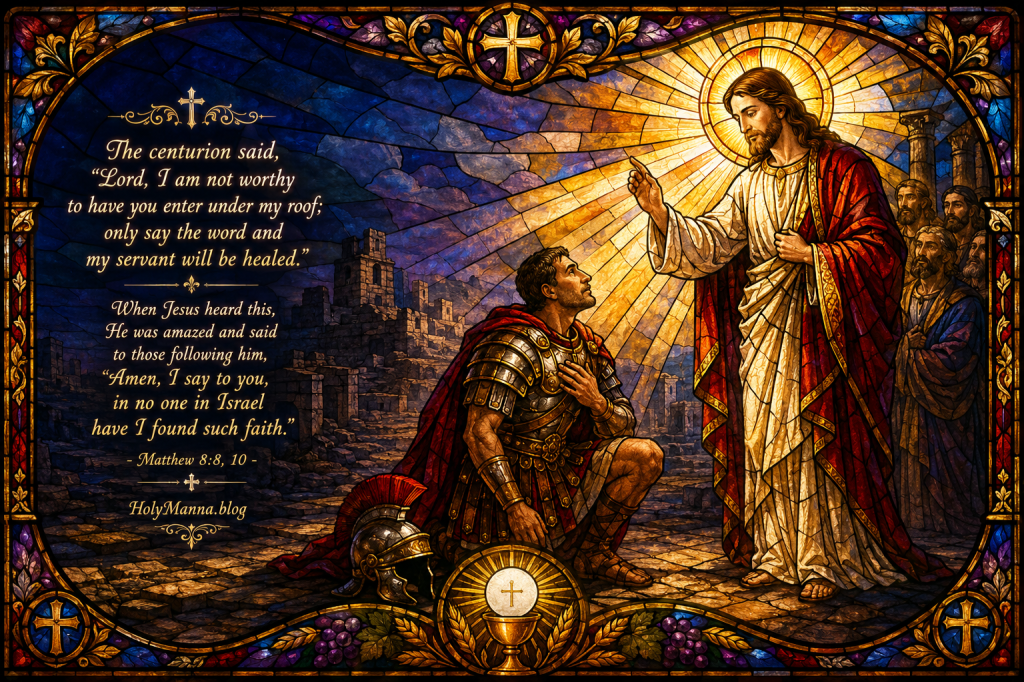
5 When he entered Capernaum, a centurion approached him and appealed to him, 6 saying, “Lord, my servant is lying at home paralyzed, suffering dreadfully.” 7 He said to him, “I will come and cure him.” 8 The centurion said in reply, “Lord, I am not worthy to have you enter under my roof; only say the word and my servant will be healed. 9 For I too am a person subject to authority, with soldiers subject to me. And I say to one, ‘Go,’ and he goes; and to another, ‘Come here,’ and he comes; and to my slave, ‘Do this,’ and he does it.” 10 When Jesus heard this, he was amazed and said to those following him, “Amen, I say to you, in no one in Israel have I found such faith. 11 I say to you, many will come from the east and the west, and will recline with Abraham, Isaac, and Jacob at the banquet in the kingdom of heaven, 12 but the children of the kingdom will be driven out into the outer darkness, where there will be wailing and grinding of teeth.” 13 And Jesus said to the centurion, “You may go; as you have believed, let it be done for you.” And at that very hour [his] servant was healed.
The Cure of Peter’s Mother-in-Law. 14 Jesus entered the house of Peter, and saw his mother-in-law lying in bed with a fever. 15 He touched her hand, the fever left her, and she rose and waited on him.
Other Healings. 16 When it was evening, they brought him many who were possessed by demons, and he drove out the spirits by a word and cured all the sick, 17 to fulfill what had been said by Isaiah the prophet:
“He took away our infirmities
and bore our diseases.”
Detailed Exegesis
Verses 5-6: “When he entered Capernaum, a centurion approached him and appealed to him, saying, ‘Lord, my servant is lying at home paralyzed, suffering dreadfully.’”
A Roman centurion commanded roughly eighty to one hundred soldiers and represented the occupying power that governed Israel by force. His approach to a Jewish rabbi was culturally unexpected, and his address of Jesus as “Lord,” the Greek Kyrios, carries enormous theological weight in Matthew’s Gospel, as it is the same title used in the Septuagint to translate the divine name of God. This soldier arrives not with demands but with vulnerability, stating the problem plainly and without conditions. His prayer is a model of honest petition: a real need, brought to the right person, with nothing performed or embellished.
Verse 7: “He said to him, ‘I will come and cure him.’”
Jesus does not deliberate. He does not ask for background information or a demonstration of worthiness. He simply responds with an unconditional offer. The willingness of Christ to come, to move toward the suffering, reflects the whole logic of the Incarnation itself.
Verses 8-9: “The centurion said in reply, ‘Lord, I am not worthy to have you enter under my roof; only say the word and my servant will be healed. For I too am a person subject to authority, with soldiers subject to me. And I say to one, Go, and he goes; and to another, Come here, and he comes; and to my slave, Do this, and he does it.’”
This is the theological epicenter of the entire pericope. The centurion declines the offer of Christ’s physical presence not from indifference but from a recognition that physical proximity is unnecessary when the authority of the speaker is absolute. He has learned from his own military experience that genuine authority acts on reality through the spoken word alone, without requiring presence or procedure. What he grasps intuitively about Jesus is a truth the Church would spend centuries articulating in councils and creeds. These words were so theologically precise that the Roman Rite incorporated them permanently into the Mass. Every Catholic speaks a version of this prayer before receiving Holy Communion: “Lord, I am not worthy that you should enter under my roof, but only say the word and my soul shall be healed.” CCC 1386 states directly that “before so great a sacrament, the faithful can only echo humbly and with ardent faith the words of the Centurion.”
Verses 10-12: “When Jesus heard this, he was amazed and said to those following him, ‘Amen, I say to you, in no one in Israel have I found such faith. I say to you, many will come from the east and the west, and will recline with Abraham, Isaac, and Jacob at the banquet in the kingdom of heaven, but the children of the kingdom will be driven out into the outer darkness, where there will be wailing and grinding of teeth.’”
Jesus is amazed. The Greek word used here, ethaumasen, describes genuine astonishment, not a teaching technique. A Gentile soldier has understood something about Christ’s authority that the people who walked with Jesus daily had not grasped. The declaration that follows is both promise and warning. The messianic banquet image comes directly from Isaiah 25:6-8, the great eschatological feast God will prepare for all nations, which the Eucharist anticipates at every Mass (CCC 1402-1405). The warning about the “children of the kingdom” is not ethnic condemnation; it is a solemn alert against spiritual presumption, the assumption that heritage or religious identity alone secures salvation without living faith.
Verse 13: “And Jesus said to the centurion, ‘You may go; as you have believed, let it be done for you.’ And at that very hour his servant was healed.”
The healing is instantaneous and complete, accomplished entirely by the spoken word of Christ across physical distance. The centurion asked for one thing and received it exactly as he trusted it would come, through the authority of the Word.
Verses 14-15: “Jesus entered the house of Peter, and saw his mother-in-law lying in bed with a fever. He touched her hand, the fever left her, and she rose and waited on him.”
Where the centurion’s servant was healed by word alone, Peter’s mother-in-law is healed by touch, the two fundamental modes of Christ’s healing ministry and the same two modes the Church employs in the sacraments: spoken word and physical gesture. Her immediate response is equally significant. The Greek word for “waited on” is diakonein, the root of deacon and diaconate. She receives grace and immediately serves. This is the template of discipleship and the template of the Mass: receive the Eucharist, then go and serve.
Verses 16-17: “When it was evening, they brought him many who were possessed by demons, and he drove out the spirits by a word and cured all the sick, to fulfill what had been said by Isaiah the prophet: ‘He took away our infirmities and bore our diseases.’”
Matthew quotes Isaiah 53:4, the fourth Suffering Servant Song, and applies it not to Calvary but to the healing ministry in Galilee. This is theologically audacious and deeply important. The healings are not pre-Cross acts of compassion separable from the Redemption; they are the Redemption in its early register. Christ was already bearing human infirmity in the villages of Galilee, just as He would bear the fullness of human sin on Good Friday.
Teachings
St. John Chrysostom, in his Homilies on Matthew (Homily 26), identified three characteristics of the centurion’s faith that distinguish it from lesser forms of religious engagement. He came directly to Christ without waiting for permission. He acknowledged his unworthiness without theater or performance. And he understood that the word of Christ, not the physical proximity of Christ, is the instrument of healing. Chrysostom observed pointedly that the centurion did not ask Jesus to pray to the Father on his servant’s behalf; he asked Jesus to act, because he recognized that Christ’s authority was not delegated but inherent and divine.
St. Hilary of Poitiers, in his Commentary on Matthew, read the centurion typologically as representing the Gentile nations who would come to faith before much of historical Israel, with the servant healed from a distance representing all peoples who would receive the healing of the Gospel without direct proximity to the historical Jesus.
CCC 1503 provides the theological framework for the healing ministry as a whole: “Christ’s compassion toward the sick and his many healings of every kind of infirmity are a resplendent sign that ‘God has visited his people’ and that the Kingdom of God is close at hand.” The Catechism adds in CCC 1505 that Christ “did not heal all the sick” during His earthly ministry because His healings were signs of the Kingdom’s arrival, not its completion. The full abolition of suffering awaits the resurrection of the body.
Reflection
The centurion’s prayer is not a historical artifact. It is spoken at every single Mass by every Catholic preparing to receive the Eucharist, which means that on June 27, every person at that Saturday morning liturgy will read this Gospel and then, within minutes, will speak these exact words. Is that prayer said out of habit, or out of the same living faith that stopped Jesus in His tracks on the road to Capernaum? The centurion understood that one word from Christ was sufficient to heal everything. He did not need a sign, a confirmation, or a second opinion. He asked and he trusted. What would it look like to bring that same quality of faith to the altar this Saturday, to approach the Eucharist not as a routine but as the healing encounter it actually is? The Word that healed a paralyzed servant two thousand years ago is the same Word present in the Blessed Sacrament today, and He is still saying exactly what He said then: as you have believed, let it be done for you.
Pour It Out, Then Listen for the Word
There is a thread running through everything the Church has placed before us today, and it is this: the God who permits devastation is the same God who heals through a single spoken word, and the only thing standing between those two realities is the willingness to pray honestly.
Lamentations opened in the ruins of a city that had been warned, had been loved, and had repeatedly looked away. The prophet sat in the ash and did not write a theology paper. He wrote a lament, raw and embodied, pouring out grief that had nowhere else to go. And then, after all the description of destruction and the devastating indictment of false prophets who said what people wanted to hear instead of what they needed to hear, the text issued a single pastoral command: cry out to the Lord from your heart. Pour it out like water. Do not manage the presentation. Bring the real thing.
Psalm 74 took that command and modeled it in real time. A community standing in the ruins of the Temple, looking at everything their enemies had burned and smashed and profaned, turned toward God and asked the question that genuine faith always permits: “Why, God, have you cast us off forever?” They did not go silent. They did not perform composure they did not feel. They appealed to the covenant, to the God who had claimed them before any Temple existed, and they held on. The psalm does not end in triumph. It ends in petition, which is exactly the right place to end when the healing has not arrived yet.
And then Matthew 8 arrived with the healing. A Roman soldier walked up to Jesus and demonstrated, in a few simple sentences, what Lamentations had been commanding and what Psalm 74 had been practicing. He came with a real need. He acknowledged his unworthiness without theater. He trusted that the word of Christ was sufficient to accomplish what no human effort could touch, and Jesus stopped in His tracks and called it the greatest faith He had encountered in all of Israel. The servant was healed at that very hour. The word was spoken, and reality obeyed.
The question Lamentations left hanging, “who could heal you?” received its answer in Capernaum. And that answer is still available at every Mass, at every altar, in every tabernacle in every Catholic church in the world. The same Word that healed across distance in Galilee is present in the Blessed Sacrament, and every Catholic who approaches for Communion speaks the centurion’s prayer as their own.
So here is the invitation for this Saturday: bring the real version of the prayer. Not the composed draft, not the spiritually presentable version, but the honest one, the poured-out-like-water one, the one that might sound more like wailing than worship. What is the thing that feels too broken, too heavy, or too far gone to bring to God today? That is precisely the thing He is waiting to hear, because the Word that heals everything is still speaking, and He has not changed His answer.
Engage With Us!
Today’s readings have a way of reaching into the places people usually keep hidden, the grief that has not been named, the prayer that has not been spoken, the faith that is still finding its footing. The invitation is to sit with that for a moment and then share it. Drop a reflection in the comments below, because this community grows stronger when people are honest with each other about where they actually are on the journey.
- Lamentations 2:2, 10-14, 18-19 asks us to pray from the heart rather than from a script. Where in your life right now is God inviting you to stop managing the presentation and simply pour out what is actually there, even if it comes out more like a cry than a prayer?
- Psalm 74:1-7, 19-21 models the courage of bringing honest questions directly to God without pretending to have it all together. Is there a “why” that has been sitting quietly in the back of your heart, something you have been afraid or embarrassed to bring before God? What would it look like to finally speak it out loud to Him?
- Matthew 8:5-17 shows us a man whose faith amazed Jesus Himself, not because it was perfect or elaborate, but because it was direct, humble, and completely trusting in the word of Christ. The next time you say the centurion’s prayer before receiving Communion, what would it mean to say it the way he meant it, as a genuine act of trust rather than a familiar line?
- All three readings point toward the same truth: honest prayer reaches a God whose word heals everything. What is the one thing you have been holding back from God that these readings are nudging you to finally bring to Him today?
The faith is not meant to be carried alone or kept tidy. It is meant to be lived out loud, with honesty, with community, and above all with the confidence that the Word who healed at Capernaum is still speaking today. Go live it with everything you have got.
Sacred Heart of Jesus, we trust in You!
Immaculate Heart of Mary, pray for us!
Saint Michael the Archangel, defend us in battle!
Follow us on YouTube, TikTok, Instagram and Facebook for more insights and reflections on living a faith-filled life.


Leave a comment