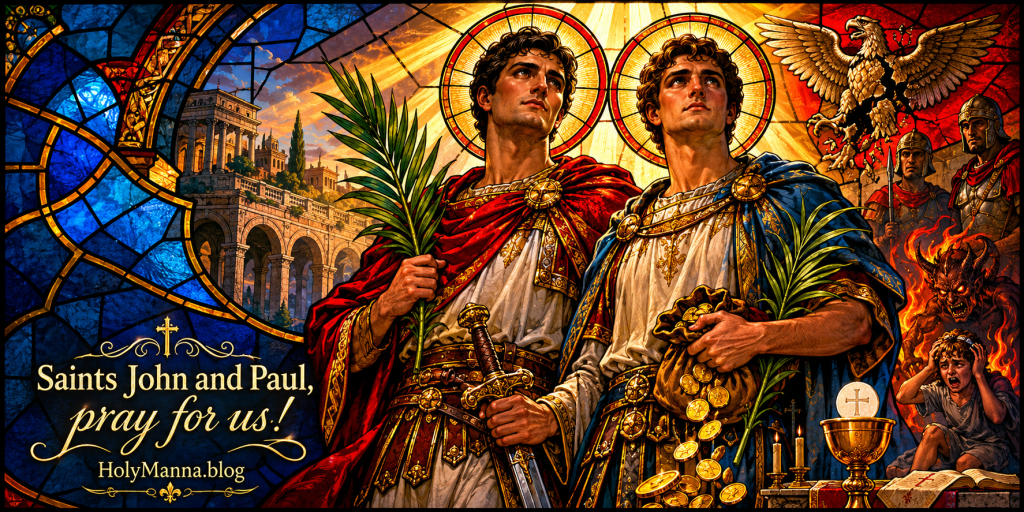
Two Brothers Who Chose Christ Over Caesar
Before anything else, a clarification that matters a great deal: Saints John and Paul are not the Apostle John and the Apostle Paul. They are not the beloved disciple or the great missionary to the Gentiles. They are two Roman brothers, laymen, fourth-century men of the imperial court, who made a quiet and total decision to choose Christ over the most powerful empire the world had ever known. Their names are not famous the way the Apostles’ names are famous. Most Catholics have never heard a homily about them. But here is the remarkable thing: every Catholic who has ever attended a Mass in the Roman Rite has heard their names. Every single time the Roman Canon, also called the First Eucharistic Prayer, is prayed at the altar, the priest says aloud, “…Chrysogonus, John and Paul, Cosmas and Damian, and all your Saints by whose merits and prayers grant that we may in all things be fortified by the aid of your protection.” For over fifteen hundred years, in every corner of the world where the Roman Rite has been celebrated, these two brothers have been remembered. They are among the most consistently venerated martyrs in the history of the Church, and yet most people today could not tell you a single thing about them.
That is exactly the kind of story worth telling.
Men of the Palace — A Life Built on Imperial Privilege
The historical record on John and Paul is honest about its limits. Butler’s Lives of the Saints states plainly that “apart from their names and the fact that they are Christian martyrs there is little that is certain about these two saints.” What the Church does know, and what has never been seriously disputed, is that they were Roman brothers martyred on the Caelian Hill in Rome around 362 AD, venerated almost immediately after their deaths, and enshrined in the oldest Eucharistic Prayer of the Church within a century of dying. That alone is a stunning legacy.
The traditional account of their lives comes primarily from their ancient Acta — the Acts of Saints John and Paul — and from The Golden Legend (Legenda Aurea), the great 13th-century compendium of saints’ lives compiled by Blessed Jacobus de Voragine around 1260. These sources contain legendary and narrative elements that historians note cannot always be independently verified, and this post will flag those elements clearly. But they represent the story the Church has passed down and prayed over for centuries, and they carry a depth of spiritual truth regardless of every biographical detail.
According to the traditional account, John and Paul were brothers who rose to prominence as high officials in the court of the Emperor Constantine the Great. Some accounts describe them as army officers; others as court dignitaries. What is consistent across the sources is that Constantine held them in high esteem and eventually entrusted them to the service of his daughter, Constantia. Constantia was a remarkable woman in her own right. She had made a vow of perpetual virginity after being miraculously healed through the intercession of Saint Agnes, and she lived that vow with great devotion. John and Paul served faithfully at her side.
It is important to sit with this for a moment. These were not monks or priests. They were men embedded in the machinery of the most powerful government on earth. They had access, influence, wealth, and comfort. And yet they were Christians. Quietly, faithfully, without fanfare, they were doing exactly what CCC 897 describes as the vocation of the laity: living the faith from the inside of the world, not apart from it.
The Pagan General and the Hand of God
Among the stories associated with John and Paul, the one involving a Roman general named Gallicanus is among the most compelling — and it is presented here as a legendary account drawn from the Acta and The Golden Legend, which, while revered in Catholic tradition, cannot be independently verified as historical fact.
The legend goes like this. The Roman Empire was under threat from the Scythians, who were pouring into Dacia and Thrace. Emperor Constantine needed his best general to lead the campaign. That general was Gallicanus, a pagan, and a man with a condition attached to his military service: he wanted Constantia as his wife. Constantine was in a bind. He knew his daughter had consecrated herself to God, but the political pressure to give Gallicanus what he wanted was immense.
Constantia proposed a solution. She arranged for John and Paul to go with Gallicanus into battle as his companions. And before the fighting began, Gallicanus, staring down an enemy he was not sure he could defeat, made a private vow: if God gave him victory, he would believe in Christ and be baptized.
The battle turned. The Scythians were driven back. Gallicanus returned to Rome a different man. He found Constantia herself had been healed at the tomb of Saint Agnes during his absence, and that his own three daughters had already consecrated their virginity alongside Constantia. He kept every word of his vow. He was baptized, renounced his claim on Constantia’s hand, gave away his wealth, and eventually became a pilgrim and martyr for the faith, later venerated as a saint himself.
John and Paul were at the center of that story. They went to war with a pagan general and came back with a Christian convert. That is what lay holiness looks like when it is lived without compromise.
The Inheritance They Gave Away
When Constantia died, she bequeathed a significant portion of her wealth to John and Paul. What they did with it says everything about who they were. The Golden Legend records that “they had received a vast inheritance from Constance and were very wealthy. John and Paul became famous in Rome as they used this fortune for the relief of the poor.”
Think about what that meant in fourth-century Rome. These were men with real money, real connections, and every reason to build themselves a comfortable life. Instead, they turned their home into a place of generosity, distributing their fortune to those who had nothing. Their wealth became a tool for the Kingdom of God rather than a cushion for their own comfort. It is no exaggeration to say that before they ever faced a sword, John and Paul had already been giving their lives away.
An Empire Demands Apostasy
In 361 AD, the Emperor Julian came to power. Julian had been raised nominally Christian but secretly embraced the ancient pagan religion of Rome. When he became Emperor, he went public with his paganism and set about systematically dismantling the privileges and presence of Christianity throughout the empire. History calls him Julian the Apostate. He called Christians “the Galileans,” which was intended as a sneer. He did not throw people to the lions, but he was methodical and relentless. He expelled Christian teachers, removed Church privileges, and pressured Christian officials to renounce their faith and offer sacrifice to the Roman gods.
Julian had his eye on John and Paul for two reasons. First, they were prominent Christians who had served under Constantine, and their continued visibility was an affront to his agenda. Second, he coveted the inheritance they had received from Constantia, which they were using to feed and clothe the Christian poor — wealth he wanted redirected into the imperial treasury.
Julian summoned them to his court. He ordered them to serve him as they had served Constantine, and to participate in the sacrifice to the Roman gods. It was a command with flattery attached — the emperor was offering them a place of honor at the highest table in the world. All they had to do was deny the faith.
They said no.
According to the tradition preserved in The Golden Legend, John and Paul told Julian directly: “When the glorious Constantine and Constant his son glorified them to be Christian, we would well serve them, but since thou hast forsaken thy religion full of virtues, we be departed from thee, and we will no more serve thee.” It is worth noting that this is a legendary account from the Acta tradition and cannot be verified word-for-word as a historical transcript. But the substance of it, the refusal itself, is what history holds firm.
Julian gave them ten days to reconsider.
Ten Days to Die Well
Most people, given ten days between a death sentence and its execution, would spend that time in desperate bargaining, regret, or terror. John and Paul spent those ten days celebrating Mass with a priest of the Roman community, meeting with their friends, and distributing every last possession they had to the poor. They did not spend those days trying to save their lives. They spent them making sure they arrived before God with nothing left to give.
CCC 2473 teaches that “martyrdom is the supreme witness given to the truth of the faith: it means bearing witness even unto death.” John and Paul understood this. Their deaths were not a tragedy that happened to them. They were a decision they made.
On June 26, around 362 AD, the Emperor Julian sent his officer, a man named Terentianus, to the brothers’ home on the Caelian Hill. To avoid creating public martyrs and sparking a Christian uprising, the execution was carried out in secret. John and Paul were beheaded inside their own house and buried on the spot. Terentianus then spread the rumor that they had fled the city. Three other Christians who had been ministering to them — Crispus, Crispinianus, and Benedicta — were also executed and buried nearby. The world was supposed to forget them.
It did not.
The Executioner Who Could Not Escape God
What happened after the execution of John and Paul is one of the most startling stories in the early Church’s memory of them — and it comes from the Acta tradition. While it cannot be independently verified as a historical event, it has been passed down in Catholic devotion for centuries and preserved in visual form on the very walls of the basilica built over their tomb.
According to the tradition: after Terentianus killed John and Paul and buried them beneath the house, a demon entered his son. The boy was tormented, crying out that he was being burned by the devil, right there in that house where innocent blood had been shed. Terentianus watched it happen. He saw what his sin had brought into his own home. And he broke.
The Golden Legend records it this way: “An evil demon entered into the son of Terentianus and he began to cry in that house that he was burnt of the devil. When Terentianus saw this, he acknowledged his sin, became a Christian, and put in writing the passion of these two holy saints. His son was delivered of the devil.”
The man who killed John and Paul became a Christian because of what happened after he killed them. His son was healed. And then Terentianus sat down and wrote out the account of their martyrdom, becoming one of the primary witnesses to the very story he had tried to bury. The Church preserved his account. If this legend holds even a grain of truth, it is one of the most extraordinary reversals in the history of Christian witness. Romans 8:28 says “all things work for good for those who love God.” This story reads like a footnote to that verse.
When God Answered in His Own Time
Julian the Apostate did not live long. One year after ordering the secret execution of John and Paul, he was killed in battle against the Neo-Persian empire. The date of his death? June 26. The feast day of John and Paul, exactly one year to the day after their martyrdom.
Tradition holds that as Julian lay dying from a spear wound, he murmured the words: “Thou hast conquered, O pale Galilean!” It is worth noting that historians debate whether Julian actually said these precise words, as they are not attested in contemporary sources. But the sentiment the Church attached to his death carries a truth that transcends the exact phrasing: the man who called Christians “Galileans” as an insult died acknowledging, at least in the telling of Christian memory, that the Galilean had won.
Julian was succeeded by Jovianus, who embraced the Catholic faith. The age of Julian was over. The age of the martyrs he had tried to silence had only just begun.
A House Becomes a Shrine, a Shrine Becomes a Basilica
After Julian’s death, the new emperor Jovianus permitted a basilica to be constructed over the site of the martyrdom. A Roman senator named Byzantius and his son Saint Pammachius — a man well known in Rome for his piety and his friendship with Saint Jerome — formally transformed the house on the Caelian Hill into a Christian church. Pammachius deposited the relics of John and Paul there, and the site quickly became a place of pilgrimage.
The church, known as the Basilica of Santi Giovanni e Paolo, was sacked during Alaric’s invasion of Rome in 410, damaged again by an earthquake in 442, restored by Pope Paschal I in 824, sacked again by the Normans in 1084, and restored once more. It has survived nearly everything history has thrown at it.
In the 19th century, the Passionist Fathers who have cared for the basilica since 1773 rediscovered the ancient ground-floor rooms of the original house beneath the church. Those rooms are decorated with significant early Christian frescoes, and the original confessio, the tomb of the martyrs, is covered with paintings depicting John and Paul. Catholic scholars have described these underground rooms as “one of the most important early Christian memorials in Rome.” The altar of the basilica is built over the bath chamber that holds the remains of the two brothers. In the apse, a stunning fresco of Christ in Glory painted in 1588 by Cristoforo Roncalli presides over the space, and below it hang three 18th-century paintings: the Martyrdom of Saint John, the Martyrdom of Saint Paul, and notably, The Conversion of Terentianus — keeping the miracle story alive in stone and pigment for every visitor who enters.
The basilica became the Lenten stational church for the Friday after Ash Wednesday, meaning the Pope himself would celebrate Mass there each year, giving this site annual prominence in the life of Rome and the whole Church.
The connection to papal history runs even deeper. The basilica carries a Cardinal Title of great prestige. Among the men who have held that title are three who became Pope: Pope Honorius III in the 12th century, Pope Adrian VI in the 16th century, and Pope Pius XII, Eugenio Pacelli, who was elevated to the title in 1929 before becoming one of the most significant pontiffs of the 20th century. Since Cardinal Francis Spellman received the red hat in 1946, the Archbishop of New York has traditionally held the title. The Passionist founder, Saint Paul of the Cross, is buried in the basilica, adding yet another layer of sanctity to the ground where John and Paul rest.
Venice Calls Them Her Own
Across northern Italy, the Basilica di San Zanipolo in Venice is also dedicated to Saints John and Paul. “Zanipolo” is the Venetian dialect’s contraction of Giovanni e Paolo, which is Italian for John and Paul. It is one of the largest Gothic churches in all of Italy, a breathtaking landmark that rises over the Campo San Zanipolo in Venice’s Castello neighborhood. For centuries, it was the burial church of the Doges of Venice. That two fourth-century martyrs from the Caelian Hill ended up as patron saints of one of the most magnificent Gothic churches on earth is the kind of thing only God’s Providence could arrange.
A small village near Caiazzo in the Campania region of Italy is also named Ss. Giovanni e Paolo in their honor, a quiet testament to how deeply their memory rooted itself in the Italian landscape.
In England, the 1222 Council of Oxford formally ordered that the feast of Saints John and Paul be kept as a day of obligation, with the faithful attending Mass before going to work. Medieval England took these Roman brothers seriously enough to place their feast among the days that required a visit to the altar.
And then there is one more connection, stranger than any of the others. The oldest surviving written account of the legend of the Pied Piper of Hamelin dates the famous disappearance of the children to “the day of Saints John and Paul on the 26th of June” in the year 1284. The Lüneburg manuscript of around 1440 to 1450 states it plainly, and an inscription on the Rattenfängerhaus, the so-called Pied Piper’s House in Hamelin, repeats the dating. Whether the Pied Piper legend has historical roots or is purely a story, one of the most famous folk tales in all of European culture is permanently anchored to the feast day of two Roman martyrs. June 26 carries more weight than most people realize.
They Were Never Separated
The Church’s own Liturgy of the Hours once drew on Revelation 11:4 to describe John and Paul, calling them the two olive trees and the two lampstands that stand in the presence of the Lord. And the Magnificat antiphon for Vespers on their feast day proclaims: “These just men have stood before the Lord and have not been separated from one another.”
That is the sentence that defines them. They lived together, served together, gave their wealth away together, prayed together in those final ten days, and died in the same house on the same day. The Church looked at their story and said: these two were never separated. Not by fear, not by flattery, not by the sword, and not even by death.
CCC 2474 reminds the faithful that “the Church has painstakingly collected the records of those who persevered to the end in witnessing to their faith.” John and Paul are in that collection. They are in the Roman Canon. They are in the Mass. They have been there for fifteen hundred years, and they will be there at every Mass offered until the end of time.
What John and Paul have to say to this generation is not complicated. They were laypeople. They were not bishops or priests or monks. They were men in the middle of the world, doing ordinary work, navigating a culture that was hostile to their faith. CCC 898 teaches that “the laity are called to make the Church present and operative in those places and circumstances where only through them can it become the salt of the earth.” John and Paul were the salt of the earth in the imperial court of Rome. They seasoned that world with their witness, and when the world demanded they dissolve into it entirely, they refused.
There is an emperor alive in every generation who asks the same thing Julian asked. He goes by different names and uses different tools, but the demand is always the same: abandon your faith, take what the world is offering, and stop making people uncomfortable with your Christianity. John and Paul already answered that demand. They answered it in ten days of prayer and almsgiving, and then with their lives.
How does their example challenge the small, daily ways we compromise our faith to avoid conflict, keep the peace, or protect our own comfort? And what would it look like to live with the kind of generosity John and Paul showed in those final ten days, giving away everything before they faced death?
The answer to those questions is not theoretical. It starts at Mass, where the priest prays their names, and where the entire life and death of Jesus Christ is made present on the altar. John and Paul were always most at home there. In a sense, they never left.
Engage With Us!
There is something about the story of John and Paul that feels both ancient and uncomfortably current, and we would love to hear how it is landing for you. Share your thoughts, reactions, and reflections in the comments below. This community grows when we think out loud together, so do not be shy.
- John and Paul refused the Emperor’s offer of honor, wealth, and safety in exchange for apostasy. In what areas of your own life does the world offer you something comfortable in exchange for quietly setting your faith aside?
- The brothers spent their final ten days giving away everything they owned and praying with their community. If you knew you had ten days left, what would you do with them, and what does your answer reveal about what you actually value most?
- CCC 897 describes the laity as being called to sanctify the world from within. How does the example of John and Paul, as laypeople in the imperial court, challenge or inspire the way you think about living your faith in your workplace, your neighborhood, or your family?
- Terentianus, the man who killed John and Paul, ended up converting to Christianity and writing down their story. Is there someone in your life whose opposition to the faith might one day become part of your testimony? How does that possibility change the way you pray for them?
- Their names have been spoken at every Roman Canon for over fifteen hundred years. The next time you hear Eucharistic Prayer I at Mass, what will you be thinking about?
The lives of the saints are not museum pieces. They are road maps. John and Paul walked a road that looked impossible from the outside and walked it anyway, arm in arm, all the way to the end. That road is still open. Go live your faith with everything you have, love the people in front of you with the generosity of men who gave away an entire inheritance, and trust that the God who conquered in the first century will conquer in this one too.
Saints John and Paul, pray for us!
Follow us on YouTube, TikTok, Instagram and Facebook for more insights and reflections on living a faith-filled life.


Leave a comment