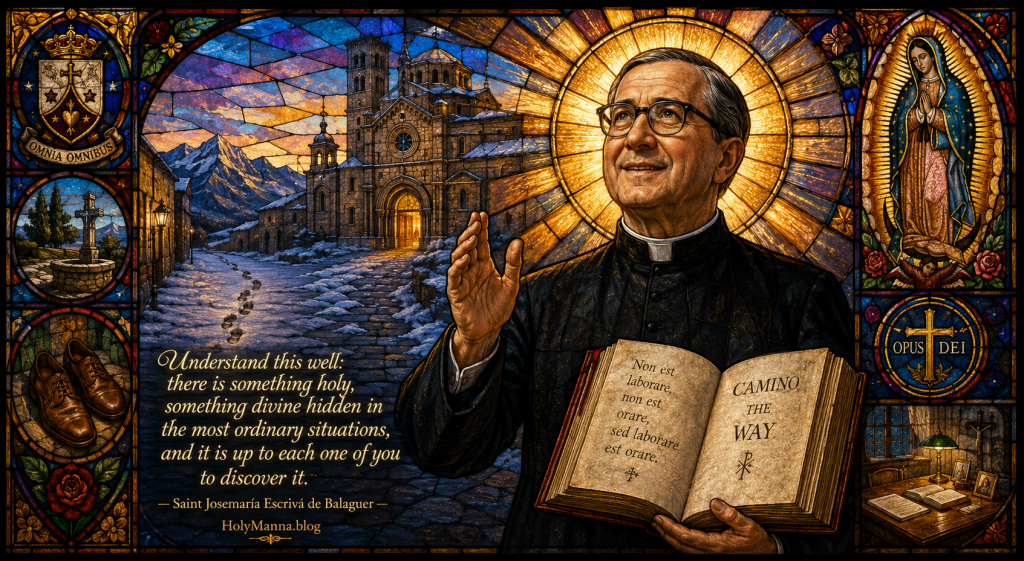
The Saint Who Found God in the Ordinary
Here is a question worth sitting with for a moment. Have you ever looked at your day and wondered if any of it matters to God? The alarm, the commute, the inbox, the dishes, the deadlines, the fatigue — all of it piling up, day after day, while somewhere in the back of your mind a quiet voice wonders whether a truly holy life is reserved for monks, nuns, and people who have more time than you do.
If that sounds familiar, then Saint Josemaría Escrivá de Balaguer was sent, in no small part, for you.
Born in Spain in 1902 and canonized by Pope Saint John Paul II in 2002, Saint Josemaría was a Spanish Catholic priest who founded Opus Dei, an organization of laypeople and priests dedicated to the principle that ordinary daily life is the very ground on which holiness is won or lost. He is the patron saint of Opus Dei and, through popular devotion connected to his own personal suffering with the disease, of people with diabetes. He is remembered by the Church as “The Saint of the Ordinary,” a title given to him by Pope Saint John Paul II himself, and it is one of the most perfectly chosen titles in all of modern Catholic history. His feast day is celebrated every year on June 26.
His message was simple, radical, and utterly transforming: every baptized person, in every walk of life, is called to full holiness. Not someday. Not after a major life change. Right here, right now, exactly where they are. He preached this truth for nearly fifty years, and the world is still catching up with him.
The Making of a Saint
Josemaría Escrivá de Balaguer y Albás came into the world on January 9, 1902, in Barbastro, a small town nestled in the Aragonese highlands of northeastern Spain. He was the second of six children born to José Escrivá and María Dolores Albás, a couple whose Catholic faith was not decorative but daily, lived out through frequent Confession, Holy Communion, the Rosary, and a genuine commitment to helping those in need. From his earliest years, faith was simply the air the family breathed.
God wasted no time testing the boy’s soul. Between 1910 and 1913, three of his younger sisters died in rapid succession. Then in 1914, the family’s financial world collapsed when his father’s textile business failed completely. The Escrivás were left with very little. In 1915, José Escrivá found work in Logroño, a larger city nearby, and the whole family relocated. Young Josemaría absorbed each of these blows not with bitterness, but with a quiet deepening of spirit.
He was, by all accounts, a joyful and bright young man — sharp in his studies, warm with people, and carrying within him a certain fire that those around him could sense without quite naming. And here is something surprising about his early ambitions: he had absolutely no plans to become a priest. What he dreamed of was becoming an architect.
That dream met its end on a cold winter day in Logroño, and it met it in the most un-dramatic way imaginable. Walking through the snow, young Josemaría spotted the barefoot footprints of a Discalced Carmelite friar pressed into the frozen ground. He stopped. He stared at those prints. And something moved inside him that he could not fully articulate but could not ignore. He later described the moment simply: “I began to have an inkling of what Love is, to realise that my heart was yearning for something great, for love.” If a barefoot friar could sacrifice that much for God and neighbor, what might God be asking of him?
He did not yet know what the answer was. But he decided that becoming a priest was the surest way to keep himself available to find out. He began seminary studies in Logroño and later at the Seminary of Zaragoza, while simultaneously pursuing a degree in civil law on his father’s advice. His father died suddenly and unexpectedly on November 27, 1924, leaving Josemaría, not yet ordained, as the sole support of his mother, sister, and younger brother.
On March 28, 1925, Josemaría Escrivá was ordained a priest in the church of the Seminary of Saint Charles in Zaragoza. Two days later, he celebrated his first Solemn Mass in the magnificent Holy Chapel of the Basilica of Our Lady of Pilar. He was twenty-three years old, head of a family in need, newly ordained, and still carrying in his heart a vocation he could feel but not yet name.
Around 1935, he did something quietly personal and quietly symbolic: he merged his two given names, “José María,” into the single name “Josemaría.” He explained that his love for Saint Joseph and for the Virgin Mary had become so inseparably intertwined that he wanted even his own name to reflect that unity. It is a small detail, but it is very much a saint’s detail.
A Vision in the Retreat House
In April 1927, with his Archbishop’s blessing, Father Josemaría moved to Madrid to pursue his doctorate in civil law at the Central University, the only institution in Spain that offered the degree. He brought his mother, his sister Carmen, and his younger brother Santiago with him. To support them all, he tutored law students. And to sanctify the long hours of his days, he threw himself headlong into pastoral work across Madrid’s poorest neighborhoods.
He ministered in the city’s slums. He visited hospitals and cared for the sick in the outer suburbs where few others went. He worked with children living in desperate poverty, with artists and manual laborers, with university students who quickly gathered around this young priest whose energy and spiritual intensity were simply impossible to ignore. He organized some of those students to accompany him in this service to the poor, so that they too might understand in their bones what Christian charity actually means.
All of this was preparation for something he did not yet fully understand. The moment of clarity came on October 2, 1928 — the Feast of the Guardian Angels.
Father Josemaría was on spiritual retreat at a house in Madrid. He had with him notes documenting interior movements that he had been sensing and discerning for some time. While prayerfully reviewing those notes, something happened that he would spend the rest of his life describing with a single word: he “saw.” He himself always used that word and no other. In a sudden and luminous interior illumination, God showed him the full shape of his mission: to open a new path within the Catholic Church by which men and women of every state in life, every profession, every background could seek and attain genuine holiness through the ordinary circumstances of their daily lives, especially through their work.
That was the day Opus Dei was born. The name means, simply, “The Work of God.”
He would later describe it in these terms: “God is calling you to serve Him in and from the ordinary, material, and secular activities of human life.”
A few months later, on February 14, 1930, God deepened the vision: Opus Dei must include women as fully as it included men. He moved immediately to make it so.
What made this message so revolutionary was the context in which it arrived. In 1928, the prevailing understanding — both cultural and ecclesiastical — was that true holiness was the province of those who withdrew from the world: priests, monks, nuns, and consecrated religious. The layperson going to work, raising a family, paying bills, and navigating an ordinary life was expected, at best, to avoid serious sin and to follow the Church’s minimum requirements. The idea that this same ordinary person was called to the same fullness of holiness as a Carmelite mystic or a Benedictine abbot was, to put it plainly, not the common assumption of the age.
Josemaría Escrivá was shown otherwise. And he spent the rest of his life repeating it until the whole Church heard him. “Holiness is for everyone, everyone, everyone,” he would say. And he meant it without exception.
War, Hiding, and a Crossing Through the Mountains
Before Opus Dei could spread across the world, it nearly died in the streets of Madrid.
When the Spanish Civil War erupted in July 1936, Father Josemaría was in the capital. The Republican faction that controlled Madrid was violently anti-Catholic. The persecution was not a metaphor; it was systematic and lethal. It is estimated that in Madrid alone, approximately 35 percent of the clergy were killed. Priests did not simply face hostility; they faced execution. Soldiers roamed the streets hunting for them.
Father Josemaría went underground immediately. He dressed in civilian clothes. He wore his father’s wedding ring to appear as a layman. He moved from one safe house to another, never staying long enough to become predictable. At one point, a friend who was a doctor arranged for him to take refuge in a psychiatric clinic that the friend managed in the Ciudad Lineal neighborhood of Madrid. Father Josemaría pretended to be a patient, feigning mental illness whenever soldiers or informants came near. He kept up the act as long as necessary.
On August 30, 1936, he was hiding with two young companions in the apartment of some friends when a unit of armed soldiers arrived to search the building. The elderly maid who answered the door announced loudly enough for the whole house to hear: “Oh! You must be here for the search and requisition… The owner isn’t here, but make yourselves at home!” The three men scrambled up to a narrow attic, crouched behind old furniture, airless and sweltering in the summer heat. They listened as the soldiers moved through the building, room by room. When the soldiers reached the room right next to their hiding place, Father Josemaría whispered to his two companions: “We’re in a tight spot. If you wish, make an act of contrition while I give the absolution.” He absolved them both. One of the young men then asked, “Father, and if they kill us, what will happen?” Father Josemaría’s reply was so calm, so certain, so thoroughly anchored in eternity that one of the young men literally fell asleep in the middle of the crisis. The soldiers searched the adjacent room and moved on. The three were not discovered.
Throughout this period, Father Josemaría continued to exercise his priestly ministry in secret. He celebrated Mass in private homes. He heard Confessions. He anointed the dying, sometimes disguised as a doctor in order to approach the bedsides of those who needed him. He visited communities of religious sisters who had been forced into hiding in private residences, bringing them the sacraments they could no longer receive publicly.
When it became clear that there was no safe future for him in Republican Madrid, he organized an escape. In November 1937, Father Josemaría joined a group of companions and a band of experienced mountain guides, and they set out on foot to cross the Pyrenees Mountains into France, then back into the Nationalist zone of Spain. The journey was brutal: days of hiking through snow and rough alpine terrain, constantly avoiding government patrols, moving carefully through a landscape where being caught meant death. They crossed into the tiny country of Andorra on December 2, 1937, exhausted, nearly frozen, but alive. A severe snowstorm pinned them there for several days.
When the storm cleared and they were finally able to travel through France, Father Josemaría made one insistence before re-entering Spain: they would stop at Lourdes. Even in the immediate aftermath of one of the most harrowing experiences of his life, his first instinct was to go and give thanks to Our Lady. He knelt before the grotto. He prayed. When they crossed back into Spain at the border town of Hendaye, Father Josemaría dropped to his knees on Spanish soil and prayed the Salve Regina — the ancient Catholic prayer of thanksgiving to the Queen of Heaven.
He settled in Burgos in the Nationalist zone, where he spent more than a year continuing his priestly work, preaching retreats and spiritual exercises to priests and laypeople across the war front. When the Civil War finally ended in 1939, he returned to Madrid, completed his doctorate in law, and published the book that would make him known throughout the Catholic world: The Way.
The Writer, the Preacher, and the Teacher
The Way, published in 1939, is one of the most widely read Catholic spiritual books of the twentieth century. It is a collection of 999 short, pointed meditations drawn from Scripture, conversations, personal letters, and the lived experience of pastoral work. Each entry is brief — sometimes a single sentence — but each one lands with the precision of someone who has spent years in prayer and years with people. The book has sold over four million copies and has been translated into dozens of languages. In the preface, the author addresses the reader personally: “Read these counsels slowly. Pause to meditate on these thoughts. They are things that I whisper in your ear — confiding them — as a friend, as a brother, as a father. And they are being heard by God.”
The book is not dense theology. It is practical, urgent, and sometimes startlingly direct. A few samples give a sense of the man:
“Understand this well: there is something holy, something divine hidden in the most ordinary situations, and it is up to each one of you to discover it.”
“To begin is for everyone. To persevere is for saints.”
“Either we learn to find the Lord in ordinary, everyday life, or else we shall never find Him.”
“An hour of study, for the modern apostle, is an hour of prayer.”
“Don’t say, ‘That person bothers me.’ Think: ‘That person sanctifies me.’”
“When you approach the tabernacle remember that he has been waiting for you for twenty centuries.”
He later wrote two more books that together with The Way form a spiritual trilogy: Furrow and The Forge, both published after his death. He also authored Holy Rosary, Christ Is Passing By, Friends of God, The Way of the Cross, and other collected homilies and conversations. His writings have now reached millions of readers across more than forty languages and continue to be among the most widely read spiritual texts in the Catholic world.
In 1946, Father Josemaría moved permanently to Rome to be near the Holy See and to secure formal Vatican recognition for Opus Dei. Pope Pius XII initially approved it in 1947, and the definitive pontifical approval was granted in June 1950. Pope Pius XII also named him an honorary prelate — allowing him to use the title Monsignor — appointed him as a consultor to two Vatican Congregations, and admitted him as an honorary member of the Pontifical Academy of Theology. In 1955, he earned a doctorate in theology from the Pontifical Lateran University.
When the Second Vatican Council convened between 1962 and 1965, Monsignor Escrivá was a quiet but influential presence. Pope Francis has since identified him as a “precursor” to the Council’s renewal, particularly to the Council’s watershed teaching on the universal call to holiness, enshrined in the Dogmatic Constitution on the Church, Lumen Gentium. The fact that Escrivá had been preaching this exact doctrine since 1928 — thirty-six years before the Council formally articulated it — is not a small detail. It is, by any measure, a prophetic witness.
His closest collaborator, Blessed Álvaro del Portillo, served as an expert theologian during the Council itself, helping to shape precisely the documents that would vindicate what his spiritual father had been preaching for decades.
Between 1970 and 1975, Josemaría, now in his late sixties and seventies, undertook an extraordinary series of catechetical journeys across Europe and Latin America — to Mexico, Guatemala, Peru, Ecuador, Chile, Venezuela, Brazil, Argentina, and beyond — speaking to enormous gatherings about the love of God, the sacraments, Christian vocation, and the sanctification of work and family life. He was said to have never stopped smiling, regardless of how tired he was or how much he suffered.
A Death as Beautiful as His Life
On June 26, 1975, Josemaría Escrivá died in his workroom in Rome. He was seventy-three years old.
That morning, he had carried out his usual duties. He had genuflected reverently before the tabernacle. He had entered his study to continue his work. And as he stepped through the doorway, his gaze settled on an image of Our Lady of Guadalupe hanging on the wall. He looked at it with what those present described as a fond and deliberate look — the look of a man who knew he was loved and knew by whom. Then he collapsed. A cardiac arrest. Medical assistance was rushed to him, last rites were administered, and he died peacefully, at the age of seventy-three, with his last earthly sight being the face of the Mother of God.
It is a fitting death for a man whose every aspiration had been directed toward Her Son. From his first seminary days, Josemaría had prayed five Latin aspirations daily, which he had begun reciting from the age of sixteen and never stopped:
“Domine, ut videam!” — Lord, that I might see! “Domina, ut sit!” — Lady, that it might be! “Omnes cum Petro ad Iesum per Mariam!” — All together with Peter to Jesus through Mary! “Regnare Christum volumus!” — We want Christ to reign! “Deo omnis gloria!” — All the glory to God!
At the time of his death, Opus Dei had grown to include more than 60,000 members from 80 nationalities, spread across 30 nations on five continents.
Heaven Confirms the Mission
Even within his lifetime, those who encountered Father Josemaría noticed something that transcended natural explanation. There are accounts of people whose vocations and even physical conditions were transformed through contact with him or through prayer in his presence. The woman who came to hear him lecture on law and came away instead with a changed vocation after watching him celebrate Mass is one such account — small, quiet, and spiritually unmistakable.
But it was after his death that the flood truly came.
Within three years of his passing, by 1978, over 10,000 documented accounts of favors, healings, and miraculous interventions attributed to his intercession had been collected and sent to the Church. Among those who wrote formal letters to the Vatican requesting the opening of his cause of canonization were 69 cardinals, 241 archbishops, and 987 bishops. Nearly a third of the world’s bishops. That number speaks for itself.
The miracle formally approved for his beatification involved an inexplicable cure that was fully investigated by the Congregation for the Causes of Saints. The details were not made public in full by the Church, but the Congregation’s review concluded to the miraculous character of the healing, and Pope John Paul II promulgated the Decree confirming it on July 6, 1991. On May 17, 1992, Josemaría Escrivá was beatified in St. Peter’s Square before approximately 300,000 pilgrims.
At the beatification, Pope Saint John Paul II said: “With supernatural intuition, Blessed Josemaría untiringly preached the universal call to holiness and apostolate. Christ calls everyone to become holy in the realities of everyday life. Hence work too is a means of personal holiness and apostolate, when it is done in union with Jesus Christ.”
The miracle that opened the door to canonization is one of the most carefully documented miraculous healings in modern Church history. Dr. Manuel Nevado Rey was a Spanish physician who had developed cancerous chronic radiodermatitis, a degenerative condition caused by radiation exposure that had destroyed the skin of his hands and progressed into its third and irreversible stage. The medical community had no treatment to offer him. In November 1992, a colleague gave Dr. Nevado a prayer card of the newly beatified Josemaría Escrivá, encouraging him to pray for healing through his intercession. Dr. Nevado began to pray. He and his wife visited churches in Vienna and found more prayer cards of Blessed Josemaría there, deepening his confidence. From the day he entrusted his healing to Escrivá’s intercession, the lesions on his hands began to improve. Within approximately fifteen days, they had disappeared completely — immediately, fully, and permanently, leaving no trace of the condition that medical science had declared irreversible.
The case was formally submitted to the Church. A diocesan investigation was opened in Badajoz, Spain in 1994. In 1997, the Medical Consultants of the Congregation for the Causes of Saints unanimously declared the cure to be “very quick, complete, lasting and scientifically unexplainable.” In January 1998, the Theologian Consultants of the Congregation unanimously affirmed the preternatural character of the cure and attributed it to the invocation of Blessed Josemaría Escrivá. On September 21, 2001, the Ordinary Congregation of Cardinals and Bishops confirmed it unanimously. On December 20, 2001, the Pope promulgated the Decree on the Miracle.
On October 6, 2002, Pope Saint John Paul II canonized Josemaría Escrivá de Balaguer in St. Peter’s Square. The ceremony was attended by 42 cardinals, 470 bishops, and pilgrims from more than 80 countries. It was one of the largest canonizations in modern Catholic history. The reading chosen for the Mass was from the second chapter of Genesis — God entrusting the earth to man to till it and keep it. The connection to Escrivá’s entire spiritual mission was exact and profound.
Pope John Paul II proclaimed at the canonization: “St. Josemaría was chosen by the Lord to proclaim the universal call to holiness and to indicate that everyday life, its customary activities, are a path towards holiness. It could be said that he was the saint of the ordinary.”
And in the thanksgiving Mass following the ceremony, the Pope added: “In the Founder of Opus Dei, there is an extraordinary love for the will of God. There exists a sure criterion of holiness: fidelity in accomplishing the divine will down to the last consequences. For each one of us the Lord has a plan, to each he entrusts a mission on earth. The saint could not even conceive of himself outside of God’s plan. He lived only to achieve it.”
Cardinal Joseph Ratzinger — who would later become Pope Benedict XVI — commented on the centennial of Escrivá’s birth: “If therefore St. Josemaría speaks of the common vocation to holiness, it seems to me that he is basically drawing on his own personal experience, not of having done incredible things himself, but of having let God work. Therefore a renewal, a force for good was born in the world.”
Today, his mortal remains rest in the prelatic church of Our Lady of Peace in Rome, where pilgrims from around the world continue to come and venerate him. A statue of Saint Josemaría now stands permanently on the exterior wall of St. Peter’s Basilica itself — a sign of what the Church thinks of his place in her history.
Opus Dei itself has continued to grow since his death. It now numbers approximately 90,000 members in more than 68 countries, with roughly 98 percent of those members being laypeople — married men and women, single professionals, workers of every background — living out exactly the message their founder preached. In 1982, Pope Saint John Paul II formally established Opus Dei as the first personal prelature in the history of the Catholic Church. The Pontifical University of the Holy Cross in Rome, founded in Escrivá’s name by his first successor Blessed Álvaro del Portillo in 1990, continues to form priests and scholars in the spirit of its founder.
His book The Way alone has now sold over four million copies and shows no sign of slowing down. His complete works have been translated into more than forty languages. Every June 26, the Church gathers across the world — in Spain, in the Philippines, in Latin America, in sub-Saharan Africa, in the United States and beyond — to celebrate this man who insisted that God is reachable right here, in the exact life you are already living.
The Saint the World Has Always Needed, Now More Than Ever
What does a saint born in 1902 have to say to someone sitting at a laptop in 2025?
More than almost any other figure in the modern Catholic Church, Saint Josemaría Escrivá speaks directly into the kind of life that most people actually live. Not the monastic life. Not the seminary life. The ordinary life of alarm clocks and work deadlines and family tensions and chronic fatigue and that nagging sense that real holiness must belong to someone further along than you are.
He would disagree with that sense, firmly and joyfully.
His spirituality is built on a truth that is both ancient and urgent: Colossians 3:23 calls every Christian to work heartily, “as for the Lord and not for men.” The Catechism of the Catholic Church, drawing on the teaching of the Second Vatican Council, states clearly in CCC 2013 that “all Christians in any state or walk of life are called to the fullness of Christian life and to the perfection of charity.” This is not a nice sentiment. It is a doctrine of the Church, and it is the doctrine that Josemaría Escrivá lived, preached, and died for.
The practical application is not complicated. It simply asks one question: Are you doing what you are doing with love for God?
The meeting can be an act of prayer. The meal prepared for the family can be an act of sanctification. The difficult coworker, as Escrivá himself said, is not a burden but a teacher: “Don’t say, ‘That person bothers me.’ Think: ‘That person sanctifies me.’” The ordinary moments of each day are not obstacles to holiness. They are its very raw material.
He also offers a model for endurance in suffering that speaks powerfully to anyone carrying something heavy right now. He lost three sisters in childhood. He lost his father before his ordination. He navigated financial poverty, political violence, the constant threat of death, misunderstanding from within the Church, and years of apparent fruitlessness. Through all of it, those who knew him said he never stopped smiling. Not because he was naive, but because he had anchored himself in something that suffering could not reach.
“The life of a man who lives by faith will always be the story of the mercies of God,” he wrote. “At some moments the story may perhaps be difficult to read, because everything can seem useless and even a failure.” But it is still the story of God’s mercies. Even the hard chapters.
His personal motto, which he prayed from the age of sixteen to the moment of his death, says everything about how he faced each day: “Domine, ut videam!” — Lord, that I might see. Not Lord, remove the difficulty. Not Lord, make it easier. Simply: Lord, let me see what You are doing here. Let me see You in this.
That is the prayer of a saint who found God in footprints in the snow. It is a prayer worth borrowing.
Engage With Us!
The life of Saint Josemaría Escrivá is an invitation — not to a more extraordinary life, but to a more awake one. His story reminds us that God is already present in the life each person is living, waiting to be found in the routines, the struggles, the ordinary moments that fill up most of every day. The holiness the Church is calling every believer toward is not somewhere else. It is right here.
Please share your thoughts and reflections in the comments below. This community grows when its members bring their real questions and real stories to the table, and your voice matters here.
Here are a few questions to sit with this week:
- When you think about your daily work — your job, your studies, your role at home — does it feel like a path to holiness or an obstacle to it? What would change if you began offering each task explicitly to God?
- Saint Josemaría lost his father, his financial security, and nearly his life, and yet he never stopped smiling. Where in your own life is God asking you to anchor your joy in something deeper than your circumstances?
- He prayed every day, “Domine, ut videam!” — Lord, that I might see. What ordinary situation in your life right now might look completely different if you asked God to help you see it through His eyes?
- Escrivá said that “To begin is for everyone. To persevere is for saints.” Is there something in your spiritual life — a prayer practice, a virtue, a commitment — that you have started and stopped? What would it take to begin again today?
- He taught that the person who irritates you is actually the person who sanctifies you. Who in your life is God using to make you holier, even if it does not feel that way right now?
Go forward this week with the confidence that the life you are living is already the raw material of sainthood. Show up to the ordinary moments with love. Offer the work, the waiting, the weariness, and the wonder — all of it — to the God who has been waiting in the tabernacle for twenty centuries just to meet you there.
Saint Josemaría Escrivá de Balaguer, pray for us!
Follow us on YouTube, TikTok, Instagram and Facebook for more insights and reflections on living a faith-filled life.

 Holy Manna!
Leave a comment