Friday of the Twelfth Week in Ordinary Time – Lectionary: 375
When God Reaches Into the Wreckage
There is something about hitting rock bottom that makes people either turn away from God or fall at His feet. Today’s readings sit right at that crossroads, and they have something urgent to say to anyone who has ever felt cut off, cast out, or completely forgotten.
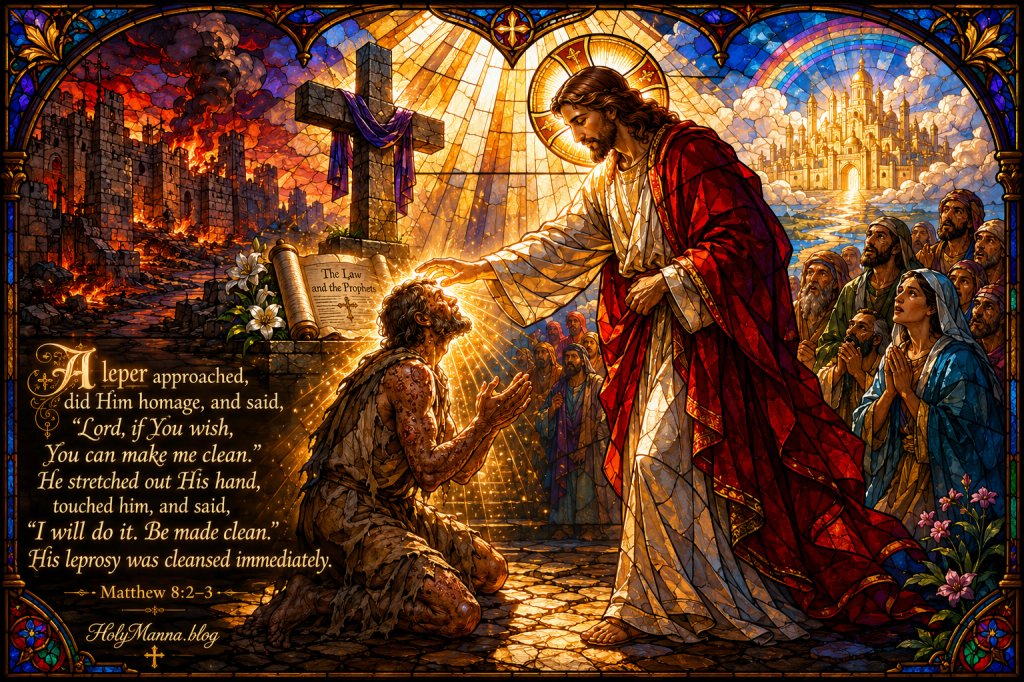
On this Friday of the Twelfth Week in Ordinary Time, the Church places before her children three texts that belong together like panels of the same painting. In 2 Kings 25, a nation watches its world collapse in real time. Jerusalem falls. The Temple burns. The last king of Judah is blinded and marched to Babylon in chains. It is the lowest moment in Israel’s entire history, the catastrophic end product of decades of spiritual infidelity, of a people who kept choosing Babylon in their hearts long before Babylon ever came to their gates. Then Psalm 137 gives voice to the grief that follows. The exiles sit by the rivers of a foreign empire and weep, their harps hanging silent in the willows, their captors mocking them with demands for songs of joy. And then the Gospel of Matthew 8 arrives like a breath of clean air after a long season of smoke. Jesus comes down from the mountain, a leper breaks through the crowd, falls at His feet, and says the most honest prayer any human being has ever prayed: “Lord, if you wish, you can make me clean.” And Jesus reaches out His hand and touches the one man nobody in that entire world was allowed to touch.
The central theme running through all three readings today is exile and the God who ends it. Not just the historical exile of the Jewish people in sixth-century Babylon, but the deeper exile that every human being carries around: the exile from God, from community, from wholeness, that sin produces in the human soul. The First Reading shows what that exile looks like on a national scale. The Psalm shows what it feels like in the human heart. And the Gospel shows what God does about it.
To appreciate the full weight of what is happening in these readings, it helps to understand something about the world they come from. Ancient Israel understood itself as a covenant people, a nation in a unique relationship with the living God, sustained by fidelity to the Law He had given them. The Temple in Jerusalem was not merely a religious building. It was the dwelling place of God on earth, the place where heaven and earth met, the center of the entire world as Israel understood it. When the Catechism of the Catholic Church speaks of exile in CCC 710, it describes it as “the mysterious fidelity of the Savior God and the beginning of a promised restoration”, standing already “in the shadow of the Cross.” The loss of the Temple, in other words, was not the end of God’s plan. It was a brutal purification that pointed forward to an even greater dwelling of God among His people, one that no army could ever burn down.
In the same ancient world, leprosy carried a weight that goes far beyond physical illness. It was not just a disease. It was a sentence. The Law of Moses required lepers to live outside the community, to wear torn clothes, to cover their mouths, and to cry out “Unclean! Unclean!” to warn anyone who came near. They were barred from the Temple, cut off from their families, and forbidden any human touch. A leper was, in every practical sense, a dead person still breathing. Carrying that image into the Gospel of Matthew is not accidental. The leper is Israel in miniature. He is every human soul that sin has separated from God and from the community of the living.
These readings are not ancient history. They are a mirror. How many people reading this today feel like they are living in exile, far from the God they once knew, from the community they once belonged to, carrying something inside them that makes them feel disqualified from love? Today’s Mass has something to say to that person. It has something to say to all of us.
First Reading: 2 Kings 25:1–12
The Day the Lights Went Out in Jerusalem
There are moments in history that function like a cliff edge, where everything before and everything after are simply different worlds. The fall of Jerusalem in 586 BC is one of those moments. What the Church places before her children in today’s First Reading is not a dry recitation of military history. It is a theological reckoning, a sacred text asking the hardest question a believer can ask: how does a people who belong to God end up watching God’s own house burn to the ground? The answer that Scripture gives is not comfortable, but it is honest, and it is full of mercy hiding underneath the rubble. This passage from 2 Kings 25 is the climax of a long, painful story of a nation that kept choosing its own way over God’s way, and it stands at the opening of today’s Mass as a sober mirror for anyone willing to look into it.
To understand the weight of what is described here, it helps to know what Jerusalem meant to ancient Israel. The Temple was not simply a magnificent building, though it was certainly that. It was the place where heaven and earth intersected, the dwelling place of the living God among His people. The Ark of the Covenant rested there. The great feasts of Israel were celebrated there. The entire identity of the Jewish nation was bound up with that city and that sanctuary. When the Babylonians arrived, they were not simply conquering a city. In the minds of the people who watched it fall, they were unraveling the very fabric of reality.
King Zedekiah, the last king of Judah, had been placed on the throne by Nebuchadnezzar himself after a previous deportation in 597 BC. He was, in every political sense, a vassal king, and he broke his oath of loyalty to Babylon by seeking an alliance with Egypt, a move the prophet Jeremiah had warned him against repeatedly. Zedekiah was not a wicked king in the dramatic mold of some of his predecessors, but he was a weak one. He knew the truth from God’s messenger and chose political calculation over faithfulness. That choice cost him everything.
2 Kings 25:1-12 – New American Bible (Revised Edition)
1 In the tenth month of the ninth year of Zedekiah’s reign, on the tenth day of the month, Nebuchadnezzar, king of Babylon, and his whole army advanced against Jerusalem, encamped around it, and built siege walls on every side. 2 The siege of the city continued until the eleventh year of Zedekiah. 3 On the ninth day of the month, when famine had gripped the city, and the people of the land had no more food, 4 the city walls were breached. That night, all the soldiers came to the gate between the two walls near the king’s garden (the Chaldeans had the city surrounded), while the king went toward the Arabah. 5 But the Chaldean army pursued the king and overtook him in the desert near Jericho, abandoned by his whole army. 6 The king was therefore arrested and brought to Riblah to the king of Babylon, who pronounced sentence on him. 7 They slew Zedekiah’s sons before his eyes; then they put out his eyes, bound him with fetters, and brought him to Babylon.
8 On the seventh day of the fifth month (this was in the nineteenth year of Nebuchadnezzar, king of Babylon), Nebuzaradan, captain of the bodyguard, came to Jerusalem as the agent of the king of Babylon. 9 He burned the house of the Lord, the house of the king, and all the houses of Jerusalem (every noble house); he destroyed them by fire. 10 The Chaldean troops who were with the captain of the guard tore down the walls that surrounded Jerusalem, 11 and Nebuzaradan, captain of the guard, led into exile the last of the army remaining in the city, and those who had deserted to the king of Babylon, and the last of the commoners. 12 But some of the country’s poor the captain of the guard left behind as vinedressers and farmers.
Detailed Exegesis
Verse 1: “In the tenth month of the ninth year of Zedekiah’s reign, on the tenth day of the month, Nebuchadnezzar, king of Babylon, and his whole army advanced against Jerusalem, encamped around it, and built siege walls on every side.”
The precision of this date is deliberate and theologically significant. The sacred authors of the Books of Kings wrote history as testimony, and they recorded this date so that no one would ever forget it. The prophet Ezekiel, writing from exile in Babylon, received a divine revelation on this exact day and was told to write it down. Ezekiel 24:2 records God saying “Son of man, write down today’s date, this very day; for on this very day the king of Babylon laid siege to Jerusalem.” Two witnesses, separated by hundreds of miles, marking the same catastrophic morning. The siege wall surrounding the city was a standard Babylonian military technique designed not primarily to storm the walls but to starve the population into surrender. Nebuchadnezzar was patient. He had done this before with Jerusalem, and he was prepared to wait as long as necessary.
Verse 2: “The siege of the city continued until the eleventh year of Zedekiah.”
This single verse covers approximately eighteen months of unimaginable suffering. Josephus, the first-century Jewish historian, describes conditions inside the besieged city that defy comprehension: families selling everything they owned for scraps of food, the collapse of all normal social order, the slow horror of starvation pressing in on an entire population. The prolonged nature of the siege is itself a reflection of the prolonged nature of Israel’s spiritual decline. The judgment did not fall suddenly. God had been sending messengers, prophets, and warnings for generations.
Verse 3: “On the ninth day of the month, when famine had gripped the city, and the people of the land had no more food.”
Famine is one of the covenant curses explicitly described in Deuteronomy 28, the passage in which God warned Israel of what would happen if the nation broke its covenant with Him. The people of Israel knew this text. The priests would have known it. The king would have known it. The famine in Jerusalem was not a random natural disaster. It was the fulfillment of a warning that had been on the books for centuries, spoken in love by a God who was still hoping His people would turn back.
Verse 4: “The city walls were breached. That night, all the soldiers came to the gate between the two walls near the king’s garden (the Chaldeans had the city surrounded), while the king went toward the Arabah.”
The breach of the wall is the collapse of the last line of defense. Zedekiah’s flight toward the Arabah, the desert region east of Jerusalem toward the Jordan River, is the final act of a man who has run out of options. He is heading in the direction of the wilderness, which in the biblical imagination is the place of wandering, the anti-Promised Land. He is fleeing toward the desert just as his ancestors had once been led through it toward the Promised Land. Everything is running backward.
Verse 5: “But the Chaldean army pursued the king and overtook him in the desert near Jericho, abandoned by his whole army.”
The detail that his whole army had deserted him by the time he was captured near Jericho is crushing. Jericho is not a random location. It is the first city that fell when Israel entered the Promised Land under Joshua, a city that came down by the power of God when His people were faithful. Now, at the end of the story, the last king of Judah is captured near that same city, alone, his army gone, his plans in ruins. The geography of the Bible is always doing theological work.
Verse 6: “The king was therefore arrested and brought to Riblah to the king of Babylon, who pronounced sentence on him.”
Riblah was Nebuchadnezzar’s military headquarters in Syria, far to the north. The journey there in chains, as a conquered king, was designed to be maximally humiliating. The pronouncement of sentence by a foreign pagan king over the heir of David’s throne is an image that would have been almost cosmically shocking to any Israelite. This was not supposed to be possible. David’s throne was supposed to be eternal.
Verse 7: “They slew Zedekiah’s sons before his eyes; then they put out his eyes, bound him with fetters, and brought him to Babylon.”
This is one of the most devastating verses in the entire Old Testament, and it demands to be read slowly. The last thing Zedekiah ever saw was the execution of his sons. Every one of his heirs, killed in front of him. And then immediately afterward, his eyes were put out. The darkness fell. He would carry that final image in his memory all the way to Babylon, where he would eventually die. Ancient commentators recognized the terrible symmetry here. Zedekiah had been spiritually blind for years. He had refused to see the word of God coming to him through Jeremiah. He had closed his eyes to the truth. And so, in the end, his physical blindness became the outward sign of the inner blindness that had governed his reign from the beginning. One ancient commentary states it directly: “He had his eyes put out; so he was condemned to darkness who had shut his eyes against the clear light of God’s word. Those who will not believe God’s words will be convinced by the event.”
Verse 8: “On the seventh day of the fifth month (this was in the nineteenth year of Nebuchadnezzar, king of Babylon), Nebuzaradan, captain of the bodyguard, came to Jerusalem as the agent of the king of Babylon.”
The text now moves forward in time by about a month. Nebuzaradan, the commander of the elite Babylonian troops, arrives not to conquer but to complete the demolition. His title is significant: he is described as the captain of the bodyguard, the head of the king’s personal military force, which indicates that what follows has the full personal authority of Nebuchadnezzar behind it.
Verse 9: “He burned the house of the Lord, the house of the king, and all the houses of Jerusalem (every noble house); he destroyed them by fire.”
The burning of the Temple is the theological center of this entire catastrophe. Everything else, the military defeat, the capture of the king, the exile of the nobles, is painful but survivable. The destruction of the Temple is something else entirely. The Temple was where God’s name dwelt. It was the place of atonement, of sacrifice, of encounter between God and His people. Its destruction appeared to the watching world, and to many in Israel itself, as evidence that God had been defeated. That the God of Israel was simply not strong enough to protect His own house. The sacred author of 2 Kings knows this is not the truth, but he does not try to soften the blow. He lets the reader feel the full weight of it.
Verse 10: “The Chaldean troops who were with the captain of the guard tore down the walls that surrounded Jerusalem.”
The walls of a city in the ancient world were not merely military fortifications. They were the boundary of civilization, the marker of identity and security. To tear down the walls was to unmake the city, to return it to open field. Jerusalem without walls was no longer Jerusalem in any meaningful sense.
Verse 11: “Nebuzaradan, captain of the guard, led into exile the last of the army remaining in the city, and those who had deserted to the king of Babylon, and the last of the commoners.”
The deportation of the population to Babylon is the completion of the exile. Scholars estimate that the journey from Jerusalem to Babylon covered roughly 600 miles, much of it through harsh desert and difficult terrain. The people were marched in chains, stripped of their possessions, removed from the land God had given their ancestors, and transplanted into the heart of a pagan empire that worshipped foreign gods. Everything they had built their identity around, the land, the Temple, the Davidic monarchy, the covenant community, had been taken from them in a matter of weeks.
Verse 12: “But some of the country’s poor the captain of the guard left behind as vinedressers and farmers.”
This final verse is easy to read past, but it contains one of the most important theological seeds in the entire passage. The poorest of the poor, the people with no political value, no military value, no economic value to the Babylonian empire, were left behind. In the logic of the ancient world, they were irrelevant. But in the logic of God’s plan, they were the remnant. They were the thread that kept the covenant story from being completely severed.
Teachings
The fall of Jerusalem is not merely a historical tragedy. The Catholic Church reads this event as a moment of profound theological significance within salvation history, a necessary purgation that pointed forward to something far greater than anything Israel had yet known.
The Catechism of the Catholic Church addresses this directly in one of its most striking passages. CCC 710 teaches: “The forgetting of the Law and the infidelity to the covenant end in death: it is the Exile, apparently the failure of the promises, which is in fact the mysterious fidelity of the Savior God and the beginning of a promised restoration, but according to the Spirit. The People of God had to suffer this purification. In God’s plan, the Exile already stands in the shadow of the Cross, and the Remnant of the poor that returns from the Exile is one of the most transparent prefigurations of the Church.”
This is a stunning claim. The Church teaches that the exile, which looked from the outside like the final failure of God’s project, was actually a purification pointing forward to the Cross. The destruction of the Temple pointed forward to the death of the One who would declare Himself the new Temple. The remnant of the poor left behind in the ruins of Jerusalem pointed forward to the Church, the community of those who are poor in spirit, who have nothing to offer the world but their fidelity to God.
The Book of 2 Chronicles 36:14–16 is explicit about the cause of the catastrophe: “In those days, all the princes of Judah, the priests, and the people added infidelity to infidelity, practicing all the abominations of the nations and polluting the LORD’s temple, which he had consecrated in Jerusalem. Early and often did the LORD, the God of their fathers, send his messengers to them, for he had compassion on his people and his dwelling place. But they mocked the messengers of God, despised his warnings, and scoffed at his prophets until the anger of the LORD against his people was so inflamed that there was no remedy.”
What is crucial here is the phrase “for he had compassion on his people.” The judgment did not come from indifference or cruelty. It came after a long history of God reaching out to His people through the prophets, trying to bring them back, sending messenger after messenger. The exile was not the abandonment of Israel. It was the final consequence of Israel’s repeated choice to walk away from the covenant. God had honored the free will of His people, and the results were devastating.
The theologian and Scripture scholar Scott Hahn, drawing on the work of A Catholic Introduction to the Bible by Bergsma and Pitre, notes that the Babylonian exile is one of the most important events in all of salvation history precisely because it established the pattern that would later be fulfilled in the Paschal Mystery: death followed by resurrection, exile followed by return, darkness followed by light. The exile was not the end of God’s story. It was the setup for its greatest chapter.
There is also a personal moral dimension to this passage that the Church has always drawn out. Zedekiah’s spiritual blindness before his physical blindness is a warning to every believer. The Catechism teaches in CCC 1792 that “ignorance of Christ and his Gospel, bad example given by others, enslavement to one’s passions, assertion of a mistaken notion of autonomy of conscience, rejection of the Church’s authority and her teaching, lack of conversion and of charity: these can be at the source of errors of judgment in moral conduct.” Zedekiah is a case study in exactly this pattern. He had access to the word of God through Jeremiah. He knew the truth. He chose political convenience over faithfulness, repeatedly, until the consequences became irreversible.
Reflection
Today’s First Reading is not an easy passage to sit with, but it is an honest one, and that honesty is part of its gift. The fall of Jerusalem shows what happens when a person, or a people, keeps choosing their own way over God’s way, not in one dramatic act of rebellion, but in the slow accumulation of small compromises, of prophets ignored, of warnings dismissed, of conveniences chosen over convictions.
Is there a Jeremiah in your life right now, a voice you have been finding ways to not quite listen to? It could be a confessor, a spiritual director, a trusted friend who keeps gently pointing toward something you would rather not examine. Zedekiah had access to one of the greatest prophets in Israel’s history, and he could never quite bring himself to fully obey. The cost of that half-obedience was everything.
At the same time, this reading is an invitation to hope. The exile was not the end. The poor were left in the land. The thread of God’s promise was not cut, only stretched thin. The Catechism says the exile already stood in the shadow of the Cross, which means it also stood in the shadow of the Resurrection. Whatever feels burned and broken in a person’s life right now, God has a history of building His greatest work on ruins.
What in your own life has felt like a Temple burning, a loss so significant that it seemed to change everything you thought you knew about yourself and your relationship with God? The invitation of this passage is to bring that exact thing to prayer and to ask whether God might be doing something in the wreckage that cannot yet be seen from inside the smoke. The exile was not a punishment without purpose. It was a purification with a destination. And that destination, as the rest of the story makes clear, was always home.
Responsorial Psalm: Psalm 137:1–6
Harps on the Willows: The Prayer of the Exile
If the First Reading shows the catastrophe from the outside, the Responsorial Psalm takes the reader inside it and lets them feel it in their bones. Psalm 137 is one of the most emotionally raw texts in the entire Bible, a poem that does not try to clean itself up or wrap a tidy spiritual lesson around its grief. It simply sits down by the rivers of Babylon and weeps. And that honesty is precisely what makes it one of the most spiritually useful prayers a Catholic can carry into the harder seasons of life.
Known in the Latin tradition as Super flumina Babylonis, this psalm holds a remarkable place in the Church’s liturgical heritage. Following the Rule of Saint Benedict, the ancient Roman Breviary assigned it to Vespers on Wednesdays, meaning generations of monks and religious prayed these very words as the sun went down in the middle of every week. In the Roman Missal of 1962, the opening verse served as the Offertory antiphon for the twentieth Sunday after Pentecost. The Church did not treat this psalm as an embarrassing expression of ancient grief to be tolerated. She placed it at the center of her prayer life precisely because she recognized in it the voice of every soul that has ever found itself far from home, far from God, far from the joy it once knew.
The psalm is believed to have been composed during the Babylonian exile itself, or shortly after the return, by someone who had lived the experience or heard it from those who had. The Septuagint, the ancient Greek translation of the Hebrew Scriptures used by the early Church, attributes it to Jeremiah, the weeping prophet who never stopped mourning for Jerusalem even as he proclaimed its coming fall. Whether or not Jeremiah was the author in a strictly literary sense, the attribution fits perfectly. This is precisely the voice of a man who loved Jerusalem with everything he had and watched it destroyed anyway.
Today the liturgy places this psalm immediately after the account of Jerusalem’s fall in 2 Kings 25, and the pairing is an act of pastoral genius. The First Reading describes what happened. The Psalm gives voice to what it felt like. Together they complete the picture of exile, not just as a historical event but as a spiritual condition, and they set up the Gospel’s answer with exquisite precision.
Psalm 137:1-6 – New American Bible (Revised Edition)
Sorrow and Hope in Exile
1 By the rivers of Babylon
there we sat weeping
when we remembered Zion.
2 On the poplars in its midst
we hung up our harps.
3 For there our captors asked us
for the words of a song;
Our tormentors, for joy:
“Sing for us a song of Zion!”
4 But how could we sing a song of the Lord
in a foreign land?5 If I forget you, Jerusalem,
may my right hand forget.
6 May my tongue stick to my palate
if I do not remember you,
If I do not exalt Jerusalem
beyond all my delights.
Detailed Exegesis
Verse 1: “By the rivers of Babylon there we sat weeping when we remembered Zion.”
The opening image is deceptively simple and devastatingly effective. The exiles are sitting, not standing, not marching, not building. They are sitting, which in the ancient world was the posture of mourning. They are sitting by rivers, which in Babylon meant the great network of canals and waterways that ran through the flat Mesopotamian plain. These were not the rivers of home. Israel had no great river. The Jordan was modest and beloved precisely because it was theirs. The Euphrates and its tributaries were massive, imperial, overwhelming, belonging to the empire that had crushed them. And sitting beside these foreign waters, with nothing to do but remember, the weeping comes.
The word “remembered” is doing enormous theological work in this verse. In the Hebrew biblical tradition, remembering is not a passive mental act. It is an act of presence, of re-engagement, of loyalty. To remember Zion is to refuse to let Zion die. It is to keep the fire of belonging alive in a place designed to extinguish it. The tears of the exiles are not simply the tears of homesickness. They are the tears of a people who have begun to understand the weight of what they lost, and what they lost because of their own infidelity. As one commentator notes, this homesickness was also a penitence. Without reckoning with their sins, the people of the exile would not be going back. These tears carried within them the seeds of conversion.
Verse 2: “On the poplars in its midst we hung up our harps.”
The harp, or lyre, was the primary instrument of Israel’s sacred music. The Psalms themselves were composed to be sung to its strings. To hang up the harp is not simply to stop playing music. It is to suspend worship, to acknowledge that something has broken in the relationship between the singer and the song. Pope Benedict XVI reflected on this image with particular insight, noting that “the hand is indispensable for the one who plays the lyre. But it has remained paralyzed by sorrow because the lyres have been hung on the willows.” The hands that once lifted in praise now hang at the sides. The instruments of joy are suspended in the trees of a foreign land like artifacts of a life that no longer exists.
The willows or poplars of Babylon are themselves a detail worth noting. The weeping willow is one of nature’s great symbols of grief, its branches hanging downward as if the tree itself is in mourning. The image of harps in the willows has become one of the most enduring poetic pictures of spiritual desolation in Western literature and music precisely because it captures something universally recognizable: the moment when a person cannot bring themselves to sing anymore.
Verse 3: “For there our captors asked us for the words of a song; our tormentors, for joy: ‘Sing for us a song of Zion!’”
This verse introduces a cruelty that goes beyond the physical suffering of captivity. The Babylonian captors are asking the exiles to perform their sacred music for entertainment. The songs of Zion were not folk songs or popular tunes. They were the liturgical hymns of Israel, the prayers of the Temple, the songs through which the people of God addressed their Lord. To be asked to sing them in a pagan context, for the amusement of the people who had just burned the Temple, was an act of profound desecration. It was not merely insensitive. It was mocking.
Pope Benedict XVI named this dynamic clearly in his 2005 General Audience reflection on this psalm, pointing out that “the songs of Zion are the Lord’s canticles; they are not folkloric songs or performances. Only in the liturgy and in the freedom of a people can they rise up to heaven.” The captors did not understand what they were asking for. They thought they were requesting entertainment. What they were actually demanding was the desecration of prayer itself.
Verse 4: “But how could we sing a song of the Lord in a foreign land?”
This is one of the great rhetorical questions of the entire Bible, and it deserves to be sat with rather than answered too quickly. On one level, it is simply the honest cry of people in grief: we cannot make ourselves perform joy we do not feel. But on a deeper level, it reflects a genuine theological struggle. The ancient world generally understood religious worship as tied to specific geographical locations. The God of Israel dwelt in the Temple in Jerusalem. To worship Him in Babylon, in the territory of Marduk and Bel, surrounded by the temples of foreign gods, felt not just emotionally impossible but cosmically disorienting.
What the exiles could not yet fully see, and what the prophets would begin to reveal during the exile itself, is that the God of Israel was not a local deity limited to one piece of real estate. He was the Lord of all creation, and He could be found and worshipped anywhere a heart genuinely sought Him. The exile, precisely in its pain, was teaching this truth. But in the rawness of verse 4, the people are not there yet. They are still in the middle of the darkness, and the psalm honors that honestly.
Verses 5–6: “If I forget you, Jerusalem, may my right hand forget. May my tongue stick to my palate if I do not remember you, if I do not exalt Jerusalem beyond all my delights.”
The psalm shifts here from communal lament to personal vow, and the intensity of the language is striking. The psalmist is invoking a curse upon himself if he allows himself to forget Jerusalem. The right hand is the hand of skill, the hand of the musician, the hand of the craftsman. To lose the right hand’s cunning is to lose the ability to create, to contribute, to serve. The tongue is the instrument of song and speech and prayer. To have it stick to the palate is to be silenced. The psalmist is saying, in essence, that he would rather lose everything that makes him capable of beauty and expression than allow Jerusalem to fade from the center of his heart.
St. Augustine, in his Expositions on the Psalms, read Jerusalem here as a figure of the heavenly city, the ultimate homeland of the human soul. He wrote: “If I forget you, O Jerusalem… there is the height of joy where we enjoy God, where we are safe of united brotherhood, and the union of citizenship. There no tempter shall assail us, no one be able so much as to urge us on to any allurement: there nought will delight us but good: there all want will die, there perfect bliss will dawn on us.” For Augustine, the vow of the psalmist becomes the vow of every Christian: to never allow the goods of this world to displace the longing for the world that is coming.
Teachings
The Church’s engagement with Psalm 137 runs deep and wide, from the patristic era through the medieval liturgical tradition to the papal teaching of the modern period. What emerges from that engagement is a reading of this psalm that operates simultaneously on three levels: the historical, the spiritual, and the eschatological.
On the historical level, the psalm is exactly what it appears to be: a record of genuine human grief experienced by a real community in a real historical catastrophe. The Church has never tried to allegorize away the concrete suffering of the Jewish people in Babylon. That suffering was real, and the tears of Psalm 137 are real tears. Pope Benedict XVI, in his 2005 General Audience devoted to this psalm, observed that the rivers of Babylon function in this text “as a symbolic anticipation of the extermination camps in which the Jewish people, in the century that just ended, were led to an infamous operation of death, which has remained as an indelible disgrace in the history of humanity.” The Holy Father was connecting the grief of ancient Babylon to the grief of the twentieth century without collapsing the distinction between them, insisting that the tears of God’s people across history are held together in the memory of God.
On the spiritual level, the Church has consistently read this psalm as a description of the condition of the soul that has wandered from God. St. Augustine’s allegorical reading, which influenced the entire Western tradition of psalm interpretation, treats Babylon as the world in its seductive disorder and Jerusalem as the soul’s true home in God. In this reading, the exile is not merely something that happened to ancient Israel. It is something that happens to every human soul that allows the loves of this world to crowd out the love of God. The Catechism echoes this reading when it teaches in CCC 30 that “the desire for God is written in the human heart, because man is created by God and for God; and God never ceases to draw man to himself. Only in God will he find the truth and happiness he never stops searching for.” The longing of Psalm 137 is, at its deepest level, the longing that is built into the structure of the human person.
On the eschatological level, the psalm’s vow to remember Jerusalem points forward to the new and heavenly Jerusalem described in Revelation 21, the city that comes down from heaven as a bride prepared for her husband, the city where every tear is wiped away and exile ends forever. Augustine wrote: “But sigh for the everlasting Jerusalem: whither your hope goes before, let your life follow; there we shall be with Christ.” The psalm that begins in tears ends in a vow of fidelity, and that vow is itself the beginning of the journey home.
Pope Benedict XVI’s reflection also drew on Augustine’s remarkable pastoral extension of the psalm’s vision. Augustine recognized that even among the inhabitants of Babylon, even among those who do not share the biblical faith, there are people who long for something beyond what the world offers. The Holy Father summarized Augustine’s teaching this way: “Now, if they strive to do these tasks with a pure conscience, God, having predestined them to be citizens of Jerusalem, will not let them perish within Babylon: this is on condition, however, that while living in Babylon, they do not thirst for ambition, short-lived magnificence or vexing arrogance…. He sees their enslavement and will show them that other city for which they must truly long and towards which they must direct their every effort.”
This is an extraordinary teaching. The God of the Bible is not indifferent to the unnamed longing that stirs in the hearts of people who have not yet found their way fully to Him. He sees it. He honors it. And He works with it.
Reflection
Psalm 137 is the kind of prayer that finds people in the dark rather than inviting them into the light, and that is precisely its gift. It does not demand that a person feel things they do not feel. It does not ask for forced joy or performed piety. It simply names the reality of spiritual exile with devastating honesty, and in doing so, it creates a space where that exile can be brought before God rather than hidden from Him.
Where is the Babylon in your life right now, the place or the season or the circumstance that feels foreign, that does not feel like home, that keeps demanding something from you that you cannot give? The psalm is permission to name it. The captors in the psalm are asking for songs of joy, and the psalmist refuses to perform what he does not feel. There is something deeply Catholic in that refusal. Authentic prayer is not performance. It is presence. And sometimes the most faithful thing a person can do is sit down by the rivers of whatever Babylon they find themselves in, and tell God exactly how they feel about being there.
At the same time, the psalm’s vow of remembrance is an invitation to active spiritual resistance. The psalmist refuses to forget Jerusalem. In practical terms for a Catholic today, this means refusing to let the noise and busyness and comfort of ordinary life crowd out the longing for God that is the deepest truth of the human person. It means keeping some practice, some habit, some daily rhythm that keeps the fire of that longing alive. It might be a daily Rosary, a regular Holy Hour, a consistent examination of conscience before bed. Whatever the form, the content is the same: the refusal to let Babylon become home.
Are the practices of your faith functioning like a harp hung in the willows, something that once filled your life with music but has been set aside for a season? The psalm does not condemn the silence. It simply names it. And in naming it, it opens the door to taking the harp back down. The God who wept over Jerusalem has not stopped longing for His people to return. He is the one who makes the return possible, and He has been waiting, with extraordinary patience, for exactly this moment.
Holy Gospel: Matthew 8:1–4
The Touch That Ends the Exile
After sitting with the ruins of Jerusalem and the tears of the exiles, the Gospel of Matthew arrives like the first light after a very long night. And what Matthew places before the reader is not a theological argument or a prophetic speech. It is a gesture. Jesus reaches out His hand and touches a man that no one in the entire world was supposed to touch. In four verses, the entire arc of today’s readings finds its resolution. The exile that began with a nation’s infidelity, the longing that a psalm could only weep over, ends here, in the dirt outside a Galilean town, with a single outstretched hand.
This passage from Matthew 8 comes immediately after the Sermon on the Mount, one of the most important teaching moments in the entire Gospel. The crowds had just heard Jesus speak with an authority that astonished them, unlike anything the scribes and Pharisees had ever offered. Matthew records in Matthew 7:28–29 that “when Jesus had finished these words, the people were astonished at his teaching, for he taught them as one having authority, and not as their scribes.” Now, coming down from that mountain, Jesus is about to demonstrate that His authority is not only over words and ideas. It is over disease, over ritual impurity, over the boundary between the clean and the unclean, over everything that separates human beings from God and from each other.
The mountain descent is itself theologically loaded. Moses came down from Sinai with the Law written on stone tablets, and the people trembled. Jesus comes down from this mountain with the New Law written in His very person, and the first person He meets is someone the old Law could not help: a man whose skin disease had placed him permanently outside the covenant community. The positioning is not accidental. Matthew is a master storyteller with a theological agenda, and he is making a point about who Jesus is and what His coming means for those whom the world has written off.
To understand the full weight of this encounter, it is essential to grasp what leprosy meant in the ancient Jewish world. The term used in the Greek text, lepra, covered a range of serious skin diseases described at length in Leviticus 13–14, two entire chapters of the Torah devoted to the identification and management of these conditions. A person declared leprous by the priest was required to live outside the community, to wear torn clothing, to leave their hair disheveled, to cover the lower part of their face, and to cry out “Unclean! Unclean!” whenever anyone approached. They were barred from the Temple, from synagogue worship, from their families, from any human contact whatsoever. They were, in every meaningful sense, the living dead, people whose bodies still breathed but who had been removed from the world of the living in every social, religious, and legal dimension. Leprosy was also widely understood as carrying a spiritual dimension, often interpreted as a divine punishment for sin. The combination of physical suffering, social isolation, religious exclusion, and spiritual stigma made the leper one of the most comprehensively marginalized figures in the ancient world.
This is the man who comes to Jesus.
Matthew 8:1-4 – New American Bible (Revised Edition)
The Cleansing of a Leper. 1 When Jesus came down from the mountain, great crowds followed him. 2 And then a leper approached, did him homage, and said, “Lord, if you wish, you can make me clean.” 3 He stretched out his hand, touched him, and said, “I will do it. Be made clean.” His leprosy was cleansed immediately. 4 Then Jesus said to him, “See that you tell no one, but go show yourself to the priest, and offer the gift that Moses prescribed; that will be proof for them.”
Detailed Exegesis
Verse 1: “When Jesus came down from the mountain, great crowds followed him.”
Matthew opens this scene by establishing two things at once: the setting and the stakes. Jesus has just finished the Sermon on the Mount, and the crowds that heard it are still with Him. They are following, which in Matthew’s Gospel is always a word with discipleship overtones. These are people who have been moved by what they heard. They are not simply curious bystanders. They are people in the process of being drawn toward something they cannot yet fully name. And into this crowd, which by all the rules of the ancient world the leper was forbidden to enter, a leper comes anyway.
Verse 2: “And then a leper approached, did him homage, and said, ‘Lord, if you wish, you can make me clean.’”
Every word of this verse rewards careful attention. The leper approaches, which in itself is a violation of Levitical law. He is breaking the rules, not out of disrespect for the Law, but out of desperate faith. He does him homage, falling prostrate before Jesus, the posture of worship reserved for God alone or for those recognized as holding divine authority. He calls Him “Lord,” a title that in Matthew’s Gospel carries increasing theological weight as the narrative progresses. And then he says something that St. John Chrysostom, in his celebrated Homily 25 on Matthew, identified as one of the most theologically precise prayers in the entire New Testament.
The leper does not say “Lord, pray to God for me” or “Lord, if God is willing.” He says “if you wish, you can make me clean.” He places the will and the power entirely in Jesus Himself. He does not treat Jesus as a prophet who intercedes before a higher authority. He treats Jesus as the authority. And in doing so, he confesses, perhaps without fully understanding the implications, that Jesus possesses the same sovereign power over creation that belongs to God alone. Chrysostom observed that the leper does not doubt the ability of Christ for a single moment. He has watched the crowds be astonished by Jesus’s teaching, and he has concluded that this man has a power unlike anything he has ever encountered. The only question in his mind is whether Jesus would be willing to direct that power toward someone as disqualified as himself. He has been turned away by everyone for years. He has learned to doubt the willingness of others, even when their ability to help was clear.
Verse 3: “He stretched out his hand, touched him, and said, ‘I will do it. Be made clean.’ His leprosy was cleansed immediately.”
This is the verse that changes everything, and it needs to be read slowly enough to feel its full impact. Jesus stretched out His hand. He did not have to. He could have spoken a word from a distance, as He would later do for the centurion’s servant. He could have simply declared the man clean without any physical contact at all. He chose to touch him. That choice is the heart of this entire passage.
Under the Levitical law, touching a leper made the person who touched him ritually unclean. Uncleanliness spread by contact. That was the entire logic of the purity system. But when Jesus reaches out His hand, something unprecedented happens: the uncleanliness does not spread to Jesus. Instead, His cleanness spreads to the leper. His holiness is more powerful than the disease. The direction of the contagion is reversed, and in that reversal, the entire economy of the Incarnation is summarized. God does not stand at a safe distance from human brokenness. He enters it, absorbs it, and transforms it from the inside.
The words that accompany the touch are equally striking. “I will do it.” Not “God wills it” or “be healed in the name of the Lord.” Jesus speaks in His own name, from His own authority, and the result is instantaneous. Matthew’s word for the cleansing, ekatharisthe, the same Greek root used throughout Leviticus 13–14 for the priestly declaration of cleanness, carries the sense of a complete and official restoration. This man is not partially improved. He is entirely made new.
Verse 4: “Then Jesus said to him, ‘See that you tell no one, but go show yourself to the priest, and offer the gift that Moses prescribed; that will be proof for them.’”
This final verse contains two instructions that are both significant and work together in unexpected ways. The first instruction, to tell no one, has puzzled readers for centuries. Jesus has just performed a stunning public miracle in front of a large crowd. How could this be kept secret? Most commentators understand this as a characteristic feature of what scholars call the Messianic Secret in Matthew’s Gospel. Jesus was not primarily conducting a healing ministry. He was on His way to the Cross, and He needed the timeline of His revelation to unfold in God’s order, not in the order dictated by popular enthusiasm that might prematurely cast Him in a political or revolutionary role.
The second instruction, to show himself to the priest and offer the prescribed gift, is even more theologically rich. Leviticus 14 describes an elaborate priestly ritual for the official reintegration of a healed leper into the community: a ceremony involving two birds, cedar wood, scarlet thread, hyssop, and eventually a series of animal sacrifices. Jesus, who has just demonstrated total authority over the disease that excluded this man from the covenant community, sends him back through the official channels of that community’s Law. He does not abolish the priestly system. He fulfills it and works through it.
St. John Chrysostom saw the wisdom in this immediately. In Homily 25, he wrote that Jesus “said not, ‘which I command,’ but for a time remits him to the law, by every means stopping their mouths. Lest they should say He had seized upon the priests’ honor, though He performed the work Himself, yet the approving of it He entrusted to them, and made them sit as judges of His own miracles.” Jesus performs the healing. The priest certifies it. The healing comes entirely from Christ, but the declaration of restored cleanness is made through the ordained mediating structure. For any Catholic who has ever sat in a confessional and wondered why they need a priest to receive God’s forgiveness, this verse is worth holding for a long time.
Teachings
The cleansing of the leper in Matthew 8 is one of the most doctrinally dense passages in the Synoptic Gospels, and the Church has drawn from it consistently across two thousand years of theological reflection. The major threads of that reflection converge on three great truths: the identity of Jesus as the one who has authority to heal the whole person, the connection between physical healing and the sacramental life of the Church, and the significance of the touch as an act of solidarity with the outcast and the suffering.
The Catechism of the Catholic Church addresses Christ’s healing ministry with direct reference to passages like this one. CCC 1503 teaches: “Christ’s compassion toward the sick and his many healings of every kind of infirmity are a resplendent sign that ‘God has visited his people’ and that the Kingdom of God is close at hand. Jesus has the power not only to heal, but also to forgive sins; he has come to heal the whole man, soul and body; he is the physician the sick have need of. His compassion toward all who suffer goes so far that he identifies himself with them: ‘I was sick and you visited me.’”
This is the Church’s definitive reading of what is happening in Matthew 8:1–4. The healing of the leper is not primarily a demonstration of supernatural power, though it is certainly that. It is a sign, a sacramental sign in the deepest sense, that the Kingdom of God has arrived and that its arrival means the restoration of human beings to wholeness in every dimension. The man’s skin is healed. His religious status is restored. His social life is given back. His relationship with God is renewed. The healing is comprehensive because the Kingdom is comprehensive.
CCC 1504 continues: “Often Jesus asks the sick to believe. He makes use of signs to heal: spittle and the laying on of hands, mud and washing. The sick try to touch him, ‘for power came forth from him and healed them all.’ And so in the sacraments Christ continues to ‘touch’ us in order to heal us.” The touch of Jesus in Matthew 8:3 is not a one-time historical event that ended when Jesus ascended into heaven. It is the origin and model of every sacramental act the Church performs. Every time a priest lays hands on a penitent in the Sacrament of Reconciliation, every time the faithful receive the Eucharist, every time the oil of the Anointing of the Sick is applied to a suffering body, Christ is stretching out His hand again and saying, with the same authority He used on the road outside Galilee: “I will do it. Be made clean.”
CCC 1505 draws the connection even more explicitly: “Moved by so much suffering Christ not only allows himself to be touched by the sick, but he makes their miseries his own: ‘He took our infirmities and bore our diseases.’ But he did not heal all the sick. His healings were signs of the coming of the Kingdom of God. They announced a more radical healing: the victory over sin and death through his Passover. On the cross Christ took upon himself the whole weight of evil and took away the ‘sin of the world,’ of which illness is only a consequence.”
The patristic tradition consistently read leprosy as a symbol of sin, and the healing of the leper as a figure of sacramental reconciliation. Epiphanius the Latin, an early Church writer, stated plainly: “Leprosy signifies sin. Now if anyone is inundated in the leprosy of sin, let him show himself faithfully to the Lord and let him confess his sins, so that he might be able to depart from this world clean.” The leper’s posture before Jesus, his humble acknowledgment of his condition, his submission to the will of Christ, his willingness to be sent to the priest: all of this maps precisely onto the structure of a good sacramental confession. The penitent approaches, acknowledges the leprosy of sin, submits to the mercy of Christ, and is sent to the priest for the official declaration of cleanness that restores full communion with God and the community.
Chrysostom in Homily 25 also made a point that carries tremendous pastoral weight. He noted that in this miracle, as in everything else Jesus did, the power flowed from the person of Christ, not from any external source. When the leper said “if you wish,” and Christ replied “I will,” Chrysostom observed that this exchange was the clearest possible declaration of Christ’s divine authority. The work followed immediately, without prayer, without petition to the Father, without any intermediary. Nature itself obeyed at His word. “Whereas, if he had not spoken well, but the saying had been a blasphemy, the work ought to have been interrupted. But now nature herself gave way at His command.”
Reflection
The leper in today’s Gospel has one thing going for him that is worth everything: he knows exactly what he needs, and he knows he cannot get it anywhere else. He does not doubt that Jesus can heal him. He only doubts whether Jesus would want to heal someone like him. Someone this disqualified. Someone who has been turned away so many times that asking feels like its own kind of humiliation.
Is there something in your life right now, some wound, some sin, some pattern of brokenness that you have been carrying with the private conviction that it is probably too much even for God? The leper in this Gospel is that conviction walking toward Jesus anyway. And the answer he receives, spoken before a crowd, with a physical touch that reverses every social and religious norm of his world, is “I will do it. Be made clean.” Not eventually. Not conditionally. Immediately.
The most practical application of this passage for a Catholic today is obvious and worth naming directly. The Sacrament of Reconciliation is the place where this Gospel continues to happen. It is the place where the leprosy of sin, which isolates, shames, and separates a person from God and from the community of the Church, is brought before Christ and healed. The confessional is the road outside Galilee. The penitent is the leper. The priest is the ordained mediator through whom Christ continues to stretch out His hand. And the words of absolution are the same words spoken in Matthew 8:3, with the same authority and the same result: “I will do it. Be made clean.”
If it has been a while since the Sacrament of Reconciliation has been received, today’s Gospel is the invitation to go back. Not because the guilt of sin demands it, though it does. But because Jesus is still reaching out His hand, still saying “I will,” still ready to end whatever exile has accumulated in the soul, and still sending the newly clean back into the fullness of community life with the Church. The leper who walked away from that encounter on the road to Galilee was a completely different person than the one who had approached. Not just in his skin, but in everything. That is what the touch of Christ does. And it is still doing it, every single day, in every confessional in every Catholic church in the world.
What would it mean to approach the Lord today with the same honesty the leper brought: not dressing up the condition, not minimizing it, not performing a confidence that is not there, but simply kneeling down and saying, “Lord, if you wish, you can make me clean”?
Coming Home to the God Who Never Left
There is a thread running through everything the Church has placed before her children today, and it is worth pulling on until the whole tapestry comes into view. It begins with a nation in ruins, a king blinded in chains, a Temple reduced to ash, and a people marched 600 miles into the heart of a pagan empire. It continues with a psalm that cannot sing, that has hung its harp in the willows and sits weeping by foreign rivers, refusing to perform a joy it does not feel. And it ends with a man whose skin disease has made him a ghost among the living, kneeling in the road before Jesus of Nazareth and asking the most vulnerable question a human being can ask: “Lord, if you wish, you can make me clean.”
These three readings are not three separate stories. They are one story, told from three different angles, about the deepest problem the human heart has ever faced and the one answer God has given to it. The problem is exile. Not just the geographical exile of the Jewish people in Babylon, though that was real and devastating. The deeper exile is the one that sin produces in every human soul: the separation from God, from community, from wholeness, from the life that was always meant to be lived. Every person reading this today knows what that exile feels like in some form. It might be the exile of a faith that has grown cold. It might be the exile of a sin that has been carried alone for too long. It might be the exile of grief, of failure, of a life that looks nothing like what was once hoped for. The readings of today’s Mass speak directly to that place.
What 2 Kings 25 establishes is that exile is real and it has causes. The fall of Jerusalem was not a random catastrophe visited on an innocent people. It was the long-deferred consequence of a nation that kept choosing its own way over God’s way, that kept ignoring the prophets, that kept finding reasons not to fully return. And yet, even in the middle of the devastation, CCC 710 reveals that God’s hand was at work in the darkness: “In God’s plan, the Exile already stands in the shadow of the Cross, and the Remnant of the poor that returns from the Exile is one of the most transparent prefigurations of the Church.” The ruins of Jerusalem were not the end of the story. They were the shadow cast backward by the Cross, and every shadow implies a light.
What Psalm 137 teaches is that grief and longing are not the opposite of faith. They are one of its deepest expressions. The psalmist who refuses to sing in Babylon, who vows to place Jerusalem above every other joy, who calls down curses on his own capacity for music if he allows himself to forget, is not a person who has lost faith. He is a person whose faith is burning so fiercely in the darkness that it refuses to be extinguished by comfort or distraction. St. Augustine read this psalm and heard in it the vow of every Christian soul: to never allow the goods of this world to replace the longing for the world that is coming. “But sigh for the everlasting Jerusalem,” Augustine wrote, “whither your hope goes before, let your life follow; there we shall be with Christ.” The harp in the willows is not a symbol of defeat. It is a symbol of a person who knows the difference between genuine praise and performance, and who is waiting for the real thing.
And then Matthew 8 shows what happens when the One who can actually end the exile shows up. Jesus does not send a delegate. He does not issue a proclamation. He comes down from the mountain and walks straight toward the most excluded person in the crowd, and He touches him. That touch is the summary of the entire Incarnation. God enters the exile. God absorbs the uncleanliness. God reverses the direction of the contagion so that His holiness flows into the brokenness rather than the brokenness flowing into Him. And He says, with complete authority and complete tenderness, “I will do it. Be made clean.”
The remarkable thing about today’s Mass is that the same Jesus who stretched out His hand on that road in Galilee is still stretching it out today. The Catechism is explicit about this in CCC 1504, teaching that “in the sacraments Christ continues to ‘touch’ us in order to heal us.” The exile that any person carries into Mass today, whatever form it takes, is not too much for the One who healed a leper with a word and a touch. It is not too old, not too complicated, not too shameful, not too far gone. The same authority that reversed the uncleanliness of leprosy can reverse the uncleanliness of anything.
So here is the invitation that today’s readings extend to every person willing to receive it. Name the exile. Name the place where the harp has been hanging in the willows, where the songs have stopped, where the distance from God feels too wide to cross. And then bring it exactly where the leper brought his leprosy: to the feet of Jesus, without dressing it up, without minimizing it, without waiting until it feels more manageable. The leper did not wait until his condition improved before approaching Christ. He came in the full severity of his need, and that is precisely what moved the hand of God.
For those who have been away from the Sacrament of Reconciliation, today’s Gospel is a personal invitation. For those who have been carrying something heavy in prayer without bringing it to the Sacraments, today’s First Reading is a reminder that the exile ends not through personal willpower but through returning to the covenant. For those who are in the middle of a grief or a loss so deep that singing feels impossible, today’s Psalm is permission to hang the harp in the willows for a season, to weep honestly before God, and to make the one vow that exile cannot take away: I have not forgotten You. I will not forget You. And I am still waiting to come home.
The God who kept His promise to the exiles in Babylon is the same God who healed the leper on the road to Galilee. He is the same God present in every tabernacle in every Catholic church in the world today, still reaching out His hand, still saying the same words He has always said to every exile who has ever dared to kneel before Him: “I will do it. Be made clean.”
Engage With Us!
Today’s readings have a way of reaching into the quieter corners of the heart and asking questions that do not let go easily. Share your reflections in the comments below, because this community grows stronger when its members think out loud together, and someone else may need to hear exactly what is stirring in you today.
- In 2 Kings 25:1–12, the fall of Jerusalem came after a long accumulation of small compromises and ignored warnings. Where in your own life have you been tempted to settle for half-obedience, and what might God be inviting you to surrender more fully to Him today?
- Psalm 137:1–6 gives voice to a grief so deep that singing feels impossible, and yet the psalmist refuses to forget Jerusalem even in the darkest exile. What is the Jerusalem of your heart right now, the thing you are still holding onto with fierce love even in a difficult season, and how is that longing pointing you back toward God?
- In Matthew 8:1–4, the leper does not doubt that Jesus can heal him. He only wonders whether Jesus would want to. Is there a wound, a sin, or a hidden corner of your life where you have been quietly convinced that you might be the exception to God’s mercy, and what would it mean to bring that exact thing to the feet of Christ today?
- All three of today’s readings tell one story about exile and the God who ends it. Where do you most recognize yourself in that story right now: in the ruins of Jerusalem, weeping by the rivers of Babylon, or kneeling in the road before Jesus with everything exposed and nothing left to lose?
Every day is an invitation to stop performing and start being honest with God, to take the harp down from the willows, to kneel in the road, to say the words the leper said, and to trust that the hand reaching back is the same hand that has been reaching since the beginning of the world. Go out today and live that trust out loud, in the small moments and the big ones, in the easy conversations and the hard ones, in every act of kindness and every choice to forgive. The world is full of exiles who need to know that the exile is over. Let the life of faith be the proof.
Sacred Heart of Jesus, we trust in You!
Immaculate Heart of Mary, pray for us!
Saint Michael the Archangel, defend us in battle!
Follow us on YouTube, TikTok, Instagram and Facebook for more insights and reflections on living a faith-filled life.


Leave a comment