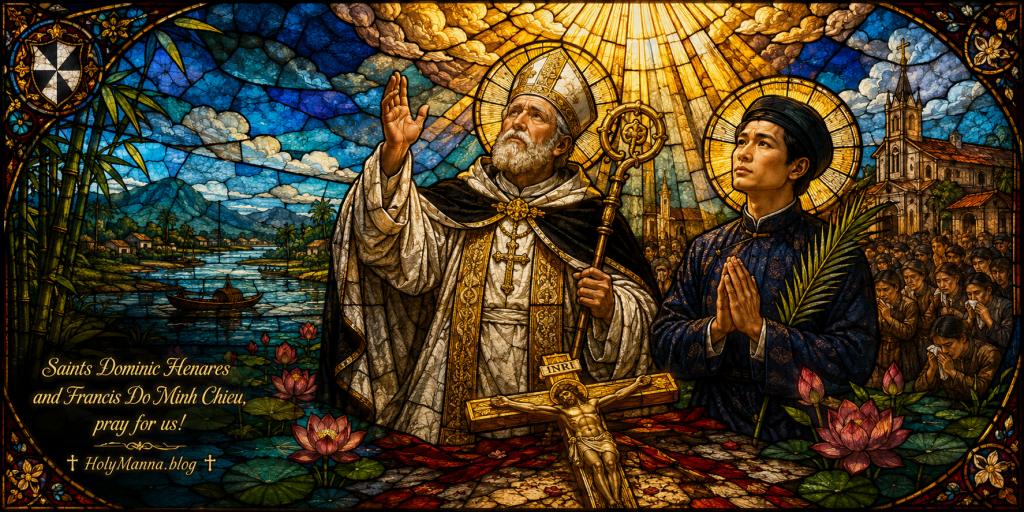
A Bishop, His Catechist, and a Cross They Would Not Trample
June 25 is one of those feast days that does not get nearly enough attention, and that is honestly a shame. The Church gives us two saints today whose story is the kind that makes you put your phone down and just sit with it for a minute. A Spanish bishop who spent 48 years in a foreign country, learned its language in six months, and died at age 73 calling out the name of Jesus. And a Vietnamese catechist, a layman, who walked to his own execution and told a weeping crowd to go home because he and his teacher were on their way to their true homeland. Saints Dominic Henares and Francis Do Minh Chieu were not famous in their lifetimes the way kings and generals are famous. They were a shepherd and his coworker. But together, they show the Catholic Church at its most beautiful and most ferocious — faithful to the very last breath, even when that breath cost them everything.
These two men are among the 117 Vietnamese Martyrs canonized on June 19, 1988, by Pope Saint John Paul II. The Vatican estimates that between 130,000 and 300,000 Catholics were martyred in Vietnam between the 15th and 20th centuries, and the story of Dominic and Francis sits right at the heart of that breathtaking and heartbreaking witness. Their feast day on June 25 invites every Catholic to ask a hard but necessary question: What would it cost to follow Christ today, and would we be willing to pay it?
From the Hills of Spain to the Rivers of Vietnam
Domingo Henares de Zafra Cubero was born on December 19, 1765, in the village of Baena, in the Diocese of Córdoba, Spain. He grew up in a wealthy family, which might make you think his life was going to be a comfortable one. But his mother, a deeply pious woman, made sure that money never became his master. She taught him from childhood to love the poor and to hold worldly comfort loosely. That formation took root in a profound way, because at the age of sixteen, young Domingo felt a pull toward religious life that no amount of wealth or social standing could quiet.
He entered the Dominican Monastery in Niebla, then later transferred to the Monastery of the Holy Cross in Granada, where he received the Dominican habit on August 30, 1783. Within a single year as a novice, Domingo went to his novice master and asked not just to be a friar but to be sent to the missions in the Far East. That kind of boldness from a novice was unusual, to say the least. But the desire was real, and it was holy, and his superiors eventually said yes.
He sailed to the Philippines, completed his theological studies in Manila, and was ordained to the priesthood on September 20, 1789. His superiors in Manila wanted to keep him there. He had talent, he had zeal, and he was exactly the kind of priest a mission province wants to hold onto. But Domingo was not made for staying. On October 29, 1790, he departed the Philippines alongside Bishop Ignacio Delgado and two other Dominican missionaries and sailed for Vietnam, then known to missionaries as Tonkin. They stopped briefly at Macau harbor before crossing into northern Vietnam, which the Vietnamese called Bắc Hà. They arrived on Vietnamese soil on October 29, 1790, and Domingo Henares’s missionary life in Vietnam had begun.
Francis Do Van Chieu, whose full Vietnamese name is Phanxicô Đỗ Văn Chiểu, was born around 1796 or 1797, just a few years after Dominic arrived in the country. He came from Trung Lễ village, in the Liên Thủy parish of Nam Định province, in what is today the Diocese of Bùi Chu, Vietnam. Unlike many saints whose stories begin with a dramatic conversion, Francis was born into a Christian family. His faith was not something he discovered later in life. It was his inheritance, and he chose to honor it completely. After four years of theology formation, he was selected to serve as a catechist and joined the Third Order of Saint Dominic, becoming what the Church calls a Dominican tertiary. This was a way for laypeople to live the Dominican charism of preaching, study, and prayer without entering vowed religious life. Francis was no part-time believer. He was all in.
A Church Built in Hiding, and a Catechist Who Burned for Souls
What Dominic Henares accomplished in Vietnam over the course of his missionary life is remarkable by any measure. Within just six months of his arrival, he was fluent in Vietnamese. Think about that for a moment. A Spanish-speaking friar, newly arrived in Southeast Asia, mastered one of the most tonally complex languages in the world in half a year. His contemporaries clearly saw this as extraordinary, and the Vietnamese people he served gave him a Vietnamese name to honor him: Minh, meaning “bright” or “enlightened.” It was a name that suited him perfectly, as he would spend the rest of his life being a light in the darkness of persecution.
He was appointed Director of the Tiên Chu Seminary, where he also served as Professor of Ascetical Theology and Latin. This is perhaps the most quietly important thing he did. By forming Vietnamese priests in their own language, in their own cultural context, he was building a Church that could survive without foreign missionaries if it needed to. He was not planting a European colony. He was planting the Kingdom of God. In 1798, Bishop Delgado recognized his gifts and appointed him Ecclesiastical Superior, making him the Vicar General of the entire mission. Then, on September 9, 1800, Pope Pius VII appointed him Coadjutor Bishop to eventually succeed Bishop Delgado. His episcopal consecration took place on January 9, 1803, in the parish of Phú Nhai. His fellow Dominican Bishop Hermosilla later wrote of him with admiration, praising his virtue, pastoral zeal, and exemplary life.
For 48 years, Bishop Dominic Henares served Vietnam. He administered sacraments in secret, formed future priests, shepherded a flock living in constant fear, and stayed at his post through waves of persecution that would have driven lesser men home to Spain a dozen times over.
Francis Do Minh Chieu served alongside him as a tireless extension of that pastoral mission. The historical record describes him as a man who burned for the salvation of souls. He once spent time at the bedside of a dying soldier who was being persecuted for his faith, encouraging him and praying with him so that he would not waver at the last moment. When Francis heard that his own younger brother had been arrested for being a Christian, his first response was not to panic or to run. He went to a priest named Father Hiển and asked him to offer two Holy Masses for his brother’s perseverance in the faith. Here is a man who, in the middle of his own danger, thought first about someone else’s soul, and his solution was the Mass. That tells you everything you need to know about Francis Do Minh Chieu.
When a Government Declared War on the Cross
The comfortable window of relative tolerance that Vietnamese Catholics had enjoyed began closing rapidly when Emperor Minh Mang came to the throne in 1820. By 1831, Catholicism was officially prohibited by imperial law. By 1832, a Catholic village near Huế was rounded up and sent into exile. By January 1833, a new empire-wide edict required Vietnamese subjects to publicly renounce Christianity by walking on a wooden cross. Christians who were identified were branded on their faces with the words tả đạo, meaning “false religion.” Entire Catholic families and villages were obliterated. The Vatican would later characterize the tortures inflicted on Christians during this period as among the worst in the entire history of Christian martyrdom, with accounts of limbs being hacked off joint by joint and flesh being torn with red-hot tongs.
Bishop Dominic Henares spent years hiding and ministering in secret during these years. He kept going. He kept the sacraments flowing to a terrified flock. He kept training priests. He kept being a bishop even when being a bishop meant sleeping in a different house every night to avoid arrest.
By the spring of 1838, the net was closing. Dominic and Francis were being actively hunted by imperial authorities. They went into hiding in the village of Kiên-Lao, where they were sheltered alongside Bishop Delgado. Henares managed to slip away temporarily by hiding in a fishing boat, but the boatman, lured by the imperial reward of approximately three kilograms of silver, betrayed his location to the authorities. A detachment of 500 soldiers was sent to arrest one elderly bishop and his lay catechist. Five hundred soldiers. The regime knew exactly how dangerous a faithful Catholic bishop and a committed catechist could be.
Francis and Dominic were separated from Bishop Delgado and imprisoned. Bishop Delgado died of starvation and exposure in a cage on public display while awaiting execution. Dominic and Francis were kept alive for their own trial.
What happened next at that trial is the reason the Church remembers them today.
The mandarin, the imperial judge, ordered both men to do what thousands of other Vietnamese Christians were being forced to do: place their feet on a sacred image of Christ and walk over it. This act was the standard test of apostasy, the government’s way of separating Christians from cowards. It was meant to be a simple administrative procedure. What it became, in the case of Dominic Henares and Francis Do Minh Chieu, was a declaration of theology.
Bishop Dominic Henares looked at the mandarin and said: “Would a mandarin have the heart to let a son trample on the body of his own parents? How could I dare step on the image of the Lord, who created heaven and earth, whom all people must revere and adore? Yet you mandarins tempt me to trample on the Holy Cross; even if my bones are crushed and my flesh torn, I cannot commit such an evil act.”
Francis Do Minh Chieu, who had been tied to a stake and given thirty lashes until he was torn and bloody before being thrown in prison, gave his own answer when the same choice was presented to him: “When Your Honor is resting, would you consent to having your own child step on your face? How much more so for God the Lord of heaven and earth, whom all must worship — how could I dare to step on His image?”
The bishop and the catechist. The ordained minister and the laywoman’s son. They answered in almost the same words without comparing notes. That is what a shared faith does to two people. It makes them say the same things when it matters most.
Despite being severely tortured, Dominic remained absolutely silent under interrogation about the location of other priests and Christians in hiding. He protected his flock even in agony. That silence was itself a form of martyrdom.
The Road to Bảy Mẫu, and a Homeland None of Us Can See Yet
On June 25, 1838, Bishop Dominic Henares and Francis Do Minh Chieu were taken together to the Bảy Mẫu execution ground in Nam Định. They were transported in cages, which was the imperial way of displaying condemned prisoners as objects of public humiliation.
As the procession moved through the streets toward the execution ground, people who loved these men lined the road weeping. They knew what was about to happen. They were watching their bishop and their catechist being carried to their deaths. Francis Do Minh Chieu looked out from his cage and saw their grief, and what he said to them is one of the most extraordinary things ever spoken at the edge of death.
“Brothers and sisters, go home, do not weep anymore; my teacher and I are returning to our true homeland today.”
He called heaven his homeland. He called the execution ground a departure gate. He comforted the people who had come to mourn him.
At the execution ground, Bishop Dominic stepped out of his cage. He called out the Most Holy Name of Jesus three times. He asked for a moment of silence to pray. He knelt on the ground, raised his eyes to heaven, and inclined his head for the executioner. He was 73 years old.
Francis Do Minh Chieu, before kneeling beside his bishop, confessed his sins to Dominic. Then he prayed aloud the words of Luke 23:46: “Lord, I commend my spirit into Your hands.” It was the same prayer Christ made on the Cross. A catechist, to the end, could not help but preach the Gospel. Even his final breath was a Scripture lesson.
They were beheaded together. Two weeks after the death of their beloved Bishop Delgado.
The faithful who had followed them, in defiance of imperial law, gathered the bodies. They buried Francis at the site of his martyrdom. Later, after the persecution ended, his remains were transferred to the church of Trung Lễ parish, where they were kept as a source of prayer and veneration. Bishop Henares’s body was recovered and buried by his successor, Bishop Hermosilla, who would himself eventually die as a martyr, continuing the unbroken chain of witness.
Miracles, Relics, and the Seed That Would Not Die
The Church teaches that the saints in heaven remain active members of the Body of Christ, interceding for the living and, through God’s grace, continuing to work wonders. The Vietnamese martyr corpus, while not as heavily documented with individual post-death miracle accounts as some older saints, carries within it something perhaps even more striking: the miracle of the Church’s survival and growth.
The Vatican estimates that between 130,000 and 300,000 Catholics were martyred in Vietnam. The imperial government of Minh Mang was systematic, brutal, and convinced that it could eliminate Christianity from Vietnamese soil entirely. It failed. Not only did the Church survive, but the blood of the martyrs became, as the great Church Father Tertullian had declared centuries before, Sanguis martyrum, semen Christianorum — the blood of martyrs is the seed of Christians. The Vietnamese Church today is one of the most vibrant Catholic communities in Asia, a direct fruit of the witness of men and women like Dominic Henares and Francis Do Minh Chieu.
The relics of Bishop Dominic Henares are enshrined in Bùi Chu, Vietnam, a place of ongoing Catholic devotion. The remains of Francis Do Minh Chieu were preserved by his own community and translated to the church of his home parish, Trung Lễ, where they have been venerated ever since.
On June 19, 1988, approximately 8,000 exiled Vietnamese Catholics gathered at St. Peter’s Square in Rome for what became one of the largest group canonizations in Church history. Pope Saint John Paul II, at that canonization Mass, declared that “the Vietnamese Church, with its martyrs and its witness, has been able to proclaim its desire and resolve not to reject the cultural traditions and the legal institutions of the country; rather, it has declared and demonstrated that it wants to incarnate them in itself, in order to contribute faithfully to the true building up of the country.” The martyrs did not die as enemies of Vietnam. They died as its most faithful sons and daughters, offering everything they had for a love that transcended every earthly boundary.
The devotion to the Vietnamese Martyrs has spread throughout the Vietnamese Catholic diaspora around the world. There are parishes dedicated to them across the United States, in cities like Arlington and Houston in Texas, in Denver, Seattle, San Antonio, Richmond, and beyond. Vietnamese Catholics celebrate the collective feast of the martyrs on November 24 on the General Roman Calendar and weave remembrance of them into the celebration of the Vietnamese Lunar New Year as well. The martyrs are not distant history for these communities. They are family.
It is also worth noting that the witness of the Vietnamese martyrs touched the heart of Saint Thérèse of Lisieux. The letters and example of Théophane Vénard, a French priest martyred in Vietnam, so moved the young Thérèse that she asked permission to join the Carmelite convent in Hanoi. Tuberculosis prevented her from going. But that a French mystic who never set foot in Vietnam was drawn to give her life for the Vietnamese Church is itself a testament to the spiritual power of what men like Dominic Henares and Francis Do Minh Chieu poured into that land.
What a Bishop and a Catechist Are Asking of Every One of Us
Here is the thing about Saints Dominic Henares and Francis Do Minh Chieu that should stop every Catholic in their tracks: they did not die because they were doing something unusual. They died because they were doing exactly what the Church asks of every single one of its members.
Dominic Henares was doing his job. He was a bishop shepherding his flock. He was a seminary director forming the next generation of priests. He was a preacher, a teacher, a pastor. He did not pick up a sword or lead a political movement. He just refused to stop being Catholic in a country that had made being Catholic illegal.
Francis Do Minh Chieu was doing his job too. He was a catechist, which means he was the person in the parish who taught the faith to ordinary people. He was the Sunday school teacher, the RCIA instructor, the guy who explained the Catechism and walked people through the sacraments. He was a layman who had committed himself to the Dominican Third Order, which meant he took preaching and truth seriously as a vocation, not just a hobby. And when the moment came, he did not waver.
The Catechism of the Catholic Church teaches in paragraph 941 that the laity share in the priestly, prophetic, and royal office of Christ. Francis Do Minh Chieu is the living — or rather the dying — proof of that teaching. His martyrdom demolishes any lazy idea that holiness is the business of priests and nuns while laypeople can keep faith as a weekend activity.
What does it look like to take faith seriously as a layperson today? It does not require a cage or an executioner. But it does require something. It requires saying out loud, in whatever situation presents itself, that Christ is Lord and that no authority on earth can demand otherwise. It requires being willing to be uncomfortable, to be misunderstood, to be called a fanatic for caring about God as much as Dominic and Francis cared.
The Catechism also speaks in paragraph 2132 about the veneration of sacred images, drawing on the ancient teaching of Saint Basil the Great that the honor shown to an image passes to its prototype. When Dominic and Francis refused to trample the image of Christ, they were not being stubborn about a piece of wood. They were affirming the Incarnation. They were saying: this image represents a real Person who really became flesh and really died and really rose, and we will not pretend otherwise with our feet.
Is there something in your life right now that is asking you to quietly step over the Cross? It might not be a literal image on the ground. It might be a conversation where you stayed silent about your faith to avoid awkwardness. It might be a moral question where you bent to social pressure rather than standing on what the Church teaches. The test of Minh Mang’s Vietnam looks dramatic because it was literal. But the same question is being asked of Catholics in quieter, less dramatic ways every single day.
Dominic Henares also gives every Catholic a striking lesson in what it looks like to go where you are sent, even when it is uncomfortable. He left wealthy Spain for a dangerous mission. He learned a foreign language in six months. He took a Vietnamese name. He formed Vietnamese priests to lead a Vietnamese Church. He understood that the Gospel had to become native, not imported. He never made being Catholic mean being Spanish. He trusted the Holy Spirit enough to let the faith take root in a completely different soil. That kind of missionary humility is something the whole Church needs right now in a culture that often mistakes the packaging for the content.
And Francis Do Minh Chieu reminds every Catholic that the sacramental life of the Church is not a decoration on top of real life. It is the response to real life. When his brother was in danger, he ran to the Mass. When he walked to his death, he made his confession. When he died, he prayed the words of Christ on the Cross. For Francis, the sacraments were not religious obligations. They were the very oxygen of his soul.
What would it look like to treat the sacraments that way today? Not as boxes to check but as lifelines. Not as things to get through but as encounters with the living God who is walking every Catholic toward their own true homeland, just as Francis said on that road to Bảy Mẫu.
The Church needs more Dominics and more Francises. It needs bishops who will form the next generation even under pressure. It needs catechists who burn for the salvation of souls. It needs laypeople who understand that their baptism made them warriors of prayer and witness, not spectators. And it needs all of them to be willing to say, when the moment demands it, that they will not trample the Cross no matter what it costs.
That is what June 25 is asking of every Catholic who pauses long enough to let these two men’s stories land.
Engage With Us!
Saints Dominic Henares and Francis Do Minh Chieu gave everything, and their stories deserve to live in the hearts of Catholics everywhere. Share your thoughts and reflections in the comments below, because this community is built on exactly the kind of conversation that these two saints gave their lives to spark.
- Dominic Henares learned Vietnamese in six months and took a Vietnamese name because he understood that the Gospel must enter a culture from within. Where in your own life is God asking you to go deeper into someone else’s world in order to bring Christ there?
- Francis Do Minh Chieu’s first response to his brother’s arrest was to request two Holy Masses for his perseverance. How central is the Mass in your response to the crises and fears in your own life, and what would it look like to make it even more central?
- Both Dominic and Francis refused to trample the image of Christ, each giving a remarkably similar answer without knowing what the other had said. Is there a “soft” version of trampling the Cross in your own daily life, a moment where faith gets quietly set aside to avoid discomfort, and what would it look like to stand firm there?
- Francis told the weeping crowd: “My teacher and I are returning to our true homeland today.” How does it change the way you move through daily life when you genuinely believe that heaven, not this world, is where you ultimately belong?
- The Vietnamese Church survived and grew even after 130,000 to 300,000 of its members were martyred. Where do you see the blood of martyrs bearing fruit in the Church today, and how does their witness encourage your own faithfulness?
Keep going. Keep showing up. Keep refusing to step over the Cross, in whatever form that challenge takes in your corner of the world. The saints are cheering from the other side of the finish line, and the God who gave Dominic Henares the courage to call out the name of Jesus three times at the edge of a blade is the same God who is walking with every one of us through whatever we are facing right now. He does not abandon His people. He proved it on a hill outside Jerusalem, and He proved it again on a field called Bảy Mẫu in 1838.
Saints Dominic Henares and Francis Do Minh Chieu, pray for us!
Follow us on YouTube, TikTok, Instagram and Facebook for more insights and reflections on living a faith-filled life.


Leave a comment