The Hermit Who Turned a Mountain into a Miracle
June 25 belongs to one of the most quietly extraordinary figures in all of Catholic hagiography. Saint William of Vercelli, also known as Saint William of Montevergine, is not a household name in most Catholic circles outside of southern Italy, and yet his life reads like something out of a medieval adventure epic: a teenage nobleman who walked barefoot across Europe wearing iron bands as penance, who tamed a wild wolf with a command, who lay down on burning coals to prove the purity of his heart, and who carved a Marian sanctuary out of a remote mountain that still draws over one and a half million pilgrims every single year.
He is the patron saint of Irpinia, a region in southern Italy, and his statue stands among the great founders of religious life in none other than Saint Peter’s Basilica in Rome. Pope Pius XII formally declared him the primary patron of Irpinia in 1942, eight hundred years after his death, and Pope Pius VI had canonized him in 1785. The Church has remembered him faithfully every June 25 for nearly nine centuries.
Saint William was a hermit first and a founder second, but history did not leave him the luxury of pure solitude. His holiness was magnetic. People could not stay away from him. And in that beautiful tension between the silence he craved and the souls who kept finding him, an entire spiritual legacy was born: a living monastery, a Marian shrine, a community of monks who still wear his white habit to this day.
Born Into Nobility, Orphaned Into God’s Hands
William was born around the year 1085 in Vercelli, a city in the Piedmont region of northwestern Italy, into a family of noble standing. Before he was old enough to understand what nobility even meant, both of his parents died, leaving him an orphan in the care of a pious relative. It would have been easy for a story like his to end there, absorbed into the comfort and privilege that his family name still afforded him. Instead, something else was stirring deep in the boy’s soul.
The devout household in which he was raised shaped him profoundly. By the time William reached his early teenage years, he had developed an interior life that his peers likely could not fully understand. He was not interested in inheriting estates or climbing the social ladder of medieval Italian nobility. He was interested in God, and that interest had the intensity of a fire that needed somewhere to go.
At around fourteen or fifteen years of age, William made a decision that changed everything. He gave up his noble title, put on a tattered pilgrim’s habit, and left Vercelli on foot, barefoot, heading for the great shrine of Saint James of Compostela in northern Spain. He did not go as a tourist or a man seeking adventure. He went as a penitent, a young man who had already understood something about the Cross that most adults spend a lifetime trying to avoid.
The detail that makes William’s pilgrimage unforgettable is what he asked a blacksmith to fashion for him before he set out: an iron implement designed to encircle his body and increase his physical suffering throughout the entire journey. He wore it every step of the way across the roads of medieval Europe. This was not a morbid act of self-destruction. It was a deliberate, chosen participation in the suffering of Christ, a way of uniting his body’s pain to the prayer of his soul, placing everything he had on the altar of love for God.
The journey to Compostela took approximately five years. He walked the entire distance, lived on bread and water, slept on the bare earth, and preached the Gospel to everyone he encountered along the road. Vatican News captures him in a single phrase: he “spoke intimately with God and proclaimed the Gospel to those he met.” That sentence is the whole man in miniature. Prayer and mission. Solitude and proclamation. These two forces would shape the rest of his life in everything he did.
Robbery, a Divine Redirection, and a Mountain Called the Virgin’s Own
After returning from Compostela, William set his sights on Jerusalem. He made his way south through Italy toward a port in Apulia from which he intended to sail for the Holy Land. Near the city of Brindisi, a band of thieves set upon him on the road. Finding that the wandering pilgrim had nothing worth stealing, they beat him savagely and left him to recover as best he could.
This is where the story takes a turn that only makes sense through the lens of faith. Rather than cursing his misfortune or simply rerouting his pilgrimage, William read the attack as a message from God. He interpreted the robbery and the beating as a divine sign that Italy was where he was meant to stay and serve. He sought out a holy man named Giovanni da Matera, himself a future saint of the Church, who confirmed this reading and encouraged William to dedicate his life to proclaiming the Gospel in the south of Italy. This was no small counsel. It redirected the entire trajectory of a man’s life.
This moment is worth pausing over carefully. The Catechism of the Catholic Church teaches that God never ceases to draw humanity toward himself, and that He does so through the ordinary and extraordinary events of human life alike. As CCC 27 reminds us, the desire for God is written in the human heart, and God never stops calling us toward himself. For William of Vercelli, a violent robbery on a dusty road in Apulia became the hinge on which his entire vocation turned. The worst moment of his journey was secretly the best thing that could have happened to him.
In the year 1118, William made his way to the Irpinia region of southern Italy and climbed into the wild, remote Partenio mountain range. He first lived as a hermit at a place called Monte Solicoli, where the earliest accounts credit him with healing a blind man through prayer. He then moved to a mountain then known as Monte Vergiliano, and it was here that the defining work of his life truly began.
According to a tradition preserved in Catholic hagiography, while William’s mind was absorbed in contemplative prayer on the mountain, Christ himself appeared to him. The Redeemer ordered him to build a church in honor of His divine Mother, using the disciples who had already begun to gather around the solitary hermit. William obeyed without hesitation. He began mining rocks from the mountain by hand, with the assistance of a lone donkey, to construct a church dedicated to the Blessed Virgin Mary. He renamed the mountain in her honor. It became Monte Vergine, the Mountain of the Virgin, a name it carries to this very day. The first church on the site was consecrated in 1126.
The Wolf Who Became a Workhorse
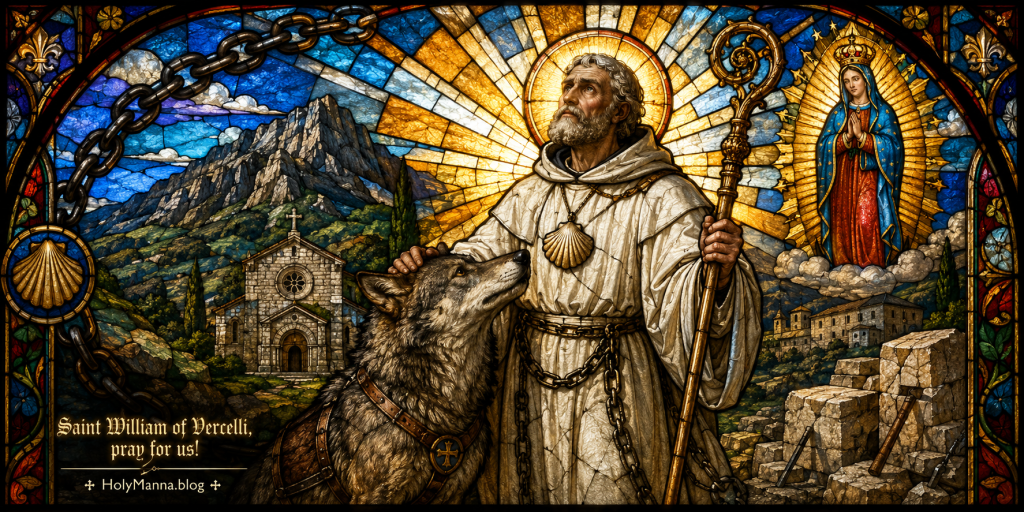
Of all the stories associated with Saint William of Vercelli, none is more beloved, more visually memorable, or more consistently present in Catholic art than the Miracle of the Wolf. This legend has defined his iconography across every century since his death, and it is the story most likely to make a first-time reader stop and read the whole thing twice.
According to the holy legend preserved across multiple Catholic sources, one evening while William and his disciples were laboring to build the church on Monte Vergine, a wild wolf attacked and killed the donkey William had been using to haul stones from the quarry. The work halted. The animal was gone. Construction of the church dedicated to Our Lady would have to pause.
William did not lament the loss or go searching for a replacement. He turned to face the wolf. He called the creature to him and commanded it, in the name of God, to take the donkey’s place and continue hauling the rocks needed for the church. According to the legend, the wolf bowed before the saint as if recognizing that it had interrupted the work of God, took up the task it had been assigned, and dragged rocks from the quarry faithfully from that day forward.
This story echoes through the entire tradition of Catholic hagiography. Saints who hold a kind of spiritual authority over wild animals, from Saint Francis of Assisi and the wolf of Gubbio to Saint Jerome and the lion, are understood in Catholic theology not as performing magic but as participating in a restoration of the original harmony between humanity and creation that existed before the Fall. When a soul is fully surrendered to God, creation responds to the peace it recognizes. CCC 2415 reminds us that humanity was given stewardship over creation, not domination for its own sake, and saints like William demonstrate what that stewardship looks like when it is animated by genuine love for the Creator.
Because of this legend, Saint William is depicted in art and sculpture almost always with a domesticated wolf at his side, sometimes wearing a saddle or harness. His founder’s statue at Saint Peter’s Basilica in Rome carries this image, placing the wolf of Irpinia permanently in the center of the Church’s most sacred space.
The Trial of the Disgruntled Monks and the Courage to Walk Away
Word of William’s holiness spread rapidly through the region. People came seeking his counsel and his prayers, and gradually a community formed around him. By 1119, the Congregation of Monte Vergine was formally founded, and William became its abbot, a role he had never sought and never coveted. He led not by writing elaborate rules but by example, spending the most hours in prayer, undertaking the most severe penances, and giving away in alms everything that came to the monastery beyond what was strictly necessary to survive.
This was, by medieval monastic standards, an extraordinarily austere life. No meat. No eggs. No dairy. Constant manual labor and unceasing prayer. Radical poverty taken to its most literal expression. For those drawn to William by his holiness, it was a graced way of life. For others who arrived with perhaps a less heroic understanding of what they were signing up for, it became a source of growing resentment.
The monks began to murmur. The life was too hard, they said. William gave away too much. The rule was too strict. In most human institutions, this would be the beginning of a conflict: the founder defending his vision, the community dividing, sides being taken and arguments being made.
William did none of that. He left. Not in anger, and not in defeat, but in a humility so deep it is almost breathtaking to read about. He concluded that if his presence was the source of the community’s discontent, the most loving thing he could do was remove himself so the monastery he had built could survive and thrive in peace. He walked away from the mountain he had renamed for the Virgin, from the church he had built stone by stone with his own hands, from the community he had founded, because he loved all of it too much to watch it fracture over his own person.
The Catechism teaches in CCC 2559 that humility is the very foundation of prayer, because only the one who recognizes his own smallness before God is in a posture to receive what God wants to give. William had not just read that lesson in a book. He lived it out in the most costly and concrete way imaginable, and the monastery he walked away from survived for centuries because of it.
A King’s Court, a Test of Fire, and a Conversion That Built a Monastery
After leaving Monte Vergine, William traveled through southern Italy and came under the patronage of King Roger of Naples, associated historically with Roger II of Sicily. The king was so moved by the sanctity of William’s life and the wisdom of his counsel that he constructed an entire monastery opposite his own palace in Salerno, simply to ensure that William remained near him. This detail speaks volumes about the spiritual authority William carried into every room he entered: even kings rearranged their palaces around him.
A striking legend from this period of William’s life was recorded by the hagiographer Tommaso Costo in 1591. According to this account, a woman at the royal court decided to test whether William’s famous virtue was genuine or merely a kind of public performance. With the king’s knowledge, she entered William’s room at night with the intent of seducing him.
William’s response was neither a lecture nor a flight from the room. He gathered burning coals and placed them on his bed. Then he lay down upon them and invited the woman to do the same. The legend holds that the coals did not burn him. The woman was shaken to the core of her being. She not only left without achieving her aim but repented entirely of what she had attempted and converted from her former way of life. Later sources add that the woman’s name was Agnes, and that after her conversion she went on to found a monastery of her own in the town of Venosa, living the rest of her days as a religious woman and coming to be known as Blessed Agnes of Venosa.
This account originates from a 1591 literary source and carries the weight of holy legend rather than verified historical fact. It is included here as legend and cannot be independently confirmed. That said, it belongs to a well-established pattern in Catholic hagiography: the test of a saint’s virtue that ends in the conversion of the one who brought the test. From the Desert Fathers of Egypt through the medieval mystics, the tradition has recorded such moments as evidence that a soul sufficiently saturated with divine fire becomes untouchable by every lesser flame.
What is historically confirmed, and documented in the Catholic Encyclopedia and multiple primary sources, is that William founded numerous monasteries for both men and women throughout southern Italy and Sicily during this period, and that the king’s respect and admiration for him never diminished throughout their relationship.
A Holy Death Foreseen and a Life’s Work Left Standing
In the final decades of his life, William continued to plant new communities across southern Italy. He established the Abbey of San Guglielmo al Goleto in the territory between Campania and Basilicata, and this place became the primary home of his last years. He founded hermitages and communities at Monte Laceno, Basilicata, Conza, Guglietto, and Salerno. By the time death approached, he had established a network of communities rooted in radical poverty, intense contemplative prayer, and passionate devotion to the Mother of God.
Catholic tradition, drawing on the earliest hagiographic source about his life, the Legenda de vita et obitu sancti Guilielmi Confessoris et heremitae, records that God gave William a special revelation informing him that his death was imminent. He gathered himself, retired to the monastery at Goleto, and died peacefully on June 25, 1142, the same date now celebrated every year as his feast day. The Catholic Encyclopedia notes simply: “Knowing by special revelation that his end was at hand, William retired to his monastery of Guglieto, where he died, and was buried in the church.”
He was buried at Goleto. In 1807, by order of Gioacchino Murat, King of Naples, his remains were transferred to the sanctuary at Montevergine, where they rest to this day in the crypt of the great basilica. Catholic tradition holds that his body is incorrupt, a sign the Church has long recognized as consistent with extraordinary holiness, though incorruption is not itself a formal requirement for canonization. Some of his relics are also distributed among churches in the Benevento cathedral and other sites in Campania.
A Mountain That Never Stopped Drawing Souls Home
The miracles associated with Saint William did not end at his death. On the contrary, the sanctuary he founded became one of the most powerful pilgrimage sites in all of southern Italy, and its long history of reported graces stands as an ongoing testimony to his intercession before God.
During his lifetime, the healing of a blind man at Monte Solicoli is among the earliest verified miraculous accounts. The Catholic Encyclopedia and every major Catholic source record that the people who came to Monte Vergine did so precisely because they were attracted by the many miracles William performed. The Legenda de vita et obitu sancti Guilielmi, the most reliable primary source about his life written in the first half of the 13th century, confirms his miraculous works. The broader tradition also includes his ability to foresee his own death as a gift of divine revelation, placing him in the company of saints such as Padre Pio and Philip Neri who received similar prophetic graces.
After William’s death, the Sanctuary of Montevergine became a focal point for accounts of graces received through his intercession and through the intercession of Our Lady of Montevergine. The ex-voto room in the basilica complex houses hundreds of years of offerings left by pilgrims in thanksgiving for healings, deliverances, and divine interventions. These offerings, ranging from jewels and artwork to handwritten testimonies, span the centuries from William’s era to the present day.
The sanctuary was consecrated in 1126 and quickly became the mother church of smaller Marian communities throughout the region. The Angevin kings of Naples took it under their patronage from 1266 to 1435, transforming and expanding the original structure along Gothic architectural lines. A Baroque renovation came later, and in 1961 a new Neo-Gothic basilica was added to the complex. Today the Sanctuary of Montevergine is an Italian national monument.
The most venerated object in the sanctuary today is the icon of the Madonna di Montevergine, also known as the Black Madonna or Mamma Schiavona, an image of the Virgin Mary enthroned with the Christ Child. The icon is believed by some traditions to have origins tracing back through Constantinople, with parts of it attributed by legend to Saint Luke the Evangelist himself, though scholarly analysis conducted during the Second Vatican Council era attributed the painting to the school of Pietro Cavallini, a Roman artist active in Naples around the year 1300. The icon was installed at Montevergine around that time and has been the heart of Marian devotion at the site ever since.
The cultural and spiritual impact of Saint William’s legacy on the Irpinia region of southern Italy cannot be overstated. Ancient pilgrimage customs surrounding the sanctuary include women intertwining broom branches on the ascent and promising to return with a future spouse, young girls making the climb barefoot on behalf of others in thanksgiving, and men conducting ceremonial chariot races called recanata on the descent. These traditions, some stretching back centuries, reflect the deep and living bond between the people of this region and the mountain their saint consecrated to the Virgin Mary.
Approximately one and a half million pilgrims visit the Sanctuary of Montevergine every year. That number is not a relic of a distant era. It is the present-day harvest of seeds a young orphan from Vercelli planted on a remote mountain in 1118, with iron bands on his body and the name of Mary on his lips.
What a Medieval Hermit Has to Say to a Modern Catholic
There is a reason people today are hungry for silence, for contemplative practice, for something that feels genuinely real in a world drowning in noise and distraction. Saint William of Vercelli felt that hunger in the 12th century, and he found his answer not in escapism but in a radical orientation of his entire life toward God. His story has things to say to every Catholic trying to live faithfully in the 21st century.
First, there is the question of what to do when a plan completely falls apart. William planned to walk to Jerusalem. He got beaten and robbed on a road in Apulia instead. He could have limped back to Vercelli, reclaimed his family’s social standing, and lived a comfortable and entirely respectable life. He chose instead to read the disaster as a divine redirection. How often does a closed door, a lost job, a broken relationship, or an unexpected illness get treated as pure misfortune rather than as God pivoting a life toward something it could never have reached by the original route? William’s example does not minimize the pain. He was genuinely beaten and left bruised on a road. But he brought that pain into conversation with God, and God turned it into an eight-hundred-year pilgrimage site.
Second, there is the challenge of humility within community. When his monks complained about the severity of his leadership, William did not launch a defense of his methods or appeal to his authority as founder. He walked away. This is possibly the most counter-cultural move imaginable in any century, but especially in this one. The age of personal branding, platform defense, and curated public identity has almost no room for this kind of radical self-surrender. And yet CCC 2546 reminds us that the poverty of heart the Beatitudes promise belongs to those who cling not to their own position or reputation but to God alone. William’s departure from Monte Vergine was not a failure. It was the most powerful thing he ever did for the community he loved.
Third, there is the invitation to build everything in honor of the Blessed Virgin Mary. Every community William founded, every church he erected, every monastery he established was ordered toward the worship of Christ and the honor of His Mother. He renamed a mountain after her. He built her a church by hand. He gave her the best real estate on the ridge. In a cultural moment that finds Marian devotion puzzling or excessive, William’s entire biography stands as a joyful and direct challenge: What would it look like to build the next season of your life, your marriage, your work, your creative output, entirely in honor of the Mother of God?
Practically speaking, the invitation from Saint William’s life is both simple and demanding: find the silence. Even twenty minutes each day of genuine quiet before God, carved deliberately out of a busy schedule like a hermit’s cell in the middle of an ordinary house, can begin to do what it did for William. It opens a space in which God can redirect, humble, heal, and commission. The iron bands William wore on pilgrimage were a chosen instrument of focus, a way of saying with his body that this journey was not a vacation but a consecration. Every Catholic has the same choice to make. The instruments are simply different.
Engage With Us!
Saint William of Vercelli reminds us that God can turn any hardship into a holy direction, and that a life built on silence, humility, and passionate devotion to Our Lady is never small, no matter how hidden it looks from the outside. Share your thoughts and reflections in the comments below. This community exists for honest, faith-filled conversation, and your perspective genuinely matters to everyone here.
- Has there ever been a moment in your life when something that looked like a disaster turned out to be God redirecting you toward something you never could have reached on your original path? How did you recognize it for what it was?
- Saint William walked away from everything he had built in order to protect the community he loved. Is there an area of your life right now where God might be inviting you to let go of something, a position, a plan, a grudge, a need to be right, for the sake of something greater?
- William wore iron bands on his pilgrimage as a chosen instrument to stay focused on God rather than on his own comfort. What are the small, practical decisions you can make this week to create more intentional space for prayer and silence in the middle of your ordinary life?
- The monastery William founded still draws one and a half million pilgrims a year, nearly nine centuries after he built it with his own hands on a remote mountain. What small act of faithfulness in your own life do you believe God might be using right now to build something that outlasts you?
- The monastery William founded still draws one and a half million pilgrims a year, nearly nine centuries after he built it with his own hands on a remote mountain. What small act of faithfulness in your own life do you believe God might be using right now to build something that outlasts you?
Every saint started exactly where you are standing right now: in the middle of an ordinary life, trying to hear an extraordinary God. Keep going. Pray boldly. Give generously. Build everything in love. And do all of it with the mercy and tenderness that Jesus himself modeled for every one of us. For more reflections on the saints, the Mass readings, and the beauty of the Catholic faith, visit HolyManna.blog and join the conversation.
Saint William of Vercelli, pray for us!
Follow us on YouTube, TikTok, Instagram and Facebook for more insights and reflections on living a faith-filled life.

 Holy Manna!
Leave a comment