Thursday of the Twelfth Week in Ordinary Time – Lectionary: 374
When the House Comes Down
There is a moment most people recognize, even if they have never had words for it. It is the moment when something that looked solid turns out not to be. A relationship, a career, a version of yourself that you had carefully constructed over years suddenly cracks under pressure, and you are left standing in the rubble wondering how you did not see it coming. That moment is not just a personal experience. It is, as it turns out, one of the oldest stories in the Bible.
Thursday of the Twelfth Week in Ordinary Time brings together three readings that are startling in how well they speak to each other, and how directly they speak to life right now. 2 Kings 24:8-17 drops the reader into the final, agonizing collapse of Jerusalem. Psalm 79 gives voice to the grief, confusion, and desperate prayer of a people sitting in the rubble of everything they thought was permanent. And then Matthew 7:21-29 closes the loop with the most sobering words Jesus ever spoke at the end of the Sermon on the Mount, warning that a house built on sand does not just look fragile. It looks exactly like a house built on rock, right up until the storm arrives.
The central theme threading through all three readings is both uncomfortable and deeply necessary: it is not enough to claim God. It is not enough to use His name, attend the Temple, perform the rituals, or even do impressive things in His honor. What God has always required, from the kings of Judah to the crowds listening to Jesus on the hillside, is something far more costly and far more intimate. He requires obedience. He requires that the life a person actually lives matches the God that person claims to follow.
To understand why this theme lands with such force, it helps to know something about the world these readings come from. By the time 2 Kings 24 opens its scene, the Kingdom of Judah had been warned for generations. Prophet after prophet had stood in the streets of Jerusalem and declared that the covenant with God was not a cultural inheritance to be assumed. It was a living relationship that demanded fidelity. Isaiah had said it. Micah had said it. Jeremiah had been saying it so persistently that the king before Jehoiachin had literally burned his scroll to make him stop. The people had the Temple, the sacrifices, the prayers, and the lineage of David. What they did not have was a heart that matched any of it.
This is not ancient history in the distant sense. The framework the sacred authors of 2 Kings used to interpret Jerusalem’s fall came directly from Deuteronomy, specifically the covenant blessings and curses laid out in chapter 28. Obedience to God brings life and flourishing. Persistent infidelity brings collapse. This was not presented as a threat but as a description of reality, the way a physician describes what happens to a body that is chronically malnourished. The body of Judah had been malnourished for a long time, and Nebuchadnezzar was simply the moment the symptoms became impossible to ignore.
Jesus is standing inside that same tradition when He closes the Sermon on the Mount. His audience knew the history. They knew what happened to Jerusalem. They had prayed Psalm 79 in their synagogues. So when He says that a house built without obedience to His words will collapse completely, He is not introducing a new idea. He is bringing an ancient truth to its sharpest possible point, and placing Himself at the center of it. Is it possible that the most dangerous spiritual condition is not doubt, but the comfortable assumption that belonging to God requires nothing more than saying so?
First Reading – 2 Kings 24:8-17
The Day the Temple Went Silent
There are moments in history that feel like a door slamming shut. The fall of Jerusalem to Babylon was one of those moments. For the people of Judah, the city of Jerusalem was not just a capital. It was the place where heaven and earth met, where the Temple of Solomon stood as the visible sign of God’s dwelling among His people. And in 597 BC, in the span of a few devastating weeks, it was all carried away. What 2 Kings 24:8-17 records is not simply a military defeat. It is the theological reckoning of a people who had been warned for generations and had chosen, again and again, not to listen.
To understand the weight of this passage, it is important to know what Judah looked like spiritually by this point. The Northern Kingdom of Israel had already been destroyed by Assyria over a century earlier in 722 BC, and that catastrophe had done almost nothing to change Judah’s course. The prophets had been relentless. Isaiah, Micah, Habakkuk, and most urgently Jeremiah had all declared the same essential message: the covenant with God was a living relationship, not a cultural inheritance. It required fidelity, justice, and worship directed exclusively at the God of Israel. Instead, the kings of Judah had filled Jerusalem with foreign gods, oppressed the poor, and treated the Temple as a kind of lucky charm while living however they pleased. Jehoiachin’s father, Jehoiakim, had gone so far as to burn the scroll of Jeremiah’s prophecies in the royal fire. The warnings had been given. The warnings had been ignored. And now Nebuchadnezzar was at the gates.
2 Kings 24:8-17 – New American Bible (Revised Edition)
Reign of Jehoiachin. 8 Jehoiachin was eighteen years old when he became king, and he reigned three months in Jerusalem. His mother’s name was Nehushta, daughter of Elnathan, from Jerusalem.
9 He did what was evil in the Lord’s sight, just as his father had done.
10 At that time officers of Nebuchadnezzar, king of Babylon, attacked Jerusalem, and the city came under siege. 11 Nebuchadnezzar, king of Babylon, himself arrived at the city while his officers were besieging it. 12 Then Jehoiachin, king of Judah, together with his mother, his ministers, officers, and functionaries, surrendered to the king of Babylon, who, in the eighth year of his reign, took him captive. 13 He carried off all the treasures of the house of the Lord and the treasures of the king’s house, and broke up all the gold utensils that Solomon, king of Israel, had provided in the house of the Lord, as the Lord had decreed. 14 He deported all Jerusalem: all the officers and warriors of the army, ten thousand in number, and all the artisans and smiths. Only the lowliest of the people of the land were left. 15 He deported Jehoiachin to Babylon, and the king’s mother, his wives, his functionaries, and the chiefs of the land he led captive from Jerusalem to Babylon. 16 All seven thousand soldiers of the army, and a thousand artisans and smiths, all of them trained warriors, these too the king of Babylon brought captive to Babylon. 17 In place of Jehoiachin the king of Babylon made Mattaniah, Jehoiachin’s uncle, king; he changed his name to Zedekiah.
Detailed Exegesis
Verse 8: “Jehoiachin was eighteen years old when he became king, and he reigned three months in Jerusalem. His mother’s name was Nehushta, daughter of Elnathan, from Jerusalem.”
The sacred author opens with details that seem almost mundane until you sit with them. Jehoiachin was eighteen years old. He inherited a kingdom already spiritually bankrupt and militarily surrounded. The mention of his mother, Nehushta, is not incidental. In the royal court of Judah, the queen mother held significant influence, and her inclusion here signals that this collapse involved the entire household of the king, not just one man’s poor decisions.
Verse 9: “He did what was evil in the Lord’s sight, just as his father had done.”
This single sentence is one of the most efficient and devastating verdicts in all of Scripture. The sacred author does not need paragraphs to make the point. Jehoiachin had barely taken the throne before the moral assessment was already written. The phrase “just as his father had done” points to something important: sin has a generational momentum. Jehoiakim had modeled contempt for God’s Word, and his son walked right into the same posture. The Catechism of the Catholic Church speaks to this reality in CCC 1869, which states that “sins give rise to social situations and institutions that are contrary to the divine goodness. ‘Structures of sin’ are the expression and effect of personal sins.” What we see in Judah’s royal line is exactly that: personal sin hardening into a structural pattern that eventually collapses the whole structure.
Verse 10: “At that time officers of Nebuchadnezzar, king of Babylon, attacked Jerusalem, and the city came under siege.”
The Babylonian siege of Jerusalem in 597 BC was not a surprise to anyone who had been paying attention to the prophets. What the sacred author wants the reader to understand is the connection between the moral verdict in verse 9 and the military reality in verse 10. These two events are not coincidental neighbors on the page. They are cause and consequence. The Deuteronomistic theological framework that shapes the entire Books of Kings makes this explicit: infidelity to the covenant invites the curses described in Deuteronomy 28, and foreign domination is chief among them.
Verse 11: “Nebuchadnezzar, king of Babylon, himself arrived at the city while his officers were besieging it.”
The personal arrival of Nebuchadnezzar is a significant detail. This was not a minor skirmish handled by a general. The most powerful ruler on earth showed up at the walls of Jerusalem himself. The contrast is almost unbearable: the king God had chosen to reign over His city now faces the king of a pagan empire, and there is no miraculous deliverance coming this time.
Verse 12: “Then Jehoiachin, king of Judah, together with his mother, his ministers, officers, and functionaries, surrendered to the king of Babylon, who, in the eighth year of his reign, took him captive.”
Jehoiachin surrendered. The whole royal household, the entire apparatus of power and administration, walked out of Jerusalem and gave themselves over to Nebuchadnezzar. The phrase “in the eighth year of his reign” provides a precise historical anchor that archaeologists and historians have actually confirmed through Babylonian records, giving this passage remarkable historical credibility. The surrender of Jehoiachin is also cited later in the prophecy of Jeremiah 22:24-30, where God says of him that even if he were a signet ring on God’s right hand, He would pull him off. The prophet had seen this coming.
Verse 13: “He carried off all the treasures of the house of the Lord and the treasures of the king’s house, and broke up all the gold utensils that Solomon, king of Israel, had provided in the house of the Lord, as the Lord had decreed.”
This verse is the theological heart of the passage. The treasures of the Temple, the gold vessels that Solomon had consecrated to God’s worship, were stripped and carried to Babylon. The phrase “as the Lord had decreed” is critical. The sacred author is not presenting this as a defeat of God by Babylon. He is presenting it as God’s own judgment being executed through the instrument of a pagan king. CCC 304 affirms this understanding of divine providence: “And so we see him at work in the providence of things, using both willing and unwilling instruments to carry out his design.” Nebuchadnezzar did not win because his gods were stronger. He won because the God of Israel used him to discipline a people who had abandoned their covenant.
Verse 14: “He deported all Jerusalem: all the officers and warriors of the army, ten thousand in number, and all the artisans and smiths. Only the lowliest of the people of the land were left.”
Ten thousand people removed in a single deportation. Babylon’s strategy was ruthlessly effective: take the leadership, the military, the skilled workers, and the intellectuals, and leave behind those who could not organize resistance. But the detail that stays with the reader is the last line: “Only the lowliest of the people of the land were left.” The forgotten ones, the people the powerful had overlooked and dismissed, were the ones who remained on the land God had given His people. There is something quietly prophetic about that.
Verse 15: “He deported Jehoiachin to Babylon, and the king’s mother, his wives, his functionaries, and the chiefs of the land he led captive from Jerusalem to Babylon.”
The king, the queen mother, the wives, and all the chiefs: the entire governing class of Judah was now in Babylon. The line of David, which God had promised would endure forever in 2 Samuel 7, now sat captive in a foreign empire. To the people of Israel, this must have felt like the end of everything. It was, instead, the beginning of a profound purification.
Verse 16: “All seven thousand soldiers of the army, and a thousand artisans and smiths, all of them trained warriors, these too the king of Babylon brought captive to Babylon.”
The numbers here are precise and staggering. Seven thousand soldiers. A thousand skilled craftsmen. The entire productive and defensive capacity of Judah was now gone. What remained was a hollowed-out shell of a kingdom, a remnant of the poor with no capacity to resist what would come next.
Verse 17: “In place of Jehoiachin the king of Babylon made Mattaniah, Jehoiachin’s uncle, king; he changed his name to Zedekiah.”
The renaming of Mattaniah as Zedekiah is an act of dominance. In the ancient Near East, renaming a person or a king signified authority over them. Nebuchadnezzar was not just installing a puppet. He was making a statement about who held ultimate power over the throne of David. The name Zedekiah means “the Lord is my righteousness” and carries a bitter irony: the man bearing a name invoking God’s righteousness would go on to be the last king of Judah, presiding over the final, total destruction of Jerusalem in 586 BC.
Teachings
The theological argument of 2 Kings 24 operates on a framework that the Jewish audience understood deeply. The Books of Kings were composed and edited through what scholars call the Deuteronomistic lens, meaning that all of Israel’s history is interpreted through the covenant spelled out in Deuteronomy. Fidelity to God brings blessing; infidelity brings the curses of Deuteronomy 28, which include, almost word for word, exactly what happens in this passage: siege, deportation, foreign domination, and the loss of the land.
But the Catholic reading of this passage goes deeper than a simple moral equation of obedience equaling reward. The great Fathers of the Church saw in the exile a figure of the soul’s captivity to sin. Origen, one of the earliest and most prolific Christian interpreters of Scripture, wrote that whenever the soul turns away from God and toward the world, it enters its own Babylon. The exile was not just something that happened to Israel. It is something that happens to every human being who builds their life on something other than God.
St. Augustine, in The City of God, drew a profound contrast between Babylon as the figure of the earthly city built on pride and self-love, and Jerusalem as the figure of the City of God built on love of God and neighbor. Augustine saw in the fall of Jerusalem a warning for every civilization and every soul that mistakes external religious practice for genuine interior transformation. His words in The City of God, Book XVII are worth sitting with: “The earthly city glories in itself, the Heavenly City glories in the Lord. The one seeks glory from men, the other finds its highest glory in God.”
The Catechism addresses the reality of communal sin and its consequences in CCC 1869: “Sins give rise to social situations and institutions that are contrary to the divine goodness. ‘Structures of sin’ are the expression and effect of personal sins. They lead their victims to do evil in their turn.” This is precisely what happened in Judah. The sins of individual kings accumulated into a national spiritual condition that made the Babylonian exile not just possible but, in the providence of God, necessary.
It is also worth noting what the exile was not. It was not the end of God’s love for Israel. The prophet Jeremiah, writing to the exiles in Babylon in Jeremiah 29:11, delivered one of the most quoted promises in all of Scripture: “For I know well the plans I have in mind for you, declares the Lord, plans for your welfare and not for woe, so as to give you a future of hope.” The exile was discipline, not abandonment. It was a painful purification ordered toward restoration. And this is the Catholic understanding of suffering more broadly: God does not waste pain. He redeems it.
Reflection
What does it look like in daily life to claim God on Sundays but live by a completely different set of values from Monday to Saturday? The kings of Judah were not atheists. They performed the Temple rituals. They had the lineage, the traditions, and the prayers. What they lacked was a life that actually corresponded to the God they claimed to worship. And that gap, over generations, brought down a kingdom.
The invitation of this reading for anyone willing to take it seriously is to examine where that same gap might exist in everyday life. Not in a self-flagellating way, but in the honest, clear-eyed way that a person of faith who actually loves God has to be willing to examine themselves. Where has comfort replaced obedience? Where has religious habit replaced genuine encounter with God? Where have the warnings, whether from a confessor, a spouse, a friend, or a quiet moment of prayer, been heard and then set aside?
A practical place to begin is the examination of conscience, practiced daily rather than saved for annual confession. The Church has always recommended this discipline because it keeps the gap from widening. It is the spiritual equivalent of checking the foundation of a house before the storm season arrives, rather than after the walls have already cracked. CCC 1454 recommends that the faithful “prepare themselves for the reception of this sacrament by an examination of conscience, conducted in the light of the Word of God.” Taking fifteen minutes at the end of each day to honestly review where love of God and love of neighbor either showed up or failed to show up is one of the most underrated and underused spiritual practices in the Catholic tradition. It is also, given what 2 Kings 24 shows about what happens when it is neglected for long enough, one of the most urgent.
Responsorial Psalm – Psalm 79:1-5, 8-9
When the Only Thing Left to Do Is Cry Out
There is a kind of prayer that does not come from a place of peace or gratitude or even quiet desperation. It comes from the rubble. It comes from the moment when everything that was supposed to be permanent has been taken, and the only thing left to do is turn to God and say exactly what is true, no matter how raw or ugly or confused it sounds. Psalm 79 is that kind of prayer. It is a communal lament, written in the aftermath of catastrophe, and it is one of the most honest pieces of writing in all of Scripture.
The psalm is attributed to Asaph, one of King David’s chief musicians and the founder of a guild of Temple singers whose descendants continued to compose and perform sacred music for generations (1 Chronicles 15:17). The Sons of Asaph were still active at the time of the Babylonian exile, and Psalm 79 bears every mark of having been written in direct response to what 2 Kings 24 has just described, the desecration of the Temple, the deportation of the people, and the reduction of Jerusalem to ruins. This is not a psalm composed at a safe distance from suffering. It is a psalm written from inside it.
In the structure of the Mass, the Responsorial Psalm is not filler between readings. It is the people’s response to what God has just spoken in the First Reading. After hearing the account of Jerusalem’s fall and the Temple’s desecration, the assembly does not move on quickly to the next item. Instead, the liturgy pauses and gives the community a voice, a divinely inspired voice at that, to process what they have just heard. Psalm 79 teaches something essential about how God’s people are supposed to respond to suffering: not with denial, not with despair, but with honest, persistent, faith-filled prayer directed straight at God.
Psalm 79:1-5, 8-9 – New American Bible (Revised Edition)
A Prayer for Jerusalem
1 A psalm of Asaph.
O God, the nations have invaded your inheritance;
they have defiled your holy temple;
they have laid Jerusalem in ruins.
2 They have left the corpses of your servants
as food for the birds of the sky,
the flesh of those devoted to you for the beasts of the earth.
3 They have poured out their blood like water
all around Jerusalem,
and no one is left to do the burying.
4 We have become the reproach of our neighbors,
the scorn and derision of those around us.5 How long, Lord? Will you be angry forever?
Will your jealous anger keep burning like fire?8 Do not remember against us the iniquities of our forefathers;
let your compassion move quickly ahead of us,
for we have been brought very low.9 Help us, God our savior,
on account of the glory of your name.
Deliver us, pardon our sins
for your name’s sake.
Detailed Exegesis
Verse 1: “O God, the nations have invaded your inheritance; they have defiled your holy temple; they have laid Jerusalem in ruins.”
The psalm opens by naming the disaster directly and framing it in theological terms. Jerusalem is called “your inheritance,” meaning it belongs to God, not merely to Israel. The Temple is called “your holy temple,” not Israel’s Temple. The psalmist is making a bold and important claim: what Babylon has attacked is not just a nation but God’s own possession. This framing does two things simultaneously. It makes the lament more urgent, because the desecration is personal to God, and it grounds the prayer in relationship, because the one being addressed is not a distant cosmic force but a God who has a stake in what just happened.
The word translated as “defiled” in the Hebrew is tame, which carries the specific meaning of ritual impurity. This was the worst possible thing that could happen to the Temple. The place set apart for the worship of the living God had been made unclean by the presence and actions of pagan armies. The horror of this for a Jewish audience cannot be overstated.
Verse 2: “They have left the corpses of your servants as food for the birds of the sky, the flesh of those devoted to you for the beasts of the earth.”
This verse describes something that a modern reader might skim past but that would have struck ancient Israelite listeners with particular force. In Jewish tradition, burial of the dead was a profound moral and religious obligation. The Book of Tobit is built almost entirely around Tobit’s insistence on burying the dead at great personal risk. To leave a body unburied was to deny the deceased their final dignity, and to have bodies consumed by scavengers was considered a mark of utter dishonor. The psalmist is not being melodramatic here. He is naming the full depth of the humiliation that has been inflicted on God’s people.
Verse 3: “They have poured out their blood like water all around Jerusalem, and no one is left to do the burying.”
The image of blood poured out like water evokes both the scale of the violence and the desecration of the holy city. Jerusalem was the place where the blood of sacrifices was carefully and ritually poured out before God. Now it is the blood of the people themselves running through the streets. And the final detail, “no one is left to do the burying” – compounds the grief. The community has been so thoroughly devastated that it cannot even perform its most basic religious duty toward its own dead.
Verse 4: “We have become the reproach of our neighbors, the scorn and derision of those around us.”
The suffering has a public dimension. The surrounding nations are watching, and what they see looks like evidence that Israel’s God has been defeated or has abandoned His people. This is not simply a matter of wounded national pride. For a people whose entire identity was bound up in being the covenant people of the living God, to be mocked by the nations was to have that identity publicly shattered. The theological crisis embedded in this verse is real: How does a people bear witness to a God who appears, from the outside, to have lost?
Verse 5: “How long, Lord? Will you be angry forever? Will your jealous anger keep burning like fire?”
This is one of the most important questions in all of Scripture, and the fact that it appears here, in a divinely inspired psalm used in the liturgy of Israel, is itself profoundly significant. The question “How long?” appears repeatedly throughout the Psalter, in Psalm 13, Psalm 35, Psalm 89, and Psalm 94 among others. It is not a question born of faithlessness. It is a question born of a relationship that is deep enough and honest enough to bring its pain directly to God rather than away from Him. The Catechism affirms in CCC 2589 that the Psalms are “both a human and a divine work,” and this verse exemplifies that: it is fully human in its anguish and fully faithful in its address.
The reference to God’s “jealous anger” uses the Hebrew word qin’ah, which describes the jealousy not of a petty or insecure party but of a covenant partner who has been genuinely betrayed. God’s jealousy is the jealousy of a spouse whose beloved has repeatedly chosen other partners. It is grief wrapped in justice, and the psalmist is not asking God to stop caring. He is asking how long this painful expression of God’s care will have to continue.
Verse 8: “Do not remember against us the iniquities of our forefathers; let your compassion move quickly ahead of us, for we have been brought very low.”
After the raw lament of the opening verses, the psalm makes a significant theological move here. The community acknowledges that what has happened is connected to a history of infidelity, the very infidelity that 2 Kings 24 has just narrated. The prayer is not claiming innocence. It is asking God not to hold inherited guilt against a people who are already crushed. The phrase “let your compassion move quickly ahead of us” is striking in its imagery: the people are asking God’s mercy to go before them like a guide, to arrive at their need before they do. This is a deeply Marian image as well, anticipating the role of Our Lady as the one whose intercession runs ahead of our prayers.
Verse 9: “Help us, God our savior, on account of the glory of your name. Deliver us, pardon our sins for your name’s sake.”
The psalm closes its selected verses with one of the boldest arguments in all of Scripture. The appeal is not primarily to Israel’s merit or even to God’s love for His people. The appeal is to God’s own reputation. If God allows His people to be utterly destroyed, the nations will conclude that their gods are stronger. The psalmist is essentially saying: God, Your honor is at stake here. This is not manipulation. It is the logic of covenant. God has bound His name to this people, and His faithfulness to them is a testimony to who He is. The movement from lament to confession, “pardon our sins,” and finally to trust in God’s name is the movement of authentic repentance, and it is the same movement the liturgy invites the faithful to make every time they gather for Mass.
Teachings
The Church has always understood the Psalms as the privileged school of prayer. CCC 2585 teaches that “from the composition of the Psalms until the coming of Christ, the Holy Spirit uses the Psalms to inspire the People of God to prayer.” And CCC 2589 describes them as nourishing and expressing “the prayer of the People of God assembled during the great feasts at Jerusalem and every Sabbath in the synagogues.” Psalm 79 belongs to a specific category of psalms that theologians and Scripture scholars call communal laments, prayers voiced not by an individual but by the entire community in a moment of shared suffering. These psalms were not peripheral to Israel’s worship. They were central to it.
St. John Chrysostom, preaching in the fourth century on the use of the Psalms in Christian prayer, wrote that the Psalms were given precisely because human beings need words when their own words fail. His reflection in his Homilies on the Psalms captures this beautifully: “Whatever you need to say to God, the Psalms have already said it for you. In them you will find words for your grief, your confusion, your guilt, and your hope. This is why the Holy Spirit gave them to us.” The lament of Psalm 79 is God giving His people permission and language to bring their worst moments before Him without pretense.
St. Teresa of Avila, one of the greatest teachers on prayer in the history of the Church, wrote in The Interior Castle that authentic prayer requires honesty above all else: “God does not need our fine words. He needs our real ones.” The raw, direct, almost confrontational prayer of Psalm 79, with its question of “How long, Lord?” and its appeal to God’s own glory, is exactly the kind of prayer St. Teresa was describing. It is prayer that does not perform. It simply speaks.
The connection between this psalm and the broader Catholic tradition of lamentation is also worth noting. The Church has never been afraid of grief. The liturgy itself contains multiple forms of penitential prayer, the Confiteor, the Kyrie, the Act of Contrition, all of which echo the movement of Psalm 79: naming what has gone wrong, acknowledging human frailty and sin, and casting oneself entirely on God’s mercy. CCC 1431 teaches that “interior repentance is a radical reorientation of our whole life, a return, a conversion to God with all our heart, an end of sin, a turning away from evil, with repugnance toward the evil actions we have committed.” The psalm models this reorientation from its opening cry through its final appeal for pardon.
Reflection
When was the last time prayer came not from a place of peace or routine, but from genuine desperation? Most people are comfortable with the kind of prayer that feels good, the kind said in a quiet moment when things are going reasonably well. Psalm 79 invites something harder and, in many ways, more honest: prayer that names the rubble, that asks the difficult questions, that does not pretend everything is fine when it is not.
The movement of this psalm is a template for how to pray in the dark seasons of life. It begins by naming reality honestly. The psalmist does not open with “everything happens for a reason” or a quick pivot to gratitude. He opens with what is actually true: the Temple is in ruins, the people are scattered, and God seems absent. This kind of honesty before God is not a failure of faith. According to the entire tradition of Catholic prayer, it is the foundation of faith. Is there a grief, a confusion, or a disappointment that has not yet been brought honestly before God?
The psalm then moves to confession, acknowledging that the community’s own failures have contributed to its suffering. This is not self-punishment. It is clarity. And clarity is the beginning of conversion. A practical step drawn directly from this psalm is the practice of bringing not just petitions to prayer, but laments. At the end of a hard day, before reaching for distraction, a person can try simply naming what is true: what is broken, what is heavy, what does not make sense, and then following the psalmist’s lead by asking God to let His compassion move quickly ahead.
Finally, the psalm ends with trust, not because the situation has changed, but because God’s name and character have not. CCC 2656 reminds the faithful that “prayer is not a matter of performing a ritual, but of crying out to the living God.” The living God who heard Psalm 79 prayed in the ruins of Jerusalem hears it still, prayed in the ruins of whatever is breaking in a person’s life today. What would it look like to end every season of suffering not with bitterness or silence, but with the psalmist’s final word: deliver us, pardon our sins, for your name’s sake?
Holy Gospel – Matthew 7:21-29
The Most Unsettling Thing Jesus Ever Said
There is a moment near the end of the Sermon on the Mount that tends to get overlooked because it comes right before the famous parable of the two houses, and everyone remembers the houses. But the words that precede that parable are, if taken seriously, among the most disturbing sentences in the entire Gospel. Jesus looks at the crowd gathered on that hillside and tells them plainly that there will be people who prophesied in His name, drove out demons in His name, and performed mighty deeds in His name, and He will still look them in the eye on the last day and say He never knew them. That is not a warning directed at atheists. That is a warning directed at religious people. And it lands differently when that sinks in.
Matthew 7:21-29 is the conclusion of the Sermon on the Mount, the longest and most comprehensive teaching Jesus ever delivered. Chapters five through seven of Matthew contain the Beatitudes, the Lord’s Prayer, teaching on almsgiving and fasting, the command to love enemies, warnings about anxiety and judgment, and now this: the capstone. Everything Jesus has taught in those three chapters has been building toward a single, unavoidable question. Are you actually doing any of this, or are you just listening?
To appreciate the weight of what Jesus is doing here, it helps to understand the setting. The Sermon on the Mount was delivered to a Jewish audience that had a deep and sophisticated relationship with the Law of Moses. The scribes and Pharisees were the recognized religious authorities of the day, and they taught by appealing to tradition, citing earlier rabbis and building elaborate interpretive frameworks around the Torah. What made Jesus different, shockingly different to His audience, was that He taught from Himself. Not “Rabbi Hillel says,” but “I say to you.” That kind of direct, self-referential authority had no precedent in Jewish religious life. Only God spoke that way about the Law. And Jesus spoke that way about it constantly.
This passage also sits at the intersection of all three of today’s readings in a way that makes it feel like a verdict. The First Reading showed what happens to a people who claim God’s covenant while living outside His will. The Responsorial Psalm showed what honest prayer in the ruins looks like. And now Jesus closes the loop by warning that the pattern of Judah is not just ancient history. It is a perennial human temptation, and it does not get a pass simply because it is dressed in Christian clothing.
Matthew 7:21-29 – New American Bible (Revised Edition)
The True Disciple. 21 “Not everyone who says to me, ‘Lord, Lord,’ will enter the kingdom of heaven, but only the one who does the will of my Father in heaven. 22 Many will say to me on that day, ‘Lord, Lord, did we not prophesy in your name? Did we not drive out demons in your name? Did we not do mighty deeds in your name?’ 23 Then I will declare to them solemnly, ‘I never knew you. Depart from me, you evildoers.’
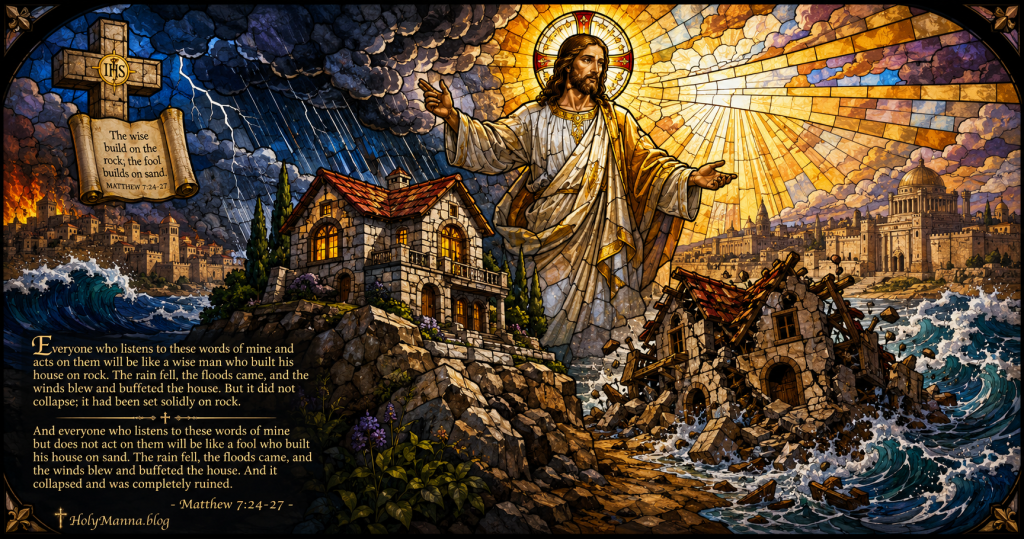
The Two Foundations. 24 “Everyone who listens to these words of mine and acts on them will be like a wise man who built his house on rock. 25 The rain fell, the floods came, and the winds blew and buffeted the house. But it did not collapse; it had been set solidly on rock. 26 And everyone who listens to these words of mine but does not act on them will be like a fool who built his house on sand. 27 The rain fell, the floods came, and the winds blew and buffeted the house. And it collapsed and was completely ruined.”
28 When Jesus finished these words, the crowds were astonished at his teaching, 29 for he taught them as one having authority, and not as their scribes.
Detailed Exegesis
Verse 21: “Not everyone who says to me, ‘Lord, Lord,’ will enter the kingdom of heaven, but only the one who does the will of my Father in heaven.”
Jesus opens with the doubled address, “Lord, Lord,” which in the Greek carries a sense of urgency and insistence. This is not casual religious language. The people Jesus is describing are fervent. They are emphatic. They genuinely believe they have a relationship with Him. And He is saying that sincerity alone is not enough. The criterion for entering the kingdom of heaven is not the warmth of one’s feelings about Jesus but the alignment of one’s life with “the will of my Father in heaven.”
This is not a works-righteousness argument, and the Catholic tradition has always been careful to hold this distinction. The Catechism is clear in CCC 1949 that “called to beatitude but wounded by sin, man stands in need of salvation from God. Divine help comes to him in Christ through the law that guides him and the grace that sustains him.” Obedience to the Father’s will is not something a person earns salvation through. It is the fruit of a genuine relationship with God, the evidence that grace has actually taken root in a life. A tree is known by its fruit, as Jesus said just a few verses earlier in Matthew 7:16, and a life genuinely transformed by encounter with Christ will look different from a life that has merely adopted Christian vocabulary.
Verse 22: “Many will say to me on that day, ‘Lord, Lord, did we not prophesy in your name? Did we not drive out demons in your name? Did we not do mighty deeds in your name?’”
The three claims these people make are not trivial. Prophesying, exorcising demons, and performing mighty deeds are significant spiritual activities. These are not people who attended church occasionally and called it a day. They were active, visible, apparently powerful in their ministry. And yet Jesus is about to tell them that none of it counted. The reason is embedded in a detail that is easy to miss: every single claim is framed around what they did. “Did we not prophesy? Did we not drive out demons? Did we not do mighty deeds?” The center of gravity in every claim is the speaker, not God. Religious activity performed for self-validation, social status, or personal significance, even when done in Jesus’ name, is not the same as doing the Father’s will.
Verse 23: “Then I will declare to them solemnly, ‘I never knew you. Depart from me, you evildoers.’”
This is the most chilling verse in the Sermon on the Mount. The word “knew” here translates the Greek ginosko, which in the biblical tradition carries a depth of meaning far beyond intellectual familiarity. To be known by God is to be in covenant relationship with Him, the way God “knew” Moses in Exodus 33:17 or the way a husband and wife know each other in the intimacy of marriage. To be told “I never knew you” is not to be told “you were not religious enough.” It is to be told “we were never actually in relationship. You were performing, not communing.”
The phrase “you evildoers” translates the Greek anomia, which literally means workers of lawlessness. Despite all their visible religious activity, these people were fundamentally lawless, operating outside the will of God while wearing the costume of devotion. St. John Chrysostom preached on this with characteristic directness in his Homilies on Matthew: “Nothing is worse than to make a pretence of virtue, while indulging in vice. For such a man not only fails to gain any benefit, but suffers greater shipwreck in proportion to the length of time he continues in this course.”
Verse 24: “Everyone who listens to these words of mine and acts on them will be like a wise man who built his house on rock.”
Jesus shifts from warning to invitation. The contrast He draws is deceptively simple: hear and act, or hear and do not act. The Greek word for “acts on them” is poiei, meaning to do, to make, to produce. It is an active, ongoing, habitual word. The wise builder is not someone who heard the Sermon on the Mount once and felt moved by it. He is someone whose daily life has been restructured around its demands. And that kind of person, Jesus says, is building on rock.
Catholic tradition has always connected this rock to Christ Himself. St. Paul writes in 1 Corinthians 10:4 that “the rock was Christ,” drawing on the typology of the rock that sustained Israel in the desert. And in Matthew 16:18, Jesus will tell Peter that “upon this rock I will build my Church,” establishing that the Church founded on Peter is ultimately founded on Christ and His Word. The wise builder who constructs his life on Jesus’ words is participating in the same foundation on which the Church itself is built.
Verse 25: “The rain fell, the floods came, and the winds blew and buffeted the house. But it did not collapse; it had been set solidly on rock.”
Jesus does not promise that the storm will not come. He promises that the house will hold. This is a crucial distinction that the prosperity gospel, which has always been a temptation in Christian communities, gets exactly wrong. Faith built on Christ is not a shield against suffering. It is a foundation that holds through suffering. The same storm hits both houses in this parable. What differs is not the intensity of the trial but the integrity of the foundation. 2 Kings 24 has already shown what happens when a kingdom’s foundation crumbles: the storm of Babylon blew right through it. Judah’s problem was not that Nebuchadnezzar was too powerful. It was that their foundation was already compromised before he arrived.
Verse 26: “And everyone who listens to these words of mine but does not act on them will be like a fool who built his house on sand.”
The foolish builder is not ignorant. He has heard the same words as the wise builder. He sat in the same crowd on the same hillside and listened to the same Sermon on the Mount. His problem is not lack of information. His problem is lack of integration. He heard the words and left them at the level of the interesting or the inspiring without allowing them to reshape how he actually lives. This is the profile of the person in verse 22 who called Jesus “Lord, Lord” but never did the Father’s will. He was a hearer of the Word without being a doer of it, and James 1:22 names this dynamic explicitly: “Be doers of the word and not hearers only, deluding yourselves.”
Verse 27: “The rain fell, the floods came, and the winds blew and buffeted the house. And it collapsed and was completely ruined.”
The Greek word for “completely ruined” is megale, suggesting a total, catastrophic collapse. Not a partial failure. Not a fixable crack. Complete ruin. Jesus is not describing a setback. He is describing a final, irreversible outcome. And the storm that causes it is the same storm that tested the first house. The difference was always in the foundation, not the weather.
Verse 28: “When Jesus finished these words, the crowds were astonished at his teaching.”
The word translated as “astonished” in the Greek is exeplessonto, which carries the sense of being struck out of oneself, overwhelmed beyond the capacity for a measured response. The crowd has just sat through the most comprehensive moral and spiritual teaching any of them had ever heard, and they are undone by it. This is the appropriate response to a genuine encounter with the Word of God. Not comfortable agreement. Not polite appreciation. Astonishment.
Verse 29: “For he taught them as one having authority, and not as their scribes.”
The scribes taught by appealing to earlier authorities. Their teaching was always derivative, always rooted in what someone else had said before them. Jesus taught from Himself, with the same kind of direct, original, self-grounding authority with which God spoke the Law to Moses. CCC 581 captures this precisely: “The Jewish people and their spiritual leaders viewed Jesus as a rabbi. He often argued within the framework of rabbinical interpretation… Yet Jesus could not help but offend the religious authorities, for he was not content to propose his interpretation alongside theirs but taught the people ‘as one who had authority,’ with a finality that exceeded all others.” The crowd’s astonishment is not just aesthetic appreciation for a good speaker. It is the dawning recognition that the one standing before them is something more than a teacher.
Teachings
The closing passage of the Sermon on the Mount has generated some of the most searching and honest preaching in the history of the Church, precisely because it refuses to let religious people off the hook. It is aimed not at the indifferent but at the devout, and that makes it one of the most challenging passages in the entire Gospel.
Pope Benedict XVI, in his landmark work Jesus of Nazareth, reflected on this passage at length and noted that Jesus places Himself at the center of the final judgment in a way that no merely human teacher would dare to do. Benedict wrote: “Jesus is not just a teacher of wisdom, not just a prophet. He is the one who stands at the end of history and declares who belongs to the kingdom and who does not. This is a claim that only God can make. And Jesus makes it as naturally as breathing.” The authority of verse 29 is not separate from the warning of verse 23. They are the same claim from two different angles: this man speaks with the voice of God, and what He says about the relationship between hearing and doing is not a suggestion.
St. Augustine, in his Commentary on the Sermon on the Mount, addressed the distinction between hearing and doing with characteristic theological precision: “The words ‘not everyone who says to me Lord, Lord’ refer not to those who entirely lack faith, but to those who have faith without the corresponding works. Faith without works cannot save.” Augustine’s reading is entirely consistent with the Catholic understanding of faith and works as inseparable dimensions of the Christian life, held together not in tension but in unity, the way a tree and its fruit are inseparable.
Blessed John Henry Newman, in his Parochial and Plain Sermons, preached extensively on what he called the difference between notional assent and real assent in the life of faith. Notional assent is knowing the truths of the Catholic faith in the head, being able to articulate them, perhaps even defending them in argument. Real assent is when those truths have moved from the head into the bones and sinews of daily life, shaping decisions, relationships, priorities, and habits. Newman’s warning was that notional assent is far more common than people realize, and far more comfortable, and far more dangerous: “We have the knowledge of God’s will, yet we live as though we had it not. We hear the Gospel Sunday after Sunday, and it makes no difference to Monday.”
The Catechism connects the teaching of this passage to the virtue of religion, which it defines in CCC 1807 as the moral virtue that disposes one to give God what is owed to Him. Authentic religion is not primarily an emotional experience or a set of ritual observances. It is a consistent orientation of the whole life toward God, expressed in obedience, worship, and charity. When that orientation is absent, even the most impressive religious activity becomes, in Jesus’ words, the work of the lawless.
Pope Francis, in a morning homily at Casa Santa Marta in October 2014, brought this passage into sharp contemporary focus. He described what he called a “decorative Christianity,” a faith worn like an accessory, present enough to be socially acceptable but never deep enough to cost anything. He said: “Jesus is asking: do you obey God, or do you use God? There is a big difference. One is love. The other is idolatry.” The warning of Matthew 7:21-23 is precisely about this distinction: using God’s name for one’s own purposes, even religious purposes, is not the same as knowing Him.
Reflection
What would it look like to audit not just what is believed but how those beliefs actually show up in the ordinary decisions of daily life? The people in verse 22 had an impressive resume. They could point to real spiritual activity. And Jesus said it was not enough. The gap between what was professed and what was actually lived was wide enough that He could honestly say He never knew them. Is there a similar gap somewhere in everyday life right now?
The invitation of this passage is not to spiritual anxiety or scrupulosity. It is to something far more grounding: the willingness to let Jesus’ words actually restructure life from the inside. This is what the Church means by ongoing conversion. It is not a one-time event that happened at baptism or at a retreat or in a moment of emotional fervor. It is a daily, sustained orientation of the will toward God that shows up in concrete choices: how money is spent, how time is allocated, how people in need are treated, whether the words spoken in private match the faith professed in public.
A practical starting point is to take one teaching from the Sermon on the Mount each week and ask honestly: How does this actually show up in daily life, or where does it conspicuously fail to? The Beatitudes alone could occupy months of this kind of examination. The command to love enemies could occupy a lifetime. But the point is not to be overwhelmed by the distance between the ideal and the reality. The point is to close that distance, one day and one decision at a time, trusting that the God who laid out these demands in the Sermon on the Mount is the same God who provides the grace to meet them.
CCC 1996 reminds the faithful that “our justification comes from the grace of God. Grace is favor, the free and undeserved help that God gives us to respond to his call to become children of God, adoptive sons, partakers of the divine nature and of eternal life.” The rock on which the wise builder builds is not just Christ’s teaching. It is Christ Himself, the one who not only delivered the Sermon on the Mount but who makes it possible, through grace, to actually live it. What is one concrete area of life where His words have been heard but not yet acted upon, and what would it look like to begin building there today?
The Storm Reveals the Foundation
There is a thread that runs through everything the Church has placed before her people today, and it is worth pulling on until the full picture comes into view. 2 Kings 24 opened the day with a scene of catastrophic collapse: a city that was supposed to be God’s own dwelling place reduced to rubble, its king carried off in chains, its Temple stripped bare. Psalm 79 gave voice to the grief of a people sitting in that rubble, crying out to a God who seemed impossibly far away, asking the most honest question faith can ask: How long, Lord? And then Matthew 7 brought it all forward two thousand years and placed it directly in front of anyone willing to listen, with Jesus standing on a hillside and warning that the pattern of Judah is not a relic of ancient history. It is a permanent human temptation, and it does not become less dangerous simply because it is dressed in the language of Christian devotion.
The thread connecting all three readings is not complicated, but it is costly. God does not want performers. He wants people. He does not want a nation that maintains the Temple while worshiping foreign gods in the high places. He does not want disciples who prophesy and drive out demons while living as workers of lawlessness. He does not want prayer that is polished and composed when the soul beneath it is hollow. What He wants, what He has always wanted, is the alignment of an entire life with the covenant He has offered. Not perfection. Not a flawless record. But an honest, sustained, daily orientation of the heart toward Him that shows up in how a person actually lives when no one else is watching.
The kings of Judah had every external advantage a covenant people could ask for. They had the Temple, the priesthood, the Davidic lineage, the prophets, and centuries of God’s demonstrated faithfulness. What they lacked was the one thing that could not be inherited or performed or substituted: a heart genuinely ordered toward God. And the Babylonian exile, as devastating as it was, did not come because God stopped loving them. It came because love sometimes allows consequences, because a father who never lets his children feel the weight of their choices is not a loving father at all. The exile was not the end of the story. It was the purification that made the restoration possible.
Psalm 79 teaches something equally important about what to do when the consequences arrive. The answer is not silence, and it is not despair, and it is certainly not the pretense that everything is fine. The answer is exactly what the psalmist does: turn toward God with everything that is true, name the rubble honestly, acknowledge the failures that contributed to it, and then appeal not to personal merit but to who God is. “Help us, God our savior, on account of the glory of your name.” That is the prayer of a people who have run out of arguments for their own righteousness and discovered that God’s name is a better argument anyway. It is also, quietly, the prayer that the Mass teaches every single week: Lord, I am not worthy, but only say the word.
And Jesus, at the end of the greatest sermon ever preached, does not leave anyone without a clear and actionable path forward. Build on the rock. Not just hear the words, but act on them. Let the Beatitudes, the command to love enemies, the instruction on prayer and fasting and trust, let all of it actually reshape the architecture of daily life. Not as a program to be completed but as a foundation to be inhabited, one decision and one day at a time, knowing that the storm is coming for every house and that the only variable is what the house is built on.
The invitation of this Thursday in Ordinary Time is not to feel bad about the gap between who one is and who Christ calls one to be. The invitation is to close that gap, with honesty, with the sacraments, with daily prayer that is willing to be as raw as Psalm 79 when it needs to be, and with the quiet, unglamorous, deeply countercultural decision to let the Word of God be more than something heard at Mass on Sunday. The liturgy has told a story today, a story about a city that fell, a people who cried out, and a teacher whose words are the only foundation that holds when everything else gives way. The only question left is whether those words are being built upon, or simply admired from a comfortable distance.
Engage With Us!
Today’s readings have a way of getting under the skin in the best possible way, and the best thing that can happen after an encounter with the Word of God is to talk about it. Share your reflections in the comments below, because this community grows stronger when the faithful think out loud together and learn from one another’s experience of Scripture and daily life.
- In 2 Kings 24:8-17, the Temple treasures are stripped away and the people are carried into exile as a consequence of generations of infidelity to God’s covenant. Where in your own life have you experienced the painful but purifying consequences of drifting away from God, and what did that season teach you about His faithfulness?
- Psalm 79:1-5, 8-9 gives the community permission to bring raw, unfiltered grief and confusion directly to God, asking “How long, Lord?” without any pretense that everything is fine. Is there a situation in your life right now where you have been holding back that kind of honest prayer, and what would it look like to finally bring it before God without rehearsing it first?
- In Matthew 7:21-29, Jesus warns that hearing His words without acting on them is building a house on sand, destined to collapse when the storm arrives. If you were to honestly identify one area of your life where you have been a hearer of the Word but not yet a doer, what would that area be, and what is one concrete step you could take this week to begin building there?
- All three of today’s readings point to the same uncomfortable truth: claiming to belong to God while living outside His will is a foundation that cannot hold. What does your daily life, not your Sunday life but your Tuesday morning and Friday afternoon life, say about who or what you are actually building upon?
The Word of God proclaimed today is not meant to leave anyone where they found it. It is meant to do what Jesus’ words have always done: cut through the noise, name what is true, and then offer the only foundation that has ever held when everything else gives way. Go forward this week not just as someone who heard these readings, but as someone who is building on them, one honest prayer, one act of obedience, and one moment of grace at a time. The world needs people who are not just fluent in the language of faith but are actually living it, and that is exactly what this community is called to be.
Sacred Heart of Jesus, we trust in You!
Immaculate Heart of Mary, pray for us!
Saint Michael the Archangel, defend us in battle!
Follow us on YouTube, TikTok, Instagram and Facebook for more insights and reflections on living a faith-filled life.


Leave a comment