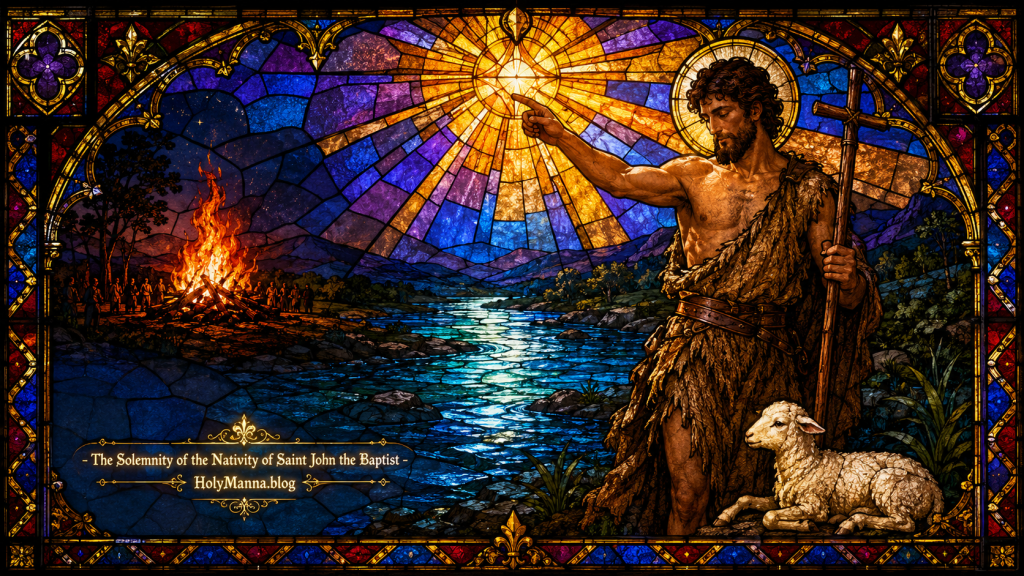
A Voice Before the Word
Picture this: it is the evening of June 23, somewhere in rural Ireland, and a family is gathered around a fire blazing in their backyard. The father reads from an ancient blessing in the Roman Ritual, the fire is sprinkled with holy water, and then the family prays the Canticle of Zechariah together in the fading summer light. In Quebec, thousands of people are gathering on the Plains of Abraham for bonfires and Mass to honor the patron saint of French Canada. In Florence, the city itself carries on a centuries-old feast for its own patron, the man whose finger relic rests just down the street from Michelangelo’s David. In Puerto Rico, the whole island celebrates the saint for whom its capital, San Juan, was named. In the Church herself, the June 24 Solemnity takes precedence over an ordinary Sunday on the liturgical calendar, something almost no other saint’s celebration ever does.
This is not a minor observance tucked quietly into the summer calendar. This is the Solemnity of the Nativity of Saint John the Baptist, and it is one of the oldest, most layered, most theologically rich celebrations in all of Catholic Christianity.
Most Catholics know John the Baptist as the wild figure in camel hair who baptized Jesus in the Jordan River and got himself beheaded for speaking the truth to a king. That story, on its own, would already make him remarkable. But the full picture of who John was, why the Church honors his birth with the same liturgical solemnity she gives to Christmas, and how his words and presence have been woven permanently into the structure of the Mass itself — that picture is something most people never fully encounter, and it is extraordinary.
Saint John the Baptist is patron of baptism, converts, monastic life, the Sovereign Military Order of Malta, the country of Jordan, Puerto Rico, Florence, Genoa, Turin, French Canada, tailors, printers, and many other cities and causes across the globe. He is one of the central figures in all of salvation history, and his feast on June 24 deserves to be celebrated with full awareness of everything it carries.
Born of the Impossible: The Promise That Broke a Priest’s Silence
Every great story in Scripture begins before the main character arrives, and John the Baptist is no exception. His story starts with two people named Zechariah and Elizabeth, an elderly priestly couple who had spent a lifetime faithful to God and a lifetime carrying a hidden sorrow. The Gospel of Luke describes them as “righteous in the eyes of God, observing all the commandments and ordinances of the Lord blamelessly.” These were not people who had given up on faith. These were people whose faith had held through something genuinely painful: Elizabeth was barren, and they had never had children.
Zechariah was a priest of the division of Abijah, one of the organized groups who served in rotation at the Temple in Jerusalem. On one particular day, when his division was serving, the lot fell to Zechariah to enter the sanctuary and burn incense. The whole assembly of the people was praying outside. What happened inside the sanctuary changed the history of the world.
The Archangel Gabriel appeared at the right side of the altar of incense. Zechariah was gripped with fear. Gabriel’s message was direct: his prayer had been heard, Elizabeth would bear a son, and the son was to be named John. He would be great before the Lord, he would drink no wine, he would be filled with the Holy Spirit from his mother’s womb, and he would go before the Lord “in the spirit and power of Elijah” to turn the hearts of Israel back to God and prepare a people for the coming of the Messiah.
Zechariah struggled with it. He was old, Elizabeth was old, the whole thing was biologically impossible, and he said so. “How shall I know this?” For that moment of doubt, Gabriel struck him mute on the spot. Zechariah returned to the assembly unable to speak, completed his priestly duties, and went home in silence. Elizabeth conceived.
Six months into her pregnancy, Gabriel was sent again. This time he went to a young virgin in Nazareth named Mary. When he told Mary about the plan of God for her, he pointed to Elizabeth as proof of what God can do: “And behold, your kinswoman Elizabeth in her old age has also conceived a son, and this is the sixth month with her who was called barren. For with God nothing will be impossible.” Mary said yes, and the Incarnation began.
What happened next is one of the most beautiful moments in the entire New Testament. Mary set out immediately and traveled with haste to the hill country of Judah to visit Elizabeth. When she arrived and called out her greeting, John, still unborn, six months in the womb, leapt for joy. Elizabeth was filled with the Holy Spirit at that instant and cried out: “And why is this granted me, that the mother of my Lord should come to me? For behold, when the voice of your greeting came to my ears, the baby in my womb leapt for joy.”
That was John’s first act in salvation history, and he performed it before he had drawn a single breath. He recognized the presence of Christ, and he leapt. The Catechism of the Catholic Church treats this with full theological weight, teaching that John was “filled with the Holy Spirit even from his mother’s womb” by Christ himself, “whom the Virgin Mary had just conceived by the Holy Spirit” (CCC 717). His sanctification did not wait for adulthood, or even for birth. It happened in the womb, at the moment he encountered the Lord.
This is also the foundation for one of the most ancient and beautiful beliefs of the Catholic tradition: that John was cleansed of original sin in the womb at the moment of the Visitation. It is worth stating with care that this is a longstanding pious belief and a widespread devotional conviction, not a dogmatically defined teaching of the Church in the precise way the Immaculate Conception of Mary is defined dogma. Mary was preserved from original sin from the very first moment of her existence by a singular privilege. John, in this tradition, was cleansed of original sin at the moment of the Visitation. Two different graces, both extraordinary, both entirely ordered toward the coming of Christ.
When the time came for John to be born, the neighbors wanted to name him Zechariah after his father, as was the custom. Elizabeth refused plainly. “No, he shall be called John.” The relatives turned to the mute Zechariah in writing tablets: what did he want the boy called? He wrote five words: “John is his name.” His mouth opened, his tongue was freed, and he broke into the great canticle of praise that the Church has prayed every morning since, the Benedictus: “And you, child, will be called the prophet of the Most High; for you will go before the Lord to prepare his ways, to give knowledge of salvation to his people in the forgiveness of their sins, through the tender mercy of our God, when the day shall dawn upon us from on high to give light to those who sit in darkness and in the shadow of death, to guide our feet into the way of peace.”
Fear came upon all the neighbors. Everyone who heard this story took it to heart and asked: “What then will this child be?” The hand of the Lord was clearly upon him.
Camel Hair, Wild Honey, and a Voice That Shook the Crowds
Luke’s Gospel records simply that “the child grew and became strong in spirit, and he was in the wilderness till the day of his manifestation to Israel.” Those hidden years in the desert of Judea are a window into John’s entire character: a life stripped of everything comfortable and unnecessary, oriented entirely toward God, preparing in silence for a mission that would last only a few years but would ripple through every century that followed. It is no surprise that he became the patron of monastic life and hermits. He lived that life first, and he lived it completely.
At about the age of 30, John emerged from the desert and began his public ministry along the banks of the Jordan River. His appearance was deliberately ascetic: clothed with camel’s hair, with a leather belt around his waist, eating locusts and wild honey. He was not trying to attract a crowd through comfort or charm. He was preaching a baptism of repentance for the forgiveness of sins, and the crowds came anyway. People poured out from Jerusalem, from all of Judea, from the region around the Jordan, to hear him and be baptized.
John’s preaching held nothing back. When religious leaders came out to observe him, he addressed them directly and without flattery: “You brood of vipers! Who warned you to flee from the wrath to come?” He demanded fruit that matched repentance, not religious credentials or ancestral pride. To tax collectors he said: collect no more than you are obligated to. To soldiers he said: do not extort anyone, do not falsely accuse, be content with your wages. He called everyone to genuine conversion, not just external ritual.
And yet, for all the fire and directness, John was luminously humble about his own identity. When the priests and Levites came from Jerusalem to ask who he was, he stated it with complete clarity. He was not the Christ. He was not Elijah in the literal sense. He was not the Prophet. He was the voice. “I am the voice of one crying out in the wilderness, ‘Make straight the way of the Lord.’” His entire identity was relational, a role that only made sense in reference to Someone else.
When the day came that Jesus walked to the Jordan River and stood in line to be baptized with everyone else, John recognized him immediately and tried to refuse. “I need to be baptized by you, and do you come to me?” Jesus answered that it was fitting to fulfill all righteousness, and John consented. After the baptism, as Jesus came up from the water, the heavens opened and the Spirit descended like a dove, and a voice from heaven declared: “This is my beloved Son, with whom I am well pleased.” The next day, seeing Jesus pass by, John turned and spoke the words that would be embedded in every Mass celebrated from that day until the end of time: “Behold, the Lamb of God, who takes away the sin of the world!”
As Jesus’ ministry grew and John’s diminished, John’s own disciples came to him anxious: everyone was flocking to the one John had baptized. John’s answer is one of the most profound expressions of humility in all of Scripture: “He must increase, but I must decrease.” This was not defeat. It was mission accomplished. The voice had carried the Word. Now the Word would be heard.
Saint Augustine, preaching on this very feast in the early 5th century, built an entire theology from that image. John calls himself merely the vox, the voice, in the wilderness. Christ is the verbum, the eternal Word who was with God in the beginning. Augustine reflected: “John is the voice, but the Lord is the Word who was in the beginning. John is the voice that lasts for a time; from the beginning Christ is the Word who lives forever.” A voice exists only to carry a word beyond itself, and then it fades. The whole meaning of John’s life is contained in that image. His entire existence was a delivery system for Someone else.
The Truth He Refused to Keep Silent
John did not preach repentance to ordinary people while politely excusing the sins of the powerful. Herod Antipas, the tetrarch of Galilee, had divorced his wife Phasaelis and taken Herodias, the wife of his still-living brother Philip. John confronted him publicly and without diplomatic softening: “It is not lawful for you to have your brother’s wife.” Herod imprisoned him at the fortress of Machaerus on the east side of the Dead Sea. It was not enough for Herodias, who wanted him dead, but Herod, who “feared John, knowing that he was a righteous and holy man,” would not go that far.
Even from prison, John experienced something the Church has never shied away from acknowledging: a genuine moment of human uncertainty. He sent word to Jesus through his disciples with the most direct question imaginable: “Are you he who is to come, or shall we look for another?” Jesus sent them back with an answer drawn from the prophecies of Isaiah: the blind see, the lame walk, lepers are cleansed, the deaf hear, the dead are raised, and the poor have good news preached to them. And then, speaking of the man sitting in chains because he had told the truth about a king’s marriage, Jesus said: “Among those born of women there has arisen no one greater than John the Baptist.”
The end came at a birthday banquet. Herod, delighted by the dancing of Herodias’ daughter (named Salome in the accounts of the historian Flavius Josephus), swore an oath to give her whatever she asked for. The girl consulted her mother. Herodias had one answer: she asked for the head of John the Baptist, immediately, on a platter. Herod was grieved. He had liked John. But he had made an oath in front of his guests, and pride and politics overrode conscience. The order was given, the deed was done, and John’s disciples came and took his body and buried it, and then went to tell Jesus.
The Venerable Bede, writing in the 9th century, captured the heart of what John died for with striking clarity: “St. John gave his life for Christ. He was not ordered to deny Jesus Christ, but was ordered to keep silent about the truth.” John could have kept his platform by staying quiet about a sin. He chose the truth instead, and he paid for it with his life. Many homilists today draw a direct line from John’s witness to that of Saint Thomas More, the 16th-century English martyr who was beheaded for refusing to accept King Henry VIII’s unlawful marriage, and whose last words were: “The King’s good servant, but God’s first.” Same sin, same courage, same cost, separated by fifteen centuries.
One point of doctrinal precision worth noting: John is rightly called a martyr in the broad sense of witnessing unto death. But the Church reserves the specific title “Protomartyr,” meaning the first martyr, for Saint Stephen, whose death in Acts 7 came after Pentecost as a witness to the risen Christ within the founded Church. John, the greatest of the Old Testament prophets, stands in his own category: the last prophetic voice of the old covenant, the first to lay down his life in the era of the new.
Why the Church Dedicates a Solemnity to His Birthday
The theological weight behind June 24 is something most Catholics never fully encounter, and once they do, the feast looks completely different.
The Catholic Church, as a general rule, celebrates the feast days of saints on the day of their death, the day their sanctity was sealed and crowned in eternal life. There are exactly two exceptions to this rule across the entire calendar: the earthly birthday of the Blessed Virgin Mary on September 8, and the earthly birthday of Saint John the Baptist on June 24. Out of thousands of saints across twenty centuries, only those two receive the exceptional honor of having their earthly births commemorated in the Roman Rite. Both receive this honor for the same essential reason: both were sanctified in an extraordinary way before their births, making their entry into the world a theological event worth marking.
The date itself was not chosen arbitrarily or borrowed from a pagan festival. It flows directly from Luke’s Gospel. John was conceived six months before Jesus. Since the Annunciation is fixed on March 25 (nine months before Christmas), John’s birth falls almost exactly six months before Christmas. The Church also used the ancient Roman method of counting backward from the first day of the following month, placing John’s Nativity on “the eighth day before the Kalends of July” — June 24 — in deliberate, calculated relationship to Christmas, which was “the eighth day before the Kalends of January.”
There is also a cosmic dimension to this date that the Church Fathers preached on with real enthusiasm. Christmas falls just after the winter solstice, the moment when days in the Northern Hemisphere begin to grow longer. The Nativity of John falls just after the summer solstice, the moment when days begin to shorten. Creation itself enacts John’s most famous line. The sun grows after Christ is born. The sun diminishes after John is born. “He must increase, but I must decrease.” God wove John’s theological purpose into the movement of the heavens themselves.
Saint Augustine preached on this feast in Sermon 293, a text so beloved that the Church still reads it annually in the Liturgy of the Hours during Advent: “The Church observes the birth of John as in some way sacred; and you will not find any other of the great men of old whose birth we celebrate officially. We celebrate John’s, as we celebrate Christ’s.” He then noted that John is born of an old and barren woman, while Christ is born of a young virgin. Two miraculous births, two different kinds of impossibility, both accomplished by the same God for the same salvation.
Pope Benedict XVI preached on this feast more than once across his pontificate, which is itself a testament to how much theological depth this day holds. In his Angelus address of June 2006, he offered this reflection: “His Feast reminds us that our life is entirely and always ‘relative’ to Christ and is fulfilled by accepting him, the Word, the Light and the Bridegroom, whose voices, lamps and friends we are.” He then called “He must increase, but I must decrease” “a programme for every Christian.” In a separate June 24 address, Benedict developed the “nothing is impossible to God” theme, noting that this feast is celebrated in the Church “because it is closely connected to the mystery of the Incarnation of the Son of God.” John’s miraculous conception, announced by Gabriel to Mary as evidence of God’s power, means this feast is structurally ordered toward the Incarnation itself, not just toward honoring a remarkable man.
A Legacy Too Vast for One Tomb
Here is one of the most genuinely surprising facts about Saint John the Baptist: during his earthly ministry, he performed no recorded miracles. None at all. Scripture says so plainly, when people came to the place where John had once baptized and reflected: “John did no sign, but everything that John said about this man was true” (John 10:41). Jesus called him the greatest man born of woman, and yet John worked no wonders. The lesson is uncomfortable in its directness: greatness in the Kingdom of God is measured by fidelity and witness, not by signs and spectacle. The miraculous things that surrounded John were the leap in the womb, Zechariah’s restored speech at his naming, and his own impossible conception to elderly parents — all of them gifts ordered toward pointing to Someone else.
After his execution, John’s disciples took his body and buried it, traditionally at Sebaste in Samaria, where a basilica was eventually built over the site. In 362 AD, pagans desecrated his tomb at Sebaste and burned his remains. Monks managed to rescue a portion of the relics and sent them to Saint Athanasius of Alexandria, meaning one of the greatest Doctors of the Church personally received and safeguarded the bones of the last prophet. A portion was eventually transferred to the church of San Silvestro in Capite in Rome, after Pope Innocent II had it moved there in the 12th century.
The story of John’s head is one of the most layered and fascinating threads in all of Catholic hagiography. The Eastern Church formally commemorates three separate “Findings of the Head of Saint John the Baptist” on different liturgical dates, reflecting centuries of carefully tracked devotion. The relic venerated today in the treasury of Amiens Cathedral in France was reportedly brought from Constantinople after the Fourth Crusade in 1204 by a canon named Wallon de Sarton, and presented to the Bishop of Amiens on December 17, 1206. The bishop received it with great ceremony, and the Church immediately began construction of what would become one of the largest Gothic cathedrals in Europe, built largely to house and honor this relic. Pilgrims came from across Europe to venerate it. French kings, including Louis IX, who was later canonized as Saint Louis, came to Amiens specifically to venerate the head of the Forerunner.
During the French Revolution, the revolutionary government demanded that the relic be surrendered and destroyed. What happened next is one of those small stories of heroic fidelity that rarely make it into the textbooks. The mayor of Amiens, a man named Louis-Alexandre Lescouve, secretly removed the relic from the cathedral and hid it in his own home, at real personal risk during a period when such acts could cost a person everything. When the danger had passed, he eventually entrusted the relic to an abbot, and it was returned to Amiens Cathedral in 1816, where it remains today in a rock-crystal reliquary.
Other sites hold their own relic traditions. The Duomo of Florence venerates what tradition holds to be a finger of Saint John, possibly the very finger with which he pointed at Jesus and spoke the words that would echo through every Mass celebrated since. The Cathedral of Siena venerates his right arm, which is displayed publicly each year in advance of his June 24 feast. Historians have counted as many as a dozen “head of John the Baptist” relics venerated across medieval Europe, a fact that underscores both the intensity of devotion to him and the serious need for the Church’s careful relic authentication processes.
He Has Been at Every Mass You Have Ever Attended
Most Catholics think of Saint John the Baptist as a figure who belongs to Advent, or to the summer feast in June. What almost nobody stops to realize is that John has actually been present at every single Mass they have ever attended. Three times, in three distinct ways, his name or his exact words appear in the permanent structure of the Roman Rite.
The first is the traditional Confiteor, the form of the penitential prayer used before the Second Vatican Council and still prayed in the Extraordinary Form of the Roman Rite today. At the start of Mass, the faithful confess: “I confess to almighty God, to blessed Mary ever Virgin, to blessed Michael the Archangel, to blessed John the Baptist, to the holy Apostles Peter and Paul, and to all the Saints.” John’s name is spoken aloud before every apostle, every martyr, and every other saint in the calendar. He stands immediately after Mary and Michael, and that placement is not an accident.
The second is the Litany of the Saints, prayed at the Easter Vigil, at ordinations to the priesthood and episcopate, at religious professions, and at the dedication of churches. After the Blessed Virgin Mary and the Angels, Saint John the Baptist is the very first individual saint named, ahead of Saint Joseph, ahead of every patriarch, prophet, apostle, martyr, bishop, and doctor that follows. The Church teaches quietly but consistently, every time this litany is sung, exactly how highly John stands in the communion of saints.
The third connection is the one that might actually stop people mid-Mass once they know it. Immediately before Communion, the priest elevates the Host and says: “Behold the Lamb of God, behold him who takes away the sins of the world.” Every Catholic who has ever been to Mass has heard those words dozens, possibly hundreds of times. Almost nobody pauses to ask where those words came from. They are John’s own words. He spoke them standing at the Jordan River, pointing at Jesus: “Behold, the Lamb of God, who takes away the sin of the world!” (John 1:29). The single most defining phrase of John’s entire ministry has been permanently embedded in the Mass, spoken at every altar, in every parish, in every country on earth, every single day.
There is also the Benedictus, Zechariah’s hymn at John’s birth, which is prayed by the Church every morning at Lauds, the Morning Prayer of the Liturgy of the Hours. The words spoken on the occasion of this Nativity have never stopped being prayed. They have been on the lips of priests, monks, religious sisters, and lay faithful praying the Divine Office every single morning for centuries.
The Vigil of this Solemnity also carries one of the most ancient blessings in the entire Rituale Romanum: the official blessing of a bonfire, to be lit on the evening of June 23. The prayer reads: “O Lord God, Father almighty, unfailing Ray and Source of all light, sanctify this new fire, and grant that after the darkness of this life we may come unsullied to Thee Who art Light eternal.” The fire is sprinkled with holy water. The symbolism is deliberate: John himself is described in Scripture as “a burning and shining lamp” (John 5:35) that testified to the true Light. The Vatican’s own Directory on Popular Piety and the Liturgy affirms this custom as genuinely approved popular devotion.
One final and genuinely delightful connection: the traditional Latin Vespers hymn for this Solemnity, Ut queant laxis, was composed in the 8th century in honor of Saint John the Baptist. In the 11th century, the Benedictine monk Guido of Arezzo, the man credited with inventing the musical staff notation still used today, noticed that the first note of each successive phrase in that hymn’s melody rose exactly one step up the musical scale. He took the first syllable of each phrase, Ut, Re, Mi, Fa, Sol, La, and used them to name the notes, creating the solfège system still taught to children in music classes all over the world. “Ut” eventually became “Do,” and “Si,” taken from the final words of the hymn, “Sancte Ioannes,” became the seventh note. Every time a child anywhere on earth sings “do, re, mi,” they are, completely without knowing it, singing the opening syllables of a hymn written in praise of the birth of Saint John the Baptist.
From the Jordan River to the Ends of the Earth
The cultural footprint of Saint John the Baptist stretches across continents, centuries, and languages in ways that are almost impossible to map fully.
He is the principal spiritual patron of the Sovereign Military Order of Malta, the Knights Hospitaller, one of the oldest continuously active religious orders in the world, tracing its origins to the 11th century and still operating humanitarian missions in more than 120 countries today. Knights and Dames of the Order celebrate his June 24 feast with solemn Masses on five continents each year.
He is the patron saint of Florence, Italy, where the historic Baptistery, one of the oldest buildings in the city and the site where Dante himself was baptized, is dedicated entirely to him. He is the patron of French Canada, and June 24 is a statutory public holiday in the province of Quebec, the Fête nationale du Québec, with celebrations that date back to 1636. The whole island of Puerto Rico and its capital, San Juan, bear his name. He is the patron of Genoa, Turin, Porto, Perth in Scotland, Newfoundland, and dozens of other cities and regions across six continents.
Across Spain and much of Latin America, the Noche de San Juan on June 23 is marked by bonfires along coastlines and riverbanks, gatherings by water, and traditions of renewal and new beginnings, all echoing John’s own ministry of baptism and preparation at the river. In Ireland, where the bonfire blessing tradition ran especially deep, ashes from the Saint John’s fires were historically sprinkled over fields the following morning to ask God’s blessing on the harvest.
He is also among the most painted figures in all of Catholic sacred art. Leonardo da Vinci, Raphael, El Greco, and especially Caravaggio, who returned to John the Baptist as a subject more often than almost any other, produced masterworks depicting the Forerunner. His image fills baptisteries and chapels from Rome to Santiago de Compostela, from Jerusalem to Quebec City.
For pilgrims who make it to the Holy Land, Ein Karem, a village about 4.5 miles southwest of Jerusalem, is one of the most intimate and moving places in all of Christian holy sites. The Franciscan Custody of the Holy Land maintains the Church of Saint John the Baptist there, built over Byzantine and Crusader ruins on the traditional site of his birth. Steps on the left side of the sanctuary descend into a natural grotto venerated as the actual room where John was born. Set into the floor is a marble star inscribed in Latin: Hic praecursor Domini natus est. Here was born the precursor of the Lord. The church’s courtyard displays the Canticle of Zechariah on ceramic tiles in 24 different languages. A short walk away is the Church of the Visitation, marking where Mary greeted Elizabeth and John leapt in the womb. And nearby is the Monastery of Saint John in the Wilderness, maintained by the Franciscans, marking the traditional site of John’s years of hidden desert preparation.
Even beyond Christianity, John’s significance resonates. He appears in the Qur’an as the prophet Yahya, and the ancient Mandaean religion, still practiced today primarily in Iraq and Iran, venerates him as its central and greatest prophet. The man who called himself merely a voice has turned out to have a very long reach.
Becoming the Voice in Your Own Story
Saint John the Baptist lived an extreme life by almost any measure. Most readers will not be called to the desert, to confronting kings, or to martyrdom. But the heart of John’s life is not the drama. The heart of his life is the orientation.
John knew who he was because he always saw himself in relation to Jesus. He was the voice; Christ was the Word. He was the lamp; Christ was the Light. He was the friend of the Bridegroom; Christ was the Bridegroom. Every title John accepted for himself was a relational title, a title that only made sense in reference to Someone else. He never let his genuine gifts, his crowds, his followers, his prophetic fire, become about him. When the moment came where he had to choose between his platform and his purpose, he chose his purpose without hesitation: “He must increase, but I must decrease.”
That is the word this feast has for every person who has ever been given a gift, a voice, a platform, a talent, or a calling. The gift is not the point. The Giver is the point. The voice is not the point. The Word is the point.
There are also deeply practical lessons in John’s courage. He died because he told the truth about a sin, to a man with the power to imprison and kill him, without softening it or waiting for a better political moment. He said what was true, plainly, and he accepted the consequences. In a cultural moment that pressures people of faith to be quiet, to soften their convictions, to describe hard truths as something other than what they are, John the Baptist is exactly the patron the Church needs. Speaking truth charitably, consistently, and without fear of social consequences is a very Johannine thing to do.
Finally, there is the lesson of the hidden years. John spent decades in the wilderness in preparation before anyone outside his family had ever heard of him. Those years were not wasted time. They were, in fact, the making of everything that came after. If there are seasons right now that feel like wilderness, if the mission feels far away and the preparation feels endless, John’s hidden years are a reminder that God is not wasting this season. He is forming something in it.
Where in life right now is God calling for a decrease, so that Christ might increase in the people around you?
Are there truths that need to be spoken plainly, regardless of the cost?
And in whatever wilderness you find yourself in today, can you trust that God is not wasting it, but using it to prepare you for your own manifestation to Israel?
The feast of the Nativity of Saint John the Baptist is the Church saying, with full liturgical solemnity: this man mattered, his birth mattered, and his example matters to you. Not because John was the hero of the story, but because he understood perfectly that he was not, and he lived every day in light of that understanding. He was the voice. He found his whole identity in the Word he was sent to carry.
That is available to every Catholic on June 24, and honestly, on every other day of the year as well.
Engage With Us!
This feast is one of the richest in the entire Catholic calendar, and there is so much here to reflect on and discuss. Share thoughts, questions, and reflections in the comments below. Whether this is someone’s first real encounter with Saint John the Baptist or whether they have loved this feast for years, the conversation is always better when people bring their full selves to it.
Here are some questions to sit with and share:
- The Catholic Church celebrates only three earthly birthdays liturgically across her entire calendar: Jesus, Mary, and Saint John the Baptist. Before reading this post, did you know that June 24 holds the same liturgical rank as Christmas? How does knowing that change the way you will celebrate this feast going forward?
- Saint John the Baptist performed no recorded miracles during his lifetime, and yet Jesus called him the greatest man ever born of woman. What does that say about what God values and how He measures greatness? How does that challenge the way you think about your own calling, your own gifts, and your own sense of whether what you are doing matters?
- “He must increase, but I must decrease” (John 3:30). Where in your life, whether in your work, your relationships, your use of social media, or your ministry, are you being invited to live out those words right now? What would it actually look like in practice?
- John spent years in the desert in hidden preparation before God called him into his public mission. If you are in a season of waiting, obscurity, or what feels like wasted time, what might God be forming in you? How does John’s hidden life speak to where you are?
- The words “Behold the Lamb of God, behold him who takes away the sins of the world” come directly from Saint John the Baptist (John 1:29), and they are spoken at every single Mass before Communion. Knowing that, how does it change the way you experience that moment the next time you are at Mass?
Saint John the Baptist spent his whole life doing one thing: pointing away from himself and toward Christ. He was extraordinary by every measure, and he spent every drop of that extraordinary life saying: not me. He was the voice, and the voice existed for the Word.
Go and live that in whatever ordinary, faithful, unspectacular, beautiful way God has placed in front of you. Speak truth. Prepare the way. Decrease so that He might increase. And the next time the priest raises the host and says “Behold the Lamb of God,” remember who first said those words, at the Jordan River, two thousand years ago, and let it fill you with the same joy with which John leapt in his mother’s womb.
That joy is yours. It has always been yours.
Saint John the Baptist, pray for us!
Follow us on YouTube, TikTok, Instagram and Facebook for more insights and reflections on living a faith-filled life.

 Holy Manna!
Leave a comment