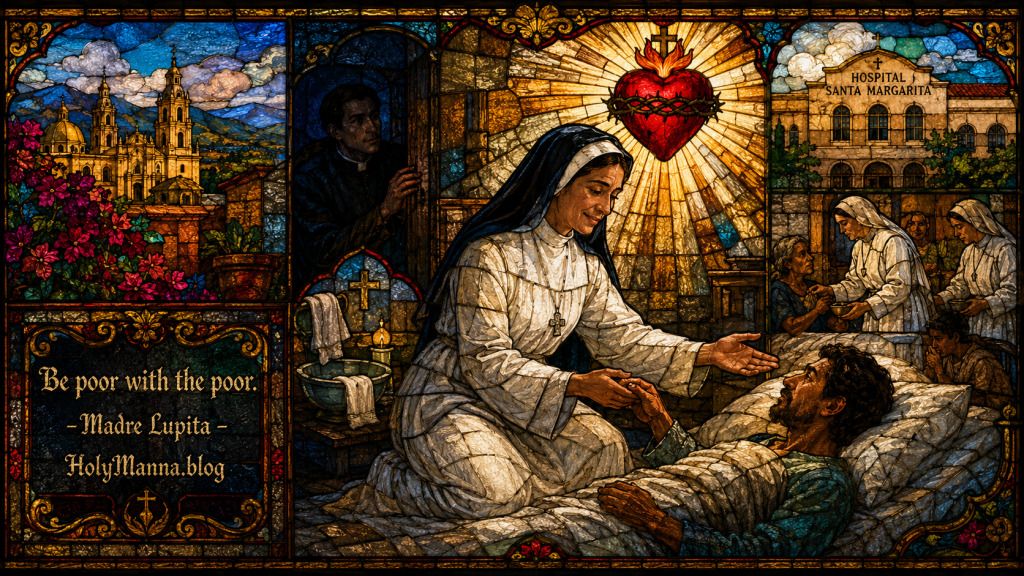
The Angel Who Knelt on the Floor
There is a kind of holiness that dazzles from a distance, the kind that comes with visions and ecstasies and miraculous lights in the sky. And then there is the kind of holiness that smells like antiseptic, that has callused knees from kneeling on hard floors, that begs strangers for coins so a dying patient can have medicine. Saint Mother María Guadalupe García Zavala was that second kind of saint, and that is precisely what makes her one of the most compelling figures in the entire history of the Catholic Church in the Americas.
Known to generations of Mexicans simply as Madre Lupita, she was a co-founder of the Congregation of the Handmaids of Saint Margaret Mary and the Poor, a nursing sister who served the sick and destitute for over six decades, a woman who risked her life to shelter persecuted priests during one of the darkest chapters in Mexican Catholic history, and a saint whose intercession continues to draw miracles from heaven to this day. She is the patron saint of nurses and of the Handmaids of Santa Margherita Maria and the Poor. Her feast day is celebrated each year on June 24, the very day she died, because in the Catholic tradition, the day a saint dies is the day they are truly born into eternal life.
Pope Francis, who canonized her on May 12, 2013, captured her entire life in a single phrase at her canonization Mass. He said that Mother Lupita had learned the art of “touching the flesh of Christ” in every poor and suffering body she served. That phrase is the key that unlocks everything about who she was and why she matters. She did not serve the poor as a charitable project. She served them as an encounter with Jesus Himself.
Born at the Feet of Our Lady
The story begins, as so many great Catholic stories do, in the shadow of a shrine. Anastasia Guadalupe García Zavala was born on April 27, 1878, in Zapopan, Jalisco, Mexico, to Fortino García and Refugio Zavala de García. Her baptism was celebrated at the Parish of Saint Peter the Apostle, and she went by María, one of the names she received at her christening, for the rest of her life. The name Anastasia, fittingly enough, means resurrection in Greek, but it is Lupita, the name she would take upon her religious vows, that the world remembers.
Her father Fortino ran a religious goods store, and that store happened to be located directly next to the Basilica of Our Lady of Zapopan, one of the most beloved Marian shrines in all of Mexico. The Basilica is home to a small statue of the Virgin Mary, less than fourteen inches tall, that has been venerated in Jalisco since the sixteenth century. Every year since 1734, that little statue has traveled in procession through every parish in Guadalajara, and the faithful line the streets to receive her. Little María grew up with that image of Our Lady as her next-door neighbor, and she absorbed its lessons deeply. Her family prayed together daily, her mother cultivated a home of charity and devotion, and from the time she was old enough to walk, María would accompany her father to the shop and then slip next door to the Basilica to pray.
Those childhood visits to the shrine were not just moments of quiet piety. They were her first classroom. At the feet of Our Lady of Zapopan, she encountered the full spectrum of human need. The extremely poor, the handicapped, and indigenous people newly arrived from the countryside were constant fixtures at the front steps of the Basilica, begging for help and hoping for miracles. María watched them day after day, year after year, and something in her soul was being shaped by what she saw. God was preparing her, through the ordinary geography of her childhood, for the extraordinary life ahead.
Her First Communion was received on September 8, 1887, at that same Basilica of Our Lady of Zapopan. September 8 is the feast of the Nativity of the Blessed Virgin Mary. For a girl who would spend her entire life in Marian devotion and Eucharistic service, receiving Jesus for the first time on Mary’s birthday, in Mary’s own shrine, is the kind of detail that makes you believe God has a sense of beautiful irony.
Those who knew her in childhood described her as nice, likeable, and always ready to help those in need. She was not a child prodigy in any dramatic sense. She was simply a girl who loved God, loved Our Lady, and could not seem to pass a suffering person without wanting to do something about it.
The Dance, the Engagement, and the Undivided Heart
By the time María was in her early twenties, she had grown into a beautiful and well-regarded young woman. She was engaged to Gustavo Arreola, described as a handsome and up-and-coming young businessman. By every measure of the world she lived in, her future was set. A good family, a good man, a comfortable life in Guadalajara. There was no obvious reason to change anything.
And then, at a dance, right before she was to be married, she called off the engagement.
She told Gustavo that she had a different calling, that Jesus was asking her to love Him with an undivided heart through service to the poor and the sick. By all accounts, this was not the result of a dramatic vision or an angel appearing in the night. It was a quiet, deep, unmistakable interior conviction that the comfortable life she was walking toward was not the life she was made for. The Catechism of the Catholic Church teaches that God calls each soul by name (CCC 2158), and in that ballroom in Guadalajara, María heard her name called in a way she simply could not ignore.
She went to her spiritual director, Father Cipriano Iñiguez, and told him of her sudden change of heart. What happened next is the kind of providential coincidence that makes you stop and shake your head in wonder. Father Iñiguez listened to her pour out her desire to serve the poor and the sick in religious life, and then he told her that he had been carrying an almost identical desire for years. He had long felt called to establish a religious congregation that would care for the hospitalized and the destitute. He had simply been waiting for the right person to help him do it.
Two souls, carrying complementary callings, arriving at the same conversation at exactly the right moment. After months of prayer and planning together, on October 13, 1901, Father Iñiguez and María García Zavala co-founded the Congregation of the Handmaids of Saint Margaret Mary and the Poor. The congregation chose as its patroness Saint Margaret Mary Alacoque, the seventeenth-century French Visitation nun to whom Our Lord had appeared and revealed the devotion to His Sacred Heart. From its very first day, the congregation was rooted in the burning, personal love of Christ poured out for humanity, the love the Sacred Heart represents, and dedicated to making that love visible in the bodies of the sick and the poor.
After taking her vows, Anastasia Guadalupe García Zavala took the religious name Lupita. The little mother. Madre Lupita. The name that would one day be inscribed in the canon of the saints.
The Hospital That Became a Home and a Hiding Place
The Congregation began its work in a small, run-down building in the Capilla de Jesús neighborhood of Guadalajara, what would become the Santa Margarita Hospital. The conditions were humble. The resources were sparse. The patients who arrived had no money to pay for their care, and the sisters who tended them had very little to offer except their time, their hands, and their love. But that, it turned out, was enough to draw women from across the region who wanted to give their lives to the same mission.
As the Congregation grew, Father Iñiguez appointed María as its Superior General. She led not through lectures or structured programs, but through the sheer force of her example. She was the first to kneel on the hospital floor. She was the first to stay through the night with a suffering patient. She was the first to go out into the streets to beg when the hospital ran out of funds. And she always went with joy, which is one of the most striking things about her character. She was running an underfunded hospital for the destitute in a country sliding toward political chaos, and the people who knew her described her as a woman of extraordinary, infectious joy.
Her motto, spoken often and lived daily, was simple. “Be poor with the poor.” She did not believe that you could truly serve the poor while remaining insulated from their condition. She believed that solidarity, real solidarity, meant sharing in the vulnerability of those you served. When the hospital needed funds, she did not write letters to wealthy patrons from the comfort of her office. She and her sisters went out into the street and asked strangers for coins. They collected exactly what was needed and never asked for more. When the bills were met, they went back to the wards and kept working.
The sisters also extended their service beyond the hospital walls. They worked in local parishes, teaching catechism and assisting priests with the elderly and the sick in the community. Mother Lupita understood, instinctively and theologically, that caring for the body and nurturing the soul were two expressions of the same vocation. You could not truly serve a sick person without also tending to their relationship with God.
And then the world outside the hospital walls began to change in ways that would test everything the Congregation had built.
The Fire That Proved the Gold
Beginning in 1911, the political situation in Mexico deteriorated dramatically for the Catholic Church. A new constitution introduced severe restrictions on religious practice, and President Plutarco Elías Calles enforced those restrictions with increasing brutality. Churches were shuttered. Foreign clergy were expelled. Church properties were seized. Priests were arrested, exiled, and in many cases executed. The faithful were denied the sacraments. Across the countryside of Jalisco, Zacatecas, and Michoacán, ordinary Catholic men and women took up arms in what became known as the Cristero War, or La Cristiada, crying out “¡Viva Cristo Rey!” as they fought for the right to practice their faith openly.
Mother Lupita and her sisters could not take up arms. But they could take in the hunted. As the persecution intensified, the Santa Margarita Hospital became something more than a place of healing. It became a sanctuary. Mother Lupita, at enormous personal risk, began sheltering priests within the hospital’s walls, concealing clerical activities as medical care to evade detection by government forces. She and her sisters gave up wearing their religious habits and dressed as modest laywomen so they could continue their work without being targeted.
The most extraordinary act of this period came when Mother Lupita agreed to shelter the Archbishop of Guadalajara himself, Francisco Orozco y Jiménez, the most wanted Catholic clergyman in Mexico. Hiding the government’s most sought-after religious figure inside a Catholic hospital was not a minor act of civil disobedience. It was a declaration, made in quiet and in secret, that she would rather face arrest or death than abandon a shepherd to his hunters.
But here is the detail of this story that sets Mother Lupita apart from every other hero of the Cristero period. While she was hiding priests from the soldiers, she was simultaneously treating the soldiers themselves. When government forces arrived at the hospital wounded or sick, she cared for them with the same tenderness and thoroughness she showed the priests in the hidden rooms down the hall. No means test. No ideological loyalty required. If you were suffering and you needed help, you were welcome.
The result was astonishing. Pope John Paul II, at her beatification, noted that because of her impartial charity, the soldiers who had come as adversaries became defenders. Some of them actively protected the hospital from attack. The woman who could have been their enemy became, through the logic of the Gospel, their mother.
Matthew 5:44 could not have a more concrete illustration in the life of any saint. “Love your enemies and pray for those who persecute you.” Mother Lupita did not quote that verse. She lived it, and it changed the outcome of a war in her neighborhood.
The Virtues That Held It All Together
Before moving to the miracles and the path to sainthood, it is worth pausing to look at the specific character of this woman, because her virtues are not vague generalities. They are specific, repeatable, and deeply instructive for ordinary life.
Her devotion to the Sacred Heart of Jesus was the spiritual engine of everything she did. She nursed the sick physically and spiritually, sustained by that devotion, and she founded her congregation under the patronage of the saint most associated with it. The Sacred Heart is the theological image of a love that does not hold back, that pours itself out completely, that beats for every human being without exception. Mother Lupita made that image her life’s program.
She led by example rather than by instruction. She taught her sisters the importance of joyful interior poverty mostly by demonstrating it, not by delivering lectures about it. There were no grand motivational speeches in her convent. There was simply the sight of the Superior General kneeling on the floor, begging in the streets, and working through the night, and the younger sisters watching and learning.
She treated everyone with what eyewitness accounts describe as uncommon transparency and simplicity, giving equal love and respect to the Archbishop of Guadalajara and the government soldier in the next bed. She was always, as her friend Mother Josefina Lopez remembered years later, “very neat, very quiet, and always talking to anyone who needed her.”
And she kept a room near the front door of the hospital so she could personally ensure the nurses were arriving on time. Because holiness and accountability are not in tension with each other. They are partners.
The Two Mottos That Define Her Legacy
Mother Lupita left her congregation and the whole Church two phrases that deserve to be written on walls and prayed over at kitchen tables.
The first is the one she lived every day of her religious life: “Be poor with the poor.” This was not a nice sentiment. It was a methodology. It was her interpretation of the first Beatitude, “Blessed are the poor in spirit, for theirs is the kingdom of heaven” (Matthew 5:3), made concrete in begging bowls and empty pockets and hospital floors.
The second is the spiritual inheritance she left to her daughters and to all who invoke her: “Charity to the point of sacrifice and perseverance until death.” Pope John Paul II quoted this motto directly at her beatification on April 25, 2004, saying from the Vatican, “With deep faith, unlimited hope, and great love for Christ, Mother ‘Lupita’ sought her own sanctification beginning with love for the Heart of Christ and fidelity to the Church. In this way she lived the motto which she left to her daughters: ‘Charity to the point of sacrifice and perseverance until death.’”
Not charity when it is easy. Not charity when there is surplus. Charity to the point where it costs something real, sustained not by emotion or seasons of enthusiasm, but by the daily choice to love until there is nothing left to give, and then to keep going.
The Miracles That Opened Heaven’s Door
The Catholic Church’s process of canonization is one of the most rigorous investigation systems in the world. It requires verified miracles, documented through exhaustive medical and theological review, to confirm that a soul is truly in glory and actively interceding for those who pray to them. For Mother Lupita, two such miracles were documented, examined, and approved.
The first miracle, which supported her beatification, involved a man named Abraham Arceo Higaresa, who had suffered from severe pancreatitis. After intense prayer to Madre Lupita for her intercession, Abraham reported experiencing an inexplicable sweet fragrance, and then felt completely healed. His doctors could offer no medical explanation for his recovery. This phenomenon, the sweet fragrance that accompanied the healing, is recognized in Catholic tradition as the odor of sanctity, an inexplicable scent associated with the presence of a saint that has been reported across the centuries in connection with figures from Padre Pio to Saint Thérèse of Lisieux.
The miracle went through a lengthy formal process. The Congregation for the Causes of Saints validated the initial investigation on January 11, 2002. A panel of medical experts approved the healing as scientifically inexplicable on March 13, 2003. Theologians confirmed their assent on June 17, 2003, as did the full Congregation for the Causes of Saints on November 11, 2003. Pope John Paul II gave his final approval on December 20, 2003, and beatified Madre Lupita in Saint Peter’s Square on April 25, 2004.
The second miracle, required for canonization, occurred at the very hospital she had founded. An elderly woman, 82 years old, arrived unconscious at the Santa Margarita Hospital with a brain hemorrhage so severe that doctors recommended immediate transfer to a larger medical facility. Before she was moved, her children gathered in the hospital chapel and prayed for Madre Lupita’s intercession. The woman regained consciousness and made a complete, medically inexplicable recovery.
The second miracle received Congregation for the Causes of Saints validation on May 14, 2010. A medical board approved it on December 15, 2011. Theologians voiced their assent on May 26, 2012, and the Congregation for the Causes of Saints confirmed on October 2, 2012. Pope Benedict XVI approved the second miracle on December 20, 2012 and signed the decree of canonization. Then, on May 12, 2013, Pope Francis proclaimed her a saint before tens of thousands gathered in Saint Peter’s Square.
Three popes touched her path to sainthood. John Paul II declared her Venerable and then Beatified her. Benedict XVI approved the second miracle and signed the decree. Francis proclaimed her a saint. The entire modern papacy, across three pontificates, ratified the holiness of this woman who begged in the streets of Guadalajara.
What Pope Francis Said at Her Canonization
The homily Pope Francis preached on the day of her canonization is itself a document worth keeping close. Speaking directly of Mother Lupita, he said from the Vatican, “St. Guadalupe García Zavala was well aware of this. By renouncing a comfortable life, what great harm an easy life and well-being cause, the adoption of a bourgeois heart paralyzes us, by renouncing an easy life in order to follow Jesus’ call, she taught people how to love poverty, how to feel greater love for the poor and for the sick. Mother Lupita would kneel on the hospital floor, before the sick, before the abandoned, in order to serve them with tenderness and compassion. And this is called ‘touching the flesh of Christ’. The poor, the abandoned, the sick and the marginalized are the flesh of Christ. And Mother Lupita touched the flesh of Christ and taught us this behaviour: not to feel ashamed, not to fear, not to find ‘touching Christ’s flesh’ repugnant.”
And then, addressing the faithful directly, Pope Francis continued: “This new Mexican saint invites us to love as Jesus loved us, to come out of ourselves and care for those who are in need of attention, understanding and help, to bring them the warm closeness of God’s love through tangible actions of sensitivity, of sincere affection and of love.”
“Come out of ourselves.” That is always the invitation. That has always been the invitation. And it was Mother Lupita’s entire life compressed into four words.
After Death, She Never Really Left the Hospital
After more than six decades of service, Mother Lupita entered a period of grave illness in 1961. She who had spent her life caring for the suffering was now asked to share in it herself. She died on June 24, 1963, at the age of 85, in Guadalajara, at the Santa Margarita Hospital she had helped build from nothing. She died on her own feast day, which the Church observes as a sign of particular grace, a soul so surrendered to God that even the date of its departure is a gift from heaven.
At the time of her death, the Congregation operated eleven foundations in Mexico. Today, the Handmaids of Saint Margaret Mary and the Poor have twenty-two houses in five countries, including Peru, Greece, Italy, and Iceland. The congregation that began in a run-down building in Guadalajara now sends sisters to one of the most remote nations on earth.
Her room at the Santa Margarita Hospital has been preserved as a shrine. It contains her books, locks of her hair, and a wax statue made in her likeness. In a nearby room, pilgrims leave letters, photographs, and objects in thanksgiving for miracles they attribute to her intercession. And throughout the years since her death, hospital patients have reported something remarkable. There are stories, passed among the faithful in Guadalajara and beyond, of patients who say that a woman walks the halls of the Santa Margarita Hospital at night, offering care, attention, and comfort to those who are suffering, and that the woman looks very much like Madre Lupita. These stories cannot be verified and have not been formally investigated by the Church. But those who tell them believe them with great conviction, and they are consistent with the character of a woman who spent her entire life refusing to stop serving, even when she had every reason to rest.
Today, her veneration continues to grow, particularly among young Mexicans, who look upon her as a grandmotherly figure, a patron of those who are sick, those who care for the sick, and all who are searching for a faith that is not merely theoretical but expressed in hands and knees and the willingness to kneel on a hard floor for someone who cannot get up.
What Madre Lupita Is Still Teaching Us
There is a question embedded in every detail of Mother Lupita’s life, and it is the same question Pope Francis posed to the crowd in Saint Peter’s Square on the day she was canonized. How am I faithful to Christ? Am I attentive to others? Do I notice who is in need? Do I see everyone as a brother or sister to love?
Her life is not just a beautiful story to admire from a safe distance. It is a direct challenge to the way most people in the comfortable world arrange their days. She left an engagement. She gave up security. She begged in public. She hid fugitives. She healed enemies. She led a congregation for sixty years through poverty and persecution, and she did all of it with joy. Not the performance of joy, but the deep, unshakeable joy of a soul that knows it is exactly where God needs it to be.
The Catechism calls us to a preferential love for the poor (CCC 2448). That phrase is easy to say at Mass and difficult to practice on a Tuesday afternoon. Mother Lupita is the saint who shows us what preferential love looks like when it is translated from doctrine into flesh, when it moves from the page of a catechism into the rooms of a hospital, when it walks out the front door of a convent with an empty begging bowl and comes back with exactly what the patients need.
For those who work in healthcare, she is not just a patron. She is a companion who has walked every step of that road before. For those who are suffering, she is a woman still making her rounds, still interceding, still kneeling on the floor beside the ones the world has forgotten. And for those who are comfortable and quietly wondering if God might be asking something more of them, she is the woman at the dance in Guadalajara, hearing a voice that says there is something better than comfort, something more lasting than security, and something more beautiful than the life the world has planned for you.
“Charity to the point of sacrifice and perseverance until death.” That is the invitation. It was hers. And in some specific, particular, beautiful way that only God can see, it is also yours.
Engage With Us!
The story of Madre Lupita is the kind of story that doesn’t let you sit still for long. It reaches into the ordinary details of life, the daily commute, the neighbor who is struggling, the coworker who is suffering quietly, and asks what it might look like to be a little more like her today. Share your thoughts and reflections in the comments below. This is a community of people who are trying to grow in faith together, and your voice matters here.
Here are a few questions to sit with this week:
- Mother Lupita heard God’s call in an unexpected moment at a dance, and it changed everything. Has there been a moment in your own life when you heard God asking something of you that felt inconvenient or even impossible? What did you do with that?
- She cared for the soldiers who persecuted her with the same love she showed the priests she was sheltering. Is there someone in your life, perhaps someone who has hurt you or opposed you, whom God might be calling you to serve with that same impartial charity?
- Pope Francis said that the poor, the sick, and the marginalized are the flesh of Christ. Who is the flesh of Christ in your immediate world today, and what is one specific thing you could do this week to touch that flesh with love?
- Mother Lupita’s joy was one of the most remarkable things about her. What does the presence or absence of joy in your service to others reveal about where your service is coming from?
- Her motto was “Charity to the point of sacrifice and perseverance until death.” Where in your life is God asking you to go further than is comfortable, to give more than feels reasonable, and to keep going anyway?
Madre Lupita did not do extraordinary things. She did ordinary things with extraordinary love, for an extraordinarily long time, without ever stopping. That is the whole secret. Do everything with the love and mercy Jesus taught us, even the small things, especially the small things, because in the economy of grace, nothing given in love is ever wasted. Go be a Lupita for someone today.
Madre Lupita, pray for us!
Follow us on YouTube, TikTok, Instagram and Facebook for more insights and reflections on living a faith-filled life.


Leave a comment