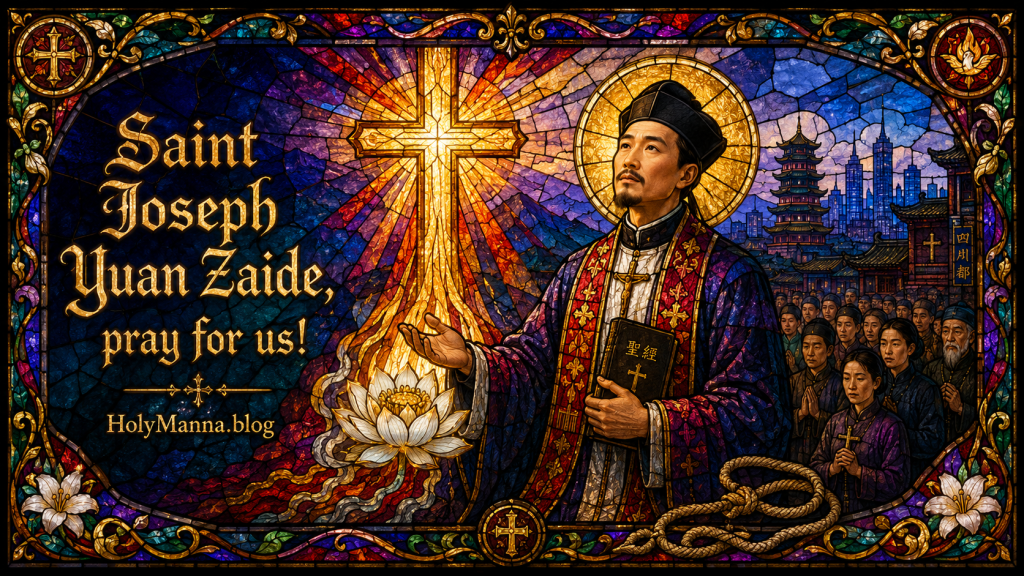
The Shepherd Who Would Not Let Go of His Flock
There are saints whose names fill cathedral windows and whose statues stand in every parish hall. And then there are saints like Joseph Yuan Zaide, whose story is just as powerful, just as urgent, and just as worth knowing, even if most Catholics in the Western world have never heard his name. He was a Chinese diocesan priest who spent his entire adult life doing one thing: shepherding souls in secret, at tremendous personal risk, in a land where being Catholic could get you killed. And when they finally came for him, he did not run. He did not deny Christ. He walked to his death encouraging the very people he had served to hold on to Jesus.
Saint Joseph Yuan Zaide was a priest born in 1766 in Sichuan, China, in the Apostolic Vicariate of Sichuan. He was strangled on June 24, 1817, in Chengdu, Sichuan, China, and died as a martyr. He was canonized on October 1, 2000, by Pope John Paul II. He is one of the 120 Martyrs of China, a group of men, women, and children from wildly different backgrounds who share one thing in common: they refused to renounce Jesus Christ, and it cost them everything.
His story is not just a piece of distant history. It is a living word for anyone who has ever wondered if faith is really worth the cost.
The Youngest of Five, Called From the Beginning
Joseph Yuan Zaide was the youngest of five children, born in 1766 at Peng County, Sichuan Province. Growing up in a God-fearing home, Joseph’s thoughts were constantly directed towards the Bible and serving God. From the very beginning, there was something in this young man that was oriented toward heaven. He was not a reluctant saint. He was not someone dragged into faith against his will. He was a child raised in a family that loved God, and that love took root.
His Chinese name carries a meaning that feels almost prophetic in hindsight. “Zaide” can be understood to mean “existing in virtue” or “abiding in virtue.” For a man who would spend decades serving Christ in hidden, dangerous, and unglamorous ways, the name fits perfectly.
Joseph Yuan Zaide entered the seminary at Luorenggou at age 16 and was sent in 1786 to assist Bishop Gabriel-Taurin Dufresse in Chengdu. That assignment would change the entire trajectory of his life, because the bishop he went to serve would become the instrument of his deepest conversion.
Having heard Bishop Dufresse speak of the Christian faith, he was overcome by its beauty and then became an exemplary neophyte. That phrase is worth sitting with for a moment. He was overcome by its beauty. This was not a conversion born of fear or obligation. This was a young man who encountered the Gospel proclaimed with conviction and holiness, and it stopped him in his tracks. The faith he had grown up with suddenly became something personal, something blazing and alive, and he never looked back.
He felt a calling to the priesthood and studied to become a priest at the Luoranggou mission seminary in Yibin, Sichuan. He was ordained to the priesthood on September 20th, 1794. He was twenty-eight years old, newly ordained, and stepping into a world that had no intention of making things easy for him.
A Priest in the Shadows, a Shepherd in the Storm
One of the most remarkable and often overlooked facts about Saint Joseph Yuan Zaide is the extraordinary company he keeps among the saints. His conversion and that of Saint Augustine Zhao Rong are directly linked through the same bishop and the same moment of grace. One day in 1785, while Dufresse was part of a convoy of prisoners, one of his guards was moved by the faith and patience of the bishop and converted. He was Augustine Zhao Rong, who became the first Chinese-born diocesan priest and was martyred in 1815. Joseph Yuan was also converted at that time, was ordained a priest, and was arrested in 1816 after evangelizing a vast region. He was strangled on June 24, 1817.
Think about what that means. One bishop, being transported as a prisoner in chains, radiated such peace and faith that he became the instrument of conversion for two future saints, both of whom became priests, and both of whom eventually gave their lives for Christ. Bishop Dufresse’s witness in captivity bore fruit that would echo through eternity. This is exactly what The Catechism of the Catholic Church means when it says, “Martyrdom is the supreme witness given to the truth of the faith: it means bearing witness even unto death. The martyr bears witness to Christ who died and rose, to whom he is united by charity” (CCC 2473).
After his ordination, Father Joseph Yuan Zaide threw himself into missionary work across the districts of Sichuan. The following year, a severe persecution against the White Lotus Society was launched by the Chinese authorities, and many Catholics were caught up in it. Yuan risked his life by continuing to take care of the flock entrusted to his care. In the end, he had to flee to Dezhou, where he lived on a farm while the authorities searched for him. During this time, he continued to share the Gospel whenever he had an opportunity.
Picture that. A priest, living as a farmer to avoid detection by imperial authorities, still finding ways to gather his people, still administering the sacraments in secret, still baptizing, still absolving, still teaching the faith to anyone who would listen. He evangelized discreetly in several locales, baptizing converts and administering sacraments despite these risks. For more than twenty years, Father Joseph Yuan Zaide operated as an underground priest in Sichuan Province, doing the work of the Gospel one soul at a time, with no guarantee that tomorrow would come.
There are no recorded miracles from his lifetime in the formal canonical sense. What history gives instead is something equally powerful: the miracle of a man who sustained heroic virtue in ordinary, hidden, daily faithfulness over two decades. That kind of perseverance is its own sign of grace.
Betrayal, Arrest, and the Walk to the End
After more than twenty years of faithful hidden ministry, the moment finally came. A female member of his flock had fallen into the sin of adultery. Yuan reprimanded her publicly for her sin and lack of repentance. The woman felt deeply humiliated and looked for an opportunity to get revenge on Yuan. Learning that he was leaving on a secret mission to Hezhou, she passed the information on to the local authorities. Yuan was arrested on July 9, 1816, along with many other Catholics whose identity had been revealed by the adulterous woman.
There is no softening this detail. Father Joseph Yuan Zaide was handed over to the authorities by someone from within his own congregation, someone he had tried to help, tried to call back from sin, tried to love with the difficult love of a pastor who tells the truth even when the truth is hard to hear. His act of pastoral courage became the instrument of his arrest. The woman he had tried to save was the one who condemned him.
The parallels to Christ are impossible to ignore. Jesus was betrayed by one of the Twelve. Joseph Yuan Zaide was betrayed by one of his own flock. Both had given love and truth. Both were handed over because of it.
He was arrested in August 1816, condemned to be strangled, and was killed in this way on June 24, 1817. He spent nearly a year in prison before his execution. And when the day finally came, as he was taken to the execution ground to be killed, Joseph Yuan Zaide encouraged his flock to remain faithful to Jesus Christ. The 51-year-old priest was killed at Chengdu on June 24, 1817.
He was being led to his death, and his last concern was for his people. Not for his own suffering. Not for his own fear. His final act of ministry was to turn back to the faithful who had gathered and urge them with everything he had left: stay faithful. Hold on to Jesus. Those words are his legacy in miniature. They are the portrait of a shepherd who lived for his flock and died for them.
A Century of Waiting, a Day of Glory
The formal recognition of Saint Joseph Yuan Zaide’s martyrdom by the Church unfolded over more than a century, which is itself a testament to the Church’s careful and patient discernment in matters of sainthood.
His decree of martyrdom was issued on July 2, 1899, by Pope Leo XIII. He was beatified on May 27, 1900, by Pope Leo XIII. Then, exactly one hundred years later, on October 1, 2000, during the Great Jubilee Year, Pope John Paul II canonized him alongside 119 companions as part of one of the most significant single canonization events in modern Church history.
Of the 120 saints canonized that day, 87 are Chinese and 33 are foreign missionaries. Among them are 6 bishops, 23 priests, 8 monks, 7 nuns, and 76 lay people. In his homily, Pope John Paul II proclaimed: “Chinese men and women of every age and state, priests, religious and lay people, showed the same conviction and joy, sealing their unfailing fidelity to Christ and the Church with the gift of their lives.” The pope concluded by saying in Chinese: “May God send happiness on you!” It was a deeply personal gesture to the Chinese faithful, many of whom could not freely celebrate this moment in their own homeland.
The symbol chosen to represent the 120 Martyrs at the canonization was deeply meaningful. Unlike the other new saints, the Chinese were represented not by portraits but by a hanging showing a cross around which was woven a vine. At the foot of the cross was a lotus flower in a pool of blood. On either side, the words “the blood of the martyrs, the seed of Christians” were written in Chinese and Latin. The lotus flower, which rises from mud and water to bloom in beauty, is one of the most powerful symbols in Chinese culture. Placed at the foot of the cross in a pool of martyrs’ blood, it speaks of resurrection. Life from death. Beauty born of suffering.
The canonization was not without controversy. The People’s Republic of China denounced the event as an insult to the Chinese people and a violation of state sovereignty over religious matters. The Chinese government called the martyrs traitors, even those who were native Chinese and had given their entire lives in service to the Chinese people. The irony is breathtaking. A government that persecutes believers today was outraged at the Church honoring believers it had persecuted two centuries ago.
No specific individual miracles are formally attributed to Saint Joseph Yuan Zaide alone in the canonical record after his death. His canonization proceeded as part of the collective cause of the 120 Martyrs of China, for whom the verified martyrdom itself served as the foundation of the cause. As The Catechism reminds the faithful, “the Church has painstakingly collected the records of those who persevered to the end in witnessing to their faith. These are the acts of the Martyrs. They form the archives of truth written in letters of blood” (CCC 2474). His witness in life and in death is the miracle the Church has proclaimed.
The Chinese Martyrs Catholic Church in Toronto, Ontario, is named for the 120 Martyrs as a group, standing as a living memorial to the faith these men and women poured out with their blood. Around the world, Chinese Catholic communities in diaspora and on the mainland celebrate July 9 as a day of particular pride and solidarity, keeping the memory of saints like Joseph Yuan Zaide alive for the next generation.
His legacy burns brightest among the underground Catholics of China, those who to this day remain in communion with Rome rather than the state-controlled Chinese Patriotic Catholic Association. Devout Chinese Catholics, particularly in the underground Church loyal to the Holy See, invoke his intercession for fidelity amid ongoing restrictions, drawing strength from his final encouragement to believers to remain faithful to Jesus Christ as he was led to execution in Chengdu on June 24, 1817.
The Shepherd Still Speaks
Most people reading this are not being hunted by imperial authorities. No one is likely to be strangled for going to Mass on Sunday. But the interior battles that Saint Joseph Yuan Zaide faced are very much alive in the modern world.
There is the pressure to water down the faith, to say nothing when a colleague mocks Christianity, to laugh along, to stay quiet because speaking up feels like too much. There is the slow burn of faithfulness that nobody sees, serving a family, a parish, or a community year after year without applause or recognition. There is the sting of betrayal, being hurt by people inside the Church, by those entrusted with one’s confidence. And there is the specific and very human fear of speaking truth in love, of being the person who tells a friend or a family member something difficult and true, knowing it might cost the relationship.
Father Joseph Yuan Zaide was betrayed because he told a parishioner the truth about her sin. He paid for that pastoral honesty with his life. Most Catholics today will pay far less than that. But the temptation to stay silent, to protect comfort over truth, to choose peace over charity, is just as real now as it was in Qing-dynasty China.
The Catechism is clear about what the witness of the martyrs means for every believer. It is not just history. It is a call. “The Christian is not to be ashamed of testifying to our Lord in deed and word. Martyrdom is the supreme witness given to the truth of the faith” (CCC 2506). Most are not called to martyrdom. But all are called to witness, in homes, in workplaces, in friendships, and yes, even in the comment sections.
Saint Joseph Yuan Zaide spent twenty years doing the unglamorous, invisible, dangerous work of keeping a scattered flock alive in faith. He did it in hiding. He did it without recognition. He did it when it would have been so much easier to simply stop. And when his time came, he faced death with the serenity of a man who had already surrendered everything to God long before the soldiers arrived.
That is the invitation his life extends to every Catholic today. Not a dramatic, one-time gesture of heroism, but a daily, faithful, unglamorous choice to show up for God and for the people entrusted to one’s care, no matter what it costs.
Engage With Us!
The story of Saint Joseph Yuan Zaide is not just something to admire from a distance. It is an invitation to look at one’s own life and ask some honest questions. Please share your thoughts and reflections in the comments below. This is a community of people growing in faith together, and your voice matters here.
- Father Joseph Yuan Zaide spent over twenty years serving God faithfully in secret, with no recognition and at great personal risk. Where in your own life are you being called to quiet, hidden faithfulness that no one may ever applaud?
- He was betrayed by someone he was trying to help spiritually. Have you ever been hurt by someone inside the Church? How did that experience affect your faith, and what did it teach you about keeping your eyes on Christ rather than on people?
- His last recorded act was to encourage his flock to remain faithful to Jesus Christ as he walked to his execution. What does faithfulness to Christ cost you right now, and what is one concrete step you can take this week to lean into that cost rather than away from it?
- Bishop Dufresse converted two future saints simply by the witness of his patience and faith while in chains. Who in your life is watching how you carry your sufferings and difficulties? How might your witness right now be planting seeds you cannot yet see?
Keep going. Keep showing up. Keep choosing Christ in the small things, because that is exactly where the saints were made. The world needs faithful, courageous, loving witnesses of the Gospel now more than ever, and God has placed each person reading this exactly where they are for a reason. Go be the witness only you can be, with all the love and mercy Jesus has poured into your heart.
Saint Joseph Yuan Zaide, pray for us!
Follow us on YouTube, TikTok, Instagram and Facebook for more insights and reflections on living a faith-filled life.


Leave a comment