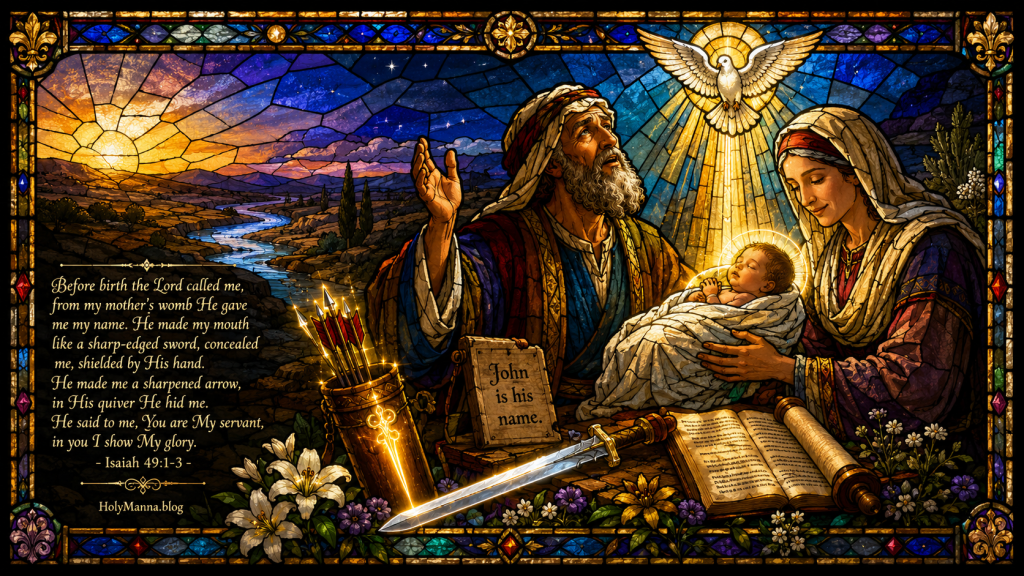
Solemnity of the Nativity of Saint John the Baptist – Lectionary: 587
A Birthday Worth Celebrating
Most people remember their birthday as a private milestone, a day for cake and candles and maybe a few cards from family who still send them in the mail. The Catholic Church, however, only sets aside a handful of birthdays each year to be celebrated by the entire world, and today is one of those rare and remarkable days. The Solemnity of the Nativity of Saint John the Baptist stands alongside the Nativity of the Lord and the Nativity of the Blessed Virgin Mary as one of only three birth dates honored on the universal calendar, and that detail alone should make a person pause and ask why this particular birth mattered so much to the early Church that it has been celebrated for over sixteen centuries.
The answer begins long before John ever drew breath in the hill country of Judea. Saint Augustine, writing in his Sermon 293, noticed something that the ancient world would have appreciated far more readily than modern readers do, which is the placement of this feast near the summer solstice, when the daylight hours begin to shrink toward winter. Six months later, the Church celebrates the birth of Christ near the winter solstice, when the daylight hours begin to grow again toward summer. The Fathers of the Church read this as creation itself preaching a sermon, since John would later say of Jesus, “He must increase; I must decrease” (John 3:30). Even the turning of the seasons becomes a quiet witness to the truth that John spent his entire life pointing toward someone greater than himself.
That single idea, a life known by God before birth and offered entirely in service of someone else, ties together every reading proclaimed at Mass today. In Isaiah 49:1-6, the Servant of the Lord declares that he was named and set apart while still in his mother’s womb, a calling that the Church has long heard echoed in John’s own story. The Responsorial Psalm, taken from Psalm 139, deepens that same truth by reminding the faithful that every person is “knit together” in secret by a God who already knows their thoughts, their travels, and their rest before they ever take shape. The Second Reading from the Acts of the Apostles shows what a life formed by that kind of calling actually looks like once it reaches adulthood, as Paul recounts how John refused to let anyone mistake him for the Messiah, insisting instead that he was not even worthy “to unfasten the sandals of his feet” (Acts 13:25). Finally, the Gospel passage from Luke 1:57-66, 80 brings the story back to its beginning, describing the very day John received his name and the wonder that followed when his father’s voice was suddenly restored.
What unites these four passages is not simply that they all mention John, but that together they paint a single portrait of vocation as something given rather than chosen. Long before John could speak a word of prophecy or baptize a single soul in the Jordan River, God had already called him, named him, and set him apart for a mission that would prepare the world for Christ. What would it feel like to know with total certainty that God had a plan for your life before you ever took your first breath? That question sits at the heart of this solemnity, and it is worth carrying into each of today’s readings, since the same God who formed John in the womb of Elizabeth is the very same God who formed every reader of these words in secret, fashioning each one with a purpose every bit as real, even if it remains less famous than the one given to the last and greatest of the prophets.
First Reading – Isaiah 49:1-6
A Voice Hidden in the Quiver, Waiting for Its Moment
Long before the prophet Isaiah ever wrote the words proclaimed in today’s First Reading, the people of Israel had grown weary. They had endured exile in Babylon, watched their temple fall, and wondered whether the promises God made to their ancestors still held any weight. It was into that atmosphere of doubt and longing that the prophet delivered what scholars now call the second of the four Servant Songs found in the Book of Isaiah, poetic passages that describe a mysterious figure chosen by God to accomplish a mission far greater than himself. Scholars have debated for generations whether this servant represents the nation of Israel as a whole, an individual prophet, or someone still to come, and the Church has always read these songs with a generous and layered vision, recognizing in them a prophecy that finds its deepest fulfillment in Christ while also hearing an unmistakable echo of John the Baptist, the very man whose birth the Church celebrates today. The connection becomes clear almost immediately, since the servant in this passage describes being called and named by God while still in his mother’s womb, a detail that mirrors exactly what the angel Gabriel told Zechariah about the son who would be born to him and Elizabeth. This reading sets the foundation for everything that follows in today’s liturgy, establishing the truth that a person’s mission from God does not begin at baptism, at confirmation, or even at birth, but in the secret and hidden moment when life itself begins.
Isaiah 49:1-6 – New American Bible (Revised Edition)
The Servant of the Lord
1 Hear me, coastlands,
listen, distant peoples.
Before birth the Lord called me,
from my mother’s womb he gave me my name.
2 He made my mouth like a sharp-edged sword,
concealed me, shielded by his hand.
He made me a sharpened arrow,
in his quiver he hid me.
3 He said to me, You are my servant,
in you, Israel, I show my glory.4 Though I thought I had toiled in vain,
for nothing and for naught spent my strength,
Yet my right is with the Lord,
my recompense is with my God.
5 For now the Lord has spoken
who formed me as his servant from the womb,
That Jacob may be brought back to him
and Israel gathered to him;
I am honored in the sight of the Lord,
and my God is now my strength!
6 It is too little, he says, for you to be my servant,
to raise up the tribes of Jacob,
and restore the survivors of Israel;
I will make you a light to the nations,
that my salvation may reach to the ends of the earth.
Detailed Exegesis
Verse 1 – “Hear me, coastlands, listen, distant peoples. Before birth the Lord called me, from my mother’s womb he gave me my name.” The servant opens not by addressing Israel alone but by calling out to the coastlands and distant peoples, signaling from the very first line that this mission was never meant to remain confined to one nation. The phrase about being called before birth and named from the womb is the verse that the Church hears most clearly fulfilled in John, since his name was chosen by God through the angel Gabriel before he was ever conceived, a detail that Zechariah and Elizabeth had no authority to change no matter how strongly tradition pulled them toward naming him after his father.
Verse 2 – “He made my mouth like a sharp-edged sword, concealed me, shielded by his hand. He made me a sharpened arrow, in his quiver he hid me.” The imagery here is striking because it describes weapons that are useless until the precise moment they are needed. A sword does no good sheathed and an arrow accomplishes nothing while still resting in the quiver, yet both remain sharp, prepared, and protected by the hand of God until the appointed time arrives. This verse speaks beautifully to John’s own hidden years in the desert, a long season of preparation before his public ministry of preaching repentance ever began.
Verse 3 – “He said to me, You are my servant, in you, Israel, I show my glory.” Here the servant receives his identity directly from God rather than constructing it for himself, and the name Israel applied to him connects his individual calling to the destiny of the whole people of God. This is a theme the Church returns to again and again, since true vocation is always received as a gift rather than achieved through personal effort or self promotion.
Verse 4 – “Though I thought I had toiled in vain, for nothing and for naught spent my strength, Yet my right is with the Lord, my recompense is with my God.” This verse gives voice to a discouragement that anyone who has ever labored for God can recognize, the quiet fear that the work has produced nothing of value. Yet the servant does not abandon his trust, choosing instead to rest his confidence entirely in the Lord rather than in visible results, a posture that John himself would later embody when crowds began following Jesus instead of him and he felt no need to defend his own reputation.
Verse 5 – “For now the Lord has spoken who formed me as his servant from the womb, That Jacob may be brought back to him and Israel gathered to him; I am honored in the sight of the Lord, and my God is now my strength!” The servant’s mission is described here as gathering and restoring a scattered people, and the honor he receives comes not from human applause but from being seen rightly in the eyes of God. This verse reminds the reader that true honor in the Christian life is never measured by popularity but by faithfulness to the task God has assigned.
Verse 6 – “It is too little, he says, for you to be my servant, to raise up the tribes of Jacob, and restore the survivors of Israel; I will make you a light to the nations, that my salvation may reach to the ends of the earth.” This final verse expands the servant’s mission beyond anything he could have imagined for himself, taking what already seemed like an enormous calling and stretching it outward to embrace the entire world. This is the verse that Paul and Barnabas would later quote directly while preaching to the Gentiles in the very city of Pisidian Antioch described in today’s Second Reading, proving that the light promised here did not stop with Israel or even with John, but continues to spread through the missionary life of the Church to this very day.
Teachings
The Catechism of the Catholic Church gathers up much of what this reading points toward in its teaching on John the Baptist found in CCC 523, which states plainly that “St. John the Baptist is the Lord’s immediate precursor or forerunner, sent to prepare his way. ‘Prophet of the Most High’, John surpasses all the prophets, of whom he is the last. He inaugurates the Gospel, already from his mother’s womb welcomes the coming of Christ, and rejoices in being ‘the friend of the bridegroom’, whom he points out as ‘the Lamb of God, who takes away the sin of the world’. Going before Jesus ‘in the spirit and power of Elijah’, John bears witness to Christ in his preaching, by his Baptism of conversion, and through his martyrdom.” This single paragraph captures nearly everything Isaiah’s Servant Song anticipates, drawing a straight line from a prophecy written centuries before Christ to the flesh and blood witness of a man born into a priestly family in the hill country of Judea. The Church Fathers, including Saint Augustine, read these Servant Songs with full awareness that their ultimate fulfillment belongs to Christ himself, yet they never hesitated to recognize in John a true and living foretaste of that fulfillment, since he was the one chosen to announce that the long awaited light had finally arrived. History bears out this connection in a remarkable way, since the Acts of the Apostles records that Paul and Barnabas later stood before a synagogue of Gentiles and Jews in Pisidian Antioch and quoted this very prophecy from Isaiah to explain why salvation was now being offered to the whole world, showing that the mission first whispered to a hidden servant before his birth had grown, through John and ultimately through Christ, into a fire that the early Church could no longer contain within the borders of Israel.
Reflection
There is something deeply comforting in knowing that long before a person accomplishes anything of note, long before they choose a career or make a single decision that shapes their future, God has already known them, named them, and set a purpose into motion on their behalf. Many people spend years searching for a sense of identity in achievements, in the approval of others, or in comparison with the lives of those around them, yet this reading offers a far steadier foundation, reminding every believer that their worth was settled before they ever took their first breath. What might change in daily life if a person truly believed that God had hidden them away like a sharpened arrow, preparing them for a purpose still unfolding rather than already finished? There is also a quiet lesson here for anyone who has ever felt that their efforts amounted to nothing, since even the servant in this passage admits to feeling that his strength had been spent in vain before recalling that his reward rests with the Lord rather than with visible success. Carrying that trust into ordinary life, whether at work, within a family, or in the quiet labor of raising children in the faith, allows a person to keep laboring faithfully even when the fruit of that labor is not yet visible. And when the noise of comparison or self doubt grows loud, is there room to ask whether today’s small, hidden faithfulness might be exactly the kind of preparation God once asked of John before the world ever knew his name?
Responsorial Psalm – Psalm 139:1-3, 13-15
The God Who Already Knows the Words Before They Are Spoken
Long before the printing press, long before a person could record their own thoughts in a private journal, the people of Israel were praying a psalm that described something almost unimaginable for the ancient world, which was a God who already knew every word a person would speak before it ever left their lips. Psalm 139 is traditionally attributed to King David, and it belongs to a category of psalms that scholars often call wisdom or meditative psalms, since it does not ask God for anything specific but instead simply marvels at who God is and how completely he knows the one praying to him. The Church places this psalm immediately after the First Reading from Isaiah for a very deliberate reason, since Isaiah described a servant who was named and called from his mother’s womb, and this psalm now turns that same truth inward, inviting every believer to recognize that the same intimate knowledge God had of his chosen servant he also has of every single person he has ever formed. On a day when the Church celebrates the birth of John the Baptist, a man known and set apart before he ever breathed his first breath, this psalm becomes the prayer of every reader who has ever wondered whether their own life carries that same quiet significance in the eyes of God.
Psalm 139:1-3, 13-15 – New American Bible (Revised Edition)
The All-knowing and Ever-present God
1 For the leader. A psalm of David.
Lord, you have probed me, you know me:
2 you know when I sit and stand;
you understand my thoughts from afar.
3 You sift through my travels and my rest;
with all my ways you are familiar.13 You formed my inmost being;
you knit me in my mother’s womb.
14 I praise you, because I am wonderfully made;
wonderful are your works!
My very self you know.
15 My bones are not hidden from you,
When I was being made in secret,
fashioned in the depths of the earth.
Detailed Exegesis
Verse 1 – “Lord, you have probed me, you know me.” The psalm opens with a verb that suggests something closer to careful searching than a quick glance, the kind of attention a craftsman gives when examining every detail of his work. This is not a distant or impersonal God observing from far away, but one who has searched the depths of the human heart and already knows what he finds there.
Verse 2 – “You know when I sit and stand; you understand my thoughts from afar.” Even the smallest and most ordinary movements of daily life, the simple act of sitting down or rising up, fall within the gaze of God. The phrase about understanding thoughts from afar reveals that God does not need to be physically present in a room to know what is happening in someone’s mind, a truth that should bring great comfort to anyone who has ever felt alone in their struggles.
Verse 3 – “You sift through my travels and my rest; with all my ways you are familiar.” The image of sifting suggests a God who separates and examines every detail of a person’s journey, including both the moments of activity and the moments of stillness. There is no portion of daily life, whether busy or restful, that escapes this familiar and attentive love.
Verse 13 – “You formed my inmost being; you knit me in my mother’s womb.” This verse moves the psalm from God’s knowledge of the present moment back to the very beginning of life itself, describing the womb not as a place of random biological development but as the workshop of a God who personally knits together every human person. This is the verse most directly connected to John the Baptist, since Elizabeth’s womb became the very place where God formed a child destined to prepare the way for the Messiah.
Verse 14 – “I praise you, because I am wonderfully made; wonderful are your works! My very self you know.” The psalmist responds to this revelation not with anxiety about being so thoroughly known, but with praise, recognizing that being wonderfully made is a cause for gratitude rather than fear. This verse has become one of the most beloved expressions in all of Scripture for affirming the inherent dignity and goodness of every human life.
Verse 15 – “My bones are not hidden from you, when I was being made in secret, fashioned in the depths of the earth.” The phrase about being made in secret echoes the hidden years that both John and Jesus would spend in obscurity before their public missions began, while the reference to the depths of the earth recalls the ancient belief that the womb itself was as mysterious and unseen as the deepest places of creation. Even in that hidden darkness, the psalmist insists, nothing about a person’s formation escapes the knowledge of God.
Teachings
The Catechism of the Catholic Church draws directly upon this psalm when teaching about the sanctity of human life from the very first moment of conception, stating in CCC 2270 that “Human life must be respected and protected absolutely from the moment of conception. From the first moment of his existence, a human being must be recognized as having the rights of a person, among which is the inviolable right of every innocent being to life.” The Catechism then supports this teaching by quoting Scripture, including the very words of this psalm, “My frame was not hidden from you, when I was being made in secret, intricately wrought in the depths of the earth” (Psalm 139:15), placing this ancient prayer at the very foundation of the Church’s teaching on the dignity of every human life. Saints and theologians throughout history have returned to this psalm again and again when reflecting on the mystery of vocation, recognizing that if God knew and formed a person before birth, then no life is accidental and no calling is randomly assigned. This conviction stands at the very heart of why the Church celebrates John’s birth with such solemnity, since his story stands as living proof that God’s knowledge of a person in the womb is not merely poetic language but a reality with consequences that unfold across an entire lifetime.
Reflection
There is a particular kind of peace available to anyone willing to sit with the truth of this psalm, since it answers one of the deepest fears the human heart carries, which is the fear of being unknown or overlooked. Many people move through their days assuming that their value depends on how visible their accomplishments are to others, yet this psalm insists that long before any achievement was possible, a person was already fully known and already considered wonderfully made by the God who formed them. What would it look like to begin each morning by remembering that the same God who knit John the Baptist together in his mother’s womb formed every reader of these words with that same careful attention? This truth also carries real weight for how Catholics are called to view every stage of human life, from the earliest moments in the womb to old age, since a God who knows a person that intimately before birth does not stop knowing or loving them once that life becomes inconvenient, unborn, elderly, or sick. Living out this psalm in daily life might mean praying it slowly during a quiet moment, allowing each line to settle into the heart rather than rushing past it, or it might mean carrying its truth into encounters with others, remembering that every person met throughout the day was also knit together in secret by the same loving hand. And when self doubt or comparison creeps in, is there room to return to this psalm and simply rest in the truth that being wonderfully made was never something that needed to be earned in the first place?
Second Reading – Acts 13:22-26
A Sermon in a Roman Frontier Town That Changed How the Gospel Would Be Preached
By the time Paul and Barnabas arrived in Pisidian Antioch during the first missionary journey, the early Church had already begun discovering something remarkable, which was that the message of Christ could not be contained within the borders of Israel any longer. Pisidian Antioch sat on the edge of the Roman frontier in what is now central Turkey, a city with a sizable Jewish community as well as a number of Gentile God fearers, people who admired the God of Israel and attended synagogue worship without having fully converted through circumcision and the Mosaic law. Today’s Second Reading comes from the sermon Paul delivered in that synagogue, a speech so significant that it stands as the longest recorded sermon of Paul found anywhere in the Acts of the Apostles and serves almost as a template for how the early Church explained the Gospel to a mixed audience of Jews and Gentiles. In the verses proclaimed today, Paul walks his listeners through the line of King David down to Jesus, then pauses to give John the Baptist his proper place in that story, describing him as the herald who prepared Israel for the Savior’s arrival. This reading carries today’s theme forward in a powerful way, since the earlier readings spoke of John being known, named, and formed before birth, while this passage finally shows what that calling looked like once it reached full maturity in his adult ministry along the banks of the Jordan River.
Acts 13:22-26 – New American Bible (Revised Edition)
22 Then he removed him and raised up David as their king; of him he testified, ‘I have found David, son of Jesse, a man after my own heart; he will carry out my every wish.’ 23 From this man’s descendants God, according to his promise, has brought to Israel a savior, Jesus. 24 John heralded his coming by proclaiming a baptism of repentance to all the people of Israel; 25 and as John was completing his course, he would say, ‘What do you suppose that I am? I am not he. Behold, one is coming after me; I am not worthy to unfasten the sandals of his feet.’
26 “My brothers, children of the family of Abraham, and those others among you who are God-fearing, to us this word of salvation has been sent.
Detailed Exegesis
Verse 22 – “Then he removed him and raised up David as their king; of him he testified, I have found David, son of Jesse, a man after my own heart; he will carry out my every wish.” Paul is recounting the moment when God set aside the failed kingship of Saul in favor of David, and the phrase describing David as a man after God’s own heart was never meant to suggest moral perfection, since David’s life included serious sin, but rather a heart fundamentally oriented toward obedience and repentance whenever he strayed. This sets the stage for the promise that would follow, since it was through David’s line that God committed himself to raising up a savior for his people.
Verse 23 – “From this man’s descendants God, according to his promise, has brought to Israel a savior, Jesus.” Here Paul moves directly from David to Jesus, collapsing centuries of waiting into a single sentence that announces the promise has finally been fulfilled. The word savior would have carried enormous weight for a Jewish audience steeped in the prophetic tradition, since it spoke not merely to political deliverance but to the restoration of the covenant relationship between God and his people.
Verse 24 – “John heralded his coming by proclaiming a baptism of repentance to all the people of Israel.” This verse places John precisely where the earlier readings prepared him to stand, as the one chosen to announce the Savior’s arrival before that Savior ever began his own public ministry. The baptism of repentance John offered was not the sacramental baptism of the New Covenant but rather a ritual cleansing meant to prepare hearts for the coming of the Messiah, a fitting task for the man who had been set apart for this very purpose from his mother’s womb.
Verse 25 – “And as John was completing his course, he would say, What do you suppose that I am? I am not he. Behold, one is coming after me; I am not worthy to unfasten the sandals of his feet.” The phrase about completing his course uses an image borrowed from the athletic stadium, describing John’s ministry as a race run with purpose and finished with integrity. The humility expressed here is striking, since John had every opportunity to bask in the attention of crowds who flocked to him in the wilderness, yet he consistently redirected that attention toward the one who was coming after him, declaring himself unworthy even to perform the lowly task of loosening another man’s sandal strap.
Verse 26 – “My brothers, children of the family of Abraham, and those others among you who are God-fearing, to us this word of salvation has been sent.” Paul closes this portion of his sermon by addressing both the Jewish members of his audience and the God fearing Gentiles who had gathered alongside them, making clear that the message of salvation he proclaims belongs to both groups equally. This verse quietly anticipates what Paul will say only a few verses later, when he applies the very prophecy from Isaiah 49 read earlier today to his own mission of bringing salvation to the nations, showing that the light first promised to a hidden servant and then heralded by John was never meant to stop at the edges of Israel.
Teachings
The Catechism of the Catholic Church speaks directly to John’s role described in this passage, teaching in CCC 719 that “John the Baptist is ‘more than a prophet.’ In him, the Holy Spirit concludes his speaking through the prophets… He proclaims the imminence of the consolation of Israel; he is the ‘voice’ of the Consoler who is coming.” This teaching captures exactly what Paul describes in his sermon, presenting John not as one prophet among many but as the final voice of the Old Covenant standing at the threshold of the New. The humility John displays in declaring himself unworthy to untie the sandals of the one coming after him became a touchstone for later Church teaching on the proper posture of anyone called to ministry, and centuries later Pope Benedict XVI would reflect on this very humility by saying that John’s words in the Gospel of John, “He must increase, but I must decrease” (John 3:30), stand as “a program for every Christian.” Saint Augustine, preaching on this same feast in his Sermon 293, marveled at how a man so honored by the crowds of Israel could speak of himself with such total self forgetfulness, recognizing in John’s humility a deliberate echo of the Servant’s mission first announced in Isaiah, a mission fulfilled not through self promotion but through faithful pointing toward another.
Reflection
There is a kind of freedom available in John’s example that feels almost countercultural in a world built around personal branding and curated images, since here stands a man with genuine influence and a devoted following who consistently used every ounce of that influence to draw attention away from himself. What would it look like to imitate that same posture in ordinary life, whether at work, within a parish community, or even in the more public spaces of social media where the temptation to seek personal recognition runs especially strong? John’s image of completing a race also offers a steady and encouraging picture for anyone walking through a difficult season of life, since it suggests that faithfulness matters more than visible success and that finishing well, even quietly, fulfills the purpose for which a person was sent. There is real wisdom in regularly examining whether daily choices, conversations, and even prayers tend to point toward Christ or quietly circle back toward self interest, since John’s witness makes clear that true greatness in the eyes of God often looks like humility rather than recognition. And in the moments when credit or attention seems within reach, is there room to pause and ask, as John so often did, whether stepping back might actually be the more faithful response?
Holy Gospel – Luke 1:57-66, 80
The Day a Father’s Silence Finally Broke
By the time the events of today’s Gospel take place, nine months had already passed since the angel Gabriel appeared to Zechariah inside the sanctuary of the Jerusalem Temple and struck him mute for doubting that his elderly wife Elizabeth would ever bear a son. That long silence was not simply a punishment hanging over an old priest who had questioned a divine messenger, but rather a sign meant for the whole community, a visible reminder that something extraordinary was unfolding even while it remained hidden from view. In first century Jewish culture, the naming of a child carried far more weight than it often does today, since a name was understood to reveal something essential about a person’s identity and destiny, and the custom of naming a firstborn son after his father was so deeply rooted that the neighbors gathered for the circumcision simply assumed it would happen without question. Today’s Gospel passage from the Gospel of Luke captures the moment when that assumption was overturned, revealing that this child belonged to a story far larger than family tradition. This reading brings the entire arc of today’s readings to its proper conclusion, since the Servant Song from Isaiah, the intimate knowledge described in the Psalm, and the adult ministry described in the Acts of the Apostles, all trace back to this single ordinary household in the hill country of Judea where God’s plan finally became visible for everyone present to see.
Luke 1:57-66, 80 – New American Bible (Revised Edition)
57 When the time arrived for Elizabeth to have her child she gave birth to a son. 58 Her neighbors and relatives heard that the Lord had shown his great mercy toward her, and they rejoiced with her. 59 When they came on the eighth day to circumcise the child, they were going to call him Zechariah after his father, 60 but his mother said in reply, “No. He will be called John.” 61 But they answered her, “There is no one among your relatives who has this name.” 62 So they made signs, asking his father what he wished him to be called. 63 He asked for a tablet and wrote, “John is his name,” and all were amazed. 64 Immediately his mouth was opened, his tongue freed, and he spoke blessing God. 65 Then fear came upon all their neighbors, and all these matters were discussed throughout the hill country of Judea. 66 All who heard these things took them to heart, saying, “What, then, will this child be?” For surely the hand of the Lord was with him.
80 The child grew and became strong in spirit, and he was in the desert until the day of his manifestation to Israel.
Detailed Exegesis
Verse 57 – “When the time arrived for Elizabeth to have her child she gave birth to a son.” After months of waiting that must have felt impossibly long for a woman who had endured the social shame of barrenness for so many years, the promise made by the angel to Zechariah finally reached its fulfillment. This simple, almost understated verse carries enormous weight, since it marks the arrival of the very child whom Isaiah had described centuries earlier as being named and called before birth.
Verse 58 – “Her neighbors and relatives heard that the Lord had shown his great mercy toward her, and they rejoiced with her.” The community’s response centers entirely on God’s mercy rather than on Elizabeth’s own accomplishment, recognizing correctly that a child conceived in old age was nothing less than a direct act of divine kindness. This shared rejoicing also reflects the deeply communal nature of life in first century Judea, where a family’s joy or sorrow belonged in some real sense to the whole village.
Verse 59 – “When they came on the eighth day to circumcise the child, they were going to call him Zechariah after his father.” The eighth day held deep significance in Jewish religious life, since circumcision marked a male child’s formal entrance into the covenant God had made with Abraham, and the assumption that the boy would carry his father’s name reveals just how strong and unquestioned that custom remained. No one present had any reason yet to suspect that this particular child would break from that expectation.
Verse 60 – “But his mother said in reply, No. He will be called John.” Elizabeth’s firm and immediate correction stands out sharply against the backdrop of custom, and her insistence reveals that she had clearly been told by Zechariah, even through his silence, exactly what name the angel had commanded. Her willingness to stand against an entire gathering of neighbors and relatives on this point shows a quiet but unmistakable trust in what God had already communicated to her household.
Verse 61 – “But they answered her, There is no one among your relatives who has this name.” The crowd’s objection is rooted entirely in family precedent, since no one in their extended family tree had ever carried the name John, and this absence of precedent must have seemed like sufficient reason to override Elizabeth’s wishes. Their confusion highlights just how unprecedented God’s plan for this child truly was, refusing to fit neatly within the expectations of even his own relatives.
Verse 62 – “So they made signs, asking his father what he wished him to be called.” Unable to resolve the disagreement through Elizabeth alone, the gathered relatives turned to Zechariah, who could still hear and understand everything happening around him even though he remained unable to speak. The fact that they needed to communicate through signs rather than simple conversation kept the tension of his nine month silence present in this very scene.
Verse 63 – “He asked for a tablet and wrote, John is his name, and all were amazed.” Zechariah’s written confirmation aligns perfectly with what Elizabeth had already declared, removing any lingering doubt that this name had come from God rather than from personal preference. The amazement of the crowd reflects their growing awareness that something beyond ordinary family decision making was taking place before their eyes.
Verse 64 – “Immediately his mouth was opened, his tongue freed, and he spoke blessing God.” The very instant Zechariah submits in writing to the name God had commanded, his voice returns to him, and the first words he speaks are words of blessing rather than complaint or explanation. This restoration of speech functions as a sign confirming everything that had been promised, demonstrating that obedience to God’s will, even in something as small as a name, has the power to loosen what sin and doubt had once bound.
Verse 65 – “Then fear came upon all their neighbors, and all these matters were discussed throughout the hill country of Judea.” The word fear here carries the sense of reverent awe rather than simple terror, the kind of response appropriate when ordinary people sense that they have witnessed the hand of God moving directly in their midst. News of these events spreading throughout the entire region shows that this was never meant to remain a private family matter but rather a public sign meant to prepare hearts for what was still to come.
Verse 66 – “All who heard these things took them to heart, saying, What, then, will this child be? For surely the hand of the Lord was with him.” The question lingering in the minds of those present captures perfectly the sense of anticipation that surrounded John from his earliest days, and the phrase about the hand of the Lord being with him echoes language used elsewhere in Scripture to describe figures specially chosen for God’s purposes. This question would not find its full answer until John grew into manhood and began the public ministry described in today’s Second Reading.
Verse 80 – “The child grew and became strong in spirit, and he was in the desert until the day of his manifestation to Israel.” This final verse compresses roughly three decades of John’s hidden life into a single sentence, describing years spent away from public attention in the wilderness, a setting deeply connected to Israel’s own history of formation and to the prophet Elijah, whose spirit and power John was sent to carry. The phrase manifestation to Israel points forward to the day when this quiet preparation would finally give way to public ministry, fulfilling at last the purpose for which he had been named and set apart from his mother’s womb.
Teachings
The Catechism of the Catholic Church draws together much of what this Gospel reveals about John’s identity, teaching in CCC 717 that “John was ‘filled with the Holy Spirit even from his mother’s womb’ by Christ himself, whom the Virgin Mary had just conceived by the Holy Spirit. Mary’s visitation to Elizabeth thus became a visit from God to his people.” This teaching helps explain why the naming of John carried such weight for everyone present, since his identity had already been shaped by the Holy Spirit long before this scene at his circumcision ever took place. The Catechism continues this teaching in CCC 718, explaining that “John is ‘Elijah who must come.’ The fire of the Spirit dwells in him and makes him the forerunner of the coming Lord.” This connection to Elijah illuminates the meaning behind verse 80 and John’s years spent in the desert, a setting the prophet Elijah knew well and one that the Church has always associated with spiritual purification and preparation. The significance of John’s name itself finds support in the Catechism’s teaching on the sacredness of every name given to a Christian, found in CCC 2158, which states that “God calls each one by name. Everyone’s name is sacred. The name is the icon of the person.” Long before any child receives a name at the baptismal font, John’s own naming demonstrated this truth in dramatic fashion, since his identity belonged to God’s plan rather than to the preferences of his own family. The Venerable Bede, a Doctor of the Church writing several centuries after these events, reflected on this Gospel by describing John as standing at “the boundary between the two testaments, the old and the new,” representing in his very person the hinge point between the long centuries of promise and the arrival of their fulfillment in Christ. Pope Saint John Paul II later drew attention to this same homily during a General Audience, noting how Bede connected Zechariah’s restored voice to the larger mystery of salvation, since the God who loosens a father’s tongue at the birth of his son is the same God who would later tear the Temple veil at the death of that son’s cousin, opening what had long remained closed.
Reflection
There is something deeply encouraging in watching Zechariah’s voice return the very moment he submits to God’s will rather than to family custom, since it suggests that obedience, even in matters that seem small or inconvenient, often becomes the very thing that unlocks blessings a person has been waiting on for far too long. Is there an area of life where holding onto personal preference or family expectation might actually be standing in the way of something God wants to do? This Gospel also offers a gentle but important reminder about identity, since John’s name was given to him rather than chosen by him, much like every Christian receives their own name and identity as a gift in baptism rather than something earned or invented through personal effort. Living out this truth in daily life might mean returning often to the question those neighbors asked so long ago in the hill country of Judea, wondering aloud what kind of person God is shaping someone to become through the ordinary and sometimes hidden circumstances of their own life. The image of John spending years quietly growing strong in spirit within the desert before his public ministry ever began also speaks powerfully to anyone walking through a season that feels hidden, unremarkable, or far from any visible fruit, since even the greatest of the prophets needed that long season of preparation before the day of his manifestation arrived. And in the quiet, unseen seasons of life right now, is there room to trust that God is still forming something faithful, even when no one else can yet see what it will become?
From a Hidden Womb to a Voice Crying Out
By the time the sun sets on this solemnity, the Church has walked through four very different passages of Scripture that all somehow arrive at the very same destination, and that destination is the quiet but unshakable truth that God writes the story of a person’s life long before that person ever picks up the pen themselves. The reading from Isaiah 49:1-6 introduced a servant hidden away like a sharpened arrow in God’s quiver, named and called before birth for a mission that would eventually stretch far beyond the borders of Israel. Psalm 139 then turned that same truth inward, reminding every reader that the God who formed this servant in secret is the very same God who knit each of them together in their own mother’s womb, fashioning every detail with the same careful and loving attention. The Second Reading from the Acts of the Apostles showed what that calling looked like once it reached full maturity, watching John the Baptist stand before crowds eager to elevate him and instead insist that he was not worthy to untie the sandal of the one coming after him. Finally, the Gospel of Luke brought the whole story back to where it began, describing the very day a frightened community watched a mute father regain his voice the moment he obeyed God’s command to name his son John rather than Zechariah.
What ties these readings together so beautifully is the realization that John’s entire life, from his hidden formation in the womb to his public ministry along the Jordan River, was lived as one long act of pointing away from himself and toward Christ. Saint Augustine captured this truth perfectly when he noticed that John’s birth falls near the summer solstice, when daylight begins to shrink, while the Lord’s birth falls near the winter solstice, when daylight begins to grow, a detail that creation itself seems to preach every single year as the seasons turn. John’s own words, recorded later in the Gospel of John, “He must increase; I must decrease” (John 3:30), summarize not only his own mission but the pattern every Christian is invited to imitate, since a life well lived is rarely about gathering attention for oneself but rather about faithfully revealing Christ to a world still waiting to recognize him.
This solemnity offers far more than an interesting history lesson about a man who lived two thousand years ago in the hill country of Judea, since it ultimately asks every reader to consider their own story in light of these same truths. The same God who hid John away like a sharpened arrow before his public ministry began has also been quietly preparing every person reading these words for a purpose that may still be unfolding, even in seasons that feel hidden, uncertain, or far from finished. What might it look like this week to set aside a few quiet minutes in prayer, asking God to reveal what he has been forming in secret, much like he formed John in the womb of Elizabeth long before the world ever knew his name? Perhaps that prayer could take the shape of slowly praying through Psalm 139 again, allowing its words to settle into the heart rather than rushing past them, or perhaps it could mean spending a few moments with the Catechism of the Catholic Church sections on John found in CCC 523 and CCC 717 through CCC 720, letting the Church’s own teaching deepen what Scripture has already revealed. Whatever shape that prayer takes, today’s solemnity leaves behind a gentle but persistent invitation for every believer to trust that they were never an accident, that their own mission has already been written by a loving God, and that the truest measure of a well lived life is not how much attention it gathers but how faithfully it points toward Christ, the very light John spent his entire life preparing the world to receive.
Engage with Us!
Faith has always grown deeper when it is shared rather than kept silent, and there is something genuinely encouraging about hearing how the very same readings can speak to different hearts in such personal and varied ways. Readers are warmly invited to share their own reflections in the comments below, whether that means a single sentence describing what stood out most or a longer reflection on how this solemnity touched a particular season of life. To help that conversation begin, here are a few questions worth carrying into prayer this week.
- Isaiah 49:1-6 describes a servant hidden away like a sharpened arrow until the moment God called him into action. What might God be quietly preparing in a hidden season of life right now, even if its full purpose has not yet become clear?
- Psalm 139 declares that every person was knit together in secret and wonderfully made before ever taking a first breath. How might remembering that truth change the way someone views their own worth or the worth of the next person they encounter today?
- Acts 13:22-26 shows John completing his course by directing every bit of attention toward Christ rather than himself. In what specific corner of daily life might there be a temptation to seek recognition rather than quietly pointing others toward Jesus?
- Luke 1:57-66, 80 reveals how Zechariah’s voice was restored the very moment he obeyed God’s will instead of clinging to family tradition. Is there an act of obedience that feels difficult right now but might be exactly what unlocks a deeper freedom or peace?
- Taken together, today’s readings reveal a God who calls, names, and forms every life with intention and love long before that life ever becomes visible to the world. What is one concrete step that could be taken this week to live as though life was never an accident but a mission entrusted by God himself?
These questions are worth carrying far beyond a single afternoon of reading, since faith was never meant to remain something private and tucked quietly away. Every reader is encouraged to take whatever has stirred in their heart today and carry it forward into the days ahead, choosing again and again, in ordinary conversations and quiet decisions alike, to love as Jesus loved and to extend the same mercy he so freely offers to every soul he meets. Saint John the Baptist spent his whole life decreasing so that Christ could increase, and that same invitation remains open to every person willing to answer it, one humble and faithful day at a time.
Sacred Heart of Jesus, we trust in You!
Immaculate Heart of Mary, pray for us!
Saint Michael the Archangel, defend us in battle!
Follow us on YouTube, TikTok, Instagram and Facebook for more insights and reflections on living a faith-filled life.


Leave a comment