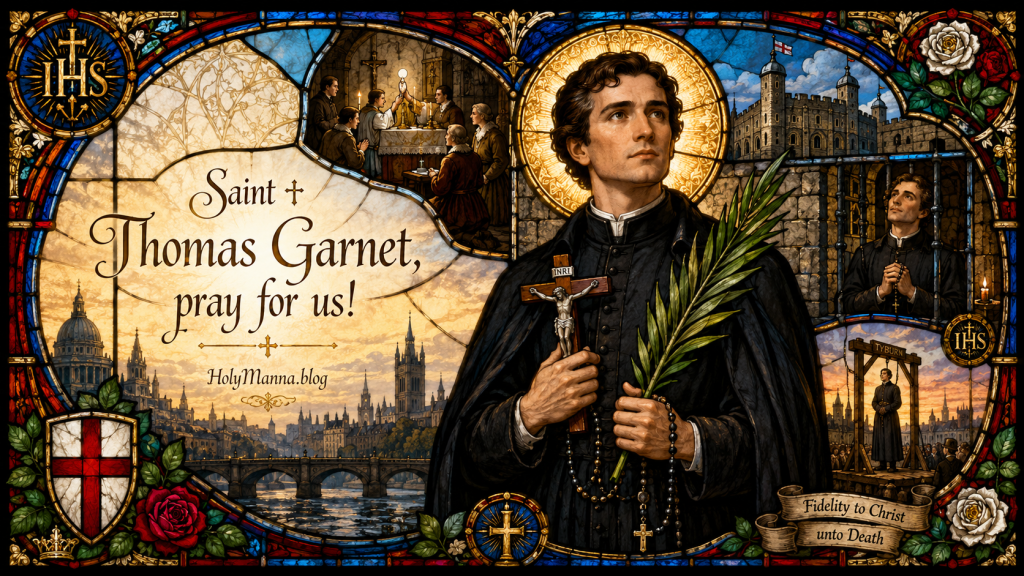
The Happiest Man at Tyburn
Saint Thomas Garnet was an English Jesuit priest, missionary, and martyr who gave his life for the Catholic faith during one of the most dangerous chapters in England’s history. He is remembered as one of the Forty Martyrs of England and Wales, a group of heroic Catholics who chose Christ and His Church rather than deny the faith under pressure from the state.
He is most known for returning to England as a priest even after he had already been arrested, imprisoned, and banished. He knew that returning could cost him his life. He returned anyway because English Catholics still needed the Mass, confession, the sacraments, and faithful priests willing to risk everything for their souls.
Saint Thomas Garnet was not a loud revolutionary. He was not a political schemer. He was a priest who quietly carried Christ into hidden homes, fearful communities, and persecuted Catholic families. His courage was not theatrical. It was steady, obedient, and deeply Catholic.
At Tyburn, the place of his execution, he reportedly called himself “the happiest man this day alive.” That line captures the strange and beautiful joy of the martyrs. The world saw a condemned man. The Church saw a faithful priest going home to God.
A Catholic Child in a Dangerous England
Saint Thomas Garnet was born around 1575 into a recusant Catholic family. Most Catholic sources associate his birth with Southwark in London, though some Jesuit tradition preserves a Nottinghamshire connection. What matters most is that he was born into a family where the Catholic faith was not casual, comfortable, or safe.
This was post-Reformation England, where Catholic life had been forced underground. To be loyal to Rome was treated by the authorities as disloyalty to the Crown. Catholic priests were hunted. Catholic families were fined, watched, and sometimes imprisoned. Catholic children could be pressured away from the faith of their parents.
Thomas’s father, Richard Garnet, suffered for the Catholic faith, and in 1588 he was imprisoned along with his wife and children. His uncle was Father Henry Garnet, S.J., the Jesuit Superior in England, who would later be executed after the fear and fury surrounding the Gunpowder Plot. Thomas grew up seeing that Catholic fidelity could cost a family its peace, safety, and freedom.
As a boy, Thomas attended grammar school at Horsham in Sussex. He later served as a page in a Catholic household connected with the family of the Earl of Arundel. This was more than social placement. For Catholic families under persecution, placing a child in a faithful Catholic household could help protect his soul.
From his earliest years, Thomas was surrounded by sacrifice. The faith was not merely something taught to him. It was something lived, defended, and suffered for.
Formed in Exile for a Mission at Home
Because Catholic education in England had become dangerous, Thomas was sent to the continent. In 1593, he became one of the first students at the English Jesuit College of St. Omer, near Calais. That college existed because English Catholic families needed a place where their sons could be formed in the faith without compromise.
Thomas later traveled to the English College of St. Alban at Valladolid in Spain to study for the priesthood. Even that journey became part of his story of perseverance. A storm drove his ship back toward England, where he and his companions were discovered, arrested, separated, and questioned. Eventually, he escaped and made his way back to the continent. Catholic accounts say he attempted the journey several times before finally reaching Valladolid.
This was not the romantic life of a young student traveling abroad. It was the hard road of a Catholic vocation formed under suspicion, danger, and uncertainty.
Thomas was ordained a priest in 1599. Then he made the decision that defined his life. He returned to England.
He later described his mission with these words: “Returning to England I wandered… from place to place, to reduce souls which went astray and were in error as to the knowledge of the true Catholic Church.”
That sentence reveals the heart of Saint Thomas Garnet. He did not return to England to make trouble. He returned because souls were confused, scattered, frightened, and deprived of the sacraments. He returned as a shepherd.
The Hidden Priest and the Grace of Fidelity
For several years, Father Thomas Garnet ministered secretly to Catholics in England. He likely used the alias Thomas Rokewood or Rookwood, and he served as chaplain in Catholic circles connected with Ambrose Rookwood. Because Catholic priests were treated as criminals, his priesthood had to be lived in hiding.
There are no major verified miracles associated with Saint Thomas Garnet during his earthly life. He is not remembered primarily as a wonderworker in the usual sense. His miracle was the hidden endurance of grace in a world determined to crush it. His life shows that holiness is not always dramatic in the way people expect. Sometimes holiness looks like a priest quietly moving from house to house, hearing confessions, celebrating Mass in secret, strengthening families, and risking death so others can receive Christ.
His life matters because it reminds Catholics that the sacraments are worth sacrifice. The Mass is not an accessory to the Christian life. Confession is not a small gift. The priesthood is not merely a job. In a time when Catholics could lose everything for the faith, Saint Thomas Garnet returned to bring them what no earthly power had the right to take away.
The Catechism teaches that “the Eucharist is ‘the source and summit of the Christian life.’” CCC 1324 Saint Thomas Garnet lived as if that were true because it is true. He risked everything so persecuted Catholics could remain close to the Eucharistic Lord.
Prison, Exile, and the Road Back to Danger
After the Gunpowder Plot was discovered in 1605, suspicion fell heavily on Catholics, especially Jesuits and missionary priests. Father Thomas Garnet was arrested near Warwick and imprisoned first in the Gatehouse, then in the Tower of London.
The authorities tried to make him give evidence against his uncle, Father Henry Garnet. Thomas was severely handled, but no connection between Thomas and the plot could be proven. He had been close to Catholic households, and he was a priest, but Catholic sources present him clearly as a missionary, not a conspirator.
In 1606, he was banished from England along with forty-six other priests. A royal proclamation warned that if they returned, they would be executed.
Thomas went back across the Channel. He spent time at St. Omer, then Brussels, and then entered the English Jesuit novitiate at Louvain. There he became the first novice received into that English Jesuit novitiate. He took his vows as a Jesuit on July 2, 1607.
Then he returned to England again.
That detail should stop every reader for a moment. He had already been arrested. He had already been imprisoned. He had already been exiled. He had already been warned that returning could mean death. Yet he came back because the Catholic faithful still needed priests.
A famous story says that after his final arrest, a plan was formed to break him out of prison, but Thomas wrote to his superior asking that the escape not be attempted. This story is preserved in Catholic accounts of his life. It fits the pattern of his holiness, though it should be treated as a traditional story rather than a detail every source records. He did not seek death recklessly, but once martyrdom stood before him, he accepted it in obedience and peace.
Betrayed, Condemned, and Joyful at the Gallows
Within weeks of returning to England, Father Thomas Garnet was betrayed by an apostate priest named Rouse. He was arrested again, imprisoned, examined, and brought to trial at the Old Bailey on June 19, 1608.
The evidence against him was thin. One witness claimed to have seen a letter where Thomas had signed his name and added the word “priest.” Under the anti-Catholic laws of the time, that was enough. He was condemned for being a Catholic priest ordained under Rome.
On June 23, 1608, Saint Thomas Garnet was taken to Tyburn for execution. He was offered his life if he would take the oath demanded of Catholics, but he refused. He publicly affirmed that he was both a priest and a Jesuit.
At the scaffold, he prayed for those responsible for his death. Pope Saint Paul VI later remembered that Thomas forgave those who had betrayed, arrested, and condemned him, praying: “May all obtain salvation and with me attain heaven.”
That is not normal human strength. That is grace.
Saint Thomas Garnet died as a martyr. The Catechism teaches: “Martyrdom is the supreme witness given to the truth of the faith: it means bearing witness even unto death.” CCC 2473 His death was not about stubbornness or politics. It was about witness. He would not deny the priesthood. He would not deny the Catholic Church. He would not place the state above Christ.
His famous final saying, “the happiest man this day alive,” still echoes because it sounds impossible unless the Gospel is true. Only a soul anchored in Christ can speak that way before death.
Relics, Memory, and the Forty Martyrs
After his death, Saint Thomas Garnet’s memory lived on among English Catholics, Jesuits, and Catholic educators. He is remembered as the protomartyr of St. Omer and Stonyhurst College, meaning the first martyr associated with that educational tradition. For Catholic schools formed in exile and sacrifice, his life became a living lesson in courage.
His relic story is especially moving. Some relics once preserved at St. Omer were later reported lost during the French Revolution. However, other relics associated with him survived through the courage of Luisa de Carvajal, a Spanish noblewoman who helped persecuted Catholics in England. She cared for Thomas while he was in prison and sent a trusted servant to collect relics at his execution.
Relics associated with his blood-soaked shirt, hair, and other remains were preserved. Luisa wrote of one relic from his shirt and called him “my master and my friend.” That small detail says so much. To the authorities, he was a criminal. To the faithful, he was a priest, a martyr, a friend, and a witness to Christ.
There are no famous individual posthumous miracles widely attached to Saint Thomas Garnet alone. However, his canonization with the Forty Martyrs of England and Wales was connected with miraculous favors attributed to the group. The recognized miracle involved the healing of a young mother suffering from a malignant tumor, a cure judged medically inexplicable and attributed to God through the intercession of the Forty Martyrs.
Saint Thomas Garnet was beatified by Pope Pius XI in 1929 and canonized by Pope Saint Paul VI on October 25, 1970, along with the Forty Martyrs of England and Wales. His individual feast day is June 23, and he is also honored with the Forty Martyrs on October 25.
His canonization was not meant to reopen old wounds between Catholics and Anglicans. It was meant to honor the witness of conscience, fidelity, charity, and truth. Pope Saint Paul VI presented these martyrs as men and women whose blood should inspire not hatred, but holiness, reconciliation, and renewed love for Christ.
The Lesson of a Priest Who Came Back
Saint Thomas Garnet’s life asks a hard question in a gentle way: What is worth suffering for?
He could have stayed safely on the continent. He could have built a quieter life away from danger. He could have told himself that someone else would go. Instead, he returned to England because souls needed the sacraments.
His courage was not reckless. It was priestly. He understood that the Catholic faith is not simply an opinion to hold privately when life is easy. It is the truth for which saints have lived and died.
For Catholics today, his story is a reminder to stop treating the faith casually. The Mass should not be squeezed into life only when convenient. Confession should not be postponed forever. Catholic identity should not disappear the moment it becomes socially uncomfortable. Saint Thomas Garnet lived in a time when Catholic faithfulness could cost a person everything, and he still chose Christ with joy.
His life also teaches forgiveness. He prayed for the people who betrayed and condemned him. That kind of mercy does not come from personality alone. It comes from union with Jesus, who prayed from the Cross: “Father, forgive them, they know not what they do.” The Gospel of Luke 23:34
To follow Saint Thomas Garnet’s example, Catholics do not need to seek dramatic suffering. They need to be faithful in the place God has already placed them. Attend Mass with reverence. Go to confession with humility. Defend the faith with charity. Teach children the truth. Pray for priests. Forgive enemies. Choose Christ when comfort asks for compromise.
Where is God asking for courage today?
What part of the faith has become too easy to take for granted?
Who needs the quiet witness of a faithful Catholic life?
Saint Thomas Garnet reminds the Church that hidden fidelity is never wasted. The world may forget the quiet priest moving from house to house in secret, but heaven does not forget. The Church does not forget. And souls strengthened by grace never forget.
Engage With Us!
Share your thoughts and reflections in the comments below. Saint Thomas Garnet’s story is powerful because it does not only speak about persecution in the past. It asks every Catholic to consider what faithfulness looks like right now, in ordinary homes, workplaces, schools, parishes, and families.
- What part of Saint Thomas Garnet’s story challenges you the most?
- Do you ever take the Mass, confession, or the priesthood for granted?
- Where is Christ asking you to be more courageous in your Catholic faith?
- How can you forgive someone who has hurt, betrayed, or misunderstood you?
- What would it look like to choose faithfulness over comfort this week?
May Saint Thomas Garnet pray for all Catholics who feel pressure to hide, soften, or compromise their faith. May his courage renew love for the Mass, confession, the priesthood, and the salvation of souls. And may every heart learn to live with the joy of the saints, doing all things with the love and mercy Jesus taught us.
Saint Thomas Garnet, pray for us!
Follow us on YouTube, TikTok, Instagram and Facebook for more insights and reflections on living a faith-filled life.

 Holy Manna!
Leave a comment