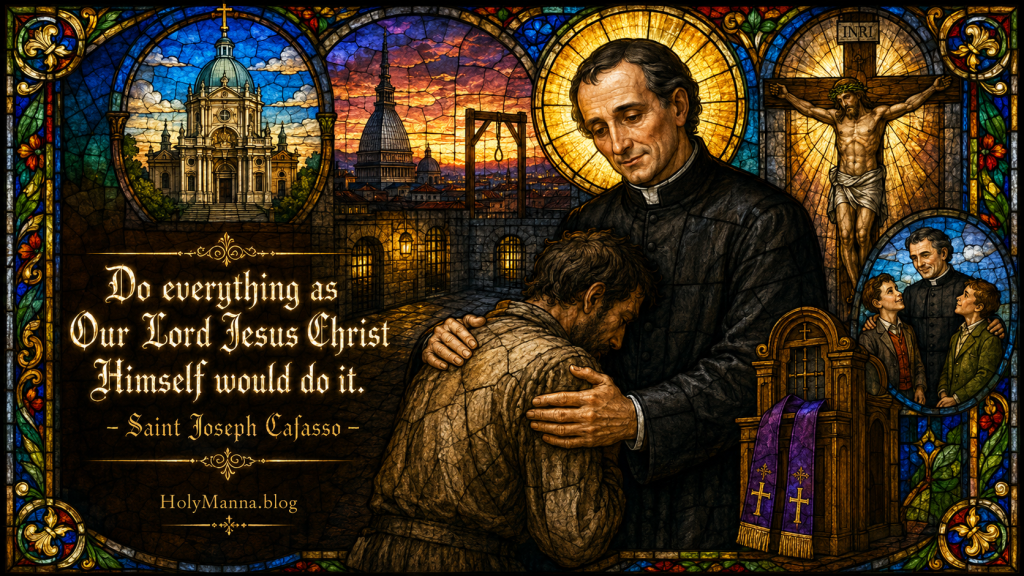
The Priest Who Walked Mercy to the Gallows
In 19th-century Turin, Italy, there was a small, frail priest who did not look like the kind of man who would shake the gates of hell.
He was not physically strong. He was not dramatic. He did not become a bishop. He did not found a worldwide religious order. He did not chase political power or public applause.
Yet Saint Joseph Cafasso became one of the great priestly saints of the Catholic Church because he brought the mercy of Christ into places most people avoided: the prison cell, the confessional, the classroom, and the scaffold.
He is remembered as the “Priest of the Gallows” because he accompanied condemned prisoners to their executions, helping many return to God through confession, repentance, and the Eucharist before death. He is also remembered as a master spiritual director, a teacher of priests, and the mentor of Saint John Bosco.
Saint Joseph Cafasso is the patron saint of Italian prisons. He is also commonly invoked by prisoners, prison chaplains, confessors, spiritual directors, captives, and those condemned to death.
His life is a powerful reminder that no soul is beyond God’s mercy. Not the prisoner. Not the sinner. Not the person who thinks it is too late. Not the soul convinced it has gone too far.
The Church teaches in The Catechism that the works of mercy are acts of charity by which Christians come to the aid of their neighbor in spiritual and bodily needs. Visiting the imprisoned is one of those works of mercy, and Saint Joseph Cafasso lived that teaching with heroic tenderness.
He did not merely preach mercy.
He walked with mercy all the way to the gallows.
A Frail Boy from Piedmont with a Strong Soul
Saint Joseph Cafasso was born on January 15, 1811, in Castelnuovo d’Asti, now known as Castelnuovo Don Bosco, in the Piedmont region of Italy. This same village would later become famous as the birthplace of Saint John Bosco, whom Cafasso would eventually guide and support.
Joseph was born into a humble and devout Catholic family. He was the third of four children. His youngest sister, Marianna, would later become the mother of Blessed Joseph Allamano, the founder of the Consolata Missionaries and the Consolata Missionary Sisters. That means Joseph Cafasso belonged to a family line that quietly helped shape generations of Catholic missionary work.
From his earliest years, Joseph showed signs of deep faith. He was drawn to prayer, the Mass, and the priesthood. He was not known for physical strength or worldly confidence. In fact, Catholic accounts often describe him as small, pale, and physically fragile, with a curvature of the spine. Some stories say he was teased as a child because of his appearance and soft voice.
That detail matters because it makes his holiness even more striking. Saint Joseph Cafasso did not become great by looking powerful. He became great by becoming faithful.
He entered seminary formation and was ordained a priest in 1833, when he was only twenty-two years old. Shortly after ordination, he entered the Convitto Ecclesiastico di San Francesco d’Assisi in Turin, a house of advanced pastoral formation for young priests.
That place became the heart of his priestly mission. He entered as a young priest still being formed, and he remained there as a teacher, spiritual director, and eventually rector. For roughly twenty-four years, he helped form priests in moral theology, confession, pastoral wisdom, and priestly holiness.
Saint John Bosco later said of that house, “At the Convitto, men learn to be priests.”
That was one of Cafasso’s great gifts to the Church. He formed priests who would go out and form souls.
A Priest Formed by Mercy, Not Fear
Saint Joseph Cafasso lived during a time when parts of Catholic Europe still carried the heavy influence of Jansenism. Jansenism often made the spiritual life feel harsh, fearful, and almost impossible. It could make people afraid of confession, afraid of Communion, and afraid to trust the mercy of God.
Cafasso resisted that cold spirit. He did not excuse sin. He did not soften the call to holiness. But he understood that sinners are not healed by despair. They are healed by grace.
His priestly heart was shaped by the wisdom of Saint Alphonsus Liguori and Saint Francis de Sales. From Saint Alphonsus, he learned a balanced moral theology that served the salvation of souls. From Saint Francis de Sales, he learned gentleness, patience, and confidence in God’s love.
This made him an exceptional confessor. People came to him from every walk of life. Bishops, priests, religious, laypeople, workers, troubled souls, scrupulous souls, and hardened sinners all found in him a priest who could tell the truth with tenderness.
He once taught, “When we hear confessions, the Lord wants us to be loving, merciful and fatherly to all.”
That sentence reveals the heart of his priesthood.
The Catechism teaches that the Sacrament of Penance reconciles us with God and restores us to His grace. Saint Joseph Cafasso lived that truth as a spiritual father. He knew that confession was not a place where God crushed the sinner. It was the place where Christ raised the sinner back to life.
He understood sin clearly, but he understood mercy even more deeply.
The Hidden Father of Saint John Bosco
One of the most important parts of Saint Joseph Cafasso’s legacy is his relationship with Saint John Bosco.
Cafasso met Don Bosco when Bosco was still young, and he eventually became his spiritual director. For about twenty-five years, he helped guide Don Bosco through major vocational decisions. He supported him, corrected him, encouraged him, and helped him discern where God was calling him.
This was not controlling spiritual direction. Cafasso did not try to make Don Bosco into a copy of himself. He helped Don Bosco become the saint God intended him to be.
According to Catholic tradition, Don Bosco once considered becoming a foreign missionary. Cafasso helped him see that his mission field was much closer: the poor, abandoned, and neglected boys of Turin. That guidance helped shape what would become the Salesian mission, one of the most important Catholic educational and missionary movements in the modern Church.
That is one of the most beautiful lessons from Cafasso’s life. Some saints become famous because of what they build. Other saints become holy because they help someone else build what God wants built.
Saint Joseph Cafasso was one of those hidden pillars.
He helped form Saint John Bosco, but he also guided other priests, founders, and lay Catholics. His wisdom shaped the Catholic renewal of Turin during a time of poverty, political unrest, industrial change, and deep spiritual need.
He was not loud. He was not flashy.
He was steady.
And steady holiness changes history.
The Prison Cell Became His Mission Field
Saint Joseph Cafasso is most famous for his ministry to prisoners.
Turin’s prisons in the 19th century were harsh and often degrading. Many prisoners were poor, abandoned, angry, uneducated, and spiritually wounded. Some had committed serious crimes. Some were hardened. Some had lost all hope.
Cafasso went to them anyway.
He visited prisoners for more than twenty years. He brought food, small gifts, and even tobacco or cigars as simple human gestures of care. He catechized them, listened to them, prayed with them, heard their confessions, and helped prepare them to receive the Eucharist.
He also cared for prisoners’ families and helped men after their release. He understood that mercy did not end when a prison door opened. A man leaving prison still needed friendship, guidance, dignity, and hope.
This is deeply Catholic. Mercy is not only a feeling. Mercy is love that enters another person’s misery and brings Christ there.
Saint Joseph Cafasso did not look at prisoners and see only their crimes. He saw souls made in the image of God.
That does not mean he denied justice. It means he knew that justice without mercy can become cold, and mercy without truth can become empty. Cafasso held both together because he was a priest of Jesus Christ.
The Priest of the Gallows
The most dramatic and heartbreaking part of Saint Joseph Cafasso’s ministry was his work with condemned prisoners.
He accompanied fifty-seven men to execution.
Think about that for a moment. Fifty-seven times, he walked with a man toward death. Fifty-seven times, he stood near the edge of eternity. Fifty-seven times, he brought the Church’s prayer, the mercy of confession, and the hope of the Eucharist to a soul who had very little time left.
He did not accompany them as a spectator. He accompanied them as a father.
He spent their final hours with them. He helped them examine their consciences. He heard their confessions. He prepared them for Holy Communion. He prayed beside them. He encouraged them not to despair. Then he walked with them to the scaffold and remained with them until the end.
Some of these men had committed terrible crimes. Cafasso did not pretend otherwise. But he believed with all his heart that while a man still lives, grace can still reach him.
That is why Catholic tradition says he referred to some of these converted condemned men as his “hanged saints.” It is a startling phrase, but it does not glorify their crimes. It glorifies the mercy of God. It means that even at the last moment, repentance can open the soul to grace.
This part of Cafasso’s life speaks powerfully to the Church today. The Catechism teaches that every human person possesses dignity because every person is made in the image of God. Even grave sin does not erase that dignity. Even prison bars do not erase it. Even a death sentence does not erase it.
Saint Joseph Cafasso lived that truth with his feet.
He walked it into the darkest places of Turin.
The Beard, the Confession, and a Soul Won Back
One of the most famous stories about Saint Joseph Cafasso comes through the tradition connected with Saint John Bosco’s memories of him.
According to the story, a group of prisoners had promised to go to confession on the vigil of a feast of Our Lady. But when the day came, none of them wanted to go. They resisted. They delayed. They hardened themselves again.
Cafasso approached the strongest and most intimidating prisoner, a man with a long beard. With surprising boldness, the small priest grabbed the man by the beard and told him he would not let go until the man went to confession.
The prisoner protested.
Cafasso held on.
The prisoner said he was not prepared.
Cafasso answered, “Then I will prepare you.”
The man could have easily pushed the frail priest away. But something happened. Grace entered the moment. The prisoner allowed Cafasso to lead him aside. Cafasso prepared him for confession, and the man broke down in tears.
Afterward, the prisoner reportedly told the others that he had never been so happy in his life. His joy moved the others to confess as well.
This story is often repeated in Catholic accounts of Cafasso’s life. While every dramatic detail cannot be independently verified with modern historical certainty, it beautifully reflects what the Church remembers about him: he was gentle, but not weak. He was humble, but not timid. He was merciful, but not passive.
He fought for souls.
No Political Crown, Only the Priesthood
Saint Joseph Cafasso was deeply respected in Turin. Because of his intelligence, prudence, and public reputation, some people encouraged him to enter political life. He refused.
His response became one of his most famous sayings: “In the day of judgment, the Lord will ask me if I was a good priest, not a good deputy.”
That line reveals his soul.
He was not saying that politics does not matter. The Church has always taught that laypeople have an important vocation to shape society according to justice and truth. But Cafasso knew his own calling. God had made him a priest, and he intended to answer for that vocation.
He did not want power. He wanted fidelity.
That is rare in every age.
It is especially rare in an age like ours, where influence, platforms, titles, and public recognition can easily become idols. Cafasso reminds us that holiness begins when a person stops asking, “How important can this make me?” and starts asking, “What has God actually asked of me?”
A Marian Priest of the Eucharist and Confession
Saint Joseph Cafasso’s priesthood was deeply Eucharistic and Marian.
He encouraged devotion to the Eucharist and helped souls approach Holy Communion with trust, reverence, and repentance. This was especially important in a time when many Catholics, influenced by fear or scrupulosity, hesitated to receive Communion frequently.
Cafasso wanted souls to understand that the Eucharist is not a prize for the spiritually impressive. It is Christ Himself, given to nourish the weak, heal the wounded, and strengthen those who desire holiness.
He also loved the Blessed Virgin Mary tenderly. He called her “Our beloved Mother, our consolation, our hope.”
That devotion makes perfect sense in his life. Mary is the Mother of Mercy, and Cafasso spent his priesthood bringing mercy to the abandoned. He lived like a son of Mary: quiet, faithful, courageous, and close to suffering souls.
According to pious tradition, Cafasso desired to die on a day associated with Our Lady. He died on Saturday, June 23, 1860, during the octave of the feast of Our Lady of Consolation in Turin. This should be understood as a pious tradition rather than a formally verified miracle, but it is a fitting final note for a priest who loved Mary and served at the Sanctuary of mercy in so many human hearts.
Trials Without Martyrdom
Saint Joseph Cafasso was not a martyr in the traditional sense. He was not executed for the faith, and he did not die under violent persecution.
His hardships were quieter, but they were real.
He lived with physical frailty and poor health. He carried the emotional and spiritual burden of prison ministry. He spent long hours in confession, formation, teaching, preaching, and pastoral care. He entered prison cells filled with despair. He accompanied men to death. He carried the weight of souls who were afraid, guilty, angry, hardened, or broken.
That kind of life costs something.
There is a hidden martyrdom in spending yourself completely for others. Saint Joseph Cafasso offered his body, his time, his mind, his compassion, and his priesthood until there was nothing left to give.
He died at only forty-nine years old.
His martyrdom was not bloody, but it was sacrificial. He died as he had lived: consumed for Christ and for souls.
Miracles, Relics, and a Legacy That Still Speaks
Saint Joseph Cafasso died in Turin on June 23, 1860. Saint John Bosco preached at his funeral, honoring the spiritual father who had helped him become the saint God called him to be.
Cafasso was beatified by Pope Pius XI on May 3, 1925, and canonized by Pope Pius XII on June 22, 1947. The Church’s canonization process includes the recognition of sanctity and, ordinarily, miracles attributed to the saint’s intercession. However, the commonly available Catholic sources do not provide detailed public accounts of the specific miracle cases connected with his beatification and canonization. Because of that, it is best not to invent names, illnesses, or circumstances that cannot be verified.
What can be said with confidence is that the Church has officially recognized him as a saint and placed him before the faithful as a model of heroic virtue and heavenly intercession.
His relics are venerated at the Sanctuary of Our Lady of Consolation, known as the Consolata, in Turin. This is fitting because Cafasso loved Mary under the title of consolation, and his whole priesthood was a ministry of consolation to souls who were suffering, ashamed, imprisoned, or afraid.
His impact after death has remained strong, especially in Italy and among priests, prison chaplains, and those devoted to works of mercy. Pope Pius XII proclaimed him patron of Italian prisons in 1948. He is also honored as a model for confessors and spiritual directors.
His legacy is especially tied to Turin’s great Catholic renewal in the 19th century. He belongs among the “social saints” of Turin, along with Saint John Bosco and Saint Giuseppe Benedetto Cottolengo. These saints responded to the wounds of their age not with bitterness, ideology, or despair, but with concrete Catholic charity.
Cafasso’s cultural impact is not flashy, but it is deep. Every prison chaplain who walks into a cell with the mercy of Christ follows in his footsteps. Every confessor who welcomes a frightened sinner with fatherly patience reflects something of his spirit. Every spiritual director who helps a soul discern God’s will without control or manipulation echoes his wisdom.
His life still says to the Church: go to the forgotten places. Go to the people everyone else avoids. Go to the sinner who thinks he is beyond saving. Bring Christ there.
The Saint Who Teaches Us That Mercy Must Go All the Way
Saint Joseph Cafasso is not remembered because he made mercy sound nice.
He is remembered because he made mercy concrete.
He walked into prisons. He heard confessions for hours. He formed priests. He guided Saint John Bosco. He comforted families. He helped released prisoners. He prepared condemned men for death. He stood beside sinners when the world was finished with them.
That is the kind of mercy Jesus teaches.
In The Gospel of Matthew, Christ says, “I was in prison and you visited me.”
Saint Joseph Cafasso took those words seriously. He saw Christ in the prisoner. He saw Christ in the condemned man. He saw Christ in the frightened sinner. He saw Christ in the soul at the edge of eternity.
His life asks a direct question of every Catholic heart: Who are the people most easily forgotten, avoided, or written off today?
Maybe it is the person in prison. Maybe it is the addict. Maybe it is the family member who has made terrible choices. Maybe it is the person who keeps falling into the same sin. Maybe it is the soul in the mirror who quietly wonders whether God is tired of forgiving.
Saint Joseph Cafasso would answer with the confidence of the Church: no soul is beyond grace while life remains.
His spirituality can be summarized in one of his own maxims: “Do everything as Our Lord Jesus Christ Himself would do it.”
That is simple, but it is not easy.
Speak as Christ would speak. Forgive as Christ would forgive. Correct as Christ would correct. Visit as Christ would visit. Listen as Christ would listen. Walk with the suffering as Christ would walk with them.
This is not sentimental faith. This is Catholic discipleship.
Saint Joseph Cafasso reminds us that holiness often looks quiet, steady, and hidden. It looks like showing up. It looks like being faithful. It looks like refusing to abandon people who are difficult to love. It looks like trusting that grace can still work, even at the final hour.
Engage With Us!
Share your thoughts and reflections in the comments below. Saint Joseph Cafasso’s life gives us a powerful picture of mercy, confession, priestly courage, and hope for souls that seem far from God.
- What part of Saint Joseph Cafasso’s prison ministry challenges you the most?
- Is there someone in your life whom you have quietly written off, even though God has not stopped loving them?
- How can you practice one work of mercy this week, especially toward someone who feels forgotten?
- What does Saint Joseph Cafasso’s devotion to confession teach you about God’s mercy?
- How would your daily life change if you tried to follow his advice: “Do everything as Our Lord Jesus Christ Himself would do it”?
Saint Joseph Cafasso teaches us that mercy must go all the way. It must go to the prison cell, the confessional, the hospital bed, the broken family, the anxious heart, and the sinner who thinks it is too late.
May his example help us live with courage, compassion, and faith. May we do everything with the love and mercy Jesus taught us, trusting that no soul is beyond the reach of God’s grace.
Saint Joseph Cafasso, pray for us!
Follow us on YouTube, TikTok, Instagram and Facebook for more insights and reflections on living a faith-filled life.

 Holy Manna!
Leave a comment