Tuesday of the Twelfth Week in Ordinary Time – Lectionary: 372
When Fear Is Laid Before God
Every heart eventually receives a letter it does not know how to answer, a threat, a burden, a temptation, or a fear that seems larger than its faith.
Today’s readings bring us into that sacred place where pressure becomes prayer and trust becomes obedience. In 2 Kings 19:9-11, 14-21, 31-36, Jerusalem stands beneath the shadow of Assyria, the terrifying empire that had already crushed nations and mocked their gods. King Sennacherib does not merely threaten Hezekiah’s city. He attacks his faith, warning him not to trust the Lord. Yet Hezekiah does something deeply Catholic before Catholicism had a name. He takes the enemy’s letter into the house of the Lord, spreads it before God, and prays. His strength is not bravado. His strength is worship.
That same confidence echoes through Psalm 48, where Zion is praised not because its walls are impressive, but because God dwells there. The city is secure because the Lord is its stronghold. The psalm teaches Israel, and now the Church, to remember that true safety is not found in power, popularity, or control, but in the presence of the living God. This points forward to Christ, to His Church, and to every soul that becomes a dwelling place of grace.
Then, in The Gospel of Matthew 7:6, 12-14, Jesus shows what faith looks like after the prayer is finished. The disciple must guard what is holy, treat others with the love he hopes to receive, and enter through the narrow gate. This is not a soft or sentimental faith. It is the demanding road of holiness. As The Catechism teaches, “The way of Christ ‘leads to life’; a contrary way ‘leads to destruction.’” CCC 1696
The central theme of today’s readings is clear: when the world mocks trust in God, the faithful soul brings the threat before the Lord and chooses the narrow road of obedient love. Hezekiah shows us how to pray under pressure. The psalm shows us where our security rests. Jesus shows us how to walk once God has heard our prayer. What fear needs to be spread before the Lord today, and what narrow step of faith is Christ asking for next?
First Reading – 2 Kings 19:9-11, 14-21, 31-36
When the Enemy’s Letter Becomes a Prayer
The first reading brings us to one of the most dramatic moments in the history of Judah. Jerusalem is surrounded by fear, mocked by an empire, and standing on the edge of disaster. The Assyrian king Sennacherib has already conquered nations with terrifying force. Assyria was not just another military power. It was the superpower of the ancient Near East, known for intimidation, brutality, exile, and psychological warfare. Its armies did not merely fight cities. They crushed morale before the battle began.
King Hezekiah of Judah receives a message designed to break his faith before Jerusalem falls. Sennacherib does not only threaten his kingdom. He mocks the Lord Himself. Hezekiah is being tempted to believe that the God of Israel is no stronger than the idols of conquered nations.
This is why today’s reading fits so beautifully into the central theme of the Mass readings. When the world mocks trust in God, the faithful soul brings the threat before the Lord and chooses the narrow road of obedient faith. Hezekiah does not respond with pride. He does not collapse into despair. He walks into the house of the Lord, spreads the enemy’s letter before God, and prays.
That image is unforgettable. A king lays his fear on the altar. A nation’s crisis becomes a prayer. And the Lord answers.
2 Kings 19:9-11, 14-21, 31-36 – New American Bible (Revised Edition)
Sennacherib, Hezekiah, and Isaiah. 9 The king of Assyria heard a report: “Tirhakah, king of Ethiopia, has come out to fight against you.” Again he sent messengers to Hezekiah to say: 10 “Thus shall you say to Hezekiah, king of Judah: Do not let your God in whom you trust deceive you by saying, ‘Jerusalem will not be handed over to the king of Assyria.’ 11 You, certainly, have heard what the kings of Assyria have done to all the lands: they put them under the ban! And are you to be rescued?
14 Hezekiah took the letter from the hand of the messengers and read it; then he went up to the house of the Lord, and spreading it out before the Lord, 15 Hezekiah prayed in the Lord’s presence: “Lord, God of Israel, enthroned on the cherubim! You alone are God over all the kingdoms of the earth. It is you who made the heavens and the earth. 16 Incline your ear, Lord, and listen! Open your eyes, Lord, and see! Hear the words Sennacherib has sent to taunt the living God. 17 Truly, O Lord, the kings of Assyria have laid waste the nations and their lands. 18 They gave their gods to the fire—they were not gods at all, but the work of human hands—wood and stone, they destroyed them. 19 Therefore, Lord, our God, save us from this man’s power, that all the kingdoms of the earth may know that you alone, Lord, are God.”
20 Then Isaiah, son of Amoz, sent this message to Hezekiah: “Thus says the Lord, the God of Israel, to whom you have prayed concerning Sennacherib, king of Assyria: I have listened! 21 This is the word the Lord has spoken concerning him:
She despises you, laughs you to scorn,
the virgin daughter Zion!
Behind you she wags her head,
daughter Jerusalem.31 For out of Jerusalem shall come a remnant,
and from Mount Zion, survivors.
The zeal of the Lord of hosts shall do this.32 “Therefore, thus says the Lord about the king:
He shall not come as far as this city,
nor shoot there an arrow,
nor confront it with a shield,
Nor cast up a siege-work against it.
33 By the way he came he shall leave,
never coming as far as this city,
oracle of the Lord.
34 I will shield and save this city
for my own sake and the sake of David my servant.”35 That night the angel of the Lord went forth and struck down one hundred and eighty-five thousand men in the Assyrian camp. Early the next morning, there they were, dead, all those corpses! 36 So Sennacherib, the king of Assyria, broke camp, departed, returned home, and stayed in Nineveh.
Detailed Exegesis
Verse 9 – “The king of Assyria heard a report: ‘Tirhakah, king of Ethiopia, has come out to fight against you.’ Again he sent messengers to Hezekiah to say:”
Sennacherib hears that Tirhakah, the king of Ethiopia or Cush, is coming against him. Historically, this points to the larger political struggle of the time. Judah was caught between powerful empires, especially Assyria and Egypt. Small kingdoms often tried to survive by making alliances, but Scripture consistently teaches that Judah’s true security was not in foreign armies. It was in covenant fidelity to the Lord. This verse shows Sennacherib under pressure, yet still arrogant enough to threaten Jerusalem.
Verse 10 – “Thus shall you say to Hezekiah, king of Judah: Do not let your God in whom you trust deceive you by saying, ‘Jerusalem will not be handed over to the king of Assyria.’”
Here the battle becomes spiritual. Sennacherib attacks Hezekiah’s trust in God. The phrase “Do not let your God in whom you trust deceive you” is more than political intimidation. It is blasphemy. It accuses the living God of being unreliable. Every believer eventually hears some form of this temptation. It whispers that prayer is useless, obedience is foolish, and God will not come through. Hezekiah’s crisis becomes a mirror for the soul under spiritual attack.
Verse 11 – “You, certainly, have heard what the kings of Assyria have done to all the lands: they put them under the ban! And are you to be rescued?”
Sennacherib appeals to evidence. He points to history, conquest, and destruction. He says, in effect, “Look at the facts. No one survives Assyria.” This is how fear often works. It gathers evidence against hope. It reminds the soul of every failure, every wound, every impossible circumstance, and then asks, “And are you to be rescued?” Faith does not deny the danger. Hezekiah knows Assyria is powerful. But faith refuses to treat earthly power as greater than God.
Verse 14 – “Hezekiah took the letter from the hand of the messengers and read it; then he went up to the house of the Lord, and spreading it out before the Lord,”
This is the turning point. Hezekiah reads the letter, but he does not let the letter define reality. He takes it into the temple. He spreads it before the Lord. This is one of the most beautiful images of prayer in the Old Testament. Hezekiah brings the problem exactly as it is. He does not pretend. He does not perform. He places the threat in God’s presence. For Catholics, this scene naturally points to bringing fears before the Lord in prayer, especially before Christ in the Eucharist. The temple was the dwelling place of God’s presence for Israel. Today, the tabernacle is where the Catholic soul can bring every letter, every wound, and every fear.
Verse 15 – “Hezekiah prayed in the Lord’s presence: ‘Lord, God of Israel, enthroned on the cherubim! You alone are God over all the kingdoms of the earth. It is you who made the heavens and the earth.’”
Hezekiah begins with adoration. Before asking for rescue, he remembers who God is. The Lord is not one tribal deity among many. He is the Creator of heaven and earth. He is enthroned above the cherubim, a reference tied to the Ark of the Covenant and the holy presence of God. Hezekiah’s prayer teaches the right order of faith. The believer does not begin by magnifying the crisis. The believer begins by magnifying the Lord.
Verse 16 – “Incline your ear, Lord, and listen! Open your eyes, Lord, and see! Hear the words Sennacherib has sent to taunt the living God.”
Hezekiah speaks with holy boldness. He asks God to hear and see. Of course, God already knows. Yet prayer invites the believer into honest relationship with Him. Hezekiah does not simply say, “They have insulted me.” He says Sennacherib has taunted the living God. This is important. The deepest issue is not Hezekiah’s reputation. It is the honor of the Lord. True prayer gradually purifies the heart so that God’s glory becomes more important than personal comfort.
Verse 17 – “Truly, O Lord, the kings of Assyria have laid waste the nations and their lands.”
Hezekiah does not deny reality. This is not shallow optimism. He admits the danger plainly. Assyria really has destroyed nations. Catholic faith is not make-believe. It does not ask Christians to ignore suffering, evil, sickness, persecution, or fear. Instead, it teaches believers to face reality with God. Hezekiah names the truth, but he names it inside prayer.
Verse 18 – “They gave their gods to the fire, they were not gods at all, but the work of human hands, wood and stone, they destroyed them.”
Hezekiah exposes the difference between idols and the living God. The gods of the nations could be burned because they were made by human hands. They were wood and stone. The Lord is not made by man. He is the Maker of man. This verse is deeply relevant in every age because idols still exist, even when they are not carved statues. Money, status, pleasure, ideology, control, and self-image can all become modern idols. They promise security, but they cannot save. When the fire comes, only the living God remains.
Verse 19 – “Therefore, Lord, our God, save us from this man’s power, that all the kingdoms of the earth may know that you alone, Lord, are God.”
Hezekiah asks for deliverance, but his request is ordered toward God’s glory. He does not say only, “Save us so we can be comfortable.” He says, “that all the kingdoms of the earth may know that you alone, Lord, are God.” This is mature prayer. It seeks rescue, but not as an end in itself. It seeks rescue so that God may be known. Catholic prayer at its deepest is not about bending God to human plans. It is about entering the providence of the Father and desiring His will.
Verse 20 – “Then Isaiah, son of Amoz, sent this message to Hezekiah: ‘Thus says the Lord, the God of Israel, to whom you have prayed concerning Sennacherib, king of Assyria: I have listened!’”
God answers through the prophet Isaiah. The words “I have listened!” are tender and powerful. The Lord has heard the prayer of His servant. In the Catholic tradition, this does not mean every prayer is answered in the exact way a person expects. It means no faithful prayer is wasted. God hears, God sees, and God acts according to His wisdom. Hezekiah’s prayer is not swallowed by fear. It reaches the living God.
Verse 21 – “This is the word the Lord has spoken concerning him: She despises you, laughs you to scorn, the virgin daughter Zion! Behind you she wags her head, daughter Jerusalem.”
The Lord reverses the humiliation. Sennacherib mocked Jerusalem, but now Jerusalem is pictured as laughing at him. The “virgin daughter Zion” represents the holy city preserved by God. The image is striking because the city looked weak by worldly standards, yet she is protected by the Lord. This reveals a biblical pattern that reaches its fullness in Christ. God often conquers through what appears small, poor, humble, and vulnerable. The Cross itself will look like defeat before becoming the sign of victory.
Verse 31 – “For out of Jerusalem shall come a remnant, and from Mount Zion, survivors. The zeal of the Lord of hosts shall do this.”
The word “remnant” is essential in salvation history. Throughout the Old Testament, even when Israel suffers judgment or invasion, God preserves a faithful remnant through whom His promises continue. This remnant points forward to the Church, gathered by Christ from Israel and the nations. The verse also says, “The zeal of the Lord of hosts shall do this.” Jerusalem is not saved because of human brilliance. It is saved because God is faithful, passionate, and committed to His covenant.
Verse 32 – “Therefore, thus says the Lord about the king: He shall not come as far as this city, nor shoot there an arrow, nor confront it with a shield, Nor cast up a siege-work against it.”
The Lord gives a specific promise. Sennacherib will not enter the city. He will not shoot an arrow there. He will not build siege works against it. God’s word directly contradicts the enemy’s threat. This verse shows the authority of divine speech. Assyria has armies, but God has the final word. For Catholics, this is a reminder that faith rests on revelation, not merely on appearances. God’s promises are more trustworthy than fear’s predictions.
Verse 33 – “By the way he came he shall leave, never coming as far as this city, oracle of the Lord.”
The proud king will retreat. The path he used to threaten Jerusalem will become the path of his humiliation. This is a sobering reminder that human arrogance has limits. Every empire, ruler, ideology, and temptation that exalts itself against God eventually meets a boundary it cannot cross. The phrase “oracle of the Lord” seals the promise. This is not Hezekiah’s wishful thinking. It is the Lord’s decree.
Verse 34 – “I will shield and save this city for my own sake and the sake of David my servant.”
God reveals why He will act. He will save Jerusalem “for my own sake and the sake of David my servant.” This points to the Davidic covenant. God had promised David that his house and kingdom would endure. Jerusalem’s deliverance is rooted in God’s fidelity to His covenant promises. Catholics hear this with Christian ears because the Davidic promise finds its fulfillment in Jesus Christ, the Son of David. God saves for His name, His glory, and His covenant love.
Verse 35 – “That night the angel of the Lord went forth and struck down one hundred and eighty-five thousand men in the Assyrian camp. Early the next morning, there they were, dead, all those corpses!”
The deliverance comes suddenly and decisively. The angel of the Lord strikes the Assyrian camp, and the threat collapses overnight. This scene reveals that God does not need equal earthly power to defeat earthly power. He is not one force competing among others. He is Lord of hosts. Historically, the Assyrian invasion of Judah around 701 BC is one of the most significant crises of the Old Testament period. Even Assyrian records remember Sennacherib trapping Hezekiah in Jerusalem, yet they do not claim the city was conquered. Scripture gives the theological meaning of that deliverance. Jerusalem survived because God acted.
Verse 36 – “So Sennacherib, the king of Assyria, broke camp, departed, returned home, and stayed in Nineveh.”
The reading ends with Sennacherib leaving. The man who mocked the living God returns home defeated. Hezekiah stays in Jerusalem because God has preserved the city. The contrast is clear. The proud king moves away from the city of God. The faithful king remains under God’s protection. This final verse quietly teaches that the threats which seem unstoppable are still temporary before the Lord.
Teachings
This reading teaches that prayer is not an escape from reality. It is the most faithful way to face reality. Hezekiah sees the danger clearly, but he refuses to let fear become his lord. He brings the threat into God’s presence.
The Catechism gives language for this kind of prayer when it teaches, “The revelation of prayer in the economy of salvation teaches us that faith rests on God’s action in history. Our filial trust is enkindled by his supreme act: the Passion and Resurrection of his Son. Christian prayer is cooperation with his providence, his plan of love for men.” CCC 2738
That is exactly what Hezekiah models. He does not pray as if God were distant. He prays as a son of the covenant. He trusts that the Lord has acted in history, is acting now, and will act according to His providence.
This reading also teaches that God alone is God. Hezekiah contrasts the idols of the nations with the Lord, saying they were “not gods at all, but the work of human hands.” 2 Kings 19:18 The Catholic faith continues to warn against idolatry, not only in ancient forms but in modern ones. The Catechism teaches, “Idolatry not only refers to false pagan worship. It remains a constant temptation to faith. Idolatry consists in divinizing what is not God.” CCC 2113
That line lands hard in a modern world filled with polished idols. A person may not bow before wood and stone, but the heart can still bow before comfort, approval, success, lust, politics, money, or control. Hezekiah’s prayer reminds the believer that only the living God can save.
The deliverance of Jerusalem also rests on covenant. God says, “I will shield and save this city for my own sake and the sake of David my servant.” 2 Kings 19:34 The Lord acts because He is faithful to His promises. This matters because Catholic faith is covenantal. God’s plan unfolds through Adam, Noah, Abraham, Moses, David, and finally Jesus Christ, the Son of David and Savior of the world.
St. Augustine’s famous words help illuminate the deep restlessness beneath this reading: “You have made us for yourself, O Lord, and our heart is restless until it rests in you.” St. Augustine, Confessions, I.1
Hezekiah’s heart finds its rest not in strategy, not in alliances, and not in denial, but in the Lord. That is why he goes to the temple. That is why he prays. That is why fear does not get the final word.
St. Teresa of Avila gives the same lesson in a simple and piercing way: “Let nothing disturb you, let nothing frighten you, all things are passing away: God never changes. Patience obtains all things. Whoever has God lacks nothing; God alone suffices.” St. Teresa of Avila
That is the spiritual heart of 2 Kings 19. Assyria passes. Sennacherib passes. The threat passes. God remains.
Reflection
This reading speaks directly to the Catholic who is trying to stay faithful while feeling surrounded. Some pressures are obvious. A financial problem. A health scare. A broken relationship. A hostile workplace. A family wound. Some pressures are hidden. Anxiety. Temptation. Spiritual dryness. Shame. The quiet fear that God may not answer.
Hezekiah teaches the faithful soul what to do first. Bring the letter to the Lord.
Not every fear needs to be solved before it is prayed over. Not every threat needs to be answered immediately. Not every insult deserves a response. Sometimes the holiest first step is to take the whole mess into God’s presence and say, “Lord, look at this with me.”
This can be lived very concretely. A Catholic can bring a painful message, a difficult decision, or a heavy worry into prayer before the Blessed Sacrament. A parent can place a child’s struggle before God. A husband or wife can bring a marriage wound to the Lord instead of letting resentment write the next chapter. A young adult can bring temptation into the light before it becomes a pattern. A sinner can bring shame to confession and let mercy speak louder than accusation.
The reading also asks believers to examine their idols. When pressure comes, the heart often reveals what it really trusts. Some run first to control. Some run to distraction. Some run to anger. Some run to the approval of others. Hezekiah runs to the Lord.
What letter needs to be spread before God today?
What fear has been allowed to speak louder than the Lord’s promises?
Which modern idol is tempting the heart to trust something less than God?
Is prayer being treated as a last resort, or as the first act of faith?
The good news is that God hears. His answer may not always come overnight as it did for Jerusalem, but His presence is never absent. The same Lord who heard Hezekiah has come even closer in Christ. He is present in the Eucharist. He speaks through Scripture. He forgives in confession. He strengthens the soul through grace.
When fear sends its letter, the disciple does not have to let it become the final word. The letter can become a prayer. The threat can become an offering. The crisis can become the place where faith learns to say, “You alone, Lord, are God.”
Responsorial Psalm – Psalm 48:2-4, 9-11
The City Is Strong Because God Is There
After the first reading shows Jerusalem rescued from the terrifying power of Assyria, Psalm 48 gives the Church the language of worship. This psalm is one of the great songs of Zion, praising Jerusalem as the city of God, the place where the Lord made His presence known among His people. In ancient Israel, Jerusalem was not merely a capital city. It was the holy city of the temple, the place of sacrifice, covenant memory, priestly worship, and divine protection.
That background matters because the psalm is not celebrating stone walls as if Jerusalem were safe by military strength alone. It is celebrating the Lord who dwells in the midst of His people. This fits perfectly with today’s theme. Hezekiah spreads the threat before God in the temple, and the psalm answers with praise: God is the true stronghold. The city is secure because the Lord is present.
For Catholics, this psalm also points beyond ancient Jerusalem. Zion prepares the heart to understand the Church, the heavenly Jerusalem, and the Eucharistic presence of Christ. The believer does not simply admire a city from the past. The believer is invited to ponder God’s mercy within His temple and to trust that His victorious right hand still protects His people.
Psalm 48:2-4, 9-11 – New American Bible (Revised Edition)
2 Great is the Lord and highly praised
in the city of our God:
His holy mountain,
3 fairest of heights,
the joy of all the earth,
Mount Zion, the heights of Zaphon,
the city of the great king.4 God is in its citadel,
renowned as a stronghold.9 What we had heard we have now seen
in the city of the Lord of hosts,
In the city of our God,
which God establishes forever.
Selah
10 We ponder, O God, your mercy
within your temple
11 Like your name, O God,
so is your praise to the ends of the earth.
Your right hand is fully victorious.
Detailed Exegesis
Verse 2 – “Great is the Lord and highly praised in the city of our God:”
The psalm begins with praise, not fear. The Lord is “great” because He is not one power among many. He is the living God, Creator, King, and defender of His people. The phrase “the city of our God” identifies Jerusalem as belonging to the Lord before it belongs to any earthly king. This connects directly to Hezekiah’s prayer in 2 Kings 19, where he confesses that the Lord alone is God over all kingdoms. The city is sacred because God has chosen to make His name dwell there.
Verse 3 – “His holy mountain, fairest of heights, the joy of all the earth, Mount Zion, the heights of Zaphon, the city of the great king.”
Mount Zion is described with majestic language. It is “His holy mountain” and “the city of the great king.” In the Old Testament, Zion is the place of temple worship and Davidic promise. The phrase “the joy of all the earth” reveals that Jerusalem’s meaning is never meant to be small or private. Through Israel, God’s blessing is meant to reach the nations. Catholics read this with eyes fixed on Christ, the Son of David, whose kingdom fulfills what Zion symbolized. The holiness of Jerusalem points toward the holiness of the Church and, ultimately, the heavenly city where God’s people will dwell with Him forever.
Verse 4 – “God is in its citadel, renowned as a stronghold.”
This verse gives the reason for the city’s confidence. Jerusalem is not strong because of its towers, walls, or weapons. It is strong because “God is in its citadel.” In the context of today’s readings, this line sounds like a response to Sennacherib’s arrogance. Assyria sees only military weakness. Faith sees divine presence. This is still true in the spiritual life. A soul in grace may look fragile to the world, but if God dwells there, that soul has a stronghold no enemy can overthrow.
Verse 9 – “What we had heard we have now seen in the city of the Lord of hosts, In the city of our God, which God establishes forever. Selah”
The psalmist moves from hearing to seeing. Israel had heard of God’s mighty deeds, but now His people have seen His faithfulness with their own eyes. This is especially powerful after the deliverance of Jerusalem. God’s promises are no longer only remembered from the past. They have been confirmed in the present. The phrase “which God establishes forever” points to covenant permanence. Earthly Jerusalem endured many sufferings, yet the deeper promise reaches fulfillment in Christ and His Church, and finally in the heavenly Jerusalem.
Verse 10 – “We ponder, O God, your mercy within your temple”
This verse brings the heart into worship. The people do not merely celebrate victory outside the walls. They enter the temple and ponder God’s mercy. That word “ponder” is important. Biblical worship is not shallow excitement. It is grateful remembrance. It is the quiet prayer of a people who know they have been saved by mercy. For Catholics, this line naturally calls to mind adoration before the Blessed Sacrament. In the presence of Christ, the soul ponders mercy not as an abstract idea, but as a living Person who gives Himself to His Church.
Verse 11 – “Like your name, O God, so is your praise to the ends of the earth. Your right hand is fully victorious.”
The psalm ends by turning outward. God’s praise reaches “to the ends of the earth.” What happens in Zion is meant to become a witness to all nations. This connects with Hezekiah’s prayer, where he asks God to save Jerusalem so that “all the kingdoms of the earth may know that you alone, Lord, are God.” 2 Kings 19:19 The Lord’s “right hand” symbolizes His power, justice, and saving action. The victory belongs to God, and His people are called to proclaim it.
Teachings
Psalm 48 teaches that the presence of God is the true security of His people. The ancient world often trusted in fortified cities, military alliances, high walls, and royal power. Israel was constantly tempted to do the same. Yet the psalm insists that Zion’s glory is not found in political strength. It is found in the Lord who dwells there.
This matters deeply in Catholic teaching because the holy city and the temple prepare the way for the mystery of the Church. The Catechism teaches, “Often, too, the Church is called the building of God. The Lord compared himself to the stone which the builders rejected, but which was made into the corner-stone. On this foundation the Church is built by the apostles and from it the Church receives solidity and unity. This edifice has many names to describe it: the house of God in which his family dwells; the household of God in the Spirit; the dwelling-place of God among men; and, especially, the holy temple.” CCC 756
This helps Catholics read Psalm 48 with Christian depth. Zion is not erased. It is fulfilled. The temple points toward Christ, and Christ forms the Church as the dwelling place of God among His people. The psalm’s praise of the city becomes a window into the mystery of the Church, where God continues to gather, protect, sanctify, and feed His people.
The psalm also teaches the importance of worship in sacred space. Ancient Israel went up to the temple to ponder the Lord’s mercy. Catholics continue to understand that churches are not ordinary buildings. They are set apart for divine worship, especially because the Eucharistic Lord is present in the tabernacle. The Catechism teaches, “In its earthly state the Church needs places where the community can gather together. Our visible churches, holy places, are images of the holy city, the heavenly Jerusalem, toward which we are making our way on pilgrimage.” CCC 1198
That quote beautifully connects Psalm 48 to Catholic life. The parish church is not merely a meeting hall. It is an image of the heavenly Jerusalem. It is a place where fears are brought before God, sins are confessed, mercy is pondered, and Christ gives Himself in the Eucharist.
St. John Paul II, reflecting on this kind of biblical praise, often emphasized that Zion’s beauty is not merely architectural. Its true splendor comes from God’s presence and covenant love. That is why the psalm says, “We ponder, O God, your mercy within your temple.” Psalm 48:10 The heart of worship is not human achievement. It is grateful contemplation of divine mercy.
This psalm also looks forward to the final destiny of God’s people. The Book of Revelation speaks of the heavenly Jerusalem as the fulfillment of all God’s promises. The Church on earth is still on pilgrimage, but every Mass lifts the faithful toward that final city where God will be all in all.
Reflection
This psalm asks a very simple but searching question: where does the heart look for safety?
Modern life has its own fortified cities. Careers, savings, reputation, physical health, political power, personal control, and social approval can all feel like strong walls. None of these things are evil in themselves, but none of them can become God. When they become the soul’s ultimate security, anxiety grows because every earthly wall can crack.
Psalm 48 gently redirects the heart. The city is strong because God is there. The soul is strong because God is there. The family is strong because God is invited there. The parish is strong because Christ is present there.
This does not mean life becomes easy. Jerusalem still faced enemies. Hezekiah still received the letter. The psalm does not deny danger. It teaches believers where to stand when danger comes.
A Catholic can live this psalm by returning to worship when fear becomes loud. Go to Mass with the burden. Visit the church when the mind feels crowded. Sit before the tabernacle and ponder mercy. Let the heart remember that God’s presence is not a religious idea, but a real refuge.
The psalm also invites believers to praise before every problem is solved. Praise is not pretending. Praise is remembering who God is while the pressure is still real. Hezekiah prayed before the deliverance. The psalm sings after the deliverance. The Catholic life needs both.
Where is the heart searching for security apart from God?
When fear rises, does the soul run first to distraction, control, or prayer?
What would change if the local parish church were treated as an image of the heavenly Jerusalem and not just a place to attend on Sunday?
How can the family home become more like Zion, a place where God is honored, mercy is pondered, and praise is heard?
The Lord’s people do not praise because life is never threatened. They praise because God is faithful in the middle of the threat. The same Lord who guarded Jerusalem still guards His Church. The same mercy pondered in the temple is now poured out through Christ. The same victorious right hand still saves.
So when the world feels unstable, the Catholic heart can return to the psalm’s quiet confidence: “God is in its citadel, renowned as a stronghold.” Psalm 48:4
Holy Gospel – Matthew 7:6, 12-14
The Narrow Gate and the Holy Things of God
Today’s Gospel comes from the Sermon on the Mount, where Jesus teaches His disciples what life in the Kingdom of Heaven looks like. This is not a collection of inspirational sayings for people who want a softer life. It is the charter of Christian holiness. Jesus is forming hearts that can live under the Father’s gaze, love with integrity, and choose the road that leads to eternal life.
The verses proclaimed today may feel like three separate teachings at first. Jesus warns His disciples not to throw holy things before those who will trample them. Then He gives the Golden Rule. Then He commands them to enter through the narrow gate. But together, they form a powerful spiritual path. The disciple must guard what is sacred, love others with active charity, and choose the difficult road of obedience.
This fits beautifully with today’s theme. Hezekiah brings the enemy’s letter before God. Psalm 48 praises the Lord as the true stronghold of His people. Now Jesus shows what trust looks like in daily life. Faith is not only what the heart professes in crisis. Faith is also how the soul speaks, loves, chooses, and walks when the pressure is real.
Matthew 7:6, 12-14 – New American Bible (Revised Edition)
Pearls Before Swine. 6 “Do not give what is holy to dogs, or throw your pearls before swine, lest they trample them underfoot, and turn and tear you to pieces.
The Golden Rule. 12 “Do to others whatever you would have them do to you. This is the law and the prophets.
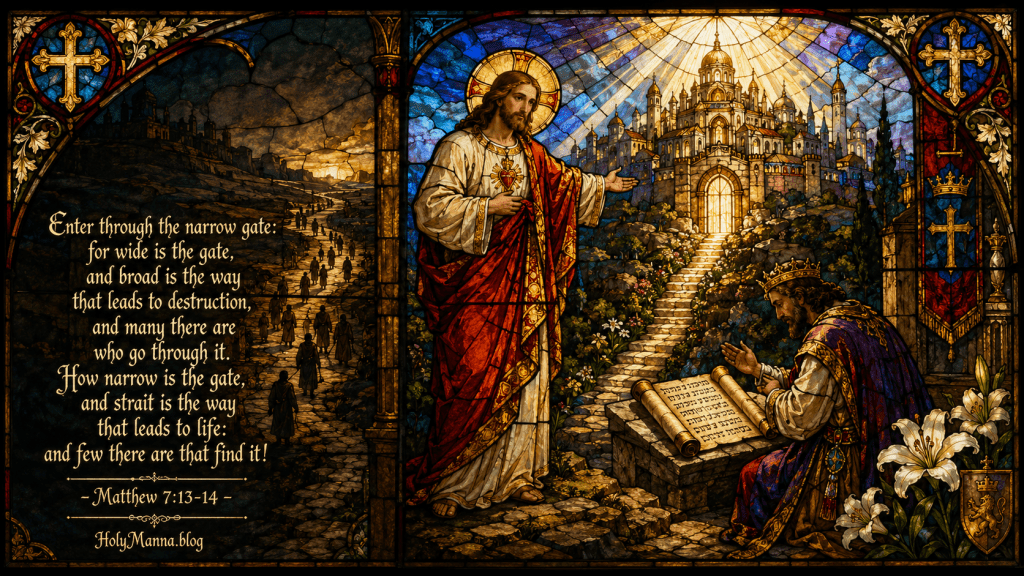
The Narrow Gate. 13 “Enter through the narrow gate; for the gate is wide and the road broad that leads to destruction, and those who enter through it are many. 14 How narrow the gate and constricted the road that leads to life. And those who find it are few.
Detailed Exegesis
Verse 6 – “Do not give what is holy to dogs, or throw your pearls before swine, lest they trample them underfoot, and turn and tear you to pieces.”
This verse can sound harsh to modern ears, but Jesus is not giving permission for contempt. He is teaching prudence. In the Jewish world, holy things were set apart for God, especially what belonged to sacrifice, worship, covenant, and temple life. Pearls were precious and costly. Dogs and swine, in this biblical context, represented what was unclean or unable to recognize sacred value.
Jesus is warning His disciples that holy things must be treated as holy. The Gospel, the Eucharist, the dignity of the human person, the moral law, and the mysteries of faith are not cheap objects for entertainment, mockery, or careless argument. The disciple must evangelize, but evangelization requires wisdom. Not every person is ready to receive every truth at every moment. Not every conversation is fruitful. Not every hostile debate honors God.
St. Augustine teaches this with pastoral balance. He explains that the Lord Himself did not reveal everything all at once, even to His disciples, because love considers what the hearer can bear. This does not mean hiding the faith out of fear. It means sharing the faith with reverence, timing, and charity.
Verse 12 – “Do to others whatever you would have them do to you. This is the law and the prophets.”
This is the Golden Rule, but Jesus presents it as far more than good manners. He says, “This is the law and the prophets.” That means this command expresses the moral heart of God’s revealed will. The disciple is not merely commanded to avoid harming others. The disciple is called to actively seek the good of others.
This verse gathers the commandments into a simple, piercing question. How would this person want to be treated if the roles were reversed? How would correction feel if it came with humility? How would mercy feel if it came without condescension? How would truth feel if it were spoken with patience rather than pride?
St. John Chrysostom saw the beauty of this command because it places moral responsibility close to the heart. A person does not need a complex argument to understand basic charity. Each person already knows, from within, the kind of fairness, patience, mercy, and respect he would hope to receive. Jesus turns that knowledge into a command.
Verse 13 – “Enter through the narrow gate; for the gate is wide and the road broad that leads to destruction, and those who enter through it are many.”
Jesus does not flatter the crowd. He speaks with the seriousness of a Savior who knows where roads lead. The wide gate is attractive because it requires little conversion. It is the road of self-will, comfort, pride, resentment, lust, greed, compromise, and spiritual laziness. It feels spacious because the ego has room to stretch out.
The broad road also feels normal because “those who enter through it are many.” That detail matters. Jesus warns that popularity is not proof of truth. The fact that many people choose a path does not mean it leads to life. The disciple cannot let the crowd become his conscience. Catholic faith calls the believer to follow Christ, not the spirit of the age.
Verse 14 – “How narrow the gate and constricted the road that leads to life. And those who find it are few.”
The narrow gate is not narrow because God is cruel. It is narrow because love is real, truth is specific, and holiness requires conversion. The road to life passes through Christ, through the Cross, through obedience, through repentance, and through grace.
The word “life” is the key. Jesus is not merely warning against destruction. He is inviting His disciples into eternal life. The narrow road may feel difficult because it asks the whole person to change. Yet it is the only road that leads to true freedom. The wide road promises ease and ends in slavery. The narrow road demands surrender and leads to joy.
This is the road of daily Catholic discipleship. It is confession instead of hiding. Chastity instead of using another person. Forgiveness instead of revenge. Truth instead of convenience. Prayer instead of distraction. The Eucharist instead of spiritual self-reliance. The narrow gate is not an abstract image. It is the next faithful choice.
Teachings
This Gospel teaches that Christian life requires both charity and discernment. Jesus’ warning about pearls before swine reminds disciples that holy things must be guarded with reverence. The faith is not a weapon for winning arguments, but a treasure to be offered with love. The disciple must speak the truth, but also recognize when pride, mockery, or hostility has made a conversation spiritually unfruitful.
St. Augustine writes about this verse in On the Sermon on the Mount, explaining the need to consider the readiness of the hearer. He says, “A thing is rightly said to be given to dogs, when it is given to those who attack it with hostile bite; and to swine, when it is given to those who trample it under foot.” St. Augustine, On the Sermon on the Mount, Book II
This is not a call to spiritual arrogance. It is a call to reverence. Sacred truth should never be treated casually, and the Christian should not confuse loud argument with faithful witness.
The Golden Rule is deeply connected to the Catholic understanding of conscience and moral action. The Catechism teaches, “Some rules apply in every case: One may never do evil so that good may result from it; the Golden Rule: ‘Whatever you wish that men would do to you, do so to them.’ Charity always proceeds by way of respect for one’s neighbor and his conscience: ‘Thus sinning against your brethren and wounding their conscience … you sin against Christ.’ Therefore ‘it is right not to … do anything that makes your brother stumble.’” CCC 1789
This paragraph shows that Christian morality is never just private. Every decision affects the neighbor. The Golden Rule is not sentimental. It is demanding because it asks the disciple to treat the other person with the same dignity, fairness, patience, and mercy he desires for himself.
The teaching on the narrow gate is also central to Catholic moral life. The Catechism teaches, “The way of Christ ‘leads to life’; a contrary way ‘leads to destruction.’ The Gospel parable of the two ways remains ever present in the catechesis of the Church. It shows the importance of moral decisions for our salvation: ‘There are two ways, the one of life, the other of death; but between the two, there is a great difference.’” CCC 1696
This is exactly what Jesus places before the disciple. There are two ways. One leads to life. One leads to destruction. Moral decisions matter. Grace is real, mercy is abundant, and forgiveness is always offered to the repentant, but the Christian life still requires a choice.
St. John Chrysostom, preaching on this passage, reminds believers not to judge the road by its difficulty, but by its destination. He teaches, “For not only is the gate strait, but the way also is narrow. And He calls it narrow, not as though it were naturally so, but because of the negligence of the many.” St. John Chrysostom, Homilies on the Gospel of Matthew
That insight is convicting. The road of Christ feels narrow not because grace is lacking, but because the fallen heart resists conversion. Holiness feels constricting to the part of the soul that still wants sin. Yet to the soul being healed, the narrow road becomes freedom.
This Gospel also belongs within the ancient Christian tradition of the Two Ways. The early Christian text known as The Didache begins with this moral contrast, saying, “There are two ways, one of life and one of death, and there is a great difference between the two ways.” The Didache, Chapter 1
The Church has always understood discipleship this way. Following Jesus is not drifting with the crowd. It is choosing the way of life.
Reflection
This Gospel asks the Catholic heart to grow up in holiness. It is not enough to have strong feelings about faith. It is not enough to know the right answers. Jesus calls His disciples to reverence, charity, and conversion.
First, the disciple must guard what is holy. That means treating the Eucharist with reverence, speaking about the Church with love, handling moral truth with humility, and refusing to turn sacred things into online entertainment or argument bait. Some conversations about faith should happen slowly. Some should happen privately. Some should begin with prayer before words. The goal is not to win. The goal is to witness.
Second, the disciple must live the Golden Rule concretely. This can begin in the ordinary places where holiness is often tested. The family group chat. The workplace meeting. The traffic jam. The parish hallway. The difficult conversation with a spouse, parent, friend, or coworker. Before speaking, the Christian can ask, Would this be fair if it were said to me? Would this be merciful if it were done to me? Would this correction help me if the roles were reversed?
Third, the disciple must choose the narrow gate. This is where the Gospel becomes very practical. The narrow gate may mean going to confession instead of defending the sin. It may mean ending a relationship that pulls the soul away from Christ. It may mean forgiving someone without pretending the wound was acceptable. It may mean telling the truth when silence would be easier. It may mean choosing prayer when the phone is more attractive.
The narrow gate is not always dramatic. Most days, it is small and hidden. It is the choice to be patient. The choice to be pure. The choice to be honest. The choice to keep praying. The choice to go to Mass. The choice to trust the Church when the culture laughs. The choice to treat another person as a beloved child of God.
What holy thing needs to be guarded more carefully in your life?
Where has evangelization become argument instead of witness?
Who needs to receive the Golden Rule from you today in a concrete way?
What broad road has become comfortable, and what narrow gate is Jesus asking you to enter?
The Gospel does not leave the disciple with vague inspiration. It places a road under his feet. Christ does not simply say, “Admire the narrow gate.” He says, “Enter through the narrow gate.” Matthew 7:13 The invitation is urgent because the destination is eternal.
And the good news is that the narrow gate is not entered alone. Christ Himself is the Way. He gives the grace to walk where He commands. He forgives when the disciple falls. He strengthens through the Eucharist. He guides through the Church. He teaches the soul to guard what is holy, love the neighbor, and choose the road that leads to life.
Bring the Letter, Trust the Stronghold, Choose the Narrow Gate
Today’s readings move like a spiritual journey from fear to worship, and from worship to faithful action. Hezekiah receives a letter meant to break his courage, but instead of letting fear write the ending, he brings the threat into the house of the Lord. He spreads it before God and prays. That simple act becomes a lesson for every Catholic heart: what feels too heavy to carry should not be hidden, denied, or handled alone. It should be placed before the Lord.
Then Psalm 48 teaches the soul why that prayer is not empty. God is the stronghold of His people. Jerusalem is not praised because its walls are impressive, but because the Lord is present there. The same truth remains for the Church and for every soul living in grace. Strength does not begin with control, reputation, money, comfort, or success. Strength begins with God dwelling in the midst of His people.
Finally, in The Gospel of Matthew, Jesus shows what faithful trust looks like after prayer. The disciple must guard what is holy, love others through the Golden Rule, and enter through the narrow gate. The Lord does not call His followers to vague inspiration. He calls them to a real road. It is narrow because love is specific, holiness is demanding, and eternal life matters.
The message of today is clear. When fear comes, bring it to God. When the world feels unstable, remember that the Lord is the true stronghold. When the broad road looks easier, choose Christ anyway.
This is the Catholic life in its daily form. Pray before reacting. Worship before panicking. Love before judging. Choose obedience before comfort. Go to confession when sin has gained ground. Return to the Eucharist when the heart feels weak. Let the Church teach, form, and steady the soul.
The same God who heard Hezekiah still hears His people. The same Lord praised in Zion still dwells with His Church. The same Christ who says, “Enter through the narrow gate” also gives the grace to walk that road. Matthew 7:13
What fear needs to be placed before the Lord today?
Where is God inviting the heart to stop trusting false strongholds and return to Him?
What narrow step of holiness is Christ asking for right now?
Let today become a turning point. Bring the letter. Enter the temple. Ponder His mercy. Then walk through the narrow gate with courage, because the road may be constricted, but it leads to life.
Engage with Us!
Share your reflections in the comments below. Today’s readings invite the heart to bring fear before God, trust Him as the true stronghold, and choose the narrow road that leads to life. These passages are not just ancient words from Scripture. They are a living invitation to pray more honestly, worship more deeply, and follow Christ more faithfully.
- In the First Reading from 2 Kings 19:9-11, 14-21, 31-36, Hezekiah takes the threatening letter into the house of the Lord and spreads it before God. What fear, burden, temptation, or difficult situation needs to be brought honestly before the Lord in prayer today?
- In Psalm 48:2-4, 9-11, Jerusalem is strong because God dwells there. Where is the heart tempted to look for security apart from God, and how can daily prayer, Mass, confession, or Eucharistic adoration help restore trust in the Lord as the true stronghold?
- In the Holy Gospel from Matthew 7:6, 12-14, Jesus teaches His disciples to guard what is holy, treat others with love, and enter through the narrow gate. What narrow step of holiness is Christ asking for right now, especially in relationships, speech, purity, forgiveness, or obedience?
- How do all three readings challenge the soul to move from fear to faith, from faith to worship, and from worship to concrete action?
- What is one practical way to live the Golden Rule today by doing for someone else what would be desired if the roles were reversed?
May these readings encourage every heart to live with deeper trust in God, greater reverence for what is holy, and stronger courage to walk the narrow road with Christ. Let faith become more than a belief held quietly inside. Let it shape words, choices, relationships, habits, and hidden sacrifices. Above all, may everything be done with the love and mercy Jesus taught us.
Sacred Heart of Jesus, we trust in You!
Immaculate Heart of Mary, pray for us!
Saint Michael the Archangel, defend us in battle!
Follow us on YouTube, TikTok, Instagram and Facebook for more insights and reflections on living a faith-filled life.


Leave a comment