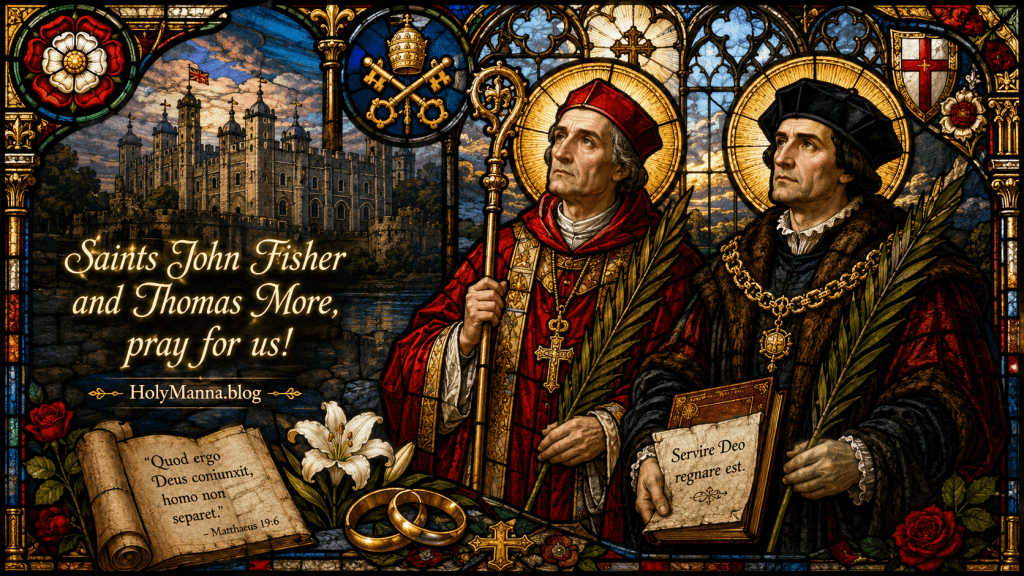
The King’s Servants Who Put God First
Saints John Fisher and Thomas More are remembered together because they stood at one of the most dangerous crossroads in Catholic history. One was a bishop, theologian, scholar, and cardinal. The other was a husband, father, lawyer, writer, and Lord Chancellor of England. Their lives looked very different, but their final witness was united by one holy truth: no earthly ruler can take the place of Christ and His Church.
They lived during the reign of King Henry VIII, when England was being pulled away from communion with Rome. Henry wanted his marriage to Queen Catherine of Aragon declared invalid so he could marry Anne Boleyn. When the Pope would not grant what Henry demanded, the king began claiming authority over the Church in England. Fisher and More saw clearly what was at stake. This was not only a political crisis. It was a crisis of marriage, conscience, truth, and the unity of the Catholic Church.
Saint John Fisher is remembered as a model bishop, a defender of Catholic doctrine, and the only English bishop who openly refused Henry VIII’s claim to be Supreme Head of the Church in England. Saint Thomas More is remembered as a brilliant Catholic layman, author of Utopia, and a public servant who chose conscience over career. Pope Saint John Paul II proclaimed Thomas More patron of statesmen and politicians. He is also widely honored as a patron of lawyers, civil servants, public servants, large families, stepparents, adopted children, and difficult marriages. John Fisher is especially honored as patron of the Diocese of Rochester and remembered as a model for bishops, theologians, scholars, and Catholics facing persecution.
Their feast is celebrated on June 22, the day Saint John Fisher was martyred. The Church honors them in red, the color of martyrs, because they gave the supreme witness of love. As The Catechism teaches in CCC 2473, martyrdom is “the supreme witness given to the truth of the faith.”
A Scholar Bishop and a Brilliant Young Lawyer
John Fisher was born in Beverley, Yorkshire, around 1469. His father was a merchant, and John’s early brilliance eventually brought him to Cambridge. There, his gifts unfolded quickly. He became a fellow, a priest, a professor, and one of the great academic leaders of his age. He later became chaplain and confessor to Lady Margaret Beaufort, the mother of King Henry VII. Under Fisher’s guidance, Lady Margaret helped support and strengthen Catholic learning at Cambridge, including the founding of Christ’s College and St. John’s College.
Fisher became Bishop of Rochester in 1504. Rochester was not a glamorous diocese. It was small, poor, and not the sort of place an ambitious churchman would choose if he wanted worldly advancement. But Fisher stayed. That says a lot about him. He was not chasing prestige. He was shepherding souls.
He preached, studied, corrected abuses, supported learning, and defended the Catholic faith. He encouraged the study of Greek and Hebrew, welcomed the scholarship of Erasmus, and wrote against Martin Luther. He defended the Eucharist, the sacraments, and the authority of the Church. He was a reformer, but he was a Catholic reformer. He wanted renewal within the Church, not rebellion against the Church.
Thomas More was born in London in 1477 or 1478, the son of Sir John More, a respected lawyer and judge. As a young boy, Thomas entered the household of Cardinal John Morton, Archbishop of Canterbury and Lord Chancellor of England. Morton saw something extraordinary in him and helped send him to Oxford.
More became one of the sharpest minds of his generation. He studied Latin, Greek, law, history, music, mathematics, and the Fathers of the Church. He became friends with great humanist scholars, including Erasmus, who admired his wit, intelligence, and holiness.
One of the most surprising parts of Thomas More’s early life is that he seriously considered becoming a priest or religious. He lived near the London Charterhouse and joined in the spiritual practices of the Carthusian monks. He also practiced penance and wore a hair shirt, a hidden sign of self-denial beneath the clothing of a busy public man. Erasmus later said More chose marriage because he believed he was called to be a faithful husband rather than an unfaithful priest.
In 1505, More married Jane Colt. They had four children: Margaret, Elizabeth, Cecilia, and John. After Jane died in 1511, More married Alice Middleton, a widow who helped him raise his children. His home became known for learning, prayer, music, affection, and serious Catholic formation. At a time when many girls were denied advanced education, More gave his daughters, especially Margaret, a strong intellectual and spiritual formation. That was not just progressive for the time. It was deeply Catholic. He saw the dignity of the mind and soul in every person entrusted to him.
Holiness in Study, Family, and Public Life
John Fisher’s holiness was not flashy. It was steady, disciplined, and deeply pastoral. He was known for preaching at a time when many bishops were more interested in politics than souls. He preached the funeral sermons for King Henry VII and Lady Margaret Beaufort. He also wrote spiritual works, including reflections on the penitential psalms, and theological works defending the Catholic faith.
No major famous miracles are commonly attributed to John Fisher during his lifetime in the Catholic sources most often used for his biography. His life was not remembered because he healed crowds or performed dramatic wonders. He was remembered because he lived like a bishop should live. He taught the truth, defended the flock, and stayed faithful when silence would have been safer.
Thomas More’s holiness was also hidden in ordinary life before it became heroic in martyrdom. He rose in public service, became a lawyer, served in Parliament, became Under-Sheriff of London, carried out diplomatic missions, entered royal service, was knighted, became Speaker of the House of Commons, and eventually became Lord Chancellor of England in 1529.
He also wrote Utopia, one of the most famous works of Renaissance literature. The title means “nowhere,” and the book became so influential that the word “utopia” entered common language. Yet More was not merely a clever writer. He was a Catholic thinker. He wrote in defense of the sacraments, the Eucharist, prayer to the saints, relics, images, pilgrimage, and the authority of the Church.
More’s family life may be one of the most beautiful parts of his witness. He was not a saint because he escaped the world. He became holy while living inside the world as a husband, father, lawyer, writer, friend, and public servant. He joked, taught, prayed, worked, suffered, and loved. His life reminds Catholics that sanctity is not only found in monasteries. It can also be found at the dinner table, in the courtroom, in the office, and in the quiet choices made when nobody is applauding.
The Catechism teaches in CCC 1776 that conscience is man’s “most secret core and his sanctuary.” Fisher and More show what happens when conscience is not treated as personal opinion, but as a sacred place where the soul must listen to God.
When the King Wanted the Church
The great trial of their lives began with Henry VIII’s desire to end his marriage to Queen Catherine of Aragon. Saint John Fisher became one of Catherine’s strongest defenders. He argued that the marriage was valid and could not simply be dissolved because the king wanted another wife.
Fisher’s defense of marriage was not merely personal loyalty to Catherine. It was Catholic doctrine. Marriage is not a temporary contract controlled by power. As Christ teaches in The Gospel of Matthew 19:6, “What therefore God has joined together, let not man put asunder.” The Catechism teaches in CCC 1614 that Jesus insisted on the original meaning of marriage as an indissoluble union. Fisher knew that if a king could bend marriage to his will, then the sacrament itself was being treated as property of the state.
In one powerful moment, Fisher compared himself to Saint John the Baptist, who had defended the truth about marriage before Herod. That comparison was not dramatic exaggeration. It was prophecy. Like John the Baptist, Fisher would die because he refused to bless a ruler’s unlawful marriage.
Thomas More also saw the danger. He served Henry faithfully, but he knew the king’s favor was not the same as God’s favor. A famous saying attributed to More captures his realism about royal power. Speaking of Henry, he warned that “If my head should win him a castle in France, it should not fail to go.”
As Henry’s demands grew more severe, the crisis moved beyond marriage. Henry wanted to be recognized as Supreme Head of the Church in England. For Catholics, this was impossible. The Pope, as successor of Saint Peter, is the visible source of unity in the Church. As The Catechism teaches in CCC 882, the Roman Pontiff has supreme, full, immediate, and universal power in the care of souls.
Fisher resisted. More resisted with careful silence and legal precision. Neither man wanted rebellion. Neither wanted drama. Neither wanted death. They simply would not say what was false.
Towers, Trials, and the Price of Truth
John Fisher faced multiple dangers even before his final imprisonment. One dark story from his life involves a suspected poisoning attempt. Several members of his household became ill after eating porridge, and two died. Fisher himself had not eaten the food. Catholic sources report that many believed the poisoning was intended for him. This event is historically reported, though the full motive and responsibility remain matters of historical interpretation.
Fisher was also connected to the case of Elizabeth Barton, known as the Holy Maid of Kent, a nun who claimed to receive visions warning Henry against his marriage to Anne Boleyn. Fisher was punished for his association with her, though his martyrdom was ultimately not about private revelations. It was about refusing to deny Catholic truth.
In 1534, Fisher refused the oath connected to the Act of Succession because it required acceptance of Henry’s position in a way Fisher could not reconcile with the Catholic faith. He was imprisoned in the Tower of London. He was elderly, sick, and treated harshly. He lacked proper food and clothing, and Catholic accounts say he was deprived of priestly ministry and the sacraments.
In May 1535, Pope Paul III made Fisher a cardinal, perhaps hoping the honor would protect him. Henry was furious. A famous story says the king declared that Fisher’s head would be off before the cardinal’s hat could be placed on it. Whether remembered in exact wording or not, the story captures the brutality of the moment. Henry was no longer merely angry. He wanted submission, and Fisher would not give it.
Fisher was tried for treason and condemned. On June 22, 1535, he was taken to Tower Hill. He was weak in body, but firm in soul. On the scaffold, he is traditionally remembered as saying, “Christian people, I am come hither to die for the faith of Christ’s Holy Catholic Church.” He forgave his executioner, prayed, and gave his life for Christ.
Thomas More’s road to martyrdom was quieter, but no less courageous. He resigned as Lord Chancellor in 1532 because he could not support Henry’s actions against the Church. He tried to remain silent where speech would trap him, but silence was not enough for the king. In 1534, More refused the oath connected to the Act of Succession and was imprisoned in the Tower.
In prison, he wrote some of his most beautiful spiritual works, including Dialogue of Comfort Against Tribulation and meditations on the Passion of Christ. When deprived of books and writing materials, he wrote with a charred stick or coal. His prayer from prison begins with the famous words, “Give me thy grace, good Lord.” It is a prayer of detachment, courage, humility, and surrender.
His love for his daughter Margaret shines through his prison letters. In one of his most beloved lines, he wrote, “Nothing can come but what God wills.” Near the end, he told her, “Pray for me, and I shall for you and all your friends, that we may merrily meet in heaven.”
More was tried on July 1, 1535. The key witness against him was Richard Rich, whose testimony More firmly denied. More was convicted of treason and sentenced to death. Henry changed the punishment from the gruesome traitor’s death to beheading.
On July 6, 1535, Thomas More was led to execution. His most famous final words are traditionally remembered as, “I die the King’s good servant, but God’s first.” A famous scaffold story says that More moved his beard away from the blade and joked that his beard had committed no treason. This story is part of the traditional memory of More’s holy humor, though it should be treated as a beloved story rather than a fully verified quotation.
What makes his final moments so powerful is not only that he died bravely. It is that he died without bitterness. He remained a loyal subject as far as conscience allowed, but he belonged to God before any king.
Relics, Memory, and a Legacy That Would Not Die
After John Fisher was executed, his body was first buried near All Hallows Barking and later moved to the Chapel of St. Peter ad Vincula in the Tower of London. His head was displayed on London Bridge and later thrown into the Thames. This was meant to shame him, but history tells a different story. The king’s power looked victorious for a moment. Fisher’s witness has lasted for centuries.
Thomas More’s body was also buried in the Chapel of St. Peter ad Vincula. His head was displayed on London Bridge for about a month. A famous and deeply moving tradition says that his daughter Margaret Roper bribed the official responsible for disposing of it and preserved it from being thrown into the river. A head found later in the Roper family vault at St. Dunstan’s in Canterbury is traditionally believed to be his, though complete certainty is difficult after so many centuries.
Several relics and personal items associated with More became part of Catholic memory, including his hair shirt, crucifix, cap, seal, and other objects. His hair shirt is especially striking because it shows how deeply penitential his private life had been, even while he moved through the highest circles of English public life.
There are no widely known, formally celebrated miracle stories attached to John Fisher or Thomas More in the way there are with some saints known for healings, apparitions, or wonders. Their posthumous impact is centered on martyrdom, relics, intercession, Catholic memory, and the witness of conscience. That does not make their sanctity less powerful. Their miracle, in a sense, is the endurance of their witness. They lost their offices, freedom, reputations, and lives, yet they continue to form Catholic consciences almost five hundred years later.
They were beatified by Pope Leo XIII in 1886 and canonized together by Pope Pius XI in 1935, the four-hundredth anniversary year of their martyrdom. In 2000, Pope Saint John Paul II named Saint Thomas More patron of statesmen and politicians. Their shared feast on June 22 has also become closely associated with religious freedom, especially for Catholics who must live their faith in public life without surrendering conscience.
Their cultural impact is especially visible in the life of Thomas More. His book Utopia shaped political thought and language. His life inspired the famous title “a man for all seasons,” a phrase connected to Erasmus’s praise of his character and later popularized in drama and film. But Saint John Fisher’s legacy is just as needed. He stands as a bishop who did not abandon his flock, did not flatter power, and did not trade truth for safety.
Together, they remind the Church that public life needs saints. The courtroom needs saints. Parliament needs saints. Universities need saints. Families need saints. Bishops need saints. The modern world needs men and women who can say yes to lawful authority, but no to any authority that demands the place of God.
The Courage to Keep a Catholic Soul
The lives of Saints John Fisher and Thomas More speak directly to modern Catholics. Their world was filled with pressure, ambition, fear, politics, reputation, and compromise. That sounds familiar. The details have changed, but the temptation is still the same. It is easy to soften the truth to keep peace. It is easy to stay silent to protect comfort. It is easy to treat faith as private decoration instead of public conviction.
Fisher teaches the courage of a shepherd. He reminds bishops, priests, parents, teachers, and leaders that love must sometimes speak clearly. Real charity does not abandon truth. Real mercy does not pretend sin is harmless. Real pastoral care does not lead souls away from Christ in order to please the powerful.
More teaches the courage of a lay Catholic in the world. He was not perfect, and his era was complicated, but his final witness is luminous. He shows that holiness can live in family life, public service, scholarship, humor, friendship, and ordinary responsibilities. He also shows that conscience must be formed before the crisis comes. A person does not suddenly become courageous on the scaffold. Courage is formed in prayer, study, sacrifice, confession, discipline, and daily fidelity.
What would happen if Catholic faith shaped every decision, not only the convenient ones? What parts of life are most tempted to serve the king before God? Where is Christ asking for quiet courage right now?
The witness of these saints is not an invitation to become harsh, angry, or politically obsessed. It is an invitation to become faithful. They did not die because they hated the king. They died because they loved Christ more. That is the difference between stubbornness and sanctity.
Engage with Us!
Share your thoughts and reflections in the comments below. Saints John Fisher and Thomas More lived in a time when faithfulness had a serious cost, and their witness still asks every Catholic to examine the heart with honesty.
- Where is God asking for greater courage in daily life right now?
- Is conscience being formed by Catholic truth, or mostly by comfort, fear, and public opinion?
- How can Saint John Fisher’s courage as a bishop inspire stronger faithfulness in family, parish, or leadership responsibilities?
- How can Saint Thomas More’s example help Catholics live faithfully in work, politics, law, education, or public life?
- What would it look like to be a good servant in the world, but God’s first?
May Saints John Fisher and Thomas More pray for Catholics who face pressure to compromise the truth. May their witness inspire courage without bitterness, conviction without pride, and fidelity without fear. Live the faith with joy, defend the truth with charity, and do everything with the love and mercy Jesus taught.
Saints John Fisher and Thomas More, pray for us!
Follow us on YouTube, TikTok, Instagram and Facebook for more insights and reflections on living a faith-filled life.

 Holy Manna!
Leave a comment