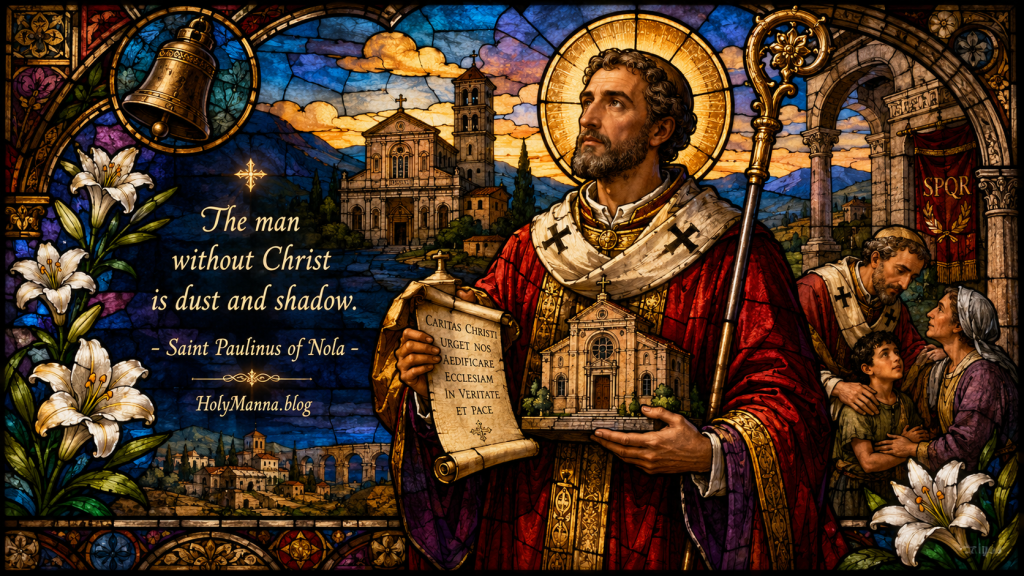
The Bishop Who Gave Christ Everything
Saint Paulinus of Nola is one of those saints whose life feels like a dramatic reversal written by grace. He was born into power, educated among the elite, admired in public office, gifted in poetry, blessed with wealth, and connected to some of the most important figures of his age. By the standards of the Roman world, he had everything a man could want.
Then Christ asked for his heart.
Paulinus did not simply become a better version of a Roman nobleman. He became poor for Christ. He became a servant of pilgrims. He became a bishop who loved the poor personally. He became a Christian poet who could say, “To my mind the only art is the faith, and Christ is my poetry.”
He is remembered as a bishop, confessor, poet, husband, monk, and pastor of charity. He is traditionally honored as the patron saint of bellmakers and bell-ringers, and his memory remains especially beloved in Nola, Italy, where his feast is still celebrated with great devotion and cultural joy.
Saint Paulinus shows the Church something beautiful. Conversion does not destroy a person’s gifts. It purifies them. The politician became a shepherd. The aristocrat became a servant. The poet became a witness. The wealthy man became poor, and in losing everything for Christ, he became truly rich.
A Son of Nobility With a Soul Made for More
Saint Paulinus was born around the year 354 in Bordeaux, in Roman Gaul, which is modern-day France. His full name was Pontius Meropius Anicius Paulinus. He came from a wealthy senatorial family and received one of the finest educations available in the Roman world. His teacher was the famous poet Ausonius, a major literary figure of the late Roman Empire.
Paulinus grew into a cultured, intelligent, and respected man. He entered public service and eventually became governor of Campania in southern Italy. During his time there, he encountered the deep devotion of the people of Nola to Saint Felix, a local martyr whose tomb drew pilgrims from near and far.
That devotion marked him. Paulinus saw ordinary Christians honoring a saint, making pilgrimage, praying, and seeking God with simple faith. He began to assist the shrine of Saint Felix, building a road for pilgrims and a hospice for the poor. Before he had fully surrendered his life to Christ, grace was already teaching him through the faith of the Church.
His conversion was not shallow or sudden in the cheap sense. It was a long road. He learned from holy people, including Bishop Delphinus of Bordeaux, the priest Amandus, Saint Ambrose of Milan, and Saint Martin of Tours. Catholic tradition also remembers that Saint Martin healed Paulinus of an eye disease, a grace that helped draw him closer to Christ.
Paulinus was baptized by Bishop Delphinus. Afterward, he could look back on the glittering world he had known and say with startling clarity, “The man without Christ is dust and shadow.”
That is not the line of a man who hated the world. It is the confession of a man who finally saw the world in the light of eternity.
A Marriage Changed by Grief and Grace
Paulinus married Therasia, a devout noblewoman from Spain. Their marriage is one of the tender and often overlooked parts of his story. They were not two people running away from responsibility. They were spouses learning together how to belong completely to Christ.
After years of marriage, they had a son, but the child died only a few days after birth. That wound changed them. Instead of letting grief make them bitter, Paulinus and Therasia allowed suffering to become a doorway into deeper surrender.
They sold much of their property and gave generously to the poor. By mutual consent, they embraced a chaste and ascetical life. They eventually moved near the tomb of Saint Felix in Nola, where they lived in a kind of monastic community with other Christians.
This part of Paulinus’ life is deeply Catholic. The Church does not teach that wealth is evil in itself, nor that marriage is a lower vocation. The Church teaches that every good thing must be ordered toward God. The Catechism reminds us that love for the poor belongs to the constant tradition of the Church and is inspired by the Gospel of Christ, especially His poverty and mercy toward the poor, as taught in CCC 2443-2449.
Paulinus and Therasia show what happens when Christian spouses discern together. Their sorrow did not become despair. Their wealth did not become an idol. Their marriage became a path of holiness.
The Poet Who Became a Priest
Around Christmas of 394 or 395, Paulinus was ordained a priest in Barcelona. Catholic tradition says the people strongly desired his ordination because they recognized his holiness. After becoming a priest, Paulinus returned to Nola and gave himself more fully to prayer, service, hospitality, and devotion to Saint Felix.
At Nola, he used his gifts with extraordinary generosity. He built and restored churches. He cared for pilgrims. He supported the poor. He helped create a beautiful basilica complex near the tomb of Saint Felix, decorated with sacred images, inscriptions, lamps, marble, and art meant to lift the heart toward God.
This matters because Paulinus understood beauty as evangelization. He was not decorating for vanity. He was teaching through sacred art. The poor, the tired pilgrim, the simple believer, and the learned visitor could all enter that space and be drawn toward heaven.
This is exactly the Catholic instinct. The Catechism teaches that sacred art is true and beautiful when it evokes and glorifies the mystery of God, especially the beauty revealed in Christ, as taught in CCC 2502. Paulinus lived that truth centuries before the modern Catechism expressed it.
He also remained a poet. His poems for the feast of Saint Felix, often called the Carmina Natalicia, helped preserve and spread devotion to Saint Felix. He did not stop writing after his conversion. He simply gave his writing to Christ.
That is why his famous line still speaks to Catholic artists today: “To my mind the only art is the faith, and Christ is my poetry.”
The Bishop With a Heart for the Poor
Around the year 409, Paulinus became Bishop of Nola. He did not become a prince of comfort. He became a father of the poor.
The Church remembers him especially for his love of poverty and pastoral care. The liturgical prayer for his memorial asks God that, as the Church celebrates Saint Paulinus’ merits, Christians may imitate the example of his charity. That is the key to understanding him. His holiness was not merely in what he gave up. His holiness was in how deeply he loved.
Paulinus welcomed the poor into his life. He did not treat them as an interruption or as a social problem to be managed from a distance. He saw them as Christ present before him. He reportedly called the poor his “masters,” because their prayers helped sustain his house and his ministry.
In this, he lived the Gospel with uncomfortable clarity. In The Gospel of Luke, Jesus says, “Sell your belongings and give alms” and “For where your treasure is, there also will your heart be.” Paulinus took that seriously. He knew that the Christian life is not measured by how much one owns, but by how freely one loves.
He also understood that renunciation is only the beginning. One of his important sayings teaches, “The relinquishment or sale of temporal goods possessed in this world is not the completion but only the beginning of the race.”
That is a powerful warning. Giving things up is not the finish line. It is the starting line. The real question is whether the heart becomes more like Christ.
Friend of Saints and Witness to Communion
Saint Paulinus lived during one of the great ages of the Church. He was connected with saints whose names still shape Catholic life today, including Saint Augustine, Saint Jerome, Saint Ambrose, Saint Martin of Tours, Saint Delphinus of Bordeaux, Saint Nicetas of Remesiana, and others.
He was not merely admired by them from a distance. He corresponded with them. He formed friendships rooted in Christ. He understood that holiness is not a private achievement. It is life inside the Body of Christ.
One of his beautiful lines to Saint Augustine says, “We are members of one body, we have one head, we are steeped in one grace, we live on one loaf, we walk on one road and we dwell in the same house.”
That sounds like the communion of saints because that is exactly what it is. The Catechism teaches that the communion of saints is the Church, and that the good of each member is communicated to the others in Christ, as taught in CCC 946-962. Paulinus lived this through friendship, prayer, hospitality, and shared mission.
His life reminds modern Catholics that friendship can be holy. Letters can be holy. Encouragement can be holy. A Christian community can become a school of sanctity.
The Famous Legend of the Widow’s Son
The most famous story about Saint Paulinus comes from Catholic tradition and was preserved through Pope Saint Gregory the Great. It is a beloved story, though the exact historical details cannot be fully verified.
According to the legend, barbarian invasions devastated the region, and many people were carried away into captivity. Paulinus used the resources of the Church to ransom prisoners. Eventually, a poor widow came to him begging for help because her only son had been taken captive.
Paulinus had nothing left to give.
So, according to the story, he gave himself.
He offered himself in exchange for the widow’s son and was taken away into slavery. In some versions, he worked as a gardener in a foreign land. Eventually, his identity as Bishop of Nola became known, and through God’s providence, he was released along with other captives.
The strict historical details of this story are debated, so it should be presented as a holy legend rather than a fully verified event. Still, the legend has endured because it tells the truth about the kind of man Paulinus was. He was a shepherd who did not merely preach charity. He became charity.
Even if every detail cannot be proven, the heart of the story fits the saint. Paulinus was the kind of bishop who spent himself for his people.
Hardships Without Martyrdom
Saint Paulinus was not a martyr in the usual sense. He did not die by execution for the faith. Yet his life was not free from hardship.
He endured the grief of losing his infant son. He gave up wealth, public status, and worldly ambition. He faced misunderstanding from those who thought his renunciation was foolish. His former teacher Ausonius, who had once expected great literary fame from him, struggled to understand why Paulinus would abandon such promising worldly honors.
There is also a tradition that Paulinus was threatened with a false accusation involving his brother. Whether every detail is known with certainty or not, this reminds us that his path away from power was not easy.
As bishop, he also lived through a time of political instability, invasion, fear, and suffering. The Roman world around him was shaking. Many people were poor, displaced, or vulnerable. Paulinus did not respond by clinging to comfort. He responded by becoming more available.
Saint Augustine preserves a prayer attributed to Paulinus during a time of danger and loss: “O Lord, let me not be troubled for gold and silver, for where all my treasure is You know.”
That prayer is the soul of Paulinus in one sentence. His treasure was not in vaults, estates, reputation, or Roman security. His treasure was in Christ.
Relics, Memory, and the Feast That Still Dances
Saint Paulinus died on June 22, 431, in Nola. He was already regarded as holy during his lifetime, and devotion to him continued after his death.
His relics had a long journey. They were first venerated in Nola, later taken to Benevento, then transferred to Rome, where they remained for centuries at San Bartolomeo all’Isola on the Tiber Island. In the early twentieth century, under Pope Saint Pius X, his relics were returned to Nola. Their return was a major moment of Catholic joy for the local Church.
There do not appear to be widely known, formally investigated posthumous miracles attributed to Saint Paulinus in the same way the Church records miracles for more recent canonizations. His sainthood belongs to the ancient tradition of the Church, when saints were recognized through long-standing devotion and the witness of the faithful.
Still, stories of divine providence surround his memory. The legend of his captivity and return became central to the cultural and religious imagination of Nola. According to local tradition, when Paulinus returned with freed captives, the people welcomed him with lilies. This tradition developed into the famous Festa dei Gigli, or Feast of the Lilies.
Today, the Festa dei Gigli remains one of the great cultural celebrations connected to Saint Paulinus. Huge wooden and papier-mâché structures are carried in procession through Nola in his honor. The celebration is not merely a historical pageant. It is a living expression of Catholic memory, local identity, gratitude, music, craftsmanship, and devotion.
The tradition also traveled with Italian Catholic immigrants, especially to places such as Brooklyn, where devotion to Saint Paulinus became part of immigrant Catholic life. His memory continues to ring out, fittingly, like the bells with which he is traditionally associated.
A Saint for the Successful, the Creative, and the Restless
Saint Paulinus is a powerful saint for anyone who has ever wondered what to do with gifts, success, money, education, creativity, or influence.
He does not teach that these things are evil. He teaches that they are dangerous when they become idols and beautiful when they become offerings.
He had wealth, and he gave it to the poor. He had literary talent, and he made Christ his poetry. He had public influence, and he became a servant. He had grief, and he let it lead him deeper into God. He had friends, and he made friendship a path to holiness.
His life asks a serious question: What gift has God placed in your hands, and what would happen if it were fully surrendered to Christ?
That is not a comfortable question. It is a freeing one.
Saint Paulinus reminds Catholics that holiness is not only for people who begin with nothing. It is also for people who have much and must learn how to let go. It is for the talented, the educated, the ambitious, the grieving, the married, the widowed, the creative, the generous, and the restless.
Christ does not simply ask for the broken parts of a life. He asks for everything, including the best parts.
And when those gifts are surrendered, they are not wasted. They become fruitful.
Reflection
Saint Paulinus of Nola teaches that the Christian life is not about polishing a respectable image. It is about conversion of heart.
He was not remembered because he had been rich. He was remembered because he became poor for Christ. He was not remembered because he had been powerful. He was remembered because he used power to serve. He was not remembered because he wrote beautifully. He was remembered because his beauty pointed to God.
For modern Catholics, his life is a gentle but firm invitation to examine treasure. Not just money, but time, ambition, comfort, attention, reputation, talents, and relationships.
Where is your treasure right now?
That question is not meant to shame anyone. It is meant to wake up the heart. Paulinus had to learn that worldly greatness without Christ becomes dust and shadow. But when Christ becomes the center, even ordinary things become radiant.
A practical way to live his example is to give personally, not just conveniently. Serve the poor in a way that costs time. Use creativity for God. Make the home more hospitable. Encourage a friend in the faith. Let grief become prayer instead of bitterness. Choose one possession, habit, or comfort that has too much power over the heart, and offer it back to Christ.
Saint Paulinus also reminds Catholic creators that art, writing, music, beauty, and storytelling can serve the Gospel. The Church needs beauty that tells the truth. The world needs witnesses who can say with their lives, “Christ is my poetry.”
Engage With Us!
Share your thoughts and reflections in the comments below. Saint Paulinus of Nola gave up worldly greatness so that his whole life could belong to Christ, and his witness still challenges anyone trying to live faithfully in a world obsessed with status, comfort, and success.
- What part of Saint Paulinus’ story speaks most deeply to your own faith journey?
- Is there a gift, talent, or success in your life that God may be asking you to use more intentionally for Him?
- How does the quote, “The man without Christ is dust and shadow,” challenge the way you think about worldly success?
- Who are the “poor” or overlooked people God may be placing before you right now?
- What would it look like this week to make Christ your treasure more fully?
May Saint Paulinus of Nola pray for us, that our talents may become offerings, our wealth may become mercy, our friendships may become holy, and our hearts may belong completely to Christ. Let us live with faith, serve with compassion, and do everything with the love and mercy Jesus taught us.
Saint Paulinus of Nola, pray for us!
Follow us on YouTube, TikTok, Instagram and Facebook for more insights and reflections on living a faith-filled life.

 Holy Manna!
Leave a comment