Monday of the Twelfth Week in Ordinary Time – Lectionary: 371
When the Soul Learns to See Clearly
Before the soul can help heal the world, it must first let God heal what has grown blind within itself.
Today’s readings bring us into the painful mercy of spiritual truth. In Second Kings 17:5-8, 13-15, 18, Israel’s northern kingdom falls to Assyria, not simply because of military weakness, but because the people slowly abandoned the Lord who had rescued them from Egypt. They ignored the prophets, imitated the nations around them, and traded the covenant for idols. Scripture gives the diagnosis with unforgettable honesty: “They followed emptiness and became empty” (2 Kings 17:15). This is the tragedy of every heart that chooses lesser gods. What we worship shapes what we become.
The Responsorial Psalm gives voice to a people humbled by collapse. Psalm 60 does not hide the pain of judgment, but turns that pain into prayer. The people cry out, “O God, you rejected us, broke our defenses; you were angry but now revive us” (Psalm 60:3). Their hope is no longer in armies, strategies, or human strength, because they have learned the hard way that “worthless is human help” (Psalm 60:13) when the soul is separated from God.
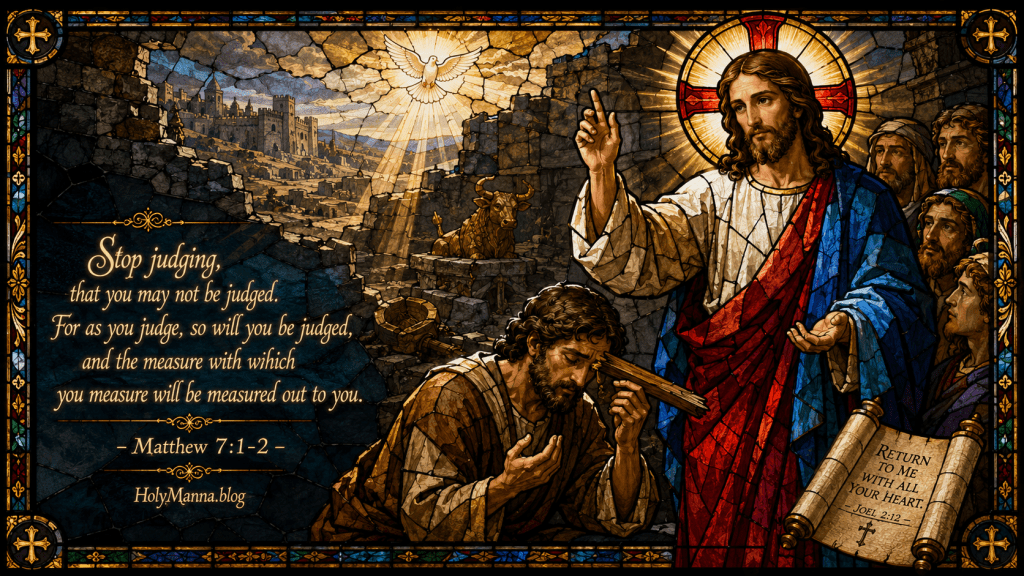
Then Jesus brings the same lesson directly into the heart in The Gospel of Matthew. He warns His disciples, “Stop judging, that you may not be judged” (Matthew 7:1). He is not telling His followers to pretend sin does not matter. He is warning against the hypocrisy of seeing another person’s splinter while ignoring the wooden beam in one’s own eye. The Lord calls His people to moral clarity, but that clarity must begin with repentance, humility, and conversion.
The central theme of today’s readings is spiritual blindness and the mercy of being corrected by God. Israel could not see its idolatry. The Psalmist begins to see the need for divine help. The disciple in the Gospel must learn to see his own beam before reaching for his brother’s splinter. This is why The Catechism teaches that conversion is “a radical reorientation of our whole life” (CCC 1431). God does not expose sin in order to crush the heart. He reveals it so the heart can return to Him and finally see clearly.
Where has the heart followed emptiness and become empty? Where has correction of others become easier than conversion of self? Today, the Lord invites every disciple to begin in the most honest place possible, not with someone else’s faults, but with the beam He is ready to remove.
First Reading – 2 Kings 17:5-8, 13-15, 18
When a People Follow Emptiness
The First Reading brings us to one of the saddest moments in the history of God’s people. The northern kingdom of Israel falls to Assyria, and Samaria, its capital, is captured after a long siege. Historically, this points to the Assyrian conquest of the northern kingdom in the eighth century before Christ, when many Israelites were deported and scattered among foreign lands. In the ancient world, deportation was not only a military tactic. It was a way to erase identity, weaken religious memory, and break a people’s connection to their land, their worship, and their traditions.
Yet Scripture does not present this collapse as merely political. The sacred author gives a theological diagnosis. Israel fell because it forgot the Lord, ignored His prophets, imitated pagan nations, and exchanged covenant love for idolatry. This reading fits perfectly into today’s theme of spiritual blindness. Israel could see the nations around them, but they could not see what was happening inside their own hearts. They followed what was empty and slowly became empty themselves.
2 Kings 17:5-8, 13-15, 18 – New American Bible (Revised Edition)
5 Then the king of Assyria occupied the whole land and attacked Samaria, which he besieged for three years.
Israelites Deported. 6 In Hoshea’s ninth year, the king of Assyria took Samaria, deported the Israelites to Assyria, and settled them in Halah, and at the Habor, a river of Gozan, and in the cities of the Medes. 7 This came about because the Israelites sinned against the Lord, their God, who had brought them up from the land of Egypt, from under the hand of Pharaoh, king of Egypt. They venerated other gods, 8 they followed the rites of the nations whom the Lord had dispossessed before the Israelites and those that the kings of Israel had practiced.
13 The Lord warned Israel and Judah by every prophet and seer: Give up your evil ways and keep my commandments and statutes, in accordance with the entire law which I enjoined on your ancestors and which I sent you by my servants the prophets. 14 But they did not listen. They grew as stiff-necked as their ancestors, who had not believed in the Lord, their God. 15 They rejected his statutes, the covenant he had made with their ancestors, and the warnings he had given them. They followed emptiness and became empty; they followed the surrounding nations whom the Lord had commanded them not to imitate.
18 The Lord became enraged, and removed them from his presence. Only the tribe of Judah was left.
Detailed Exegesis
Verse 5 – “Then the king of Assyria occupied the whole land and attacked Samaria, which he besieged for three years.”
This verse sets the scene with terrifying simplicity. Assyria was the great empire of the age, known for military strength, expansion, and brutal domination. Samaria was not defeated overnight. It was besieged for three years, which means the people endured fear, hunger, uncertainty, and the slow collapse of everything they thought would protect them. Spiritually, this siege reveals what happens when a nation’s outer walls begin to reflect its inner condition. Israel’s defenses were cracking because its covenant faith had already been weakened.
Verse 6 – “In Hoshea’s ninth year, the king of Assyria took Samaria, deported the Israelites to Assyria, and settled them in Halah, and at the Habor, a river of Gozan, and in the cities of the Medes.”
The fall of Samaria becomes exile. The Israelites are removed from the Promised Land and settled among foreign peoples. In biblical theology, land was never just geography. It was a sign of covenant blessing, a place where Israel was meant to live as God’s holy people. To be deported from the land was a visible sign of a deeper rupture. Israel had turned away from the Lord, and now they experienced the pain of separation. This does not mean God had abandoned His covenant forever. It means He allowed the consequences of sin to become painfully visible.
Verse 7 – “This came about because the Israelites sinned against the Lord, their God, who had brought them up from the land of Egypt, from under the hand of Pharaoh, king of Egypt. They venerated other gods.”
Here Scripture gives the reason for the disaster. Israel sinned against the very God who had saved them. The mention of Egypt is crucial. The Lord had delivered Israel from slavery, revealed His power, formed them as His people, and entered into covenant with them. Their idolatry was not an innocent mistake. It was a betrayal of a relationship. They did not merely break rules. They forgot mercy. This is why sin is so serious in Catholic teaching. The Catechism teaches, “Sin is an offense against reason, truth, and right conscience; it is failure in genuine love for God and neighbor caused by a perverse attachment to certain goods. It wounds the nature of man and injures human solidarity. It has been defined as ‘an utterance, a deed, or a desire contrary to the eternal law.’” (CCC 1849).
Verse 8 – “They followed the rites of the nations whom the Lord had dispossessed before the Israelites and those that the kings of Israel had practiced.”
Israel was called to be different, not because they were better than the nations, but because they belonged to the Lord. Their worship, morality, family life, justice, and identity were meant to reveal the holiness of God. Instead, they copied the nations around them. This is one of the constant temptations of God’s people in every age. The pressure to blend in can feel harmless at first. But when the people of God begin to imitate the world’s idols, the world’s values, and the world’s worship, they lose the very identity God gave them.
Verse 13 – “The Lord warned Israel and Judah by every prophet and seer: Give up your evil ways and keep my commandments and statutes, in accordance with the entire law which I enjoined on your ancestors and which I sent you by my servants the prophets.”
This verse reveals the patience of God. Before judgment comes warning. Before exile comes prophecy. The Lord sent prophets and seers because He desired repentance, not destruction. God’s commandments were not chains. They were the path of life. His warnings were not cruelty. They were mercy calling His people home. This is how God often works in the soul. He sends conscience, Scripture, the Church, confession, spiritual friendships, and even painful consequences to wake the heart before it hardens completely.
Verse 14 – “But they did not listen. They grew as stiff-necked as their ancestors, who had not believed in the Lord, their God.”
The tragedy is not that God failed to speak. The tragedy is that Israel refused to listen. To be stiff-necked means to be stubborn, resistant, and unwilling to turn. The image comes from an animal that refuses the guidance of the yoke. Spiritually, it describes a soul that will not bend before God. This is a warning for every generation. A person can hear holy words and still resist grace. A family can know the faith and still drift. A nation can receive blessings and still become proud. The danger is not always ignorance. Sometimes the danger is refusal.
Verse 15 – “They rejected his statutes, the covenant he had made with their ancestors, and the warnings he had given them. They followed emptiness and became empty; they followed the surrounding nations whom the Lord had commanded them not to imitate.”
This is the heart of the reading. Israel rejected the covenant and followed emptiness. The phrase is devastating because it shows that idolatry does not simply offend God. It hollows out the human person. Whatever the heart worships shapes the heart. If the heart worships power, it becomes harsh. If it worships pleasure, it becomes restless. If it worships approval, it becomes anxious. If it worships the living God, it becomes alive. Israel followed empty things and became like what they loved.
Verse 18 – “The Lord became enraged, and removed them from his presence. Only the tribe of Judah was left.”
This verse must be read with reverence and care. God’s anger is not a loss of control or a petty emotional reaction. Divine anger is His holy opposition to sin, because sin destroys what He loves. Israel is removed from His presence in the sense that the northern kingdom loses its place in the land and suffers the consequences of covenant infidelity. Yet even here, there is a hint of mercy. Judah remains. God’s plan of salvation continues. From Judah will come David’s line, and from David’s line will come Jesus Christ, the true King who gathers the scattered children of God.
Teachings
The fall of Samaria is one of the great Old Testament warnings about covenant infidelity. Israel’s exile shows that sin is never merely private. It damages families, communities, worship, justice, and memory. A people who forget God eventually forget who they are.
This is why The Catechism speaks so directly about idolatry: “Idolatry not only refers to false pagan worship. It remains a constant temptation to faith. Idolatry consists in divinizing what is not God. Man commits idolatry whenever he honors and reveres a creature in place of God, whether this be gods or demons, power, pleasure, race, ancestors, the state, money, etc.” (CCC 2113).
That teaching brings Second Kings directly into modern life. Most Catholics today are not tempted to worship Baal in a temple. But the human heart can still build altars. Careers can become altars. Politics can become altars. Comfort can become an altar. Sports, entertainment, money, influence, beauty, technology, and even self-image can become altars. The name of the idol changes, but the spiritual danger remains the same.
The Catechism also helps explain the mystery of exile. It teaches, “The forgetting of the Law and the infidelity to the covenant end in death: it is the Exile, apparently the failure of the promises, which is in fact the mysterious fidelity of the Savior God and the beginning of a promised restoration, but according to the Spirit.” (CCC 710). That line is essential. Exile looks like failure, but God is still faithful. Consequences are real, but they do not cancel mercy. Judgment is painful, but it can become the beginning of restoration.
St. Augustine gives a powerful lens for understanding Israel’s tragedy. In The City of God, he writes, “Two loves have made two cities: love of self even to the contempt of God, and love of God even to the contempt of self.” This is exactly the drama of the First Reading. Israel was formed to be the city of God, a people shaped by love of the Lord. Instead, they began imitating the nations and loving created things more than the Creator. Their worship became disordered, and their society followed.
This reading also prepares the soul for the Gospel, where Jesus warns against judging others while ignoring the beam in one’s own eye. Israel’s downfall began with a failure to see clearly. They could see the surrounding nations, but they could not see their own growing infidelity. They could see worldly power, but they could not see spiritual emptiness. They could hear the prophets, but they would not listen.
Catholic faith teaches that God’s corrections are not meant to humiliate His people. They are meant to save them. The Lord sends prophets before exile. He sends warnings before collapse. He sends grace before judgment. His desire is always conversion, because He is a Father who wants His children to come home.
Reflection
The First Reading asks every heart to be honest about what it has been following. Israel did not become empty in one day. The collapse came after years of compromise, imitation, ignored warnings, and stubborn refusal. That is usually how spiritual decline works. Very few people wake up one morning and decide to abandon God completely. More often, prayer gets pushed aside. Sunday Mass becomes optional. Confession becomes rare. Entertainment becomes louder than conscience. The opinions of the culture begin to matter more than the teaching of Christ and His Church.
Then, slowly, the soul starts to feel empty.
The mercy in this reading is that God tells the truth. He does not allow His people to pretend that idolatry leads to life. He names the wound so He can heal it. He exposes the emptiness so the heart can return to fullness.
A simple way to live this reading is to make a serious examination of conscience. Ask where the heart has been imitating the world instead of following Christ. Look honestly at time, money, habits, entertainment, anger, speech, relationships, and the hidden desires that quietly shape daily decisions. Then bring those places to confession, because the Sacrament of Penance is where exile begins to turn into return.
Another way to live this reading is to listen sooner. Israel heard the prophets but did not listen. A disciple today can listen through Scripture, the teachings of the Church, the voice of conscience, the wisdom of a good priest, and the loving correction of faithful friends. God often sends warnings as invitations. The humble soul learns to receive them before life has to become painfully loud.
What emptiness has the heart been following lately?
Where has the culture quietly discipled the soul more than Christ has?
What warning has God already been giving with patience and mercy?
What would it look like today to stop imitating the world and return to the covenant love of God?
The fall of Samaria is a serious reading, but it is not hopeless. Judah remains. The promise continues. God’s mercy is still moving through history. Even when His people are unfaithful, He remains faithful. The invitation today is not to despair over the places where the heart has wandered. The invitation is to come home before emptiness becomes exile.
Responsorial Psalm – Psalm 60:3-5, 7, 12-13
When Broken Defenses Become a Prayer
The Responsorial Psalm gives the wounded heart a voice. After the First Reading shows the fall of Samaria and the painful consequences of Israel’s infidelity, Psalm 60 teaches God’s people how to pray when their defenses have collapsed. This is the prayer of a people who know that something has gone wrong, not only around them, but within them.
Historically, Psalm 60 belongs to the world of Israel’s battles, national crisis, and covenant memory. In ancient Israel, military defeat was never seen as merely political. It forced the people to ask deeper questions. Had they trusted in themselves? Had they forgotten the Lord? Had they relied on armies more than covenant faithfulness? This Psalm does not give a shallow answer. It does not pretend suffering is easy. It does something more honest and more Catholic. It turns defeat into repentance, helplessness into prayer, and brokenness into dependence on God.
This Psalm fits today’s theme beautifully. Israel followed emptiness and became empty. Now the Psalmist cries out from the ruins, asking God to revive what sin has weakened. The Gospel will later warn against judging others while ignoring the beam in one’s own eye. Here, the Psalmist shows the first step toward clear sight: humility before God.
Psalm 60:3-5, 7, 12-13 – New American Bible (Revised Edition)
3 O God, you rejected us, broke our defenses;
you were angry but now revive us.
4 You rocked the earth, split it open;
repair the cracks for it totters.
5 You made your people go through hardship,
made us stagger from the wine you gave us.7 Help with your right hand and answer us
that your loved ones may escape.12 Was it not you who rejected us, God?
Do you no longer march with our armies?
13 Give us aid against the foe;
worthless is human help.
Detailed Exegesis
Verse 3: “O God, you rejected us, broke our defenses; you were angry but now revive us.”
The Psalm begins with startling honesty. The people do not hide from the pain of feeling rejected. Their defenses have been broken, and they understand that their suffering is connected to God’s righteous anger. In Scripture, divine anger is not pettiness or cruelty. It is God’s holy opposition to sin, because sin destroys the people He loves. Yet the verse does not end in despair. It ends with the prayer, “now revive us” (Psalm 60:3). That is the language of repentance. The people are not simply asking for political rescue. They are asking God to restore life.
Verse 4: “You rocked the earth, split it open; repair the cracks for it totters.”
The image is dramatic. The whole earth seems unstable, cracked, and tottering. This is what spiritual collapse can feel like. When sin and suffering expose weakness, life can feel as if the ground has opened beneath one’s feet. Yet the Psalmist knows who can repair the cracks. Only God can mend what human strength cannot fix. This verse becomes a prayer for the soul, the family, the Church, and the nation whenever foundations feel shaken. The people are asking not just for survival, but for restoration.
Verse 5: “You made your people go through hardship, made us stagger from the wine you gave us.”
The Psalmist describes hardship as something God has permitted His people to endure. The image of staggering from wine suggests confusion, weakness, and disorientation. Sin often promises clarity, freedom, and control, but it leaves the soul unsteady. Israel’s history shows that when God allows hardship, it is not because He has stopped loving His people. It is because He is waking them up. The pain becomes medicinal when it leads the heart back to Him.
Verse 7: “Help with your right hand and answer us that your loved ones may escape.”
The Psalm now turns from lament to petition. The right hand of God symbolizes power, protection, and saving action. The people call themselves His loved ones, which is deeply important. Even in distress, they still appeal to covenant love. They do not say, “We deserve rescue.” They say, in effect, “We belong to You.” This is the posture of Christian prayer. The disciple does not come before God pretending to be strong. The disciple comes as one who is loved and in need of mercy.
Verse 12: “Was it not you who rejected us, God? Do you no longer march with our armies?”
This verse captures the ache of feeling that God’s presence has withdrawn. In Israel’s history, victory was never supposed to rest on military numbers alone. The decisive question was whether the Lord was with His people. Here the Psalmist faces the terrifying possibility that human effort without God is powerless. This is not a rejection of responsible action. It is a rejection of self-reliance. When God is treated as optional, even the strongest armies become fragile.
Verse 13: “Give us aid against the foe; worthless is human help.”
The Psalm concludes with one of its clearest spiritual lessons. Human help has its place, but it cannot save the soul. It cannot forgive sin, repair covenant infidelity, heal spiritual blindness, or restore what has been broken by idolatry. The people finally see that their deepest need is not merely better strategy. Their deepest need is God. This verse prepares the heart for the Gospel, where Jesus teaches that the disciple must first remove the beam from his own eye. Human pride cannot heal spiritual blindness. Only God’s grace can.
Teachings
The Responsorial Psalm teaches the Catholic soul how to pray from a place of collapse. It is not a prayer of denial. It is not a prayer of blame. It is a prayer that recognizes brokenness, names dependence, and turns toward God with humility.
The Catechism teaches that the Psalms remain central to the prayer of God’s people: “The Psalms both nourished and expressed the prayer of the People of God gathered during the great feasts at Jerusalem and each Sabbath in the synagogues. Their prayer is inseparably personal and communal; it concerns both those who are praying and all men. The Psalms arose from the communities of the Holy Land and the Diaspora, but embrace all creation.” (CCC 2588).
That teaching matters because Psalm 60 is not only Israel’s prayer. It becomes the Church’s prayer. It becomes the prayer of every believer who has looked at the ruins of sin, weakness, or failure and whispered, “now revive us” (Psalm 60:3). The Psalms train the heart to bring everything to God, including confusion, sorrow, guilt, fear, and hope.
The Psalm also reveals the importance of humility in prayer. The Catechism teaches, “Humility is the foundation of prayer. Only when we humbly acknowledge that ‘we do not know how to pray as we ought,’ are we ready to receive freely the gift of prayer. ‘Man is a beggar before God.’” (CCC 2559). That is exactly the movement of this Psalm. The people no longer stand before God as self-sufficient. They stand before Him as beggars, asking for aid against the foe because “worthless is human help” (Psalm 60:13).
St. Augustine understood the Psalms as the prayer of the whole Christ, Head and members. In his preaching on the Psalms, he teaches, “If the psalm prays, pray; if it groans, groan; if it rejoices, rejoice; if it hopes, hope; if it fears, fear.” This is a deeply Catholic way to read Psalm 60. The Church does not stand outside the Psalm as a spectator. She enters it. She prays it with Israel, with Christ, and with every wounded soul seeking restoration.
This Psalm also connects to the long history of God correcting His people in order to save them. The exile, the collapse of kingdoms, and the suffering of Israel all point toward the need for a deeper restoration. Human kings, armies, and strategies could not heal the wound of sin. Only God could. That promise reaches its fulfillment in Jesus Christ, who does not merely repair broken walls, but restores the human heart through His Cross and Resurrection.
Reflection
The Responsorial Psalm is a gift for anyone who has ever looked around and thought, “This is not working anymore.” It speaks to the person whose spiritual defenses feel broken, whose prayer life feels dry, whose habits feel disordered, whose family feels strained, or whose heart feels tired from trying to fix everything alone.
The Psalm does not begin with confidence in human strength. It begins with honesty before God. That is often where real healing starts. A person cannot be revived while pretending not to be wounded. A family cannot be healed while pretending nothing is cracked. A soul cannot return to God while still insisting it has everything under control.
The practical invitation is to pray with humility. Instead of immediately reaching for distractions, opinions, control, or self-protection, the disciple can learn to say, “repair the cracks for it totters” (Psalm 60:4). That prayer can be brought into confession, before the tabernacle, during a quiet drive, or at the end of a long day when the heart finally admits it needs grace.
Another way to live this Psalm is to stop treating human help as ultimate. Friends, family, planning, therapy, discipline, and wise counsel can all be good gifts. But none of them can replace God. When the deepest wound is spiritual, the deepest healing must come from the Lord. The Psalmist is not rejecting help from others. He is putting it in the right order. God first. Everything else beneath Him.
Where do the defenses feel broken right now?
What cracks in the heart need to be repaired by God rather than hidden by pride?
Where has human help been treated as more reliable than prayer, confession, and trust in the Lord?
Can the soul honestly pray today, “Lord, now revive us”?
This Psalm teaches that collapse does not have to be the end of the story. In God’s hands, broken defenses can become the doorway to humility. Hardship can become a summons to return. The confession that “worthless is human help” (Psalm 60:13) can become the beginning of real hope, because the soul finally stops pretending it can save itself and begins reaching for the only One who can.
Holy Gospel – Matthew 7:1-5
The Beam That Blocks the Eye
The Holy Gospel brings today’s theme into the most personal place possible: the way one sinner looks at another sinner. Jesus is speaking during the Sermon on the Mount, where He teaches His disciples how to live as citizens of the Kingdom of Heaven. This is not a surface-level morality lesson. Jesus is forming hearts that can see as God sees.
In the Jewish world of Jesus’ time, teachers often used vivid images to awaken the conscience. The splinter and the wooden beam would have sounded almost humorous at first, but the humor carried a sharp spiritual point. It is absurd to perform delicate eye surgery on a brother while a huge beam blocks one’s own vision. Yet that is exactly what happens when someone notices another person’s fault while refusing to confront his own sin.
This Gospel fits today’s readings perfectly. In Second Kings, Israel could not see its own idolatry and followed emptiness until it became empty. In Psalm 60, the people begin to see their brokenness and cry out for God’s help. Now, in The Gospel of Matthew, Jesus reveals the path to clear sight: humble repentance before loving correction.
Matthew 7:1-5 – New American Bible (Revised Edition)
Judging Others. 1 “Stop judging, that you may not be judged. 2 For as you judge, so will you be judged, and the measure with which you measure will be measured out to you. 3 Why do you notice the splinter in your brother’s eye, but do not perceive the wooden beam in your own eye? 4 How can you say to your brother, ‘Let me remove that splinter from your eye,’ while the wooden beam is in your eye? 5 You hypocrite, remove the wooden beam from your eye first; then you will see clearly to remove the splinter from your brother’s eye.
Detailed Exegesis
Verse 1 – “Stop judging, that you may not be judged.”
Jesus begins with a command that is often misunderstood. He is not saying that right and wrong do not exist. He is not telling His disciples to abandon moral truth, ignore sin, or pretend that all choices are spiritually equal. The Lord Himself teaches clearly about sin, repentance, holiness, and the narrow way. What He condemns here is rash, arrogant, hypocritical judgment. This is the kind of judgment that looks down on another person while avoiding conversion of self. Catholic teaching holds both truths together. Christians must discern good from evil, but they must never treat themselves as if they stand above the mercy they also need.
Verse 2 – “For as you judge, so will you be judged, and the measure with which you measure will be measured out to you.”
Jesus warns that the standard one uses against others will be applied to oneself. This is not meant to make disciples careless about truth. It is meant to make them merciful, honest, and humble. A person who demands mercy from God but refuses mercy to others has not understood the Gospel. The measure of condemnation, suspicion, harshness, and pride will return to the one who uses it. The measure of mercy, truth, patience, and charity reflects the heart of Christ. This verse invites every disciple to ask whether his judgments are shaped by love or by superiority.
Verse 3 – “Why do you notice the splinter in your brother’s eye, but do not perceive the wooden beam in your own eye?”
The image is unforgettable. A splinter is small, painful, and real. Jesus does not say the brother has no problem. The splinter may truly be there. But the greater problem belongs to the one who cannot see himself clearly. The wooden beam represents serious spiritual blindness. It may be pride, hypocrisy, resentment, hidden sin, self-righteousness, or a refusal to repent. Jesus is teaching that sin damages spiritual vision. The person who refuses conversion cannot correct another person well, even when the other person truly needs help.
Verse 4 – “How can you say to your brother, ‘Let me remove that splinter from your eye,’ while the wooden beam is in your eye?”
Here Jesus exposes the contradiction. The person with the beam still wants to be useful. He still wants to correct. He may even think he is helping. But without humility, correction becomes dangerous. The brother’s eye is delicate. A careless hand can wound more deeply. Spiritually, this means that correction must never come from anger, gossip, contempt, embarrassment, or the desire to win an argument. The brother is not a project. He is a person made in the image of God. If correction is not guided by charity, it can become another form of pride.
Verse 5 – “You hypocrite, remove the wooden beam from your eye first; then you will see clearly to remove the splinter from your brother’s eye.”
This final verse gives the proper order. Jesus does not say, “Never remove the splinter.” He says to remove the beam first. That matters. Christ is not abolishing fraternal correction. He is purifying it. The disciple must first repent, examine his conscience, and allow God to heal his own blindness. Then, with clearer sight, he may help his brother. The goal is not silence in the face of sin. The goal is charity that sees clearly enough to heal. In the Catholic life, this means conversion first, then correction, always in humility and love.
Teachings
This Gospel is one of the Church’s great safeguards against rash judgment. It protects truth from becoming cruelty and mercy from becoming moral laziness. Jesus does not ask His disciples to become passive or indifferent. He asks them to become holy enough to correct without hypocrisy.
The Catechism teaches clearly about rash judgment and the dignity owed to every person’s reputation: “Respect for the reputation of persons forbids every attitude and word likely to cause them unjust injury. He becomes guilty: of rash judgment who, even tacitly, assumes as true, without sufficient foundation, the moral fault of a neighbor; of detraction who, without objectively valid reason, discloses another’s faults and failings to persons who did not know them; of calumny who, by remarks contrary to the truth, harms the reputation of others and gives occasion for false judgments concerning them.” (CCC 2477).
That teaching shines a bright light on modern life. Rash judgment can happen in family conversations, parish drama, workplace frustration, social media comments, text threads, and the private courtroom of the mind. A person can sin against charity without saying a word out loud, simply by assuming the worst without sufficient reason.
The Catechism then gives a beautiful Catholic path for guarding the heart from harsh judgment: “To avoid rash judgment, everyone should be careful to interpret insofar as possible his neighbor’s thoughts, words, and deeds in a favorable way: Every good Christian ought to be more ready to give a favorable interpretation to another’s statement than to condemn it. But if he cannot do so, let him ask how the other understands it. And if the latter understands it badly, let the former correct him with love. If that does not suffice, let the Christian try all suitable ways to bring the other to a correct interpretation so that he may be saved.” (CCC 2478).
This is not weakness. This is disciplined charity. It does not deny sin. It refuses to rush into condemnation. It asks questions before assuming motives. It gives the other person the dignity of being understood before being corrected.
At the same time, Catholic teaching also affirms that love may require correction. The Catechism teaches, “The fruits of charity are joy, peace, and mercy; charity demands beneficence and fraternal correction; it is benevolence; it fosters reciprocity and remains disinterested and generous; it is friendship and communion.” (CCC 1829). That one line keeps the Gospel in balance. Charity is not sentimental silence. Charity sometimes corrects. But it corrects as a friend, not as an enemy. It seeks communion, not humiliation.
St. John Chrysostom, preaching on this passage, explains that Christ does not forbid correction itself. Rather, He forbids the proud correction of another while one’s own greater sin remains untouched. The Lord commands the disciple to remove the beam first so that he may help his brother with clearer sight. St. Augustine also reads this teaching as a warning against the proud heart that corrects others without first examining itself before God. For the saints, the point is clear: the Christian must never use truth as a weapon for self-exaltation. Truth must be carried with humility, because every disciple stands in need of mercy.
This Gospel also prepares the soul for the Sacrament of Penance. In confession, the Catholic does not enter to announce someone else’s splinter. He enters to name his own beam. This is one of the great graces of the Church. Confession trains the soul to stop hiding, stop blaming, stop pretending, and stand honestly before the mercy of Christ.
Reflection
This Gospel lands hard because it is so ordinary. Most people do not need training in noticing other people’s splinters. That comes naturally. The co-worker’s arrogance, the spouse’s tone, the friend’s inconsistency, the parishioner’s hypocrisy, the stranger’s bad opinion online, and the family member’s obvious flaw can all look painfully clear. Meanwhile, the beam in one’s own eye can feel strangely invisible.
Jesus is merciful enough to interrupt that pattern.
The practical first step is daily examination of conscience. Before correcting another person, a disciple can ask whether the same sin lives in his own heart under a different form. Anger may condemn anger. Pride may condemn pride. Impatience may condemn impatience. A person may notice another’s vanity while secretly worshiping approval in his own way. The beam is not always identical to the splinter, but it always blocks clear sight.
The second step is confession. The Sacrament of Penance removes the illusion that holiness is achieved by comparing oneself to someone worse. In confession, the soul comes before Christ and says the truth without excuses. That humility changes the way a person sees others. The one who has received mercy becomes slower to condemn and more ready to help.
The third step is charitable correction when it is truly needed. Jesus does not say to leave the splinter forever. A splinter in the eye hurts. Sin hurts the soul. If someone is being harmed by sin, love may require speaking. But the manner matters. Correction should be private when possible, gentle in tone, clear in truth, and ordered toward the person’s good. The goal is never to win, shame, dominate, or prove superiority. The goal is healing.
Where is it easier to notice someone else’s splinter than to face the beam in one’s own eye?
What judgment has been formed too quickly, without prayer, patience, or enough understanding?
Who needs mercy more than criticism right now?
What would change if correction began only after examination of conscience and prayer?
This Gospel does not make Christians less truthful. It makes them more Christlike. The Lord wants disciples with clear eyes, clean hearts, and steady hands. He wants people who can name sin without delighting in condemnation. He wants correction that comes from love, not ego. He wants mercy that does not excuse sin, and truth that does not forget mercy.
The world already has plenty of critics. Christ is forming saints. A critic sees the splinter and feels superior. A saint sees the splinter and first kneels before God with his own beam. Then, when grace has cleared his vision, he can finally help his brother see.
Clear Eyes, Humbled Hearts, and Mercy That Leads Us Home
Today’s readings tell one story from three angles. In Second Kings 17:5-8, 13-15, 18, Israel falls because the people stop listening to God and begin imitating the nations around them. They forget the Lord who rescued them, reject His covenant, and follow idols until Scripture gives that painful diagnosis: “They followed emptiness and became empty” (2 Kings 17:15).
Then Psalm 60 teaches the humbled heart how to pray after the collapse. The people no longer pretend that human strength can save them. They cry out, “O God, you rejected us, broke our defenses; you were angry but now revive us” (Psalm 60:3). That prayer is not despair. It is the beginning of repentance. It is what happens when the soul finally stops defending its idols and starts asking God to repair what sin has cracked.
Finally, in The Gospel of Matthew, Jesus brings the whole lesson into daily life. He warns against the kind of judgment that sees another person’s splinter while ignoring the beam in one’s own eye. He does not call His disciples to moral confusion or silence before sin. He calls them to humility first, conversion first, and charity always. The Lord says, “Remove the wooden beam from your eye first; then you will see clearly to remove the splinter from your brother’s eye” (Matthew 7:5).
This is the path of clear sight. Stop following emptiness. Cry out for revival. Let Christ remove the beam. Then, and only then, can a disciple help another person with a heart shaped by mercy instead of pride.
The invitation today is beautifully practical. Make an honest examination of conscience. Look at the places where the world has become too persuasive and prayer has become too quiet. Bring the beam to confession. Ask the Lord to revive what has grown tired, cold, distracted, or proud. Then practice charity with the people nearby, especially the ones who are easiest to criticize.
What emptiness is God asking the heart to leave behind today?
Where is He calling for repentance before correction?
Who needs to be seen with the same mercy that Christ has shown to every sinner who comes home?
God does not expose sin to humiliate His people. He reveals it to heal them. He does not allow the soul to feel empty so it will despair. He allows the soul to hunger again for the living God. Today, the Lord is offering the grace of clear eyes and a humbled heart. The only faithful response is to stop pretending, turn back to Him, and let His mercy lead the soul home.
Engage with Us!
Share your reflections in the comments below. Today’s readings invite an honest look at the heart, especially the places where emptiness, pride, or self-reliance may have quietly taken root. These questions can help carry the message of the readings into prayer, conversation, and daily life.
- For the First Reading, 2 Kings 17:5-8, 13-15, 18: Where has the heart been tempted to follow the values of the world instead of the covenant love of God? What “empty” thing has promised satisfaction but left the soul restless?
- For the Responsorial Psalm, Psalm 60:3-5, 7, 12-13: Where does the soul need to pray with honesty, “Lord, repair the cracks”? What situation needs to be surrendered to God instead of relying only on human strength?
- For the Holy Gospel, Matthew 7:1-5: Where is it easier to notice another person’s splinter than to face the wooden beam in one’s own eye? How can correction become more humble, charitable, and rooted in mercy?
May today’s readings inspire a deeper return to God, a more honest examination of conscience, and a gentler way of seeing others. Live the faith with courage, speak the truth with humility, and do everything with the love and mercy Jesus taught His disciples.
Sacred Heart of Jesus, we trust in You!
Immaculate Heart of Mary, pray for us!
Saint Michael the Archangel, defend us in battle!
Follow us on YouTube, TikTok, Instagram and Facebook for more insights and reflections on living a faith-filled life.

 Holy Manna!
Leave a comment