A Quiet Catholic Courage That Shook the Courtroom
Saint John Rigby is one of those saints whose life reminds Catholics that holiness does not always begin in a monastery, cathedral, or pulpit. Sometimes it begins in a servant’s heart, in a dangerous courtroom, with one simple decision to tell the truth.
Born around 1570 in Lancashire, England, Saint John Rigby lived during one of the most painful chapters in English Catholic history. Under Queen Elizabeth I, Catholic life was heavily restricted. Priests were hunted. Families were fined. Ordinary Catholics were pressured to attend Anglican services, even when doing so violated their conscience. To be reconciled to Rome could be treated not merely as a religious act, but as treason.
Saint John Rigby was not a bishop, theologian, or famous preacher. He was a layman, a servant and steward in a Catholic household. Yet when he was questioned about his faith, he refused to lie. He admitted he was Catholic, refused to conform to the state church, and accepted death rather than deny Christ and His Church.
He is honored as one of the Forty Martyrs of England and Wales. He is commonly invoked as patron of bachelors and torture victims. His feast day is June 21.
His witness beautifully reflects what The Catechism teaches about martyrdom: “Martyrdom is the supreme witness given to the truth of the faith” (CCC 2473). Saint John Rigby gave that witness not with a long speech, but with a faithful yes.
A Lancashire Son Formed in a Persecuted Faith
John Rigby was born into a family of minor gentry at Harrock or Harrocks Hall near Wigan in Lancashire. His father was Nicholas Rigby, and his mother was Mary Breres of Preston. The Rigby family had Catholic roots, but like many Catholic families of that time, they had to navigate a dangerous world. Some accounts say his father outwardly conformed to the Church of England, likely to protect the family estate, while Catholic faith continued quietly within the family’s world.
John’s early life was not a simple story of uninterrupted courage. Catholic sources say that while he served in Protestant households, he sometimes attended Protestant services. Later, he repented of this compromise and was reconciled fully to the Catholic Church.
That part of his story is deeply important. Saint John Rigby was not remembered because he never struggled. He was remembered because he came back. He had known pressure, weakness, and fear, but grace led him into deeper fidelity.
At some point, John entered the service of Sir Edmund Huddleston, a Catholic gentleman connected with Sawston Hall in Cambridgeshire. Sawston was part of the underground Catholic world of Elizabethan England, where priests, servants, hidden chapels, and brave families worked together to preserve the Mass and the sacraments.
Catholic sources differ slightly on the priest who reconciled John Rigby to the Church. The older standard account says he was reconciled by Saint John Jones, a Franciscan priest, in the Clink prison. A local Catholic tradition connected with his shrine says Father John Gerard, the famous Jesuit missionary, seems to have played a key role in his return. The safest way to tell the story is that the Catholic household at Sawston, the missionary priests who served there, and especially the influence of either Saint John Jones or Father John Gerard helped bring John fully home to the Catholic faith.
There is also a fascinating detail from Catholic tradition: John Rigby desired to become a Jesuit lay brother, though there is no record that he formally entered the Society of Jesus. This desire may have been inspired by the witness of Saint Nicholas Owen, the heroic Jesuit lay brother who built priest hiding places and who had built one at Sawston.
In other words, John Rigby was formed by a hidden Catholic world where holiness was practical, risky, and courageous. Faith was not just something discussed. It was something protected, lived, and sometimes died for.
A Servant Sent to Court and a Soul Put on Trial
The event that changed John Rigby’s life began almost quietly.
In 1600, Sir Edmund Huddleston’s widowed daughter, Mrs. Fortescue, was summoned to the Old Bailey because she had been accused of recusancy, which meant refusing to attend Anglican services. Since she was ill, John Rigby went to court on her behalf.
He did not arrive as the accused. He arrived as a servant carrying out a duty.
Then the officials began questioning him.
When they asked about his own religion, John admitted that he was Catholic. That admission was enough to place him in grave danger. He was arrested and sent to Newgate Prison. The next day, he signed a confession stating that he had been reconciled to the Catholic Church and had not attended Anglican worship since.
This was the turning point. He was not accused of planning violence. He was not condemned for leading a rebellion. He was condemned because he had returned to the Catholic Church and refused to betray his conscience.
In Catholic teaching, conscience is not a license to invent truth, but the place where a person must honestly answer before God. The Catechism teaches that man “must not be forced to act contrary to his conscience” (CCC 1782). Saint John Rigby understood this in the most serious way. He would not pretend in worship. He would not outwardly deny what he inwardly knew to be true.
Chains That Fell and a Faith That Would Not Bend
After his arrest, John Rigby was imprisoned, examined, pressured, and offered a way out. If he would attend the queen’s church and conform to the religious demands of the state, he could save his life.
He refused.
One traditional account remembers him saying, “There is my hand, here is my whole body, most ready I am, and willing to seal it with my blood.”
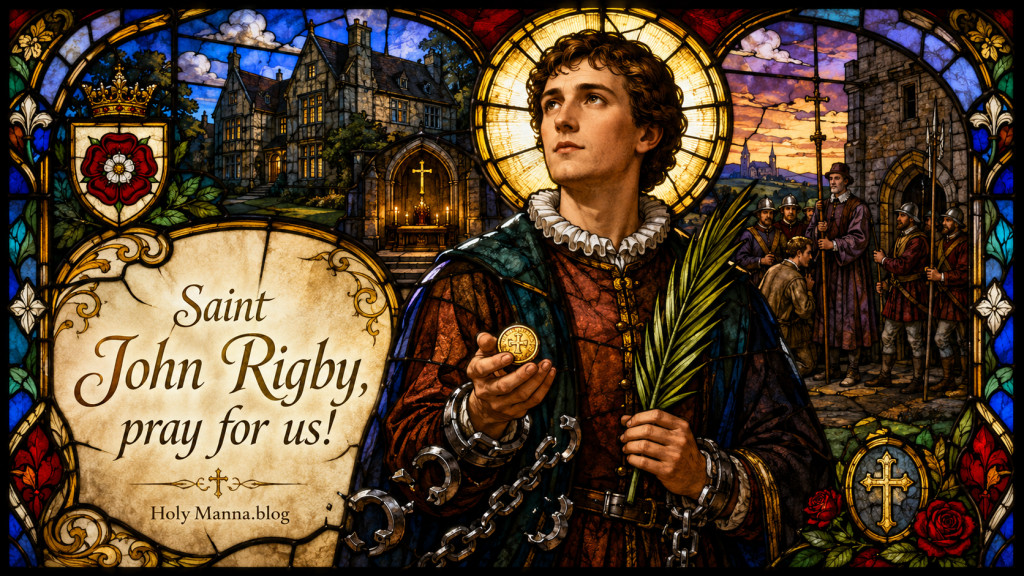
There is also a famous story from his imprisonment. Catholic tradition says that shackles placed around his wrists and riveted shut mysteriously fell off three times. The jailer was reportedly so frightened that he refused to put them back on. Some accounts remember John referring to his irons as “jewels of too great price to be lost.” He is also said to have hoped that the falling chains meant that the bonds of his mortal life would soon be loosened.
This story is part of the Catholic tradition surrounding Saint John Rigby, but it should be treated carefully. It is not a formally verified miracle in the same sense as a canonization miracle. Still, it became a powerful image of his martyrdom. The world tried to bind him, but grace had already made him free.
Saint John Rigby is not known for performing healing miracles during his lifetime. His great witness was martyrdom itself. His “miracle,” in the broader devotional sense, was the grace of final perseverance. He stood firm when compromise would have saved him.
The Martyr Who Forgave His Executioner
On June 21, 1600, Saint John Rigby was taken to St. Thomas Waterings in Southwark for execution. This was the same place where Saint John Jones, the Franciscan priest traditionally associated with his reconciliation, had been executed two years earlier.
On the way to his death, Captain Whitlock stopped the hurdle and asked whether John was married. John answered, “I am a bachelor; and more than that I am a maid.” In the language of the time, he was saying that he had remained unmarried and had preserved his virginity. Captain Whitlock was reportedly moved by his chastity and courage and asked for his prayers.
Another account says that the Earl of Rutland admired his courage and urged him to conform. Even those who wanted him to save his life could see that there was something noble in him. Yet John would not trade his soul for survival.
Before his execution, he forgave the executioner. Catholic tradition remembers him giving the executioner a gold coin and saying, “Take this in token that I freely forgive thee and others, who have been accessory to my death.”
That moment is deeply Catholic. He was not merely brave. He was merciful. He died in the spirit of Christ, who prayed from the Cross, “Father, forgive them, they know not what they do” (Luke 23:34).
The execution was brutal. Saint John Rigby was hanged, cut down while still alive, and disemboweled. Because he was physically strong, his suffering was prolonged. One account says that after being cut down, he was still able to speak and said, “God forgive you. Jesus, receive my soul.” A bystander reportedly pressed his foot on John’s throat to stop him from speaking further.
Even the crowd was horrified by the cruelty.
Saint John Rigby died around the age of thirty. He gave his life not for hatred of anyone, but for love of Christ, the Eucharist, the Catholic Church, and the truth.
A Martyr Remembered by the Church
Saint John Rigby was beatified by Pope Pius XI on December 15, 1929. He was canonized by Pope Saint Paul VI on October 25, 1970, as one of the Forty Martyrs of England and Wales.
The canonization of the Forty Martyrs was not meant to reopen old wounds between Catholics and Anglicans. It was a recognition of heroic witness. These martyrs were men and women who loved their country, but refused to give the state authority over the soul. They would not deny the Mass. They would not deny the papacy. They would not abandon the Catholic faith.
No major Catholic source confirms posthumous miracles attributed solely to Saint John Rigby. The best-known miracle-like story personally connected with him remains the account of his shackles falling off during imprisonment. The canonization miracle was attributed to the Forty Martyrs as a group. It involved the healing of a young mother suffering from malignant fibrosarcoma, judged naturally unaccountable and attributed to the intercession of the Forty Martyrs of England and Wales.
Saint John Rigby’s legacy remains especially strong in Lancashire. Saint Joseph’s Catholic Church in Wrightington is known as his official shrine. St John Rigby College in Wigan also bears his name, as do Catholic schools and communities that continue to remember his witness.
His cultural impact is not measured by monuments alone. His legacy lives in every Catholic who chooses fidelity over comfort, confession over compromise, and truth over fear.
The Courage to Come Back and Stand Firm
Saint John Rigby’s life speaks powerfully to modern Catholics because his story includes both weakness and courage. He had once compromised by attending Protestant services under pressure. Yet he returned to the Church. He repented. He became faithful. Then, when the moment came, he stood firm.
That is a very Catholic story.
The Christian life is not about pretending there has never been fear, failure, or compromise. It is about allowing grace to bring the soul home. Saint John Rigby reminds us that a person’s past weakness does not have to define the future. God can take a timid heart and make it courageous. He can take a compromised life and turn it into a witness.
His story also challenges a comfortable age. Many people today are not threatened with execution for being Catholic, but there are still pressures to conform. There is pressure to hide faith, soften truth, stay silent about moral teaching, avoid confession, skip Mass, or treat Catholicism as a private hobby instead of a whole way of life.
Saint John Rigby teaches that faith must eventually become public. Maybe not loud. Maybe not dramatic. But real.
Where is Christ asking for a more honest yes?
What compromise needs to be brought to confession, healing, and courage?
Would faith remain firm if comfort, reputation, or security were at stake?
Saint John Rigby was a servant who went to court for someone else and ended up witnessing for Christ. He did not choose the stage. He chose fidelity when the stage appeared.
That is why the Church remembers him.
Engage with Us!
Share your thoughts and reflections in the comments below. Saint John Rigby’s life invites a serious look at courage, conscience, repentance, and fidelity in ordinary life.
- What part of Saint John Rigby’s story challenges you the most?
- Have you ever felt pressure to hide or soften your Catholic faith?
- What does his repentance after earlier compromise teach you about God’s mercy?
- How can you practice courage in small daily decisions before the larger tests come?
- Who in your life needs to see a quiet, faithful witness to Christ this week?
Saint John Rigby reminds us that holiness is not only for the famous, educated, or powerful. It is for servants, workers, families, students, converts, reverts, and ordinary Catholics trying to remain faithful in a world that often asks them to bend.
May his witness inspire us to live with courage, speak with truth, forgive with mercy, and do everything with the love and mercy Jesus taught us.
Saint John Rigby, pray for us!
Follow us on YouTube, TikTok, Instagram and Facebook for more insights and reflections on living a faith-filled life.

 Holy Manna!
Leave a comment