The Prince Who Gave His Crown to Christ
Saint Aloysius Gonzaga is one of those saints whose life can sound almost too polished at first. A young nobleman. A future prince. A brilliant student. A soul known for purity. A Jesuit who died serving plague victims at only twenty-three years old.
But when his story is told properly, he is not some distant statue made of marble. He is a young man who stood right in the middle of ambition, luxury, pressure, lust, family expectations, political power, and real suffering, then chose Jesus Christ over all of it.
Born into one of the most powerful noble families of Renaissance Italy, Aloysius could have lived for comfort, influence, and honor. Instead, he gave away his inheritance, entered the Society of Jesus, and spent his short life seeking holiness with an intensity that still challenges the Church today.
He is especially revered as the patron saint of Catholic youth, students, Jesuit scholastics, AIDS patients, caregivers, and those suffering during epidemics. He is often remembered for purity, but that word needs to be understood in the Catholic sense. His purity was not fear, weakness, or contempt for the body. It was a heart ordered completely toward God. The Catechism teaches that chastity means “the successful integration of sexuality within the person” in CCC 2337. Saint Aloysius lived that integration with heroic seriousness, and it freed him to love courageously.
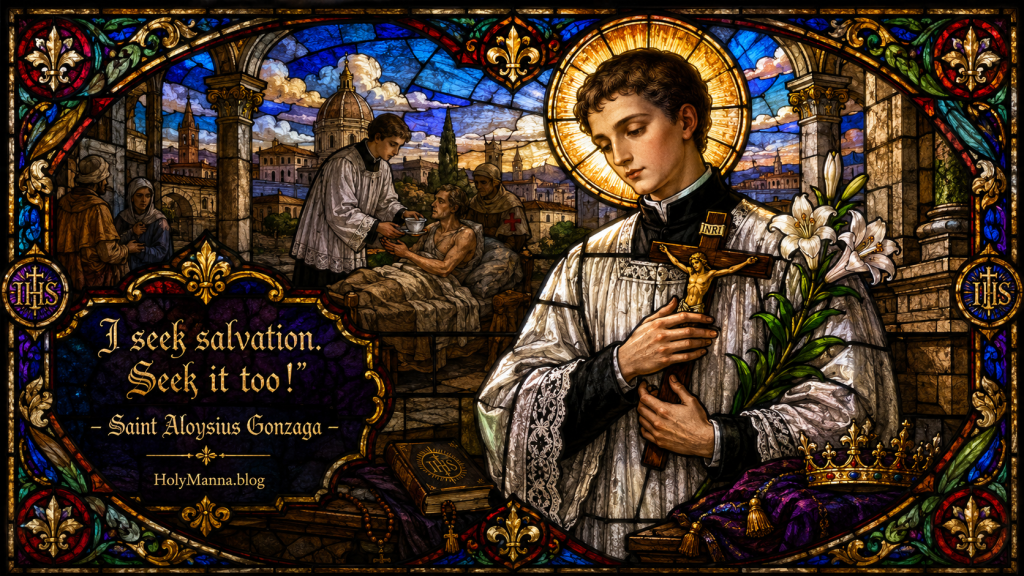
He is also remembered for the words he reportedly spoke when others tried to pull him away from his vocation: “I seek salvation. Seek it too!”
That sentence could summarize his whole life.
A Noble Childhood Under Two Very Different Influences
Aloysius Gonzaga was born on March 9, 1568, in the family castle at Castiglione delle Stiviere in northern Italy. He was baptized on April 20, 1568. His father, Ferrante Gonzaga, Marquis of Castiglione, wanted him to become a soldier, ruler, and man of power. His mother, Marta Tana, was deeply devout and helped form him in prayer from his earliest years.
This tension marked his childhood. His father placed him among weapons, soldiers, armor, and military language. His mother placed before him prayer, reverence, and the things of God.
As the eldest son, Aloysius was expected to inherit his father’s title and estate. In worldly terms, his future was already decided. He was supposed to become a nobleman of influence, a man who could protect family honor and expand family power.
Yet even as a child, something else was happening in his soul.
Catholic tradition says that by the age of seven, Aloysius had already begun to take prayer seriously. He prayed the Psalms, practiced penance, and became deeply aware of sin. This should not be read as the gloominess of a strange child, but as the early awakening of a soul that understood eternity.
At about eight or nine years old, he was sent with his brother to Florence, where he entered the court of Grand Duke Francesco de’ Medici. The court was polished, wealthy, and politically impressive, but it was also filled with intrigue, vanity, immorality, and violence. Aloysius saw the world from the inside, and instead of being seduced by it, he began to pull away from it.
That is one of the first great surprises of his life. He did not reject the world because he knew nothing of it. He rejected its emptiness after seeing it up close.
A famous story from his childhood says that Aloysius once had a dangerous encounter with a cannon or military weapon while living around soldiers. According to devotional retellings, the incident frightened him and became part of the spiritual turning point that helped turn his heart away from earthly warfare and toward spiritual combat. This story is part of Catholic devotional tradition, but it cannot be verified with certainty.
Still, even as a story, it captures something true. Aloysius was born into a world that wanted to make him a soldier for earthly kingdoms. God was preparing him to become a soldier for Christ.
The Day One Saint Helped Form Another
When Aloysius was twelve, he received his First Holy Communion from Saint Charles Borromeo. That detail is beautiful. One of the great reforming bishops of the Church helped nourish the soul of a boy who would one day be canonized himself.
His faith deepened through prayer, study, and the sacraments. While living in Spain as a page in the royal court, he continued to grow in learning and discipline. He was gifted intellectually and excelled in studies such as philosophy, mathematics, and theology.
At first, Aloysius considered joining the Discalced Carmelites, but through spiritual direction, especially from Jesuit confessors, he discerned that God was calling him to the Society of Jesus.
This decision was not easy. His father resisted fiercely. Aloysius was the heir. His family expected him to marry, rule, and preserve the Gonzaga name. Some relatives mocked him. Others tried to redirect him toward a more prestigious Church career, perhaps one that would allow him to retain noble influence while appearing religious.
But Aloysius wanted Christ, not status dressed in religious clothing.
In 1585, at only seventeen years old, he renounced his inheritance in favor of his younger brother Rodolfo. Then he went to Rome and entered the Jesuit novitiate on November 25, 1585. He made his vows on November 25, 1587, and began studies at the Roman College.
His spiritual director was Saint Robert Bellarmine, another future saint and Doctor of the Church. This is another striking providential detail. Aloysius’ life was surrounded by giants of Catholic holiness, but he was not simply standing near them. He was becoming one of them.
Purity That Became Strength, Not Fragility
Saint Aloysius is often called the patron of purity, but his purity has sometimes been misunderstood. Later devotional art and preaching sometimes made him appear fragile, sentimental, or disconnected from normal human life. That does not do justice to the real saint.
Aloysius was not weak. He was disciplined, intelligent, strong-willed, and capable. At about twenty-one, he was even sent back to Castiglione to help mediate a political and family conflict involving his brother Rodolfo and the Duke of Mantua. He succeeded. That is not the work of a timid soul hiding from life. That is the work of a serious young man whose natural gifts had been purified by grace.
His chastity was not a rejection of creation. It was a rightly ordered love. He wanted God first, and because he wanted God first, he refused to let lust, vanity, ambition, or social pressure rule him.
This is deeply Catholic. The Catechism teaches that chastity includes self-mastery and the integration of desire into the whole person in CCC 2337 and CCC 2339. It is not about pretending desire does not exist. It is about letting grace govern the heart so that love becomes real, sacrificial, and free.
Saint Aloysius’ purity made him available for charity. That is the key. His holiness did not end with personal discipline. It became love for the suffering.
The Hidden Fire of His Daily Holiness
There are no major verified public miracles attributed to Saint Aloysius during his lifetime in the way some saints are known for healings, visions, or wonders. His holiness was quieter, but not less powerful.
His daily life was marked by prayer, penance, obedience, study, and charity. He attended Mass, received Communion with devotion, meditated deeply, and trained his will to serve God rather than self. He practiced poverty of spirit long before he formally gave away his inheritance.
The miracle of his life was not that he dazzled crowds. The miracle was that he conquered himself.
That kind of holiness matters because many people want dramatic signs, but the Gospel often begins with hidden fidelity. In The Gospel of Luke, Jesus says, “If any man would come after me, let him deny himself and take up his cross daily and follow me” in Luke 9:23. Saint Aloysius lived that daily cross before he ever carried plague victims through the streets of Rome.
He is important because he shows that holiness can begin young. The young are not merely the future of the Church. They can become saints now. Aloysius did not wait until old age to become serious about God. He gave the best of his youth to Christ.
Love in the Streets of Plague-Stricken Rome
In 1590 and 1591, Rome was struck by famine and plague. The city was filled with fear, sickness, and death. The Jesuits opened hospitals and served the suffering. Aloysius, already physically delicate, threw himself into the work.
He begged alms for the sick. He carried plague victims from the streets. He washed them, fed them, comforted them, and helped prepare them for the sacraments. He saw Christ in the suffering bodies others were tempted to avoid.
This is where his life becomes impossible to dismiss as mere private piety. Aloysius did not stay clean and safe in a chapel while others suffered outside. He went to the sick. He touched them. He served them.
The Catechism teaches that the works of mercy are charitable actions by which Christians help their neighbors in bodily and spiritual need, including feeding the hungry and visiting the sick in CCC 2447. Saint Aloysius lived this teaching with his hands, his strength, and eventually his life.
His superiors eventually limited his service because many young Jesuits were becoming infected. He was allowed to serve at the Hospital of Our Lady of Consolation, which was believed to receive non-contagious cases. But one man he cared for was infected. Aloysius contracted the disease.
He became ill on March 3, 1591. For a time, he seemed to improve, but fever and weakness returned. He suffered for months. Some Catholic devotional accounts say that he received a mysterious sign or heavenly warning that his death was near. Some retellings identify the messenger as Saint Gabriel the Archangel. This belongs to devotional tradition and cannot be verified with certainty.
What can be said with confidence is that Aloysius faced death with remarkable peace.
Shortly before his death, he wrote a letter to his mother. In it, he showed no bitterness, no panic, and no resentment toward God. One of his most beautiful verified lines is: “God’s mercies shall be my song for ever.”
He also comforted his mother with the hope of heaven, writing words remembered in English as: “We shall see each other again in heaven.”
Saint Aloysius Gonzaga died in Rome on June 21, 1591. He was only twenty-three years old. He died holding a crucifix and calling upon the name of Jesus.
He was not technically a martyr in the strict sense, because he was not killed by persecutors for refusing to deny the faith. Yet Catholic tradition often sees him as a kind of martyr of charity because he offered his life in love while serving the sick. He did not die because he chased danger. He died because charity led him toward people the world feared.
The Saint Who Kept Working After Death
Devotion to Aloysius spread quickly after his death. He was beatified by Pope Paul V on October 19, 1605, and canonized by Pope Benedict XIII on December 31, 1726. His feast day is celebrated on June 21.
His body is venerated in the Church of Sant’Ignazio in Rome. His head is kept in the basilica dedicated to him in Castiglione delle Stiviere, his birthplace. That basilica became an important center of devotion, and pilgrims continue to honor him there.
Several posthumous miracles and devotional stories are associated with Saint Aloysius. One famous account tells of a Jesuit novice named Nicholas Celestini, who was reportedly near death. According to the story, an image of Saint Aloysius was placed before him, and Aloysius appeared to him, telling him that God was granting him life so that he could grow in virtue and promote devotion to the Sacred Heart of Jesus. This story became well known in Catholic devotional tradition and even inspired sacred art, but the exact historical details cannot be fully verified here.
Another devotional story tells of a twelve-year-old orphan in Rome who suffered from violent epileptic fits. According to the account, the boy had devotion to Saint Aloysius and was cured after the saint appeared to him holding an image of Our Lady. This story is also part of Catholic devotional tradition, but it cannot be fully verified here.
Saint Mary Magdalene de’ Pazzi, the Carmelite mystic, is also associated with a vision of Saint Aloysius in heavenly glory. Catholic tradition says she saw him radiant among the blessed and recognized the hidden greatness of his soul. This story has been preserved in devotional tradition and reflects the Church’s deep admiration for him, though mystical visions are received by the Church with careful discernment.
These stories point to an important Catholic truth. The saints do not stop loving the Church after death. The Catechism teaches that the saints in heaven continue to intercede for those on earth in CCC 956. Catholics do not worship the saints. Catholics ask their prayers because they are alive in Christ.
Saint Aloysius’ cultural impact has been especially strong among young Catholics and Catholic schools. Many churches, schools, colleges, and youth ministries bear his name. Gonzaga University and Gonzaga College High School are two well-known examples of institutions connected to his legacy. Pope Benedict XIII declared him a protector of students. Pope Pius XI named him patron of Catholic youth in 1926. In 1991, Saint John Paul II named him patron of AIDS patients and caregivers, recognizing the connection between Aloysius’ care for plague victims and the modern call to serve those suffering in epidemics.
In sacred art, he is often shown as a young Jesuit in cassock and surplice, holding a crucifix, lily, skull, or rosary. The lily represents purity. The crucifix represents sacrificial love. The skull reminds believers of death and eternity. The rosary points to Marian devotion. Sometimes a crown appears nearby, symbolizing the earthly nobility he gave up for Christ.
The Lesson of a Life Spent Completely
Saint Aloysius Gonzaga speaks powerfully to the modern heart because he understood pressure. He knew what it meant to be surrounded by expectations. He knew what it meant to live in a world obsessed with image, status, influence, pleasure, and achievement.
He could have had almost everything the world celebrates. He chose Christ.
That choice did not make his life smaller. It made his life eternal.
His story is a challenge to anyone tempted to believe that holiness is boring, weak, or unrealistic. Aloysius shows that holiness takes courage. It takes discipline. It takes a willingness to disappoint the world in order to please God.
His purity challenges a culture that treats desire as something that must always be indulged. His renunciation challenges a culture that treats success as the highest good. His service to plague victims challenges a culture that often avoids suffering people because they are inconvenient, uncomfortable, or frightening.
He reminds Catholic readers that love is not a feeling floating somewhere in the air. Love bends down. Love carries the sick. Love gives up comfort. Love risks being misunderstood. Love chooses heaven over applause.
The Catechism teaches that the Christian life is a call to holiness in CCC 2013. That call is not only for priests, religious, monks, nuns, or elderly saints in stained glass. It is for students, workers, parents, young adults, single people, and anyone trying to follow Jesus in the middle of real life.
Saint Aloysius did not live long, but he lived completely. He gave his youth to God, and God made that gift fruitful for centuries.
What ambition, comfort, habit, or fear might God be asking you to surrender so that your heart can become more free?
Where is Christ asking you to love someone who is suffering, inconvenient, or easy to overlook?
If Saint Aloysius could choose salvation over status at seventeen, what holy decision can you make today?
Engage with Us!
Share your thoughts and reflections in the comments below. Saint Aloysius Gonzaga’s life invites every reader to think seriously about purity, courage, sacrifice, and the call to love Christ above everything.
- What part of Saint Aloysius Gonzaga’s story challenges you the most?
- How does his choice to give up power, wealth, and comfort speak to the pressures young people face today?
- Where in your life is God asking for a more disciplined, rightly ordered love?
- How can you practice one work of mercy this week, especially toward someone who is sick, lonely, or forgotten?
- What would it look like to live by Saint Aloysius’ words: “I seek salvation. Seek it too!”
May Saint Aloysius Gonzaga pray for all young people, all students, all caregivers, and all who are suffering in body or soul. May his witness inspire a life of purity, courage, service, and holy freedom. And may every action, every sacrifice, and every hidden act of love be done with the love and mercy Jesus taught us.
Saint Aloysius Gonzaga, pray for us!
Follow us on YouTube, TikTok, Instagram and Facebook for more insights and reflections on living a faith-filled life.

 Holy Manna!
Leave a comment