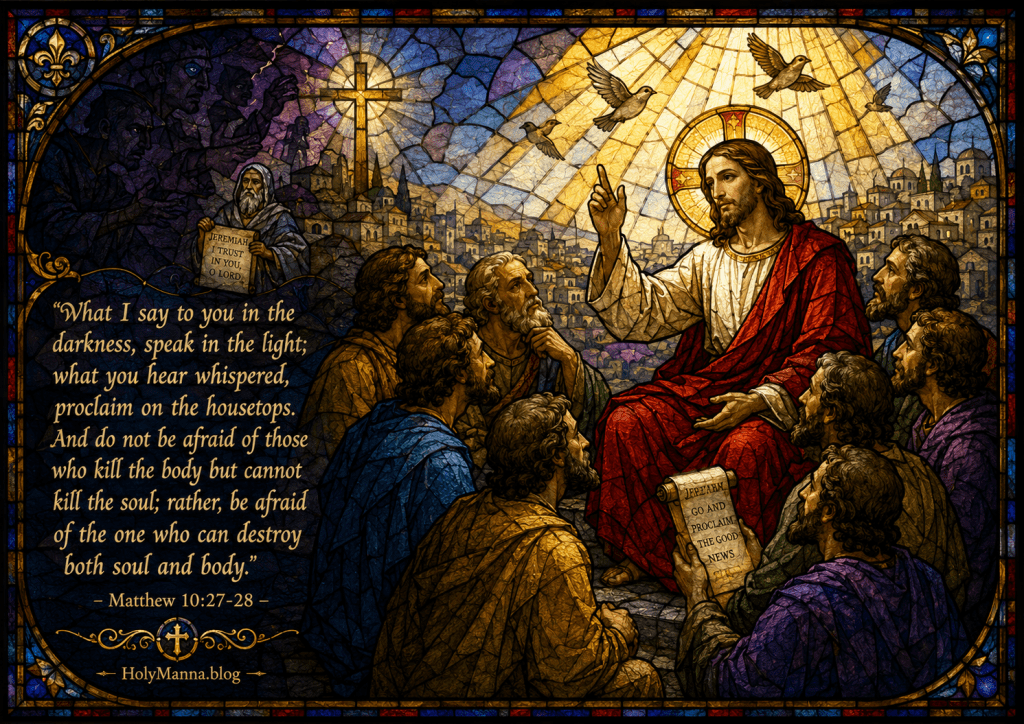
Twelfth Sunday in Ordinary Time – Lectionary: 94
When the Father Sees What the World Threatens
There is a quiet kind of courage that begins when a soul finally believes God sees everything.
Today’s readings gather around one central theme: the courage to witness to God when fear, rejection, sin, and death seem louder than His promises. In The Book of Jeremiah, the prophet stands surrounded by whispers, betrayal, and enemies who are waiting for him to fall. Yet in the middle of that pressure, he clings to the truth that “the Lord is with me, like a mighty champion.” In Psalm 69, the suffering servant bears insult because of zeal for God’s house, becoming a stranger even among his own people. In The Letter to the Romans, St. Paul takes the story deeper, all the way back to Adam, showing that fear and death entered through sin, but grace overflows through Jesus Christ. Then, in The Gospel of Matthew, Jesus tells His Apostles three times not to be afraid, reminding them that not even a sparrow falls without the Father’s knowledge.
These readings come from a world where faithfulness often carried a price. Jeremiah preached in a time when Judah resisted God’s warning and preferred comfortable lies over painful truth. The psalm gives voice to the righteous sufferer, the one mocked precisely because he belongs to the Lord. St. Paul speaks to Christians who needed to understand that Christ is not merely a moral teacher, but the New Adam whose grace is greater than humanity’s fall. Jesus, in His missionary discourse, prepares the Twelve for a hostile world where proclaiming the Kingdom would invite rejection, persecution, and even death.
From a Catholic perspective, this is not just a lesson in bravery. It is a lesson in grace. The Catechism teaches that God’s providence watches over all creation and that His grace heals, restores, and raises fallen humanity in Christ. The disciple does not stand firm because life is safe. The disciple stands firm because the Father is near, the Son has conquered sin, and the Holy Spirit gives courage to bear witness.
Today, the Lord speaks to every believer tempted to stay silent, blend in, or hide the faith out of fear. He does not pretend the world will always welcome the truth. He simply says, “Do not be afraid.” The readings invite us to ask: Where has fear made faith quiet, and where is Christ calling the soul to trust the Father enough to speak in the light?
First Reading – Jeremiah 20:10-13
The Prophet Who Stood Firm While Everyone Whispered
The first reading places us beside Jeremiah at one of the most painful moments in his prophetic mission. Jeremiah lived during the final decades before the fall of Jerusalem, when Judah was spiritually sick, politically unstable, and resistant to God’s call to repentance. He warned the people that covenant infidelity would bring disaster, but his message was not welcomed. It was mocked, resisted, and treated as treason.
Just before today’s passage, Jeremiah had been beaten and placed in the stocks by Pashhur, a priest and Temple official. That detail matters because Jeremiah was not suffering at the hands of outsiders only. He was being rejected from within the religious life of his own people. His pain was public, personal, and deeply humiliating.
This reading fits beautifully into today’s central theme: Christian courage is born from trust in God’s presence, not from the approval of the crowd. Jeremiah is surrounded by suspicion, betrayal, and hostility, but he refuses to let fear have the final word. Like the Apostles in The Gospel of Matthew, he shows what it means to stand in the truth when the world wants silence.
Jeremiah 20:10-13 – New American Bible (Revised Edition)
10 Yes, I hear the whisperings of many:
“Terror on every side!
Denounce! let us denounce him!”
All those who were my friends
are on the watch for any misstep of mine.
“Perhaps he can be tricked; then we will prevail,
and take our revenge on him.”
11 But the Lord is with me, like a mighty champion:
my persecutors will stumble, they will not prevail.
In their failure they will be put to utter shame,
to lasting, unforgettable confusion.
12 Lord of hosts, you test the just,
you see mind and heart,
Let me see the vengeance you take on them,
for to you I have entrusted my cause.
13 Sing to the Lord,
praise the Lord,
For he has rescued the life of the poor
from the power of the evildoers!
Detailed Exegesis
Verse 10 – “Yes, I hear the whisperings of many: ‘Terror on every side! Denounce! let us denounce him!’ All those who were my friends are on the watch for any misstep of mine. ‘Perhaps he can be tricked; then we will prevail, and take our revenge on him.’”
Jeremiah begins by describing the atmosphere around him. He hears whispers, accusations, and plots. The phrase “Terror on every side” is especially powerful because it captures the social and spiritual pressure closing in on him. He is not simply facing criticism. He is surrounded by people who want to destroy his credibility.
The most painful line may be this: “All those who were my friends are on the watch for any misstep of mine.” Jeremiah’s suffering is sharpened by betrayal. People who once stood near him are now watching him like enemies. They are not seeking truth. They are looking for a mistake they can use against him.
This verse reveals a timeless reality about prophetic witness. When someone speaks God’s truth, especially to a comfortable or compromised culture, opposition often becomes personal. Jeremiah becomes a target because his message exposes sin. In Catholic life, this reminds us that fidelity to God will not always be applauded, even by people close to us. Sometimes holiness unsettles others because it quietly challenges what they have chosen to tolerate.
Verse 11 – “But the Lord is with me, like a mighty champion: my persecutors will stumble, they will not prevail. In their failure they will be put to utter shame, to lasting, unforgettable confusion.”
The word “But” changes the entire movement of the reading. Jeremiah has heard the whispers, but he is not ruled by them. He knows his enemies are watching, but he also knows Someone greater is watching over him.
Jeremiah says, “The Lord is with me, like a mighty champion.” This is covenant language. God is not distant. He is not merely sympathetic. He is present as defender, warrior, and protector. Jeremiah does not claim that his life is easy or that the threats are imaginary. He claims that God is stronger than the threats.
The prophet’s confidence is not rooted in himself. It is rooted in the Lord. This is the heart of Catholic fortitude. Courage is not pretending fear does not exist. Courage is choosing fidelity because God is real, near, and trustworthy.
When Jeremiah says his persecutors will not prevail, he is not being petty. He is entrusting justice to God. Evil may seem strong for a time, but it cannot defeat the purposes of the Lord. This prepares us for Jesus’ words in The Gospel of Matthew, where He tells His disciples, “Do not be afraid of those who kill the body but cannot kill the soul.”
Verse 12 – “Lord of hosts, you test the just, you see mind and heart, Let me see the vengeance you take on them, for to you I have entrusted my cause.”
Jeremiah now addresses God directly as “Lord of hosts.” This title presents God as the Lord of heavenly armies, the sovereign ruler whose power exceeds every earthly threat. Jeremiah knows that human beings judge appearances, twist motives, and weaponize suspicion. God, however, sees the “mind and heart.”
This matters because Jeremiah’s enemies are watching for missteps, but God sees the whole truth. He sees what is hidden. He knows Jeremiah’s intentions. He knows the malice of those plotting against him. The prophet can endure false accusation because he trusts the judgment of the One who sees perfectly.
The request for vengeance must be read carefully from a Catholic perspective. Jeremiah is not giving Christians permission to hate their enemies. He is placing judgment in God’s hands. There is a major difference between personal revenge and divine justice. Jeremiah says, “To you I have entrusted my cause.” That is the key. He does not take matters into his own hands. He hands his suffering, his reputation, and his future over to the Lord.
For Christians, this finds its fullness in Christ, who was falsely accused, rejected, and crucified, yet entrusted Himself to the Father. The disciple does not seek revenge. The disciple seeks justice purified by mercy, trusting that God alone sees every heart.
Verse 13 – “Sing to the Lord, praise the Lord, For he has rescued the life of the poor from the power of the evildoers!”
The reading ends in praise. This is remarkable because Jeremiah’s circumstances have not magically become easy. The enemies are still real. The wounds are still deep. Yet the prophet sings because faith has lifted his eyes beyond the immediate crisis.
Jeremiah praises God as the rescuer of “the poor.” In Scripture, the poor are not only those lacking material resources. They are the lowly, the afflicted, the vulnerable, and those who depend completely on the Lord. Jeremiah stands among them. He has no earthly power strong enough to save him, so he clings to God.
This verse shows that praise is not only the response after deliverance. Sometimes praise is the act of trust in the middle of danger. The poor can sing because God hears them. The persecuted can praise because God has not abandoned them. The faithful can stand because the Lord remains their champion.
Teachings: Fortitude, Prophetic Witness, and Entrusting Justice to God
This reading teaches that fidelity to God often brings opposition, but it also reveals the deeper truth that God never abandons His servants. Jeremiah’s mission was not easy because prophecy is rarely comfortable. A prophet does not simply predict the future. A prophet speaks God’s Word into the present, calling His people back to covenant faithfulness.
That is why Jeremiah’s suffering matters for Catholics today. He is not just an ancient figure with a hard assignment. He is a witness to the cost of truth. His life points toward Christ, the rejected Prophet, Priest, and King. Jesus would also be watched, tested, accused, betrayed, and handed over. Jeremiah’s loneliness becomes a shadow of the Passion.
The Catechism speaks directly to the virtue Jeremiah displays. CCC 1808 teaches: “Fortitude is the moral virtue that ensures firmness in difficulties and constancy in the pursuit of the good. It strengthens the resolve to resist temptations and to overcome obstacles in the moral life. The virtue of fortitude enables one to conquer fear, even fear of death, and to face trials and persecutions. It disposes one even to renounce and sacrifice his life in defense of a just cause.”
Jeremiah lives this fortitude. He is firm in difficulty. He remains constant in his mission. He faces persecution without surrendering the Word of God. He shows that courage is not noise, pride, or stubbornness. Courage is faithfulness under pressure.
The reading also connects to the Church’s teaching on witness. CCC 2472 teaches: “The duty of Christians to take part in the life of the Church impels them to act as witnesses of the Gospel and of the obligations that flow from it. This witness is a transmission of the faith in words and deeds.”
Jeremiah bears witness in words, but also in endurance. His life becomes part of his message. That is a crucial Catholic lesson. The truth is not only spoken. It is embodied. A Christian who remains peaceful under pressure, honest when it costs something, and faithful when misunderstood gives the world a living testimony.
This reading also warns against revenge. Jeremiah entrusts his cause to God. He does not pretend evil is harmless, but he also does not make himself judge and executioner. In the Christian life, justice belongs to God, and every desire for justice must be purified by charity. The Lord sees the mind and heart, which means no human being sees enough to judge with perfect righteousness.
St. Augustine often reflected on the danger of placing ultimate trust in human praise or fearing human rejection too much. His wisdom fits Jeremiah’s situation well. The heart becomes disordered when it needs the crowd more than God. Jeremiah is free because he knows that public opinion is not final. God is final.
Reflection: Standing With God When the Whispers Begin
Jeremiah’s story feels surprisingly modern. Most Catholics are not dragged into stocks or publicly beaten for speaking the truth, but many know what it feels like to be watched, judged, mocked, or quietly excluded because of faith.
A person may feel it at work when Catholic beliefs are treated like something embarrassing. A college student may feel it when chastity, Sunday Mass, or belief in objective truth sounds strange to friends. A parent may feel it when trying to raise children with moral clarity in a culture that calls confusion compassion. A Catholic may feel it even within family life, where faithfulness to Christ can create tension around marriage, forgiveness, sexuality, money, prayer, or priorities.
Jeremiah teaches that the first response is not panic. The first response is remembrance: “The Lord is with me, like a mighty champion.”
That truth can become a daily practice. Before entering a difficult conversation, remember that God sees the mind and heart. Before responding to criticism, entrust the cause to the Lord. Before giving in to the fear of being disliked, ask for fortitude. Before seeking revenge, pray for justice purified by mercy. Before collapsing under discouragement, praise God even if the situation is not yet resolved.
This reading also invites a serious examination of conscience. Where has fear of being watched, judged, or misunderstood made faith quiet? Where is God asking for courage without resentment? What cause needs to be entrusted to the Lord instead of controlled through anxiety, anger, or revenge? Can the soul still praise God before the rescue is fully visible?
Jeremiah does not show us a painless faith. He shows us a faithful heart under pressure. That is the kind of courage today’s Church needs. Not loud outrage. Not bitter defensiveness. Not the need to win every argument. The Church needs Catholics who can stand in the truth with clean hearts, steady voices, and deep trust.
The Lord was with Jeremiah like a mighty champion. He is still with His people now.
Responsorial Psalm – Psalm 69:8-10, 14, 17, 33-35
The Prayer of the Rejected Heart That Still Trusts God
The responsorial psalm gives voice to the soul that suffers because it belongs to God. Psalm 69 is one of the great lament psalms of Israel, prayed by someone surrounded by insult, rejection, and distress, yet still turning toward the Lord with confidence. In the ancient world, honor, family belonging, and public reputation carried enormous weight. To become an outcast among one’s own kin was not a small emotional wound. It was a deep social and spiritual humiliation.
That is why this psalm belongs so naturally beside Jeremiah 20:10-13. Jeremiah hears the whispers of those who want to denounce him, and the psalmist bears disgrace because of fidelity to God. Both readings reveal the cost of holy zeal. They also prepare the heart for The Gospel of Matthew, where Jesus tells His disciples not to be afraid when they are opposed for proclaiming the truth.
For Catholics, Psalm 69 carries a powerful Christological meaning. The line “Because zeal for your house has consumed me” is remembered by the disciples when Jesus cleanses the Temple in The Gospel of John. The suffering voice of the psalm points beyond itself toward Christ, the truly righteous sufferer, rejected by His own, consumed with love for the Father, and faithful even unto the Cross.
Psalm 69:8-10, 14, 17, 33-35 – New American Bible (Revised Edition)
8 For it is on your account I bear insult,
that disgrace covers my face.
9 I have become an outcast to my kindred,
a stranger to my mother’s children.
10 Because zeal for your house has consumed me,
I am scorned by those who scorn you.14 But I will pray to you, Lord,
at a favorable time.
God, in your abundant kindness, answer me
with your sure deliverance.17 Answer me, Lord, in your generous love;
in your great mercy turn to me.33 “See, you lowly ones, and be glad;
you who seek God, take heart!
34 For the Lord hears the poor,
and does not spurn those in bondage.
35 Let the heaven and the earth praise him,
the seas and whatever moves in them!”
Detailed Exegesis
Verse 8 – “For it is on your account I bear insult, that disgrace covers my face.”
The psalmist begins by naming the reason for his suffering. He is not disgraced because of selfish ambition or personal wrongdoing. He bears insult “on your account.” His humiliation comes from his relationship with God.
This verse reveals a painful truth about discipleship. Sometimes belonging to the Lord brings misunderstanding. A person may be mocked not because he is unkind, but because he takes God seriously. A family may be criticized not because it lacks love, but because it tries to live according to the commandments. The psalmist teaches that suffering for God is not meaningless. When endured faithfully, it becomes part of the witness of the righteous.
Verse 9 – “I have become an outcast to my kindred, a stranger to my mother’s children.”
The rejection moves from public insult to family estrangement. The psalmist is not only opposed by strangers. He feels alienated from those who should have known him best. In the biblical world, kinship was a vital source of identity, protection, and belonging. To become a stranger to one’s own family was a profound sorrow.
This verse helps Catholics understand the emotional cost of faithfulness. Jesus Himself warned that discipleship could divide even households when love for God is resisted. This does not mean Christians should seek conflict or treat family members harshly. It means that the love of God must remain first, even when obedience creates tension.
Verse 10 – “Because zeal for your house has consumed me, I am scorned by those who scorn you.”
This verse is one of the most important lines in the psalm. The psalmist is consumed by zeal for God’s house, meaning he burns with love for the Lord’s dwelling, worship, covenant, and holiness. In Israel, the Temple was not just a religious building. It was the sacred place of sacrifice, prayer, and God’s presence among His people.
Catholics hear this verse in light of Christ. In The Gospel of John, after Jesus drives the money changers from the Temple, His disciples remember, “Zeal for your house will consume me.” Jesus reveals the perfect zeal of the Son for the Father. His zeal is not ego, rage, or self-righteousness. It is love so pure that it leads Him to the Cross.
This verse also challenges modern believers. True zeal is not loud anger dressed up as faith. True zeal is love for God’s glory, reverence for worship, concern for holiness, and willingness to suffer rather than treat sacred things casually.
Verse 14 – “But I will pray to you, Lord, at a favorable time. God, in your abundant kindness, answer me with your sure deliverance.”
After naming insult and rejection, the psalmist turns to prayer. This movement is important. He does not collapse into bitterness. He does not make revenge his first response. He prays.
The phrase “at a favorable time” expresses trust in God’s timing. The psalmist knows that deliverance belongs to the Lord, and that God answers according to His wisdom. He appeals not to his own worthiness, but to God’s “abundant kindness” and “sure deliverance.”
For Catholics, this is the pattern of faithful suffering. Pain is not ignored, but it is brought before God. The wounded heart is not meant to become hard. It is meant to become prayerful.
Verse 17 – “Answer me, Lord, in your generous love; in your great mercy turn to me.”
The psalmist now appeals to God’s mercy. He does not demand to be heard because he has earned it. He asks to be heard because the Lord is generous in love.
This verse reveals the heart of biblical prayer. The faithful soul comes before God honestly, but humbly. It trusts the Lord’s mercy more than its own strength. This is deeply Catholic because every act of prayer depends on grace. The soul does not climb to God by force. God bends toward the lowly in mercy.
The word “turn” is tender. The psalmist longs for God’s face, God’s attention, and God’s nearness. In suffering, what the faithful heart needs most is not simply a solution. It needs the presence of the Lord.
Verse 33 – “See, you lowly ones, and be glad; you who seek God, take heart!”
The psalm now turns outward. The prayer of one sufferer becomes encouragement for all the lowly. Those who seek God are told to take heart. This is not cheap optimism. It is hope born from trust in God’s faithfulness.
The “lowly ones” are those who know their dependence on the Lord. They may be poor, rejected, afflicted, or powerless in the eyes of the world, but they are not forgotten by God. The psalmist’s personal suffering becomes a testimony that strengthens others.
This is one reason the psalms remain central to Catholic prayer. They teach the Church how to turn anguish into worship, loneliness into trust, and personal suffering into communion with all who seek God.
Verse 34 – “For the Lord hears the poor, and does not spurn those in bondage.”
Here the reason for hope becomes clear. The Lord hears the poor. He does not despise those who are bound, imprisoned, trapped, or afflicted. In Scripture, poverty often includes material need, but it also points to spiritual lowliness, the humble dependence of those who know they need God.
This verse foreshadows the Gospel tenderness of Christ, who draws near to the sick, the sinful, the poor, the rejected, and the forgotten. It also reflects the Church’s constant teaching that the poor have a special place in the heart of God. The Lord does not measure human worth by status, wealth, power, or public approval. He hears the lowly.
Verse 35 – “Let the heaven and the earth praise him, the seas and whatever moves in them!”
The psalm ends in cosmic praise. The prayer began with insult, disgrace, and rejection, but it ends with heaven, earth, sea, and every living creature praising God.
This movement is beautiful. The suffering of the righteous does not get the last word. Praise does. The psalmist’s world may feel small because of rejection, but faith expands his vision until all creation is caught up in worship.
Catholic prayer often moves this way. Lament becomes trust. Trust becomes praise. Praise becomes hope. The heart that suffers with God does not stay imprisoned in pain. It is slowly opened to the greatness of the Lord.
Teachings: The Psalms, Holy Zeal, and the Suffering of Christ
Psalm 69 teaches the Church how to pray when faithfulness costs something. It does not offer a sanitized spirituality where believers pretend pain does not hurt. Instead, it gives sacred words to the rejected, the insulted, and the lowly who still seek God.
The Catechism explains the unique place of the psalms in the prayer of God’s people. CCC 2588 teaches: “The Psalms both nourished and expressed the prayer of the People of God gathered during the great feasts at Jerusalem and each Sabbath in the synagogues. Their prayer is inseparably personal and communal; it concerns both those who are praying and all men. The Psalms arose from the communities of the Holy Land and the Diaspora, but embrace all creation. Their prayer recalls the saving events of the past, yet extends into the future, even to the end of history; it commemorates the promises God has already kept, and awaits the Messiah who will fulfill them definitively. Prayed by Christ and fulfilled in him, the Psalms remain essential to the prayer of his Church.”
This teaching helps Catholics read today’s psalm properly. The psalm is personal, because it speaks from the wound of one suffering heart. It is communal, because Israel and the Church pray it together. It is also fulfilled in Christ, because Jesus is the righteous sufferer whose zeal for the Father’s house leads Him to rejection and sacrifice.
The New Testament connection is especially important. In The Gospel of John, the disciples see Jesus cleanse the Temple and remember the words of Psalm 69: “Zeal for your house will consume me.” The Church sees in this not merely an emotional moment, but a revelation of the Son’s total love for the Father. Jesus does not tolerate the profaning of worship because the Father’s house matters. Sacred worship matters. Reverence matters. The purity of the heart before God matters.
At the same time, Catholic tradition guards us from misunderstanding zeal. Zeal must be purified by charity. A person can be passionate and still be proud. A person can claim to defend truth while secretly enjoying conflict. Christ shows the difference. His zeal is never selfish. His zeal is obedient love.
The Catechism also teaches the dignity of the poor and afflicted. CCC 544 says: “The kingdom belongs to the poor and lowly, which means those who have accepted it with humble hearts. Jesus is sent to ‘preach good news to the poor’; he declares them blessed, for ‘theirs is the kingdom of heaven.’ To them, the ‘little ones’ the Father is pleased to reveal what remains hidden from the wise and the learned. Jesus shares the life of the poor, from the cradle to the cross; he experiences hunger, thirst and privation. Jesus identifies himself with the poor of every kind and makes active love toward them the condition for entering his kingdom.”
This is why the psalm’s promise matters so much: “The Lord hears the poor.” God hears the lowly because His heart is not captured by worldly power. In Christ, God Himself becomes poor, rejected, and crucified. The rejected psalmist is not alone. Christ has entered that place and redeemed it from within.
Reflection: When Faith Makes You Feel Like an Outsider
This psalm speaks to anyone who has ever felt the sting of being misunderstood because of faith. It speaks to the Catholic who wants to honor Sunday Mass but feels pressure to treat worship as optional. It speaks to the young adult trying to live chastely while friends laugh it off. It speaks to parents trying to raise children in truth while the culture calls confusion compassion. It speaks to anyone who has carried insult quietly because they wanted to remain faithful to God.
The psalm does not tell believers to pretend rejection does not hurt. It gives permission to pray from the wound. The faithful heart can say, “I bear insult.” It can admit loneliness. It can grieve family tension. It can confess exhaustion. But it must not stop there. Like the psalmist, the heart must turn toward the Lord and pray, “Answer me, Lord, in your generous love.”
That is the practical invitation of this reading. When rejected, pray before reacting. When insulted, ask whether the suffering is truly for God’s sake or merely wounded pride. When zeal rises in the heart, examine whether it is shaped by charity. When loneliness comes, remember that Christ Himself was rejected by His own. When discouragement grows, repeat the psalm’s command: “You who seek God, take heart!”
This week, the psalm invites a deeper kind of courage. Not the courage to win every debate. Not the courage to look tougher than everyone else. The courage to stay faithful without becoming bitter. The courage to love God’s house, God’s truth, and God’s people with a purified heart.
Where has faithfulness made you feel like an outsider?
Is your zeal for God shaped more by love, or by frustration?
When you are insulted or misunderstood, do you turn first to prayer or to self-defense?
What would it look like this week to seek God with the humble confidence of the lowly?
The psalm begins with disgrace, but it ends with creation singing. That is the Christian path. Pain may begin the prayer, but praise is where God wants to lead the heart.
Second Reading – Romans 5:12-15
The Gift Is Greater Than the Fall
The second reading brings us to one of the deepest wells in all of Catholic theology. In The Letter to the Romans, St. Paul is writing to Christians in the heart of the empire, teaching them that salvation is not a human achievement, not an ethnic privilege, and not the reward of perfect religious performance. Salvation is a gift given through Jesus Christ.
This passage reaches back to the beginning of human history, to Adam, sin, and death. St. Paul is not giving a biology lesson or a mythological aside. He is explaining the spiritual condition of the human family. Something has gone wrong at the root. Sin entered the world. Death followed. Humanity became wounded, divided, and unable to save itself.
Yet Paul’s purpose is not despair. His purpose is hope. Adam matters because Christ matters more. Sin matters because grace is greater. Death matters because Jesus has come to bring life.
This reading fits today’s theme by showing where Christian courage truly comes from. Jeremiah stands firm because the Lord is with him. The psalmist hopes because God hears the poor. The Gospel will tell the disciples not to be afraid. But Romans 5 tells us why fear does not get the last word: in Jesus Christ, the gift overflows beyond the damage of sin.
Romans 5:12-15 – New American Bible (Revised Edition)
Humanity’s Sin Through Adam. 12 Therefore, just as through one person sin entered the world, and through sin, death, and thus death came to all, inasmuch as all sinned— 13 for up to the time of the law, sin was in the world, though sin is not accounted when there is no law. 14 But death reigned from Adam to Moses, even over those who did not sin after the pattern of the trespass of Adam, who is the type of the one who was to come.
Grace and Life Through Christ. 15 But the gift is not like the transgression. For if by that one person’s transgression the many died, how much more did the grace of God and the gracious gift of the one person Jesus Christ overflow for the many.
Detailed Exegesis
Verse 12 – “Therefore, just as through one person sin entered the world, and through sin, death, and thus death came to all, inasmuch as all sinned.”
St. Paul begins with Adam, the first man, because Adam represents the beginning of the human story wounded by sin. Through one person, sin enters the world, and through sin comes death. Paul is showing that death is not merely a biological event. It is also the visible sign of a deeper rupture between humanity and God.
This verse is foundational for the Catholic doctrine of original sin. The Church teaches that Adam’s sin wounded human nature and that all his descendants inherit a fallen condition. This does not mean every person is personally guilty of Adam’s individual act. It means humanity is born into a state deprived of original holiness and justice, inclined toward sin, and in need of redemption.
The phrase “inasmuch as all sinned” reminds us that original sin is not only something behind us. Its effects show up in every human life. Pride, fear, selfishness, envy, lust, resentment, and the desire to hide from God all reveal that the human heart needs more than advice. It needs grace.
Verse 13 – “For up to the time of the law, sin was in the world, though sin is not accounted when there is no law.”
Paul now looks at the period before the Mosaic Law was given. Sin was already present in the world before God gave Israel the Law through Moses. The Law revealed sin more clearly, named it, and exposed the seriousness of disobedience, but it did not create the problem.
This matters because Paul is showing that humanity’s wound is deeper than legal failure. Sin is not merely breaking a rule written on stone. Sin is a disorder in the human heart, a turning away from God. The Law is holy and good, but it cannot by itself heal the wound of Adam. It can reveal the disease, but only Christ can bring the cure.
For Catholics, this helps explain why moral teaching is necessary but not sufficient on its own. The commandments are good. The Church’s moral teachings are good. But human beings do not become holy by information alone. They need conversion, grace, the sacraments, and union with Christ.
Verse 14 – “But death reigned from Adam to Moses, even over those who did not sin after the pattern of the trespass of Adam, who is the type of the one who was to come.”
Paul personifies death as a ruler. “Death reigned” means that death held humanity under its power from Adam onward, even before the Law was given. People died even if they had not sinned in the same direct way Adam sinned. This shows the universal reach of sin’s consequences.
Then Paul calls Adam “the type of the one who was to come.” In Catholic reading, a type is a figure in salvation history that points forward to a greater fulfillment. Adam points forward to Christ, but by contrast as much as by resemblance. Adam is the first head of fallen humanity. Christ is the New Adam, the head of redeemed humanity.
This is the great turn in the passage. Paul does not compare Adam and Christ as equals. He places Adam before us so that the glory of Christ becomes clearer. Through Adam came sin and death. Through Christ comes grace and life.
Verse 15 – “But the gift is not like the transgression. For if by that one person’s transgression the many died, how much more did the grace of God and the gracious gift of the one person Jesus Christ overflow for the many.”
This is the heart of the reading. Paul says, “The gift is not like the transgression.” The sin of Adam is real, but it is not equal in power to the grace of Christ. The fall wounded the many, but grace overflows for the many through Jesus.
The phrase “how much more” is filled with hope. Paul is teaching that redemption is not barely enough. Christ does not simply patch the damage. His grace overflows. God’s mercy is not stingy. The gift is abundant, victorious, and greater than the ruin caused by sin.
This verse is essential for Christian courage. If the human story ended with Adam, fear would make sense. But the Christian story does not end with Adam. It is fulfilled in Christ. The disciple can face rejection, suffering, temptation, and even death because grace has entered history in a Person, Jesus Christ, and His gift is stronger than the fall.
Teachings: Original Sin, the New Adam, and the Overflowing Gift of Grace
This reading is one of the Church’s great biblical foundations for understanding original sin and redemption. St. Paul does not allow us to treat sin as a small mistake or death as a natural inconvenience. He shows that the human condition is wounded at the root. At the same time, he refuses to make sin the center of the story. Christ is the center.
The Catechism explains why the doctrine of original sin is inseparable from the Gospel. CCC 389 teaches: “The doctrine of original sin is, so to speak, the ‘reverse side’ of the Good News that Jesus is the Savior of all men, that all need salvation and that salvation is offered to all through Christ.”
That line is important because it prevents two opposite errors. The first error is pretending humanity is basically fine and only needs encouragement. The second error is despairing as if sin is stronger than God. Catholic faith rejects both. Humanity is wounded, but Christ is Savior. Sin is real, but grace is greater.
CCC 402 connects this directly to St. Paul’s teaching in Romans 5: “All men are implicated in Adam’s sin, as St. Paul affirms: ‘By one man’s disobedience many were made sinners’: ‘sin came into the world through one man and death through sin, and so death spread to all men because all men sinned.’ The Apostle contrasts the universality of sin and death with the universality of salvation in Christ. ‘Then as one man’s trespass led to condemnation for all men, so one man’s act of righteousness leads to acquittal and life for all men.’”
The Church also carefully explains how original sin is transmitted. CCC 404 teaches: “How did the sin of Adam become the sin of all his descendants? The whole human race is in Adam ‘as one body of one man.’ By this ‘unity of the human race’ all men are implicated in Adam’s sin, as all are implicated in Christ’s justice. Still, the transmission of original sin is a mystery that we cannot fully understand. But we do know by Revelation that Adam had received original holiness and justice not for himself alone, but for all human nature. By yielding to the tempter, Adam and Eve committed a personal sin, but this sin affected the human nature that they would then transmit in a fallen state. It is a sin which will be transmitted by propagation to all mankind, that is, by the transmission of a human nature deprived of original holiness and justice. And that is why original sin is called ‘sin’ only in an analogical sense: it is a sin ‘contracted’ and not ‘committed,’ a state and not an act.”
This teaching is deeply pastoral. It explains why even people who want to do good still struggle. It explains why cultures collapse into selfishness, why families wound each other, why fear is so stubborn, and why no one can self-improve his way into salvation. The human race needs a Redeemer.
Yet Catholic doctrine is never content to leave us in the shadow of Adam. CCC 412 teaches: “But why did God not prevent the first man from sinning? St. Leo the Great responds, ‘Christ’s inexpressible grace gave us blessings better than those the demon’s envy had taken away.’ And St. Thomas Aquinas wrote, ‘There is nothing to prevent human nature’s being raised up to something greater, even after sin; God permits evil in order to draw forth some greater good. Thus St. Paul says, ‘Where sin increased, grace abounded all the more’; and the Exsultet sings, ‘O happy fault, . . . which gained for us so great a Redeemer!’”
This is the Catholic heart of the passage. The fall is tragic, but redemption is glorious. Adam’s sin wounded humanity, but Christ’s obedience brings a greater gift. This is why the Church can sing of the “happy fault” at the Easter Vigil, not because sin is good, but because God’s mercy is so mighty that He brings a greater good even out of evil.
St. Augustine, one of the great Doctors of the Church and a key voice in the Church’s understanding of grace and original sin, wrote in Enchiridion: “For Almighty God, who, as even the heathen acknowledge, has supreme power over all things, being Himself supremely good, would never permit the existence of anything evil among His works, if He were not so omnipotent and good that He can bring good even out of evil.”
That teaching harmonizes beautifully with Paul’s words. God does not pretend Adam’s sin was small. He conquers it through Christ. Grace does not deny the wound. Grace heals, elevates, and transforms.
Pope Benedict XVI, reflecting on St. Paul, often emphasized that Christianity is not first a moral system but an encounter with Christ, the living Redeemer. That fits this reading perfectly. The answer to Adam is not merely better behavior. The answer to Adam is Jesus Christ.
Reflection: Living Like Grace Has the Final Word
This reading reaches into the hidden places of daily life. Everyone knows the effects of Adam, even if they do not use theological language for it. People know what it feels like to want the good and still choose badly. They know the pull of fear, pride, lust, resentment, laziness, and self-protection. They know how quickly the heart can hide from God, blame others, or settle for spiritual mediocrity.
St. Paul does not let anyone romanticize the human condition. Sin is real. Death is real. The wound is real. But he also refuses to let the wound define the whole story. “The gift is not like the transgression.”
That sentence is worth carrying into the week. When shame says the past is final, remember that the gift is greater. When temptation says change is impossible, remember that grace overflows. When fear says silence is safer than witness, remember that Christ has broken the reign of death. When discouragement says the world is too far gone, remember that the New Adam has entered history.
Practically, this reading invites Catholics to stop treating grace like a vague religious word. Grace is the life of God given to the soul. It is received especially through Baptism, strengthened through the Eucharist, restored through Confession, and nourished through prayer, Scripture, and obedience. If sin entered human history through Adam, then the Christian must intentionally remain close to Christ, the source of new life.
This week, that may mean making a good confession instead of carrying hidden shame. It may mean going to Mass with deeper gratitude instead of routine. It may mean rejecting the lie that personal weakness is stronger than God’s mercy. It may mean praying before a difficult moment and saying, “Lord Jesus, let Your grace be stronger than this fear.”
The reading also invites humility. No one saves himself. No one outgrows the need for grace. The most polished life, the most successful career, the most disciplined personality, and the most respectable reputation still need redemption. The Church’s message is not that good people earn heaven. The message is that sinners are saved by Jesus Christ and made new by grace.
Where do you still live as if Adam has more power over your life than Christ?
What wound, habit, fear, or sin needs to be brought honestly into the overflowing grace of Jesus?
Do you approach the sacraments as routine obligations, or as encounters with the New Adam who gives life?
How would your witness change if you truly believed that grace is stronger than sin and death?
St. Paul gives the Church a sentence of hope for every frightened disciple: “The gift is not like the transgression.” The fall is real, but Christ is greater. Sin is heavy, but grace overflows. Death has reigned, but it does not reign forever. In Jesus Christ, the Father has given the world more than a second chance. He has given the world a Redeemer.
Holy Gospel – Matthew 10:26-33
Do Not Be Afraid, Because the Father Sees Everything
The Holy Gospel brings today’s readings to their clearest and most personal point. Jesus is speaking to the Twelve during what is often called the missionary discourse in The Gospel of Matthew. He has chosen His Apostles, given them authority, and sent them to proclaim that the Kingdom of Heaven is at hand. But He does not send them with false comfort. He tells them that opposition will come. They will be misunderstood, dragged before authorities, hated, and rejected because of His name.
That historical setting matters. In the first-century Jewish world, public loyalty to a teacher carried real consequences. To preach in someone’s name was to represent his authority, his message, and his mission. Jesus is preparing the Apostles to proclaim the Gospel in a world where religious leaders, political powers, and fearful crowds would often resist the truth. He is also preparing every future disciple who will have to choose between silence and witness.
This Gospel gathers the whole theme of today’s Mass into one command: “Do not be afraid.” Jeremiah stood firm while enemies whispered against him. The psalmist bore insult because zeal for God’s house consumed him. St. Paul taught that sin and death entered through Adam, but grace overflowed through Christ. Now Jesus tells His disciples why they can stand in that grace without fear. The Father sees them. The Father knows them. The Father values them. The world may threaten the body, reputation, comfort, or social standing, but it cannot take the soul that belongs to God.
Matthew 10:26-33 – New American Bible (Revised Edition)
Courage Under Persecution. 26 “Therefore do not be afraid of them. Nothing is concealed that will not be revealed, nor secret that will not be known. 27 What I say to you in the darkness, speak in the light; what you hear whispered, proclaim on the housetops. 28 And do not be afraid of those who kill the body but cannot kill the soul; rather, be afraid of the one who can destroy both soul and body in Gehenna. 29 Are not two sparrows sold for a small coin? Yet not one of them falls to the ground without your Father’s knowledge. 30 Even all the hairs of your head are counted. 31 So do not be afraid; you are worth more than many sparrows. 32 Everyone who acknowledges me before others I will acknowledge before my heavenly Father. 33 But whoever denies me before others, I will deny before my heavenly Father.
Detailed Exegesis
Verse 26 – “Therefore do not be afraid of them. Nothing is concealed that will not be revealed, nor secret that will not be known.”
Jesus begins with the words every frightened disciple needs to hear: “Do not be afraid of them.” The word “them” refers to those who oppose the Gospel, those who threaten, accuse, intimidate, or try to silence the followers of Christ.
Jesus does not say that enemies are harmless. He says they are not ultimate. Hidden things will be revealed. Secrets will be made known. This means that truth belongs to God, not to the powerful, the popular, or the loudest voices in the room. Lies may spread for a time. Reputations may be attacked for a time. The faithful may be misunderstood for a time. But God sees what is hidden, and His judgment is final.
This verse is deeply connected to Jeremiah. Jeremiah’s enemies watched for a misstep, but the Lord saw the mind and heart. Jesus now teaches the Apostles the same confidence. The disciple can endure false accusation because God will reveal the truth in His time.
Verse 27 – “What I say to you in the darkness, speak in the light; what you hear whispered, proclaim on the housetops.”
Jesus now gives the mission. The teaching received privately must be proclaimed publicly. The Apostles are not being formed for hidden admiration. They are being formed for witness.
The image of proclaiming from the housetops would have been vivid in the ancient Near East, where flat roofs were common and could function as places of gathering, conversation, and public announcement. Jesus is saying that the Gospel is not meant to stay in safe rooms among safe people. What He gives His disciples must be shared openly.
For Catholics, this does not mean every believer must become loud, argumentative, or performative. It means faith cannot remain a secret identity. The truth of Christ must become visible in words, choices, priorities, and public witness. The disciple receives the Word not to possess it privately, but to hand it on faithfully.
Verse 28 – “And do not be afraid of those who kill the body but cannot kill the soul; rather, be afraid of the one who can destroy both soul and body in Gehenna.”
Here Jesus places fear in its proper order. Human beings can harm the body. They can threaten comfort, reputation, employment, friendships, and even life itself. But they cannot kill the soul.
This verse does not minimize suffering. The Church knows the cost of persecution through the martyrs, confessors, missionaries, and saints who suffered for Christ. But Jesus teaches that the soul is more precious than earthly security. The greatest danger is not being rejected by the world. The greatest danger is being separated from God.
The reference to Gehenna recalls a valley associated with judgment and corruption. Jesus uses it as an image of final separation from God. This is not meant to produce panic, but holy reverence. The fear of the Lord is not terror before a cruel master. It is the serious love of a soul that refuses to treat eternity casually.
Verse 29 – “Are not two sparrows sold for a small coin? Yet not one of them falls to the ground without your Father’s knowledge.”
After speaking about persecution and Gehenna, Jesus turns to one of the tenderest images in the Gospel. Sparrows were small, common, and inexpensive. In the marketplace, they were easy to overlook. Yet Jesus says not one falls without the Father’s knowledge.
This is divine providence made simple enough for ordinary hearts to understand. The Father is not distant. He is not vaguely aware of creation. He knows even the smallest creatures. Nothing is too little for His care.
This verse also changes the tone of Christian courage. The disciple is not brave because he is tough. The disciple is brave because he is known by the Father. Courage comes from belonging.
Verse 30 – “Even all the hairs of your head are counted.”
Jesus goes even further. God does not merely know His disciples generally. He knows them intimately. The image is almost shocking in its tenderness. The Father knows what no one else counts.
This verse teaches the personal care of God. A Catholic does not believe in a cold, distant power. The Church believes in the Father revealed by Jesus Christ, the One who knows each soul personally, lovingly, and completely.
For a disciple facing fear, this matters. God sees the hidden sacrifices. He sees the awkward conversations, the quiet obedience, the lonely fidelity, the tears no one notices, and the pressure that no one else understands. The Father’s knowledge is not surveillance. It is love.
Verse 31 – “So do not be afraid; you are worth more than many sparrows.”
Jesus repeats the command: “Do not be afraid.” But now He gives the reason in plain language: “You are worth more than many sparrows.”
This is not sentimental self-esteem. It is Christian anthropology. Human dignity comes from God. Every person is created in the image and likeness of God, called to communion with Him, and redeemed by Christ. The disciple’s worth is not measured by social approval, wealth, beauty, influence, or worldly success. It is measured by the Father’s love.
This verse is especially powerful in a culture where people often feel disposable. Jesus tells His disciples that they are seen, known, and valued. Because of that, they can witness without being enslaved to human opinion.
Verse 32 – “Everyone who acknowledges me before others I will acknowledge before my heavenly Father.”
Jesus now gives a promise. To acknowledge Him before others means to confess Him, belong to Him, and publicly identify with Him. This includes words, but it also includes a life that makes faith visible.
The promise is breathtaking. The one who acknowledges Christ on earth will be acknowledged by Christ before the Father in Heaven. Jesus is not ashamed of those who are not ashamed of Him. The disciple who stands with Christ before the world will find Christ standing for him before the Father.
This verse connects directly to the Church’s teaching on witness. Faith is not only interior belief. It must be confessed, lived, and handed on. The Christian life is meant to become a visible testimony.
Verse 33 – “But whoever denies me before others, I will deny before my heavenly Father.”
The Gospel ends with a warning. Jesus is gentle, but He is never vague. To deny Him before others is spiritually dangerous. Silence can become denial when it comes from fear, shame, or the desire to belong to the world more than to Christ.
This verse should sober every Catholic, but not lead to despair. Peter himself denied Jesus three times, yet through repentance and mercy he was restored. The warning is real, and so is grace. Christ calls His disciples away from cowardice, but He also restores those who return to Him with contrite hearts.
The point is not that every Catholic must speak perfectly in every situation. The point is that discipleship cannot be hidden forever. A faith that never becomes visible is not the witness Jesus asks for.
Teachings: Providence, Fortitude, Martyrdom, and Public Witness
This Gospel teaches that Christian courage rests on four Catholic truths: God reveals what is hidden, the soul matters more than earthly safety, the Father governs all things by providence, and faith must be publicly confessed.
The Catechism speaks beautifully about divine providence. CCC 302 teaches: “Creation has its own goodness and proper perfection, but it did not spring forth complete from the hands of the Creator. The universe was created ‘in a state of journeying’ toward an ultimate perfection yet to be attained, to which God has destined it. We call ‘divine providence’ the dispositions by which God guides his creation toward this perfection.”
This helps explain the sparrows. Jesus is not saying that nothing painful happens. Sparrows still fall. Disciples still suffer. Martyrs still die. But nothing falls outside the knowledge and providence of the Father. God guides creation, even through suffering, toward His final purpose.
CCC 305 deepens this teaching with the words of Jesus Himself: “Jesus asks for childlike abandonment to the providence of our heavenly Father who takes care of his children’s smallest needs: ‘Therefore do not be anxious, saying, “What shall we eat?” or “What shall we drink?” . . . Your heavenly Father knows that you need them all. But seek first his kingdom and his righteousness, and all these things shall be yours as well.’”
This childlike abandonment is exactly what Jesus is forming in the Apostles. They are not being sent as orphans. They are being sent as sons under the care of the Father.
The Gospel also calls for fortitude. CCC 1808 teaches: “Fortitude is the moral virtue that ensures firmness in difficulties and constancy in the pursuit of the good. It strengthens the resolve to resist temptations and to overcome obstacles in the moral life. The virtue of fortitude enables one to conquer fear, even fear of death, and to face trials and persecutions. It disposes one even to renounce and sacrifice his life in defense of a just cause.”
This is exactly what Jesus means when He says not to fear those who kill the body. Christian fortitude does not deny death. It puts death in its proper place beneath God.
The Church also teaches clearly about witness. CCC 1816 says: “The disciple of Christ must not only keep the faith and live on it, but also profess it, confidently bear witness to it, and spread it: ‘All however must be prepared to confess Christ before men and to follow him along the way of the Cross, amidst the persecutions which the Church never lacks.’ Service of and witness to the faith are necessary for salvation: ‘So every one who acknowledges me before men, I also will acknowledge before my Father who is in heaven; but whoever denies me before men, I also will deny before my Father who is in heaven.’”
This passage from The Catechism is almost a direct echo of today’s Gospel. Catholic faith is not meant to remain private in the modern sense of hidden, quiet, and socially harmless. It must be professed, lived, and witnessed.
CCC 2472 adds: “The duty of Christians to take part in the life of the Church impels them to act as witnesses of the Gospel and of the obligations that flow from it. This witness is a transmission of the faith in words and deeds.”
That line matters because it keeps witness balanced. Catholics witness in words and deeds. A bold mouth without a faithful life becomes noise. A quiet life that never acknowledges Christ can become cowardice. The Church calls for both truth and integrity.
Finally, this Gospel shines through the history of the martyrs. CCC 2473 teaches: “Martyrdom is the supreme witness given to the truth of the faith: it means bearing witness even unto death. The martyr bears witness to Christ who died and rose, to whom he is united by charity. He bears witness to the truth of the faith and of Christian doctrine. He endures death through an act of fortitude.”
The early Church lived this Gospel literally. The Apostles preached from rooftops, synagogues, streets, prisons, and eventually through their blood. St. Peter, who once denied Christ out of fear, later confessed Him unto martyrdom. St. Paul, once a persecutor, became a fearless witness in the heart of the Roman world. The martyrs prove that Jesus’ words were not poetry. They were a way of life.
St. John Chrysostom, preaching on this Gospel, emphasized that Christ strengthens His disciples by showing them the limits of their enemies. Human persecutors can harm the body, but they cannot touch the immortal soul held by God. That is why Christian courage is not reckless. It is rightly ordered. The disciple fears separation from God more than suffering before men.
Reflection: When Faith Has to Become Visible
This Gospel lands right in the middle of ordinary modern Catholic life. Most believers are not standing before kings or facing execution. But many are standing in break rooms, classrooms, family gatherings, dating relationships, group chats, parish tensions, and quiet moral choices where acknowledging Christ still costs something.
It may cost being misunderstood. It may cost being labeled rigid. It may cost a relationship that was built on compromise. It may cost the comfort of blending in. It may cost the easy laugh when everyone else mocks the faith, the Church, purity, marriage, confession, or the dignity of life.
Jesus does not shame the fearful disciple. He teaches him. He says, “Do not be afraid.” Then He gives reasons. The truth will be revealed. The soul matters more than the body. The Father sees every sparrow. Every hair is counted. The disciple is worth more than he knows. Christ will acknowledge before the Father those who acknowledge Him before others.
This reading invites Catholics to practice visible faith with humility and courage. That may begin with making the Sign of the Cross in public without embarrassment. It may mean speaking calmly when Catholic teaching is misrepresented. It may mean admitting that Sunday Mass comes first. It may mean refusing to laugh at something degrading. It may mean sharing the Gospel with a friend who is quietly searching. It may mean choosing confession after a season of denial.
A good daily step is to ask where fear has made faith smaller. Then ask the Holy Spirit for one concrete act of witness. Not a dramatic performance. Not an online argument. One faithful act. One honest sentence. One visible sign. One choice that says, in a normal and humble way, that Christ is Lord.
The Gospel also invites trust in providence. When a Catholic feels unseen, Jesus says the Father sees. When obedience feels lonely, Jesus says the Father knows. When witness feels costly, Jesus says the soul is worth more than the world’s approval.
Where is Jesus asking you to stop hiding your faith out of fear?
What would it look like this week to acknowledge Christ before others with both courage and charity?
Do you fear human judgment more than separation from God?
Where do you need to trust that the Father sees the hidden sacrifices no one else notices?
The words of Jesus are simple, but they are not soft. “Do not be afraid.” That command formed Apostles, strengthened martyrs, restored sinners, and still steadies the Church today. The disciple can speak in the light because the Father sees in secret. The disciple can stand before the world because Christ stands before the Father. The disciple can lose many things and still remain rich, because the soul that belongs to God is never forgotten.
The Father Sees, the Son Saves, and the Disciple Stands
Today’s readings leave the Church with a message that is both comforting and demanding: do not let fear become louder than faith.
Jeremiah stands in the middle of whispers, betrayal, and threats, yet he remembers that “the Lord is with me, like a mighty champion.” The psalmist bears insult because zeal for God’s house has consumed him, yet his wounded prayer becomes hope for every lowly soul: “You who seek God, take heart!” St. Paul takes the story all the way back to Adam and reminds us that sin and death are real, but they are not final, because “the gift is not like the transgression.” Then Jesus gathers it all together in The Gospel of Matthew with the command that every disciple needs to hear again and again: “Do not be afraid.”
This is not the kind of courage the world usually celebrates. It is not loud, flashy, angry, or self-protective. It is the courage of a soul that knows God is near. It is the courage to speak truth with charity, to endure misunderstanding without bitterness, to choose grace over shame, and to acknowledge Christ before others even when silence would feel easier.
The Catechism teaches in CCC 1808 that fortitude “enables one to conquer fear, even fear of death, and to face trials and persecutions.” That is the virtue running through today’s readings. Jeremiah shows it. The psalmist prays through it. Paul explains its source in Christ. Jesus commands it and makes it possible through the Father’s providential love.
So the call this week is simple, but serious. Bring fear into prayer. Let confession heal what sin has wounded. Receive the Eucharist as strength for witness. Speak the truth without cruelty. Refuse to hide the faith out of embarrassment. Trust that the Father sees every hidden sacrifice, every quiet act of obedience, and every moment when discipleship costs something.
Where is Christ asking for courage this week? Where has fear made faith too quiet? What would change if the soul truly believed that the Father sees, the Son saves, and grace overflows?
The disciple does not stand because the world is gentle. The disciple stands because Christ is Lord. And the one who belongs to Him is never forgotten.
Engage with Us!
Share your reflections in the comments below. Today’s readings invite every heart to look honestly at fear, witness, sin, grace, and trust in the Father’s providence. These questions are meant to help carry the Word of God from Sunday Mass into real daily life.
- In the First Reading from Jeremiah, where do you see yourself tempted to stay silent because of criticism, rejection, or fear of being misunderstood?
- In the Responsorial Psalm, what does holy zeal for God look like in your life, and how can that zeal be purified by charity instead of frustration?
- In the Second Reading from Romans, where do you need to stop living as if sin has the final word and begin trusting that the grace of Jesus Christ overflows?
- In the Holy Gospel from Matthew, what is one concrete way you can acknowledge Christ before others this week with courage, humility, and love?
- Across all the readings, how is God inviting you to trust that the Father sees your hidden sacrifices, your quiet obedience, and the battles no one else notices?
May these readings strengthen every disciple to live with courage, speak the truth with charity, and trust that grace is greater than fear. Let this week become an opportunity to live the faith openly, love generously, forgive quickly, and do everything with the mercy and love Jesus taught us.
Sacred Heart of Jesus, we trust in You!
Immaculate Heart of Mary, pray for us!
Saint Michael the Archangel, defend us in battle!
Follow us on YouTube, TikTok, Instagram and Facebook for more insights and reflections on living a faith-filled life.

 Holy Manna!
Leave a comment