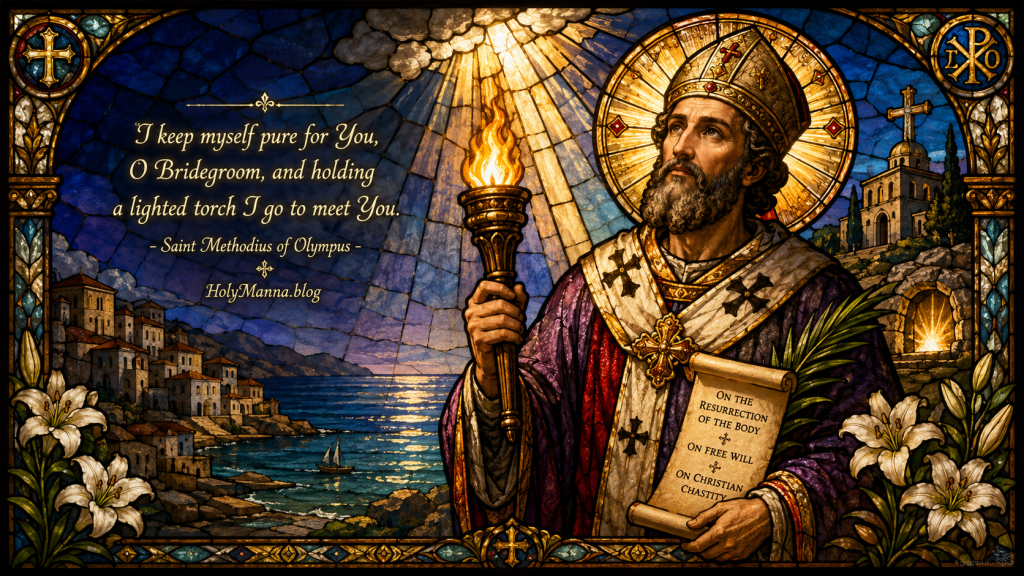
The Bishop Who Defended the Body
Saint Methodius of Olympus is one of the early Church’s quieter giants. His name may not be as familiar as Saint Augustine, Saint Jerome, or Saint Athanasius, but his witness still speaks with surprising power today. He was a bishop, theologian, writer, defender of Christian truth, and martyr, most likely killed around A.D. 311 during the last great Roman persecutions.
Methodius is remembered especially for defending the resurrection of the body, the goodness of creation, human free will, and the beauty of Christian chastity. In a world that often treats the body as either an idol or a burden, his teaching feels remarkably timely. He reminds the Church that salvation is not an escape from the body. It is the redemption of the whole person, body and soul, in Jesus Christ.
That is deeply Catholic. The Catechism teaches in CCC 990 that “the ‘resurrection of the flesh’ means not only that the immortal soul will live on after death, but that even our ‘mortal body’ will come to life again.” Saint Methodius defended this truth with courage, intelligence, and, finally, his blood.
A Life Hidden in the Early Church
Very little is known with certainty about the early life of Saint Methodius. His birth date, family background, and childhood are not clearly preserved in the historical record. Catholic tradition remembers him as connected to Olympus in Lycia, a region in Asia Minor, in modern-day Turkey. He became Bishop of Olympus and served the Church during a time when Christianity was still emerging from the shadows of persecution.
Some later traditions connect him with other cities, including Tyre, Patara, Philippi, or even Byzantium, but these details are uncertain. The most reliable Catholic account is that he was Bishop of Olympus, a gifted teacher, and a martyr near the end of the Roman persecutions.
What stands out most is not a dramatic childhood conversion story, but the mature fruit of his faith. Methodius became a man of learning and holiness. He knew Greek philosophy, especially the intellectual world shaped by Plato, but he did not allow philosophy to rule over revelation. Instead, he brought reason into the service of the Gospel. He used the tools of the educated world to defend the truths entrusted to the Church.
That alone gives modern Catholics something to admire. Methodius shows that faith is not anti-intellectual. The Catholic mind is called to think deeply, pray humbly, and remain obedient to Christ.
The Defender of the Resurrection
Saint Methodius is most known for his writings. His most famous surviving work is The Symposium, or On Virginity, also known as The Banquet of the Ten Virgins. It is the only one of his works that survives complete in Greek.
He also wrote On Free Will and On the Resurrection, both of which reveal the heart of his theology. He opposed certain errors associated with Origen, especially ideas that weakened the Christian understanding of the resurrection of the body. Methodius was careful, though. He was not simply attacking another Christian thinker. He recognized Origen’s influence and brilliance, but he rejected teachings that did not align with the faith received from the apostles.
In On the Resurrection, Methodius defended the truth that the body matters. The body is not a prison for the soul. It is not trash to be discarded. It is part of God’s good creation. It is wounded by sin, but destined for glory through Christ.
This teaching is not abstract. It changes how a Catholic sees everything. The body is involved in prayer, fasting, chastity, service, suffering, the sacraments, and the works of mercy. The body kneels. The body receives the Eucharist. The body carries the cross. The body will rise.
That is why Methodius still matters. He defended a Catholic vision of the human person long before the Church had to answer modern confusions about identity, sexuality, dignity, and death.
The Garden of Virtue and the Ten Virgins
The most famous story associated with Saint Methodius is not a biographical miracle story, but a literary and theological scene from The Banquet of the Ten Virgins. It should be understood as a sacred Christian literary work, not as a verified event from his life.
In this work, ten virgins gather in the garden of Arete, whose name means Virtue. Each one gives a speech praising Christian virginity. Methodius borrows the style of a classical philosophical dialogue, but he fills it with Christian meaning. Where pagan philosophy often searched for beauty through human wisdom, Methodius points to Christ, the true Bridegroom of the soul.
The work ends with a beautiful hymn led by Thecla, a revered figure of early Christian tradition. One of its most famous lines is: “I keep myself pure for You, O Bridegroom, and holding a lighted torch I go to meet You.”
This is not a rejection of marriage. Catholic teaching has always honored marriage as good, holy, and sacramental. Methodius was praising consecrated virginity as a special sign of total devotion to Christ. This fits the Church’s teaching in CCC 1618, which explains that Christ is the center of all Christian life and that virginity for the sake of the Kingdom is a powerful sign of the world to come.
His writing shows that chastity is not cold repression. It is love ordered toward God. It is the lamp kept burning for the Bridegroom.
Freedom, Evil, and the Goodness of God
Methodius also wrote powerfully about free will. In On Free Will, he argued against fatalistic and Gnostic ideas that treated evil as if it came from God, from matter, or from some dark eternal force. He insisted that God is good, creation is good, and man is morally responsible.
One of his clearest teachings is the line: “man was made with a free-will.”
This matters because Catholic faith does not teach that people are helpless machines trapped by fate. Sin wounds the will, but it does not erase responsibility. Grace heals, strengthens, and elevates freedom. The Catechism teaches in CCC 1731 that “Freedom is the power, rooted in reason and will, to act or not to act.”
Methodius also preserved the simple and profound truth: “God did not make evil.”
That one line is worth sitting with. Evil does not come from God. Sin is not God’s design. Death is not God’s dream for humanity. God created man for life, holiness, communion, and resurrection. The tragedy of sin is real, but so is the victory of Christ.
A Faith Sealed in Blood
Saint Methodius lived during a dangerous age for Christians. The Roman Empire had not yet fully accepted Christianity, and believers could still face suspicion, exile, torture, and death. His martyrdom is usually placed around A.D. 311, near the end of the persecutions connected with Diocletian and Maximinus Daja.
The details of his martyrdom are not preserved in a dramatic passion account. There are no widely verified stories of miraculous escapes, courtroom speeches, or signs in the sky. What Catholic tradition does preserve is the essential truth: Methodius was crowned as a martyr.
That matters. A martyr is not merely someone who dies tragically. A martyr is a witness. The Catechism teaches in CCC 2473 that “Martyrdom is the supreme witness given to the truth of the faith.”
Methodius wrote about the body, freedom, purity, and resurrection. Then he gave his body to death rather than deny Christ. His martyrdom becomes the final signature on his theology. He did not merely argue that the body belongs to God. He proved it by offering his own body in witness to Christ.
The Legacy of a Forgotten Father
After his death, Saint Methodius remained important through his writings, though many of them were lost or only partially preserved. His influence lived on in Catholic theology, especially in discussions about the resurrection of the body, human freedom, chastity, and the goodness of creation.
Some writings were later falsely attributed to him, especially apocalyptic works connected with the name “Pseudo-Methodius.” These writings became influential in certain parts of Christian history, but they were not written by Saint Methodius of Olympus. That distinction is important. The real Methodius is not best remembered for dramatic end-times speculation. He is remembered for defending the Catholic vision of the human person.
There are no major, well-attested miracle stories associated with Saint Methodius in the standard Catholic tradition. There are also no widely known posthumous healing stories or famous relic miracles preserved in the usual sources. His legacy is quieter, but not weaker. It is the legacy of truth taught clearly, lived faithfully, and sealed by martyrdom.
The Church honors him on June 20. His memory is especially meaningful for theologians, writers, teachers, consecrated men and women, and anyone trying to understand what it means to live faithfully in the body God has given them.
A Saint for a Confused Age
Saint Methodius may not be a household name, but he speaks directly to the confusions of the modern world. He reminds Catholics that the body is not an accident. It is not a toy. It is not an enemy. It is created by God, redeemed by Christ, and destined for resurrection.
He reminds the Church that freedom is real. People are not simply victims of fate, appetite, culture, or emotion. By grace, the human person can choose the good.
He reminds Christians that chastity is beautiful. Not because love is bad, but because love is sacred. Chastity teaches the heart to love rightly, whether in marriage, consecrated life, priesthood, religious life, or single life.
Most of all, he reminds believers that the resurrection is the center of Christian hope. Catholic faith does not end with the soul floating away from the body. It ends with Christ raising the dead, restoring creation, and making all things new.
Reflection
Saint Methodius teaches that Catholic doctrine is never just an idea on paper. It shapes how people live, suffer, repent, love, and die.
His defense of the resurrection invites Catholics to honor the body without worshiping it. That means treating the body with dignity, practicing chastity, caring for health without vanity, and remembering that every human person is made for eternal life.
His teaching on free will invites serious repentance. It is easy to blame everything on circumstances, wounds, habits, or culture. Those things matter, but they do not have the final word. Grace makes real change possible. A Catholic does not have to remain trapped in the same sins forever.
His witness to chastity invites a deeper kind of love. In a world that often confuses desire with love, Methodius points back to Christ the Bridegroom. Real love gives. Real love sacrifices. Real love waits. Real love tells the truth.
And his martyrdom invites courage. Most Christians today will not be asked to die for the faith, but every Christian is asked to live for it. That may mean speaking truth when it is unpopular, resisting sin when it feels normal, or choosing holiness when the culture laughs at it.
Where is Christ asking for greater freedom in your life today?
How would your view of the body change if you remembered that it is destined for resurrection?
What desire needs to be purified so it can become real love?
Saint Methodius of Olympus shows that holiness is not vague inspiration. It is the whole person given to Christ. Mind, heart, body, freedom, and future all belong to Him.
Engage with Us!
Share your thoughts and reflections in the comments below. Saint Methodius may not be one of the most famous saints, but his witness speaks powerfully to modern questions about the body, freedom, chastity, and resurrection.
- What part of Saint Methodius’ life or teaching stood out to you the most?
- How does the Catholic teaching on the resurrection of the body change the way you see your own body and the dignity of others?
- Where do you need God’s grace to help you choose true freedom instead of comfort, habit, or sin?
- How can chastity become a more joyful and intentional part of daily discipleship?
- What is one practical way you can live today with greater hope in the resurrection?
May Saint Methodius help every Catholic remember that the body is made for glory, freedom is made for love, and life is made for Christ. Live the faith with courage, speak the truth with mercy, and do everything with the love and mercy Jesus taught us.
Saint Methodius of Olympus, pray for us!
Follow us on YouTube, TikTok, Instagram and Facebook for more insights and reflections on living a faith-filled life.

 Holy Manna!
Leave a comment