The Restless Monk Who Found His Holy Land in Puglia
Saint John of Matera was a man who kept searching for God until God turned his restlessness into a mission. He was an Italian Benedictine monk, hermit, preacher, abbot, reformer, and founder of the Congregation of the Pulsanese Hermits. Born around 1070 in Matera, in southern Italy, he became one of those saints whose life feels rugged, intense, and deeply uncomfortable in the best possible way.
He is remembered as a patron of Matera and as a compatron of the city and the Archdiocese of Matera-Irsina. His feast is celebrated on June 20, the date of his death in 1139. The Church remembers him for his austerity of life, his preaching to the people, and his foundation of a strict Benedictine community at Pulsano near Monte Sant’Angelo.
Saint John was not a comfortable saint. He was not polished in the worldly sense. He was a man of caves, roads, prisons, silence, hunger, preaching, and obedience. He wanted the Holy Land, but God gave him Puglia. He wanted solitude, but God gave him disciples. He wanted to disappear into prayer, but God made him a father of monks.
His life reminds Catholics that holiness is not comfort with religious decoration. Holiness is surrender.
The Noble Son Who Walked Away from Comfort
Saint John was born in Matera, likely around 1070, though some sources place his birth closer to 1080. Catholic tradition often gives his family name as Scalcione and describes his family as noble and Christian. The exact details of his childhood are not fully preserved, but the direction of his young heart is clear. John wanted God more than status, comfort, or approval.
As a young man, he secretly left his father’s house. According to tradition, he exchanged his fine clothing for the clothing of a poor man or beggar and set out toward Taranto. This story cannot be verified in every modern historical detail, but it is one of the cherished stories passed down about him. It reveals how Catholics remembered his soul. John did not simply admire poverty. He chose it.
Near Taranto, he found shelter with Basilian monks on the island of San Pietro and worked as a shepherd. This was not a glamorous beginning. He was not building a name for himself. He was learning obscurity, labor, and obedience. Yet even among the monks, his severe austerity caused tension. John’s hunger for penance and solitude was so intense that he eventually moved on.
That pattern would repeat throughout his life. He would seek God, settle for a time, suffer misunderstanding, and then keep walking.
The Desert Road of a Searching Soul
After leaving the Basilian monks, John wandered through Calabria, Sicily, and other parts of southern Italy. He sought solitude, prayer, and a deeper life of penance. Some Catholic accounts say he spent two years in this hidden life. Others say two and a half years. The exact timeline varies, but the spiritual meaning is clear.
God was forming him in the desert.
Devotional accounts describe his penances as extreme. One hagiographical tradition says that, during his time of solitude, he practiced such severe mortifications that he would immerse himself in cold water so his body would not grow too comfortable, even tying himself near a tree. This story should be understood as hagiographical tradition rather than a fully verifiable detail, but it captures the way the Church remembered him: as a man who believed comfort could become a cage if it kept the soul from God.
Catholic spirituality does not teach hatred of the body. The body is created by God and destined for resurrection. But the Church does teach self-mastery. The Catechism explains that freedom grows when the human person chooses the good. Saint John’s austerity was not meant to destroy the body. It was meant to train desire, purify the heart, and make room for obedience.
During one difficult moment, tradition says John was strengthened by the words “Dio è con te,” which means “God is with you.” This should not be presented as a verified formal quotation from his own writings, because no famous authenticated writings or sermons from him are clearly preserved. It is best understood as part of the hagiographical memory of his life. Still, the words fit him beautifully.
God was with him when he left home. God was with him in the fields. God was with him in silence. God was with him when nobody understood the fire burning inside him.
The Preacher Who Would Not Stay Hidden
Eventually John returned to Puglia and came to Ginosa, near Matera and Taranto. There, according to tradition, he lived in silence and penance before beginning a more active ministry. Some accounts say he spent a long period speaking only with God before speaking again to the people.
That detail matters. John did not preach because he wanted attention. He preached because prayer had made him ready.
When he began preaching, people listened. His words carried weight because his life had already been stripped down. He called people to conversion, repentance, and deeper faith. Disciples began gathering around him, and a small monastic community formed.
But spiritual fruit often attracts opposition. John’s preaching and growing influence stirred suspicion and jealousy. Catholic tradition says he was falsely accused and imprisoned by Count Roberto di Chiaromonte. One story connects the conflict to greed and a treasure used to support the monastic foundation, though this detail cannot be fully verified.
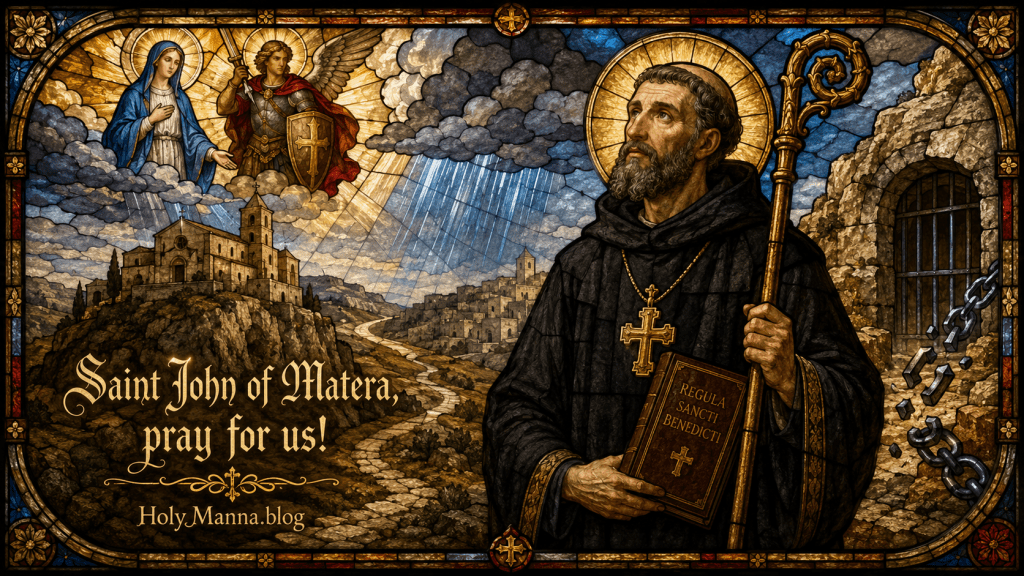
One of the major miracle stories associated with Saint John is his miraculous liberation from prison and chains. The sources do not preserve a detailed modern account of exactly how it happened, but Catholic tradition remembers the event as divine intervention in the life of a persecuted servant of God.
John did not let prison harden him. He did not stop preaching because people misunderstood him. He kept following the road God placed before him.
The Saint Almost Mistaken for a Heretic
Another striking tradition comes from his time in Bari. John preached there with force and conviction. Bari was already an important Catholic city, especially after the relics of Saint Nicholas had arrived there in the late eleventh century. It was a place of devotion, politics, tension, and reform.
John’s preaching challenged people. That made him loved by many and hated by others.
Some Catholic accounts say he was falsely accused of heresy. One tradition says he narrowly escaped being burned as a heretic. This is one of the most surprising details associated with his life. A man later recognized as a saint was almost condemned because people misunderstood, feared, or resented his preaching.
This story reminds Catholics that holiness is not always recognized immediately. Sometimes the saints are opposed not because they are wrong, but because truth spoken with fire makes comfortable people nervous.
John’s orthodoxy was eventually vindicated. His suffering became part of his witness.
A Holy Friendship and a Different Mission
During his wandering, John met Saint William of Vercelli, the founder of Montevergine. The two saints spent time together in a hermit community in the mountains of Irpinia. They shared a love for prayer, penance, and reform. But eventually, their paths separated.
Tradition says God revealed that each man had his own mission. Saint William would be connected with Montevergine. Saint John would be sent toward Puglia and the Gargano.
This is a beautiful Catholic lesson. Saints do not have to copy each other. They can share the same love for Christ and still be sent in different directions. Holiness is not mass-produced. God forms each soul for a particular mission.
John kept walking.
When Puglia Became His Holy Land
One of the most memorable moments in Saint John’s life is his desire to go to Holy Land. After years of wandering, preaching, and searching, he wanted to travel to the Holy Land.
But while passing through Bari, he discerned something unexpected. God was not calling him across the sea. God was calling him to stay.
Catholic tradition beautifully summarizes this turning point by saying that John realized his Holy Land was there, in Puglia.
That line is the key to his whole life. John wanted a holy place far away. God showed him the holy mission right in front of him. He wanted Jerusalem. God gave him southern Italy. He wanted the land of Christ’s earthly footsteps. God gave him the people who needed Christ’s mercy where he already stood.
That is not settling. That is obedience.
Many people spend life waiting for the perfect mission, the perfect parish, the perfect relationship, the perfect job, the perfect season, or the perfect spiritual clarity. Saint John of Matera teaches that God often begins with the place already under your feet.
What if the mission you keep looking for is already in front of you?
The Drought, the Priest, and the Mercy of Conversion
When John came near Monte Sant’Angelo on the Gargano, the region was already famous for devotion to Saint Michael the Archangel. There, a traditional miracle story says the people came to John during a prolonged drought and asked him to intercede for rain.
According to Catholic tradition, John discerned that the drought was connected to the infidelity of a local priest. He called the priest to repentance. When the priest converted, rain returned and the land was renewed.
This story should be treated as a traditional miracle account that cannot be verified in every modern historical detail. Still, its spiritual meaning is deeply Catholic. Sin dries up the soul. Repentance opens the heavens.
The miracle was not only that rain fell. The greater miracle was that a priest came back to God.
That is the kind of miracle the Church always needs. Not just water for the land, but conversion for the heart.
The Mother of God, Saint Michael, and the Hill of Pulsano
Around 1129 or 1130, John came to Pulsano, near Monte Sant’Angelo. The abbey tradition says the Mother of God and Saint Michael the Archangel appeared to him and indicated the hill of Pulsano as the place where he should build a church. This should be presented as sacred tradition rather than a detail that can be fully verified by modern historical standards.
John obeyed. With six disciples, he began rebuilding the old monastic site and church. Tradition says he adapted a cave as the apse and placed above the altar a Byzantine-style image of the Blessed Virgin Mary, the Mother of God Hodegetria of Pulsano.
The title Hodegetria means “she who shows the way.” That is perfect for Saint John’s life. He spent years searching for the way, and at Pulsano, the Mother of God pointed him where to go.
The community grew quickly. Several accounts say the group began with six disciples and grew to around fifty monks in only a few months. Some sources give the number as sixty. These monks became known as the Pulsanese Hermits, or the “Scalzi,” meaning the barefoot ones.
Their life followed the Rule of Saint Benedict, but with especially strict observance. They embraced poverty, silence, prayer, manual labor, penance, preaching, and obedience. John was not merely founding a monastery. He was lighting a monastic fire.
A Benedictine Fire Before the Franciscan Flame
Saint John founded the Congregation of Pulsano, a reform movement within the Benedictine tradition. After his death, under successors such as Blessed Jordan and Blessed Joel, the congregation grew into an autonomous Benedictine family with both male and female branches.
Eventually, the Pulsanese Congregation spread across regions of Italy and beyond, with more than forty monasteries associated with its life. Its influence reached places in Basilicata, Abruzzo, Lazio, Tuscany, and even Adriatic islands.
This is one of the most surprising facts about Saint John. He lived before Saint Francis of Assisi, but many Catholic writers see in him a kind of early Franciscan spirit. He was not a Franciscan, of course. He was a Benedictine monk and reformer. But his love of poverty, preaching, penance, and evangelical simplicity anticipated some of the spiritual energy that would later flourish in the mendicant movements.
He began as a restless young man fleeing comfort. He became the father of a monastic movement.
That is what grace does. It takes the fire that could have burned a man up and turns it into light for the Church.
Hardship Without Martyrdom
Saint John was not a martyr in the strict sense. He did not die by execution for the faith. But his life was marked by suffering for Christ.
He endured misunderstanding among monks, harsh wandering, false accusation, imprisonment, and the danger of being condemned as a heretic. He faced the loneliness that often comes with reform. He suffered the cost of obedience when God kept redirecting his plans.
His hardships reveal a different kind of witness. Not every saint sheds blood. Some saints are slowly carved into holiness by obedience, poverty, humiliation, and perseverance.
Saint John’s life shows that endurance can be a form of preaching. He did not just tell people to repent. He lived like a man who had placed everything before God.
Death, Relics, and the Memory of a Holy Father
Saint John died on June 20, 1139. Most Catholic sources associate his death with the monastery of San Giacomo in Foggia, though some traditions mention Pulsano. The Foggia tradition is strongly represented in the Church’s memory.
He was canonized in 1177 by Pope Alexander III. That same year, according to abbey tradition, the church of Santa Maria di Pulsano was solemnly dedicated, and John’s remains were placed beneath the altar.
His body was later translated from Foggia to Pulsano. In 1830, his relics were brought to the Cathedral of Matera. Since 1939, they have been kept in a sarcophagus there, making Matera an important place of devotion to its native saint.
The place associated with his birthplace in the Sassi of Matera also became connected with local devotion, especially the rupestrian church known as Purgatorio Vecchio. This links Saint John to the cave-church spirituality of Matera and to the long Christian memory of southern Italy, where Latin and Byzantine traditions often met.
No major, detailed posthumous miracle stories tied to specific healings at his tomb were found in the standard Catholic sources. His after-death legacy is instead preserved through his canonization, relics, monastic congregation, local veneration, and the continued importance of Pulsano and Matera.
The Abbey That Would Not Be Forgotten
The Abbey of Santa Maria di Pulsano remains one of the most important places connected to Saint John’s memory. The Pulsanese Congregation eventually declined and disappeared in the fifteenth century, but the spiritual mark of the abbey endured.
Over the centuries, the site experienced abandonment, damage, suppression, and loss. Yet in modern times, Pulsano experienced renewal. A new monastic presence returned to the abbey in the late twentieth century, and the place again became associated with prayer, silence, hospitality, pilgrimage, iconography, and liturgical life.
That renewal feels fitting. Saint John himself was a rebuilder. He rebuilt not only stone walls, but souls. His abbey’s survival in Catholic memory is a reminder that God can revive places that seem forgotten.
The geography of his life still matters. Matera remembers him as a native son and patron. Foggia remembers his final foundation and death. Pulsano remembers him as founder and father. Monte Sant’Angelo places him near the powerful devotion to Saint Michael. His life belongs deeply to southern Italy, but his message belongs to the whole Church.
What Saint John Teaches the Church Today
Saint John of Matera is a saint for restless people. He shows that restlessness is not always rebellion. Sometimes it is the ache of a soul being pulled toward God.
But his life also gives a necessary warning. Restlessness must become obedience. A person cannot wander forever. At some point, God points to a place, a people, a duty, and a cross.
For John, that place was Pulsano. His Holy Land was Puglia.
His life also teaches that silence and mission belong together. John’s preaching came from prayer. His authority came from penance. His reform came from surrender. He did not become fruitful by chasing influence. He became fruitful because God emptied him first.
The Catechism teaches that consecrated life belongs to the holiness of the Church, and that those called to the evangelical counsels bear witness that Christ is worth everything. Saint John lived that truth with rugged intensity. Poverty was not an aesthetic. Prayer was not a hobby. Obedience was not a slogan. Christ was the center.
That is why his story still feels so alive. A distracted world needs saints who know how to be silent. A comfortable Church needs saints who remember penance. A restless generation needs saints who show that the hunger for meaning must become surrender to God.
A Restless Heart Made Useful by Grace
Saint John of Matera did not live an easy life. He left home, wandered through the South, clashed with comfort, endured prison, faced accusation, preached repentance, founded a community, and spent himself for God.
He was not famous because he found the easiest path. He became holy because he followed the path God gave him.
That is the invitation in his life. Stop waiting for a perfect mission. Start obeying the grace already in front of you. Pray with seriousness. Repent with honesty. Serve with humility. Let God use the very restlessness that once confused you.
Where is your Holy Land?
What place, person, duty, or cross is God asking you to stop avoiding?
What would change if your restlessness became obedience?
Saint John of Matera teaches that God can take a searching soul and make it a shelter for others. He can take a lonely road and turn it into a monastery. He can take a man who wanted to disappear and make him a father.
Engage with Us!
Share your thoughts and reflections in the comments below. Saint John of Matera’s life is full of rugged holiness, surprising turns, and powerful lessons for anyone trying to follow God with an undivided heart.
- What part of Saint John of Matera’s story challenged you the most?
- Have you ever wanted a mission somewhere else while God was asking you to serve right where you were?
- Where is God inviting you to turn restlessness into obedience?
- What comfort might God be asking you to surrender so you can grow in freedom?
- How can silence, prayer, and repentance become more real in your daily life?
May Saint John of Matera help every restless heart find its mission in Christ. Live with courage, repent with humility, serve where God has placed you, and do everything with the love and mercy Jesus taught us.
Saint John of Matera, pray for us!
Follow us on YouTube, TikTok, Instagram and Facebook for more insights and reflections on living a faith-filled life.

 Holy Manna!
Leave a comment