Saturday of the Eleventh Week in Ordinary Time – Lectionary: 370
When the Heart Chooses Its Master
Every soul eventually has to answer one quiet but life-shaping question: Who or what is truly being served?
Today’s readings bring that question into sharp focus. In 2 Chronicles 24:17-25, King Joash begins as a man protected by holy influence, but after the death of Jehoiada the priest, he listens to the wrong voices and abandons the house of the Lord. Judah turns toward asherahs and idols, and when Zechariah courageously calls them back, he is killed in the Temple court. It is a tragic picture of what happens when a heart forgets grace, rejects correction, and gives worship to something other than God.
Then Psalm 89 reminds us that God’s covenant mercy is stronger than human failure. The Lord promises David, “Forever I will maintain my mercy for him; my covenant with him stands firm.” Psalm 89:29 Yet this mercy does not erase discipline. God says that when His people forsake His commandments, He will correct them, but He will not betray His faithfulness. This is the Catholic story of covenant love: sin has consequences, but God’s mercy keeps calling His people home.
In The Gospel of Matthew, Jesus goes straight to the root of the matter: “No one can serve two masters.” Matthew 6:24 The idols of Judah may look ancient, but the human heart still knows how to bow before false gods. Money, comfort, status, control, and fear can all become modern forms of mammon when they claim the trust that belongs to God alone. The Catechism teaches that “Idolatry consists in divinizing what is not God.” CCC 2113 That is why Jesus does not simply tell His disciples to worry less. He tells them to seek rightly: “Seek first the kingdom of God and his righteousness.” Matthew 6:33
Together, these readings reveal one central theme: peace comes when the heart stops serving false masters and returns to the faithful Father. Joash shows the danger of drifting from God. The psalm shows the mercy of a covenant-keeping Lord. Jesus shows the path back to freedom through trust, surrender, and rightly ordered love. The Father knows what His children need, but He also knows that the heart will never be free until He is first.
What false master has been quietly asking for your trust?
First Reading – 2 Chronicles 24:17-25
The King Who Forgot Mercy and Listened to the Wrong Voices
The first reading brings us into one of the saddest turns in the story of Judah. King Joash had once been protected by Jehoiada the priest, rescued from royal violence, raised under holy guidance, and led toward the restoration of the Temple. For a time, his reign looked promising. But after Jehoiada died, Joash’s faith collapsed because it had never fully become his own.
This passage is set in the kingdom of Judah during the period of the divided monarchy, when the descendants of David ruled in Jerusalem while Israel and Judah often struggled with idolatry, political pressure, and spiritual compromise. The worship of asherahs and idols was not just a private religious preference. It was a rejection of the covenant, a turning away from the Lord who had chosen Israel, delivered them, and given them His law.
This reading fits perfectly into today’s central theme: the human heart cannot serve two masters. Joash listens to flattering nobles instead of faithful prophets. He chooses power over truth, idols over the Lord, and self-protection over gratitude. His story prepares us to hear Jesus say in The Gospel of Matthew, “No one can serve two masters.” Matthew 6:24 Joash’s tragedy is the Old Testament picture of a heart that stops seeking first the Kingdom of God.
2 Chronicles 24:17-25 – New American Bible (Revised Edition)
Joash’s Apostasy. 17 After the death of Jehoiada, the princes of Judah came and paid homage to the king; then the king listened to them. 18 They abandoned the house of the Lord, the God of their ancestors, and began to serve the asherahs and the idols; and because of this crime of theirs, wrath came upon Judah and Jerusalem. 19 Although prophets were sent to them to turn them back to the Lord and to warn them, the people would not listen. 20 Then the spirit of God clothed Zechariah, son of Jehoiada the priest. He took his stand above the people and said to them: “Thus says God, Why are you transgressing the Lord’s commands, so that you cannot prosper? Because you have abandoned the Lord, he has abandoned you.” 21 But they conspired against him, and at the king’s command they stoned him in the court of the house of the Lord. 22 Thus King Joash was unmindful of the devotion shown him by Jehoiada, Zechariah’s father, and killed the son. As he was dying, he said, “May the Lord see and avenge.”
Joash Punished. 23 At the turn of the year a force of Arameans came up against Joash. They invaded Judah and Jerusalem, killed all the princes of the people, and sent all their spoil to the king of Damascus. 24 Though the Aramean force was small, the Lord handed over a very large force into their power, because Judah had abandoned the Lord, the God of their ancestors. So judgment was meted out to Joash. 25 After the Arameans had departed from him, abandoning him to his many injuries, his servants conspired against him because of the murder of the son of Jehoiada the priest. They killed him on his sickbed. He was buried in the City of David, but not in the tombs of the kings.
Detailed Exegesis
Verse 17 – “After the death of Jehoiada, the princes of Judah came and paid homage to the king; then the king listened to them.”
This verse marks the spiritual turning point. While Jehoiada lived, Joash had wise priestly guidance. After Jehoiada’s death, the princes of Judah approach the king with homage, likely appealing to his pride and royal authority. The danger is subtle. Joash does not begin by openly declaring war on God. He begins by listening to the wrong voices. In the spiritual life, the voices we allow near the heart matter deeply. Good counsel draws us toward humility, repentance, and worship. Bad counsel flatters the ego and slowly loosens the soul’s grip on God.
Verse 18 – “They abandoned the house of the Lord, the God of their ancestors, and began to serve the asherahs and the idols; and because of this crime of theirs, wrath came upon Judah and Jerusalem.”
The abandonment of the house of the Lord is covenant betrayal. The Temple was the visible sign of God’s presence among His people, the place of sacrifice, worship, and communion. To abandon it for asherahs and idols was to exchange the living God for created things. This is why the reading says wrath came upon Judah and Jerusalem. God’s wrath is not emotional instability. It is His holy opposition to sin, especially sin that destroys His people and leads them away from life.
Verse 19 – “Although prophets were sent to them to turn them back to the Lord and to warn them, the people would not listen.”
God does not abandon His people without warning. He sends prophets to call them back, which reveals His mercy even in the face of their rebellion. The prophets are not merely predictors of future events. They are covenant messengers who expose sin and invite conversion. The tragedy is that the people refuse to listen. In Catholic life, this same danger remains. God often sends correction through Scripture, the Church, the Sacrament of Confession, faithful friends, and the quiet conviction of conscience. Refusing correction is one of the ways the heart hardens.
Verse 20 – “Then the spirit of God clothed Zechariah, son of Jehoiada the priest. He took his stand above the people and said to them: ‘Thus says God, Why are you transgressing the Lord’s commands, so that you cannot prosper? Because you have abandoned the Lord, he has abandoned you.’”
The phrase “the spirit of God clothed Zechariah” is powerful. Zechariah does not speak merely from personal frustration. He speaks under divine inspiration. His message is direct: sin does not lead to prosperity because it cuts the people off from the Lord, who is the source of life. His words are not cruelty. They are mercy spoken plainly. He is trying to awaken a people who are walking toward destruction. This verse reminds us that true love sometimes sounds like warning.
Verse 21 – “But they conspired against him, and at the king’s command they stoned him in the court of the house of the Lord.”
This is one of the darkest verses in the reading. Zechariah is murdered in the court of the Temple, the very place meant for worship and sacrifice. Even worse, the murder happens at the king’s command. Joash has fallen so far that he kills the son of the priest who once saved his life and protected his throne. This is what idolatry does. It does not simply add something false to a person’s life. It disorders the whole soul until truth feels threatening and evil feels justified.
Verse 22 – “Thus King Joash was unmindful of the devotion shown him by Jehoiada, Zechariah’s father, and killed the son. As he was dying, he said, ‘May the Lord see and avenge.’”
Joash’s sin is intensified by ingratitude. He forgets the devotion of Jehoiada and kills Jehoiada’s son. In Scripture, forgetfulness is often more than a failure of memory. It is a spiritual failure to live in gratitude for God’s mercy. Zechariah’s final words entrust justice to the Lord. He does not take revenge into his own hands. He appeals to God, the righteous judge. His death foreshadows the long history of prophets rejected by God’s people and points ultimately toward Christ, the innocent Son who is rejected and killed.
Verse 23 – “At the turn of the year a force of Arameans came up against Joash. They invaded Judah and Jerusalem, killed all the princes of the people, and sent all their spoil to the king of Damascus.”
The judgment begins through the invasion of the Arameans. The princes who influenced Joash are killed, showing the emptiness of their worldly power. The leaders who helped turn Judah away from God cannot save themselves. In the biblical worldview, military disaster often reveals a deeper spiritual disorder. Judah’s external defeat mirrors its internal collapse.
Verse 24 – “Though the Aramean force was small, the Lord handed over a very large force into their power, because Judah had abandoned the Lord, the God of their ancestors. So judgment was meted out to Joash.”
This verse makes the theological meaning explicit. The Arameans win not because they are stronger, but because Judah has abandoned the Lord. A small army defeats a large one because covenant unfaithfulness has weakened Judah at the deepest level. The lesson is not that every suffering is a direct punishment for personal sin. Catholic faith rejects that oversimplification. But this passage does teach that sin has consequences, and when a people abandon God, no amount of worldly strength can replace Him.
Verse 25 – “After the Arameans had departed from him, abandoning him to his many injuries, his servants conspired against him because of the murder of the son of Jehoiada the priest. They killed him on his sickbed. He was buried in the City of David, but not in the tombs of the kings.”
Joash dies in humiliation. He is wounded by enemies and then killed by his own servants. His burial in the City of David but not in the tombs of the kings shows the disgrace attached to his legacy. The inspired author wants readers to understand that Joash’s fall was not merely political. It was spiritual. He had been given mercy, guidance, priestly friendship, royal authority, and time to repent. Yet he chose idols and silenced the prophet. His ending warns every generation that a life built on false masters cannot produce peace.
Teachings
The first reading teaches that idolatry begins when the heart gives God’s place to something else. Joash does not merely make a political mistake. He commits covenant infidelity. He abandons the house of the Lord and serves false gods. The Catechism explains this clearly: “Idolatry not only refers to false pagan worship. It remains a constant temptation to faith. Idolatry consists in divinizing what is not God. Man commits idolatry whenever he honors and reveres a creature in place of God, whether this be gods or demons, for example, satanism, power, pleasure, race, ancestors, the state, money, etc. Jesus says, ‘You cannot serve God and mammon.’ Many martyrs died for not adoring ‘the Beast’ refusing even to simulate such worship. Idolatry rejects the unique Lordship of God; it is therefore incompatible with communion with God.” CCC 2113
That teaching makes Joash’s story uncomfortably close to home. Ancient Judah had asherahs and idols. Modern life has its own false gods. Power, comfort, money, pleasure, image, control, and approval can all become idols when they claim the obedience, trust, and reverence that belong to God alone.
This passage also teaches the importance of forming a personal faith. Joash appeared faithful while Jehoiada guided him, but after Jehoiada’s death, his heart followed the princes of Judah. Holy influences matter, but they are meant to lead each person into a mature covenant relationship with God. Parents, priests, mentors, catechists, and faithful friends can help form the soul, but no one can live another person’s faith for them.
There is also a serious lesson about rejecting correction. Zechariah speaks because the Spirit of God clothes him. He warns the people so they can return to the Lord. His death shows how far sin will go to avoid repentance. This connects to the Church’s teaching on conscience. The Catechism says, “Conscience is a judgment of reason whereby the human person recognizes the moral quality of a concrete act that he is going to perform, is in the process of performing, or has already completed. In all he says and does, man is obliged to follow faithfully what he knows to be just and right.” CCC 1778
Joash’s conscience should have been awakened by Zechariah’s warning, but instead he chose violence. This is the danger of a hardened heart. When a person repeatedly refuses truth, truth begins to feel like an enemy.
St. Augustine’s famous teaching on the two loves helps illuminate the reading. In The City of God, he writes, “Two loves have made two cities: love of self, even to contempt of God, made the earthly city; love of God, even to contempt of self, made the heavenly city.” Joash becomes an image of disordered love. He chooses himself, his power, and the approval of nobles over God. Zechariah becomes an image of ordered love. He chooses fidelity to God even when truth costs him his life.
The reading also points toward Christ. Zechariah, the righteous son of a priest, is killed in the sacred precincts because he speaks God’s truth. Jesus Himself later laments the blood of the righteous, from Abel to Zechariah, and reveals the long tragedy of prophets rejected by those they came to save. In this way, Zechariah’s death becomes part of the larger biblical pattern that reaches its climax in the Passion of Christ, where the perfectly righteous Son is rejected, condemned, and killed, yet conquers through mercy.
Reflection
Joash’s story is a warning against spiritual drift. Very few people wake up one morning and decide to abandon God completely. More often, the heart starts listening to the wrong voices. A little flattery becomes welcome. A little compromise becomes normal. A little neglect of prayer becomes routine. A little distance from the sacraments becomes easier to justify. Then, slowly, the house of the Lord no longer feels like home.
This reading invites a serious but hopeful examination. Whose voice has been shaping your decisions lately? Are the people closest to your heart drawing you toward the Lord or away from Him? Is there a truth God has been trying to speak through Scripture, conscience, Confession, or a faithful person, but you have been avoiding it?
The good news is that God sends warnings because He desires return, not destruction. Zechariah’s message was severe, but it was also merciful. God still calls His people back before the collapse. He still sends grace before judgment. He still gives the soul time to repent.
A practical response to this reading begins with gratitude. Joash forgot the devotion shown to him by Jehoiada. The faithful soul remembers. Remember who prayed for you. Remember who taught you the faith. Remember the priests who brought you the sacraments. Remember the people who corrected you when it would have been easier to stay silent. Remember the mercy of God that protected you even when you did not fully understand it.
Then take one concrete step back toward the Lord. Return to daily prayer. Go to Confession if sin has been excused for too long. Ask God for the humility to receive correction. Choose friends who love your soul more than your ego. Put Sunday Mass back at the center if it has become negotiable. Refuse to let any idol take the place of God.
Joash shows what happens when the heart serves the wrong master. Zechariah shows what faithfulness looks like when truth is costly. And the Lord, even in judgment, shows that He is still calling His people home.
What voice needs to lose influence in your life?
Where has God been calling you back, and what would obedience look like today?
What false master has been quietly asking for the loyalty that belongs to the Lord alone?
Responsorial Psalm – Psalm 89:4-5, 29-34
The Covenant That Mercy Refuses to Abandon
Psalm 89 brings the wounded story of Judah into the light of God’s covenant faithfulness. After hearing about Joash’s apostasy in 2 Chronicles 24:17-25, the psalm reminds the faithful that the failure of a king does not mean the failure of God. Human rulers may forget mercy. David’s descendants may abandon the commandments. The people may chase idols and suffer correction. Yet the Lord remains faithful to His promise.
Historically, Psalm 89 is rooted in the Davidic covenant, the promise God made that David’s throne would endure. This promise shaped Israel’s hope for centuries, especially during times when the monarchy looked weak, corrupt, or even destroyed. For Catholics, that promise finds its fulfillment in Jesus Christ, the true Son of David, whose Kingdom is not built on political power, wealth, or earthly security, but on obedience to the Father and the victory of the Cross.
This psalm fits today’s central theme beautifully. Joash shows what happens when the heart serves false masters. The Gospel will teach, “No one can serve two masters.” Matthew 6:24 But Psalm 89 reveals the deeper consolation beneath that warning: God is not fickle, forgetful, or fragile. He corrects sin, but He does not betray His covenant. His mercy is not weak sentiment. His mercy is faithful love that calls His people back to Him.
Psalm 89:4-5, 29-34 – New American Bible (Revised Edition)
4 I have made a covenant with my chosen one;
I have sworn to David my servant:
5 I will make your dynasty stand forever
and establish your throne through all ages.”
Selah29 Forever I will maintain my mercy for him;
my covenant with him stands firm.
30 I will establish his dynasty forever,
his throne as the days of the heavens.
31 If his descendants forsake my teaching,
do not follow my decrees,
32 If they fail to observe my statutes,
do not keep my commandments,
33 I will punish their crime with a rod
and their guilt with blows.
34 But I will not take my mercy from him,
nor will I betray my bond of faithfulness.
Detailed Exegesis
Verse 4 – “I have made a covenant with my chosen one; I have sworn to David my servant.”
This verse begins with God’s initiative. The covenant is not something David creates for himself. It is something God makes and swears. David is called “my chosen one” and “my servant,” which shows both his dignity and his dependence. He is king, but he is still under God. In the Catholic understanding of salvation history, God’s covenants reveal His plan to gather His people into communion with Himself. David’s throne becomes a sign pointing beyond David to Christ, the King who perfectly serves the Father.
Verse 5 – “I will make your dynasty stand forever and establish your throne through all ages.”
This promise reaches beyond ordinary politics. Earthly kingdoms rise and fall, but God promises David a dynasty that will endure. Historically, this was difficult for Israel to understand when David’s descendants sinned or when the kingdom suffered humiliation. Yet the Church reads this promise in the light of Christ. Jesus is the Son of David whose throne is established forever, not through military conquest, but through His death, Resurrection, and eternal reign.
Verse 29 – “Forever I will maintain my mercy for him; my covenant with him stands firm.”
This verse is the heart of the psalm’s comfort. God’s mercy is not temporary. His covenant does not collapse because human beings are weak. The word mercy here carries the sense of steadfast covenant love, the faithful love of God that does not abandon His promise. This does not mean sin is ignored. It means God’s faithfulness is deeper than human failure. After Joash’s betrayal, this verse feels like a strong hand placed on the shoulder of every discouraged believer.
Verse 30 – “I will establish his dynasty forever, his throne as the days of the heavens.”
The image is vast. David’s throne is compared to the enduring heavens. This does not mean every king in David’s line will be holy. Joash proves that they will not be. It means God’s saving plan will not be defeated by their sin. In Christ, this verse becomes fully luminous. The Kingdom promised to David reaches its fulfillment in the eternal reign of Jesus, whose throne cannot be shaken by death, politics, persecution, or human betrayal.
Verse 31 – “If his descendants forsake my teaching, do not follow my decrees.”
Here the psalm becomes realistic. God’s covenant does not pretend that David’s descendants will always be faithful. Some will forsake His teaching and refuse His decrees. This verse speaks directly to Joash’s story. He abandons the house of the Lord, listens to corrupt leaders, and rejects prophetic correction. The covenant does not remove human freedom. God’s promises are sure, but His people are still responsible for obedience.
Verse 32 – “If they fail to observe my statutes, do not keep my commandments.”
The psalm deepens the warning. Sin is not merely emotional distance from God. It is concrete disobedience. The Lord gave Israel commandments as a path of life, worship, justice, and covenant fidelity. To reject them is to step outside the order of love. Catholic teaching sees the commandments not as arbitrary restrictions, but as wisdom from the Father who desires His children’s freedom. When commandments are ignored, the heart becomes vulnerable to idols.
Verse 33 – “I will punish their crime with a rod and their guilt with blows.”
This verse can sound severe, but it reveals a fatherly truth: love corrects. God’s discipline is not revenge. It is judgment ordered toward truth. In the story of Joash, Judah’s abandonment of the Lord leads to painful consequences. The Arameans invade, the princes fall, and Joash receives judgment. This verse reminds the faithful that mercy does not mean sin is harmless. The Father who loves His children will not bless what destroys them.
Verse 34 – “But I will not take my mercy from him, nor will I betray my bond of faithfulness.”
This final verse holds together justice and mercy. God corrects, but He does not revoke His covenant love. He punishes crime, but He does not betray His faithfulness. This is one of the great Catholic truths about God’s love: He is both just and merciful. His correction is real, but His mercy is never exhausted. For the Christian, this verse points directly to Jesus Christ, the faithful Son of David, in whom God’s covenant promise stands forever.
Teachings
Psalm 89 teaches that God’s covenant faithfulness is stronger than the failures of His people. This matters because the first reading shows a king who forgets mercy, rejects correction, and leads Judah into idolatry. The psalm answers that tragedy without minimizing it. Yes, sin has consequences. Yes, the descendants of David can forsake God’s law. Yes, the Lord may punish crime with a rod. But God will not betray His bond of faithfulness.
The Davidic covenant is one of the great foundations of biblical hope. God promised that David’s throne would endure, and Catholics understand this promise as fulfilled in Jesus Christ. The angel Gabriel announces this to Mary in The Gospel of Luke: “He will be great and will be called Son of the Most High, and the Lord God will give him the throne of David his father.” Luke 1:32 This is why Psalm 89 is not merely about ancient monarchy. It is about the coming of the Messiah.
The Catechism teaches that Jesus is the fulfillment of Israel’s hope and the promised Messiah: “The word ‘Christ’ comes from the Greek translation of the Hebrew Messiah, which means ‘anointed.’ It became the name proper to Jesus only because he accomplished perfectly the divine mission that ‘Christ’ signifies. In effect, in Israel those consecrated to God for a mission that he gave were anointed in his name. This was the case for kings, for priests and, in rare instances, for prophets. This had to be the case all the more so for the Messiah whom God would send to inaugurate his kingdom definitively.” CCC 436
This helps explain why the psalm speaks so powerfully after the failure of Joash. The kings of Judah were anointed, but they were imperfect. Some were faithful, others were corrupt, and none could fully establish the Kingdom of God. Their failures created a longing for the true Anointed One, the King who would never abandon the Father’s will.
The Catechism also teaches that the Kingdom belongs to Christ because He is King and Lord: “Christ is Lord of the cosmos and of history. In him human history and indeed all creation are ‘set forth’ and transcendently fulfilled.” CCC 668 This is the fulfillment of the psalm’s promise that David’s throne would be established forever. The throne is not finally preserved by Joash, Hezekiah, Josiah, or any earthly ruler. It is fulfilled in Christ, whose reign is eternal.
This psalm also teaches the Catholic balance between mercy and discipline. God does not say, “If they forsake my teaching, it does not matter.” He says He will punish their crime. But He also says, “I will not take my mercy from him.” Psalm 89:34 This is the heart of covenant love. God’s correction is not opposed to His mercy. It is often an expression of it.
The Letter to the Hebrews gives the same fatherly teaching: “For whom the Lord loves, he disciplines; he scourges every son he acknowledges.” Hebrews 12:6 Discipline is painful, but it can become a path back to life when received with humility. Joash resisted correction and fell. The faithful soul is invited to receive correction as mercy.
St. Augustine’s teaching on the Psalms often returns to this truth: the psalms train the heart to hope in God, not in unstable earthly things. The Davidic king points to Christ, and the suffering of God’s people points toward the mystery of the Church united to her Lord. In that light, Psalm 89 becomes a prayer for anyone who has seen human weakness, scandal, failure, or disappointment and wondered whether God’s promise still stands. The answer is yes. The covenant stands firm because God stands firm.
Reflection
This psalm is a needed breath after the heaviness of Joash’s fall. It does not let the soul escape the seriousness of sin, but it also does not allow despair to have the last word. That is very Catholic. Sin must be confessed. Idols must be torn down. False masters must be rejected. Yet even after failure, the Lord’s mercy still calls.
There are moments when a person may look at weakness in the family, corruption in leadership, confusion in the culture, or sin in the mirror and feel discouraged. Psalm 89 speaks into that exact place. God’s faithfulness is not built on human perfection. His covenant does not depend on the emotional strength of the believer or the moral consistency of every leader. His mercy stands because He is faithful.
That does not make obedience optional. The psalm is clear that forsaking God’s commandments brings discipline. A soul cannot serve idols and expect peace. A family cannot ignore God and expect spiritual health. A culture cannot reject truth and expect flourishing. But correction is not the same as abandonment. The Father corrects because He has not stopped loving.
A practical way to live this psalm is to bring both sin and discouragement honestly before God. Name the places where obedience has weakened. Name the places where trust has faded. Name the places where the heart has become tired of waiting for God’s promise. Then pray with the psalm’s confidence: “My covenant with him stands firm.” Psalm 89:29
This reading also invites gratitude for Christ the King. Earthly leaders disappoint. Personal strength fails. Emotions shift. Circumstances change. But Jesus remains the faithful Son of David. His throne is not threatened by the chaos of the world or the weakness of His people. The Christian life becomes steadier when the soul stops expecting created things to be unshakable and rests instead in the Kingdom that cannot fall.
Where do you need to remember that God’s mercy still stands firm?
Have you mistaken God’s correction for rejection, when He may actually be calling you back to life?
What would change today if Christ the King, not fear, disappointment, money, or control, truly held the throne of your heart?
Holy Gospel – Matthew 6:24-34
The Father Who Frees the Anxious Heart
In The Gospel of Matthew, Jesus continues the Sermon on the Mount by placing His finger on one of the oldest struggles in the human heart: divided trust. After hearing about Joash, a king who listened to the wrong voices and abandoned the Lord, and after praying Psalm 89, which proclaims God’s covenant faithfulness even when His people fail, the Gospel brings the theme into daily life with painful clarity. A person cannot belong fully to God while serving a false master.
In the world of Jesus, daily survival was not theoretical. Many of His listeners lived close to hunger, debt, labor, illness, and political instability. Food, clothing, and tomorrow’s needs were not abstract worries. They were real burdens. Yet Jesus does not dismiss those needs. He names them, then lifts the eyes of His disciples toward the Father who already knows them.
This Gospel is not an invitation to laziness, denial, or irresponsibility. It is an invitation to freedom. Jesus exposes mammon because money becomes dangerous when it stops being a tool and becomes a master. He challenges worry because anxiety can quietly become a rival liturgy, asking the heart to rehearse fear instead of trusting the Father. In today’s central theme, this Gospel becomes the healing answer to Joash’s tragedy: the heart finds peace only when it stops serving false masters and seeks first the Kingdom of God.
Matthew 6:24-34 – New American Bible (Revised Edition)
God and Money. 24 “No one can serve two masters. He will either hate one and love the other, or be devoted to one and despise the other. You cannot serve God and mammon.
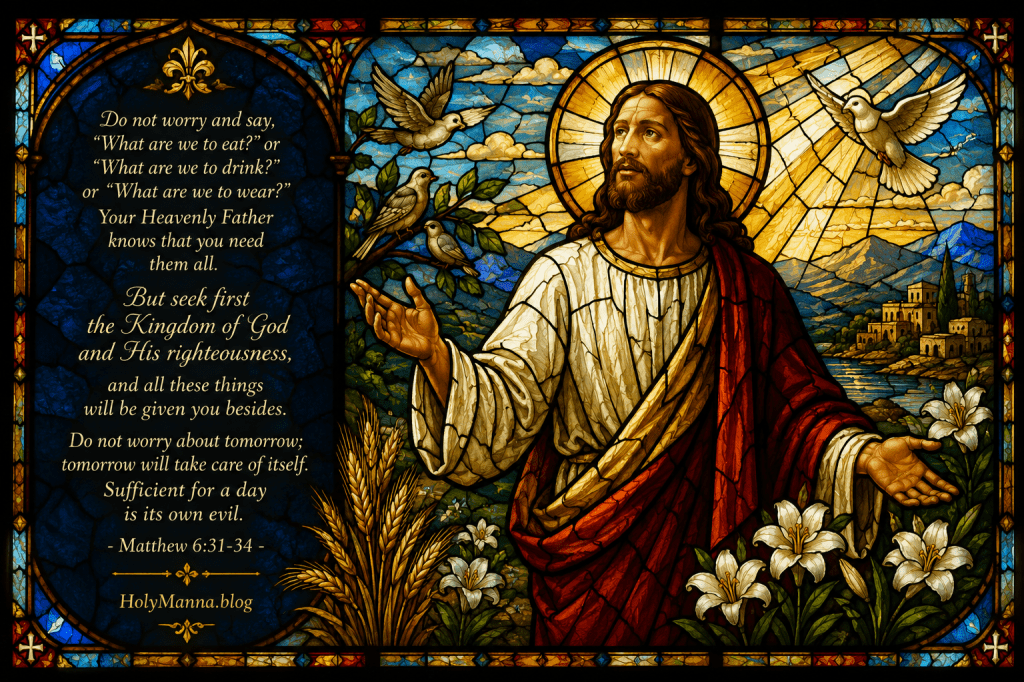
Dependence on God. 25 “Therefore I tell you, do not worry about your life, what you will eat [or drink], or about your body, what you will wear. Is not life more than food and the body more than clothing? 26 Look at the birds in the sky; they do not sow or reap, they gather nothing into barns, yet your heavenly Father feeds them. Are not you more important than they? 27 Can any of you by worrying add a single moment to your life-span? 28 Why are you anxious about clothes? Learn from the way the wild flowers grow. They do not work or spin. 29 But I tell you that not even Solomon in all his splendor was clothed like one of them. 30 If God so clothes the grass of the field, which grows today and is thrown into the oven tomorrow, will he not much more provide for you, O you of little faith? 31 So do not worry and say, ‘What are we to eat?’ or ‘What are we to drink?’ or ‘What are we to wear?’ 32 All these things the pagans seek. Your heavenly Father knows that you need them all. 33 But seek first the kingdom [of God] and his righteousness, and all these things will be given you besides. 34 Do not worry about tomorrow; tomorrow will take care of itself. Sufficient for a day is its own evil.
Detailed Exegesis
Verse 24 – “No one can serve two masters. He will either hate one and love the other, or be devoted to one and despise the other. You cannot serve God and mammon.”
Jesus begins with a hard line because the human heart needs clarity. He does not say that serving two masters is difficult. He says it is impossible. Mammon refers to wealth, possessions, and worldly security when they become objects of trust. Money itself can be used for good, especially when ordered toward family responsibility, justice, generosity, and care for the poor. But when mammon becomes master, it demands worship. It tells the soul that peace depends on having enough, earning enough, controlling enough, and protecting enough. Jesus exposes the lie. God alone can receive the whole heart because God alone can save it.
Verse 25 – “Therefore I tell you, do not worry about your life, what you will eat or drink, or about your body, what you will wear. Is not life more than food and the body more than clothing?”
The word “therefore” connects worry to worship. Jesus has just spoken about serving God or mammon, and now He addresses anxiety over basic needs. He is not mocking human concern. He is reordering it. Food, drink, and clothing matter, but they are not the meaning of life. The Father gives life before He gives food. He gives the body before He gives clothing. If God has given the greater gift, the disciple is invited to trust Him with the lesser needs too.
Verse 26 – “Look at the birds in the sky; they do not sow or reap, they gather nothing into barns, yet your heavenly Father feeds them. Are not you more important than they?”
Jesus turns creation into a classroom. Birds do not farm, harvest, or store grain in barns, yet they are fed by divine providence. This does not mean creatures do nothing. Birds still search, fly, and gather. The lesson is not passivity. The lesson is trust. The Father’s care reaches even the birds, and human beings are more precious because they are made in the image of God and called to communion with Him. The disciple is not an orphan trying to survive in a careless universe.
Verse 27 – “Can any of you by worrying add a single moment to your life-span?”
Jesus asks a question that every anxious heart needs to hear. Worry feels productive, but it cannot lengthen life. It cannot control tomorrow. It cannot make the soul holy. It often drains the strength needed for today’s duties. This does not mean that planning is wrong or that serious problems should be ignored. It means anxious control is not the same as faithful stewardship. Worry promises power but usually delivers exhaustion.
Verse 28 – “Why are you anxious about clothes? Learn from the way the wild flowers grow. They do not work or spin.”
Again, Jesus points to creation. Wildflowers do not weave or spin thread, yet they are clothed with beauty. In the ancient world, clothing often revealed social status, wealth, dignity, and security. Jesus knows that people worry not only about survival, but also about appearance, reputation, and being seen as enough. The flowers preach a quiet sermon. Beauty does not begin with self-display. It begins with receiving from God.
Verse 29 – “But I tell you that not even Solomon in all his splendor was clothed like one of them.”
Solomon was Israel’s great king of wisdom, wealth, and splendor. To say that a field flower surpasses Solomon is stunning. Jesus is not insulting Solomon. He is revealing the generosity of the Father. God gives beauty even to things that seem small, temporary, and overlooked. If earthly glory fades, and even royal splendor cannot compare to the simple beauty God gives creation, then the disciple should not build life around image, luxury, or status.
Verse 30 – “If God so clothes the grass of the field, which grows today and is thrown into the oven tomorrow, will he not much more provide for you, O you of little faith?”
Jesus now makes the argument personal. Grass is temporary. It grows today and is gone tomorrow, sometimes used as fuel for ovens. Yet God clothes it. If God cares for what is passing, how much more will He care for His children? The phrase “O you of little faith” is not a rejection. It is a loving correction. Jesus is calling anxious disciples to deeper trust. Worry is not just an emotional burden. It can reveal where faith still needs healing.
Verse 31 – “So do not worry and say, ‘What are we to eat?’ or ‘What are we to drink?’ or ‘What are we to wear?’”
Jesus names the repeated questions of anxiety. These are practical questions, but when they dominate the heart, they become spiritual noise. The Lord is not forbidding ordinary responsibility. He is forbidding the kind of worry that makes earthly needs the center of life. A disciple can shop, work, budget, cook, plan, and provide while still refusing to let those concerns become the master of the soul.
Verse 32 – “All these things the pagans seek. Your heavenly Father knows that you need them all.”
Jesus contrasts pagan striving with filial trust. In this context, “pagans” refers to those who do not know God as Father and therefore chase security as if everything depends on their own power. The Christian does not live that way. The Father knows. That simple truth changes everything. God’s knowledge is not distant observation. It is loving providence. He knows the real needs, the hidden fears, the unpaid bills, the family burdens, the aching body, and the anxious thoughts that never get spoken aloud.
Verse 33 – “But seek first the kingdom of God and his righteousness, and all these things will be given you besides.”
This is the heart of the passage. Jesus does not say to seek the Kingdom after life becomes stable. He says to seek it first. The Kingdom of God is the reign of God over the whole life: worship, work, money, family, habits, priorities, desires, and decisions. His righteousness is the life rightly ordered to God’s will. When God is first, created things return to their proper place. Food, clothing, money, and planning become gifts and responsibilities, not masters.
Verse 34 – “Do not worry about tomorrow; tomorrow will take care of itself. Sufficient for a day is its own evil.”
Jesus ends with holy realism. He does not say that tomorrow will have no trouble. He says not to carry tomorrow’s trouble before tomorrow arrives. Each day has enough of its own burden, and each day also has its own grace. The disciple is called to faithfulness today, not imaginary control over every possible future. This is deeply practical. God gives daily bread, not a lifetime of bread held anxiously in advance. The Father meets His children in the present moment.
Teachings
This Gospel teaches that the spiritual life is not only about avoiding obvious sin. It is about ordering love correctly. Jesus says, “You cannot serve God and mammon.” Matthew 6:24 That means the heart must decide what will be ultimate. God may be loved above all, or mammon may be treated like a savior. But the two cannot share the throne.
The Catechism gives a direct warning about this danger when it teaches: “A theory that makes profit the exclusive norm and ultimate end of economic activity is morally unacceptable. The disordered desire for money cannot but produce perverse effects. It is one of the causes of the many conflicts which disturb the social order.” CCC 2424
This does not condemn work, business, investment, earning a living, or providing for a family. Catholic teaching honors honest labor and responsible stewardship. The problem is not money in its proper place. The problem is money as master. When profit becomes the ultimate end, the human person gets pushed aside. When financial security becomes the soul’s deepest trust, God is treated as secondary.
The Catechism also connects Jesus’ words to divine providence: “Jesus asks for childlike abandonment to the providence of our heavenly Father who takes care of his children’s smallest needs: ‘Therefore do not be anxious, saying, “What shall we eat?” or “What shall we drink?”… Your heavenly Father knows that you need them all. But seek first his kingdom and his righteousness, and all these things shall be yours as well.’” CCC 305
This is the Catholic heart of the Gospel. The Father is not indifferent. He cares for the smallest needs of His children. Yet this trust is childlike, not childish. Childlike trust still works, prays, sacrifices, plans, and takes responsibility. It simply refuses to live as if God has disappeared.
That is why the Church also teaches about daily bread with a helpful balance: “Taken in a temporal sense, this word is a pedagogical repetition of ‘this day,’ to confirm us in trust ‘without reservation.’ Taken in the qualitative sense, it signifies what is necessary for life, and more broadly every good thing sufficient for subsistence. Taken literally, it refers directly to the Bread of Life, the Body of Christ, ‘the medicine of immortality,’ without which we have no life within us.” CCC 2837
This teaching helps reveal the depth of Jesus’ command not to worry. The Father provides daily bread, but the deepest bread is Christ Himself in the Eucharist. The anxious soul does not only need bills paid and food on the table, although those needs matter. The soul needs communion with the Lord. Without Him, even a full pantry can leave a heart starving.
St. John Chrysostom, preaching on this Gospel, explains why Jesus speaks of mammon as a master. He says, “He calls mammon here a master, not because of its own nature, but on account of the wretchedness of them that bow themselves beneath it.” Homily 21 on Matthew
That line is timeless. Money is not a god by nature, but fallen human beings can bow beneath it. The same can happen with career, reputation, comfort, control, politics, entertainment, and even the approval of others. Anything created can become tyrannical when it receives the trust that belongs to the Creator.
St. Augustine’s teaching on rightly ordered love also helps illuminate this Gospel. In The City of God, he writes: “Two loves have made two cities: love of self, even to contempt of God, made the earthly city; love of God, even to contempt of self, made the heavenly city.” This is exactly what Jesus is teaching. The heart that serves mammon belongs to the logic of the earthly city. The heart that seeks first the Kingdom belongs to the city of God.
The Gospel also connects with the first reading. Joash’s heart became divided, then disordered. He listened to the powerful instead of the prophet. He chose idols instead of the house of the Lord. He protected his pride instead of receiving correction. Jesus gives the antidote: undivided service, trust in the Father, and the Kingdom first.
Reflection
This Gospel is tender, but it is not soft. Jesus is gentle with anxious hearts, but He is firm about false masters. He knows how easily worry can become a daily habit and how quickly money can become a spiritual ruler. He also knows that the Father’s children were not made to live like orphans.
A person can believe in God and still live as if everything depends on control. A person can pray on Sunday and still let mammon set the emotional temperature of the week. A person can say that God is Father while carrying tomorrow like a private punishment. Jesus steps into that tension and says, “Seek first the kingdom of God and his righteousness.” Matthew 6:33
That means the day should begin by returning the heart to God. Before the phone, before the inbox, before the budget, before the worry spiral, the soul needs to remember who the Father is. Prayer is not decorative. It is reorientation. It tells the heart, “God is first, and everything else must take its proper place.”
A practical response to this Gospel can be simple and concrete. Place prayer at the beginning of the day. Make financial decisions with generosity and justice, not fear. Practice gratitude before making complaints. Choose Sunday Mass even when life feels busy. Bring anxiety honestly to the Lord instead of pretending it is not there. When worry about tomorrow rises, ask for the grace to be faithful to today.
There is also a call to examine what mammon looks like personally. For one person, mammon may be money. For another, it may be career status. For another, it may be the need to appear successful. For another, it may be comfort, security, beauty, influence, or control. The false master is whatever quietly says, “Without me, you will not be safe.”
Christ answers that lie with the Father’s care. The birds are fed. The flowers are clothed. The grass is adorned. The Father knows what His children need. The disciple’s task is not to control every outcome. The disciple’s task is to seek the Kingdom first and trust that grace will be given for today.
What has been acting like a master in your life, even if you have never called it one?
Where has worry been taking up space that belongs to trust?
What would it look like today to seek first the Kingdom of God in your money, schedule, relationships, and decisions?
Can the Father be trusted with tomorrow while you are faithful to Him today?
Let the Father Take the Throne Again
Today’s readings leave the heart with a clear and honest invitation: choose the Master who gives life.
Joash shows what happens when a soul forgets grace and listens to voices that flatter instead of voices that lead back to God. He had received mercy, protection, priestly guidance, and a restored place of worship, yet he abandoned the house of the Lord and silenced the prophet who called him to repentance. His story is a warning that faith cannot remain borrowed forever. Every heart must personally decide whether God will be obeyed, trusted, and loved above all things.
Psalm 89 answers that tragedy with covenant hope. God does not pretend sin is harmless. He corrects His people when they forsake His commandments. Yet He also promises, “But I will not take my mercy from him, nor will I betray my bond of faithfulness.” Psalm 89:34 This is the steady heartbeat beneath the whole day: human beings may drift, but God remains faithful. His mercy does not excuse idolatry, but it keeps calling sinners home.
Then Jesus brings everything to the center of daily life in The Gospel of Matthew: “No one can serve two masters.” Matthew 6:24 The idols of Judah may seem ancient, but the modern heart still knows how to bow before money, control, comfort, reputation, fear, and tomorrow’s anxieties. Christ does not expose these false masters to shame His disciples. He exposes them to free them. The Father knows what His children need, and the anxious soul is invited to seek first the Kingdom instead of carrying tomorrow as if grace will not be waiting there.
The Catechism teaches, “Jesus asks for childlike abandonment to the providence of our heavenly Father who takes care of his children’s smallest needs.” CCC 305 That is not a call to laziness. It is a call to trust. The Christian still works, plans, provides, repents, and takes responsibility, but does not live like an orphan. The Father is not far away. The King is faithful. The Kingdom is worth seeking first.
So today, let the heart come back to the Lord with honesty. Name the false master. Renounce the idol. Receive correction as mercy. Give thanks for the people who have helped form your faith. Return to prayer, return to Confession, return to the Eucharist, return to the Father who has not forgotten His covenant.
The birds are fed. The flowers are clothed. The Son of David reigns. The Father knows what His children need.
What would change today if God truly held first place in your heart?
Where is Jesus asking you to stop worrying and start trusting?
What false master needs to lose its throne so the Kingdom of God can come alive in you again?
Engage with Us!
Share your reflections in the comments below, especially how today’s readings are speaking to your heart and where God may be inviting you to trust Him more deeply.
- For the First Reading from 2 Chronicles 24:17-25: Like Joash, are there any voices in your life that have been pulling you away from faithfulness to God instead of drawing you closer to Him?
- For the Responsorial Psalm from Psalm 89:4-5, 29-34: Where do you need to remember that God’s mercy remains faithful, even when sin, weakness, or discouragement makes the spiritual life feel heavy?
- For the Holy Gospel from Matthew 6:24-34: What false master, such as money, control, comfort, approval, or worry, has been asking for the trust that belongs to the Father alone?
- For today’s central theme: What would it look like in your daily life to seek first the Kingdom of God before seeking security, success, or control?
May today’s readings help every heart return to the faithful Father, trust His providence, and live with the freedom of children who know they are loved. Let every decision, conversation, sacrifice, and act of service be done with the love and mercy Jesus taught us.
Sacred Heart of Jesus, we trust in You!
Immaculate Heart of Mary, pray for us!
Saint Michael the Archangel, defend us in battle!
Follow us on YouTube, TikTok, Instagram and Facebook for more insights and reflections on living a faith-filled life.

 Holy Manna!
Leave a comment