The Brothers Who Spoke After Death
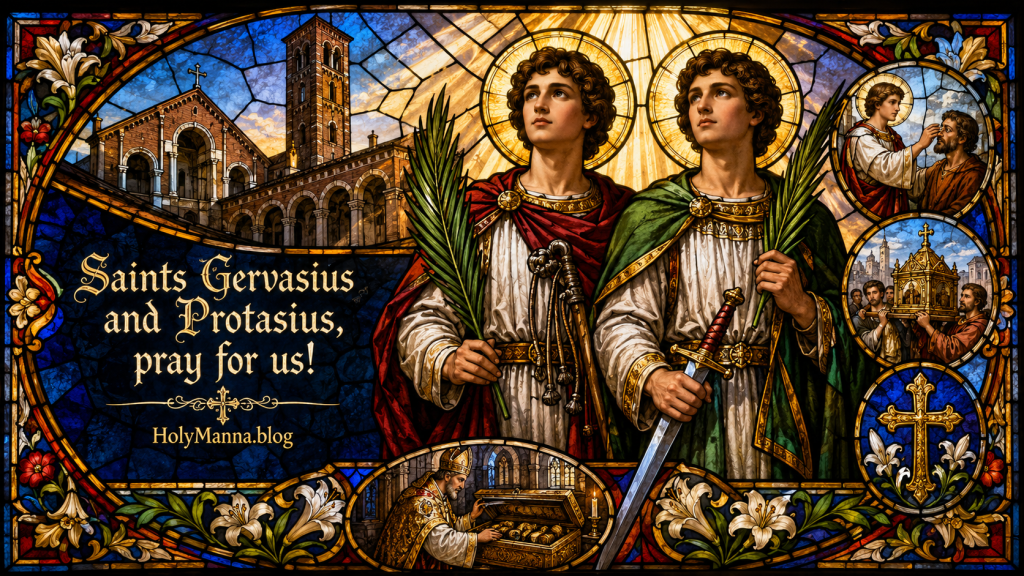
Saints Gervasius and Protasius are among the ancient martyrs of Milan, remembered in Catholic tradition as twin brothers who gave their lives for Christ. Their feast is celebrated on June 19, and they are honored as patrons of Milan, haymakers, and those seeking the discovery of thieves. They are also associated with the symbols of the scourge, club, and sword, because tradition says one brother was scourged to death and the other was beaten and beheaded.
Their story is unusual because the most historically powerful part of their legacy happened long after their martyrdom. For years, their bodies rested hidden beneath the earth, their names known to God even when their memory had faded among men. Then, in the fourth century, Saint Ambrose of Milan discovered their relics during one of the most tense moments in the Catholic Church’s struggle against Arianism.
That is what makes their story so moving. Gervasius and Protasius were not famous because they built a monastery, wrote a theological masterpiece, or preached before kings. They were famous because they belonged completely to Christ, even unto death. Then, when the Church in Milan needed courage, God allowed their hidden witness to rise again.
The Catechism teaches in CCC 2473, “Martyrdom is the supreme witness given to the truth of the faith: it means bearing witness even unto death.” That sentence describes the whole meaning of Saints Gervasius and Protasius. Their bodies were buried, but their testimony was not dead. Their voices had been silenced by persecutors, but the Church would hear them again.
Born Into a Family of Witnesses
The early life of Gervasius and Protasius is known mostly through Catholic tradition and later hagiographical accounts. They are traditionally described as twin brothers, born into a Christian family of noble standing. Their parents were Saint Vitalis and Saint Valeria, both remembered as martyrs.
According to tradition, their father, Vitalis, was martyred at Ravenna, and their mother, Valeria, later died for the faith at Milan. Some details of this family story come from later accounts that cannot be fully verified, but the tradition has long shaped the Catholic memory of these saints. Their lives are presented as part of a household that did not merely believe in Christ privately, but followed Him all the way to sacrifice.
After the martyrdom of their parents, tradition says Gervasius and Protasius distributed their inheritance to the poor and freed their servants. This detail is beautiful because it reveals the heart of Christian discipleship. They did not cling to rank, wealth, or security. They lived as men who already understood that everything belongs to God.
Their exact date of martyrdom is uncertain. Some ancient traditions placed their death during the reign of Nero, while other historians suggest a later date, perhaps in the second century, around the reign of Antoninus. What remains central in Catholic memory is not the exact political timeline, but the witness itself. These brothers were remembered by the Church as martyrs of Milan, men who refused to deny Christ when faithfulness became dangerous.
A Quiet Life of Fidelity
Very little can be stated with certainty about the daily lives of Gervasius and Protasius before their martyrdom. No verified writings from them survive, and there are no historically secure personal sayings that can be confidently attributed to them. Their holiness is not preserved through sermons or letters, but through witness.
That silence itself teaches something important. Not every saint leaves behind a library. Not every holy person is remembered because of public achievements. Some saints are remembered because, when the decisive hour came, they chose Christ.
The tradition that they gave their wealth to the poor shows the kind of Christian men the Church believes them to have been. They were formed by martyr parents, shaped by sacrifice, and detached from the false promises of the world. If their story feels hidden, that is part of its power. They remind Catholics that hidden holiness is still real holiness.
In ordinary life, this matters. Most people will never be asked to stand before a pagan judge. Most people will never be threatened with death for refusing to worship an idol. Yet every Christian is asked, in small ways, to choose Christ over comfort, truth over approval, and holiness over convenience.
What parts of daily life quietly reveal whether Christ truly comes first?
That is the kind of question Saints Gervasius and Protasius place before the heart.
Faith Under Pressure
The traditional account of their martyrdom says that a pagan official named Astasius was preparing for war and consulted pagan priests. According to the legend, the priests claimed that the gods would not grant success unless Gervasius and Protasius were forced to sacrifice to them. This story comes from later hagiographical tradition, so it should be understood as a devotional legend rather than a fully verified historical record.
In the story, Gervasius refused to offer sacrifice to false gods. For that refusal, he was scourged with leaded whips until he died. Protasius was then commanded to abandon Christ. He also refused. Tradition says he was beaten with rods and then beheaded.
A saying attributed to Protasius in later legend has him speaking to his persecutor with pity rather than hatred: “I have great pity of thee.” Since this comes from later tradition, it should not be treated as a verified historical quotation. Still, it captures the Catholic spirit of martyrdom. The martyr does not look at the persecutor with revenge. The martyr sees a soul in danger and remains free in Christ.
That is a hard lesson for modern Catholics. The world often teaches that strength means domination, sarcasm, anger, or proving everyone wrong. The martyrs teach something different. Real strength is fidelity. Real courage is refusing to betray Christ, even when compromise looks easier.
Gervasius and Protasius show the calm courage of souls that belong to God. Their persecutors could wound their bodies, but they could not take away their victory in Christ.
Buried by the World, Remembered by God
For generations, the bodies of Gervasius and Protasius rested hidden. Then came one of the most dramatic moments in the history of the Church in Milan.
In the year 386, Saint Ambrose was bishop of Milan. He was locked in a fierce conflict with the Arian party, which denied the full divinity of Christ. Empress Justina supported the Arians and pressured Ambrose to surrender a Catholic basilica for Arian worship. The Catholic faithful stood with their bishop, keeping watch in the church, ready to suffer rather than surrender the faith.
During this crisis, Ambrose desired to consecrate a basilica with the relics of martyrs, as was done in Rome. Then, according to his own testimony and the witness of Saint Augustine, the location of the martyrs’ bodies was revealed. Ambrose ordered digging near the church of Saints Nabor and Felix, and the bodies of Gervasius and Protasius were found.
Saint Ambrose wrote of the discovery, “We found two men of marvellous stature.” He described their bones as complete and noted the presence of much blood. The bodies were brought first to the Basilica of Fausta, where the faithful kept vigil, and then solemnly translated to the basilica that would become deeply associated with Ambrose himself.
This discovery was not just an archaeological event. For the Catholic faithful of Milan, it was a sign of heavenly encouragement. At the exact moment when the Church was under pressure from false teaching, the martyrs appeared as defenders of the true faith.
Saint Augustine, who was in Milan at the time and still on the road toward baptism, later wrote about this event. He saw how the discovery strengthened the Catholic people and helped restrain the fury of those opposing Ambrose.
Here the story becomes almost cinematic. The Church is under pressure. The faithful are anxious. A holy bishop stands firm. Then the hidden bodies of the martyrs are found, as if God were saying that the saints are not absent from the battle. They are alive in Christ, and they still stand with the Church.
The Blind Man Who Saw
The most famous miracle associated with Saints Gervasius and Protasius happened during the translation of their relics. A blind man, known in tradition as Severus, was brought near the martyrs’ bodies. According to Saint Augustine, he touched the bier with a cloth, placed the cloth to his eyes, and immediately received his sight.
This miracle was not reported in some remote corner where no one could verify that anything had happened. Saint Augustine says it became widely known because it occurred in a great city, before a large crowd, while public attention was fixed on the martyrs’ relics.
Saint Ambrose also testified that a blind man was healed during the translation. Other accounts say that people afflicted by sickness and demonic oppression were also healed in connection with the relics of the martyrs.
The Catholic meaning of this miracle is not that relics are magic. The Church has never taught that. Relics are holy because they are connected to holy people who belonged to Christ. God may choose to work through them, not because the object has power apart from Him, but because He delights in honoring His saints and helping His people.
The Catechism teaches in CCC 956 that the saints “do not cease to intercede with the Father for us.” The miracles connected with Gervasius and Protasius point to that Catholic belief. The saints are not dead members of a forgotten past. They are alive in Christ, praying for the Church, and still united to the faithful through the communion of saints.
Saints Who Guarded a City
After their discovery, the relics of Gervasius and Protasius were placed beneath the altar in the basilica built by Saint Ambrose. When Ambrose died in 397, he was buried near them. This created one of the great sacred centers of Milanese Catholic life.
The basilica became known as a place of pilgrimage, prayer, and identity for the Church in Milan. Over time, the relics of Ambrose, Gervasius, and Protasius were kept together, linking the great bishop with the martyrs whose discovery had strengthened his people.
Their veneration spread rapidly beyond Milan. Churches were dedicated to them in Italy, Gaul, and Rome. Their names entered the Litany of the Saints, which shows how deeply they became woven into the prayer of the Church. In the Ambrosian tradition especially, they remained part of the spiritual memory of Milan.
Their relics also inspired sacred art. In the Basilica of Sant’Ambrogio, they appear in mosaics and artistic programs that present them not merely as figures from the past, but as heavenly intercessors and protectors of the Church.
There are also later medieval traditions claiming that some relics associated with them were taken to places such as Breisach in Germany and Soissons in France. These traditions are historically contested, and Milan has rejected certain claims about the removal of their relics. Still, the existence of those traditions shows how far their devotion spread and how greatly medieval Catholics desired closeness to the martyrs.
Legends, Memory, and a Surprising Modern Discovery
Several stories and legends grew around Saints Gervasius and Protasius over the centuries. One later version says Saint Ambrose saw two young men in white who revealed the place of their burial. Another version says Saint Peter appeared and showed Ambrose where to dig. These are beautiful devotional traditions, but they cannot be verified in every detail.
Another legendary connection places Gervasius and Protasius near the story of Saints Nazarius and Celsus. Some accounts say Nazarius encouraged or visited them during imprisonment. This also belongs to later hagiographical tradition and should be treated as a pious story rather than certain history.
One especially surprising fact is that modern study of the remains preserved in Milan has supported several elements of the ancient tradition. Scientific examination found that the two martyrs were young men, likely in their twenties, unusually tall, and closely related. One showed signs consistent with decapitation, while the other showed signs of traumatic injury. These findings do not prove every legend, but they do fit the long Catholic memory of two young brother martyrs whose bodies bore signs of violent death.
That is remarkable. After so many centuries, the bones themselves still seem to echo the old story. Two brothers. Young men. Violent death. Hidden in the earth. Raised again in the memory of the Church.
The Lesson of the Hidden Martyrs
Saints Gervasius and Protasius are saints for anyone who feels hidden, forgotten, or unseen. Their earthly story disappeared into silence for generations. Then, at the right moment, God brought their witness back into the life of the Church.
That is often how grace works. God does not waste hidden fidelity. He does not forget quiet sacrifices. He does not overlook the Christian who remains faithful in ordinary life, even when no one applauds.
Their story also reminds Catholics that the faith is worth defending. They died rather than worship false gods. Later, their relics strengthened Catholics against Arianism, a heresy that attacked the truth of who Jesus is. In both moments, their witness points to the same truth: Jesus Christ is Lord, and no earthly pressure is worth betraying Him.
For daily life, their example is simple but demanding. Stay faithful when the faith feels unpopular. Give generously when the world says to cling tightly. Pray for courage when truth costs something. Remember that the saints are not distant museum figures, but living members of the Body of Christ who intercede for the faithful.
Where is Christ asking for quiet courage today?
What hidden act of faithfulness might God be asking for, even if no one else sees it?
Saints Gervasius and Protasius teach that holiness does not need a spotlight. It needs fidelity. Their bodies were hidden under the ground, but their witness was alive in the heart of God.
Engage with Us!
Share your thoughts and reflections in the comments below. Saints Gervasius and Protasius remind the Church that no act of faithful love is ever forgotten by God.
- What part of the story of Saints Gervasius and Protasius stands out the most to you?
- Have you ever felt like your faithfulness was hidden or unnoticed?
- Where might God be asking you to stand firm in truth with patience and charity?
- How does the healing of the blind man challenge you to trust more deeply in the intercession of the saints?
- What is one practical way you can live with greater courage and fidelity this week?
May the witness of Saints Gervasius and Protasius strengthen every heart that feels hidden, pressured, or tired. May their courage remind the faithful that Christ sees every sacrifice, honors every act of love, and calls His people to live with mercy, truth, and holy perseverance. Go forward with faith, and do everything with the love and mercy Jesus taught us.
Saints Gervasius and Protasius, pray for us!
Follow us on YouTube, TikTok, Instagram and Facebook for more insights and reflections on living a faith-filled life.

 Holy Manna!
Leave a comment