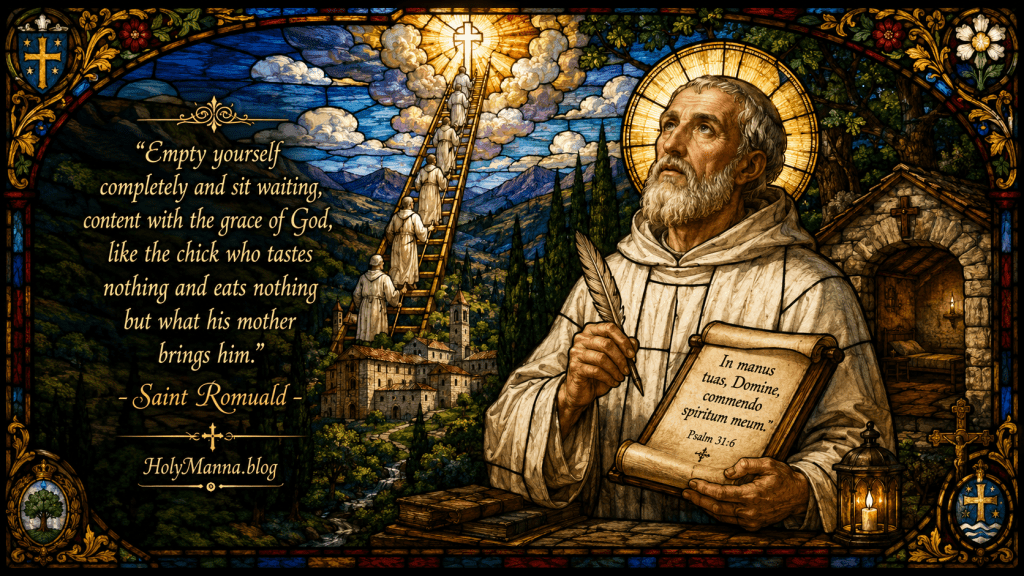
The Saint Who Found Paradise in Silence
Saint Romuald is one of the great hidden giants of Catholic history. He was an Italian nobleman’s son, a monk, a hermit, an abbot, a reformer, and the spiritual father of the Camaldolese Order. His life was not quiet because it was easy. It became quiet because he learned that the soul only becomes truly peaceful when it belongs completely to God.
He is especially remembered for renewing the hermit life in the Western Church and founding the Camaldolese tradition, a branch of the Benedictine family that combines community life with solitude, silence, prayer, fasting, and penance. He is honored as a patron of hermits, the Camaldolese, Camaldoli in Italy, and Suwalki in Poland.
His life beautifully reflects what The Catechism of the Catholic Church teaches about hermits, who “devote their life to the praise of God and salvation of the world through a stricter separation from the world, the silence of solitude and assiduous prayer and penance,” CCC 920. The Catechism also says the hidden life of the hermit is “a silent preaching of the Lord,” CCC 921. That is Saint Romuald in one sentence. His life preached Christ without needing applause.
A Duel, a Wound, and the Beginning of Conversion
Saint Romuald was born in Ravenna, Italy, probably around the year 950 or 951, into the noble Onesti family. Some older traditions claimed he lived to be 120 years old, placing his birth much earlier, but many modern Catholic scholars consider the later birth date more historically likely.
As a young man, Romuald grew up surrounded by noble privilege, wealth, and worldly expectations. He was not born into the desert. He was not raised in a quiet monastery. He came from a powerful family in a violent age, and the moment that changed his life was terrible.
When Romuald was about twenty years old, his father, Sergius, became involved in a duel over property. Romuald witnessed his father kill another man. The shock of that violence pierced him deeply. Although Romuald himself had not committed the killing, he felt the weight of sin and the need for penance. He fled to the Abbey of San Apollinare-in-Classe near Ravenna and began a period of penance, traditionally said to have lasted forty days.
That moment became the doorway of grace. What began as horror became conversion. What began as a family wound became a lifelong call to holiness.
Romuald entered monastic life, but he soon discovered that his hunger for God was more intense than the discipline around him. The monastery had been reformed, but Romuald still found the observance too relaxed. His zeal made some monks uncomfortable. In fact, one Catholic tradition describes him as almost “uncomfortably holy.” He corrected laxity, resisted compromise, and longed for a life stripped down to prayer, silence, and God.
Eventually, he received permission to leave the monastery and live under the guidance of a hermit named Marinus near Venice. There, Romuald began to learn the hard school of solitude.
One famous story from this time says that Romuald struggled while learning to read the Psalms. According to the tradition, Marinus would strike him when he made mistakes. After repeated blows to one side of his face, Romuald calmly said, “But, dear master, hit me on the right cheek in the future. My left ear is almost deaf.” The story is passed down as a sign of his patience and humility, though like many early medieval saint stories, it should be treated as a traditional account rather than something that can be verified in every detail.
The Restless Hermit Who Reformed Monasteries
Saint Romuald did not live a lazy solitude. His silence was not escape. It was mission.
Around the year 978, he became connected with Pietro Orseolo I, the Doge of Venice. Pietro was a powerful ruler who had been troubled by the violent circumstances surrounding his rise to power. With the influence of holy men, including Romuald, Pietro left political glory behind and became a Benedictine monk at the monastery of San Miguel-de-Cuxa in Catalonia. Romuald and Marinus built a hermitage nearby and continued their austere life of prayer.
This is one of the surprising things about Saint Romuald. He was a hermit, but his holiness reached powerful people. He had a gift for calling sinners, rulers, nobles, and monks back to God. His life reminds Catholics that silence is not weakness. A soul deeply rooted in God can shake the conscience of the powerful.
Romuald later returned to Italy when he heard that his father, Sergius, had become a monk but was wavering in his vocation. The son whose conversion began after witnessing his father’s violence now helped his father persevere in repentance. It is a beautiful reversal. Grace healed what sin had wounded.
For roughly thirty years, Romuald traveled through Italy founding and reforming monasteries and hermitages. He did not settle easily. He moved from place to place, not because he was unstable, but because he was consumed with reform. He wanted monks to remember why they had left the world in the first place.
He also desired martyrdom and tried to go to Hungary as a missionary, but illness repeatedly prevented him. That detail matters. Romuald’s solitude was never selfish. The Camaldolese tradition would later be described through the “triple good” of solitude, community life, and evangelization. Romuald wanted the desert, but he also wanted souls for Christ.
During his life, he became known for deep prayer, spiritual discernment, prophecy, and a powerful ability to guide souls. Some accounts attribute healings, visions, and other spiritual gifts to him, though many of these stories come from hagiographical tradition and cannot be verified with modern certainty. What can be said safely is that the Church remembers him as a man filled with the spirit of reform, penance, and contemplative prayer.
One of the most important spiritual moments in his life came during a period of dryness. While praying from Psalm 31, especially the line “I will give you understanding and I will instruct you,” Romuald received an extraordinary light and consolation that remained with him. He did not escape dryness by running from prayer. He stayed with the Psalms until grace broke through.
The Cross of False Accusation
Saint Romuald was not a martyr in the bloody sense. He was not executed for the faith. Yet his life was still marked by suffering, opposition, humiliation, and spiritual combat.
His zeal made enemies. Some monks resented him. Some communities resisted his reforms. His holiness exposed mediocrity, and not everyone wanted to be exposed.
One of the most painful stories from his life concerns a false accusation. According to Catholic tradition, a young nobleman whom Romuald had rebuked for sinful living accused him of a scandalous crime. Shockingly, the accusation was believed. Romuald was punished, forbidden to offer Mass, and unjustly excommunicated for a time. He endured the humiliation in silence.
That silence says a great deal about him. Romuald could be stern. He could rebuke sin. He could call monks to serious discipline. But when he was innocent and humiliated, he accepted the cross. His holiness was not merely toughness. It was crucified patience.
This is where Romuald becomes especially challenging for modern Catholics. It is one thing to speak boldly when others are wrong. It is another thing to remain faithful when others are wrong about you.
Camaldoli and the Vision of Monks Climbing to Heaven
Saint Romuald’s most famous foundation was Camaldoli in Tuscany. Around the year 1012, he came into the Diocese of Arezzo. According to a famous tradition, a man named Maldolus had a vision of monks dressed in white ascending a ladder into Heaven. Maldolus gave land to Romuald, and the place became known as Campus Maldoli, later Camaldoli.
There Romuald built five hermit cells and a small oratory. This became the spiritual seed of the Camaldolese Order. Later, a monastery developed lower down the mountain, allowing the hermits to preserve solitude while still being connected to a wider monastic community.
This is the genius of Saint Romuald’s vision. He did not simply create isolated hermits. He helped form a way of life where solitude and community supported one another. The Camaldolese monk could live hidden in prayer while still belonging to the Church in obedience, liturgy, and charity.
This is why sacred art often shows Saint Romuald in a white monastic habit, pointing toward a ladder where white-robed monks climb toward Heaven. The image is not just decorative. It tells the whole story. Romuald taught that the cell, the Psalms, silence, obedience, and penance could become a ladder to God.
His most famous spiritual teaching is known as the Brief Rule of Saint Romuald. It was preserved through Saint Bruno of Querfurt and remains one of the treasures of Camaldolese spirituality. Romuald taught: “Sit in your cell as in paradise. Put the whole world behind you and forget it. Watch your thoughts like a good fisherman watching for fish. The path you must follow is in the Psalms, never leave it.”
He continued: “If your mind wanders as you read, do not give up; hurry back and apply your mind to the words once more.”
He also taught: “Realize above all that you are in God’s presence, and stand there with the attitude of one who stands before the emperor.”
And then he offered one of the most tender images in monastic spirituality: “Empty yourself completely and sit waiting, content with the grace of God, like the chick who tastes nothing and eats nothing but what his mother brings him.”
Another saying attributed to him is: “Better to pray one psalm with devotion and compunction than a hundred with distraction.”
These are not soft words, but they are deeply merciful. Romuald understood distraction, weakness, and spiritual struggle. His answer was not panic. His answer was to return to God again, and again, and again.
A Hidden Death and a Legacy That Would Not Stay Hidden
Near the end of his life, Saint Romuald returned to Val-di-Castro. He had reportedly prophesied that he would die there alone and unaided. On June 19, 1027, he died alone in his cell.
It was a fitting death for a father of hermits. The man who taught others to sit in the cell as in paradise passed from the silence of the cell into the eternal presence of God.
After his death, many miracles were reported at his tomb. An altar was permitted over his tomb in 1032, only a few years after his death, which shows how quickly devotion to him spread. His body was later said to have been found incorrupt in 1466, and his relics were translated to Fabriano in 1481. Some later accounts give different details about the condition of his body after exhumation, so the safest way to say it is that Catholic tradition strongly associates Saint Romuald with incorrupt relics and miracles after death, though some details vary in later retellings.
His relics became an object of veneration, and his memory remained especially important in Camaldoli and Fabriano. His feast is celebrated on June 19, the day of his death. In older calendars, his feast was celebrated on February 7, connected with the translation of his relics.
His legacy continued through the Camaldolese Order, which remains active in the Church. The Camaldolese tradition produced monks, scholars, missionaries, reformers, and saints. It also had a broader cultural impact, especially through Camaldoli, which became a place of prayer, learning, hospitality, and reflection. Centuries after Romuald’s death, Camaldoli remained important not only as a monastic center, but also as a place where Catholic thought influenced culture and society.
Romuald’s influence also touched women’s monastic life. Catholic tradition connects him with the founding or encouragement of monasteries for women, including a house for the ancillarum Dei, meaning “servants of God.” Some details about these foundations are difficult to verify completely, but the tradition shows that his reforming spirit was not limited to men’s monasteries.
The Saint Who Teaches the Soul to Be Still
Saint Romuald’s life is not easy to imitate on the surface. Most Catholics are not called to live in a hermit cell in the mountains of Tuscany. Most Catholics are called to family life, parish life, work, service, and ordinary responsibilities. But the heart of Romuald’s witness is for every Catholic.
He teaches that silence is not empty. Silence can become the place where God speaks.
He teaches that penance is not despair. Penance is the road home.
He teaches that holiness is not always comfortable. Sometimes a saint makes people uneasy because his life reveals how much compromise has become normal.
He teaches that prayer does not need to be impressive. One psalm prayed with attention and love is better than a hundred prayers rushed without the heart.
He teaches that distraction is not defeat. When the mind wanders, the soul can return. When prayer feels dry, the soul can remain. When the world feels loud, the heart can still seek God.
There is something deeply needed about Saint Romuald today. Modern life is noisy, distracted, restless, and constantly entertained. Romuald stands as a holy contradiction. He says that the soul does not need more noise to be healed. It needs God.
Where is God inviting the soul to become quiet again?
The lesson is not that every Catholic must become a hermit. The lesson is that every Catholic needs some kind of interior cell. A place of prayer. A place without performance. A place where the phone is set down, the noise is quieted, and the heart stands before God.
Saint Romuald’s life reminds the Church that holiness often begins when a person stops running from silence.
Engage with Us!
Share your thoughts and reflections in the comments below. Saint Romuald’s life is a powerful reminder that God can turn even restlessness, family wounds, and painful memories into a path of holiness.
- What part of Saint Romuald’s story challenges you the most?
- Do you find silence peaceful, uncomfortable, or difficult? Why?
- Where could you create a small “interior cell” for prayer in your daily life?
- What would it look like to pray one psalm slowly and with real attention this week?
- How can Saint Romuald’s example help you return to God when your mind feels distracted or your soul feels restless?
Saint Romuald shows that a life hidden with God is never wasted. May his example inspire every heart to seek silence, return to prayer, and live with the faithful love and mercy Jesus taught us.
Saint Romuald, pray for us!
Follow us on YouTube, TikTok, Instagram and Facebook for more insights and reflections on living a faith-filled life.

 Holy Manna!
Leave a comment