Friday of the Eleventh Week in Ordinary Time – Lectionary: 369
When the Heart Crowns Its King
Every soul has a throne, and today’s readings ask a simple but searching question: Who, or what, is sitting there?
In 2 Kings 11:1-4, 9-18, 20, the kingdom of Judah is shaken by Athaliah, a queen who clings to power so fiercely that she tries to destroy the royal line of David. Her violence is not only political. It is spiritual. She threatens the covenant promise God made to David, the promise that his line would endure and that his throne would point forward to the Messiah. Yet hidden in the house of the Lord is Joash, the young heir preserved by God’s quiet providence. While false power rules in public, the true king is protected in the Temple.
That hidden king prepares the heart for the promise sung in Psalm 132:11-14, 17-18, where the Lord declares, “Your own offspring I will set upon your throne.” The Psalm reminds Israel that God does not forget His covenant, even when human sin seems to place everything in danger. The Lord chooses Zion, preserves the lamp of David, and keeps alive the hope that will be fulfilled in Jesus Christ, the true Son of David and eternal King. As The Catechism teaches, Jesus is the Christ, the Anointed One, in whom the messianic hope of Israel reaches its fullness.
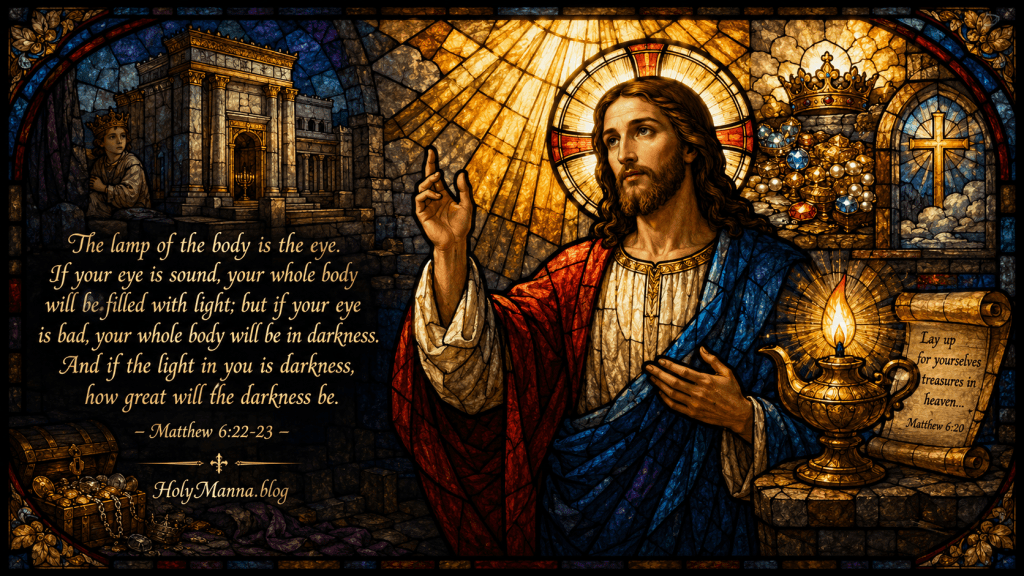
Then, in Matthew 6:19-23, Jesus brings the whole drama into the heart. He says, “For where your treasure is, there also will your heart be.” Athaliah treasures power, and her heart becomes dark. Jehoiada treasures the covenant, and his courage restores worship. The Psalm treasures God’s promise, and it becomes a song of hope. The Gospel reveals the root beneath it all: whatever the heart treasures will eventually shape its vision, its choices, and its worship.
Today’s readings are about more than an ancient queen, a rescued child, and a warning against earthly wealth. They are about the battle between false rule and holy surrender. They ask whether the heart is storing up treasures that decay, or treasures that lead to heaven. They ask whether the eye of the soul is filled with light, or clouded by lesser loves. Most of all, they invite every Catholic to let Christ be crowned again in the quiet places of daily life, where the true kingdom of God begins.
First Reading – 2 Kings 11:1-4, 9-18, 20
The Hidden King and the Covenant God Refused to Let Die
The first reading opens in one of the darkest political and spiritual moments in the history of Judah. Athaliah, the mother of King Ahaziah, sees that her son is dead, and instead of turning to God in grief, she reaches for power. She begins killing the royal heirs so that she can rule the kingdom herself. This is more than a family tragedy. It is an assault on the house of David, the royal line through which God had promised to bring lasting kingship and, ultimately, the Messiah.
Judah was not just another ancient kingdom. It carried the covenant promise made to David. God had sworn that David’s line would endure, and today’s Psalm will echo that promise: “Your own offspring I will set upon your throne.” That makes this reading deeply connected to today’s theme. Athaliah treasures power, and her heart becomes violent. Jehosheba treasures the promise, and her courage preserves the king. Jehoiada treasures the covenant, and his faithfulness restores worship. Before Jesus teaches in Matthew 6:19-23, “For where your treasure is, there also will your heart be,” the first reading shows that truth unfolding in the life of a kingdom.
This story also prepares Catholic readers to recognize how carefully God protects His saving plan. Joash, the hidden son of David’s line, is protected in the house of the Lord. The rightful king is concealed in the Temple while a false ruler occupies the throne. It is a striking image. The covenant seems fragile, but God is not absent. The promise seems hidden, but it is not dead. In the fullness of time, the preserved line of David will lead to Jesus Christ, the true Son of David, the eternal King whose reign cannot be destroyed by violence, fear, or sin.
2 Kings 11:1-4, 9-18, 20 – New American Bible (Revised Edition)
Death of the Heirs of Ahaziah of Judah. 1 When Athaliah, the mother of Ahaziah, saw that her son was dead, she began to kill off the whole royal family. 2 But Jehosheba, daughter of King Joram and sister of Ahaziah, took Joash, Ahaziah’s son, and spirited him away, along with his nurse, from the bedroom where the princes were about to be slain. He was concealed from Athaliah, and so he did not die. 3 For six years he remained hidden with her in the house of the Lord, while Athaliah ruled as queen over the land.
Death of Athaliah. 4 But in the seventh year, Jehoiada summoned the captains of the Carians and of the guards. He had them come to him in the house of the Lord, made a covenant with them, exacted an oath from them in the house of the Lord, and then showed them the king’s son.
9 The captains did just as Jehoiada the priest commanded. Each took his troops, both those going on duty for the week and those going off duty that week, and came to Jehoiada the priest. 10 He gave the captains King David’s spear and quivers, which were in the house of the Lord. 11 And the guards, with drawn weapons, lined up from the southern to the northern limit of the enclosure, surrounding the altar and the temple on the king’s behalf. 12 Then Jehoiada brought out the king’s son and put the crown and the testimony upon him. They proclaimed him king and anointed him, clapping their hands and shouting, “Long live the king!”
13 When Athaliah heard the noise made by the people, she came before them in the house of the Lord. 14 When she saw the king standing by the column, as was the custom, and the captains and trumpeters near the king, and all the people of the land rejoicing and blowing trumpets, Athaliah tore her garments and cried out, “Treason, treason!” 15 Then Jehoiada the priest instructed the captains in command of the force: “Escort her with a guard detail. If anyone follows her, let him die by the sword.” For the priest had said, “She must not die in the house of the Lord.” 16 So they seized her, and when she reached the Horse Gate of the king’s house, she was put to death.
17 Then Jehoiada made a covenant between the Lord and the king and the people, by which they would be the Lord’s people; and another between the king and the people. 18 Thereupon all the people of the land went to the temple of Baal and demolished it. They shattered its altars and images completely, and slew Mattan, the priest of Baal, before the altars. Jehoiada the priest appointed a detachment for the house of the Lord,
20 All the people of the land rejoiced and the city was quiet, now that Athaliah had been slain with the sword at the king’s house.
Detailed Exegesis
Verse 1 – “When Athaliah, the mother of Ahaziah, saw that her son was dead, she began to kill off the whole royal family.”
Athaliah responds to the death of her son with ruthless ambition. Instead of mourning as a mother, she acts as a usurper. Her first instinct is not mercy, but control. Spiritually, this verse reveals what happens when earthly power becomes the highest treasure of the heart. Once power becomes an idol, even family can become expendable. Athaliah’s violence also threatens the Davidic covenant because she tries to destroy the royal line through which God’s promise was being preserved.
Verse 2 – “But Jehosheba, daughter of King Joram and sister of Ahaziah, took Joash, Ahaziah’s son, and spirited him away, along with his nurse, from the bedroom where the princes were about to be slain. He was concealed from Athaliah, and so he did not die.”
Jehosheba becomes a quiet instrument of providence. She does not rule an army or sit on a throne, but her hidden courage protects the future of the kingdom. Joash is only a child, completely vulnerable, yet God preserves him through the brave action of one faithful woman. This verse reminds the Church that God often protects His promises through hidden fidelity. The most important acts in salvation history are not always public or praised. Sometimes they happen in bedrooms, nurseries, homes, churches, and quiet places where someone chooses courage over fear.
Verse 3 – “For six years he remained hidden with her in the house of the Lord, while Athaliah ruled as queen over the land.”
This verse gives the whole story its spiritual weight. The false queen rules in public, but the true heir is hidden in the house of the Lord. The Temple becomes the place where the covenant survives. For six years, it may have looked like Athaliah had won. Yet the promise was alive, hidden near the altar. This is often how God works in the life of faith. Grace can be hidden. Renewal can be hidden. Christ Himself can seem hidden, especially in the quiet mystery of the Eucharist, where the King of Kings comes under humble appearances.
Verse 4 – “But in the seventh year, Jehoiada summoned the captains of the Carians and of the guards. He had them come to him in the house of the Lord, made a covenant with them, exacted an oath from them in the house of the Lord, and then showed them the king’s son.”
The seventh year signals a moment of restoration. Jehoiada the priest acts not as a political schemer, but as a guardian of the covenant. He gathers the military leaders in the house of the Lord, binds them by oath, and reveals the hidden king. The setting matters. This plan begins in the Temple because the restoration of Judah is not merely political. It is religious. The kingdom must be placed back under God. Jehoiada understands that rightful rule must be ordered to the Lord, not personal ambition.
Verse 9 – “The captains did just as Jehoiada the priest commanded. Each took his troops, both those going on duty for the week and those going off duty that week, and came to Jehoiada the priest.”
The obedience of the captains shows that restoration requires disciplined cooperation. Jehoiada gives the command, but others must respond faithfully. In the spiritual life, renewal is rarely a vague feeling. It requires obedience, order, and concrete action. These guards place themselves at the service of the rightful king. Catholic discipleship asks for the same interior movement. The heart must stop serving false rulers and begin serving Christ with practical fidelity.
Verse 10 – “He gave the captains King David’s spear and quivers, which were in the house of the Lord.”
The weapons of David carry symbolic weight. They connect this restoration to the memory of David’s kingdom and the promises God made to him. These are not merely tools of defense. They are signs that the Davidic line is being protected. The past faithfulness of God becomes the strength for the present crisis. The Church lives with this same memory. Sacred Tradition, Scripture, the sacraments, and the witness of the saints remind Catholics that present battles are never fought alone. God’s faithfulness has a history.
Verse 11 – “And the guards, with drawn weapons, lined up from the southern to the northern limit of the enclosure, surrounding the altar and the temple on the king’s behalf.”
The guards surround the altar and the Temple on behalf of the king. This image joins worship and kingship together. The rightful king is protected in relation to the house of God. The altar stands at the center because the life of the kingdom must be ordered around the Lord. For Catholics, this points toward a deeper reality. Christ is King, and the center of Christian life is not a throne room of worldly power, but the altar where His sacrifice is made present in the Eucharist.
Verse 12 – “Then Jehoiada brought out the king’s son and put the crown and the testimony upon him. They proclaimed him king and anointed him, clapping their hands and shouting, ‘Long live the king!’”
The hidden heir is finally revealed. Joash receives the crown and the testimony, likely the covenant law associated with the king’s duty before God. His kingship is not meant to be independent from the Lord’s commandments. He is crowned and anointed, which reminds Catholic readers of the biblical pattern of anointed kings, priests, and prophets. This points forward to Jesus Christ, the Anointed One. In The Catechism, CCC 436 teaches: “The word ‘Christ’ comes from the Greek translation of the Hebrew Messiah, which means ‘anointed.’ It became the name proper to Jesus only because he accomplished perfectly the divine mission that ‘Christ’ signifies. In effect, in Israel those consecrated to God for a mission that he gave were anointed in his name. This was the case for kings, for priests and, in rare instances, for prophets. This had to be the case all the more so for the Messiah whom God would send to inaugurate his kingdom definitively. It was necessary that the Messiah be anointed by the Spirit of the Lord at once as king and priest, and also as prophet. Jesus fulfilled the messianic hope of Israel in his threefold office of priest, prophet and king.”
Verse 13 – “When Athaliah heard the noise made by the people, she came before them in the house of the Lord.”
Athaliah hears the sound of joy and comes to investigate. False power is disturbed by the sound of rightful worship. The rejoicing of the people signals that her rule is ending. Spiritually, this verse reveals how sin reacts when Christ begins to reclaim the heart. Disordered attachments do not leave quietly. Pride, control, resentment, and fear resist the restoration of the true King.
Verse 14 – “When she saw the king standing by the column, as was the custom, and the captains and trumpeters near the king, and all the people of the land rejoicing and blowing trumpets, Athaliah tore her garments and cried out, ‘Treason, treason!’”
Athaliah calls the restoration of the rightful king treason. This is one of the tragic ironies of the reading. The usurper accuses the true king of betrayal. Sin often does this in the soul. It calls repentance a threat. It calls obedience oppression. It calls surrender weakness. Athaliah’s words show how distorted the heart becomes when it treasures power more than truth. The rightful king is not committing treason. He is revealing that her reign was false.
Verse 15 – “Then Jehoiada the priest instructed the captains in command of the force: ‘Escort her with a guard detail. If anyone follows her, let him die by the sword.’ For the priest had said, ‘She must not die in the house of the Lord.’”
Jehoiada acts decisively but with reverence for the sacred place. Athaliah must be removed, but not killed in the house of the Lord. The Temple is not to be defiled by her death. This verse shows that justice and reverence belong together. Evil must be resisted, but even the resistance of evil must respect what is holy. In Catholic moral life, the end does not justify any means whatsoever. Actions must remain ordered to truth, justice, and reverence for God.
Verse 16 – “So they seized her, and when she reached the Horse Gate of the king’s house, she was put to death.”
Athaliah’s reign ends outside the Temple. Her death is sobering because it shows the final collapse of power that is built apart from God. She fought for the throne, but she could not keep it. She tried to destroy the promise, but the promise survived her. This verse reminds readers that earthly power is temporary. The Gospel will later say that earthly treasures can be destroyed by moth, decay, and thieves. Athaliah’s treasure was political control, and it disappeared.
Verse 17 – “Then Jehoiada made a covenant between the Lord and the king and the people, by which they would be the Lord’s people; and another between the king and the people.”
This is the heart of the reading. Jehoiada does not stop with a coronation. He renews the covenant. Judah must remember its identity. The people are not merely subjects of a king. They are the Lord’s people. This covenant renewal gives the whole restoration its meaning. In Catholic terms, this points toward the truth that God gathers a people for Himself. The Catechism, CCC 781, teaches: “At all times and in every race, anyone who fears God and does what is right has been acceptable to him. He has, however, willed to make men holy and save them, not as individuals without any bond or link between them, but rather to make them into a people who might acknowledge him and serve him in holiness. He therefore chose the Israelite race to be his own people and established a covenant with it. He gradually instructed this people. He revealed himself and his plan to them in its history, and made them holy. All these things, however, happened as a preparation for and figure of that new and perfect covenant which was to be ratified in Christ, and of the fuller revelation which was to be given through the Word of God himself made flesh.”
Verse 18 – “Thereupon all the people of the land went to the temple of Baal and demolished it. They shattered its altars and images completely, and slew Mattan, the priest of Baal, before the altars. Jehoiada the priest appointed a detachment for the house of the Lord.”
Covenant renewal leads to the destruction of false worship. The people cannot belong to the Lord while allowing Baal’s temple to remain as a rival center of devotion. This verse may sound severe to modern ears, but the spiritual lesson is clear. Idols must be removed, not politely managed. The heart cannot be fully given to God while false gods remain enthroned. For Catholics today, the idols may not be carved images of Baal, but they can still be real. Money, power, pleasure, control, status, ideology, and comfort can all become rival altars.
Verse 20 – “All the people of the land rejoiced and the city was quiet, now that Athaliah had been slain with the sword at the king’s house.”
The reading ends with joy and quiet. The false queen is gone, the rightful king has been crowned, the covenant has been renewed, and false worship has been torn down. The city becomes peaceful because the order of the kingdom has been restored. This is also an image of the soul. When sin rules, the interior life becomes noisy. When Christ is restored to the throne, the heart becomes quiet. Peace is not merely the absence of conflict. Peace is the fruit of right order under God.
Teachings
This reading reveals the faithfulness of God to His covenant. Athaliah tries to destroy the royal line, but God preserves Joash. The Davidic promise survives because God’s plan of salvation cannot be overturned by human violence. This matters for Catholics because the Davidic line finds its fulfillment in Jesus Christ. The hidden king in the Temple points beyond himself to the true King who fulfills the promises made to David.
The Catechism, CCC 439, teaches: “Many Jews and even certain Gentiles who shared their hope recognized in Jesus the fundamental attributes of the messianic ‘Son of David,’ promised by God to Israel. Jesus accepted his rightful title of Messiah, though with some reserve because it was understood by some of his contemporaries in too human a sense, as essentially political.”
That teaching helps explain why today’s first reading matters beyond ancient history. The kingship of Joash is part of the long road of expectation. Israel waits for the Son of David, but Jesus reveals that His kingship is greater than politics. He does not come merely to restore a national throne. He comes to establish the Kingdom of God.
This reading also teaches that covenant identity must shape public and personal life. Jehoiada restores the king, but he also renews the covenant between the Lord, the king, and the people. A kingdom cannot be holy merely because it has the right ruler. It must be ordered to God. In the same way, a Catholic life cannot be reduced to outward identity. Baptism must become daily fidelity. Worship must shape choices. The heart must belong to the Lord.
The Catechism, CCC 786, teaches: “Finally, the People of God shares in the royal office of Christ. He exercises his kingship by drawing all men to himself through his death and Resurrection. Christ, King and Lord of the universe, made himself the servant of all, for he came ‘not to be served but to serve, and to give his life as a ransom for many.’ For the Christian, ‘to reign is to serve him,’ particularly when serving ‘the poor and the suffering, in whom the Church recognizes the image of her poor and suffering founder.’ The People of God fulfills its royal dignity by a life in keeping with its vocation to serve with Christ.”
Athaliah shows the false meaning of kingship. She rules by domination. Christ reveals the true meaning of kingship. He reigns by self-giving love. Jehoiada’s restoration of the Davidic heir reminds the faithful that authority must serve the covenant, not the ego.
The saints often saw the Old Testament as a school of Christ. St. Augustine taught that the Old Testament is revealed in the New, and the New Testament is hidden in the Old. That principle helps Catholics read this passage with Christian eyes. Joash is not Christ, but his preservation belongs to the history that leads to Christ. The Temple is not the final dwelling of God among His people, but it points toward Christ, who is the true Temple. The anointing of the king is not the fullness of salvation, but it points toward Jesus, the Anointed One.
This reading also speaks to the danger of idolatry. The destruction of Baal’s temple shows that worship cannot be divided. The heart cannot serve the Lord while secretly enthroning a rival god. This prepares for the Gospel, where Jesus says, “Do not store up for yourselves treasures on earth.” The idol is not always something obviously wicked. Sometimes it is something good that has been treated as ultimate.
Reflection
This first reading invites the reader to look honestly at the throne of the heart. Athaliah is a dramatic figure, but her temptation is familiar. She wants control. She wants security. She wants the throne, even if she has to destroy others to keep it. Most people will never act with her violence, but the desire to control life can still become spiritually dangerous.
What happens in the heart when control becomes more important than trust?
Jehosheba gives a different example. She protects the vulnerable heir in secret. She does what is right when the cost could have been enormous. Her courage reminds Catholics that hidden acts of faithfulness matter. A parent protecting a child’s innocence, a worker refusing dishonesty, a young adult guarding purity, a parishioner praying quietly before the tabernacle, and a friend speaking truth with charity may all be doing more for the Kingdom than they realize.
What hidden act of fidelity is God asking for today?
Jehoiada also gives a strong model for the spiritual life. He does not only oppose Athaliah. He restores the covenant. That matters because the Christian life is not only about removing what is wrong. It is about enthroning what is right. A person can reject a bad habit, but the heart must also be filled with prayer, sacramental grace, Scripture, charity, and obedience to Christ.
What false altar needs to come down so Christ can reign more fully?
The ending of the reading is beautiful because the city becomes quiet. That is the promise of rightly ordered worship. When Christ is not on the throne, the soul becomes noisy with fear, comparison, resentment, and craving. When Christ is crowned again, peace begins to return. The problems of life may not disappear, but the heart starts to live under the right King.
A practical way to live this reading is to make a simple examination of spiritual loyalty. Before the end of the day, a Catholic can ask: What has been receiving the best attention, energy, and affection of the heart? If the answer is not God, then the reading becomes an invitation rather than a condemnation. The Lord is always ready to restore what sin has disordered.
The hidden Joash reminds the faithful that God’s promise may seem concealed, but it is not dead. The false queen may seem loud, but she does not get the final word. The covenant survives. The true King is revealed. The people rejoice. The city becomes quiet.
That is what Christ desires to do in every soul that lets Him reign.
Responsorial Psalm – Psalm 132:11-14, 17-18
The Lamp of David Still Burns
The responsorial Psalm feels like a holy song rising out of the chaos of the first reading. In 2 Kings 11:1-4, 9-18, 20, Athaliah tries to crush the royal line of David. For a moment, it looks like the promise is hanging by a thread. Then Psalm 132 answers with covenant confidence. The Lord has sworn an oath to David, and God does not break His word.
Historically, Psalm 132 is tied to Israel’s memory of David, Zion, and the Lord’s dwelling among His people. Zion, the hill of Jerusalem, became the sacred place associated with the Temple, the ark, worship, kingship, and God’s covenant presence. For Israel, the throne of David and the worship of the Lord were not meant to be separate realities. The king was supposed to govern under God, and the people were called to live as the Lord’s covenant people.
This Psalm fits today’s central theme beautifully. Athaliah treasures power, but the Psalm treasures the promise. Athaliah tries to seize the throne, but the Lord declares that He is the one who establishes it. Jesus will later teach in Matthew 6:19-23, “For where your treasure is, there also will your heart be.” In Psalm 132, the heart of Israel is invited to treasure what does not decay: the faithfulness of God, the dwelling place of God, and the coming King who will fulfill the promise made to David.
Psalm 132:11-14, 17-18 – New American Bible (Revised Edition)
11 The Lord swore an oath to David in truth,
he will never turn back from it:
“Your own offspring I will set upon your throne.
12 If your sons observe my covenant,
and my decrees I shall teach them,
Their sons, in turn,
shall sit forever on your throne.”
13 Yes, the Lord has chosen Zion,
desired it for a dwelling:
14 “This is my resting place forever;
here I will dwell, for I desire it.17 There I will make a horn sprout for David;
I will set a lamp for my anointed.
18 His foes I will clothe with shame,
but on him his crown shall shine.”
Detailed Exegesis
Verse 11 – “The Lord swore an oath to David in truth, he will never turn back from it: ‘Your own offspring I will set upon your throne.’”
This verse brings the Davidic covenant into focus. God’s oath to David is not a vague encouragement. It is a divine promise. The Lord swears “in truth,” which means His word is faithful, firm, and trustworthy. In the context of the first reading, this verse is powerful because Athaliah’s violence seems to threaten David’s line. Yet God’s promise stands. Joash survives because the Lord’s covenant has not failed. For Catholics, this promise ultimately points to Jesus Christ, the Son of David, whose Kingdom is eternal and whose throne cannot be overthrown by sin, death, or worldly power.
Verse 12 – “If your sons observe my covenant, and my decrees I shall teach them, Their sons, in turn, shall sit forever on your throne.”
This verse shows both promise and responsibility. The Davidic line is chosen, but the sons of David are still called to covenant faithfulness. Kingship in Israel was never supposed to be pure privilege. It was a sacred responsibility under the law of God. The king was not above the covenant. He was bound to serve the Lord and lead the people in righteousness. This helps explain why Judah falls into disorder when false worship and corrupt rule take over. God is faithful, but His people are still called to obedience. In the Christian life, this speaks directly to the heart. Baptism gives a real identity in Christ, but that identity must be lived through faith, worship, repentance, and daily obedience.
Verse 13 – “Yes, the Lord has chosen Zion, desired it for a dwelling.”
Zion is not chosen because of human greatness. It is chosen because God desires to dwell with His people. That is the deeper beauty of this verse. The Lord does not remain distant. He chooses a place, gathers a people, and makes His presence known. In Israel’s worship, Zion became the city of the Temple, the place of sacrifice, prayer, and covenant memory. For Catholics, this prepares the heart to understand the mystery of Christ and the Church. God’s desire to dwell with His people reaches its fullness in the Incarnation, when the Word becomes flesh, and continues sacramentally in the Eucharist, where Christ remains truly present among His people.
Verse 14 – “This is my resting place forever; here I will dwell, for I desire it.”
The Lord’s words are tender and majestic. God speaks of Zion as His resting place, not because He needs rest, but because He chooses to make His home among His people. The phrase “for I desire it” reveals divine love. God’s dwelling is not forced. It is chosen. The Lord wants to be with His people. This verse also invites a Catholic reading of the soul. By grace, the baptized person becomes a dwelling place of God. The question is whether the heart is welcoming the Lord as its true treasure, or crowding Him out with lesser loves.
Verse 17 – “There I will make a horn sprout for David; I will set a lamp for my anointed.”
The horn is a biblical symbol of strength, victory, and royal power. The lamp is a symbol of life, guidance, and continuity. In today’s readings, this verse is especially striking. Athaliah tries to extinguish David’s royal line, but God promises to set a lamp for His anointed. Joash is like that small lamp preserved in the Temple. The promise seems hidden, but it still burns. In the fullness of salvation history, this lamp points to Christ, the Anointed One. He is the true light that darkness cannot overcome.
Verse 18 – “His foes I will clothe with shame, but on him his crown shall shine.”
The Psalm ends with reversal. The enemies of God’s anointed will be clothed with shame, while the king’s crown will shine. This does not mean that God’s faithful ones never suffer. David suffered. Judah suffered. Christ Himself was crowned with thorns before being revealed in glory. But the final word belongs to God. False power may look impressive for a season, but it cannot outlast the covenant. Athaliah’s rule ends. The crown returns to the rightful heir. In Christ, the crown shines forever because His kingship is not built on domination, but on truth, sacrifice, and resurrection.
Teachings
The central teaching of Psalm 132 is that God keeps His covenant. This is why the Psalm belongs so naturally beside the first reading. Athaliah’s violence raises the question, Can human sin destroy God’s promise? The Psalm answers with confidence. The Lord swore an oath to David, and He will not turn back from it.
For Catholics, the Davidic promise is fulfilled in Jesus Christ. He is not simply one more king in David’s line. He is the Messiah, the Anointed One, the eternal Son who fulfills Israel’s hope. The Catechism, CCC 439, teaches: “Many Jews and even certain Gentiles who shared their hope recognized in Jesus the fundamental attributes of the messianic ‘Son of David,’ promised by God to Israel. Jesus accepted his rightful title of Messiah, though with some reserve because it was understood by some of his contemporaries in too human a sense, as essentially political.”
That last line matters. The people often expected the Messiah in political terms. They wanted liberation, restoration, victory, and a king who would fix the nation. Jesus is truly King, but His Kingdom is greater than earthly politics. He does not merely reclaim a throne in Jerusalem. He conquers sin and death. He reigns from the Cross. He gathers a people not by fear, but by grace.
This also deepens the meaning of Zion. In the Old Testament, Zion is the place of God’s chosen dwelling, tied to Jerusalem and the Temple. In the fullness of Catholic faith, God’s dwelling with His people reaches its highest expression in Christ. The Temple pointed toward Him. The sacrifices pointed toward His sacrifice. The royal promises pointed toward His kingship. The lamp of David becomes the light of Christ.
The Catechism, CCC 436, explains the title Christ with beautiful clarity: “The word ‘Christ’ comes from the Greek translation of the Hebrew Messiah, which means ‘anointed.’ It became the name proper to Jesus only because he accomplished perfectly the divine mission that ‘Christ’ signifies. In effect, in Israel those consecrated to God for a mission that he gave were anointed in his name. This was the case for kings, for priests and, in rare instances, for prophets. This had to be the case all the more so for the Messiah whom God would send to inaugurate his kingdom definitively. It was necessary that the Messiah be anointed by the Spirit of the Lord at once as king and priest, and also as prophet. Jesus fulfilled the messianic hope of Israel in his threefold office of priest, prophet and king.”
This Psalm also teaches the Catholic heart how to hope. Hope is not optimism based on circumstances. Hope is trust in the God who keeps His word. When Joash is hidden and Athaliah seems powerful, hope remembers the oath. When the Church seems wounded by scandal, confusion, or cultural hostility, hope remembers Christ’s promise. When the soul feels dry, tempted, or spiritually tired, hope remembers that the Lord still desires to dwell with His people.
St. Augustine often taught Christians to read the Psalms as the prayer of Christ and His Body, the Church. That helps this Psalm come alive. The promise to David is not dead history. It is fulfilled in Christ, and the Church now sings it as a people who know that the true King has come. The crown shines most fully on the risen Christ, and every Christian is invited to live under His reign.
Reflection
This Psalm is a steady voice in the middle of instability. It reminds the soul that God’s promises are stronger than human chaos. Athaliah may look powerful. The royal line may seem nearly destroyed. The future may look hidden in a Temple room. Yet the Lord still says, “I will set a lamp for my anointed.”
That is a word many hearts need. There are seasons when faith feels hidden, when prayers feel small, when the culture feels loud, and when the wrong things seem to be winning. The Psalm teaches that God does not need the spotlight to remain faithful. His lamp can burn quietly before it shines publicly.
Where does the promise of God feel hidden right now?
This Psalm also invites the faithful to treasure God’s covenant more than visible success. The world usually treasures what can be measured quickly: money, influence, image, comfort, and control. God’s people are called to treasure what endures: fidelity, worship, holiness, mercy, truth, and life with Him.
A practical way to live this Psalm is to return to the places where God has promised to meet His people. Go to Mass with a heart that remembers Zion. Sit before the tabernacle and remember that the Lord still desires to dwell with His people. Open Scripture and remember that God speaks in truth. Go to confession and remember that His covenant mercy is stronger than sin. Make the home a small place of worship through prayer, blessing, forgiveness, and holy conversation.
Is the heart being trained to trust God’s promise, or only what can be controlled?
The Psalm says, “This is my resting place forever; here I will dwell, for I desire it.” That line should humble and comfort every Catholic. God desires to dwell with His people. He is not reluctant. He is not cold. He is not a distant king who must be convinced to care. He chooses to come near.
The invitation today is to let Him dwell more deeply. Let Him enter the anxious places. Let Him reign over the disordered places. Let Him light the dark places. Let Him remind the soul that the crown still belongs to the true King.
When the heart treasures God’s promise, it begins to see differently. It stops panicking every time Athaliah makes noise. It stops believing that hidden means absent. It learns to wait in hope, worship in trust, and live as if Christ is already King, because He is.
Holy Gospel – Matthew 6:19-23
The Treasure That Trains the Heart to See
The Holy Gospel brings today’s theme directly into the soul. After hearing about Athaliah grasping for power in 2 Kings 11:1-4, 9-18, 20, and after singing of God’s faithful promise to David in Psalm 132:11-14, 17-18, Jesus now asks the question beneath every throne, every idol, and every desire: What does the heart treasure most?
This passage comes from the Sermon on the Mount, where Jesus teaches His disciples how to live as children of the Father. He is not giving shallow moral advice. He is forming citizens of the Kingdom of Heaven. In the ancient world, earthly treasure was fragile. Fine garments could be eaten by moths. Stored goods could decay. Metal wealth could corrode or be stolen. Houses were not always secure, and thieves could break through walls or dig in to steal what a person had spent years gathering.
Jesus uses that ordinary reality to expose a deeper spiritual truth. Earthly things are unstable when they become ultimate. Wealth, comfort, status, control, appearance, and influence can all feel solid for a while, but they cannot save the soul. Athaliah treasured power, and darkness followed. The Psalm treasured God’s covenant, and hope remained. Now Jesus teaches that the heart will always follow its treasure, and the eye of the soul will either be filled with light or darkened by disordered love.
Matthew 6:19-23 – New American Bible (Revised Edition)
Treasure in Heaven. 19 “Do not store up for yourselves treasures on earth, where moth and decay destroy, and thieves break in and steal. 20 But store up treasures in heaven, where neither moth nor decay destroys, nor thieves break in and steal. 21 For where your treasure is, there also will your heart be.
The Light of the Body. 22 “The lamp of the body is the eye. If your eye is sound, your whole body will be filled with light; 23 but if your eye is bad, your whole body will be in darkness. And if the light in you is darkness, how great will the darkness be.
Detailed Exegesis
Verse 19 – “Do not store up for yourselves treasures on earth, where moth and decay destroy, and thieves break in and steal.”
Jesus begins with a direct command. He warns His disciples not to build their lives around earthly treasure. This does not mean that work, savings, homes, and ordinary responsibilities are evil. Catholic teaching recognizes the goodness of creation and the duty to provide for oneself, one’s family, and the vulnerable. The danger is attachment. When earthly goods become the heart’s security, identity, or master, they begin to rule the soul.
The images Jesus uses are practical and vivid. Moths destroy garments. Decay consumes stored goods. Thieves break in and steal possessions. Everything earthly is vulnerable. Even if a treasure survives moths, decay, and thieves, death still separates the person from it. Jesus is not trying to make disciples afraid of material things. He is trying to free them from slavery to what cannot last.
Verse 20 – “But store up treasures in heaven, where neither moth nor decay destroys, nor thieves break in and steal.”
Jesus does not merely say, “Stop treasuring things.” He redirects the heart toward a better treasure. Heavenly treasure cannot be destroyed because it is rooted in God. Acts of faith, hope, charity, prayer, mercy, sacrifice, forgiveness, purity, and obedience are not wasted. They are eternal when done in love for God.
This verse also connects beautifully with the first reading. Jehosheba’s hidden courage, Jehoiada’s covenant faithfulness, and the people’s return to true worship are all examples of treasure stored before God. They do not look glamorous in the way the world understands glory, but they matter in heaven. A hidden act of fidelity can carry more eternal weight than a public display of power.
Verse 21 – “For where your treasure is, there also will your heart be.”
This is the key verse of the Gospel and the center of today’s theme. The heart follows what it treasures. A person may claim to love God, but the true treasury of the heart is revealed by attention, sacrifice, anxiety, imagination, and choices. What receives the best energy of the soul usually reveals what the soul values most.
Athaliah treasured control, and her heart became violent. Jehoiada treasured the covenant, and his heart became courageous. The Psalm treasures God’s promise, and it becomes a prayer of hope. Jesus now teaches that this is not only true for kings and kingdoms. It is true for every person. The heart is not neutral. It is always moving toward what it loves.
Verse 22 – “The lamp of the body is the eye. If your eye is sound, your whole body will be filled with light.”
Jesus moves from treasure to vision because what the heart loves shapes what the person sees. In biblical language, the “eye” can point to the interior intention of a person. A sound eye is simple, clear, generous, and rightly ordered toward God. When the eye is sound, the whole person is filled with light because the soul sees reality truthfully.
This verse invites Catholics to examine not only what they do, but why they do it. A person can perform good actions with mixed motives. Prayer, service, generosity, and religious devotion are meant to be filled with light, but they can become darkened when the heart secretly seeks attention, control, superiority, or comfort. A sound eye looks at God first and lets everything else find its proper place beneath Him.
Verse 23 – “But if your eye is bad, your whole body will be in darkness. And if the light in you is darkness, how great will the darkness be.”
This is one of the most sobering lines in the Sermon on the Mount. Jesus warns that the interior eye can become bad. A bad eye is clouded by greed, envy, pride, lust, resentment, or disordered attachment. When the eye is bad, the whole person becomes darkened because the soul no longer sees clearly.
The final line is especially serious: “And if the light in you is darkness, how great will the darkness be.” The deepest danger is not merely doing wrong. It is mistaking darkness for light. This happens when sin convinces a person that selfishness is wisdom, greed is responsibility, lust is love, pride is strength, or control is peace. Athaliah believed she was protecting her throne, but she was living in darkness. Jesus reveals that the same thing can happen inside the human heart.
Teachings
The Gospel’s first major teaching is detachment. Jesus does not condemn created goods. He condemns storing up earthly treasure as if it were the final purpose of life. The heart was made for God, and when it clings to passing things as ultimate, it becomes restless, anxious, and divided.
The Catechism, CCC 2544, teaches: “Jesus enjoins his disciples to prefer him to everything and everyone, and bids them ‘renounce all that [they have]’ for his sake and that of the Gospel. Shortly before his passion he gave them the example of the poor widow of Jerusalem who, out of her poverty, gave all that she had to live on. The precept of detachment from riches is obligatory for entrance into the Kingdom of heaven.”
This teaching fits perfectly with “Do not store up for yourselves treasures on earth.” Detachment is not coldness. It is freedom. The disciple does not despise creation. The disciple refuses to worship creation. Money can serve love, but it must not rule the heart. Possessions can support a household, but they must not become the household’s god. Success can be received gratefully, but it must not become the soul’s identity.
The Catechism, CCC 2547, also teaches: “The Lord grieves over the rich, because they find their consolation in the abundance of goods. ‘Let the proud seek and love earthly kingdoms, but blessed are the poor in spirit for theirs is the Kingdom of heaven.’ Abandonment to the providence of the Father in heaven frees us from anxiety about tomorrow. Trust in God is a preparation for the blessedness of the poor. They shall see God.”
This quote shows why Jesus connects treasure with vision. The poor in spirit are not merely people without money. They are people whose hearts are free enough to trust the Father. They can see God because their eyes are not clouded by false security. Their treasure is not locked in a chest, hidden in a house, or guarded by fear. Their treasure is in heaven.
The saints read this passage as a serious examination of intention. St. John Chrysostom, commenting on earthly treasure, warned that wealth stored selfishly does not simply sit there harmlessly. It trains the heart to cling to what is passing. His teaching presses the disciple to use earthly goods for eternal purposes, especially through mercy toward the poor.
St. Augustine also understood the “eye” as the intention of the heart. In his teaching on this passage, he explains that a good intention fills the person with light, while a corrupted intention darkens even outward actions. This is a deeply Catholic way to read the Gospel because the moral life is not only about external behavior. It is also about the interior movement of the heart toward God.
This is why CCC 1752 teaches: “In contrast to the object, the intention resides in the acting subject. Because it lies at the voluntary source of an action and determines it by its end, intention is an element essential to the moral evaluation of an action. The end is the first goal of the intention and indicates the purpose pursued in the action. The intention is a movement of the will toward the end: it is concerned with the goal of the activity. It aims at the good anticipated from the action undertaken. Intention is not limited to directing individual actions, but can guide several actions toward one and the same purpose; it can orient one’s whole life toward its ultimate end. For example, a service done with the end of helping one’s neighbor can at the same time be inspired by the love of God as the ultimate end of all our actions. One and the same action can also be inspired by several intentions, such as performing a service in order to obtain a favor or to boast about it.”
This helps explain the eye of the soul. If the intention is sound, the whole person is filled with light. If the intention is bad, even good-looking actions can become spiritually disordered. A gift can become a performance. A prayer can become self-display. A sacrifice can become control. A ministry can become a platform. Jesus wants the whole person, not just the appearance of holiness.
The Gospel also fits the wider Catholic teaching on hope. Earthly treasure fails because it cannot carry the weight of eternity. Heavenly treasure endures because it is tied to God Himself. CCC 1817 teaches: “Hope is the theological virtue by which we desire the kingdom of heaven and eternal life as our happiness, placing our trust in Christ’s promises and relying not on our own strength, but on the help of the grace of the Holy Spirit.”
That is the heart Jesus is forming in Matthew 6:19-23: a heart that desires heaven, trusts the Father, uses earthly goods rightly, and sees with the light of grace.
Reflection
This Gospel is simple enough for a child to remember and deep enough to examine a person for the rest of life. “For where your treasure is, there also will your heart be.” That sentence can cut through a lot of excuses. It asks every disciple to look at the actual direction of the heart.
What receives the best attention, energy, money, imagination, and sacrifice of the heart?
For some, the treasure may be financial security. For others, it may be control, reputation, comfort, beauty, entertainment, romance, politics, career success, or being admired. These things are not always evil in themselves, but they become dangerous when they start functioning like a god. The heart becomes anxious because false gods always demand more than they can give.
A practical way to live this Gospel is to examine attachment honestly. Notice what causes panic when it is threatened. Notice what causes resentment when it is denied. Notice what dominates thoughts in quiet moments. Notice what gets protected at all costs. Often, that is where the treasure is hidden.
Is this treasure leading the heart closer to Christ, or making the soul harder to surrender?
Jesus also invites the faithful to store up treasure in heaven through concrete acts of love. Pray when nobody sees. Give without needing credit. Forgive when pride wants to keep score. Choose purity when the culture laughs at restraint. Go to confession instead of hiding in shame. Receive the Eucharist with reverence. Serve the poor. Speak truth with charity. Protect the vulnerable. Offer ordinary work to God. These are quiet treasures, and heaven does not lose track of them.
The teaching about the eye is just as important. A Catholic can ask before any action: Is this being done for God, or for applause? Is this choice filled with light, or is it secretly feeding pride, fear, envy, or control? That question is not meant to create scrupulosity. It is meant to invite purification. The Lord wants the heart free and the eye clear.
The first reading showed a kingdom restored when the false queen was removed and the rightful king was crowned. The Gospel shows that the same drama happens inside the soul. False treasures compete for rule. Disordered desires cloud the eye. Earthly attachments promise safety but create darkness. Christ comes with a better invitation.
He does not merely say, “Let go.” He says, “Store up treasure where it cannot be lost.”
He does not merely warn about darkness. He offers light.
The heart will follow its treasure. So today, the invitation is to place the treasure where the heart was always meant to rest: in Christ, in heaven, in the Kingdom that cannot decay, and in the love of the Father who never fails.
Let the True King Take the Throne
Today’s readings tell one story with three movements: a kingdom nearly stolen, a promise faithfully preserved, and a heart invited to choose its treasure wisely.
In 2 Kings 11:1-4, 9-18, 20, Athaliah shows what happens when power becomes a person’s highest treasure. Her desire to rule turns violent, and the kingdom falls into darkness. Yet hidden in the house of the Lord, Joash is preserved. The promise of David does not die because God is faithful, even when His work is quiet and unseen.
Then Psalm 132:11-14, 17-18 lifts the eyes of the faithful back to the covenant. The Lord says, “Your own offspring I will set upon your throne.” This is not wishful thinking. It is divine faithfulness. God remembers His oath, guards the lamp of David, and prepares the way for Jesus Christ, the true Son of David and eternal King.
Finally, in Matthew 6:19-23, Jesus reveals where this whole battle really takes place. It is not only in palaces, temples, or ancient kingdoms. It is in the human heart. He says, “For where your treasure is, there also will your heart be.” The heart will always crown what it treasures. If it treasures control, it becomes anxious and harsh. If it treasures comfort, it becomes fragile. If it treasures earthly success, it becomes restless. If it treasures Christ, it begins to see with light.
This is the invitation of the day: let the false rulers fall. Let Christ take the throne again. Let the heart stop storing up what moth, decay, and thieves can destroy, and begin storing up what heaven will never lose. Prayer, mercy, repentance, sacrifice, purity, forgiveness, reverence at Mass, love for the poor, and fidelity in hidden places all become treasure when they are offered to God.
What is the heart protecting most carefully right now?
What treasure is quietly shaping the way the soul sees, chooses, and loves?
Where is Christ asking to be crowned again?
The good news is that the Lord is not waiting to shame His people. He is waiting to restore them. The hidden king was brought out. The covenant was renewed. The false altar was torn down. The city became quiet.
That same peace is possible in the soul. When Christ reigns, the heart does not need to cling so tightly to passing things. It can trust. It can repent. It can worship. It can finally see clearly.
Today, let the prayer be simple and honest: Lord Jesus, true Son of David, shine Your light into the heart, cast down every false throne, and teach Your people to treasure what lasts forever.
Engage with Us!
Share your reflections in the comments below. Today’s readings invite every heart to ask what it truly treasures, where it seeks security, and whether Christ is being allowed to reign as King in the hidden places of daily life.
- In the First Reading from 2 Kings 11:1-4, 9-18, 20, Joash is hidden in the house of the Lord while Athaliah rules the land. Where might God be quietly preserving hope in your life, even if things look uncertain on the surface?
- In Psalm 132:11-14, 17-18, the Lord promises, “Your own offspring I will set upon your throne.” How does remembering God’s faithfulness help you trust Him when life feels unstable or spiritually noisy?
- In the Holy Gospel from Matthew 6:19-23, Jesus says, “For where your treasure is, there also will your heart be.” What treasure has been receiving the most attention, energy, or affection in your heart lately?
- Jesus also teaches that “The lamp of the body is the eye.” What helps you see life with more spiritual clarity, and what tends to cloud your vision?
- What false throne, attachment, or distraction might Christ be asking you to surrender so that your heart can become quiet under His reign?
May these readings help every reader choose the treasure that lasts forever, welcome Christ more fully as King, and live each day with the faith, love, and mercy Jesus taught us.
Sacred Heart of Jesus, we trust in You!
Immaculate Heart of Mary, pray for us!
Saint Michael the Archangel, defend us in battle!
Follow us on YouTube, TikTok, Instagram and Facebook for more insights and reflections on living a faith-filled life.

 Holy Manna!
Leave a comment