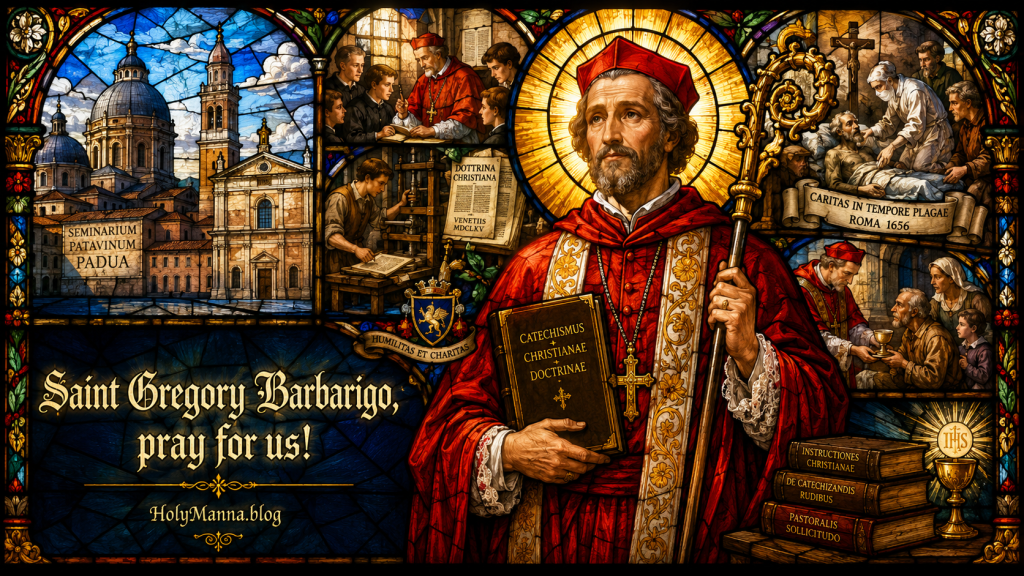
The Shepherd Who Carried the Heart of Christ
Saint Gregory Barbarigo was a 17th-century Venetian cardinal, bishop, reformer, educator, and servant of the poor. He is remembered as one of the great Catholic bishops formed by the spirit of the Council of Trent, a man who believed that the renewal of the Church begins with holy priests, faithful teaching, disciplined prayer, and concrete charity.
He is especially known for reforming the Seminary of Padua, strengthening priestly formation, teaching catechism, serving the sick during plague, and working for the reunion of Eastern Christians with Rome. He is often associated with seminarians, students, catechists, Catholic education, caregivers, the poor, and the dioceses of Bergamo and Padua.
What makes Saint Gregory so striking is that he did not separate truth from mercy. He loved doctrine, but he did not hide behind books. He loved reform, but he did not turn reform into harshness. He loved the poor, the sick, children learning the faith, and priests trying to become worthy shepherds of souls.
His life beautifully reflects what The Catechism teaches about the works of mercy, especially when it says that Christians are called to feed the hungry, visit the sick, bury the dead, instruct the ignorant, counsel the doubtful, and comfort the sorrowful. In Saint Gregory Barbarigo, those works were not theory. They became a way of life.
A Noble Son of Venice With a Heart Being Prepared by God
Saint Gregory Barbarigo was born in Venice on September 16, 1625. His full name was Gregorio Giovanni Gaspare Barbarigo. He came from a noble Venetian family. His father was Gianfrancesco Barbarigo, a senator of the Venetian Republic, and his mother was Lucrezia Lion.
His childhood was touched by sorrow. His mother died of the plague when Gregory was still very young, around two years old. That early grief did not close his heart. In a mysterious way, it seems to have prepared him for the suffering he would later face as a priest among plague victims in Rome.
Gregory’s father prepared him for public service, and as a young man he entered the world of diplomacy. At only eighteen, he accompanied the Venetian ambassador Alvise Contarini to Münster during the negotiations connected to the Peace of Westphalia, which helped bring an end to the Thirty Years’ War.
There, among diplomats, bishops, ambassadors, and the wounds of a divided Europe, Gregory met Cardinal Fabio Chigi, who would later become Pope Alexander VII. That meeting changed the direction of his life. Gregory could have remained a noble statesman. Instead, God slowly led him toward the priesthood.
After returning from diplomatic service, Gregory studied at the University of Padua and earned a doctorate in both civil and canon law. He was ordained a priest on December 21, 1655, at about thirty years old.
His conversion was not a dramatic rejection of paganism or a sudden turn from public scandal. It was the deeper conversion of a gifted Catholic layman who allowed God to redirect his talents. Diplomacy, education, law, language, administration, and noble influence would all become tools for the Gospel.
The Plague in Rome and the Priest Who Stayed
Soon after his ordination, Gregory was called to Rome by Pope Alexander VII. In 1656, plague struck the city. Fear spread quickly. Families were separated. The sick were isolated. The poor suffered terribly. The dying needed care, and the dead needed burial.
The pope entrusted Gregory with organizing relief, especially in Trastevere. This became one of the defining stories of his life. Catholic tradition remembers him not merely as an administrator giving orders from a safe distance, but as a priest close to the suffering. He helped organize care for the sick, support for widows and orphans, assistance for the poor, and burials for the dead.
During this time, Gregory reportedly wrote to his father, “I felt like I was dying.” That simple line reveals the cost of his charity. He was not fearless because suffering meant nothing to him. He was courageous because love meant more.
Devotional accounts describe him during the plague as priest, nurse, gravedigger, guide, brother, and father to the people of Trastevere. The exact wording belongs to later Catholic remembrance, but the heart of the story is well grounded in his life. He served where disease, death, and fear were strongest.
This is why Saint Gregory matters. Before he became famous as a bishop and cardinal, he showed what priesthood is supposed to look like. He stayed near the suffering. He organized mercy. He treated the vulnerable as Christ in disguise.
In The Gospel of Matthew, Jesus says, “I was sick and you visited me.” That line from Matthew 25:36 could almost be written over Saint Gregory’s plague ministry. He saw Christ in the sick, and he served Him there.
A Bishop Formed by the Gospel, Grace, and Charity
In 1657, Gregory Barbarigo was appointed Bishop of Bergamo. He entered his episcopal mission with a simple and powerful program: “the Gospel, life, grace, fraternal charity.”
That phrase is one of the most important sayings associated with him. It was not a slogan. It was a map for his entire ministry.
As bishop, he focused on pastoral visitation, catechesis, reform of the clergy, care for the poor, and renewal of seminary formation. He wanted the faith taught clearly and lived seriously. He wanted priests who were holy, educated, disciplined, and pastoral. He wanted parishes where Catholic life was not casual or confused, but rooted in the sacraments, Scripture, doctrine, and charity.
In 1660, Pope Alexander VII created him a cardinal. Then in 1664, Gregory was transferred to Padua, where he served as bishop for nearly thirty-three years. This long ministry in Padua became the great work of his life.
Saint Gregory was deeply inspired by Saint Charles Borromeo, the great reforming bishop of Milan. Like Saint Charles, he believed that true Catholic reform meant fidelity to the Church, formation of clergy, reverence for the sacraments, strong catechesis, and love for the poor.
This kind of reform is deeply Catholic. The Catechism teaches that bishops, with priests as their co-workers, have as their first task the preaching of the Gospel. It also teaches that bishops are to sanctify the Church by prayer, labor, ministry of the word, and the sacraments. Saint Gregory lived that calling with unusual seriousness.
The Seminary That Became His Joy
Saint Gregory Barbarigo’s greatest institutional legacy was the Seminary of Padua. He understood that if priests were poorly formed, the people would suffer. But if priests were holy, educated, and pastoral, whole parishes could be renewed.
He expanded the seminary, acquired the former monastery of Santa Maria in Vanzo, inaugurated the new seminary in 1670, issued rules for formation, held a diocesan synod in 1683, and promoted a serious plan of studies in 1690.
His vision was remarkably broad. Seminarians studied theology, Scripture, Church history, Greek, Hebrew, Arabic, Turkish, Persian, Syriac, and other languages. He also promoted mathematics and science. The seminary had an observatory with telescopes, globes, compasses, and scientific instruments.
That detail is surprising and beautiful. Saint Gregory was not afraid of learning. He did not see serious study as a threat to faith. He believed that learning should serve the Gospel.
In 1684, he founded the Seminary printing press in Padua. It printed works in Latin, Greek, Hebrew, Arabic, and other Eastern languages. His goal was missionary and ecumenical. He wanted priests prepared not only for local parish life, but also for dialogue, mission, and the hope of reunion with Eastern Christians.
He once described the seminary as “the only recreation” he found amid the thorns of episcopal government. That line says so much about his heart. The formation of priests was not a side project for him. It was his joy.
A Cardinal Whose Purple Meant Blood
Saint Gregory’s cardinal robes did not make him proud. They reminded him of sacrifice. Pope Saint John XXIII preserved a striking expression attributed to Gregory about the red of the cardinal’s garments. Gregory reportedly spoke of it as “the color of purple, the color of blood.”
That was not dramatic language for attention. It was a Catholic understanding of authority. The red of a cardinal symbolizes readiness to suffer, even to shed blood, for Christ and His Church.
Gregory also emphasized purity of intention. Pope Saint John XXIII highlighted his desire to do everything “to please God, to serve God.”
This is the hidden center of Saint Gregory’s holiness. He was not holy because he was busy. He was not holy because he was intelligent. He was not holy because he had a title. He was holy because his work was directed toward God.
That matters for ordinary Catholics too. A person can work hard, serve in ministry, teach, volunteer, lead, parent, study, and still slowly drift into pride or resentment. Saint Gregory reminds the Church that the question underneath every action is simple: Is this being done to please God and serve God?
The Saint of Catechism, the Poor, and the Dying
Saint Gregory’s reform was never cold. He visited parishes, assisted the dying, gave generously to the poor, taught catechism to children, opened schools, encouraged spiritual exercises, and strengthened Catholic instruction for ordinary people.
Some Catholic sources remember him as merciful with everyone and severe only with himself. Others recall that he ate with the servants and lived simply despite his noble birth and high office.
That image is worth holding onto. A nobleman from Venice became a cardinal of the Church, yet he was remembered for eating with servants, teaching children, visiting the sick, and caring for the dying.
There are no widely verified miracle stories from his lifetime in the usual dramatic sense, such as a named healing or supernatural event clearly attributed to him while he lived. His “miracles” during life were the miracles of grace working through charity, discipline, education, and mercy. That should not be dismissed. Sometimes the most powerful signs of God are not spectacular events, but a life so surrendered that it becomes a channel of Christ’s love.
Saint Gregory shows that holiness does not always look like visions and wonders. Sometimes it looks like a bishop checking on poor families, a priest near a plague bed, a teacher explaining the faith to children, and a reformer patiently building institutions that will serve the Church long after he is gone.
The Crosses of a Shepherd
Saint Gregory Barbarigo was not a martyr, and he did not die by persecution. His hardships were the burdens of a faithful shepherd.
He lost his mother early. He served during plague. He carried the exhausting responsibilities of a bishop. He worked to reform clergy and institutions, which is never easy. He dealt with the pressures of Church governance, the demands of the poor, the needs of priests, and the wounds of a divided Christian world.
He also lived during a time when Europe was still marked by religious conflict and political tension. His early experience at Münster exposed him to the consequences of division among Christians. His later work for Eastern language studies and reunion with Eastern Christians shows a heart that wanted healing, but always within fidelity to the Catholic faith.
His life teaches that not every saint is called to bloody martyrdom. Some are called to what could be called daily martyrdom, the steady offering of comfort, ambition, time, energy, and personal preference for the good of souls.
In The Catechism, the Church teaches that charity is the soul of holiness and the form of all the virtues. Saint Gregory’s life proves that point. His hardships were endured not with bitterness, but with charity.
A Holy Death and a Lasting Memory
Saint Gregory Barbarigo died in Padua on June 18, 1697, after decades of faithful episcopal service. He was buried in the Cathedral of Padua. He was beatified by Pope Clement XIII on July 6, 1761, and canonized by Pope Saint John XXIII on May 26, 1960.
His feast day is celebrated on June 18.
After his death, devotion to him continued, especially in Padua and Bergamo. His memory remained closely tied to priestly formation, Catholic education, catechesis, charity toward the poor, and pastoral reform.
There is also a notable posthumous tradition about his body. Accounts connected with the 1725 examination and translation of his remains state that his body was found remarkably preserved twenty-eight years after his death. Some devotional sources describe this as incorruption. However, the safest Catholic way to present the story is to say that his body was found in a remarkable state of preservation, but this preservation should not be presented as a formally declared miracle unless the Church explicitly identifies it as such.
Regarding miracles after death, the accessible Catholic summaries do not commonly preserve one specific named miracle story with details such as a particular healing, date, and recipient. Pope Saint John XXIII’s canonization homily referred to the broader Catholic tradition of equivalent canonization, which considers longstanding veneration, heroic virtue, trustworthy witness, and the fame of prodigies or heavenly favors. So it is fair to say that Saint Gregory was venerated for holiness and heavenly intercession, but it would not be honest to invent a specific miracle story where the sources do not provide one.
His cultural impact continues through churches, parishes, institutions, and especially the Seminary of Padua. In Padua, his legacy remains deeply connected to the clergy, who continue to honor him as a model of priestly formation and pastoral renewal.
What Saint Gregory Barbarigo Teaches the Church Today
Saint Gregory Barbarigo is a saint for anyone who wants renewal without confusion, reform without rebellion, and charity without compromise.
He reminds Catholics that the Church is renewed when priests are formed well, children are taught the faith, the poor are served, the sick are visited, and doctrine is loved rather than watered down.
He also reminds the Church that education matters. Faith does not ask the mind to become lazy. Gregory’s seminary promoted theology, languages, science, printing, and missionary preparation because truth belongs to God. A Catholic mind should be humble, but not shallow.
His life also speaks to families, catechists, teachers, parish volunteers, clergy, and anyone trying to serve the Church without burning out or becoming cynical. Saint Gregory did enormous work, but his aim was simple: “to please God, to serve God.”
What would change if every task, every conversation, every ministry, and every act of service began with that intention?
What would happen in our homes and parishes if reform began with holiness instead of complaint?
What would happen if Catholic education formed not only smart people, but saints?
Saint Gregory Barbarigo shows that authority can be humble, learning can be holy, reform can be merciful, and charity can be strong. He did not choose between doctrine and compassion. He lived both.
Engage with Us!
Share your thoughts and reflections in the comments below. Saint Gregory Barbarigo’s life gives us so much to think about, especially when it comes to faith, education, service, and renewal in the Church.
- Where in your life is God asking you to serve with more patience, even when the work feels hidden or exhausting?
- How can Saint Gregory’s love for catechesis inspire you to learn the Catholic faith more deeply and share it more faithfully?
- What does his phrase “to please God, to serve God” reveal about the intention behind your daily work?
- How can your parish, family, or ministry become more like Saint Gregory’s vision of reform, rooted in truth, prayer, formation, and mercy?
- Who is one person in your life who needs the kind of concrete charity Saint Gregory showed to the sick, the poor, and the forgotten?
May Saint Gregory Barbarigo help us renew the Church by becoming holy first. May his example teach us to serve with courage, learn with humility, teach with clarity, and love with the mercy of Christ. Let us live a life of faith and do everything with the love and mercy Jesus taught us.
Saint Gregory Barbarigo, pray for us!
Follow us on YouTube, TikTok, Instagram and Facebook for more insights and reflections on living a faith-filled life.

 Holy Manna!
Leave a comment