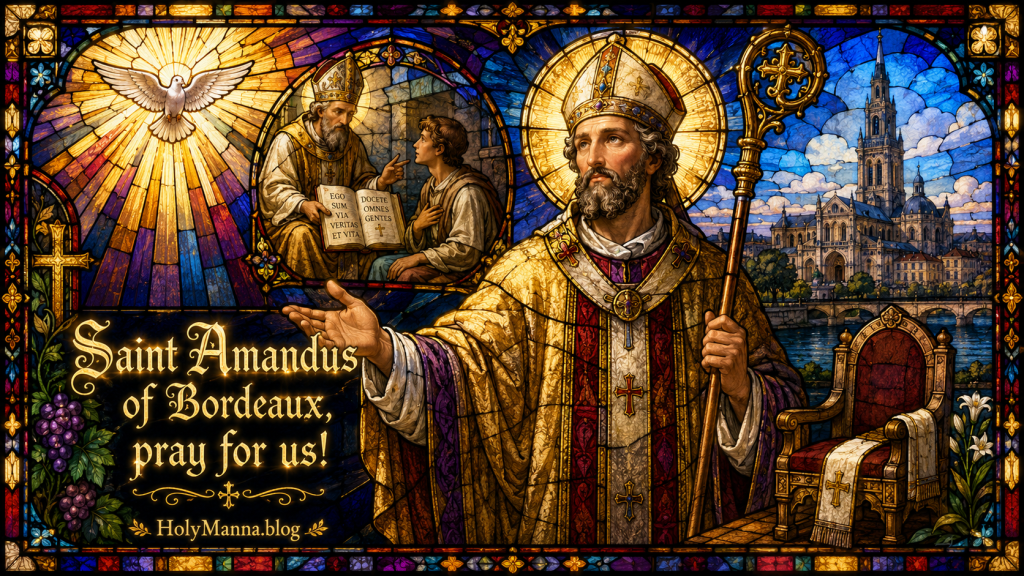
The Bishop Who Formed a Saint and Gave Up His Chair
Saint Amandus of Bordeaux is one of those saints whose name does not always fill the history books, but whose influence quietly shaped the Church for generations. He lived in the late fourth and early fifth centuries, served as a priest and later as Bishop of Bordeaux, and is most remembered as the spiritual teacher who helped form Saint Paulinus of Nola in the Catholic faith.
That alone makes his life worth remembering. Saint Paulinus would become one of the great Christian converts of late antiquity, a bishop, poet, ascetic, and defender of Christian holiness in a changing world. Behind that great saint stood a faithful priest named Amandus, patiently teaching, guiding, and preparing him for life in Christ.
The Roman Martyrology remembers Saint Amandus simply as “At Bordeaux, Saint Amandus, bishop and confessor.” That short line says very little, but his life says much more. He was a teacher of truth, a defender of Catholic doctrine, a humble bishop, and a spiritual father whose hidden work bore fruit far beyond what he could have seen.
Formed Beneath a Holy Bishop
The exact details of Saint Amandus’ birth and family background are not fully known. Catholic tradition places him in the second half of the fourth century, likely in or near Bordeaux, in the Roman province of Aquitaine. This was a world where Christianity was growing, but the Church was also facing confusion, false teaching, political instability, and the slow breakdown of Roman order in the West.
Amandus was formed under Saint Delphinus, Bishop of Bordeaux, who became his teacher and spiritual father. Delphinus ordained him a priest, and Amandus entered the pastoral life of the Church in Bordeaux. This early formation mattered deeply, because Amandus would later carry forward the same concern for sound doctrine, careful teaching, and faithful leadership.
He was not known as a dramatic public figure. He was not a wandering missionary like Saint Paul, nor a famous wonderworker like Saint Martin of Tours. His holiness was quieter. It was the holiness of the priest who teaches the faith carefully, answers difficult questions honestly, protects his people from error, and forms souls one conversation at a time.
That kind of holiness is easy to underestimate. Yet it is often how God builds the Church.
The Priest Who Formed Saint Paulinus of Nola
Saint Amandus is most known for his role in the conversion and formation of Saint Paulinus of Nola. Paulinus was a wealthy, educated aristocrat from the world of Roman culture. He had status, learning, influence, and comfort. Yet grace began to work in him, drawing him toward Christ and toward a life far deeper than worldly success.
Amandus helped prepare Paulinus for baptism and instructed him in Catholic doctrine. Some Catholic sources say Amandus baptized Paulinus, while others say Saint Delphinus administered the baptism and Amandus prepared him as catechist and spiritual guide. The most careful way to say it is that Amandus helped form Paulinus in the faith and played a major role in bringing him fully into the life of the Church.
This is the part of Amandus’ life that shines with quiet power. He helped guide one soul to Christ, and that soul became a saint.
The Catechism teaches that “Baptism is the sacrament of faith” CCC 1253. It also teaches that the catechumenate is meant to lead adults into the mystery of salvation and the life of faith. Amandus lived this mission beautifully. He did not merely give Paulinus information. He helped form him as a Christian.
Saint Paulinus never forgot it. A line associated with Paulinus’ gratitude to Amandus says, “Through you, I was born in Christ.” This was not a famous quotation from Amandus himself, but it beautifully captures what Amandus meant to the man he helped bring into the Church.
That may be Amandus’ greatest legacy. He was the hidden spiritual father behind a visible saint.
A Shepherd Who Sought Wisdom From Saint Jerome
Another important detail in Saint Amandus’ life is his correspondence with Saint Jerome, one of the greatest biblical scholars in Church history. Amandus was not content with shallow answers. He asked serious questions about Scripture, morality, marriage, penance, and the worthy reception of Holy Communion.
Saint Jerome addressed one of his letters to Amandus while Amandus was still a priest of Bordeaux. Amandus had asked him to explain passages from The Gospel of Matthew and First Corinthians, including Matthew 6:34, 1 Corinthians 6:18, and 1 Corinthians 15:25-26. He also raised a difficult pastoral question about a woman who had left her husband and entered another union, asking whether she could receive Communion without penance.
This tells us a lot about Amandus. He was a priest who cared about souls, but he also cared about truth. He wanted to be merciful without being careless. He wanted to pastor real people in real situations without betraying the teachings of Christ.
That is deeply Catholic. The Church does not separate compassion from truth. As The Catechism teaches, bishops and priests are called to teach, sanctify, and govern in service to Christ and His Church. Bishops, assisted by priests, have as their first task to preach the Gospel and guard the apostolic faith. See CCC 888-892.
Amandus understood that pastoral care without doctrine becomes confusion, and doctrine without charity becomes cold. A holy shepherd must hold both together.
Bishop of Bordeaux in a Shaken World
Around the year 404, after the death of Saint Delphinus, Amandus became Bishop of Bordeaux. He served during a dangerous and unsettled period. Aquitaine faced invasions, social disorder, and the weakening of Roman structures. The world around him was changing quickly, and the Church had to remain steady.
Amandus also had to guard the Catholic faith against heterodox influences, especially currents connected with Priscillianism, a movement that had spread from the Iberian Peninsula and mixed Christian language with dangerous errors. Catholic tradition remembers Amandus as a defender of orthodox teaching, continuing the work of Saint Delphinus before him.
This is one of the reasons Saint Amandus matters. He reminds Catholics that doctrine is not an abstract hobby for scholars. Doctrine protects souls. Truth protects worship. Sound teaching protects families, parishes, and the poor from spiritual confusion.
Saint Amandus was a bishop in a hard time, and he did what faithful bishops are called to do. He taught the faith. He defended the flock. He formed Christians. He served without making himself the center of the story.
The Bishop Who Stepped Aside
The most famous story connected with Saint Amandus concerns Saint Seurin, also known as Saint Severinus. This story comes through early and later Catholic tradition, and while some details belong to pious tradition rather than fully verifiable history, the lesson it preserves is powerful.
According to the story, Amandus received a divine warning or vision telling him to welcome Seurin, a holy bishop who had come to Bordeaux, and to yield the episcopal chair to him. Some versions say the Lord revealed that Seurin was holier or more fitting for the office at that moment. Amandus obeyed. He welcomed Seurin, honored him publicly, and stepped aside so that Seurin could serve as bishop.
That is not the normal instinct of fallen human nature. Most people do not easily surrender status, authority, or public honor. Yet Amandus seems to have understood that the episcopal office was not his possession. It belonged to Christ and existed for the good of the Church.
After Saint Seurin died, Amandus resumed the leadership of the Diocese of Bordeaux and continued to serve until his own death around 431 or 432. This means he likely served as bishop in two separate periods, which is one of the more surprising details of his life.
This story may not be verifiable in every detail, but the tradition itself is meaningful. It presents Amandus as a bishop whose humility was stronger than ambition. He could lead, and he could step aside. He could teach, and he could obey. He could hold authority, and he could surrender it when charity called.
The Hidden Work of Grace
Saint Amandus is not remembered through a large collection of miracle stories. No major verified miracle cycle is attached to him in the standard Catholic traditions about his life. He was not primarily known as a wonderworker.
The most notable supernatural story associated with him is the vision or divine warning connected to Saint Seurin. Since this story comes to us through tradition and later retellings, it should be treated as a pious story rather than a fully verifiable historical event in every detail. Still, the story reflects what the Church remembered about Amandus: humility, obedience, reverence for holiness, and a willingness to place the good of the Church above personal position.
In a way, the most visible miracle of Amandus’ life may not have been a healing or a dramatic sign. It may have been the transformation of Saint Paulinus of Nola. Amandus helped guide an aristocrat toward baptism, and that man became a saint whose writings, episcopal ministry, and devotion would bless the Church for centuries.
Grace often works like that. One faithful teacher forms one soul. One soul becomes a saint. One saint helps form generations.
A Confessor, Not a Martyr
Saint Amandus was not a martyr. He appears to have died naturally around 431 or 432 after many years of priestly and episcopal service. Yet he did face real hardships.
He lived through political instability, invasions, and doctrinal confusion. He served in a Church still laboring to form Christian communities in a world marked by old pagan habits, elite Roman culture, and competing religious ideas. He had to guard the faith while also caring for real people with real wounds and complicated lives.
His hardship was the hardship of perseverance. He did not shed blood in martyrdom, but he gave his life in service. The Church calls such saints confessors because they confessed Christ faithfully through their lives.
That kind of witness is especially important today. Many Catholics may never be asked to die for Christ, but every Catholic is asked to live for Him. Saint Amandus shows that fidelity in ordinary duties can become extraordinary holiness.
A Legacy Buried in Bordeaux but Alive in the Church
After his death, Saint Amandus was buried in the Church of Saint Seurin in Bordeaux. His memory remained connected to the sacred Christian history of the city, especially through the basilica and cemetery associated with Saint Seurin and the early bishops of Bordeaux.
There are no widely verified posthumous miracles attributed specifically to Saint Amandus in the major Catholic accounts. There are also no famous relic traditions as widely known as those of other saints. His cultural impact is quieter and more local, tied especially to the Diocese of Bordeaux and to the Christian memory of early Aquitaine.
Yet his influence reached far beyond Bordeaux through Saint Paulinus of Nola. Paulinus became a bishop, poet, ascetic, patron of Christian friendship, and an important voice in the Church of late antiquity. Amandus’ spiritual fatherhood helped make that possible.
That is the surprising beauty of Saint Amandus. His name may be less famous than the name of the saint he formed, but heaven does not measure influence the way the world does. God sees the hidden catechist, the faithful priest, the humble bishop, and the quiet shepherd who prepares another soul for greatness.
The Saint of Quiet Catholic Influence
Saint Amandus of Bordeaux is most known for forming Saint Paulinus of Nola in the Catholic faith, serving as Bishop of Bordeaux, defending orthodox teaching, corresponding with Saint Jerome, and humbly stepping aside for Saint Seurin before later resuming his episcopal office.
He is a saint for priests, teachers, catechists, parents, godparents, spiritual mentors, and anyone who wonders whether quiet faithfulness really matters.
It does.
The Church is not built only by the famous. It is built by hidden saints who teach the truth, pray for souls, answer hard questions, and serve without needing applause. Saint Amandus reminds Catholics that forming one soul well can echo through centuries.
Learning From Saint Amandus Today
Saint Amandus teaches that humility is not weakness. It takes strength to lead, but it may take even greater strength to step aside. His story with Saint Seurin shows a heart free enough to put Christ before position.
He also teaches the importance of good formation. Amandus helped prepare Saint Paulinus for baptism, and Paulinus never forgot the gift. In an age when many people are confused about faith, morality, and the Church, Catholics need patient teachers who can explain the truth with clarity and charity.
He also reminds every believer that hidden work matters. The conversation nobody notices, the lesson taught to one student, the prayer offered for one struggling soul, the patient guidance given to one person returning to the faith, these can become seeds of sainthood.
Who has God placed in front of you to encourage, teach, or guide closer to Christ?
Are you willing to serve faithfully even if someone else receives more recognition?
Do you cling to influence, or are you willing to surrender it when love asks you to?
Saint Amandus shows that the Christian life is not about being remembered by everyone. It is about being faithful before God.
Engage with Us!
Share your thoughts and reflections in the comments below. Saint Amandus of Bordeaux may not be one of the most famous saints in the Church, but his life raises powerful questions about humility, spiritual mentorship, and hidden faithfulness.
- Who has been a Saint Amandus in your life, someone who quietly helped form your faith?
- Is there someone God may be asking you to guide, encourage, or patiently teach?
- Where is Christ inviting you to choose humility over recognition?
- How can you defend the truth of the Catholic faith with both courage and charity?
- What hidden act of faithfulness can you offer to God today?
Saint Amandus of Bordeaux reminds us that a quiet life can still leave a holy legacy. Teach the truth with love. Serve without needing attention. Step aside when humility requires it. Guide others toward Christ with patience. And in everything, live a life of faith, doing all things with the love and mercy Jesus taught us.
Saint Amandus of Bordeaux, pray for us!
Follow us on YouTube, TikTok, Instagram and Facebook for more insights and reflections on living a faith-filled life.

 Holy Manna!
Leave a comment