Thursday of the Eleventh Week in Ordinary Time – Lectionary: 368
When Fire Teaches the Heart to Pray
Some readings feel like a holy flame passing through the soul, not to frighten it, but to wake it up.
Today’s Mass readings bring together the fire of the prophet Elijah, the majesty of the Lord who reigns over all creation, and the quiet intimacy of Jesus teaching His disciples to pray the Our Father. At first, these passages may seem to move in different directions. Sirach 48:1-14 remembers Elijah as a prophet whose words burned like a furnace. Psalm 97:1-7, 12 proclaims that “The LORD is king” and that all idols must fall before His glory. Then The Gospel of Matthew brings us into the Sermon on the Mount, where Jesus says, “Your Father knows what you need before you ask him.” Matthew 6:8
The central theme is the purification of the heart before the living God. Elijah’s fiery zeal exposes the danger of divided worship. The psalm announces that the Lord alone is King, and no false god can stand before Him. Jesus then shows what a purified heart sounds like when it speaks to God. It does not babble, bargain, or perform. It simply turns to the Father with trust, reverence, dependence, repentance, and mercy.
In Israel’s history, Elijah appeared during a time of spiritual compromise, when God’s people were tempted to mix covenant faith with the worship of Baal. His mission was not merely to win a public contest against false prophets. His mission was to turn hearts back to the Lord. That same movement continues in today’s Gospel. The Our Father is not just a prayer to memorize. The Catechism calls it “the summary of the whole gospel.” CCC 2761 It teaches the Christian soul to place God’s name, kingdom, and will before every lesser desire.
These readings prepare the heart to ask a serious question: What must be burned away so the soul can pray like a child of God? The fire of Elijah, the kingship proclaimed in Psalm 97, and the prayer Jesus gives in Matthew 6:7-15 all lead to the same invitation. Let the Lord be God. Let every idol fall. Let the heart return to the Father.
First Reading – Sirach 48:1-14
The Prophet Who Burned So Israel Could Return
The first reading brings us into one of the most dramatic memories in Israel’s sacred history. Sirach 48:1-14 looks back on the prophet Elijah and his successor Elisha, not simply as heroic figures from the past, but as living signs of what happens when a person belongs completely to God. Elijah appeared during a time of spiritual compromise, when the people of Israel were tempted to worship the Lord while also turning to Baal, a false god associated with storm, fertility, and political security. In that world, Elijah’s mission was clear. He came to call God’s people back from divided worship.
This fits beautifully into today’s central theme. The heart must be purified before it can truly pray. Elijah’s fire exposes idolatry. Elisha’s wonders show that God’s power continues through faithful servants. Then, in the Gospel, Jesus teaches the Our Father, the prayer of a heart that no longer belongs to idols, but to the Father.
Sirach 48:1-14 – New American Bible (Revised Edition)
1 Until like fire a prophet appeared,
his words a flaming furnace.
2 The staff of life, their bread, he shattered,
and in his zeal he made them few in number.
3 By God’s word he shut up the heavens
and three times brought down fire.
4 How awesome are you, Elijah!
Whose glory is equal to yours?
5 You brought a dead body back to life
from Sheol, by the will of the Lord.
6 You sent kings down to destruction,
and nobles, from their beds of sickness.
7 You heard threats at Sinai,
at Horeb avenging judgments.
8 You anointed the agent of these punishments,
the prophet to succeed in your place.
9 You were taken aloft in a whirlwind,
in a chariot with fiery horses.
10 You are destined, it is written, in time to come
to put an end to wrath before the day of the Lord,
To turn back the hearts of parents toward their children,
and to re-establish the tribes of Israel.
11 Blessed is the one who shall have seen you before he dies!12 When Elijah was enveloped in the whirlwind,
Elisha was filled with his spirit;
He worked twice as many marvels,
and every utterance of his mouth was wonderful.
During his lifetime he feared no one,
nor was anyone able to intimidate his will.
13 Nothing was beyond his power;
and from where he lay buried, his body prophesied.
14 In life he performed wonders,
and after death, marvelous deeds.
Detailed Exegesis
Verse 1 – “Until like fire a prophet appeared, his words a flaming furnace.”
Elijah is described as fire because his life and preaching burned with zeal for the Lord. His words were not casual religious advice. They carried the heat of divine truth. In Scripture, fire often reveals God’s holiness, purifies what is corrupt, and consumes what is false. Elijah’s mission was not to entertain Israel, but to awaken Israel.
Verse 2 – “The staff of life, their bread, he shattered, and in his zeal he made them few in number.”
This recalls the drought Elijah announced in 1 Kings 17. Bread represents daily survival, so the famine became a painful sign that Israel could not live while turning away from the living God. Elijah’s zeal was not cruelty. It was the severe mercy of a prophet calling a covenant people back to the source of life.
Verse 3 – “By God’s word he shut up the heavens and three times brought down fire.”
Elijah did not act by his own power. He acted by God’s word. The heavens were shut because the people had turned to Baal, the so-called storm god, and God revealed that He alone rules rain, fire, life, and judgment. The fire recalls Elijah’s victory on Mount Carmel, where God answered his prayer and exposed false worship.
Verse 4 – “How awesome are you, Elijah! Whose glory is equal to yours?”
Sirach pauses in wonder. Elijah’s greatness comes from his total surrender to God. He is awesome not because he sought attention, but because he became transparent to divine power. In Catholic life, this is the glory of the saints. Their greatness is borrowed light. God shines through them.
Verse 5 – “You brought a dead body back to life from Sheol, by the will of the Lord.”
This refers to the raising of the widow’s son in 1 Kings 17. Elijah’s prayer becomes an instrument of life. This miracle points forward to Christ, who does not merely raise the dead by intercession, but by His own divine authority. Elijah’s miracle is a sign. Jesus is the fulfillment.
Verse 6 – “You sent kings down to destruction, and nobles, from their beds of sickness.”
Elijah confronted powerful rulers, especially Ahab and Jezebel, because kings are still accountable to God. No throne, title, wealth, or influence stands above divine justice. This verse reminds the reader that true prophecy is not impressed by earthly power. Holiness has a courage that worldly status cannot intimidate.
Verse 7 – “You heard threats at Sinai, at Horeb avenging judgments.”
This recalls Elijah’s encounter with God at Horeb, the mountain connected with Moses and the covenant. Elijah fled there after Jezebel threatened his life. God met him not only in dramatic signs, but in the quiet mystery of His presence. The prophet who called down fire also had to learn surrender, silence, and trust.
Verse 8 – “You anointed the agent of these punishments, the prophet to succeed in your place.”
Elijah’s mission did not end with him. God commanded him to anoint others, including Elisha as his prophetic successor. This matters because God’s work is bigger than one person. Even the greatest saints are servants in a mission that belongs to the Lord.
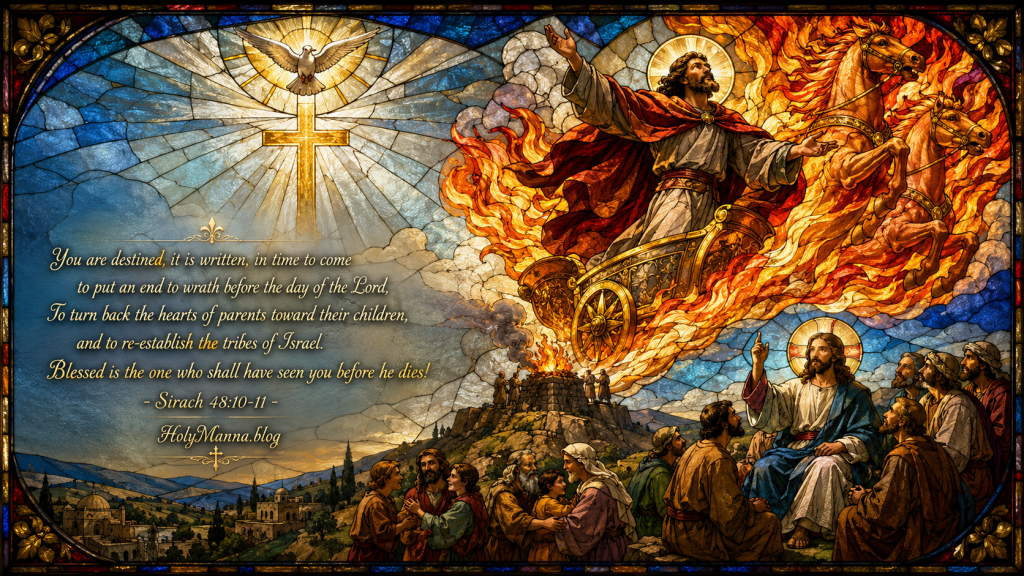
Verse 9 – “You were taken aloft in a whirlwind, in a chariot with fiery horses.”
Elijah’s mysterious departure in 2 Kings 2 made him one of the most revered figures in Jewish tradition. He did not die in the ordinary way described of other prophets. His being taken up in the whirlwind became a sign of divine favor and a reason Israel expected him to return before the day of the Lord.
Verse 10 – “You are destined, it is written, in time to come to put an end to wrath before the day of the Lord, To turn back the hearts of parents toward their children, and to re-establish the tribes of Israel.”
This verse echoes the promise later expressed in Malachi 3:23-24, where Elijah is associated with conversion before the day of the Lord. The mission is not only judgment, but reconciliation. Elijah comes to turn hearts back, especially within families and among God’s people. In the New Testament, Jesus identifies John the Baptist as coming in the spirit and power of Elijah.
Verse 11 – “Blessed is the one who shall have seen you before he dies!”
To see Elijah was considered a blessing because his return was tied to hope, repentance, and restoration. The verse reflects Israel’s longing for God to intervene again through prophetic power. For Christians, this longing finds its deepest fulfillment in Christ, the One to whom all the prophets point.
Verse 12 – “When Elijah was enveloped in the whirlwind, Elisha was filled with his spirit; He worked twice as many marvels, and every utterance of his mouth was wonderful. During his lifetime he feared no one, nor was anyone able to intimidate his will.”
Elisha receives a share in Elijah’s prophetic spirit and continues the mission with courage. The reading shows that holiness is not erased when one servant departs. Grace bears fruit across generations. Elisha’s fearlessness also reminds the reader that the person rooted in God cannot be ruled by intimidation.
Verse 13 – “Nothing was beyond his power; and from where he lay buried, his body prophesied.”
This refers to the miracle in 2 Kings 13, when a dead man touched Elisha’s bones and came back to life. From a Catholic perspective, this verse beautifully supports the biblical logic behind relics. The body of a holy person is not meaningless. The body has been touched by grace, and God can work through matter because He created matter and redeems it in Christ.
Verse 14 – “In life he performed wonders, and after death, marvelous deeds.”
Elisha’s holiness bore fruit both before and after death. This prepares the Catholic imagination to understand the communion of saints. Death does not sever the faithful from God’s life. The saints remain alive in Christ, and God continues to glorify Himself through them.
Teachings
The first reading teaches that true prophecy is not about predicting the future for curiosity’s sake. It is about calling the people of God back to covenant fidelity. Elijah appears like fire because Israel’s heart has become divided. The Lord is not one god among many. He is the living God, the King of heaven and earth.
The Catechism connects Elijah directly to the fire of the Holy Spirit. It teaches: “Fire. While water signifies birth and the fruitfulness of life given in the Holy Spirit, fire symbolizes the transforming energy of the Holy Spirit’s actions. The prayer of the prophet Elijah, who ‘arose like fire’ and whose ‘word burned like a torch,’ brought down fire from heaven on the sacrifice on Mount Carmel. This event was a ‘figure’ of the fire of the Holy Spirit, who transforms what he touches.” CCC 696
That is the key to reading Elijah well. His fire is not empty anger. It is the transforming energy of God. It burns against idolatry because idolatry destroys the soul. It exposes false worship because false worship enslaves the heart. It calls Israel back because God desires His people to live.
The Catechism also highlights Elijah as a model of prayer. It says: “The sacrifice on Mount Carmel is a decisive test for the faith of the People of God. In answer to Elijah’s plea, ‘Answer me, O LORD, answer me,’ the Lord’s fire consumes the holocaust, at the time of the evening oblation. The Eastern liturgies repeat Elijah’s plea in the Eucharistic epiclesis.” CCC 2583
This is a powerful Catholic connection. Elijah’s prayer on Mount Carmel is not merely an Old Testament spectacle. It points toward the Church’s prayer at the altar, where the Holy Spirit is invoked and God acts. The same Lord who answered Elijah with fire now feeds His Church through the Eucharist.
St. James also teaches the Church to see Elijah as a model of prayerful faith. He writes: “Elijah was a human being like us; yet he prayed earnestly that it might not rain, and for three years and six months it did not rain upon the land. Then he prayed again, and the sky gave rain and the earth produced its fruit.” James 5:17-18
That line matters because Elijah can seem larger than life. St. James reminds the Church that Elijah was not a different species of believer. He was human like us. His greatness came from faith, obedience, and prayer.
This reading also helps Catholics understand the veneration of saints and relics. Elisha’s bones becoming the occasion of a miracle shows that God’s grace can work through the bodies of His holy ones. The Catechism teaches: “The witnesses who have preceded us into the kingdom, especially those whom the Church recognizes as saints, share in the living tradition of prayer by the example of their lives, the transmission of their writings, and their prayer today.” CCC 2683
That is why the Church does not remember Elijah and Elisha as dead heroes locked in the past. They are part of the living memory of God’s people. Their lives still teach the Church how to pray, how to resist idols, and how to trust the Lord when the culture has forgotten Him.
Reflection
This reading asks the modern Catholic a direct question: Is the heart fully given to God, or is it trying to serve God and something else at the same time?
Elijah’s world was filled with religious compromise, and that is not hard to recognize today. A person can believe in God while still quietly bowing to comfort, image, money, lust, politics, control, or approval. The idols may look more sophisticated now, but they still ask for worship. They still demand attention, sacrifice, and loyalty.
Elijah’s fire is a mercy because it reveals what has become false. Every Catholic needs that kind of grace. There are moments when God gently consoles the soul, and there are moments when He exposes what is dividing it. Both are love.
A practical way to live this reading is to name one idol honestly. Not ten. Just one. It may be the thing that gets the first attention in the morning, the most anxiety during the day, or the strongest emotional reaction when threatened. Once it is named, it can be brought before God in prayer.
Another way to live this reading is to recover courage. Elijah and Elisha were not intimidated by kings, threats, or cultural pressure. Catholic faith today also requires courage, not arrogance, not harshness, but courage rooted in truth and charity. A believer does not need to be loud to be faithful. Sometimes the most prophetic thing is simply refusing to compromise.
Finally, this reading invites deeper trust in prayer. Elijah prayed, and God acted. Elisha served, and God continued the mission. The saints witnessed, and God kept working even after their deaths. The Christian life is not powered by personality. It is powered by grace.
What idol most often competes with God for first place in the heart?
Where is God asking for the fire of the Holy Spirit to purify desire, speech, or daily habits?
How can prayer become less passive and more trusting this week?
What would courageous fidelity look like at home, at work, online, or in a difficult relationship?
If someone looked at this life, would they see a heart divided among many gods, or a soul returning to the one true Lord?
Responsorial Psalm – Psalm 97:1-7, 12
The King Before Whom Every Idol Falls
Psalm 97 sounds like a thunderstorm rolling over the earth, but every crash of thunder is announcing something joyful. The Lord reigns. This psalm belongs to the great biblical tradition of proclaiming God as King, a truth Israel needed to remember again and again while surrounded by nations that worshiped many gods. In the ancient world, people often looked to idols for rain, fertility, war, health, wealth, and protection. Psalm 97 answers that confusion with holy clarity. The Lord alone rules creation. The Lord alone is holy. The Lord alone deserves worship.
This psalm fits today’s theme perfectly. In the first reading, Elijah confronts false worship with fire. In the Gospel, Jesus teaches His disciples to pray to the Father with trust. Between those readings, Psalm 97 declares why the heart must be purified. God is not one spiritual option among many. He is the King of all the earth, and every idol must fall before His glory.
Psalm 97:1-7, 12 – New American Bible (Revised Edition)
The Divine Ruler of All
1 The Lord is king; let the earth rejoice;
let the many islands be glad.
2 Cloud and darkness surround him;
justice and right are the foundation of his throne.
3 Fire goes before him,
consuming his foes on every side.
4 His lightening illumines the world;
the earth sees and trembles.
5 The mountains melt like wax before the Lord,
before the Lord of all the earth.
6 The heavens proclaim his justice;
all peoples see his glory.7 All who serve idols are put to shame,
who glory in worthless things;
all gods bow down before him.12 Rejoice in the Lord, you just,
and give thanks at the remembrance of his holiness.
Detailed Exegesis
Verse 1 – “The LORD is king; let the earth rejoice; let the many islands be glad.”
The psalm begins with a proclamation, not a suggestion. The Lord is King. This is the foundation of worship, morality, prayer, and daily life. If God reigns, then creation is not random, history is not meaningless, and the human heart is not made to serve idols. The joy of the earth and the gladness of the islands show that God’s kingship is not a threat to creation. His reign is good news because the world is safest when it belongs fully to Him.
Verse 2 – “Cloud and darkness surround him; justice and right are the foundation of his throne.”
Cloud and darkness remind the reader that God is mysterious. He cannot be reduced to a slogan, controlled by human plans, or fully grasped by the mind. Yet His mystery is never chaos. His throne is founded on justice and right. This matters for today’s readings because Elijah’s fiery mission and Jesus’ teaching on prayer both begin with reverence. God is close enough to be called Father, but He remains the holy King whose ways deserve trust.
Verse 3 – “Fire goes before him, consuming his foes on every side.”
The fire in this verse connects directly with Elijah, whose words burned like a furnace and whose prayer brought down fire from heaven. In Scripture, divine fire can judge, purify, reveal, and transform. This is not the fire of human rage. It is the fire of God’s holiness. It consumes whatever opposes His kingdom, especially sin, false worship, and hardened rebellion.
Verse 4 – “His lightning illumines the world; the earth sees and trembles.”
Lightning reveals the landscape in a sudden flash. Spiritually, God’s truth does the same. It exposes what has been hidden. It shows the real shape of the heart. The trembling of the earth is not pointless fear. It is the proper awe of creation before its Creator. In a culture that often treats God casually, this verse restores holy reverence.
Verse 5 – “The mountains melt like wax before the LORD, before the Lord of all the earth.”
Mountains were symbols of strength, permanence, and stability. Yet before the Lord, even mountains melt like wax. This image teaches that nothing created can rival the Creator. Human pride, political power, personal control, and spiritual compromise may seem immovable, but they cannot stand before the living God. The Lord is not merely the God of one tribe or one moment in history. He is the Lord of all the earth.
Verse 6 – “The heavens proclaim his justice; all peoples see his glory.”
The heavens themselves become witnesses. Creation announces that God is just, glorious, and sovereign. This verse widens the psalm beyond Israel and points toward the universal mission of salvation. All peoples are meant to see the glory of God. For Catholics, this reaches its fulfillment in Christ, whose Gospel is proclaimed to every nation and whose kingdom is catholic, meaning universal.
Verse 7 – “All who serve idols are put to shame, who glory in worthless things; all gods bow down before him.”
This verse names the central spiritual danger of the psalm. Idolatry is shameful because it gives worship to what cannot save. The phrase “worthless things” is blunt, but merciful. False gods always promise more than they can give. They may offer comfort, control, pleasure, power, or approval, but they cannot give eternal life. Before the Lord, every false god is exposed.
Verse 12 – “Rejoice in the LORD, you just, and give thanks at the remembrance of his holiness.”
The psalm ends in joy and thanksgiving. God’s holiness is not only something to fear. It is something to remember with gratitude. The just rejoice because God’s reign sets things right. His holiness means He is not corrupt, selfish, manipulative, or false. He is perfectly good. The purified heart does not resent His kingship. It gives thanks for it.
Teachings
Psalm 97 teaches that worship begins with reality. God is King. Everything else is creature, gift, servant, or temptation. The human heart becomes disordered when it treats anything created as ultimate. That is why the psalm speaks so strongly against idols. It is not being harsh for the sake of harshness. It is telling the truth about what happens when the heart bows before something less than God.
The Catechism gives a clear Catholic teaching on adoration: “Adoration is the first act of the virtue of religion. To adore God is to acknowledge him as God, as the Creator and Savior, the Lord and Master of everything that exists, as infinite and merciful Love. ‘You shall worship the Lord your God, and him only shall you serve,’ says Jesus, citing Deuteronomy.” CCC 2096
That teaching belongs right beside Psalm 97. The psalm says, “The LORD is king” Psalm 97:1, and The Catechism explains what the soul must do in response. It must adore. Adoration is not just singing at church or saying prayers before bed. It is the deep recognition that God is God, and nothing else is.
The Catechism also warns that idolatry is not just an ancient pagan problem: “Idolatry not only refers to false pagan worship. It remains a constant temptation to faith. Idolatry consists in divinizing what is not God. Man commits idolatry whenever he honors and reveres a creature in place of God, whether this be gods or demons, for example, satanism, power, pleasure, race, ancestors, the state, money, etc. Jesus says, ‘You cannot serve God and mammon.’ Many martyrs died for not adoring ‘the Beast’ refusing even to simulate such worship. Idolatry rejects the unique Lordship of God; it is therefore incompatible with communion with God.” CCC 2113
This is why the psalm still speaks so directly. Today’s idols may not have temples, statues, or ancient names, but they still demand loyalty. Money asks for trust. Pleasure asks for sacrifice. Power asks for obedience. Approval asks for silence. Control asks for anxiety. The state, career, body, reputation, and comfort can all become false gods when they take the place that belongs to the Lord.
The kingship proclaimed in Psalm 97 also points Christians to Jesus. The title “Lord” becomes central to the New Testament confession of Christ. The Catechism teaches: “In the Greek translation of the Old Testament, the ineffable Hebrew name YHWH, by which God revealed himself to Moses, is rendered as Kyrios, ‘Lord.’ From then on, ‘Lord’ becomes the more usual name by which to indicate the divinity of Israel’s God. The New Testament uses this full sense of the title ‘Lord’ both for the Father and, what is new, for Jesus, who is thereby recognized as God himself.” CCC 446
So when Catholics hear “The LORD is king” Psalm 97:1, they hear the kingship of the God of Israel, and they also hear the mystery fulfilled in Christ. Jesus is not simply a teacher of prayer in today’s Gospel. He is the Son who reveals the Father and brings the kingdom near. The same Lord before whom mountains melt is the Lord who teaches His disciples to pray, “Our Father in heaven.” Matthew 6:9
This is also why the Church’s celebration of Christ the King matters historically and spiritually. In a modern world tempted to place politics, nationalism, ideologies, and human power above God, the Church proclaims that Christ reigns over every person, family, nation, and culture. Psalm 97 prepares the soul for that Catholic conviction. No earthly throne is absolute. No idol is eternal. No human system can replace the kingdom of God.
Reflection
This psalm asks the heart to stop negotiating with idols.
That may sound intense, but it is actually freeing. Most people are exhausted because they are serving too many masters. They want God, but they also want total control. They want peace, but they also chase approval. They want holiness, but they keep protecting one compromise. Psalm 97 steps into that divided place and announces the truth with thunderous mercy: “The LORD is king.” Psalm 97:1
A practical way to pray with this psalm is to ask what currently feels like a mountain. It may be a fear that seems immovable, a habit that feels permanent, a relationship that feels impossible, or a temptation that feels stronger than grace. Then place that mountain before the Lord of all the earth. Mountains melt like wax before Him. The things that look unchangeable are not stronger than God.
Another way to live this psalm is to examine what receives the best energy of the day. The first thoughts in the morning, the repeated anxieties, the strongest cravings, and the things that cannot be surrendered often reveal what the heart is treating as king. This is not meant to create shame. It is meant to lead to freedom. An idol exposed is an idol already beginning to fall.
Finally, the psalm invites joy. God’s kingship is not bad news for the faithful. It means injustice will not have the last word. False gods will not reign forever. Evil will not defeat holiness. The Lord is King, and His throne is founded on justice and right.
What idol has been asking for trust, attention, or obedience that belongs only to God?
Where does the heart need to recover reverence before the holiness of the Lord?
What mountain in life needs to be placed before the Lord of all the earth?
How would daily life change if God’s kingship became more real than fear, comfort, money, or approval?
Can the soul rejoice today, not because life is easy, but because the Lord truly reigns?
Holy Gospel – Matthew 6:7-15
The Prayer of the Heart That Belongs to the Father
The Gospel brings today’s readings to their deepest and most personal place. After Sirach 48:1-14 shows Elijah burning against idolatry, and Psalm 97:1-7, 12 proclaims that the Lord alone is King, Jesus teaches His disciples how to pray as children of that King. This passage comes from the Sermon on the Mount, where Jesus forms His disciples from the inside out. He is not only correcting outward behavior. He is teaching the heart how to live before God.
In the ancient world, many pagan prayers were filled with repetition meant to persuade, pressure, or impress the gods. The fear behind that kind of prayer is simple. Maybe the gods are not listening. Maybe enough words will force their attention. Maybe prayer depends on performance. Jesus rejects that fear completely. He reveals the living God as Father and gives His disciples the Our Father, the prayer The Catechism calls “the summary of the whole gospel.” CCC 2761
This Gospel fits today’s central theme because a purified heart does not pray like a performer, a negotiator, or a slave. It prays like a beloved child. Elijah’s fire burns away idols. The psalm announces God’s reign. Jesus then places on our lips the words of trust, worship, surrender, dependence, mercy, and spiritual protection.
Matthew 6:7-15 – New American Bible (Revised Edition)
7 In praying, do not babble like the pagans, who think that they will be heard because of their many words. 8 Do not be like them. Your Father knows what you need before you ask him.
The Lord’s Prayer. 9 “This is how you are to pray:
Our Father in heaven,
hallowed be your name,
10 your kingdom come,
your will be done,
on earth as in heaven.
11 Give us today our daily bread;
12 and forgive us our debts,
as we forgive our debtors;
13 and do not subject us to the final test,
but deliver us from the evil one.14 If you forgive others their transgressions, your heavenly Father will forgive you. 15 But if you do not forgive others, neither will your Father forgive your transgressions.
Detailed Exegesis
Verse 7 – “In praying, do not babble like the pagans, who think that they will be heard because of their many words.”
Jesus is not condemning long prayer. The Church prays the Psalms, celebrates vigils, offers litanies, and encourages persevering prayer. Jesus Himself spends long hours in prayer. What He condemns is anxious, empty, manipulative prayer that treats God like a distant power who must be impressed. Pagan babbling comes from fear. Christian prayer comes from faith. The disciple does not pray to control God. The disciple prays to enter communion with the Father.
Verse 8 – “Do not be like them. Your Father knows what you need before you ask him.”
This verse changes everything. Prayer does not begin with the soul informing God of something He missed. Prayer begins with trust. The Father already knows. He sees needs, wounds, temptations, fears, sins, and hopes before a single word is spoken. This does not make prayer unnecessary. It makes prayer intimate. The child speaks, not because the Father is ignorant, but because love desires communion.
Verse 9 – “This is how you are to pray: Our Father in heaven, hallowed be your name.”
Jesus teaches His disciples to begin with relationship and reverence. God is Father, but He is not casual. He is in heaven, and His name is holy. This one line holds together tenderness and awe. The believer can approach God with confidence, but never with arrogance. To pray “hallowed be your name” is to ask that God be honored in the heart, in the Church, in the world, and in every action of daily life.
Verse 10 – “Your kingdom come, your will be done, on earth as in heaven.”
This petition asks for God’s reign to become visible in human life. The kingdom is not built by private preference, cultural trends, or personal control. It comes when God is obeyed, worshiped, and loved. To pray “your will be done” is not passive resignation. It is active surrender. The Christian asks for earth to reflect heaven, beginning with the ordinary places of family, work, relationships, speech, choices, and hidden desires.
Verse 11 – “Give us today our daily bread.”
This petition teaches humble dependence. The disciple asks for what is needed today, not for total control over tomorrow. In Catholic tradition, daily bread includes ordinary food, everything necessary for life, and most profoundly, the Eucharist. The Father feeds the body, but He also feeds the soul with Christ, the Bread of Life. This prayer trains the heart to receive life as a gift rather than grasp it as a possession.
Verse 12 – “And forgive us our debts, as we forgive our debtors.”
Jesus places forgiveness at the center of prayer. The disciple asks for mercy while committing to extend mercy. This does not mean pretending evil was harmless, ignoring justice, or forcing unsafe reconciliation. It means surrendering hatred, vengeance, and the desire to make another person spiritually pay forever. A heart that refuses mercy to others closes itself against the mercy it asks from God.
Verse 13 – “And do not subject us to the final test, but deliver us from the evil one.”
Christian prayer is realistic about spiritual danger. Jesus teaches His disciples to ask the Father for protection from temptation, final trial, and the evil one. The Catholic faith does not reduce evil to a vague idea or a psychological discomfort. The evil one is real, temptation is real, and spiritual battle is real. Yet the disciple does not face that battle alone. The Father protects, strengthens, and delivers.
Verse 14 – “If you forgive others their transgressions, your heavenly Father will forgive you.”
After teaching the Our Father, Jesus immediately returns to forgiveness. That is significant. Of all the petitions He could have explained further, He focuses on mercy. Forgiveness is not an optional spiritual extra. It is part of the logic of the kingdom. Those who have received mercy must become merciful. The forgiven heart must not become a locked door.
Verse 15 – “But if you do not forgive others, neither will your Father forgive your transgressions.”
This verse is serious because Jesus loves the soul too much to let it remain in bitterness. Refusing to forgive does not hurt only the other person. It poisons the one who clings to resentment. The Father’s mercy is infinite, but the heart can resist receiving it by refusing to give it. Jesus is not minimizing pain. He is revealing that mercy must move through the heart, not stop at the heart.
Teachings
The Our Father is not merely a beautiful prayer. It is the school of Christian life. Jesus gives His disciples the words that teach them what to desire, what to trust, what to surrender, what to ask, what to repent of, and what to resist.
The Catechism teaches: “The Lord’s Prayer ‘is truly the summary of the whole gospel.’ ‘Since the Lord’s Prayer is the quintessential prayer of the Church, it is an integral part of the major hours of the Divine Office and of the sacraments of Christian initiation: Baptism and Confirmation. Handed on in Baptism, it reveals the new birth to divine life. Since Christian prayer is our speaking to God with the very word of God, those who are ‘born anew’ learn to invoke their Father by the one Word he always hears. They can henceforth do so, for the seal of the Holy Spirit’s anointing is indelibly placed on their hearts, ears, lips, indeed their whole filial being.’” CCC 2761
This means the Our Father is not just something Catholics say from memory. It is a prayer that forms identity. The baptized are not spiritual orphans. They are sons and daughters in the Son, taught to speak to the Father with the words of Christ.
The Catechism also explains the boldness of calling God Father: “This power of the Spirit who introduces us to the Lord’s Prayer is expressed in the liturgies of East and of West by the beautiful, characteristically Christian expression: parrhesia, straightforward simplicity, filial trust, joyous assurance, humble boldness, the certainty of being loved.” CCC 2778
That is the opposite of pagan babbling. Christian prayer does not need panic, performance, or spiritual noise. It needs filial trust. The soul can speak simply because it is loved.
The petition for daily bread also opens into the Eucharistic heart of Catholic life. The Catechism teaches: “‘Daily’ (epiousios) occurs nowhere else in the New Testament. Taken in a temporal sense, this word is a pedagogical repetition of ‘this day,’ to confirm us in trust ‘without reservation.’ Taken in the qualitative sense, it signifies what is necessary for life, and more broadly every good thing sufficient for subsistence. Taken literally (epi-ousios: ‘super-essential’), it refers directly to the Bread of Life, the Body of Christ, the ‘medicine of immortality,’ without which we have no life within us. Finally in this connection, its heavenly meaning is evident: ‘this day’ is the Day of the Lord, the day of the feast of the kingdom, anticipated in the Eucharist that is already the foretaste of the kingdom to come. For this reason it is fitting for the Eucharistic liturgy to be celebrated each day.” CCC 2837
This makes the Gospel deeply Eucharistic. The same Father who knows what His children need gives more than ordinary bread. He gives His Son.
The teaching on forgiveness is just as direct. The Catechism says: “Now, and this is daunting, this outpouring of mercy cannot penetrate our hearts as long as we have not forgiven those who have trespassed against us. Love, like the Body of Christ, is indivisible; we cannot love the God we cannot see if we do not love the brother or sister we do see. In refusing to forgive our brothers and sisters, our hearts are closed and their hardness makes them impervious to the Father’s merciful love; but in confessing our sins, our hearts are opened to his grace.” CCC 2840
That is why Jesus repeats the lesson after the prayer. The heart cannot ask for mercy while permanently denying mercy. Forgiveness is not easy, but it is Christian.
Finally, Jesus teaches His disciples to ask for deliverance from the evil one. The Catechism explains: “In this petition, evil is not an abstraction, but refers to a person, Satan, the Evil One, the angel who opposes God. The devil is the one who ‘throws himself across’ God’s plan and his work of salvation accomplished in Christ.” CCC 2851
This brings the Gospel back to the battle already present in the first reading and psalm. Elijah fought false worship. The psalm declared that idols fall before the Lord. Jesus teaches His disciples to pray for deliverance from the evil one. The Christian life is not neutral territory. It is lived under the reign of the Father, in the victory of Christ, by the fire of the Holy Spirit.
Reflection
This Gospel invites the soul to pray less like it is trying to impress God and more like it belongs to Him.
That is a needed word in a noisy age. Many people carry prayer like a burden. They worry about saying the right words, feeling the right emotions, having enough focus, or sounding holy enough. Jesus cuts through all of that with one sentence: “Your Father knows what you need before you ask him.” Matthew 6:8 The Father is not waiting to be persuaded to care. He already loves.
A simple way to live this Gospel is to pray the Our Father slowly, one line at a time. The prayer is short, but it is not shallow. It can examine an entire life. “Hallowed be your name” asks whether God is truly honored. “Your kingdom come” asks whether His reign is welcome. “Your will be done” asks whether obedience has been delayed. “Give us today our daily bread” asks whether the soul trusts the Father for today. “Forgive us our debts” asks whether repentance is real. “As we forgive our debtors” asks whether mercy is being withheld. “Deliver us from the evil one” asks whether the heart is humble enough to admit it needs protection.
This Gospel also calls for a serious examination of forgiveness. Sometimes resentment feels justified because the wound was real. Jesus never denies the wound. He simply refuses to let hatred become the soul’s home. Forgiveness may begin as a small prayer, not a feeling. It may sound like asking God for the grace to stop replaying the injury, to release vengeance, and to desire freedom from bitterness. In some cases, reconciliation may require time, boundaries, repentance, and safety. But forgiveness begins when the heart places the wound under the mercy of the Father.
Finally, this Gospel calls Catholics back to confidence in the Eucharist. The prayer for daily bread is fulfilled most deeply in Christ, the Bread of Life. The heart purified from idols is not left empty. It is fed by God Himself.
Where has prayer become more like performance than trust?
Which line of the Our Father is most difficult to pray honestly right now?
What would change if the Father’s knowledge of every need became more real than anxiety?
Who needs to be forgiven, even if healing and reconciliation still require time?
How can the prayer Jesus gave become the pattern for decisions, relationships, work, and daily surrender?
Let Every Idol Fall, and Let the Heart Return to the Father
Today’s readings move like a holy journey from fire to prayer. Elijah appears in Sirach 48:1-14 like a prophet set ablaze by God, calling Israel away from divided worship and back to covenant faithfulness. Psalm 97:1-7, 12 lifts the eyes higher and proclaims the truth behind Elijah’s mission: “The LORD is king.” Then, in Matthew 6:7-15, Jesus brings that same truth into the heart of the disciple by teaching the Our Father, the prayer of those who no longer belong to idols, fear, or empty performance, but to the Father who knows what they need.
The message is clear and deeply personal. God does not want a divided heart. He does not want religious noise without trust, worship without surrender, or prayer without mercy. He wants children who know His name is holy, His kingdom is worth seeking, His will is worth obeying, His bread is enough for today, His mercy must be received and shared, and His protection is needed in the battle against evil.
This is where the fire of Elijah and the gentleness of the Our Father meet. The fire of God burns away what keeps the soul from praying honestly. It exposes the idols that steal peace, the resentments that harden the heart, and the anxieties that pretend the Father is far away. Then Jesus teaches the purified heart how to speak: “Our Father in heaven, hallowed be your name.” Matthew 6:9
Today is a beautiful day to pray the Our Father slowly and let every line become an examination of life. Let God’s name be holy again. Let His kingdom come into the ordinary places of work, family, habits, conversations, screens, and private thoughts. Let His will be trusted more than control. Let the Eucharist become true daily bread. Let forgiveness begin, even if it begins with a small and trembling prayer.
The Lord is King, and the Father is near. That is the good news today. The soul does not have to keep serving what cannot save. It can return to the living God, receive the fire of the Holy Spirit, and learn again how to pray like a beloved child.
What needs to fall today so the heart can belong more fully to the Father?
Engage with Us!
Share your reflections in the comments below. Today’s readings invite every heart to look honestly at what it worships, how it prays, and how freely it forgives. Elijah’s fire, the kingship proclaimed in Psalm 97, and the Our Father in Matthew 6:7-15 all point toward the same call: return to the Father with an undivided heart.
- First Reading, Sirach 48:1-14: What false idol, habit, fear, or attachment might God be asking to burn away so the heart can belong more fully to Him?
- Responsorial Psalm, Psalm 97:1-7, 12: What does it mean in daily life to truly believe that “The LORD is king”, especially when anxiety, comfort, money, or approval tries to rule the heart?
- Holy Gospel, Matthew 6:7-15: Which line of the Our Father is the hardest to pray honestly right now, and what might the Father be revealing through that struggle?
- Forgiveness: Who needs to be placed under the mercy of God, even if healing, trust, or reconciliation still requires time, prudence, and grace?
- Daily Application: How can prayer become less rushed, less performative, and more rooted in the confidence that the Father already knows every need?
May these readings lead to a deeper faith, a purer heart, and a more trusting prayer. Let every idol fall, let the Father’s name be hallowed in everyday life, and let every word, choice, and relationship be shaped by the love and mercy Jesus taught us.
Sacred Heart of Jesus, we trust in You!
Immaculate Heart of Mary, pray for us!
Saint Michael the Archangel, defend us in battle!
Follow us on YouTube, TikTok, Instagram and Facebook for more insights and reflections on living a faith-filled life.

 Holy Manna!
Leave a comment