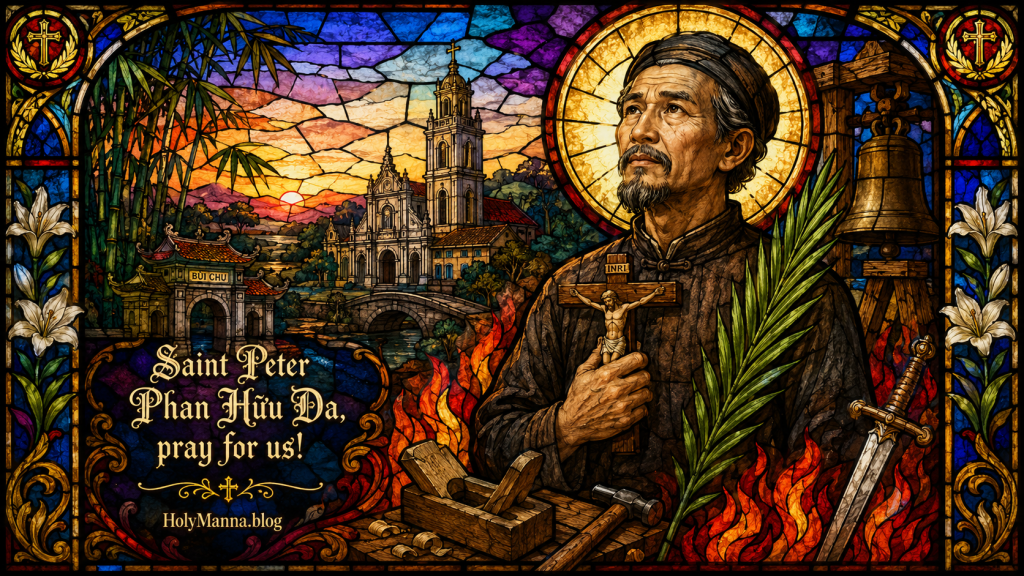
The Carpenter Who Would Not Step on the Cross
Saint Peter Phan Hữu Đa was not a bishop, a famous preacher, a missionary priest, or a public leader. He was a Vietnamese layman, a husband, a father, a carpenter, and a faithful servant of his local parish. Yet the Church remembers him among the great martyrs of Vietnam because when the moment of trial came, this ordinary Catholic man chose Christ over comfort, family reunion, public safety, and life itself.
He was born around 1802 in Ngọc Cục village, in Nam Định, in what is now associated with the Diocese of Bùi Chu in Vietnam. Catholic tradition remembers him as a poor but honest man who worked with his hands and lived his faith with steady devotion. He served his parish by ringing the church bell and helping prepare what was needed for worship. In other words, he lived the kind of holiness that often goes unnoticed because it is hidden inside daily duties.
That is part of what makes Saint Peter Phan Hữu Đa so powerful. His life tells every Catholic in the pews that sainthood is not only for monks in monasteries or priests at altars. Sainthood is also for fathers, husbands, workers, parish volunteers, and ordinary believers who quietly choose Jesus day after day.
Saint Peter Đa is most known for refusing to step on the image of Christ during a time of persecution. His persecutors offered him a way out. He could return to his family if he would publicly trample the holy image as a sign that he rejected the Catholic faith. He refused. His witness echoes the teaching of The Catechism of the Catholic Church, which says, “Martyrdom is the supreme witness given to the truth of the faith: it means bearing witness even unto death.” CCC 2473
Faith Formed in the Workshop and the Parish
Saint Peter Phan Hữu Đa’s early life was simple. He came from a poor family and worked as a carpenter. Some Catholic hagiographical sources say his father was Christian while his mother was not, but the consistent memory of the Church is that Peter Đa was formed in the Catholic faith and became known for his fidelity.
He married and became a father. He provided for his family through honest labor. His trade as a carpenter gives his story a beautiful spiritual resonance. Like Saint Joseph, he worked with wood. Like Saint Joseph, he served God in hiddenness. Like Saint Joseph, he reminds the faithful that humble labor can become holy when it is offered to God.
He also served his parish as a caretaker or sacristan-like figure. He rang the church bell, helped prepare for the sacred liturgy, and remained close to the life of the Church. That detail might seem small at first, but it reveals something important. The man who later refused to dishonor the image of Christ had already spent years honoring Christ in ordinary ways.
His martyrdom did not come from nowhere. Courage is usually prepared in secret before it is displayed in public. Saint Peter Đa learned fidelity through prayer, worship, work, family life, and reverence for the things of God.
What hidden habits are forming the soul when nobody else is watching?
A Lay Saint for Ordinary Catholics
Saint Peter Đa’s life during ordinary times is remembered more for faithfulness than for dramatic miracles. No verified miracle during his lifetime is preserved in the Catholic sources consulted. His holiness was not built around public wonders. It was built around perseverance.
That matters because many Catholics wonder whether their lives are too ordinary to become holy. They work, raise children, care for aging parents, pay bills, serve at parish events, and try to remain faithful in a noisy world. Saint Peter Đa shows that God sees all of it.
His life reminds the Church that the domestic church matters. The workshop matters. The parish bell matters. The small act of preparing the church for Mass matters. The quiet refusal to compromise in daily life matters.
The Catechism teaches that the disciple of Christ must profess the faith publicly and live it with conviction. It says, “The disciple of Christ must not only keep the faith and live on it, but also profess it, confidently bear witness to it, and spread it.” CCC 1816 Saint Peter Đa lived this teaching not through a theological lecture, but through his body, his choices, and eventually his blood.
He is important because he shows that Catholic identity is not a costume worn on Sundays. It is a way of life. It is how a person works, prays, serves, speaks, suffers, and refuses to betray the Lord.
The Cross Under the Foot or the Cross in the Heart
Saint Peter Phan Hữu Đa lived during the severe persecution of Christians under Emperor Tự Đức. During this time, many Vietnamese Catholics were arrested, exiled, imprisoned, tortured, or killed. One of the cruel practices used against Christians was to force them to step on a crucifix or holy image. This was meant to be a public rejection of Christ.
For a Catholic, this was not a meaningless external act. The body speaks. Public actions matter. Worship matters. Reverence matters. To trample the image of Christ was to declare with the body what the soul must never say: that Jesus was not Lord.
Saint Peter Đa was arrested around the age of sixty. He was taken from the life he knew, separated from his family, and pressured to renounce the faith. The authorities wanted him to save his life by stepping on the holy image of the Lord.
The governor tried to persuade him. Peter Đa’s most famous recorded words come from this moment: “If you release me and let me return to my family, I thank you. But as for stepping on the image of my Lord, I will absolutely never obey you.”
That quote is stunning because it is so human. He was not pretending that he did not love his family. He wanted to return home. He would have been grateful for mercy. He was not seeking death because of pride or anger.
But he would not return home by betraying Jesus.
That is the heart of martyrdom. It is not hatred of life. It is love for Christ above life. Saint Peter Đa understood that the Lord who had been nailed to the Cross for him could not be publicly insulted for the sake of temporary safety.
Fire, Sword, and Final Fidelity
On June 17, 1862, Saint Peter Phan Hữu Đa was taken to be executed at Nam Định. He was condemned to be burned alive for the Catholic faith.
Some devotional accounts say that on the way to execution he remained peaceful and prayerful, entrusting himself to God and asking for courage to endure his final suffering. This detail comes from hagiographical tradition and cannot be independently verified in every part, but it fits the Catholic memory of his final witness.
His death was especially brutal. Catholic sources say he was burned alive, and after the fire had nearly gone out, soldiers saw that he seemed still alive. They then beheaded him. Because of this, later retellings sometimes emphasize that his martyrdom was sealed by both fire and sword.
His wife and local Catholics buried his body at the place of execution. The following year, his remains were brought back to his homeland. That detail gives the story a deeply personal tenderness. This was not merely a public execution. This was the suffering of a real family, a real parish, and a real Catholic community that carried the memory of one faithful man back home.
The Church later recognized what the faithful already knew. Saint Peter Phan Hữu Đa was beatified by Pope Pius XII on April 29, 1951. He was canonized by Pope Saint John Paul II on June 19, 1988, together with the 117 Vietnamese Martyrs.
The Saint Who Needed No Embellishment
There are no verified posthumous miracles specifically attributed to Saint Peter Phan Hữu Đa in the Catholic sources consulted. There are also no separate famous miracle legends firmly attached to him beyond the accounts surrounding his martyrdom.
That should not disappoint anyone. His story does not need embellishment.
The greatest wonder in his life is the grace of final perseverance. A poor layman, a husband, a father, and a carpenter stood before the power of the state and refused to deny Christ. He did not write a great book. He did not found a religious order. He did not become famous in his own lifetime. He simply remained faithful when faithfulness became costly.
His relics and memory were venerated by the Catholic community that loved him, especially in connection with his homeland and the wider devotion to the Vietnamese Martyrs. He is remembered individually on June 17, the day of his martyrdom. He is also honored with Saint Andrew Dũng-Lạc and Companions on November 24, when the Church celebrates the Vietnamese Martyrs together.
The Vietnamese Martyrs have had a profound spiritual and cultural impact on Catholics in Vietnam and throughout the Vietnamese diaspora. Their feast is celebrated with Masses, prayers, processions, parish devotions, and family remembrance. They are a living sign that the Catholic faith took root deeply in Vietnamese soil, not by destroying what was noble in Vietnamese culture, but by purifying and elevating it in Christ.
Pope Saint John Paul II emphasized at their canonization that the Vietnamese Martyrs were not enemies of their homeland. They honored what was good, true, and noble, while refusing to abandon the one true God. Their witness shows that Catholic faith and love for one’s people are not enemies. In Christ, love becomes stronger, more sacrificial, and more eternal.
A Cross That Cannot Be Trampled
Saint Peter Phan Hữu Đa speaks directly to modern Catholics.
Most Catholics today will not be asked to step on a crucifix in a public square. But there are other ways the world pressures believers to treat Christ as something embarrassing, optional, or disposable. Sometimes the pressure comes at work. Sometimes it comes in dating and family life. Sometimes it comes through entertainment, social media, politics, career ambition, or the fear of being seen as too serious about the faith.
The question is not only whether a Catholic would die for Christ one day. The question is whether a Catholic is willing to live for Christ today.
Saint Peter Đa teaches that the small choices matter. Pray when it would be easier to scroll. Go to Mass when it would be easier to sleep in. Speak truth with charity when silence would win approval. Refuse sin when compromise looks convenient. Treat holy things with reverence. Do not be ashamed of Jesus.
The Cross cannot be trampled by a faithful heart.
This does not mean every Catholic must be loud, harsh, or dramatic. Saint Peter Đa was not remembered as a loud man. He was remembered as a faithful man. His courage was steady. His love was simple. His loyalty was clear.
That kind of holiness is still needed.
The Carpenter’s Lesson for Daily Life
Saint Peter Phan Hữu Đa gives the Church a beautiful model of lay holiness. He teaches that a Catholic life can become holy through family responsibility, honest work, parish service, reverence for the Mass, and courage under pressure.
For fathers, he is a reminder that leading a family in faith matters. For workers, he is a reminder that labor can be offered to God. For parish volunteers, he is a reminder that hidden service is precious in the eyes of Heaven. For every Catholic facing pressure to compromise, he is a reminder that Christ is worth more than comfort.
His story also teaches that reverence is not outdated. The way Catholics treat sacred images, churches, the Eucharist, the Mass, and the Cross matters because love always becomes visible. A heart that loves Christ will not casually dishonor what points to Him.
Where is Christ asking for quiet courage today?
What image of Christ needs to be honored more deeply in the home, the parish, or the heart?
What small compromise needs to be refused before it becomes a larger betrayal?
Saint Peter Đa’s life gives one clear answer: choose Christ now, in ordinary things, so that when extraordinary trials come, the soul already knows whom it loves.
Engage with Us!
Share your thoughts and reflections in the comments below. Saint Peter Phan Hữu Đa’s story is simple, but it reaches deep into the heart of Catholic life because it asks whether faith is merely private preference or true loyalty to Jesus Christ.
- What part of Saint Peter Phan Hữu Đa’s witness challenges you the most?
- How can ordinary work, family life, and parish service become paths to holiness today?
- Where do modern Catholics feel pressured to hide or soften their faith?
- What does it mean to honor the Cross of Christ in daily life?
- What small act of fidelity can you choose today so your heart becomes stronger tomorrow?
Saint Peter Phan Hữu Đa reminds the Church that holiness is not measured by fame, status, or worldly success. It is measured by love. He lived as a faithful layman, suffered as a courageous martyr, and died rather than dishonor the Lord who died for him.
May his witness inspire us to live with steady courage, reverence for the Cross, and love for Jesus in every ordinary duty. May we do everything with the love and mercy Jesus taught us, and may our lives quietly proclaim that Christ is worth everything.
Saint Peter Phan Hữu Đa, pray for us!
Follow us on YouTube, TikTok, Instagram and Facebook for more insights and reflections on living a faith-filled life.

 Holy Manna!
Leave a comment