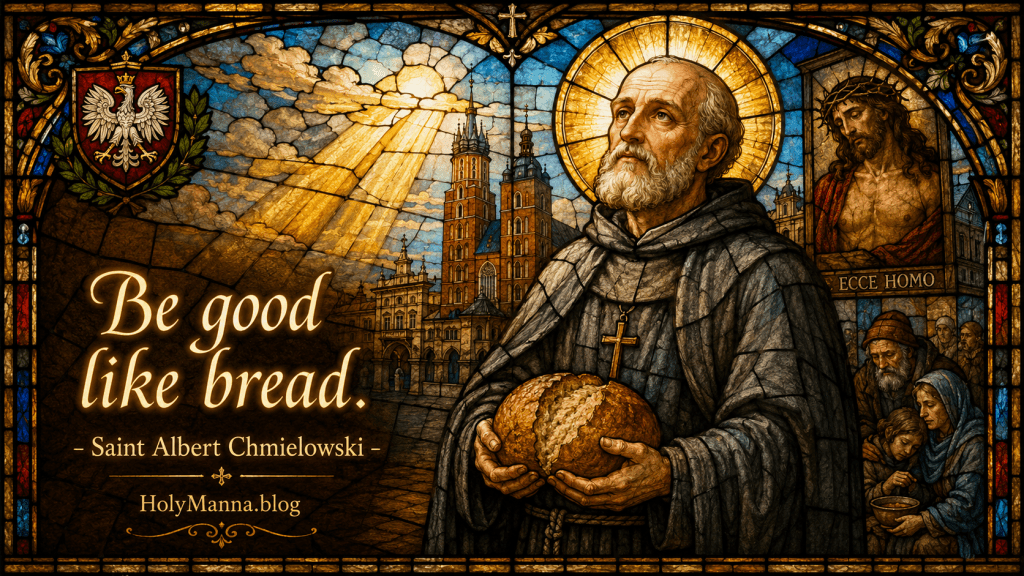
The Painter Who Became Bread for the Poor
Saint Albert Chmielowski, also known as Brother Albert, is one of those saints whose life feels almost too dramatic to be real. He was a Polish nobleman, a teenage freedom fighter, a wounded veteran, a gifted painter, a religious founder, and eventually one of the great Catholic servants of the poor.
He was born Adam Hilary Bernard Chmielowski on August 20, 1845, in Igołomia near Kraków, Poland. Today, the Church remembers him as the founder of the Albertine Brothers and Albertine Sisters, religious communities dedicated to serving the poor, the homeless, the sick, the elderly, and the abandoned.
Saint Albert is especially associated with artists, painters, the poor, the homeless, the Albertine communities, and social workers in Poland. Pope Saint John Paul II also confirmed him as principal patron of the Diocese of Sosnowiec. His feast day is June 17.
He is most famous for one simple saying: “Be good like bread.”
That was not just a nice phrase. It was his whole spirituality. Bread sits on the table quietly. It does not call attention to itself. It does not ask who is worthy. It simply gives itself to whoever is hungry.
That is what Brother Albert wanted Christians to become.
His life is a powerful witness to what The Catechism of the Catholic Church teaches about mercy. The Church reminds us that “The works of mercy are charitable actions by which we come to the aid of our neighbor in his spiritual and bodily necessities” in CCC 2447. Brother Albert took that teaching seriously. He fed the hungry, sheltered the homeless, clothed the poor, served the sick, and treated the rejected as Christ Himself.
A Young Patriot Marked by Suffering
Adam Chmielowski was born into a noble Polish family, but his childhood was not easy. His father died when Adam was still young, and his mother died several years later. He was orphaned early and raised partly by relatives, including his aunt Petronela.
His mother had once sent him to a cadet school in Saint Petersburg, but she brought him home after only a year because she feared the influence of Russian education on her son. Poland at the time was divided and dominated by foreign powers, and many Polish families were deeply concerned about preserving their Catholic faith and national identity.
As a young man, Adam studied in Warsaw and later at the Agricultural Institute in Puławy. But his studies were interrupted by a national crisis. In 1863, while still a teenager, he joined the January Uprising against Russian rule. Like many young Polish men of his generation, he longed for freedom for his homeland.
During fighting near Melchów, Adam was badly wounded. His left leg had to be amputated. Catholic biographies emphasize that the operation was performed without anesthesia. He was still very young, but already he had learned that love of country and love of sacrifice could cost a person dearly.
A famous story says that during the amputation, Adam asked for a cigar to endure the pain. Another dramatic tradition says that he later escaped Russian captivity hidden in a coffin. These stories are often repeated in Catholic retellings of his life, but because the details are difficult to verify with certainty, they should be received as traditional stories rather than fully documented facts.
Even so, the truth underneath them is clear. Adam was courageous. He suffered physically. He lived with disability for the rest of his life. And that suffering would later help him recognize the suffering of others.
After the uprising failed, Adam had to leave Poland. He went to Paris, then Ghent, and later Munich. There he pursued art seriously and became a respected painter.
The Artist Searching for God
Adam Chmielowski had real talent. He studied painting in Munich and became part of the artistic world of his time. He had the skill and social background to pursue a successful career. But something in him was unsettled.
He began to ask a question that many creative people still ask: “Can one serve God by serving art?”
This question mattered deeply to him. Art was not just a hobby. It was part of his identity. Yet he began to sense that beauty, if separated from God and neighbor, was not enough to satisfy the heart.
His most famous painting is Ecce Homo, which means Behold the Man. It shows Christ crowned with thorns, clothed in a crimson robe, wounded and humiliated before the crowd. Adam began the painting in 1879 and finished it around 1890. It became the great image of his soul.
In The Gospel of John, Pontius Pilate brings Jesus before the crowd and says, “Behold the man!” in John 19:5. Adam painted the suffering Christ, but over time he began to see that same suffering Christ in the poor, the homeless, the rejected, and the forgotten.
The painting Ecce Homo was eventually lost during World War II and recovered in 1978. Today it is kept at the Sanctuary of Ecce Homo of Saint Brother Albert in Kraków. It remains one of the most important symbols of his conversion.
For Brother Albert, the Face of Christ was not trapped inside a canvas. The Face of Christ was also in the streets.
When a Failed Vocation Became a Deeper Calling
In 1880, Adam entered the Jesuit novitiate as a lay brother. This might seem like the obvious next step in his conversion, but it did not last. After about six months, he had to leave because of poor health and a severe spiritual crisis.
That part of his story is important. Sometimes people imagine saints as people whose lives move neatly from one holy step to the next. Saint Albert reminds us that God often works through confusion, illness, false starts, and painful detours.
His first attempt at religious life seemed to fail. But that failure became part of his road to holiness.
After a period of recovery, Adam encountered the spirituality of Saint Francis of Assisi through the Third Order of Saint Francis. Franciscan poverty, simplicity, humility, and love for Christ in the poor gave him the path his heart had been seeking.
He began living more simply. He restored religious paintings, helped spread Franciscan spirituality, and gave more and more of his resources to the poor. Eventually he settled in Kraków near the Capuchins. There, the painter became more and more uncomfortable living at a distance from the misery around him.
Then he saw the public warming shelters of Kraków.
These shelters were filled with the homeless, the sick, the abandoned, the elderly, the addicted, and those society had already thrown away. Catholic retellings describe Brother Albert being deeply shaken by the conditions. These were not clean, organized shelters. They were places of poverty, misery, despair, and moral ruin.
Many people might have donated money and left. Adam did something different.
He decided to live with them.
The Day Adam Became Brother Albert
On August 25, 1887, Adam put on a gray Franciscan habit and took the name Brother Albert. One year later, with the approval of Cardinal Albin Dunajewski, he made vows as a Franciscan tertiary.
In 1888, he founded the Brothers of the Third Order of Saint Francis, Servants of the Poor, commonly known as the Albertine Brothers. In 1891, with the help of women who shared his mission, the female branch began. The Albertine Sisters would later be guided in a special way by Blessed Bernardina Maria Jabłońska.
Brother Albert’s mission was clear. He did not want to serve the poor from above. He wanted to become their brother.
He founded shelters, soup kitchens, homes for the elderly, homes for the incurably ill, nurseries, orphanages, and places where the homeless could work and regain their dignity. His shelters offered food and lodging, but they also offered order, prayer, work, and human respect.
This was not sentimental charity. This was Catholic mercy with sleeves rolled up.
The Catechism teaches that love for the poor belongs to the constant tradition of the Church. In CCC 2444, the Church teaches that “The Church’s love for the poor… is a part of her constant tradition.” Brother Albert lived that teaching in a radical way. He understood that a Christian cannot love Christ while ignoring the suffering person at the door.
He once wrote: “I look at Jesus in the Eucharist; could His love conceive something even more beautiful? He becomes bread, so let us be bread too, let us give of our very selves.”
That is the key to his life. His service to the poor was Eucharistic. He looked at Jesus, the Bread of Life, and understood that love must become something people can actually receive.
The Mercy That Did Not Look Away
Saint Albert is not mainly remembered for spectacular miracles during his lifetime. He is remembered for something both quieter and harder. He stayed.
He stayed with people others avoided. He stayed with men and women who smelled bad, behaved badly, suffered deeply, and had often lost hope. He stayed with those who could not repay him. He stayed with the poor not as a social theory, but as a brother.
That is why Pope Saint John Paul II later said that Brother Albert was not simply someone who did charity. He became a brother to the poor.
One story says that Brother Albert once brought a cold, ragged boy into his studio, fed him, and gave him a place to sleep. This story is often told as a sign of his changing heart. The studio of the painter was becoming a shelter. The man who painted Christ was beginning to receive Christ.
Another story involves Saint Raphael Kalinowski, the Carmelite priest and fellow Polish saint. Raphael reportedly suggested that Brother Albert might have a Carmelite vocation. Brother Albert is said to have answered: “What would my tramps do without me?”
This story is often repeated in Catholic accounts of his life. Whether the exact wording is preserved perfectly or not, it expresses the heart of his vocation. Brother Albert belonged to the poor because he belonged to Christ.
There is also a more dramatic story from his earlier artistic circles involving spiritualist table-turning. According to the story, a séance was interrupted when a Rosary was placed on the table, and the table reportedly split. This story cannot be verified with certainty, but it is often retold as a warning against superstition and occult practices. The Catholic meaning is sound. A heart that belongs to Christ must not seek hidden powers apart from God.
A Saint With One Leg and a Giant Heart
Brother Albert lived with the physical effects of his war injury for the rest of his life. He used a crude prosthetic leg and often suffered from pain and exhaustion. Yet he traveled, organized, begged, founded houses, encouraged his brothers and sisters, and served the poor with astonishing energy.
His life was hard. He had known war, exile, disability, vocational struggle, illness, poverty, and misunderstanding. He had given up the possibility of artistic fame. He had traded salons and studios for shelters and soup kitchens.
Yet his poverty was not bitterness. It was freedom.
He wanted his followers to live simply, serve humbly, and stay close to the poor. Near the end of his life, he pointed his community to Our Lady of Częstochowa and reportedly said: “This Madonna is your Foundress, remember this.”
He also urged them: “Above all, observe poverty.”
Those words reveal the spiritual foundation of his work. Brother Albert knew that without prayer, poverty, and dependence on God, charitable work can easily become activism, pride, or bureaucracy. But when it flows from Christ, mercy becomes holy.
By the time of his death, his work had grown to many religious houses, with brothers and sisters serving the poor in multiple places. He died of stomach cancer on December 25, 1916, Christmas Day, in Kraków, in a shelter for the poor.
That detail feels almost like a final sermon. The man who spent his life serving Christ in the poor died on the day the Church celebrates Christ becoming poor for us.
The Miracles That Confirmed His Witness
After Brother Albert’s death, devotion to him continued to grow, especially in Poland. People remembered him as the Father of the Poor and the Polish Saint Francis. His relics are venerated at the Sanctuary of Ecce Homo of Saint Brother Albert in Kraków, where his famous painting is also preserved.
The Church eventually recognized miracles connected with his intercession.
One miracle associated with his beatification involved Józefa Parzych, a woman connected to the Albertine Sisters. She reportedly suffered for years from tuberculosis and a severe abdominal wound that doctors considered incurable. After prayers through Brother Albert’s intercession, she was suddenly and permanently healed. The healing was judged medically inexplicable and became part of the path toward his beatification.
The canonization miracle involved a baby named Albert Szułczyński, born in Warsaw in 1986. As an infant, he became critically ill with infectious jaundice, sepsis, uremia, organ failure, and respiratory complications. His parents and religious sisters prayed through the intercession of Blessed Brother Albert. The child was baptized while near death. Soon afterward, according to Catholic testimony, his condition changed dramatically and he recovered. Doctors could not explain the healing. This miracle was accepted in the canonization process, and the child was present in Rome when Brother Albert was canonized.
Pope Saint John Paul II beatified Brother Albert in Kraków on June 22, 1983, and canonized him in Rome on November 12, 1989.
For John Paul II, this was deeply personal. As a young man, Karol Wojtyła loved theater, poetry, and art. Brother Albert’s life helped him understand that artistic gifts could be surrendered to an even higher calling. Wojtyła later wrote a play about him called Our God’s Brother. In a real way, Saint Albert helped shape the spiritual imagination of the future pope.
That is one of the surprising fruits of Brother Albert’s life. A man who chose hidden service among the homeless helped inspire one of the most influential popes in modern history.
The Polish Saint Francis and His Lasting Legacy
Saint Albert’s legacy continues through the Albertine Brothers and Albertine Sisters, who still serve the poor, the homeless, the elderly, the disabled, and the abandoned. His spirit also continues in Catholic ministries of mercy, especially those that work with people society prefers not to see.
In Poland, he remains a beloved national and religious figure. The Church in Poland observed 2017 as the Year of Saint Brother Albert, marking the centenary of his death and renewing attention to his message of mercy. Pilgrimages, Masses, cultural events, and charitable initiatives helped remind the faithful that his message was not only for the past.
His famous painting Ecce Homo continues to draw pilgrims and visitors to Kraków. It is not just a work of religious art. It is a visual confession of his soul. Christ stands wounded, mocked, and silent. Brother Albert understood that when the world says, “Behold the man!”, the Christian must learn to behold Christ in every suffering person.
He also left the Church a spirituality that is simple enough for a child to understand and demanding enough to make a saint tremble.
“Be good like bread.”
It means being available when someone needs help. It means giving without making everything about oneself. It means becoming humble, nourishing, steady, and generous. It means letting Christ break open the hard places of the heart so mercy can feed someone else.
The Question Brother Albert Leaves Behind
Saint Albert Chmielowski’s life asks a question that every Catholic can understand.
What gift has God placed in your hands, and how can that gift become bread for someone else?
For Adam Chmielowski, the gift was art, intelligence, courage, social standing, and a heart made tender by suffering. He could have used those gifts for comfort or fame. Instead, he placed them at the feet of Christ and gave himself to the poor.
Not everyone is called to found a religious community or live in a homeless shelter. But every Christian is called to mercy. Every Catholic is called to see Christ in the person who is inconvenient, wounded, lonely, poor, sick, addicted, rejected, or hard to love.
The Gospel of Matthew gives us the words of Jesus that shaped saints like Brother Albert: “Amen, I say to you, whatever you did for one of these least brothers of mine, you did for me.” Matthew 25:40
That was not a metaphor for Brother Albert. That was his daily life.
His witness is especially needed today because modern life makes it easy to scroll past suffering. It is easy to care in theory and avoid in practice. It is easy to say the right thing about mercy and never actually become merciful.
Brother Albert shows another way. Begin where you are. Feed one person. Visit one lonely soul. Give someone dignity. Pray before the Eucharist and ask Jesus to make your heart less selfish. Help without needing applause. Serve without needing control. Let mercy become concrete.
Holiness is not always dramatic. Sometimes holiness looks like bread on a table.
Engage with Us!
Share your thoughts and reflections in the comments below. Saint Albert’s life is a beautiful reminder that the love of Christ must become visible, practical, and generous in everyday life.
- What part of Saint Albert Chmielowski’s story speaks most deeply to your own faith journey?
- Where might Christ be asking you to see His wounded Face in someone poor, lonely, rejected, or difficult to love?
- What gift has God given you that could become “bread” for someone else?
- How can you practice one concrete work of mercy this week, even in a small and hidden way?
- When you hear Saint Albert’s words, “Be good like bread,” what do they challenge you to change in your daily life?
May Saint Albert Chmielowski teach us to love Christ not only in prayer, but also in the poor, the forgotten, and the wounded people God places before us. May his example help us live with faith, humility, courage, and mercy. And may everything we do be done with the love and mercy Jesus taught us.
Saint Albert Chmielowski, pray for us!
Follow us on YouTube, TikTok, Instagram and Facebook for more insights and reflections on living a faith-filled life.

 Holy Manna!
Leave a comment