Wednesday of the Eleventh Week in Ordinary Time – Lectionary: 367
The Hidden Heart That Receives the Mantle
God does some of His deepest work in places nobody applauds.
Today’s readings draw the soul into a beautiful tension between visible glory and hidden fidelity. In The Second Book of Kings, Elijah is taken up to heaven in a whirlwind, and Elisha receives the fallen mantle of prophecy. In Psalm 31, the faithful are reminded that the Lord stores up goodness for those who fear Him and hides them “in the shelter of your presence.” Psalm 31:21 Then, in The Gospel of Matthew, Jesus teaches His disciples that almsgiving, prayer, and fasting must not become spiritual theater, because “your Father who sees in secret will repay you.” Matthew 6:4
The central theme is simple and deeply challenging: God entrusts His mission to hearts formed in hidden faithfulness.
Elisha does not receive Elijah’s mantle by chasing power or attention. He receives it because he stays close. Even when Elijah tells him to remain behind, Elisha refuses to abandon the prophet, saying, “As the Lord lives, and as you yourself live, I will not leave you.” 2 Kings 2:6 In the world of ancient Israel, a prophet’s mantle symbolized vocation, authority, and mission. When Elisha asks for a double portion of Elijah’s spirit, he is asking not for fame, but for the grace to carry forward the work God had entrusted to his spiritual father.
Jesus then reveals the interior foundation of that kind of mission. The disciple must be purified of the need to be seen. Prayer, fasting, and almsgiving were core practices of Jewish piety, and the Church continues to receive them as essential acts of conversion. The Catechism teaches that “fasting, prayer, and almsgiving” express conversion in relation to oneself, to God, and to others. CCC 1434 Yet Jesus warns that even holy practices can become corrupted when they are performed for applause.
Together, these readings prepare the heart to ask a serious question: Is faith being lived before the Father, or performed before the crowd? The mantle falls on the faithful. The Father sees the hidden. The Christian life is not about appearing holy. It is about becoming holy where only God can see.
First Reading – 2 Kings 2:1, 6-14
The Mantle Falls on the One Who Refuses to Leave
The first reading brings readers to one of the most unforgettable scenes in the Old Testament. Elijah, the fiery prophet of Israel, is nearing the end of his earthly mission. He had confronted idolatry, challenged kings, called down fire on Mount Carmel, and reminded Israel that the Lord alone is God. Now the Lord is preparing to take him up, and Elisha, his disciple, refuses to leave his side.
In ancient Israel, a prophet was not merely a religious speaker. He was a covenant witness, a man chosen by God to call the people back to faithfulness. Elijah’s mantle was more than clothing. It symbolized his prophetic mission, authority, and identity. When Elisha asks for a double portion of Elijah’s spirit, he is not asking for fame. He is asking to inherit the mission with the heart of a son.
This reading fits beautifully with today’s theme of hidden faithfulness. Elisha receives the mantle because he stays close. He is present when the moment comes. He does not chase attention. He remains faithful, and God entrusts him with the work that must continue.
2 Kings 2:1, 6-14 – New American Bible (Revised Edition)
Elijah’s Journey. 1 When the Lord was about to take Elijah up to heaven in a whirlwind, he and Elisha were on their way from Gilgal.
6 Elijah said to him, “Stay here, please. The Lord has sent me on to the Jordan.” Elisha replied, “As the Lord lives, and as you yourself live, I will not leave you.” So the two went on together. 7 Fifty of the guild prophets followed and stood facing them at a distance, while the two of them stood next to the Jordan.
Elisha Succeeds Elijah. 8 Elijah took his mantle, rolled it up and struck the water: it divided, and the two of them crossed over on dry ground.
9 When they had crossed over, Elijah said to Elisha, “Request whatever I might do for you, before I am taken from you.” Elisha answered, “May I receive a double portion of your spirit.” 10 He replied, “You have asked something that is not easy. Still, if you see me taken up from you, your wish will be granted; otherwise not.” 11 As they walked on still conversing, a fiery chariot and fiery horses came between the two of them, and Elijah went up to heaven in a whirlwind, 12 and Elisha saw it happen. He cried out, “My father! my father! Israel’s chariot and steeds!” Then he saw him no longer.
He gripped his own garment, tore it into two pieces, 13 and picked up the mantle which had fallen from Elijah. Then he went back and stood at the bank of the Jordan. 14 Wielding the mantle which had fallen from Elijah, he struck the water and said, “The Lord, the God of Elijah—where is he now?” He struck the water: it divided, and he crossed over.
Detailed Exegesis
Verse 1 – “When the Lord was about to take Elijah up to heaven in a whirlwind, he and Elisha were on their way from Gilgal.”
The reading begins with divine initiative. Elijah does not arrange his own departure. The Lord is the one who is about to take him. This matters because prophetic ministry begins and ends in God’s hands. The whirlwind points to divine power and mystery, reminding readers that Elijah belongs completely to the Lord. Gilgal also carries covenant memory for Israel, since it was associated with Israel’s entrance into the Promised Land and renewal before God. The journey is not random. It is a sacred transition.
Verse 6 – “Elijah said to him, ‘Stay here, please. The Lord has sent me on to the Jordan.’ Elisha replied, ‘As the Lord lives, and as you yourself live, I will not leave you.’ So the two went on together.”
Elijah tells Elisha to remain behind, but Elisha refuses. His words reveal loyalty, perseverance, and filial love. He is not merely attached to Elijah emotionally. He understands that he has been drawn into a sacred mission. The Jordan is a place of transition in salvation history. Israel crossed the Jordan into the Promised Land, and now Elijah and Elisha approach it as the prophetic mission is about to pass from one generation to another.
Verse 7 – “Fifty of the guild prophets followed and stood facing them at a distance, while the two of them stood next to the Jordan.”
The guild prophets witness the scene from afar. They represent a broader prophetic community, but only Elisha stands close to Elijah at the Jordan. This small detail is spiritually important. Many can observe holy things from a distance, but discipleship requires closeness. Elisha’s nearness shows readiness. He is not a spectator. He is the one being formed to receive what God will entrust.
Verse 8 – “Elijah took his mantle, rolled it up and struck the water: it divided, and the two of them crossed over on dry ground.”
This verse echoes the great saving acts of God in Israel’s history. The dividing of the waters recalls Moses at the Red Sea and Joshua at the Jordan. God is showing that the same Lord who delivered Israel is still at work through His prophet. Elijah’s mantle becomes the visible sign of a divine mission. In Catholic life, visible signs matter because God often works through material realities to communicate grace, authority, and vocation.
Verse 9 – “When they had crossed over, Elijah said to Elisha, ‘Request whatever I might do for you, before I am taken from you.’ Elisha answered, ‘May I receive a double portion of your spirit.’”
Elisha’s request has deep biblical meaning. In the Old Testament, the double portion was associated with the inheritance of the firstborn son. Elisha is asking to be Elijah’s true spiritual heir. He does not ask for wealth, comfort, safety, or reputation. He asks for the spirit needed to carry the burden of God’s mission. This is the prayer of a disciple who understands that vocation requires grace.
Verse 10 – “He replied, ‘You have asked something that is not easy. Still, if you see me taken up from you, your wish will be granted; otherwise not.’”
Elijah’s answer makes clear that the spirit of prophecy is not something he can hand over by personal power. It belongs to God. Elisha’s request depends on divine will. The condition that he must see Elijah taken up points to spiritual perception. Elisha must be present, attentive, and receptive. He must not only inherit a mantle externally. He must be ready to receive a mission inwardly.
Verse 11 – “As they walked on still conversing, a fiery chariot and fiery horses came between the two of them, and Elijah went up to heaven in a whirlwind.”
The fiery chariot and horses reveal the glory and power of God surrounding Elijah’s departure. Fire often represents divine presence, purification, and judgment in Scripture. Elijah, the prophet so closely associated with fire, is taken up in a manner fitting his mission. This scene became deeply important in Jewish and Christian imagination because Elijah did not die in the ordinary way. His mysterious departure also prepared later expectations of his return, which appear in the Gospels in connection with John the Baptist and the coming of the Messiah.
Verse 12 – “And Elisha saw it happen. He cried out, ‘My father! my father! Israel’s chariot and steeds!’ Then he saw him no longer. He gripped his own garment, tore it into two pieces.”
Elisha sees Elijah taken up, which confirms that his request will be granted. His cry, “My father! my father!”, reveals the relationship between prophet and disciple as spiritual fatherhood. Elijah was not only a teacher. He was a father in faith. Elisha’s tearing of his garment expresses grief, reverence, and transition. Something has ended, but something new is about to begin.
Verse 13 – “And picked up the mantle which had fallen from Elijah. Then he went back and stood at the bank of the Jordan.”
Elisha picks up the mantle. This is the turning point. He must now receive the mission personally. He cannot merely admire Elijah anymore. He must continue the work. The mantle lying on the ground is an invitation. Elisha’s act of picking it up shows acceptance. In the spiritual life, every vocation eventually reaches a moment when admiration must become responsibility.
Verse 14 – “Wielding the mantle which had fallen from Elijah, he struck the water and said, ‘The Lord, the God of Elijah, where is he now?’ He struck the water: it divided, and he crossed over.”
Elisha returns to the Jordan and repeats Elijah’s action. His question is not doubt in the shallow sense. It is a cry for confirmation. He is asking whether the God who worked through Elijah will now work through him. The waters divide, and Elisha crosses over. The mission continues. The Lord has not disappeared with Elijah. God remains faithful, and His work carries on through the one He has chosen.
Teachings
This reading reveals the beauty of spiritual inheritance. God’s mission is never a private possession. It is received, lived, and handed on. Elijah’s mantle falls, and Elisha must decide whether to pick it up. This pattern speaks deeply to the Catholic understanding of tradition, vocation, and apostolic continuity.
The Church teaches that the faith is not reinvented in every age. It is received from Christ through the apostles and handed on through the Church. The Catechism of the Catholic Church teaches, “In order that the mission entrusted to them might be continued after their death, the apostles consigned, by will and testament, as it were, to their immediate collaborators the duty of completing and consolidating the work they had begun, urging them to tend to the whole flock, in which the Holy Spirit had appointed them to shepherd the Church of God. They accordingly designated such men and then made the ruling that likewise on their death other proven men should take over their ministry.” CCC 861
This does not mean Elisha’s succession is the same thing as apostolic succession in the sacramental life of the Church. It does, however, show a biblical pattern that Catholics recognize clearly. God calls certain people, forms them through obedience and closeness, and entrusts them with a mission that continues beyond one lifetime.
The Catechism continues, “Just as the office which the Lord confided to Peter alone, as first of the apostles, destined to be transmitted to his successors, is a permanent one, so also endures the office which the apostles received of shepherding the Church, a charge destined to be exercised without interruption by the sacred order of bishops. Hence the Church teaches that ‘the bishops have by divine institution taken the place of the apostles as pastors of the Church, in such wise that whoever listens to them is listening to Christ and whoever despises them despises Christ and him who sent Christ.’” CCC 862
Elijah and Elisha also remind Catholics that spiritual authority is not self-appointed. Elisha does not seize Elijah’s mantle by force. He receives it. He does not demand power on his own terms. He asks for the spirit needed to fulfill the mission. That is a very different posture from ambition. It is humility before a calling.
The saints often understood holiness in this way. A saint does not become great by trying to appear impressive. A saint becomes great by being faithful to grace. St. John Henry Newman captured this mystery of personal vocation beautifully when he wrote, “God has created me to do Him some definite service. He has committed some work to me which He has not committed to another.”
Elisha’s moment at the Jordan shows the weight of that truth. The mantle falls, but he must pick it up. God’s call is a gift, but it also becomes a responsibility.
This reading also prepares the heart for the Gospel, where Jesus warns against doing holy things for public praise. Elisha receives a visible mission, but the foundation is hidden fidelity. He stays close when others stand at a distance. He asks for the Spirit, not applause. He accepts the mantle, not as decoration, but as a burden of service.
Reflection
There is a moment in every Christian life when faith has to move from admiration to responsibility. It is one thing to admire the courage of the saints, the beauty of the Church, the wisdom of Scripture, or the witness of faithful Catholics. It is another thing to pick up the mantle placed in front of daily life.
Most people will not be called to part the Jordan. Most will not see fiery chariots or inherit the public mission of a great prophet. But every baptized Catholic has received a real calling. There is a mantle in ordinary life. It may be the vocation of marriage, parenthood, priesthood, consecrated life, single-hearted service, parish ministry, teaching the faith, caring for aging parents, forgiving someone who wounded the heart, or becoming quietly faithful after years of drifting.
Elisha teaches that the first step is staying close. He stays close to Elijah, and the Christian must stay close to Christ. This happens through Sunday Mass, confession, daily prayer, Scripture, Eucharistic adoration, fasting, works of mercy, and fidelity to the teachings of the Church. The disciple who stays close becomes ready to receive what God wants to entrust.
There is also a warning here. A mantle is not a costume. It is not something worn for attention. It is a responsibility before God. That connects directly to today’s Gospel, where Jesus warns against religious performance. The question is not whether others notice a person’s faith. The deeper question is whether God sees a heart willing to serve.
What mantle has God placed within reach right now?
Is there a responsibility that has been admired from a distance but not yet accepted personally?
Where is God asking for faithfulness when nobody else is watching?
Is the desire for spiritual growth rooted in love for God, or in the need to be seen as holy?
Today, Elisha’s example invites the soul to take one concrete step of faithful closeness. Pray before making a decision. Go to confession if the heart has grown distant. Accept one responsibility without complaining. Serve someone quietly. Ask the Holy Spirit not for attention, but for strength.
The Lord did not disappear when Elijah was taken up. The God of Elijah was still present with Elisha. The same is true now. Saints pass on. Generations change. Families struggle. Parishes shift. The culture grows restless. Yet the Lord remains faithful, and His mission continues through those humble enough to pick up the mantle.
Responsorial Psalm – Psalm 31:20-21, 24-25
The Secret Shelter of God’s Goodness
After the fiery drama of Elijah’s departure and Elisha receiving the prophetic mantle, the responsorial psalm slows the heart down and teaches it how to stand before God with trust. Psalm 31 is traditionally associated with David and belongs to the great biblical language of lament, refuge, and hope. It is the prayer of someone who knows danger, enemies, anxiety, and human instability, yet still clings to the Lord as shelter.
That makes this psalm a perfect bridge between the first reading and the Gospel. Elisha must trust that the God of Elijah is still present. Jesus will teach His disciples that the Father sees what is hidden. Psalm 31 tells the faithful soul not to panic when goodness seems hidden, because the Lord has goodness “stored up for those who fear you.” Psalm 31:20
In a world that often rewards noise, visibility, and self-promotion, this psalm reminds Catholics that the safest place is not the spotlight. It is the presence of God. The Lord sees the faithful heart, guards it from the chaos of human schemes, and strengthens those who hope in Him.
Psalm 31:20-21, 24-25 – New American Bible (Revised Edition)
20 How great is your goodness, Lord,
stored up for those who fear you.
You display it for those who trust you,
in the sight of the children of Adam.
21 You hide them in the shelter of your presence,
safe from scheming enemies.
You conceal them in your tent,
away from the strife of tongues.24 Love the Lord, all you who are faithful to him.
The Lord protects the loyal,
but repays the arrogant in full.
25 Be strong and take heart,
all who hope in the Lord.
Detailed Exegesis
Verse 20 – “How great is your goodness, Lord, stored up for those who fear you. You display it for those who trust you, in the sight of the children of Adam.”
This verse begins with wonder. The psalmist is not casually mentioning God’s goodness. He is marveling at it. The phrase “stored up” suggests that God’s goodness is not exhausted by what is visible in the present moment. There is mercy prepared, grace reserved, and providence at work even when the faithful cannot see the full picture.
The fear of the Lord does not mean servile terror. In Catholic teaching, it is reverence, humility, and holy awe before the living God. The person who fears the Lord understands that God is not a tool to be used but a Father to be loved, obeyed, and trusted. This connects directly to today’s Gospel, where Jesus teaches that the Father sees in secret. The one who fears the Lord does not need public applause, because God’s gaze is enough.
The verse also says God displays His goodness “for those who trust you.” Trust is not passive optimism. It is a decision to lean on God when circumstances feel unstable. Elisha had to trust that the Lord would continue His work after Elijah was taken up. Every Christian must learn the same lesson when a season ends, a familiar support is removed, or a calling becomes heavier.
Verse 21 – “You hide them in the shelter of your presence, safe from scheming enemies. You conceal them in your tent, away from the strife of tongues.”
This verse gives one of the most beautiful images in the psalm. God hides His faithful ones, not because they are forgotten, but because they are protected. His presence becomes a shelter. His tent becomes a place of refuge. In the world of ancient Israel, a tent could suggest hospitality, covenant belonging, and sacred protection. To be welcomed into the Lord’s tent is to be drawn close to Him.
The psalmist names two dangers: scheming enemies and the strife of tongues. These are not only physical threats. They include manipulation, gossip, slander, accusation, and the exhausting noise of human judgment. That makes this verse deeply relevant to the Gospel. Jesus warns His disciples not to live their piety for the approval of others. The one who lives for human praise will also fear human criticism. But the one hidden in God’s presence is slowly freed from both.
This verse teaches that hiddenness can be holy. Some seasons of life feel unseen, quiet, or overlooked. Yet the psalm reveals that God can use hidden places as places of shelter, healing, and formation.
Verse 24 – “Love the Lord, all you who are faithful to him. The Lord protects the loyal, but repays the arrogant in full.”
The psalm now turns from testimony to exhortation. The faithful are called to love the Lord. Biblical love is not merely emotion. It is covenant fidelity. It means choosing God, obeying His commands, trusting His goodness, and remaining loyal when life becomes difficult.
The verse contrasts the loyal with the arrogant. The loyal are protected by the Lord. The arrogant are repaid in full. This is not petty revenge. It is moral truth. Pride eventually collapses under its own weight because it refuses dependence on God. This connects strongly with Jesus’ warning in The Gospel of Matthew. The hypocrites who give, pray, and fast for attention have already received their reward. They chose human praise, and that is all they get.
The loyal heart chooses differently. It loves the Lord even when nobody notices. It does the right thing without needing a trumpet. It trusts that the Father’s hidden reward is greater than the crowd’s temporary admiration.
Verse 25 – “Be strong and take heart, all who hope in the Lord.”
The psalm ends with encouragement. Hope requires strength. Waiting on the Lord is not weakness. It is spiritual courage. The command “take heart” speaks to the inner life, where fear, discouragement, and weariness often gather.
This verse is especially important after reading about Elisha. When Elijah is taken up, Elisha must take heart. He must pick up the mantle and continue the mission. It is also important before hearing Jesus’ teaching on hidden prayer, fasting, and almsgiving. The disciple who chooses secrecy before the Father needs courage, because the world often trains people to crave recognition.
Christian hope is not shallow positivity. It is confidence rooted in God’s faithfulness. The one who hopes in the Lord can keep going, even when the work is hidden, the reward is delayed, and the path feels lonely.
Teachings
Psalm 31 teaches the soul how to trust God’s hidden goodness. It does not pretend that life is easy. The psalm speaks of enemies, schemes, and the strife of tongues. Yet it insists that the Lord shelters those who fear Him and strengthens those who hope in Him.
This is deeply connected to the Catholic virtue of hope. The Catechism of the Catholic Church teaches, “Hope is the theological virtue by which we desire the kingdom of heaven and eternal life as our happiness, placing our trust in Christ’s promises and relying not on our own strength, but on the help of the grace of the Holy Spirit.” CCC 1817
That is exactly the movement of this psalm. The faithful person does not rely on personal strength, reputation, control, or the approval of others. The faithful person relies on the Lord. This is why hope is not emotional wishful thinking. It is a theological virtue, planted by God, that teaches the soul to desire heaven and trust divine grace.
The Catechism continues, “The virtue of hope responds to the aspiration to happiness which God has placed in the heart of every man; it takes up the hopes that inspire men’s activities and purifies them so as to order them to the Kingdom of heaven; it keeps man from discouragement; it sustains him during times of abandonment; it opens up his heart in expectation of eternal beatitude.” CCC 1818
This teaching gives language to the psalm’s final command: “Be strong and take heart, all who hope in the Lord.” Psalm 31:25 Hope keeps the soul from discouragement. It sustains the faithful during abandonment. It opens the heart toward eternal life, even when the present moment feels heavy.
The psalm also speaks to the virtue of humility. The Lord protects the loyal but repays the arrogant. Pride wants to be seen, praised, and obeyed. Humility wants to belong to God. This prepares readers for Jesus’ warning in the Gospel, where religious practices become spiritually dangerous when they are performed for human applause.
St. Augustine famously prayed, “You have made us for yourself, O Lord, and our heart is restless until it rests in you.” This line fits the spirit of Psalm 31 beautifully. The heart becomes restless when it tries to find safety in reputation, control, and public approval. It begins to rest when it hides itself in the presence of God.
This psalm also carries deep Christian resonance because Psalm 31 includes the words Jesus prays from the Cross in Luke 23:46: “Father, into your hands I commend my spirit.” While that verse is not part of today’s selection, it reminds Catholics that this psalm finds its fullest depth in Christ. Jesus is the faithful Son who trusts the Father completely, even in suffering, abandonment, and death. In Him, the faithful learn how to hope.
Reflection
This psalm speaks tenderly to anyone who feels unseen, misunderstood, slandered, tired, or spiritually worn down. It reminds the soul that God’s goodness is not limited to what can be measured today. Some of His mercy is still “stored up.” Some of His protection happens quietly. Some of His best work takes place while a person feels hidden.
That truth is deeply needed in ordinary Catholic life. A person can become exhausted trying to manage how others see them. Social media, workplace pressure, family expectations, parish involvement, and even religious service can slowly create a hunger for approval. The heart starts asking, “Did anyone notice?” But Psalm 31 teaches a better question: Is the soul learning to trust the Lord who sees?
To live this psalm today, begin by bringing one hidden fear into prayer. Name it honestly before God. Ask Him to shelter the heart from the strife of tongues, especially from the noise of criticism, comparison, gossip, and the need to be praised. Then choose one quiet act of loyalty to the Lord. It may be forgiving someone, refusing to gossip, praying instead of reacting, serving without mentioning it, or trusting God with a situation that cannot be controlled.
The psalm does not promise that faithful people will never face conflict. It promises that God is their refuge within it.
Where is the heart tempted to seek safety in human approval instead of God’s presence?
What hidden goodness might the Lord be storing up in this season of waiting?
How can the soul become stronger by hoping in the Lord rather than relying on control?
What would it look like today to step away from the strife of tongues and enter the shelter of God’s presence?
The Lord’s goodness is greater than what appears on the surface. His shelter is stronger than human opinion. His presence is safer than the spotlight. The faithful soul can be strong and take heart, because the Father who sees in secret also protects, strengthens, and rewards those who hope in Him.
Holy Gospel – Matthew 6:1-6, 16-18
The Father Who Sees What the Crowd Cannot
The Gospel brings readers into the heart of the Sermon on the Mount, where Jesus teaches His disciples what true righteousness looks like before the Father. In the Jewish life of Jesus’ time, almsgiving, prayer, and fasting were central practices of faith. They were not strange or optional. They were part of the ordinary rhythm of covenant life, shaping how a person related to the poor, to God, and to the self.
Jesus does not reject these practices. He purifies them. He warns His disciples that even holy actions can become spiritually dangerous when they are done for applause. A person can give to the poor, pray beautifully, and fast seriously, yet still turn the heart away from God if the hidden motive is vanity.
This Gospel fits perfectly with today’s theme. Elisha receives the mantle because he stays faithful, not because he performs for a crowd. Psalm 31 speaks of the Lord hiding His faithful ones in the shelter of His presence. Now Jesus reveals that the Father sees the hidden heart. The Christian life is not about appearing holy. It is about becoming holy before God.
Matthew 6:1-6, 16-18 – New American Bible (Revised Edition)
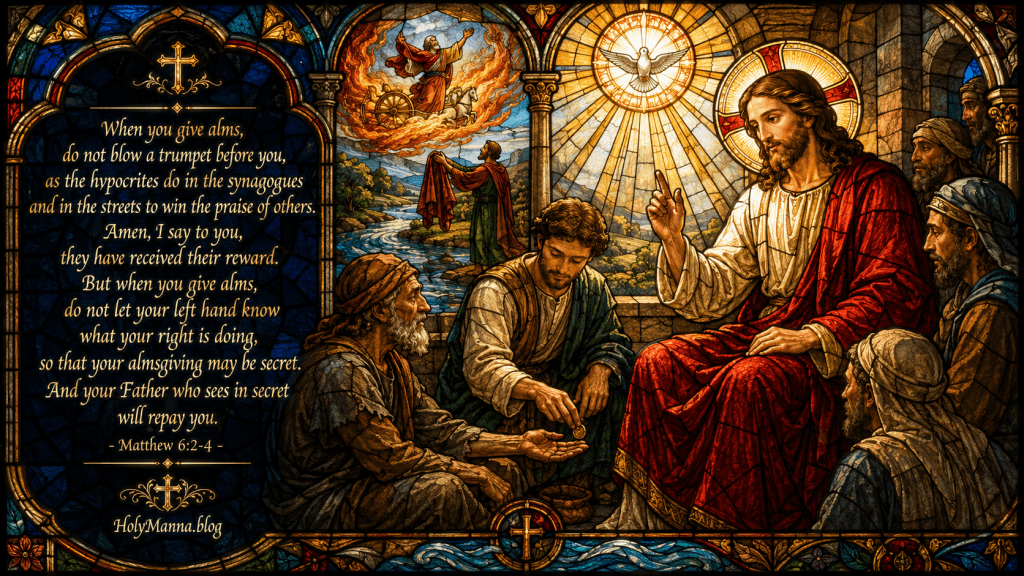
Teaching About Almsgiving. 1 “[But] take care not to perform righteous deeds in order that people may see them; otherwise, you will have no recompense from your heavenly Father. 2 When you give alms, do not blow a trumpet before you, as the hypocrites do in the synagogues and in the streets to win the praise of others. Amen, I say to you, they have received their reward. 3 But when you give alms, do not let your left hand know what your right is doing, 4 so that your almsgiving may be secret. And your Father who sees in secret will repay you.
Teaching About Prayer. 5 “When you pray, do not be like the hypocrites, who love to stand and pray in the synagogues and on street corners so that others may see them. Amen, I say to you, they have received their reward. 6 But when you pray, go to your inner room, close the door, and pray to your Father in secret. And your Father who sees in secret will repay you.
Teaching About Fasting. 16 “When you fast, do not look gloomy like the hypocrites. They neglect their appearance, so that they may appear to others to be fasting. Amen, I say to you, they have received their reward. 17 But when you fast, anoint your head and wash your face, 18 so that you may not appear to others to be fasting, except to your Father who is hidden. And your Father who sees what is hidden will repay you.
Detailed Exegesis
Verse 1 – “[But] take care not to perform righteous deeds in order that people may see them; otherwise, you will have no recompense from your heavenly Father.”
Jesus begins with a warning that cuts straight through religious appearance. He does not condemn righteous deeds. He condemns doing them “in order that people may see them.” The issue is motive. The human heart can take even good works and twist them into a search for recognition.
This verse must be read alongside Jesus’ earlier teaching in Matthew 5:16, where He says, “Your light must shine before others, that they may see your good deeds and glorify your heavenly Father.” The difference is whether the good deed leads others to glorify God or leads the person doing it to seek praise. Jesus is not teaching secretiveness for its own sake. He is teaching purity of heart.
Verse 2 – “When you give alms, do not blow a trumpet before you, as the hypocrites do in the synagogues and in the streets to win the praise of others. Amen, I say to you, they have received their reward.”
Jesus says “when you give alms,” not “if you give alms.” He assumes that His disciples will care for the poor. Almsgiving was a serious religious duty in Jewish life, and the Church continues to see it as an essential expression of mercy.
The image of blowing a trumpet is vivid. Whether literal or exaggerated, Jesus is exposing the desire to make generosity public. The word “hypocrite” originally carried the sense of an actor, someone playing a role. Jesus warns against turning mercy into theater.
The phrase “they have received their reward” is sobering. Human praise can be a real reward, but it is shallow and temporary. If a person gives mainly to be admired, admiration may be all they receive. The Father offers something deeper, but the heart must be directed toward Him.
Verse 3 – “But when you give alms, do not let your left hand know what your right is doing.”
Jesus now gives a memorable image of hidden generosity. The left hand and right hand belong to the same body, so His command is intentionally striking. He is teaching a kind of humility so deep that the giver does not dwell on his own goodness.
This does not mean Christians should never organize public charity or support visible works of mercy. The Church’s hospitals, schools, shelters, missions, and charitable works are public signs of Christ’s love. The warning is against self-congratulation. A disciple should give without constantly replaying the act internally as proof of holiness.
Verse 4 – “So that your almsgiving may be secret. And your Father who sees in secret will repay you.”
Jesus reveals the heart of the teaching. The Father sees. That truth is both comforting and purifying. It comforts the faithful person whose sacrifices go unnoticed. It purifies the person who secretly craves credit.
The Father’s repayment is not a cheap transaction. God is not buying good behavior with spiritual prizes. Rather, He receives hidden love, purifies it, and draws the soul deeper into communion with Himself. Secret almsgiving forms a heart that loves the poor for God’s sake, not for the admiration of others.
Verse 5 – “When you pray, do not be like the hypocrites, who love to stand and pray in the synagogues and on street corners so that others may see them. Amen, I say to you, they have received their reward.”
Again, Jesus says “when you pray,” assuming prayer is a normal part of discipleship. Public prayer itself is not the problem. Jesus prayed publicly. The apostles prayed publicly. The Church’s liturgy is public worship. The Holy Mass is the highest prayer of the Church.
The problem is prayer performed “so that others may see them.” Prayer becomes corrupted when God becomes a prop in a performance of religious importance. The person may be speaking to God outwardly, but inwardly speaking to the crowd.
This warning applies powerfully to modern life. A person can be physically alone and still pray for an imagined audience. A person can also be in a crowded church and pray with sincere humility. Jesus is not merely concerned with location. He is concerned with the heart.
Verse 6 – “But when you pray, go to your inner room, close the door, and pray to your Father in secret. And your Father who sees in secret will repay you.”
The inner room is a place of honesty. Jesus invites the disciple away from performance and into intimacy. Closing the door is not only a physical action. It is also a spiritual one. It means shutting out distractions, self-display, comparison, and the need to appear holy.
This verse has nourished Christian prayer for centuries. It teaches that prayer begins in the secret meeting between the soul and the Father. Catholic life includes rich public prayer, especially the Mass and the Liturgy of the Hours, but those prayers must be joined to a heart that knows how to be alone with God.
Verse 16 – “When you fast, do not look gloomy like the hypocrites. They neglect their appearance, so that they may appear to others to be fasting. Amen, I say to you, they have received their reward.”
Jesus now turns to fasting. Again, He says “when you fast,” assuming His disciples will practice bodily self-denial. Fasting was part of Jewish religious life, often connected with repentance, mourning, prayer, and dependence on God.
The hypocrites make fasting visible by looking gloomy and neglecting their appearance. Their sacrifice becomes a costume. Instead of helping them hunger for God, fasting becomes a way to be noticed as serious, disciplined, or spiritual.
Jesus exposes a temptation that remains very real. Sacrifice can become a subtle badge of superiority. A person can give something up and then quietly hope everyone finds out. That does not make fasting useless, but it shows why fasting must be purified by humility.
Verse 17 – “But when you fast, anoint your head and wash your face.”
Jesus gives a practical and almost surprisingly ordinary command. Wash your face. Anoint your head. Do not make other people carry the emotional weight of your sacrifice.
In the ancient world, anointing and washing were signs of normal grooming and even joy. Jesus is teaching that fasting should not make the disciple gloomy, harsh, or theatrical. A Christian fast should make the heart freer for God and more loving toward neighbor.
This is especially important because fasting is not self-hatred. The Catholic understanding of fasting is rooted in ordered love. The body is good, but it must not become the master. Fasting teaches the person to say no to lesser goods so the heart can say yes to God more freely.
Verse 18 – “So that you may not appear to others to be fasting, except to your Father who is hidden. And your Father who sees what is hidden will repay you.”
Jesus ends by returning to the hidden Father. The disciple fasts not to appear holy before others, but to stand truthfully before God. The Father is hidden, and He sees what is hidden. The one who lives for Him learns to become free from the need to be constantly seen.
This verse gathers the whole Gospel together. Almsgiving, prayer, and fasting are not religious performances. They are acts of conversion. They form the Christian in love of neighbor, communion with God, and mastery over the self. When done in secret before the Father, they become pathways to holiness.
Teachings
This Gospel is one of the clearest Catholic teachings on interior conversion. Jesus is not satisfied with external religion alone. He wants the heart. He wants love that is purified of vanity, prayer that is directed toward the Father, and fasting that makes the person freer for God.
The Catechism of the Catholic Church teaches, “The New Law practices the acts of religion: almsgiving, prayer and fasting, directing them to the ‘Father who sees in secret,’ in contrast with the desire to ‘be seen by men.’ Its prayer is the Our Father.” CCC 1969
This teaching is almost a direct summary of today’s Gospel. The New Law does not abolish religious practice. It directs religious practice toward the Father. The question is not only whether someone gives, prays, or fasts. The deeper question is whether those actions are aimed at God or at human praise.
The Catechism also teaches, “The Law of the Gospel fulfills the commandments of the Law. The Lord’s Sermon on the Mount, far from abolishing or devaluing the moral prescriptions of the Old Law, releases their hidden potential and has new demands arise from them: it reveals their entire divine and human truth. It does not add new external precepts, but proceeds to reform the heart, the root of human acts, where man chooses between the pure and the impure, where faith, hope, and charity are formed and with them the other virtues.” CCC 1968
This is the exact movement of Jesus’ teaching. He reforms the root. He goes beneath the action and exposes the desire. A person may do something religious, but the heart may still be divided. Jesus heals that division by calling the disciple back to the Father.
The Church also teaches that prayer, fasting, and almsgiving express conversion in a complete way. The Catechism says, “Scripture and the Fathers insist above all on three forms, fasting, prayer, and almsgiving, which express conversion in relation to oneself, to God, and to others.” CCC 1434
That line is a beautiful key to the whole Gospel. Fasting converts the self. Prayer turns the heart toward God. Almsgiving turns the heart toward the neighbor. Together, they train the Christian to love rightly.
Almsgiving also belongs to the wider Catholic tradition of the works of mercy. The Catechism teaches, “The works of mercy are charitable actions by which we come to the aid of our neighbor in his spiritual and bodily necessities.” CCC 2447
Jesus’ teaching on almsgiving is therefore not a minor moral suggestion. It belongs to the heart of Christian charity. The poor are not props in a religious performance. They are persons loved by God, and the Christian is called to serve them with humility.
The saints understood the danger of vanity in religious life. St. Augustine, reflecting on the Sermon on the Mount, taught that Jesus does not forbid being seen doing good, but forbids doing good for the purpose of being seen. This distinction matters. Christianity is not meant to be hidden out of cowardice. It is meant to be visible in a way that glorifies the Father, not the ego.
St. John Chrysostom also warned that vainglory can corrupt even acts of virtue. His preaching on this passage reminds the Church that the enemy does not only tempt people to obvious sin. He also tempts them to become proud of their holiness. This is why Jesus’ words are so merciful. He does not humiliate His disciples. He protects them from spiritual self-deception.
The Gospel also speaks deeply to Catholic worship. Public prayer is holy when it is truly ordered to God. The Mass is not a performance by the priest or the people. It is the sacrifice of Christ made present sacramentally. Personal prayer behind the closed door and public worship in the Church are meant to nourish one another. A Catholic who prays secretly learns to worship publicly with greater sincerity.
Reflection
This Gospel is gentle, but it is not soft. Jesus lovingly asks the question most religious people would rather avoid: Who is the audience of the heart?
That question matters because a person can slowly begin living for the wrong gaze. The gaze of coworkers. The gaze of friends. The gaze of social media. The gaze of parish peers. The gaze of family members. Even the imagined gaze of people who are not actually paying attention. Jesus frees the disciple from that exhausting life by pointing back to the Father.
The Father sees the quiet act of mercy. He sees the prayer whispered when nobody else knows the soul is struggling. He sees the fast that is carried with a washed face and a steady heart. He sees the hidden battle against temptation, the private decision to forgive, the unseen generosity, the effort to stay faithful when holiness feels ordinary and unnoticed.
That is good news. The Christian does not have to advertise every sacrifice. The Christian does not have to turn faith into a personal brand. The Christian does not have to perform holiness for the crowd. The Father sees.
A simple way to live this Gospel is to choose one hidden act of love today. Give quietly. Pray without announcing it. Fast from something that has too much control over the heart. Avoid mentioning the sacrifice unless charity requires it. Let the act belong to the Father.
It is also worth examining the small ways vanity enters religious life. Maybe it appears in wanting credit for serving. Maybe it appears in frustration when generosity goes unnoticed. Maybe it appears in subtle comparisons during prayer. Maybe it appears in posting more about faith than actually practicing it in secret. Jesus does not reveal these things to shame the soul. He reveals them to heal the soul.
Where is the heart tempted to seek praise instead of pleasing the Father?
What act of charity could be done secretly this week?
Does prayer feel like real communion with God, or has it become routine, distracted, or concerned with appearances?
What kind of fasting would help the heart become freer, humbler, and more loving?
Would life look different if the Father’s gaze truly felt like enough?
Today’s Gospel calls every disciple back to the hidden room. The door closes. The crowd fades. The trumpet is silenced. The face is washed. The Father is there. And in that secret place, where no one else applauds, holiness begins to become real.
When the Father’s Gaze Is Enough
Today’s readings leave the soul with a quiet but powerful invitation: stop performing and start remaining.
Elisha remains close to Elijah until the final moment, and because he stays faithful, he receives the mantle. The psalmist reminds the faithful that the Lord’s goodness is often hidden but never absent, because He shelters His people “in the shelter of your presence.” Psalm 31:21 Then Jesus brings everything into focus by teaching that almsgiving, prayer, and fasting are meant for the Father, not the crowd. “And your Father who sees what is hidden will repay you.” Matthew 6:18
Together, these readings teach that real holiness is formed in hidden places. The mantle of mission is not given to the soul that craves attention, but to the one that stays close. The Lord’s goodness is not always loud, but it is stored up for those who fear Him. The Father is not impressed by spiritual theater, but He delights in quiet love, sincere prayer, and humble sacrifice.
That is a freeing word for ordinary Catholic life. A person does not need a platform to be faithful. A person does not need applause to be holy. A person does not need everyone to know the cost of obedience. The Father sees the unseen yes, the quiet act of mercy, the private prayer, the hidden fast, the resisted temptation, the forgiven wound, and the responsibility picked up without complaint.
So today, choose one hidden act of faithfulness. Give without announcing it. Pray with the door closed. Fast with a washed face. Stay close to Christ when it would be easier to drift. Pick up the mantle that belongs to this season of life, whether it is family, work, parish life, service, forgiveness, or deeper conversion.
What would change if the Father’s gaze truly became enough?
The Christian life becomes lighter when it is no longer lived for the crowd. It becomes stronger when it is lived in the shelter of God’s presence. It becomes holy when the heart can say, with quiet trust, that the Lord sees, the Lord provides, and the Lord is still here.
Engage with Us!
Share your reflections in the comments below. Today’s readings invite every heart to look honestly at what it means to stay close to God, trust His hidden goodness, and live faith for the Father rather than for the crowd.
- In the First Reading from 2 Kings 2:1, 6-14, Elisha refuses to leave Elijah and then receives his mantle. Where is God asking you to stay faithful, even when the next step feels uncertain?
- In Psalm 31:20-21, 24-25, the Lord hides His faithful ones in the shelter of His presence. Where do you need to trust that God is protecting and forming you, even if His goodness feels hidden right now?
- In the Holy Gospel from Matthew 6:1-6, 16-18, Jesus teaches that the Father sees in secret. What is one hidden act of prayer, fasting, or charity you can offer to God this week without seeking recognition?
May these readings help every soul pick up the mantle God has placed nearby, enter the shelter of His presence, and serve with a humble heart. Let faith be lived quietly when needed, boldly when called for, and always with the love and mercy Jesus taught us.
Sacred Heart of Jesus, we trust in You!
Immaculate Heart of Mary, pray for us!
Saint Michael the Archangel, defend us in battle!
Follow us on YouTube, TikTok, Instagram and Facebook for more insights and reflections on living a faith-filled life.

 Holy Manna!
Leave a comment