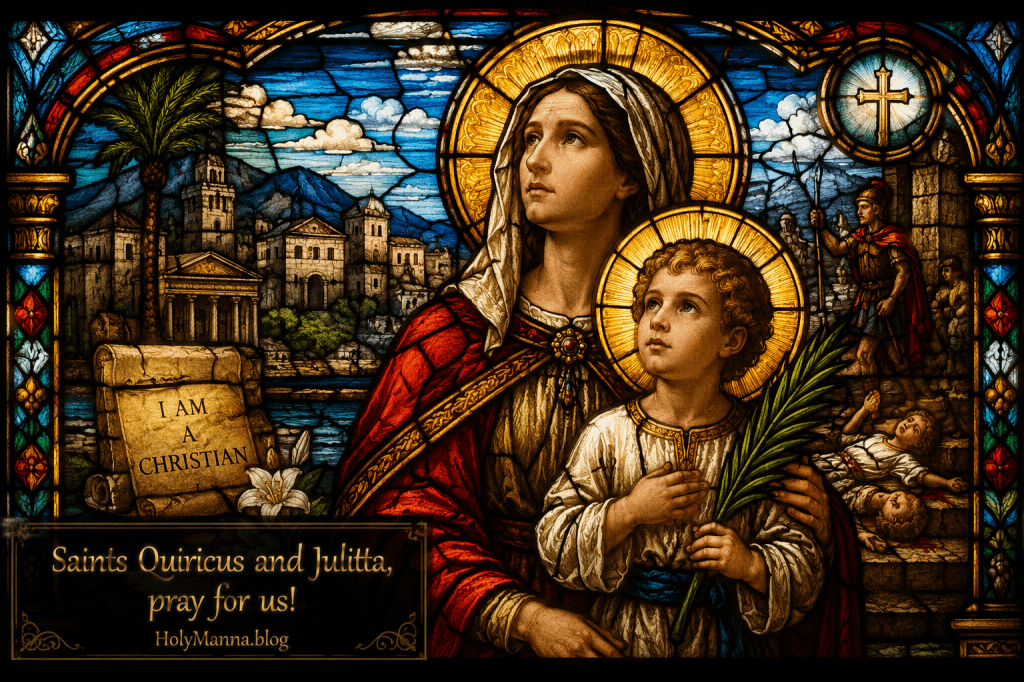
When a Mother’s Faith Became Her Child’s Crown
Some saints preach with sermons. Some preach with books. Some preach with miracles. Saints Quiricus and Julitta preached with one sentence, spoken under pressure, in the shadow of death: “I am a Christian.”
Saints Quiricus and Julitta were an early Christian mother and son martyred at Tarsus in Cilicia, in modern-day Turkey, around A.D. 304 during the persecution of Emperor Diocletian. Julitta was a Christian widow of noble background, and Quiricus was her very young son, traditionally remembered as three years old. Together, they became one of the Church’s most moving examples of family holiness under persecution.
They are honored in the Roman Catholic Church on June 16. They are traditionally invoked as patrons of children, sick children, and happy families. Their story speaks especially to parents, grandparents, godparents, teachers, and anyone trying to pass on the faith in a world that often pressures believers to stay quiet.
What makes their witness so powerful is not that they had worldly power. They did not. One was a widowed mother, and the other was a little child. Yet grace made them stronger than a governor, stronger than fear, and stronger than death.
The Catechism of the Catholic Church teaches that martyrdom is “the supreme witness given to the truth of the faith” in CCC 2473. Saints Quiricus and Julitta show that truth in one of the most tender and heartbreaking ways possible. A mother confessed Christ, and her child learned courage by watching her.
A Noble Widow, a Little Son, and a Dangerous Faith
Julitta was remembered in Christian tradition as a noble Christian woman from Iconium in Lycaonia, a region of Asia Minor. Some accounts describe her as a widow of high social rank, even from an illustrious or royal family. Her nobility, however, is not what made her great in the eyes of the Church. Her greatness came from her faithfulness to Christ when everything familiar was stripped away.
There is no clear story of Julitta’s conversion, so it is best not to invent one. The tradition simply presents her as already Christian, already formed in the faith, and already determined to remain faithful to Jesus. She was a mother whose faith was not just something private or sentimental. It shaped how she lived, how she fled danger, and how she faced death.
When persecution broke out against Christians, Julitta left Iconium with her young son Quiricus and two maidservants. She was not rushing toward death. She was a mother trying to protect her child. She first fled toward Seleucia in Isauria, but persecution had reached that area too. So she continued on to Tarsus in Cilicia.
That detail matters. Julitta did what any loving parent would do. She tried to preserve life. She tried to protect her son. She tried to escape violence. Catholic martyrdom is not a reckless search for suffering. It is fidelity when suffering cannot be avoided without betraying Christ.
Eventually, Julitta was recognized as a Christian, arrested, and brought before the governor Alexander. Her maidservants fled when she was seized, but according to tradition, they later played an important role in recovering and burying the bodies of the martyrs.
Before the governor, Julitta was asked about her identity. The tradition says she answered with one simple confession: “I am a Christian.”
That sentence became the center of her life. She was a widow. She was a mother. She was noble. She was a refugee. But before all of that, she belonged to Christ.
The Catechism teaches in CCC 2223 that “Parents have the first responsibility for the education of their children.” Julitta taught her son the faith not only with words, but with her entire body, soul, and courage. Quiricus learned what mattered most by watching his mother refuse to deny Jesus.
The Child Who Learned Courage from His Mother
Saint Quiricus is remembered as one of the youngest martyrs in Christian tradition. Some older accounts differ on his exact age, and one older scholarly notice even mentions him as an infant. However, the most common Roman Catholic devotional tradition remembers him as a three-year-old child, old enough to cry out for his mother, hear her confession, and repeat it.
That is what makes the story unforgettable.
As Julitta was tortured for refusing to sacrifice to the pagan gods, Quiricus cried for her. The governor reportedly took the child onto his lap, trying to calm him or distract him. But Quiricus wanted his mother. In some later versions of the story, the child scratched or struck the governor while struggling to return to Julitta. These details come from later hagiographical tradition, so they should be treated as devotional stories rather than fully verified history.
Then, hearing his mother confess Christ, Quiricus repeated her words. The traditional line associated with him is: “I am a Christian.”
There are no verified writings or historically certain sayings from Saints Quiricus and Julitta. This famous confession comes from the martyrdom tradition. Still, it beautifully captures the heart of their witness.
The governor, enraged by the child’s confession, killed Quiricus. The Roman Martyrology remembers that the child was dashed against the steps of the tribunal. Other versions say he was hurled down stone steps or thrown to the ground. However the scene is described, the spiritual meaning is the same. The child died because he confessed Christ.
Julitta then saw her son die before her.
It is hard to imagine a deeper grief. Yet the tradition says she did not deny Christ afterward. Instead, she thanked God that her son had received the martyr’s crown before her. That does not mean her sorrow was small. It means her faith was larger than despair.
After further torments, Julitta was beheaded. Mother and son entered eternal life together, their witness forever joined in the memory of the Church.
A Martyrdom Written into the Heart of the Church
The martyrdom of Saints Quiricus and Julitta is important because it reveals the power of the domestic church. The home is not just where children are fed, clothed, and protected. It is where they first learn what is worth living for, and if necessary, what is worth dying for.
Julitta did not give Quiricus a long theological lesson before the governor. She gave him something more powerful. She gave him an example.
Children notice what adults love. They notice what adults fear. They notice what adults compromise. They notice what adults refuse to surrender.
Quiricus heard his mother say, “I am a Christian,” and he learned that this identity was worth more than safety. In one terrible moment, the faith passed from mother to son, not as an idea, but as a living flame.
This is why their story still matters. Every Catholic parent, godparent, catechist, and grandparent should feel the weight of Julitta’s witness. The faith is not passed on only through lectures, programs, or textbooks. Those things matter, but children also learn the faith by watching how adults suffer, forgive, pray, sacrifice, and choose Christ when it costs something.
What would the children in our lives learn about Jesus by watching how we respond to fear, pressure, disappointment, or suffering?
Saint Julitta reminds the Church that a mother’s faith can become a child’s courage. Saint Quiricus reminds the Church that grace is not limited by age.
The Memory That Would Not Die
After their martyrdom, the bodies of Quiricus and Julitta were reportedly left outside the city. According to tradition, Julitta’s maidservants returned secretly, recovered the bodies, and buried them. Later, during the reign of Constantine, when peace was restored to the Church, one of the servants revealed where the martyrs had been buried.
Their veneration spread widely in both the East and the West. Their names appear in ancient martyrological traditions, and their feast became part of the Church’s memory. In the Roman Catholic tradition, they are commemorated on June 16. In many Eastern Christian calendars, their feast is observed on July 15.
Their relic traditions became especially important in France. Devotion to them was strong in Nevers, where the Cathedral of Saint-Cyr-et-Sainte-Julitte is dedicated to them. In France, Quiricus became known as Saint Cyr, and his name became attached to churches, towns, and local devotions.
There is also a famous legend involving Charlemagne and Saint Cyr. According to the story, Charlemagne dreamed that he was being chased through a forest by a wild boar. A half-clothed child appeared and promised to save him if the emperor would give him clothing. When Charlemagne awoke, the bishop of Nevers interpreted the child as Saint Cyr and the request for clothing as a sign that the neglected church dedicated to Saint Cyr and Saint Julitta needed restoration. Charlemagne then helped restore it.
This story is a legend and cannot be verified with certainty. Still, it became an important part of the cultural memory of Saint Cyr in France. Because of this legend, Saint Cyr is sometimes shown in sacred art with a wild boar.
Posthumous miracles were also associated with the relics of Saints Quiricus and Julitta, especially in the Nevers tradition. During a later translation of their relics, miracles were said to have occurred, though the specific details are not always clearly preserved. Because of that, these miracle traditions should be presented carefully. The Church’s devotion to their relics is historically strong, but some individual miracle stories cannot be verified in detail.
Their memory also spread through Italy. They are honored there as Santi Quirico e Giulitta. Churches dedicated to them stand in places such as Rome and San Quirico d’Orcia in Tuscany. Their names shaped local Catholic culture, parish identity, sacred art, and pilgrimage life for centuries.
That is one of the surprising things about these saints. They were not popes, bishops, theologians, or founders of religious orders. They were a mother and a child. Yet their witness shaped cathedrals, towns, churches, feast days, relic traditions, and family devotion across the Christian world.
The Courage Every Family Needs
Saints Quiricus and Julitta are remembered because they show what faith looks like when it becomes stronger than fear.
Julitta’s courage was not loud or dramatic in a worldly way. She simply refused to deny Jesus. Her witness was steady, direct, and rooted in love. She tried to protect her son, but when she could not protect him from suffering, she entrusted him to Christ.
That is a hard lesson, but it is deeply Catholic. Parents are called to love their children with everything they have, but they are also called to remember that children belong first to God. The goal of Catholic parenting is not merely to raise children who are successful, comfortable, or admired. The goal is to help raise saints.
Quiricus reminds the Church that children are capable of holiness. His confession was not complicated. It was not polished. It was not academic. It was simply faithful. “I am a Christian.”
There is something powerful about that. Sometimes adults make faith more complicated than it needs to be. There are difficult doctrines, deep mysteries, and real struggles in the Christian life. But at the center of it all is belonging to Christ.
Can that same confession be seen in our daily choices?
To live like Julitta is to let faith form the home. It means praying with children, speaking openly about Jesus, going to Mass even when life is busy, choosing truth when it is inconvenient, and showing children that Catholic faith is not an accessory. It is the center.
To live like Quiricus is to trust with childlike courage. It means being willing to say, by word and action, “I am a Christian,” even when the room gets uncomfortable.
Most Catholics will not be asked to face martyrdom like Saints Quiricus and Julitta. But every Catholic will face moments of witness. A conversation at work. A moral choice in a relationship. A decision about how to raise children. A moment when silence would be easier than truth. A temptation to hide the faith in order to be liked.
Saints Quiricus and Julitta remind us that holiness begins with belonging to Christ and refusing to let fear have the final word.
Engage with Us!
Share your thoughts and reflections in the comments below. Saints Quiricus and Julitta give us one of the most moving examples of family faith in the history of the Church, and their story invites each of us to think seriously about what kind of witness we are giving to the people closest to us.
- What part of the story of Saints Quiricus and Julitta challenged you the most?
- How can parents, grandparents, godparents, and teachers better pass on the faith through example, not just words?
- When have you had to quietly or courageously say, “I am a Christian,” through your actions?
- What is one practical way your home can become a stronger domestic church this week?
- How can the witness of a young child like Saint Quiricus help us recover a simpler and more courageous faith?
May Saints Quiricus and Julitta pray for our families, our children, and all those who are afraid to stand firm in the faith. May their witness help us live with courage, speak with love, and do everything with the mercy and love Jesus taught us.
Saints Quiricus and Julitta, pray for us!
Follow us on YouTube, TikTok, Instagram and Facebook for more insights and reflections on living a faith-filled life.

 Holy Manna!
Leave a comment