The Bishop, the Emperor, and the Fish That Returned the Keys
Saint Benno of Meissen was an 11th-century German bishop, confessor, reformer, and missionary figure whose feast day is celebrated on June 16. He is remembered as the tenth Bishop of Meissen, a shepherd who served during one of the most tense and complicated moments in medieval Church history: the Investiture Controversy.
That conflict was not just a political argument between popes and emperors. It was a battle over whether the Church could remain free to govern her own spiritual mission, appoint her own shepherds, and serve Christ without being controlled by worldly rulers. Saint Benno lived right in the middle of that storm.
He is especially honored as the patron saint of Munich, Bavaria, the Diocese of Dresden-Meissen, fishermen, anglers, and weavers. He is also remembered in Catholic tradition as a missionary among the Slavic peoples, especially the Sorbs or Wends, and as the saint connected to one of the most memorable legends in medieval Germany: the fish that returned the cathedral keys.
Saint Benno’s story matters because it is not the life of a saint who lived in calm times. It is the life of a bishop who faced pressure, exile, imprisonment, political confusion, and ecclesial conflict. His path was not simple, but his legacy points back to a deeply Catholic truth: Christ protects His Church, even when human powers try to claim what belongs to God.
As The Catechism teaches, the Church is apostolic because she remains founded on the apostles, taught by their successors, and guided in communion with the successor of Peter. CCC 857 reminds the faithful that the Church continues to be taught, sanctified, and guided by the apostles “until Christ’s return, through their successors in pastoral office: the college of bishops.” Saint Benno’s life shows how serious that truth becomes when the freedom of the Church is tested.
A Noble Beginning Wrapped in Mystery
Saint Benno was probably born around the year 1010 near Hildesheim in Saxony, in what is now Germany. Catholic tradition usually places him within a noble Saxon family, though the details of his parents and early childhood cannot be proven with certainty. Some later traditions identify his mother as Blessed Bezela of Göda, but this detail belongs more to devotional memory than firm historical record.
Tradition says Benno was educated from childhood in the religious world of Hildesheim, possibly at the Benedictine Abbey of Saint Michael. Some accounts say he became a monk and even served as abbot, while others simply present him as a well-formed cleric deeply shaped by prayer, learning, and the discipline of the Church.
What is more historically secure is that Benno became a canon at Goslar, an important imperial and ecclesial center. He was also connected to the royal court, serving in circles close to King Henry IV. That matters because Benno did not begin his ministry far from power. He understood court politics, imperial influence, and the pressures that came when kings wanted bishops to serve political interests.
This background prepared him for the role that would define his life. In 1066, King Henry IV appointed Benno as Bishop of Meissen.
Meissen was a frontier diocese. It was located in eastern Germany, near regions where Christian life was still being strengthened and where Slavic peoples such as the Sorbs or Wends lived. A bishop in Meissen had to be more than a church official. He had to be a missionary, teacher, builder, reformer, diplomat, and spiritual father.
Saint Benno became known for strengthening Catholic life in his diocese, supporting clergy discipline, preaching the faith, building up Church institutions, and, according to Catholic tradition, working for the conversion and formation of the Slavic peoples. Later tradition would call him the “Apostle of the Wends,” though that title should be understood as a devotional tradition rather than a fully documented historical title.
Still, the memory is meaningful. Catholics remembered Benno not as a bishop who simply occupied an office, but as a shepherd who tried to bring Christ to a people and a region still being formed in the faith.
The Bishop Who Would Not Belong to the Emperor
Saint Benno’s episcopal ministry was deeply shaped by the Investiture Controversy. This conflict centered on whether secular rulers, especially emperors and kings, had the right to appoint bishops and invest them with symbols of spiritual authority. To modern ears, that can sound like a distant medieval dispute. In reality, it touched the heart of the Church’s freedom.
A bishop is not meant to be a royal employee. A bishop is a successor of the apostles. He is called to teach the faith, sanctify the people through the sacraments, and govern the Church in communion with the Pope. When rulers tried to control bishops, they were not merely arranging political appointments. They were interfering with the spiritual order established by Christ.
Saint Benno became caught between Emperor Henry IV and Pope Saint Gregory VII. In 1073, Benno took part in the Saxon opposition to Henry IV. When Henry gained the upper hand, Benno was imprisoned for about a year. Later, because he supported the reforming party connected with Pope Gregory VII, he was deposed by the imperial side at the Synod of Mainz in 1085, and another man was placed in the See of Meissen.
This was one of the defining hardships of his life. Benno lost his position, suffered imprisonment, and endured the humiliation of seeing his diocese handed over through political pressure. Yet his story is not a cartoonish tale of a perfect bishop against a wicked emperor. It is more complicated and more human than that.
After the death of Pope Gregory VII, Benno at one point recognized the antipope Wibert of Ravenna, who called himself Clement III. Through that recognition, Benno regained his see. Later, however, he separated himself from the schismatic party and recognized Pope Urban II as the rightful pope.
This part of his life is important because it shows the real pressure of the age. Saints are not imaginary figures floating above history. They live in confusion, conflict, fear, and consequence. Benno’s sanctity is not found in pretending the conflict was simple. It is found in his eventual return to communion with the lawful Pope and his continuing work as a shepherd of souls.
His life reminds Catholics that faithfulness sometimes means finding the road back after a season of confusion. Christ does not only call the fearless. He also restores the pressured, strengthens the wounded, and brings His servants back into communion with His Church.
The Missionary Bishop of Meissen
Once the political situation became calmer, Saint Benno dedicated himself more fully to the life of his diocese. Catholic tradition remembers him as a bishop who visited parishes, promoted sacred worship, encouraged discipline among the clergy, opposed simony, supported the building of churches, and cared for the spiritual formation of his people.
He is also remembered as a missionary among the Slavic peoples in the region. The Sorbs, or Wends, were among the peoples living in and around the territory of his diocese. Later Catholic memory preserved Benno as a bishop who helped plant and strengthen the faith among them. Even if some details cannot be fully verified, the tradition reflects how Catholics remembered him: as a man who brought the Gospel into difficult mission territory.
There are no securely verified miracles from his lifetime in the way that some saints have carefully documented miracle accounts. However, several stories grew around his memory. One legend says that he struck the ground with his crozier and caused a spring to flow. Another tradition connects him with regional agriculture and even viticulture in Saxony, with local memory preserving the saying, “Here Benno has passed through.” These stories cannot be verified as historical events, but they reveal how deeply the people associated him with blessing, fruitfulness, and the presence of the Church in ordinary life.
That kind of memory says something beautiful. The people remembered Benno not merely as a bishop in a cathedral, but as a holy man whose presence marked the land, the harvest, the people, and the faith of a region.
Prison, Exile, and the Cost of Communion
Saint Benno was not a martyr in the strict sense. He was not killed for the faith. Yet his life was marked by serious hardship because of his role in the Church and the conflicts of his time.
He suffered imprisonment under Henry IV after the Saxon revolt. He was deposed from his diocese during the conflict between the emperor and the reforming papacy. He lived through the scandal of rival claimants, divided loyalties, and the painful question of who truly held spiritual authority.
Those are not small trials. A bishop is called to be a father to his people. To be taken from that people, to see the Church used as a political prize, and to live under pressure from powerful rulers would have required tremendous endurance.
Saint Benno’s hardships also make his story deeply relevant today. Many Catholics know what it feels like to live in confusing times, when public pressure, politics, cultural expectations, and personal weakness can make fidelity feel costly. Benno’s life does not offer an easy answer. It offers a Catholic one: stay close to the Church, return to communion when confusion has wounded the soul, and keep serving Christ with the time that remains.
As The Catechism teaches in CCC 882, the Pope, as successor of Saint Peter, is “the perpetual and visible source and foundation of the unity both of the bishops and of the whole company of the faithful.” Saint Benno’s life shows why communion with Peter matters. It is not an abstract idea. It is the visible sign that the Church does not belong to emperors, parties, or passing powers. She belongs to Christ.
The Fish That Brought Back the Keys
The most famous story connected to Saint Benno is the legend of the fish and the cathedral keys.
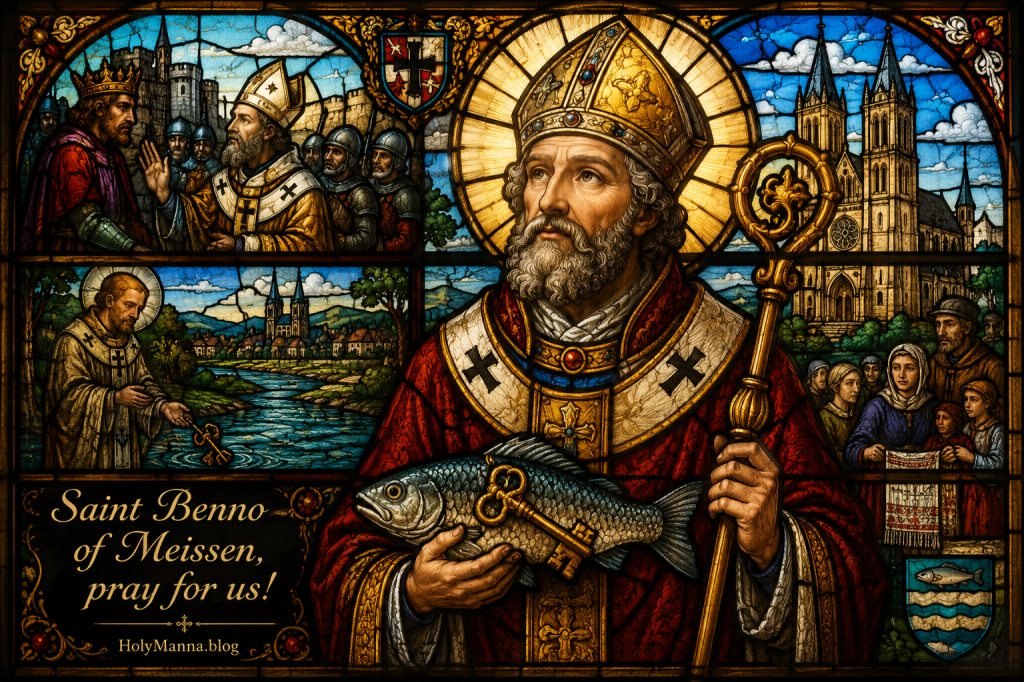
According to one version of the legend, when Benno was forced to leave Meissen during the conflict with Emperor Henry IV, he threw the keys of the cathedral into the Elbe River so that the emperor’s appointed rival could not take possession of the church. Years later, when Benno returned, a fish was served to him. Inside the fish were the keys of the cathedral.
Another version says that Benno entrusted the cathedral key to a canon before traveling to Rome. He told the canon to throw it into the Elbe if Henry IV were excommunicated. When Benno later returned, a large fish was caught, and the key was found attached to or inside the fish.
This story cannot be verified as historical fact, so it should be understood as a legend. But legends often carry spiritual meaning, and this one carries a powerful Catholic message.
The cathedral keys represented the Church in Meissen. The river represented loss, exile, and human helplessness. The fish returning the keys represented divine providence. The world tried to take possession of what belonged to God, but God returned it in His own strange and surprising way.
That is why Saint Benno is often shown as a bishop holding a fish and keys. The image is unforgettable. It tells the whole story in one symbol: the Church may suffer. The Church may be pressured. The Church may even seem to lose her keys for a time. But Christ remains Lord of the Church.
There is also a quiet echo of the Gospel in the symbol of keys. In The Gospel of Matthew, Christ says to Peter in Mt 16:18, “You are Peter, and on this rock I will build my church.” The Church’s authority does not come from emperors. It comes from Christ. Saint Benno’s legend reminds the faithful that when worldly power tries to control holy things, God has a way of returning the keys.
A Saint Whose Tomb Drew Pilgrims
Saint Benno died on June 16, 1106, and was buried in the Cathedral of Meissen. After his death, devotion to him grew steadily. Around the late 13th century, his relics were elevated and placed in a prominent tomb in the cathedral. That act recognized the devotion already surrounding him, and his tomb became a place of pilgrimage.
Catholic tradition records that many miracles and cures were associated with his tomb. The faithful came seeking healing and help through his intercession. These healings belong to the devotional tradition surrounding the saint, and the specific individual cases are not all historically verifiable. Still, the spread of devotion itself is clear. People came to Saint Benno because they believed he was alive in Christ and interceding for the Church on earth.
This is deeply Catholic. The saints are not dead religious celebrities. They are living members of the Body of Christ. The Catechism teaches in CCC 946, “The communion of saints is the Church.” It also teaches in CCC 956 that the saints in heaven “do not cease to intercede with the Father for us.”
That is the heart of Catholic devotion to Saint Benno. Catholics do not worship saints. Catholics honor what Christ has done in them and ask for their prayers. In Benno’s case, generations of Catholics sought the prayers of a bishop who had endured conflict, defended the Church’s freedom, and remained a sign of hope for a wounded region.
From Meissen to Munich
Saint Benno’s legacy took a dramatic turn during the Protestant Reformation. He was canonized by Pope Adrian VI on May 31, 1523. His relics were solemnly exposed for veneration in 1524, right as the Reformation was spreading through Germany.
Because of that timing, Benno’s canonization became controversial. Martin Luther strongly criticized the veneration of his relics and attacked the Catholic devotion surrounding him. From a Catholic perspective, that controversy made Saint Benno a symbol of something larger than his own life. His cult became connected with the Catholic defense of the communion of saints, relics, intercession, episcopal authority, and the visible continuity of the Church.
When Saxony became Protestant, Benno’s tomb in Meissen was destroyed, but his relics were preserved. In the 16th century, they were transferred to Bavaria and eventually placed in Munich’s Frauenkirche, the Cathedral of Our Lady. There, Saint Benno became one of the great patrons of Munich and Bavaria.
This is one of the most surprising parts of his legacy. A bishop of Meissen, formed in Saxony and buried in Saxony, became one of the beloved Catholic patrons of Munich. His relics helped strengthen Catholic identity in Bavaria during and after the Reformation. In Munich, devotion to him grew powerfully, with pilgrimages, processions, altars, votive offerings, and public celebrations.
In time, June 16 became a major day of celebration in Bavaria. Saint Benno was honored as a protector of the land, the city, and the faithful. Munich’s devotion to him still continues through celebrations connected to his feast, including liturgy, processions, and public Catholic witness.
A Patron Who Still Belongs to His People
Although Saint Benno became deeply connected to Munich, his memory never disappeared from Saxony. Catholic communities in the region, especially among the Sorbs, continued to honor him. When the Diocese of Meissen was restored in the 20th century, it placed itself under his patronage.
Relics of Saint Benno eventually returned in part to Saxony, including a rib relic and later other bone fragments from Munich. In recent years, his relics have been honored again in Dresden Cathedral, where the Saint Benno Chapel preserves his memory.
This modern veneration matters. It shows that Saint Benno is not only a figure from medieval history. He remains a living patron for Catholics in Germany, especially in Munich and Dresden-Meissen. His image appears in churches, schools, Catholic institutions, and local traditions. His fish and keys remain a recognizable sign of his story.
His patronage of fishermen and anglers comes naturally from the fish-and-keys legend. His patronage of weavers and clothmakers belongs to the devotional traditions that developed around his cult. His connection with protection against storms, drought, floods, and bad weather likely grew from popular devotion and the stories connecting him with water, harvest, and blessing.
Saint Benno’s cultural impact is remarkable because his memory crossed regions, survived religious upheaval, and continued to unite Catholics across centuries. He belongs to Meissen, to Munich, to Bavaria, to Dresden-Meissen, and to all Catholics who need courage in confusing times.
A Saint for Catholics Living Under Pressure
Saint Benno’s life is not neat. That may be exactly why it is so helpful.
He served during a time when Church leadership was tangled with politics. He endured imprisonment and exile. He was deposed from his diocese. He lived through the painful confusion of rival authorities. He made decisions in a world where pressure was intense and the consequences were serious.
Yet the Church remembers him as a saint.
That does not mean every decision he made was perfect. It means grace was at work in his life. It means the final shape of his witness was one of perseverance, service, repentance, communion, and fidelity.
Saint Benno teaches that holiness is not always a clean, simple path. Sometimes holiness looks like returning to the right road after confusion. Sometimes it looks like continuing to shepherd after being wounded. Sometimes it looks like trusting that God can bring the keys back from the river.
For Catholics today, his life speaks clearly. Do not hand the keys of the soul to the world. Do not let politics, pressure, fear, or convenience take possession of what belongs to Christ. Stay close to the Church. Stay close to the sacraments. Stay in communion. Ask the saints for help. Trust that God can restore what seems lost.
What part of life feels like it has been thrown into the river? What key needs to be entrusted back to Christ?
Saint Benno reminds the faithful that God’s providence often arrives in surprising ways. Sometimes, even through a fish.
Engage with Us!
Share your thoughts and reflections in the comments below. Saint Benno’s life gives plenty to think about, especially for anyone trying to stay faithful in confusing or pressured times.
- Where do you feel the most pressure to compromise your faith today?
- How does Saint Benno’s return to communion with the rightful Pope speak to the importance of staying close to the Church?
- What does the legend of the fish and the keys teach you about trusting God with what seems lost?
- How can you defend the freedom of the Church in your own family, workplace, parish, or community?
- What is one “key” in your life that needs to be handed back to Christ with trust?
May Saint Benno of Meissen pray for the Church, for bishops, for families, for workers, for fishermen, for Bavaria, for Dresden-Meissen, and for all who feel caught in the storms of history. May his witness encourage every heart to remain faithful, return when needed, and live with courage. Above all, may his life remind us to follow Jesus with humility, to love the Church with devotion, and to do everything with the love and mercy Jesus taught us.
Saint Benno of Meissen, pray for us!
Follow us on YouTube, TikTok, Instagram and Facebook for more insights and reflections on living a faith-filled life.

 Holy Manna!
Leave a comment