The Boy Who Would Not Bow to the Empire
Saint Vitus, also known in some older traditions as Saint Guy, is one of those saints whose historical record is small, but whose legacy became enormous. The Church remembers him as an early Christian martyr, traditionally associated with the persecution of Emperor Diocletian, and honors him on June 15.
He is especially known as a young martyr who refused to abandon Christ, even under pressure from family, local authorities, and imperial power. He is also remembered with Saints Modestus and Crescentia, the Christian adults who helped form him in the faith and who, according to tradition, suffered martyrdom with him.
Saint Vitus became one of the Fourteen Holy Helpers, a group of saints especially invoked in times of sickness, danger, and distress. He is the patron saint of those suffering from epilepsy, nervous disorders, convulsions, chorea, and the illness historically called Saint Vitus’ Dance. He is also invoked by dancers, actors, and those seeking protection from storms.
His story is a powerful reminder that holiness does not wait until adulthood. A child can belong completely to Christ. A young soul can have courage that puts powerful men to shame. A quiet witness can echo through centuries.
The Catechism teaches in CCC 2473 that “Martyrdom is the supreme witness given to the truth of the faith: it means bearing witness even unto death.” That is the heart of Saint Vitus’ memory. Whether every detail of the later legends can be verified or not, the Church remembers him as a witness to Christ, and that witness still speaks.
A Child Formed in Faith
The oldest Catholic sources do not give a detailed biography of Saint Vitus, so the Church is careful when speaking about his life. His veneration is ancient, but many of the stories about him come from later Christian tradition and medieval legend.
According to tradition, Vitus was born into a noble pagan family. Some accounts place his origins in Sicily, while others associate him with Lucania in southern Italy. His father is often named Hylas, a pagan nobleman who expected his son to follow the religion of the Roman world.
But Vitus was not formed by power, prestige, or fear. He was formed by faith.
The traditional story says that Vitus was taught Christianity by his tutor, Saint Modestus, and his nurse or attendant, Saint Crescentia. These two faithful Christians quietly planted the Gospel in the heart of a young boy. They taught him who Christ was. They helped him understand that the true God was not found in idols, imperial cults, or pagan sacrifices, but in Jesus Christ, crucified and risen.
That detail matters. Saint Vitus did not become courageous by accident. He was formed. He was taught. He was loved by people who believed the faith enough to pass it on.
In that sense, the story of Saint Vitus is also the story of Modestus and Crescentia. They were not famous rulers. They were not wealthy influencers. They were faithful adults who helped a child know Christ. Their hidden fidelity helped prepare a young martyr.
When Vitus’ father discovered that his son had become Christian, he was furious. The legend says Hylas tried to persuade him, punish him, and pressure him to return to pagan worship. But Vitus refused. He would not sacrifice to false gods. He would not deny Christ.
This is what Saint Vitus is most known for: youthful courage, unwavering faith, and a refusal to compromise with idolatry.
The Miracles of a Faithful Child
The stories of Saint Vitus include several miracles from his life. Since these come from later legends, they should be received as part of Catholic devotional tradition rather than as verified historical accounts. Still, they show how Christians remembered the spiritual power of his witness.
One older story says that Vitus was brought before a judge after his Christian faith was discovered. Because he had been baptized and refused pagan worship, he was scourged. According to the legend, the judge was struck blind, but Vitus prayed for him, and the judge was healed. This story cannot be historically verified, but it reflects a familiar pattern in the lives of the martyrs: the persecutor has worldly authority, but the saint reveals the mercy and power of God.
Another famous legend says that Vitus was brought to Rome because a child of Emperor Diocletian was tormented by a demon. Vitus prayed, and the child was delivered. Instead of honoring the grace of God, the imperial court accused Vitus of sorcery because he still refused to sacrifice to the pagan gods.
That part of the story is especially striking. A miracle was not enough to soften hardened hearts. The powerful saw grace and called it evil. They witnessed deliverance and still demanded idolatry.
This is not hard to recognize. The world often welcomes Christian kindness, Christian service, and Christian compassion, but only as long as Christians do not insist on the truth of Christ. Saint Vitus reminds the Church that charity and truth cannot be separated.
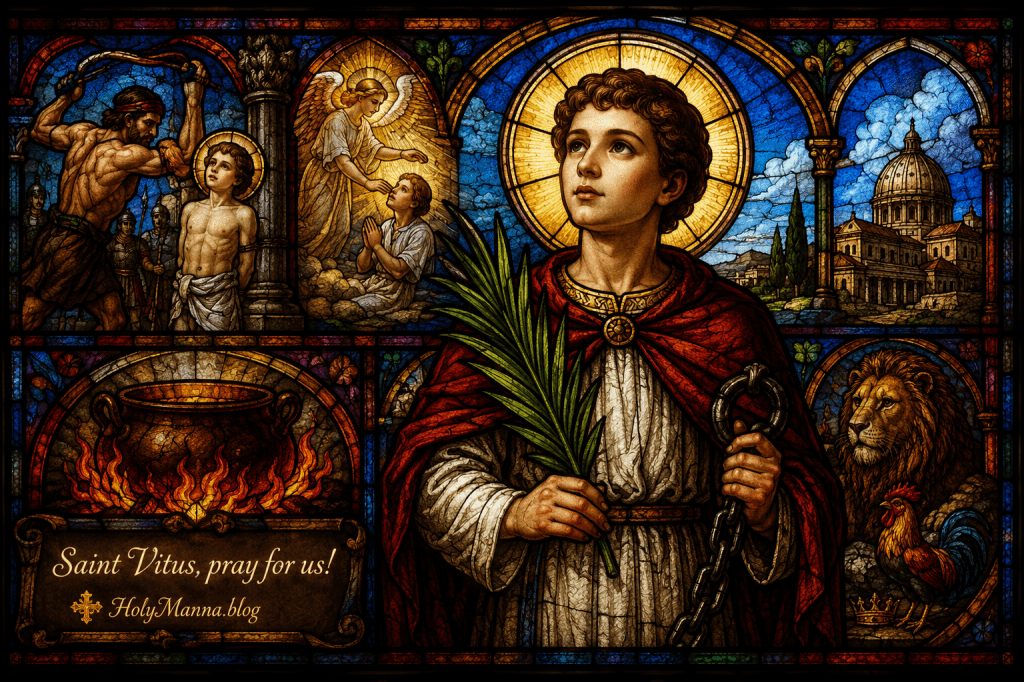
Other legends say that Vitus was protected from wild beasts, survived being placed into a cauldron of boiling oil, molten lead, tar, or resin, and was delivered by divine power from several tortures. These stories cannot be historically verified, but they explain why Saint Vitus is often shown in sacred art with a cauldron, a martyr’s palm, animals, or a rooster.
The rooster became one of his symbols because medieval pilgrims sometimes offered roosters, hens, and eggs at shrines dedicated to him. His feast fell near mid-June, which also helped connect his devotion to old seasonal customs that were later absorbed into Christian practice.
The most important truth in these stories is not the dramatic imagery. It is the faith behind it. Saint Vitus was remembered as a child who trusted Christ more than he feared suffering.
The Empire’s Threat and the Martyr’s Courage
Saint Vitus is traditionally associated with the persecution under Diocletian, one of the most severe persecutions in the early Church. Christians were pressured to sacrifice to the gods of Rome and to honor the emperor’s religious authority. Refusal could bring imprisonment, torture, exile, or death.
The legend says that Vitus, Modestus, and Crescentia fled from danger but were eventually captured. They were accused, interrogated, and tortured because they would not abandon the Christian faith.
Some traditions say they were placed on the rack. Others say they were exposed to wild beasts. Others say they were thrown into boiling oil or molten lead. In several versions of the story, God miraculously preserved them for a time. Another legend says a violent storm destroyed pagan temples during their suffering. These details cannot be historically verified, but they became part of the Catholic imagination surrounding Saint Vitus.
The traditional account says that after enduring these torments, Vitus, Modestus, and Crescentia died as martyrs. Some versions say an angel carried them back to Lucania, where they finally died from the suffering they had endured. Another story says that three days later, Vitus appeared to a noble woman named Florentia, who found and buried their bodies. This also belongs to the legendary tradition and cannot be historically verified.
Still, the meaning of the martyrdom is clear. Saint Vitus did not belong to Caesar. He belonged to Christ.
That is why the Church remembers him. Not because every medieval detail can be proven, but because the memory of his witness points to the deepest Christian conviction: Jesus is Lord, and no earthly power has the right to take His place.
A Saint for the Sick, the Shaken, and the Afraid
After his death, devotion to Saint Vitus spread widely. His relics were said to have been brought to Saint-Denis in France in the eighth century and later transferred to Corvey in Germany in the year 836. From Corvey, his veneration spread through Westphalia, Germany, and into northern and eastern Europe.
His name became especially connected with healing. Catholics invoked Saint Vitus for those suffering from epilepsy, convulsions, nervous disorders, and involuntary movements. The condition historically called Saint Vitus’ Dance was associated with him because sufferers of movement disorders and episodes of dancing mania were brought to his shrines for prayer.
During outbreaks of dancing mania in medieval Europe, people were sometimes led around his altar or statue while asking for his intercession. These practices belong to the devotional and cultural world of medieval Catholicism, and individual cures cannot always be verified. Still, they show how deeply the faithful trusted the intercession of the saints.
This fits beautifully with the Catholic understanding of the communion of saints. The Catechism teaches in CCC 956 that the saints “do not cease to intercede with the Father for us.” The saints are not dead memories. In Christ, they are alive, and their prayers assist the Church on earth.
Saint Vitus’ legacy also reached some of Europe’s most important churches. One of the greatest cultural monuments connected with him is Saint Vitus Cathedral in Prague, now formally known as the Metropolitan Cathedral of Saints Vitus, Wenceslaus, and Adalbert. It became one of the central spiritual and cultural symbols of Czech Catholic history, connected with royal coronations, saints, rulers, bishops, and the Christian identity of a nation.
This is one of the surprising facts about Saint Vitus. A young martyr with a small historical record became the namesake of one of Europe’s great Catholic cathedrals.
His feast on June 15 was once celebrated in many places with Mass, pilgrimages, rest from work, and public festivals. His devotion influenced sacred art, local customs, healing prayers, popular celebrations, and the medieval devotion to the Fourteen Holy Helpers.
For centuries, Catholics turned to Saint Vitus when bodies trembled, storms threatened, children suffered, and fear felt overwhelming. His story became a shelter for the afflicted.
The Courage of the Young and the Responsibility of the Faithful
Saint Vitus teaches that children are capable of real holiness. That may sound obvious, but modern culture often underestimates the spiritual seriousness of the young. The Church does not. The Church knows that children can love Christ deeply. They can pray sincerely. They can suffer bravely. They can witness to truth with astonishing purity.
His story also teaches that adults have a sacred responsibility. Modestus and Crescentia remind parents, godparents, teachers, catechists, and mentors that passing on the faith matters. A child’s courage is often prepared by someone else’s quiet fidelity.
What kind of faith are today’s children seeing in the adults around them?
Saint Vitus also speaks to anyone who feels pressured to compromise. Most people today will not be dragged before a pagan governor, but many are still tempted to bow. Bow to comfort. Bow to approval. Bow to popularity. Bow to career pressure. Bow to fear. Bow to the false gods of the age.
Saint Vitus reminds Catholics that faithfulness begins with small refusals. Refusing to lie. Refusing to hide the faith out of embarrassment. Refusing to treat sin as normal. Refusing to make comfort the highest good.
He also reminds the sick and suffering that they are not forgotten. His patronage of those with epilepsy, nervous disorders, and convulsions points to a tender truth in Catholic devotion. The Church brings every kind of suffering into prayer. Nothing is too frightening, too physical, too strange, or too humiliating to be placed before Christ.
Saint Vitus’ life is not easy to reconstruct in full historical detail. But his legacy is clear. He is remembered as a young witness who belonged to Jesus completely. He is honored as a helper of the sick. He is invoked by those who tremble, suffer, dance, act, create, and fear the storms of life.
His story asks a simple but serious question.
When pressure comes, will Christ still come first?
Engage with Us!
Share your thoughts and reflections in the comments below. Saint Vitus may have lived many centuries ago, but his witness still feels surprisingly close to everyday life, especially for anyone trying to stay faithful in a world that often rewards compromise.
- Where in life is God asking you to be more courageous in your faith?
- Who helped form your faith the way Modestus and Crescentia helped form Saint Vitus?
- How can adults today do a better job passing the faith to children and young people?
- When fear, sickness, anxiety, or pressure shakes your peace, how can you turn more quickly to Christ?
- What is one small compromise you need to refuse this week so that Jesus can remain first in your life?
May Saint Vitus pray for all who suffer in body, mind, or spirit. May his courage inspire young believers to stand firm in Christ. May his story remind every Catholic that holiness is possible at any age, and that a faithful life does not need worldly power to leave a lasting mark.
Live with courage. Stay close to the sacraments. Teach the faith with love. Suffer with hope. And in all things, do everything with the love and mercy Jesus taught us.
Saint Vitus, pray for us!
Follow us on YouTube, TikTok, Instagram and Facebook for more insights and reflections on living a faith-filled life.

 Holy Manna!
Leave a comment