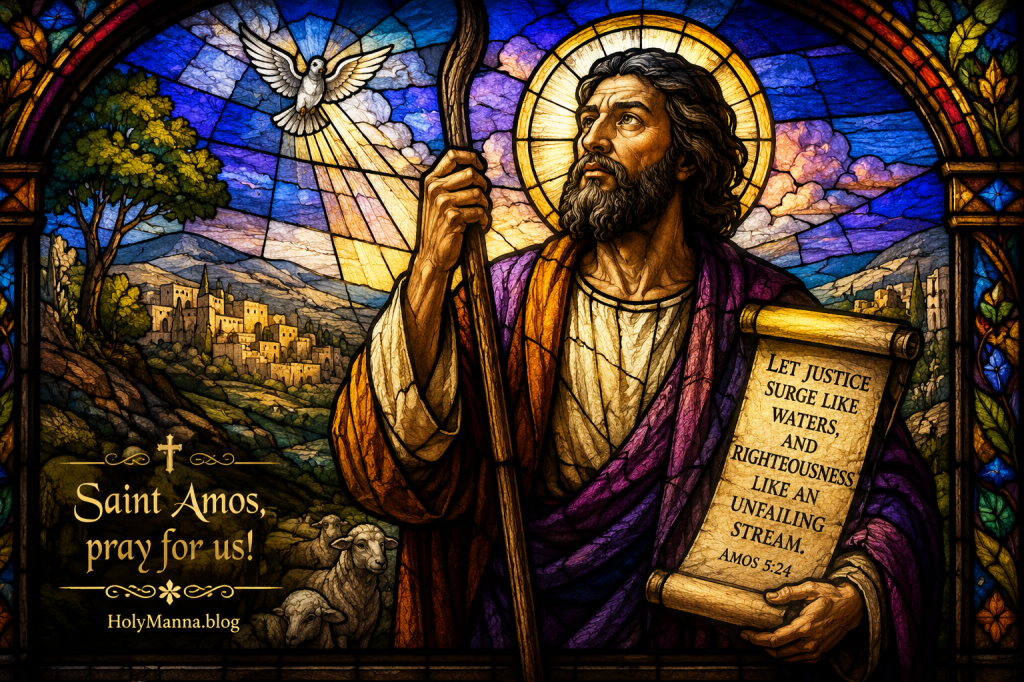
The Shepherd Who Shook a Kingdom
Saint Amos stands among the great holy voices of the Old Testament. He was not a priest, not a court official, and not a professional prophet looking for influence. He was a shepherd from Tekoa in Judah, a working man who tended flocks and dressed sycamore trees. Then God called him away from ordinary labor and sent him north to Israel with a message that still cuts straight through the heart.
Amos is remembered as the prophet of justice. His voice thundered against religious hypocrisy, dishonest trade, corrupt leadership, and the oppression of the poor. He preached during a time when Israel looked successful, wealthy, and secure, but beneath that comfort was a spiritual sickness. The people had worship, feasts, offerings, and religious language, but they had forgotten mercy, righteousness, and the poor.
His most famous words still echo through Christian history: “Let justice surge like waters, and righteousness like an unfailing stream.”
For Catholics, Amos is not simply a prophet of social concern. He is a prophet of covenant fidelity. He reminds the people of God that worship cannot be separated from repentance, holiness, and love of neighbor. The Catechism teaches that the prophets and other holy figures of the Old Testament have always been honored as saints in the Church’s liturgical traditions, and Saint Amos belongs to that sacred company of witnesses who prepared the way for Christ.
A Man of Tekoa, Taken from the Flock
Amos came from Tekoa, a village in Judah south of Jerusalem. Scripture does not tell much about his family background, and Catholic tradition does not preserve a detailed childhood story for him. What is known is beautifully humble. He was a shepherd and a dresser of sycamore trees, which likely means he worked with sycamore figs, tending the fruit so it would ripen properly.
This matters because Amos did not come from the expected places of power. He was not trained in a prophetic school. He did not belong to a class of professional prophets. He did not arrive with a polished résumé or a royal appointment. He came with the authority of God’s call.
When Amaziah, the priest of Bethel, tried to dismiss him as a prophet-for-hire, Amos answered with one of the clearest descriptions of his vocation:
“I am not a prophet, nor do I belong to a company of prophets. I am a herdsman and a dresser of sycamores, but the LORD took me from following the flock, and the LORD said to me, ‘Go, prophesy to my people Israel.’” Amos 7:14-15
That moment reveals the soul of Saint Amos. He was not chasing a platform. He was obeying a command. God took him from the fields and sent him to speak to a kingdom that did not want to listen.
Amos preached during the reign of Jeroboam II in the Northern Kingdom of Israel, a period of political strength and material prosperity. From the outside, Israel looked blessed. The economy was strong, the wealthy were comfortable, and the religious shrines were active. But Amos saw what prosperity had hidden. The poor were being crushed. The courts were being corrupted. Merchants were cheating customers. The powerful were living in luxury while the vulnerable were forgotten.
Amos’ deepening of faith was not a conversion from paganism to the God of Israel, since he belonged to the covenant people. His “conversion moment,” so to speak, was his prophetic calling. He went from ordinary work to divine mission. He became a witness to the truth that God can call any faithful soul, even one hidden in the fields, to speak with courage.
A Prophet of Justice, Not a Performer of Wonders
Saint Amos is important because he teaches that holiness is not measured by appearances. Israel had sacrifices, feasts, songs, and solemn assemblies. But God was not pleased, because worship had become detached from justice.
Through Amos, the Lord spoke a terrifying word:
“I hate, I despise your feasts, I take no pleasure in your solemnities.” Amos 5:21
This does not mean God hated true worship. The Catholic reading is much more careful than that. Amos was not condemning worship itself. He was condemning worship offered by people who refused conversion. Their hands were raised in prayer, but those same hands were participating in oppression, dishonesty, and indifference.
Amos called the people back to something whole and integrated. He called them to seek God, reject evil, and practice justice.
“Seek me, that you may live.” Amos 5:4
“Seek good and not evil, that you may live.” Amos 5:14
“Hate evil and love good, and let justice prevail at the gate.” Amos 5:15
The “gate” was where public decisions and legal judgments were made. Amos was not asking for vague niceness. He was calling for justice in real life, in business, law, worship, leadership, and daily treatment of the poor.
Scripture does not present Amos as a miracle-worker like Elijah or Elisha. No verified Catholic tradition records healings or spectacular wonders performed by Amos during his lifetime. His supernatural gift was prophecy. He received visions from God and spoke divine judgment with clarity.
In The Book of Amos, he sees visions of locusts, fire, a plumb line, a basket of summer fruit, and the Lord standing beside the altar. In the first two visions, Amos intercedes for Israel, and the Lord relents. This is important because Amos was not a cruel man hoping for destruction. He was a prophet who warned because he knew judgment was real and mercy was still being offered.
The vision of the plumb line is especially powerful. A plumb line tests whether a wall is straight. Israel had become morally crooked. The nation looked strong, but it could not stand because it was no longer aligned with God.
The vision of the basket of summer fruit announced that the end had come for Israel. The people had confused patience with permission. They thought God would ignore injustice forever. Amos made it clear that He would not.
The Priest of Bethel and the Price of Telling the Truth
The most famous conflict in Amos’ life came at Bethel, one of the major religious centers of the Northern Kingdom. There, Amaziah the priest accused Amos of conspiracy against King Jeroboam. Amaziah told him to flee back to Judah and earn his bread there as a prophet.
In modern terms, Amaziah tried to silence Amos by questioning his motives. He treated him like a religious troublemaker who was disturbing the peace. But Amos was not disturbing peace. He was exposing false peace.
This conflict reveals one of the hardest truths about prophecy. People often welcome religious voices that comfort them, but resist religious voices that call them to conversion. Amos was not rejected because he was vague. He was rejected because he was clear.
He warned Israel that the “day of the Lord,” which many expected as a day of triumph, would instead be a day of darkness for those who presumed on God while refusing repentance.
“What will the day of the LORD mean for you? It will be darkness, not light!” Amos 5:18
That must have shocked his listeners. They assumed their identity as God’s people meant they were safe. Amos reminded them that privilege without holiness becomes judgment.
The details of Amos’ death are not historically certain. Catholic sources are careful on this point. A later ancient tradition says that Amos was persecuted by Amaziah and struck by Amaziah’s son, then returned wounded to Tekoa and died there. This story is part of later prophetic legend and cannot be verified with certainty. Some Catholic references consider these martyrdom stories late and unreliable. The more historically cautious conclusion is that Amos likely returned to Judah after his mission and preserved or arranged his prophetic oracles.
Even without a verified martyrdom, Amos suffered the prophet’s hardship. He was opposed, dismissed, accused, and told to stop speaking. He endured the loneliness of carrying God’s word into a place that preferred comfort over truth.
A Voice That Still Cries Out After Death
No verified Catholic tradition records posthumous miracles, healings, relic miracles, or major pilgrimage sites specifically associated with Saint Amos. His enduring miracle, in a broader spiritual sense, is the survival and power of his prophetic word. The Book of Amos remains one of the earliest written prophetic books that has come down to us, and its message still pierces hearts centuries later.
After Amos’ death, history confirmed the seriousness of his warnings. The Northern Kingdom of Israel eventually fell to Assyria in 722 or 721 B.C. Later readers would see that destruction as connected to the kind of covenant unfaithfulness Amos had denounced.
Yet Amos’ book does not end in despair. It ends with hope.
“On that day I will raise up the fallen hut of David.” Amos 9:11
This promise becomes especially important for Christians. In The Acts of the Apostles, Saint James uses the prophecy of Amos at the Council of Jerusalem to help explain the inclusion of the Gentiles in the people of God. In other words, Amos does not only point toward judgment. He points toward restoration, the house of David, and the mission fulfilled in Christ.
That is one of the most surprising parts of Amos’ legacy. The prophet who warned Israel so fiercely also becomes part of the Church’s understanding of how God gathers the nations into His covenant through Jesus Christ.
Saint Amos is commemorated in Catholic tradition on June 15, though some older records also mention March 31. Eastern Catholic liturgical traditions also honor him, praying through his intercession and remembering him as a holy prophet who defended the righteousness and holiness of God.
His cultural impact is especially strong wherever Christians speak about justice, poverty, honest worship, and care for the vulnerable. But his message should never be reduced to a slogan. Amos is not calling people to replace worship with activism. He is calling God’s people to worship truthfully, repent sincerely, and live justly.
The Catechism teaches that love for the poor belongs to the constant tradition of the Church and that sins against the vulnerable cry out to heaven. Amos stands as one of Scripture’s great witnesses to that truth. He reminds every generation that God sees the poor, hears the oppressed, and judges the comfortable conscience that refuses mercy.
The Saint Who Makes Comfortable Faith Uncomfortable
Saint Amos is a saint for anyone tempted to separate faith from daily life. He challenges the idea that religion can be kept safely inside church walls while business, money, speech, politics, and relationships remain untouched by God.
His message is blunt, but it is merciful. Amos warns because God still calls His people back. The same prophet who announces judgment also says: “Seek me, that you may live.” Amos 5:4
That line is the heart of the whole story. God does not expose sin in order to humiliate His people. He exposes sin to save them.
For Catholics today, Amos is a needed voice. He asks whether Mass changes the way people treat coworkers, family members, employees, strangers, the poor, and the forgotten. He asks whether prayer leads to honesty. He asks whether worship leads to mercy. He asks whether comfort has made the conscience dull.
Does Sunday worship shape Monday decisions?
Is there any place where faith has become outwardly polished but inwardly compromised?
Are the poor treated as brothers and sisters, or as interruptions?
What would it look like to let justice surge like waters in ordinary Catholic life?
Saint Amos shows that God can take an ordinary person from ordinary work and make him a voice of extraordinary truth. He reminds Catholics that holiness is not about status, popularity, or religious polish. It is about hearing the word of the Lord and obeying it.
Engage with Us!
Share your thoughts and reflections in the comments below. Saint Amos is not always an easy prophet to sit with, but his words can wake up the soul in exactly the way it needs.
- Where is God calling you to greater integrity between worship and daily life?
- How does Amos’ warning against empty religious practice challenge the way you live your faith?
- Who are the poor, forgotten, or overlooked people God may be asking you to notice more intentionally?
- What part of your life needs the prayer of Amos: “Seek me, that you may live”?
- How can your home, workplace, parish, or friendships become places where justice and mercy flow more freely?
Saint Amos reminds the Church that real faith is never just performed. It is lived. It is prayed. It is practiced. It defends the vulnerable, tells the truth, and keeps returning to the mercy of God. May his example inspire a life of courage, repentance, compassion, and faithful love, and may everything be done with the love and mercy Jesus taught His people to share.
Saint Amos, pray for us!
Follow us on YouTube, TikTok, Instagram and Facebook for more insights and reflections on living a faith-filled life.

 Holy Manna!
Leave a comment