Monday of the Eleventh Week in Ordinary Time – Lectionary: 365
When the Heart Wants to Take, Christ Teaches It to Give
Sometimes the real battle with sin begins long before anyone acts. It begins in the hidden place where desire starts calling itself a right.
Today’s readings from 1 Kings 21:1-16, Psalm 5:2-7, and Matthew 5:38-42 bring us into that battle. In the first reading, King Ahab sees Naboth’s vineyard and wants it simply because it is convenient and close to his palace. Naboth refuses, not out of pride, but out of faithfulness, because his vineyard is part of his ancestral inheritance, a sacred trust rooted in Israel’s covenant with God. In ancient Israel, land was never just property. It was family, memory, responsibility, and a visible reminder that everything ultimately belonged to the Lord.
That makes Ahab’s desire more dangerous than it first appears. He does not merely want a garden. He wants to bend justice around his appetite. Jezebel then turns that disordered desire into murder, using false witnesses, public shame, and a fake religious trial to destroy an innocent man. Against that darkness, Psalm 5 gives voice to the faithful soul crying out to God: “Give ear to my words, O Lord; understand my sighing.” The Psalm reminds us that God is not indifferent to lies, violence, corruption, or the quiet suffering of the innocent.
Then Jesus speaks in The Gospel of Matthew, and He goes straight to the heart. “But I say to you, offer no resistance to one who is evil.” Christ is not telling His disciples to ignore injustice or pretend evil is harmless. He is teaching them not to let evil reproduce itself inside them. The old law of “an eye for an eye and a tooth for a tooth” restrained vengeance by limiting retaliation, but Jesus fulfills the Law by transforming the heart. As The Catechism teaches, the Law of the Gospel “reforms the heart, the root of human acts” in CCC 1968.
The central theme of today’s readings is the difference between a heart that grasps and a heart that belongs to God. Ahab takes. Jezebel manipulates. False witnesses destroy. Naboth stands faithful. The Psalmist prays. Jesus gives a new way to live, one that refuses revenge without abandoning justice, and practices mercy without surrendering truth.
These readings prepare us to ask a difficult but necessary question: When life feels unfair, does the heart become more like Ahab, or more like Christ?
First Reading – 1 Kings 21:1-16
The Vineyard, the King, and the Sin That Begins with “I Want”
The story of Naboth’s vineyard is one of the most haunting scenes in the Old Testament because it shows how quickly a disordered desire can become injustice, and how quickly injustice can become violence. King Ahab already has power, wealth, status, and a palace in Samaria, but he sees one vineyard near his house and decides that his desire should overrule another man’s inheritance.
In ancient Israel, land was not merely a private asset. It was part of the covenant life of God’s people. A family’s ancestral land was a sacred trust, received from previous generations and held under God’s authority. That is why Naboth refuses Ahab. He is not being difficult. He is protecting what the Lord entrusted to his family.
This reading fits beautifully into today’s central theme. Ahab represents the heart that grasps. Jezebel represents the world that manipulates truth to serve power. Naboth represents the faithful soul that refuses to sell what belongs to God. Before Jesus teaches in Matthew 5:38-42 that His disciples must not be ruled by revenge, 1 Kings 21:1-16 shows us what happens when a heart is ruled by entitlement, resentment, and the desire to take.
1 Kings 21:1-16 – New American Bible (Revised Edition)
Seizure of Naboth’s Vineyard. 1 Naboth the Jezreelite had a vineyard in Jezreel next to the palace of Ahab, king of Samaria. Some time later, 2 Ahab said to Naboth, “Give me your vineyard to be my vegetable garden, since it is close by, next to my house. I will give you a better vineyard in exchange, or, if you prefer, I will give you its value in money.” 3 Naboth said to Ahab, “The Lord forbid that I should give you my ancestral heritage.” 4 Ahab went home disturbed and angry at the answer Naboth the Jezreelite had given him: “I will not give you my ancestral heritage.” Lying down on his bed, he turned away and would not eat. 5 His wife Jezebel came to him and said to him, “Why are you so sullen that you will not eat?” 6 He answered her, “Because I spoke to Naboth the Jezreelite and said to him, ‘Sell me your vineyard, or, if you prefer, I will give you a vineyard in exchange.’ But he said, ‘I will not give you my vineyard.’” 7 Jezebel his wife said to him, “What a king of Israel you are! Get up! Eat and be cheerful. I will give you the vineyard of Naboth the Jezreelite.”
8 So she wrote letters in Ahab’s name and, having sealed them with his seal, sent them to the elders and to the nobles who lived in the same city with Naboth. 9 This is what she wrote in the letters: “Proclaim a fast and set Naboth at the head of the people. 10 Next, set two scoundrels opposite him to accuse him: ‘You have cursed God and king.’ Then take him out and stone him to death.”
11 His fellow citizens—the elders and the nobles who dwelt in his city—did as Jezebel had ordered in the letters she sent them. 12 They proclaimed a fast and set Naboth at the head of the people. 13 Two scoundrels came in and sat opposite Naboth, and the scoundrels accused him in the presence of the people, “Naboth has cursed God and king.” And they led him out of the city and stoned him to death. 14 Then they sent word to Jezebel: “Naboth has been stoned to death.”
15 When Jezebel learned that Naboth had been stoned to death, she said to Ahab, “Go, take possession of the vineyard of Naboth the Jezreelite which he refused to sell you, because Naboth is not alive, but dead.” 16 When Ahab heard that Naboth was dead, he started on his way down to the vineyard of Naboth the Jezreelite, to take possession of it.
Detailed Exegesis
Verse 1 – “Naboth the Jezreelite had a vineyard in Jezreel next to the palace of Ahab, king of Samaria.”
The scene begins with location. Naboth’s vineyard sits next to Ahab’s palace, which makes it convenient and desirable to the king. That small detail matters because temptation often begins with nearness. Ahab does not need the vineyard to survive. He wants it because it is close, useful, and pleasing to him. This introduces the spiritual danger of covetousness, the desire to possess what belongs to another.
Verse 2 – “Ahab said to Naboth, ‘Give me your vineyard to be my vegetable garden, since it is close by, next to my house. I will give you a better vineyard in exchange, or, if you prefer, I will give you its value in money.’”
Ahab’s offer appears reasonable on the surface. He offers either a better vineyard or money. Yet spiritually, something is already wrong. The king treats Naboth’s inheritance as if it were merely a negotiable possession. He sees land as convenience. Naboth sees it as covenant. The conflict is not only economic. It is religious, because Ahab’s desire ignores the sacred meaning of inheritance among God’s people.
Verse 3 – “Naboth said to Ahab, ‘The Lord forbid that I should give you my ancestral heritage.’”
Naboth’s answer is rooted in faith. He invokes the Lord because his refusal is not just personal preference. In Israel, ancestral land was tied to God’s covenant promises and family identity. Naboth understands that some things should not be traded simply because someone powerful wants them. His words are a quiet act of courage. He protects what was handed down to him because he believes it belongs first to God.
Verse 4 – “Ahab went home disturbed and angry at the answer Naboth the Jezreelite had given him: ‘I will not give you my ancestral heritage.’ Lying down on his bed, he turned away and would not eat.”
Ahab reacts like a man who cannot bear a holy no. He has been refused, and instead of respecting Naboth’s conscience, he collapses into resentment. This verse reveals the childishness of unchecked desire. Ahab is king, yet he is enslaved by his own appetite. He can govern a kingdom, but he cannot govern his heart.
Verse 5 – “His wife Jezebel came to him and said to him, ‘Why are you so sullen that you will not eat?’”
Jezebel notices Ahab’s mood and enters the story as an agent of manipulation. Her question exposes Ahab’s spiritual weakness. He is not grieving injustice. He is grieving that his desire was blocked. This is an important distinction. Not every sadness is holy sorrow. Sometimes sadness comes from pride, entitlement, and the frustration of not getting what we want.
Verse 6 – “He answered her, ‘Because I spoke to Naboth the Jezreelite and said to him, “Sell me your vineyard, or, if you prefer, I will give you a vineyard in exchange.” But he said, “I will not give me your vineyard.”’”
Ahab retells the story, but his retelling lacks reverence for Naboth’s reason. Naboth said, “The Lord forbid that I should give you my ancestral heritage.” Ahab reduces that faithful refusal to a personal rejection. This is what resentment does. It edits reality. It removes God from the story and turns another person’s conscience into an offense against the self.
Verse 7 – “Jezebel his wife said to him, ‘What a king of Israel you are! Get up! Eat and be cheerful. I will give you the vineyard of Naboth the Jezreelite.’”
Jezebel mocks Ahab’s weakness and offers a corrupt version of kingship. In her mind, power exists to take. She does not ask whether Naboth is right. She asks why the king has not used his authority to get what he wants. This is the logic of tyranny. When power is separated from justice, the innocent become obstacles.
Verse 8 – “So she wrote letters in Ahab’s name and, having sealed them with his seal, sent them to the elders and to the nobles who lived in the same city with Naboth.”
Jezebel uses Ahab’s name and seal, which means she corrupts royal authority itself. The elders and nobles are supposed to protect justice in the community, but they become instruments of evil. This verse shows that sin often spreads through institutions when people with responsibility lack courage. Corruption becomes especially dangerous when it dresses itself in official language.
Verse 9 – “This is what she wrote in the letters: ‘Proclaim a fast and set Naboth at the head of the people.’”
Jezebel begins her crime with religious theater. A fast was usually proclaimed in a time of crisis, repentance, or communal concern. By ordering a fast, she creates the appearance of holiness while planning murder. This is one of the darkest parts of the story. Religion is being used as a mask for injustice. God’s name is being dragged into a scheme that violates God’s law.
Verse 10 – “Next, set two scoundrels opposite him to accuse him: ‘You have cursed God and king.’ Then take him out and stone him to death.”
The accusation is calculated. Under the law, two witnesses were required to establish a serious charge, so Jezebel creates false witnesses to make the murder look legal. Naboth is accused of blasphemy and treason, crimes that would justify execution in the eyes of the people. This verse violates the Eighth Commandment through false witness, the Fifth Commandment through murder, and the Seventh Commandment through theft.
Verse 11 – “His fellow citizens, the elders and the nobles who dwelt in his city, did as Jezebel had ordered in the letters she sent them.”
The local leaders obey without resistance. Their silence makes them complicit. This verse is a sober reminder that evil does not always advance because everyone is passionate about wickedness. Sometimes evil advances because decent-looking people choose comfort, fear, or self-preservation over truth. The elders fail Naboth because they fear power more than they fear God.
Verse 12 – “They proclaimed a fast and set Naboth at the head of the people.”
The religious performance continues. Naboth is placed publicly before the people, likely in a position that makes him visible as the accused. The scene is designed to look solemn and lawful, but it is rotten at the core. This is hypocrisy in its most dangerous form. It uses the appearance of righteousness to cover the machinery of injustice.
Verse 13 – “Two scoundrels came in and sat opposite Naboth, and the scoundrels accused him in the presence of the people, ‘Naboth has cursed God and king.’ And they led him out of the city and stoned him to death.”
Naboth dies under false accusation. He is condemned publicly, removed from the city, and executed. The details anticipate the pattern of the Passion of Christ, where the innocent Lord is also falsely accused, rejected by leaders, and led away to die. Naboth becomes a figure of the righteous sufferer, the faithful man crushed by corrupt power.
Verse 14 – “Then they sent word to Jezebel: ‘Naboth has been stoned to death.’”
The report is chillingly brief. A man’s life, family inheritance, and dignity are reduced to a message confirming that the obstacle has been removed. Sin often speaks this way. It makes the person disappear and remembers only the outcome it wanted. Naboth is no longer treated as a neighbor. He is treated as a problem solved.
Verse 15 – “When Jezebel learned that Naboth had been stoned to death, she said to Ahab, ‘Go, take possession of the vineyard of Naboth the Jezreelite which he refused to sell you, because Naboth is not alive, but dead.’”
Jezebel’s words reveal the full horror of the sin. Naboth’s death becomes an opportunity for possession. The vineyard is no longer discussed as inheritance, covenant, or sacred trust. It is treated as a prize. This is what happens when the human person is pushed aside for the sake of desire. Once Naboth’s dignity is ignored, his death becomes useful.
Verse 16 – “When Ahab heard that Naboth was dead, he started on his way down to the vineyard of Naboth the Jezreelite, to take possession of it.”
Ahab may not have written the letters, hired the false witnesses, or thrown the stones, but he receives the stolen fruit of the crime. His guilt is real because he consents to the injustice and benefits from it. This verse shows that sin is not only in the violent act itself. Sin can also live in passive complicity, convenient ignorance, and the willingness to enjoy what injustice has obtained.
Teachings: The Commandments, the Poor, and the Sin of Grasping
This reading is a powerful examination of several commandments at once. Ahab covets. Jezebel lies. The elders cooperate. False witnesses accuse. Naboth is murdered. His inheritance is stolen. The story reveals how sin rarely stays small when it is welcomed into the heart. Ahab’s first sin is interior. He wants what is not his. But when that desire is nursed instead of purified, it becomes resentment, then injustice, then bloodshed.
The Catechism of the Catholic Church teaches in CCC 2401: “The seventh commandment forbids unjustly taking or keeping the goods of one’s neighbor and wronging him in any way with respect to his goods. It commands justice and charity in the care of earthly goods and the fruits of men’s labor. For the sake of the common good, it requires respect for the universal destination of goods and respect for the right to private property. Christian life strives to order this world’s goods to God and to fraternal charity.”
That teaching speaks directly to Ahab’s sin. Naboth’s vineyard is not simply an object for royal convenience. It is his rightful inheritance. Ahab fails to order worldly goods to God and fraternal charity. Instead, he orders them to appetite.
The Catechism also explains the danger of false witness in CCC 2476: “False witness and perjury. When it is made publicly, a statement contrary to the truth takes on a particular gravity. In court it becomes false witness. When it is under oath, it is perjury. Acts such as these contribute to condemnation of the innocent, exoneration of the guilty, or the increased punishment of the accused. They gravely compromise the exercise of justice and the fairness of judicial decisions.”
This is exactly what happens to Naboth. The court becomes a stage. Witnesses become weapons. Truth is exchanged for convenience. Justice is used to commit injustice.
The reading also exposes the sin of covetousness. The Catechism teaches in CCC 2534: “The tenth commandment unfolds and completes the ninth, which is concerned with concupiscence of the flesh. It forbids coveting the goods of another, as the root of theft, robbery, and fraud, which the seventh commandment forbids. ‘Lust of the eyes’ leads to the violence and injustice forbidden by the fifth commandment. Avarice, like fornication, originates in the idolatry prohibited by the first three prescriptions of the Law. The tenth commandment concerns the intentions of the heart; with the ninth, it summarizes all the precepts of the Law.”
That line, “lust of the eyes leads to the violence and injustice forbidden by the fifth commandment,” could almost be written over Ahab’s palace. He sees. He desires. He resents. He receives the benefit of murder. This is why the Church takes interior desire seriously. The heart is where either holiness or injustice begins.
St. Ambrose, in his work On Naboth, saw this passage as a permanent warning to every age. He wrote, “The story of Naboth is an ancient one as regards the time when it happened, but in practice it is of daily occurrence.” His point is painfully clear. Ahab is not only a figure from Israel’s monarchy. Ahab appears whenever the powerful crush the weak, whenever wealth forgets justice, whenever the poor are treated as inconvenient, and whenever a person’s dignity is sacrificed for someone else’s comfort.
From a Catholic perspective, this reading also points forward to Christ. Naboth is falsely accused and killed outside the city. Jesus is falsely accused and led to His Passion. Naboth’s vineyard is taken by a king. Christ gives Himself so that sinners may receive the inheritance of eternal life. The contrast is stunning. Ahab takes through another man’s blood. Jesus gives through His own Blood.
Reflection: Guard the Vineyard of the Heart
This reading asks every Christian to look honestly at desire. Ahab’s sin did not begin with bloodshed. It began with a disordered want. He saw something good, but instead of receiving reality with humility, he treated another man’s inheritance as an obstacle to his comfort.
That same temptation still lives in ordinary life. It appears when a person wants someone else’s success, someone else’s relationship, someone else’s reputation, someone else’s position, or someone else’s peace. It appears when people justify gossip because they feel slighted, manipulate situations because they want control, or ignore someone’s dignity because an outcome feels useful.
Naboth teaches the courage to say no when faithfulness requires it. Some things cannot be sold. A conscience formed by God cannot be traded for comfort. A family inheritance, a vocation, a moral boundary, a commitment to truth, or a life of integrity must not be surrendered simply because pressure comes from someone powerful.
Ahab teaches the danger of self-pity. When a person does not get what he wants, the next spiritual step matters. He can bring that frustration to God, or he can nurse it until it becomes resentment. Jezebel teaches the danger of using power without reverence. The elders teach the danger of silent complicity. Naboth teaches the dignity of fidelity.
This reading invites a simple but serious examination of conscience: Where is the heart tempted to believe that desire creates a right? Is there someone’s dignity, time, property, reputation, or vocation that needs to be respected more deeply? When disappointment comes, does the heart turn to prayer, or does it turn inward and become bitter? Is there any injustice being quietly tolerated because speaking up would be costly?
A practical way to live this reading is to guard the first movement of desire. When envy, resentment, or entitlement appears, name it before God immediately. Pray before speaking. Refuse to manipulate. Respect what belongs to another. Defend the reputation of the innocent. Be careful not to benefit from injustice simply because someone else committed it.
The vineyard in this story is more than land. It is a test of the heart. Ahab sees it and wants to take. Naboth sees it and remembers God. That is the choice before every disciple. The Christian life begins to mature when the heart stops saying, “I want it, so it should be mine,” and begins saying, “Lord, teach me to receive what You give, respect what belongs to others, and protect what You have entrusted to me.”
Responsorial Psalm – Psalm 5:2-7
The Prayer of the Wounded Heart That Still Trusts God
After the injustice of Naboth’s vineyard, Psalm 5:2-7 feels like the prayer rising from the place where innocent blood has been spilled and truth has been twisted. Naboth has been falsely accused. The elders have failed. Jezebel has manipulated religion and law. Ahab has taken possession of what was never his. Then the Psalm gives the faithful soul words to bring that pain before God.
In ancient Israel, the Psalms were the prayer book of God’s people. They gave Israel language for worship, repentance, sorrow, trust, anger, and hope. Psalm 5 is traditionally understood as a morning prayer, a cry lifted to the Lord at the beginning of the day. It is not a polished speech from someone who has everything figured out. It is the prayer of a person who sighs, cries out, waits, and trusts that God sees what wickedness tries to hide.
This Psalm fits today’s theme because it stands between the injustice of Ahab and the mercy of Christ. It reminds us that Christian mercy does not mean pretending evil is harmless. Before Jesus teaches His disciples not to retaliate in Matthew 5:38-42, the Psalm teaches us where wounded hearts must go first. They must go to God, because He alone judges evil perfectly, hears the cry of the innocent, and keeps the soul from being swallowed by revenge.
Psalm 5:2-7 – New American Bible (Revised Edition)
2 Give ear to my words, O Lord;
understand my sighing.
3 Attend to the sound of my cry,
my king and my God!
For to you I will pray, Lord;
4 in the morning you will hear my voice;
in the morning I will plead before you and wait.5 You are not a god who delights in evil;
no wicked person finds refuge with you;
6 the arrogant cannot stand before your eyes.
You hate all who do evil;
7 you destroy those who speak falsely.
A bloody and fraudulent man
the Lord abhors.
Detailed Exegesis
Verse 2 – “Give ear to my words, O Lord; understand my sighing.”
The Psalm begins with a deeply human prayer. The psalmist asks the Lord not only to hear words, but to understand sighing. This matters because some suffering is too heavy to explain neatly. After injustice, betrayal, false accusation, or grief, prayer may begin with groans rather than speeches. God is not offended by that. He receives the honest heart. This verse teaches that the Lord listens not only to formal prayers, but also to the unspoken pain beneath them.
Verse 3 – “Attend to the sound of my cry, my king and my God! For to you I will pray, Lord.”
The psalmist calls God “my king and my God.” That title is powerful in light of the first reading. Ahab is king, but he fails in justice. Jezebel uses royal authority for murder. Human kings can become corrupt, but the Lord remains the true King. The faithful soul turns to God because His authority is never unjust, never manipulative, and never blind. The phrase “For to you I will pray” also reveals spiritual discipline. The wounded heart chooses prayer instead of revenge.
Verse 4 – “In the morning you will hear my voice; in the morning I will plead before you and wait.”
Morning prayer is an act of trust. Before the day’s burdens fully unfold, the psalmist places his case before God. The word “wait” is especially important. Waiting on the Lord is not passive despair. It is faithful patience. The psalmist pleads, then waits because he believes God hears, sees, and acts according to perfect wisdom. This verse prepares the heart for Jesus’ teaching in the Gospel. The disciple who can wait on God is less likely to be ruled by retaliation.
Verse 5 – “You are not a god who delights in evil; no wicked person finds refuge with you.”
This verse gives the theological foundation for the whole Psalm. God does not delight in evil. He does not excuse wickedness. He does not give safe harbor to sin. This is essential because mercy can be misunderstood if justice is forgotten. The Lord is patient and rich in mercy, but He is never morally indifferent. The same God who calls sinners to repentance also defends truth, condemns injustice, and refuses fellowship with evil.
Verse 6 – “The arrogant cannot stand before your eyes. You hate all who do evil.”
The language is strong because the reality of evil is serious. The arrogant cannot stand before God because pride refuses truth. In Scripture, arrogance is not merely confidence. It is the heart standing against God, pretending it has the right to define good and evil for itself. Ahab and Jezebel embody this arrogance. They act as if power can rewrite justice. The Psalm reminds us that no one can manipulate God’s judgment. He sees through every false witness and every respectable-looking lie.
Verse 7 – “You destroy those who speak falsely. A bloody and fraudulent man the Lord abhors.”
This verse speaks directly into the tragedy of Naboth. False speech kills. Jezebel’s plan depends on lies. The false witnesses use words to bring death. The Psalm names this evil clearly: fraud, bloodshed, and falsehood are hateful to the Lord. This matters in daily Christian life because speech is never spiritually neutral. Words can protect the innocent or endanger them. They can heal, deceive, accuse, or destroy. The Lord abhors the combination of violence and deceit because it attacks both human life and truth.
Teachings: Prayer, Truth, and the God Who Hears the Innocent
Psalm 5:2-7 teaches that the faithful response to injustice begins with prayer, not revenge. The Psalmist does not deny evil or minimize it. He names it before God. He speaks of arrogance, falsehood, bloodshed, fraud, and wickedness. Yet he does not take judgment into his own hands. He brings the cry to the Lord, the true King.
This is deeply Catholic. The Church teaches that prayer is first a response to God, who calls the human heart into communion with Him. The Catechism of the Catholic Church teaches in CCC 2567: “God calls man first. Man may forget his Creator or hide far from his face; he may run after idols or accuse the deity of having abandoned him; yet the living and true God tirelessly calls each person to that mysterious encounter known as prayer. In prayer, the faithful God’s initiative of love always comes first; our own first step is always a response.”
That is what the psalmist does. He responds. He does not run into bitterness first. He does not run into revenge first. He turns toward the God who has already called him.
The Psalm also teaches the honesty of prayer. Catholic prayer is not pretending to be calm when the soul is wounded. It is bringing the real heart before the real God. The Catechism teaches in CCC 2559: “Prayer is the raising of one’s mind and heart to God or the requesting of good things from God. But when we pray, do we speak from the height of our pride and will, or out of the depths of a humble and contrite heart? He who humbles himself will be exalted; humility is the foundation of prayer. Only when we humbly acknowledge that ‘we do not know how to pray as we ought,’ are we ready to receive freely the gift of prayer. Man is a beggar before God.”
The psalmist prays from the depths. He brings words, sighs, cries, pleading, and waiting. That is the posture of a beggar before God, not because human dignity is low, but because God alone can give justice, mercy, peace, and deliverance.
The Psalm’s hatred of falsehood also connects to Catholic teaching on truth. In CCC 2464, The Catechism teaches: “The eighth commandment forbids misrepresenting the truth in our relations with others. This moral prescription flows from the vocation of the holy people to bear witness to their God who is the truth and wills the truth. Offenses against the truth express by word or deed a refusal to commit oneself to moral uprightness: they are fundamental infidelities to God and, in this sense, they undermine the foundations of the covenant.”
That teaching helps explain why false witness in the story of Naboth is so grave. Lies do not merely hurt reputations. They attack covenant life. They reject the God who is Truth. When Jezebel’s witnesses lie, they are not only harming Naboth. They are betraying the Lord.
St. Augustine often approached the Psalms as the voice of Christ and His Body, the Church. In that Catholic tradition, the cry of Psalm 5 can be heard as the cry of every faithful soul united to Christ, especially when falsely accused, rejected, or wounded by injustice. The innocent sufferer does not have to pray alone. Christ, the truly Innocent One, has entered human suffering and now teaches His people how to cry out to the Father without surrendering to hatred.
This is why the Psalm is not a contradiction of the Gospel. It is preparation for it. The person who brings anger and grief to God can become free enough to obey Jesus. The person who trusts God’s justice does not need to become consumed by personal vengeance.
Reflection: Bring the Sigh Before God Before It Becomes Bitterness
There are moments when the soul does not know what to say. Someone lies. Someone betrays. Someone abuses power. Someone twists the truth just enough to make the innocent look guilty. The heart wants to react immediately, defend itself loudly, and make sure the guilty person feels the pain they caused.
Psalm 5 offers another path. It does not say evil is acceptable. It does not tell the wounded person to smile through injustice. It says, “Give ear to my words, O Lord; understand my sighing.” Before the heart retaliates, it can pray. Before the tongue responds, it can plead before God. Before bitterness takes root, it can wait in the presence of the true King.
This is not easy. Waiting on God can feel painfully slow. Yet the Psalm reminds us that God is not indifferent. He does not delight in evil. He does not shelter falsehood. He does not ignore bloodshed or fraud. The Lord sees the things people hide behind respectable appearances.
A practical way to live this Psalm is to begin the day with honest prayer. Not impressive prayer. Honest prayer. Name the sigh. Name the fear. Name the resentment. Name the injustice. Then place it before God and wait. Ask Him for the grace to seek truth without hatred, correction without cruelty, and justice without revenge.
This Psalm also invites a serious examination of speech. Are my words giving life, or are they quietly damaging someone’s name? Have I ever repeated something before knowing whether it was true? Do I use prayer to surrender resentment, or do I use religious language to justify anger? When I am wounded, do I trust God enough to wait before I respond?
The faithful soul does not have to choose between truth and mercy. In God, both are perfectly united. The same Lord who hears the sighing of the wounded also purifies the anger of the wounded. He teaches His people to cry out without becoming cruel, to seek justice without worshiping revenge, and to wait without losing hope.
So today, let the Psalm become morning prayer. Let it give words to the places that feel too heavy to explain. Let it remind the heart that every false witness, every hidden wound, every act of arrogance, and every silent tear is seen by God. Then let the soul wait before Him, because the Lord is still King, and no lie gets the final word before His throne.
Holy Gospel – Matthew 5:38-42
The Freedom of the Disciple Who Refuses Revenge
Today’s Gospel comes from the Sermon on the Mount, where Jesus teaches His disciples what life in the Kingdom of God looks like from the inside out. He is not merely giving better rules. He is forming a new heart. In The Gospel of Matthew, Jesus speaks as the new Moses, teaching from the mountain and revealing the fullness of the Law. But His teaching does not abolish the Law. It fulfills it by bringing the commandments to their deepest meaning.
The command “an eye for an eye and a tooth for a tooth” may sound harsh to modern ears, but in its original context it restrained vengeance. It limited retaliation so that punishment would not exceed the injury. In a world where one insult could lead to generations of violence, that law placed a boundary around revenge.
Jesus now calls His disciples beyond proportionate retaliation into supernatural mercy. This fits perfectly with today’s theme. In 1 Kings 21:1-16, Ahab and Jezebel show what happens when desire, pride, and power rule the heart. They take, accuse, and destroy. In Psalm 5:2-7, the wounded soul cries out to God for justice. Now in Matthew 5:38-42, Jesus teaches His followers how to live when wronged without allowing evil to reproduce itself within them.
Christ is not telling His disciples to love injustice or enable abuse. He is teaching them to become so free in the Father’s love that insult, pressure, loss, and inconvenience no longer control their souls. The disciple of Jesus may seek justice, establish boundaries, and protect the vulnerable, but he must never let revenge become his master.
Matthew 5:38-42 – New American Bible (Revised Edition)
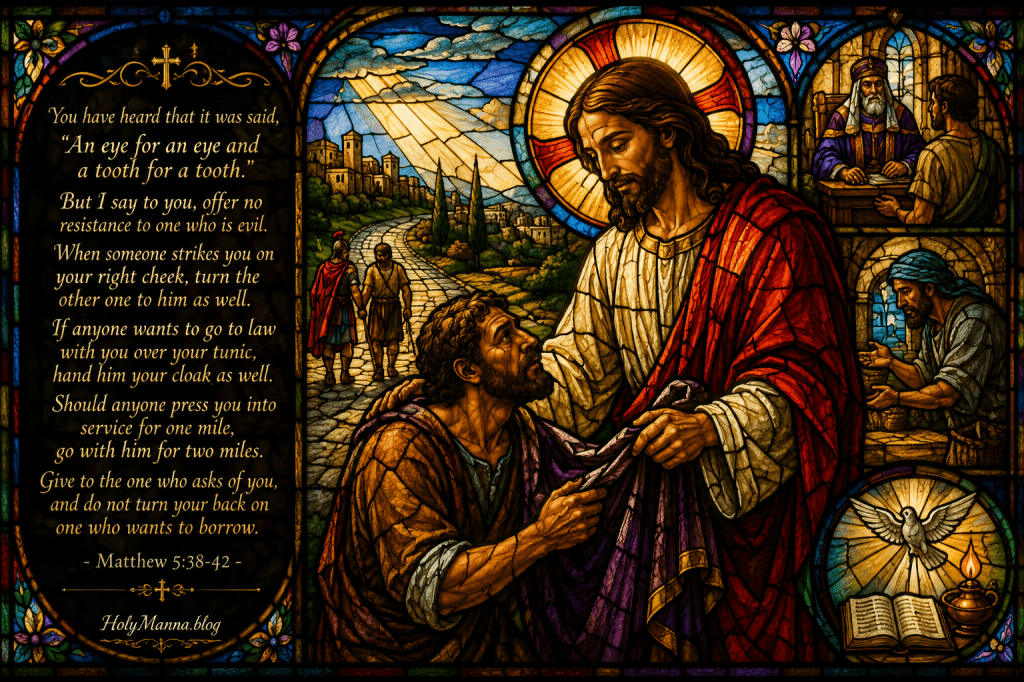
Teaching About Retaliation. 38 “You have heard that it was said, ‘An eye for an eye and a tooth for a tooth.’ 39 But I say to you, offer no resistance to one who is evil. When someone strikes you on [your] right cheek, turn the other one to him as well. 40 If anyone wants to go to law with you over your tunic, hand him your cloak as well. 41 Should anyone press you into service for one mile, go with him for two miles. 42 Give to the one who asks of you, and do not turn your back on one who wants to borrow.
Detailed Exegesis
Verse 38 – “You have heard that it was said, ‘An eye for an eye and a tooth for a tooth.’”
Jesus begins by naming the old standard of measured justice. This principle appears in the Law of Moses as a way of limiting retaliation and protecting society from escalating vengeance. It was not permission for personal cruelty. It was a restraint on revenge. If harm was done, justice had to remain proportionate.
This matters because Jesus is not correcting something evil in itself. He is bringing His disciples into something higher. The old law restrained the hand. Christ now heals the heart. In the world of Ahab and Jezebel, power takes more than it is owed. In the Kingdom of Jesus, mercy gives more than it is required.
Verse 39 – “But I say to you, offer no resistance to one who is evil. When someone strikes you on your right cheek, turn the other one to him as well.”
The phrase “But I say to you” reveals the authority of Christ. He does not speak like an ordinary teacher offering an opinion. He speaks as the Son of God who fulfills the Law and reveals the Father’s heart.
Turning the other cheek is not a command to approve of evil. It is a command to refuse the logic of revenge. A slap on the cheek was not only physical harm. It was also humiliation. Jesus teaches that His disciple does not need to answer humiliation with humiliation. The Christian is free to remain dignified, truthful, and merciful even when treated unjustly.
This verse also points toward the Passion. Jesus Himself is struck, mocked, falsely accused, and condemned. Yet He does not return hatred for hatred. He reveals the strength of meekness, which is not weakness, but power surrendered to God.
Verse 40 – “If anyone wants to go to law with you over your tunic, hand him your cloak as well.”
The tunic was the inner garment, while the cloak was the outer garment. For the poor, the cloak could be essential for warmth and protection. Jesus uses this vivid image to teach radical freedom from possessiveness. The disciple is not enslaved by the need to cling, retaliate, or win every dispute.
This does not mean Christians should allow injustice to flourish. Rather, Jesus is exposing the kind of heart that can be so secure in God that even loss does not turn it bitter. Ahab could not tolerate being denied a vineyard. Christ’s disciple learns to surrender even rightful claims when charity and witness require it.
Verse 41 – “Should anyone press you into service for one mile, go with him for two miles.”
In the Roman world, soldiers could compel civilians to carry burdens for a certain distance. This would have been humiliating for the Jewish people living under occupation. Jesus tells His disciples to go beyond forced obligation and transform it into an act of freedom.
The first mile may be taken from the disciple. The second mile is freely given. That is the spiritual genius of this teaching. Jesus does not let oppression have the final word. He teaches His followers to act from within, from a heart that belongs to God, not merely from external pressure.
Verse 42 – “Give to the one who asks of you, and do not turn your back on one who wants to borrow.”
Jesus closes with generosity. The heart formed by the Kingdom does not grasp like Ahab. It gives like Christ. This does not abolish prudence. Christian charity must be ordered by truth, justice, and the real good of the person asking. Still, the basic posture of the disciple is openness, mercy, and generosity.
This verse challenges the instinct to protect comfort first. Jesus forms a people who do not ask only, “What can I keep?” but also, “How can love be made visible here?” The disciple who has received everything from the Father can afford to become generous.
Teachings: The New Law, Meekness, and the Victory of Charity
This Gospel is one of the clearest examples of the New Law of Christ. Jesus fulfills the Old Law not by lowering its demands, but by bringing them into the heart. He does not merely tell His disciples to avoid murder. He teaches them to reject hatred. He does not merely restrain revenge. He teaches them to answer injury with mercy.
The Catechism of the Catholic Church teaches in CCC 1965: “The New Law or the Law of the Gospel is the perfection here on earth of the divine law, natural and revealed. It is the work of Christ and is expressed particularly in the Sermon on the Mount. It is also the work of the Holy Spirit and through him it becomes the interior law of charity: ‘I will establish a New Covenant with the house of Israel. I will put my laws into their minds, and write them on their hearts, and I will be their God, and they shall be my people.’”
This is exactly what Jesus is doing in Matthew 5:38-42. He is writing the law of charity on the heart. The old law limited vengeance. The New Law creates people who can forgive, give, endure insult, and remain free.
The Catechism also teaches in CCC 1968: “The Law of the Gospel fulfills the commandments of the Law. The Lord’s Sermon on the Mount, far from abolishing or devaluing the moral prescriptions of the Old Law, releases their hidden potential and has new demands arise from them: it reveals their entire divine and human truth. It does not add new external precepts, but proceeds to reform the heart, the root of human acts, where man chooses between the pure and the impure, where faith, hope, and charity are formed and with them the other virtues. The Gospel thus brings the Law to its fullness through imitation of the perfection of the heavenly Father, through forgiveness of enemies and prayer for persecutors, in emulation of the divine generosity.”
That phrase, “reform the heart, the root of human acts,” is the key to this Gospel. Jesus is not only concerned with what happens after someone insults, sues, forces, or asks. He is concerned with what happens inside the disciple. Does the heart become hard? Does it seek revenge? Does it cling? Does it despise the person who caused harm? Or does it remain rooted in the Father?
The Church also gives wise teaching on anger and revenge. The Catechism teaches in CCC 2302: “By recalling the commandment, ‘You shall not kill,’ our Lord asked for peace of heart and denounced murderous anger and hatred as immoral. Anger is a desire for revenge. ‘To desire vengeance in order to do evil to someone who should be punished is illicit,’ but it is praiseworthy to impose restitution ‘to correct vices and maintain justice.’ If anger reaches the point of a deliberate desire to kill or seriously wound a neighbor, it is gravely against charity; it is a mortal sin. The Lord says, ‘Everyone who is angry with his brother shall be liable to judgment.’”
This helps avoid a common misunderstanding. Jesus does not forbid justice. The Church says restitution can be praiseworthy when it corrects vice and maintains justice. What Christ forbids is revenge as a desire to do evil to another. Christians may seek justice, but not hatred. They may correct wrongs, but not become cruel. They may protect themselves and others, but not surrender their souls to vengeance.
St. John Chrysostom, preaching on this passage, taught that Christ raises the disciple from merely avoiding retaliation to actively practicing patience and generosity. His point is not that evil becomes good, but that the Christian becomes stronger than evil by refusing to imitate it. St. Augustine likewise saw the Sermon on the Mount as the great charter of Christian life, where the Lord teaches the interior righteousness of those who belong to the Kingdom.
This Gospel also points directly to Jesus’ Passion. He is struck and mocked. He is stripped of His garments. He is forced to carry the Cross. He gives to those who ask, even giving Himself completely. The commands of Matthew 5:38-42 are not abstract ideals. They are the shape of Christ’s own life.
Reflection: The Second Mile Begins in the Heart
This Gospel is difficult because it touches the places where the heart feels most justified in striking back. When someone insults, accuses, uses, pressures, or takes, the natural response is to defend, retaliate, and make sure the other person pays. Jesus does not ignore that pain. He enters it and teaches a freer way.
The first reading showed a man who could not accept being denied what he wanted. Ahab’s heart collapsed into resentment, and resentment opened the door to injustice. The Gospel shows the opposite path. The disciple of Jesus learns to surrender the need to control every outcome, win every argument, and repay every wound.
This does not mean becoming passive in the face of real harm. A Christian can report abuse, correct lies, defend the vulnerable, seek restitution, set boundaries, and speak the truth. Mercy is not weakness. Forgiveness is not denial. Turning the other cheek does not mean handing evil permission to destroy. It means refusing to let evil decide what kind of person the disciple becomes.
The second mile is not only about doing more. It is about doing it freely. When life imposes burdens, the disciple can choose to carry them with Christ rather than with bitterness. When someone asks for generosity, the disciple can ask what love requires rather than what comfort prefers. When insult comes, the disciple can pause before responding and ask whether the next words will serve truth, charity, and peace.
A practical way to live this Gospel is to begin with one moment of restraint. Do not send the angry message immediately. Do not repeat the insult. Do not answer humiliation with humiliation. Bring the wound to prayer first. Ask whether justice is needed, whether silence is wiser, whether generosity is possible, and whether the heart is acting from Christ or from revenge.
This Gospel invites honest questions. Where is Jesus asking the heart to stop keeping score? What injury still has the power to control your reactions? Can you seek justice without secretly wanting the other person to suffer? Who is asking for generosity, patience, or mercy in a way that feels inconvenient? What would the second mile look like today if it were walked with Christ instead of resentment?
Jesus is not asking His disciples to become doormats. He is asking them to become saints. Saints are not people who never suffer injustice. Saints are people who suffer with Christ, speak truth with charity, seek justice without hatred, and give without losing their freedom.
Ahab takes because his heart is empty. Christ gives because His love is full. The disciple must choose which kingdom will form the heart.
The Heart That Belongs to God Learns to Give
Today’s readings bring us face to face with two very different ways to live. Ahab sees a vineyard and wants to take. Jezebel sees power and wants to manipulate. The false witnesses see truth and choose to bury it. But Naboth sees his inheritance and remembers God. The Psalmist sees wickedness and brings his cry to the Lord. Jesus sees a wounded world trapped in retaliation and teaches His disciples the freedom of mercy.
The message is clear and challenging. Sin often begins when the heart says, “I want it, so it should be mine.” Holiness begins when the heart says, “Lord, teach me to receive what You give, respect what belongs to others, and love without revenge.”
1 Kings 21:1-16 warns us that unchecked desire can become injustice. Psalm 5:2-7 teaches us to bring our sighing, anger, and wounds before the true King. Matthew 5:38-42 reveals the heart of Christ, who refuses to answer evil with evil and instead gives Himself completely for sinners.
This does not mean Christians ignore wrongdoing. It means they seek justice without hatred, speak truth without cruelty, and forgive without pretending evil is good. The Catechism reminds us that the Gospel reforms the heart, “the root of human acts,” because Jesus is not only interested in what His disciples do outwardly. He wants to heal what happens inside the soul.
So today, the invitation is simple but serious. Guard the vineyard God has entrusted to you. Protect your conscience. Respect the dignity of others. Refuse to benefit from lies, gossip, manipulation, or quiet injustice. When wounded, pray before retaliating. When asked for generosity, let love stretch the heart. When forced into the first mile, ask Christ for the grace to walk the second mile freely.
Where is God asking your heart to stop grasping and start giving? What resentment needs to be brought into prayer before it becomes bitterness? Who needs to receive truth, mercy, or generosity from you today?
The world already knows how to take. Christ teaches His people how to give. And when a disciple learns to give with His heart, even in small hidden ways, the Kingdom of God becomes visible again.
Engage with Us!
Share your reflections in the comments below. Today’s readings invite a serious look at the heart, especially where desire, anger, justice, mercy, and generosity meet in daily life.
- In the First Reading from 1 Kings 21:1-16, where do you see Ahab’s temptation showing up in ordinary life today? How can we better protect what God has entrusted to us without becoming possessive, bitter, or controlling?
- In Psalm 5:2-7, the psalmist brings his sighing and cry before the Lord. When you feel wounded, falsely judged, or frustrated by injustice, do you usually turn first to prayer, or do you turn first to reaction?
- In the Holy Gospel from Matthew 5:38-42, Jesus teaches His disciples to turn the other cheek, give generously, and go the second mile. What would it look like for you to seek justice without revenge and practice mercy without abandoning truth?
May today’s readings help us guard our hearts from envy, resentment, and retaliation. May we learn to pray before we react, give before we grasp, and forgive without pretending evil is good. Above all, may we live a life of faith and do everything with the love and mercy Jesus taught us.
Sacred Heart of Jesus, we trust in You!
Immaculate Heart of Mary, pray for us!
Saint Michael the Archangel, defend us in battle!
Follow us on YouTube, TikTok, Instagram and Facebook for more insights and reflections on living a faith-filled life.

 Holy Manna!
Leave a comment