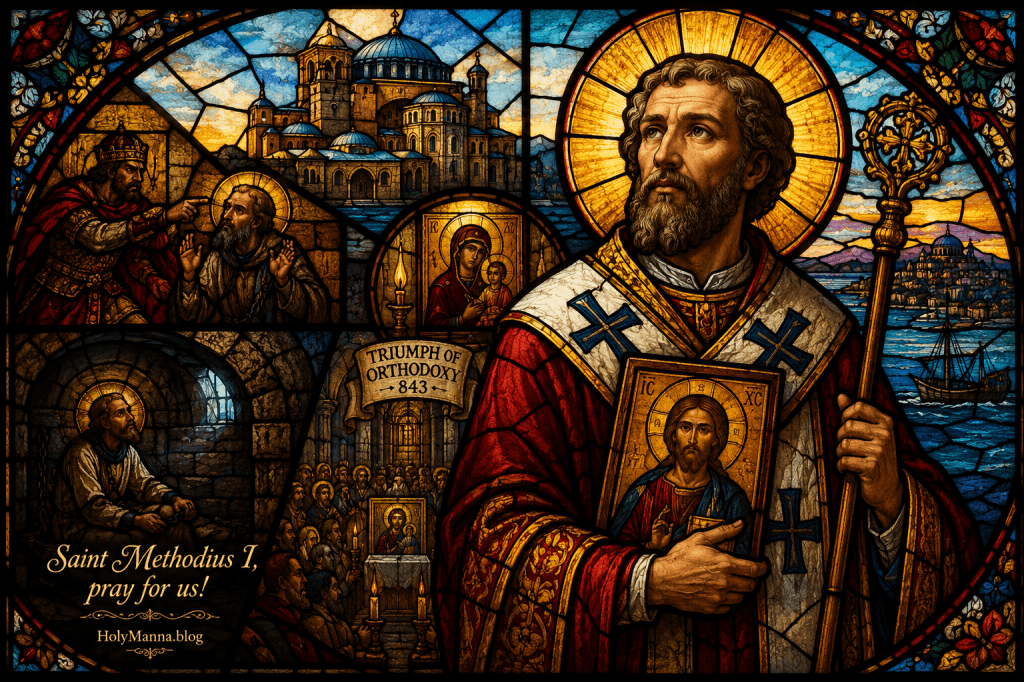
The Saint Buried Alive for Sacred Art
Saint Methodius I of Constantinople was a monk, scholar, confessor, and Patriarch of Constantinople who helped bring one of the most painful theological battles in Christian history to an end. He lived during the Iconoclast controversy, when Byzantine emperors tried to suppress the veneration of holy images, especially icons of Christ, the Blessed Virgin Mary, the angels, and the saints.
To modern ears, that might sound like an argument about religious artwork. But for the Church, it was much deeper than decoration. It was about the Incarnation. If Jesus Christ truly became man, then the visible face of Christ could be depicted. Sacred images were not worshiped as gods. They were honored because they pointed beyond themselves to the holy persons they represented.
This is why Saint Methodius matters so much. He suffered for the truth that God entered the visible world. He was beaten, imprisoned, slandered, and, according to Catholic sources, confined for years in a disused tomb because he refused to abandon the Church’s teaching on holy icons.
The Catechism of the Catholic Church teaches, “The Christian veneration of images is not contrary to the first commandment.” It also explains that the honor given to an image passes to the person represented. That teaching, rooted in the Second Council of Nicaea, is the heart of Saint Methodius’ witness.
He is remembered as Saint Methodius the Confessor, not because he died as a martyr, but because he suffered greatly for the Catholic faith and remained faithful.
From Sicilian Ambition to Monastic Surrender
Saint Methodius was born in Syracuse, Sicily, near the end of the eighth century. He came from a wealthy family and received a strong education. As a young man, he traveled to Constantinople, apparently hoping to gain a position in the imperial court.
That detail makes him immediately relatable. He was a talented young man with ambition, intelligence, and opportunity. He could have pursued influence, comfort, and recognition. But while he was in Constantinople, a monk helped him see a different path. Instead of chasing worldly honor, Methodius entered religious life.
Some traditions connect him with a monastery on the island of Chios, while other Catholic scholarly sources identify him with the monastery of Chenolakkos. Either way, the main truth is clear. Methodius became a monk, and the discipline of monastic life formed him into the kind of man who could stand firm when emperors demanded compromise.
His conversion was not from paganism to Christianity, but from worldly ambition to deeper discipleship. He allowed God to redirect his gifts. The same mind that could have served politics became a weapon for truth. The same courage that could have served personal advancement became courage for the Church.
What ambitions might God be asking us to purify, redirect, or surrender for something holier?
When the Empire Tried to Silence the Icons
Saint Methodius lived during the second wave of Byzantine Iconoclasm. Iconoclast emperors opposed the veneration of sacred images and treated icons as if they were idolatrous. Monks, bishops, and faithful Catholics who defended holy images were persecuted.
In 815, Patriarch Nicephorus I of Constantinople was deposed and exiled because he refused to support the emperor’s attack on icons. Methodius became one of his defenders and went to Rome, apparently as the representative of the exiled patriarch. There, he appealed to Pope Paschal I and remained connected to the Roman defense of sacred images.
This part of his story matters deeply from a Catholic perspective. Methodius was not just defending a local custom. He was defending the Catholic faith in communion with Rome and in continuity with the Second Council of Nicaea.
After the death of Emperor Leo V, Methodius returned to Constantinople carrying a letter from Pope Paschal I to Emperor Michael II. The letter urged the emperor to restore the rightful patriarch and end the persecution of those who defended icons.
Michael II did not repent. Instead, he punished Methodius.
Methodius was scourged with seventy lashes and then imprisoned in a disused tomb on an island in the Propontis. Catholic sources say he remained there for seven years.
It is hard to imagine a more powerful image. The future Patriarch of Constantinople was treated like a dead man because he defended sacred images. He was buried away from public life, but the truth he defended could not be buried.
The Man Who Would Not Break
After years of suffering, Methodius was eventually released during a general amnesty near the end of Michael II’s reign. He returned to Constantinople physically weakened, but spiritually unbroken.
Then came Emperor Theophilus, who continued the persecution of those who defended icons. Methodius again refused to compromise. Catholic sources say he was scourged and imprisoned under the palace. That same night, friends helped him escape, hid him, and cared for his wounds. They paid dearly for their charity, because their property was confiscated for helping him.
This was not a glamorous kind of holiness. Methodius’ sanctity was forged in exhaustion, pain, fear, and betrayal. His courage was not loud and theatrical. It was steady. He endured because he believed the truth was worth suffering for.
Eventually, Theophilus seems to have respected Methodius’ learning, even while remaining tied to iconoclast policy. Some Catholic sources suggest that Methodius may have softened the emperor’s position in his later years. That is an important part of his witness. He was not merely stubborn. He was intelligent, prayerful, and persuasive. He defended the faith with both courage and reason.
There are no major verified miracle stories from his lifetime in the way there are with some saints known for dramatic healings or wonders. Saint Methodius is remembered primarily as a confessor. His great witness was perseverance under persecution.
Still, his life contains moments that feel touched by providence. His survival after beatings, imprisonment, and years in a tomb is itself astonishing. His escape from imprisonment under Theophilus, made possible by the courage of faithful friends, also shows how God often protects His servants through the charity of ordinary believers.
Slander, Suffering, and the Cost of Fidelity
Saint Methodius’ enemies did not only attack his body. They attacked his reputation.
One famous story says that opponents tried to destroy him by accusing him of sexual sin. Catholic sources preserve the basic account that a woman accused Methodius, but later admitted that she had been paid by his enemies. Eastern hagiographical versions add more dramatic details, saying that Methodius revealed his body, weakened by fasting and suffering, to show that the accusation was impossible.
Because the fuller dramatic version belongs to hagiographical tradition, it should be treated as a story rather than a fully verified historical account. But the spiritual lesson remains powerful. The enemies of the truth often attack a person’s character when they cannot defeat his argument.
Methodius endured the humiliation of being falsely accused. He knew what it meant not only to suffer pain, but to suffer the possibility of public disgrace. That makes him a powerful saint for anyone who has been misunderstood, slandered, or punished for trying to remain faithful.
He was not a martyr in the strict sense, because he was not killed for the faith. But he was a confessor, which means he suffered for Christ and remained faithful.
In that sense, his life echoes the words of Christ in The Gospel of Matthew: “Blessed are you when they insult you and persecute you and utter every kind of evil against you falsely because of me.” Matthew 5:11
The Triumph of Holy Images
Theophilus died in 842, and his widow, Empress Theodora, became regent for their young son Michael III. Though she had lived under an iconoclast emperor, Theodora favored the restoration of icons. Under her authority, the Church began to heal.
The iconoclast patriarch John VII, also known as John the Grammarian, was removed. Methodius was chosen as Patriarch of Constantinople. Some sources place his patriarchate from 842 to 846, while others give 843 to 847. The safest summary is that he became patriarch during the great restoration of icons and died on June 14, either in 846 or 847.
As patriarch, Methodius summoned a synod in Constantinople. This synod reaffirmed the teaching of the Second Council of Nicaea, which had defended the veneration of holy images. Icons were solemnly restored to the churches in 843.
That moment became known in Byzantine Christianity as the Triumph of Orthodoxy. It is still celebrated in the Byzantine tradition on the first Sunday of Lent.
This is Saint Methodius’ greatest historical legacy. He helped restore sacred images after decades of imperial persecution. He lived long enough to see the icons come home.
The man once imprisoned in a tomb became the patriarch who helped bring sacred beauty back into the house of God.
A Shepherd After the Battle
After icons were restored, Methodius faced another difficult task. He had to govern a Church divided by years of fear, betrayal, compromise, and zeal.
Some bishops had supported iconoclasm. Some monks who had suffered under iconoclast rulers wanted severe punishment for anyone connected to the heresy. Methodius had to defend the truth without letting bitterness rule the Church.
He removed those who persisted in error, but he treated repentant iconoclasts with moderation. This angered some stricter monks, especially those connected with the famous Studios monastery. When they refused his authority, Methodius excommunicated them, and they remained in schism until his death.
This part of his life is surprisingly important. Methodius was not only a fighter. He was a healer. He knew that defending doctrine matters, but after the battle, the Church still needs mercy, order, and reconciliation.
That is deeply Catholic. Truth and mercy are not enemies. The Church cannot pretend error does not matter, but she also cannot become cruel once victory has been won.
Legends, Prayers, and the Memory of a Confessor
One famous Eastern legend says that the prayers of Saint Methodius and Empress Theodora helped deliver the soul of Emperor Theophilus from hell. Catholic sources mention this as an Orthodox legend connected with the Feast of Orthodoxy. Since it cannot be verified and should not be treated as doctrine, it is best understood as a traditional story that reflects the hope of mercy and the power of intercessory prayer.
Another Eastern tradition says that Saint Ioannikios foretold that Methodius would become patriarch and even predicted the time of his death. This also belongs to hagiographical tradition and cannot be verified with certainty.
There are no major posthumous miracles strongly attested in standard Catholic sources, and no major Catholic pilgrimage shrine universally associated with Methodius in the way there is with saints like James at Compostela or Francis at Assisi. His impact after death was more liturgical, theological, and cultural.
His memory lived on through the Feast of Orthodoxy, through the restoration of icons, and through the ongoing Catholic and Eastern Christian reverence for sacred images. His witness helped preserve a Christian culture of beauty, where churches, homes, and monasteries could once again be filled with images that lifted the heart to heaven.
That may be his greatest miracle after death. Not a single healing story. Not a famous shrine. Not an incorrupt body. His lasting miracle is that generations of Christians continued to pray before holy icons, learning through sacred beauty that Christ truly became man.
Eternal Memory and a Legacy of Sacred Beauty
No widely verified personal quotation from Saint Methodius I appears prominently in standard Catholic sources. He was known as a writer, and several sermons, letters, and hagiographical works are associated with him, including writings connected to Saint Nicholas, Saint Agatha of Syracuse, Saints Cosmas and Damian, and others. The Synodikon of Orthodoxy is also traditionally connected to him, though it was later expanded and revised.
A Byzantine liturgical remembrance honors him among the great defenders of icons with the words, “To Germanus, Tarasius, Nicephorus and Methodius, true high priests of God and defenders and teachers of Orthodoxy, eternal memory.”
That is a fitting summary of his life. Methodius defended the faith when it was costly. He taught the truth when emperors opposed it. He suffered in his body, his reputation, and his freedom. Then, by God’s providence, he became patriarch and helped restore the beauty he had suffered to defend.
Saint Methodius is venerated by both Catholics and Orthodox. The Roman Martyrology commemorates him on June 14 at Constantinople as Saint Methodius, bishop. He is remembered above all as a confessor of the faith and a defender of holy icons.
What Saint Methodius Teaches the Church Today
Saint Methodius speaks powerfully to a world drowning in images. Every day, people are surrounded by screens, advertisements, vanity, outrage, lust, and distraction. Modern life proves that images shape the soul.
Methodius reminds the Church that not every image corrupts. Some images heal. Some images teach. Some images lift the mind to heaven. A holy icon, a crucifix, a statue of Mary, or an image of the saints can become a quiet sermon in a noisy world.
The Catholic faith does not worship wood, paint, plaster, or gold. Catholics honor the persons represented. Sacred images are windows. They help the faithful remember that grace entered matter when the Word became flesh.
The Catechism of the Catholic Church teaches that Christian iconography expresses in images the same Gospel message that Scripture communicates by words. That means sacred beauty has a real place in evangelization. It can reach the heart before an argument does.
Saint Methodius also teaches perseverance. He did not get quick results. He suffered for years. He was buried in a tomb before he ever became patriarch. He was slandered before he was vindicated. He carried the truth through darkness long before he saw restoration.
That is a lesson for every Catholic trying to stay faithful in a confused age. Sometimes fidelity looks hidden. Sometimes it feels like being buried alive. Sometimes the world mocks what the Church treasures. But truth does not stop being true because it is unpopular.
Where does Christ ask for courage today? Where does the soul need to defend beauty, truth, and reverence in small daily ways?
A simple way to live Saint Methodius’ example is to restore sacred beauty at home. Place a crucifix somewhere visible. Pray before an image of Christ or Our Lady. Teach children why Catholics honor sacred images. Choose what enters the eyes carefully. Replace empty distraction with something that points the heart toward God.
Another way is to endure misunderstanding with charity. Methodius defended the truth, but once he became patriarch, he also had to govern with mercy. He shows that Catholic courage must never become bitterness. Truth should make the heart stronger, not colder.
Saint Methodius was buried for defending sacred beauty, but God raised him up to help restore beauty to the Church. His life reminds the faithful that what is holy is worth defending, even when the cost is high.
Engage With Us!
Share your thoughts and reflections in the comments below. Saint Methodius’ story is a powerful reminder that sacred beauty, faithful endurance, and love for the truth still matter today.
- How does Saint Methodius’ defense of holy icons help you understand the Catholic use of sacred images?
- What sacred image, crucifix, statue, or icon has helped you feel closer to Christ?
- Where in your life is God asking you to stay faithful, even when the truth feels costly?
- How can you make your home, phone, or daily routine more filled with things that lift your heart toward heaven?
- What does Saint Methodius teach you about defending truth without losing mercy?
May Saint Methodius help us recover a Catholic imagination filled with truth, beauty, and reverence. May his courage teach us to defend what is holy, his endurance teach us to suffer faithfully, and his pastoral heart teach us to love with mercy. Let us live a life of faith and do everything with the love and mercy Jesus taught us.
Saint Methodius I, pray for us!
Follow us on YouTube, TikTok, Instagram and Facebook for more insights and reflections on living a faith-filled life.

 Holy Manna!
Leave a comment