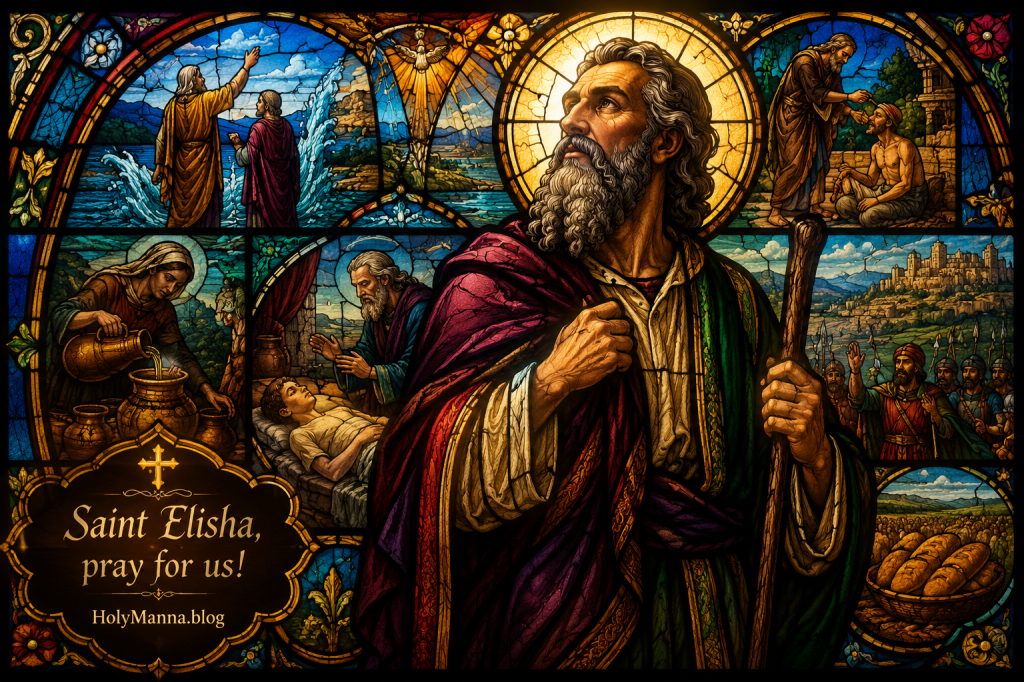
The Prophet Who Carried the Mantle
Saint Elisha stands among the great prophets of the Old Covenant. His name means God is salvation, and his life preached that truth long before he ever spoke a word of prophecy.
He was the chosen successor of the prophet Elijah, the man who received the mantle after Elijah was taken up in the fiery chariot. In Catholic tradition, Elisha is honored as a holy prophet whose miracles pointed forward to Christ. He healed the sick, fed the hungry, raised the dead, purified poisoned food and bad water, helped the poor, warned kings, and showed mercy even to enemies.
His feast day is June 14, and he is especially honored in the Carmelite tradition because of the deep spiritual connection between Carmel, Elijah, and Elisha. He is also remembered as a patron of farmers and those in need of healing, which fits his story beautifully. He was called while working in a field, and so many of his miracles brought healing, food, water, hope, and life.
The Church reads saints like Elisha through the light of Christ. The Catechism of the Catholic Church teaches that the Old Testament prepares for the Gospel and that Christians read the Old Testament in the light of Christ crucified and risen, while still honoring its own sacred value. In Elisha, the Church sees a prophet who prepares the imagination of God’s people for Jesus, the true Prophet, the true Healer, and the true Giver of life.
The Farmer Who Left the Plow Behind
Elisha first appears in The First Book of Kings. He was the son of Shaphat and came from Abel-meholah. When Elijah found him, Elisha was plowing with twelve yoke of oxen. This was not a man wandering through life without responsibility. He had work, family, land, and a future.
Then Elijah came and threw his cloak over him.
That simple gesture changed everything. The mantle was not just fabric. It was a sign of prophetic calling. God was calling Elisha to leave behind the life he knew and follow Elijah into a mission that would involve kings, widows, famine, war, miracles, grief, and glory.
Elisha asked to say goodbye to his father and mother. Then he did something unforgettable. He slaughtered the oxen and used the plowing equipment as fuel to cook a farewell meal for the people. After that, he followed Elijah and became his servant.
This is one of the most striking moments in his life. Elisha did not keep one foot in the field and one foot in the mission. He burned the tools of his old life. He made a clean break. His yes to God had no escape plan hidden behind it.
That detail makes his life deeply challenging. Many people want to follow God while keeping the old plow nearby, just in case holiness becomes inconvenient. Elisha teaches something stronger. When God calls, the faithful answer with trust.
Jesus later says in The Gospel of Luke, “No one who sets a hand to the plow and looks to what was left behind is fit for the kingdom of God” (Luke 9:62). Elisha lived that truth centuries before Christ spoke those words.
The Double Portion and the River That Opened
Elisha remained with Elijah until the end. When Elijah knew the Lord was about to take him, he told Elisha to stay behind. Elisha refused. Again and again, he would not leave his master.
At the Jordan River, Elijah struck the water with his mantle, and the river divided. The two crossed on dry ground. Then Elijah asked what Elisha wanted before he was taken away.
Elisha answered, “May I receive a double portion of your spirit” (2 Kings 2:9).
This was not greed. In biblical language, a double portion was the inheritance of a firstborn son. Elisha was asking to become Elijah’s true spiritual heir. He wanted to carry the mission faithfully.
Then came the unforgettable scene. A fiery chariot and fiery horses appeared, and Elijah was taken up in a whirlwind. Elisha cried out, “My father, my father! Israel’s chariot and steeds!” (2 Kings 2:12). Elijah’s mantle fell, and Elisha picked it up.
Standing before the Jordan, Elisha struck the water and cried, “Where is the LORD, the God of Elijah?” (2 Kings 2:14). The river divided again.
That moment confirmed his mission. The God who had worked through Elijah would now work through Elisha. The mantle had passed. The prophetic fire had not gone out.
The Prophet of Everyday Mercy
Elisha’s miracles are astonishing because they move between the grand and the ordinary. He stands before kings and armies, but he also cares for widows, hungry prophets, sick foreigners, grieving mothers, and poor men who lose borrowed tools.
At Jericho, the people complained that the water was bad and the land unfruitful. Elisha threw salt into the spring and declared that the Lord had purified the water. The water was healed, and life returned to the land.
Then comes one of the hardest stories in Elisha’s life. At Bethel, some youths mocked him, saying, “Go away, baldy!” (2 Kings 2:23). Elisha cursed them in the name of the Lord, and two bears attacked them. This story can sound shocking to modern ears. Catholic reading should not treat it as a petty outburst over a personal insult. Bethel was associated with false worship, and contempt for the prophet was contempt for the God who sent him. The story was remembered as a severe warning against mocking the Lord’s messenger.
During a military campaign against Moab, the armies of Judah, Israel, and Edom were suffering from drought. Elisha prophesied that the Lord would provide water and victory. The next morning, water came, and his prophecy was fulfilled.
But some of Elisha’s most beautiful miracles were not performed for kings. A widow of one of the prophetic guilds came to him in desperation. Her husband had died, and creditors were coming to take her sons into servitude. She had nothing but a small jug of oil. Elisha told her to borrow empty vessels, shut the door, and pour. The oil kept flowing until every vessel was filled. She sold the oil, paid her debt, and lived on what remained.
That miracle says so much about God. The Lord saw a widow facing ruin. He saw sons in danger. He saw an empty house and a little oil. Through Elisha, He turned scarcity into provision.
Another famous story centers on a woman from Shunem. She recognized Elisha as a holy man and prepared a small room for him with a bed, table, chair, and lamp. In gratitude, Elisha promised that she would have a son. The child was born, but later died suddenly. The mother went to Elisha in grief. Elisha prayed, stretched himself over the child, and the boy returned to life.
Long before Christ raised the daughter of Jairus, the son of the widow of Nain, and Lazarus, Elisha’s miracle gave Israel a glimpse that the God of Abraham was Lord even over death.
During famine, the guild prophets once prepared a stew with poisonous wild gourds. They cried out, “Man of God, there is death in the pot!” (2 Kings 4:40). Elisha threw meal into the pot, and the food became safe. In another moment, a man brought twenty barley loaves and fresh grain. Elisha told him to feed one hundred men. The servant objected that it was not enough, but Elisha insisted. The men ate, and there was food left over.
For Catholics, it is impossible not to hear echoes of Christ in this. Elisha fed one hundred with a little bread. Jesus would feed thousands and then give Himself as the Bread of Life.
The Foreign Soldier and the Humbling River
Perhaps Elisha’s most famous healing is the story of Naaman the Syrian. Naaman was a respected military commander, but he suffered from leprosy. He came to Israel seeking healing, expecting a dramatic prophetic ceremony.
Instead, Elisha did not even come out to greet him. He sent a message: “Go and wash seven times in the Jordan, and your flesh will heal, and you will be clean” (2 Kings 5:10).
Naaman was insulted. He expected grandeur, not obedience. He expected spectacle, not humility. He complained that the rivers of Damascus were better than the Jordan. But his servants wisely encouraged him to obey. Naaman went down, washed seven times, and his flesh became like that of a little child.
Then Naaman confessed, “Now I know that there is no God in all the earth, except in Israel” (2 Kings 5:15).
This miracle is so important that Jesus Himself mentions it in The Gospel of Luke. In the synagogue at Nazareth, Jesus reminds the people that there were many lepers in Israel during Elisha’s time, but none was cleansed except Naaman the Syrian. The crowd became furious because Jesus was revealing the wideness of God’s mercy. God’s grace was not tribal. It was not a possession to be hoarded. Even a foreign military commander could receive mercy if he humbled himself before the Lord.
Elisha refused to accept payment from Naaman. God’s healing could not be bought. But Elisha’s servant Gehazi secretly chased after Naaman and took gifts from him. Elisha exposed the deception, and Naaman’s leprosy came upon Gehazi. It was a severe lesson. Grace is not merchandise. The gifts of God are holy.
Fire on the Mountain and Mercy for Enemies
Elisha’s life was not only filled with private miracles. He also stood in the middle of national crisis.
When the king of Aram sought to capture him, an army surrounded the city of Dothan. Elisha’s servant panicked. Elisha answered, “Do not be afraid. Our side outnumbers theirs” (2 Kings 6:16). Then he prayed, “O LORD, open his eyes, that he may see” (2 Kings 6:17).
The servant’s eyes were opened, and he saw the mountain filled with fiery horses and chariots around Elisha.
That scene is one of the most beautiful images of divine protection in Scripture. The army looked powerful, but heaven was already there. The servant thought they were surrounded by enemies, but they were actually surrounded by God.
Then something even more surprising happened. The Lord struck the enemy soldiers blind, and Elisha led them into Samaria. The king of Israel wanted to kill them. Elisha refused. He told the king to feed them and send them home. The king prepared a great feast, and the enemy soldiers returned to their master.
Elisha defeated enemies with mercy.
That is deeply Christian before the Christian age. It points ahead to the Lord Jesus, who commands His disciples to love their enemies and pray for those who persecute them.
Elisha also prophesied during the terrible siege of Samaria. When famine had become unbearable, he declared that food would become plentiful by the next day. An officer doubted him. Elisha said the officer would see it but not eat of it. The Lord caused the Aramean army to flee, food became abundant, and the doubting officer was trampled at the gate.
Elisha also warned the Shunammite woman of a seven-year famine and told her to leave with her household. When she returned, her property was restored through a providential encounter with the king. Even after raising her son, Elisha’s care for this woman continued.
He also went to Damascus and foretold the rise of Hazael. When he saw the violence Hazael would bring upon Israel, Elisha wept. This shows the burden of prophecy. Elisha was not a performer of miracles for excitement. He was a man who carried the grief of knowing what sin and violence would do to God’s people.
The Hard Road of a Prophet
Saint Elisha was not a martyr in the usual sense. Scripture does not say that he died for the faith by execution. Yet his life was filled with hardship because true prophecy is never comfortable.
He lived in a divided kingdom during a time of idolatry, political instability, war, famine, and corruption. He had to speak God’s word to kings who did not always want to hear it. He had to confront greed in his own servant. He had to endure mockery. He had to watch Israel suffer. He had to prophesy judgment as well as mercy.
Near the end of his life, King Joash came to him while he was dying and cried, “My father, my father! Israel’s chariot and steeds!” (2 Kings 13:14). Even a king recognized that Elisha had been a greater defense for Israel than military strength.
Elisha told Joash to shoot an arrow eastward as a sign of victory over Aram. Then he told him to strike the ground with arrows. Joash struck only three times. Elisha rebuked him because he lacked zeal. He would win only three victories instead of completely defeating the enemy.
Even on his deathbed, Elisha was still teaching Israel to trust God boldly.
The Bones That Still Preached
Elisha’s story does not end with his death.
After he died and was buried, a dead man was hastily thrown into his grave during a Moabite raid. When the dead man’s body touched Elisha’s bones, the man came back to life and stood up.
This is one of the most astonishing miracle stories in the Old Testament. Sirach praises Elisha by saying, “In life he performed wonders, and after death, marvelous deeds” (Sirach 48:14).
For Catholics, this moment is especially meaningful. It is a biblical witness to the way God can work through the bodies of His holy ones. Catholics do not venerate relics because bones, garments, or objects have magical power. Catholics venerate relics because God became flesh, redeemed the body, and has often chosen to work through material things. The same God who healed through Elisha’s bones would later heal through the shadow of Peter and cloths touched by Paul, as seen in the New Testament.
The Catechism of the Catholic Church teaches that the communion of saints unites the faithful on earth with those who have gone before us in Christ. Elisha’s bones remind us that holiness is not erased by death. In God, the lives of His saints continue to bear witness.
Later Christian tradition says that Elisha was buried near Samaria. The Roman Martyrology preserves the tradition that, according to Saint Jerome, Elisha’s tomb made demons tremble, and that the prophet Obadiah rested with him. This is a later tradition rather than a detail from Scripture, but it shows how deeply Christians remembered the holiness attached to Elisha’s resting place.
There are also later traditions about relics associated with Elisha, Obadiah, and Saint John the Baptist being threatened during the reign of Julian the Apostate, with believers preserving at least some of them. This tradition cannot be verified with the same certainty as the biblical account, but it reflects the ancient Christian reverence for the prophets and their relics.
Elisha’s cultural impact is especially strong among the Carmelites. Because the Carmelite family traces its spiritual roots to Mount Carmel and the prophetic tradition of Elijah, Elisha is honored as a spiritual father and model. The Carmelite Order formally decreed the celebration of his feast in the late fourteenth century. In Carmelite spirituality, Elisha is a man of prayer, detachment, poverty, obedience, and prophetic courage. He receives the mantle, preserves the mission, and hands on the fire of fidelity.
The Saint Who Points to Christ
Elisha’s life is full of signs that point beyond himself.
He purified water, and Christ gives living water. He multiplied bread, and Christ gives the Eucharist. He healed Naaman in the Jordan, and Christ sanctifies the waters of Baptism. He raised the Shunammite woman’s son, and Christ reveals Himself as the Resurrection and the Life. His bones brought a dead man back to life, and Christ rises bodily from the grave, destroying death forever.
That is why Elisha matters so much. He is not simply an Old Testament miracle worker. He is a prophet whose life teaches the people of God how to recognize the mercy, power, and tenderness that will be fully revealed in Jesus.
He also reminds ordinary believers that holiness often begins with a practical yes. Elisha was plowing a field when the call came. He was not in a palace. He was not looking for attention. He was doing his work. Then God interrupted his life with a mantle.
Many people want God’s will to arrive with total clarity and zero sacrifice. Elisha shows another way. He recognizes the call, leaves the plow, and follows.
What plow is God asking you to leave behind?
What old security are you still tempted to keep nearby, just in case obedience becomes uncomfortable?
Who needs you to become an instrument of God’s mercy this week?
The lesson of Elisha is not complicated, but it is demanding. Receive the mantle. Trust the Lord. Serve the poor. Speak the truth. Pray with courage. Do not be afraid when the enemy seems close, because heaven is closer.
Engage with Us!
Share your thoughts and reflections in the comments below. Saint Elisha’s life is filled with miracles, courage, mercy, and total surrender to God’s call, and his story still speaks powerfully to anyone trying to follow the Lord with an undivided heart.
- What part of Saint Elisha’s story challenges you the most: leaving the plow behind, asking for a double portion, healing Naaman, feeding the hungry, or trusting God’s invisible protection?
- Where in your life is God asking you to stop looking back and follow Him with greater trust?
- Who around you needs the kind of practical mercy Elisha showed: food, encouragement, prayer, forgiveness, healing, or hope?
- How does the miracle of Elisha’s bones deepen your understanding of the communion of saints and the Catholic reverence for relics?
- What would it look like this week to carry the mantle of faith more faithfully in your home, parish, workplace, or friendships?
May Saint Elisha teach us to answer God’s call with courage, to serve others with mercy, and to trust that the Lord is already at work even when we cannot see the fiery chariots around us. Let us live lives of faith and do everything with the love and mercy Jesus taught us.
Saint Elisha, pray for us!
Follow us on YouTube, TikTok, Instagram and Facebook for more insights and reflections on living a faith-filled life.


Leave a Reply