Eleventh Sunday in Ordinary Time – Lectionary: 91
Carried by Mercy and Sent into the Harvest
Before God sends His people, He reminds them that He has already carried them.
Today’s readings begin at Mount Sinai, where Israel stands in the wilderness after being freed from slavery in Egypt. They are not powerful, polished, or settled. They are a rescued people, gathered before the mountain of God, learning what it means to belong to Him. The Lord tells Moses, “I bore you up on eagles’ wings and brought you to myself” (Exodus 19:4). That line becomes the heartbeat of the day. God’s people are not loved because they are useful. They become useful because they have first been loved.
This is the same movement that runs through every reading. In Psalm 100, the people rejoice because they know the Lord made them, claims them, and shepherds them. In Romans 5:6-11, Saint Paul takes that mercy even deeper, proclaiming that “while we were still sinners Christ died for us” (Romans 5:8). God does not wait for humanity to climb its way back to Him. In Jesus Christ, He comes down into the wilderness of sin, helplessness, and alienation, and reconciles us by His Blood. As The Catechism of the Catholic Church teaches, God’s love comes “prior to any merit on our part” (CCC 604).
Then, in The Gospel of Matthew, Jesus looks upon the crowds and His heart is moved because they are “troubled and abandoned, like sheep without a shepherd” (Matthew 9:36). The same God who shepherded Israel now stands among His people in the flesh. He sees their wounds, their confusion, and their spiritual hunger. Then He sends the Twelve, the foundation of His apostolic Church, to proclaim that “the kingdom of heaven is at hand” (Matthew 10:7).
The central theme is clear: God carries His people by mercy, reconciles them through Christ, and sends them into the world as witnesses of His compassion. Israel is called to be “a kingdom of priests, a holy nation” (Exodus 19:6), and the Church lives that calling in Christ through her apostolic mission. The harvest is abundant because grace has already gone ahead. The question for every Catholic is simple and serious: If God has carried, forgiven, and shepherded us so generously, how are we being called to give freely what we have received?
First Reading – Exodus 19:2-6
God Carries His People Before He Calls Them
The first reading brings us to one of the great turning points in salvation history. Israel has escaped Egypt. The Red Sea has been crossed. Pharaoh’s power has been broken. The people have journeyed through the wilderness, and now they stand before Mount Sinai, the mountain of God.
This is not just a dramatic location. Sinai is where a rescued people becomes a covenant people. Israel is no longer simply a group of former slaves fleeing oppression. God is preparing them to become His own holy nation, a people set apart for worship, obedience, and mission. This moment reveals something central to the whole Bible: God saves first, then He commands. He delivers first, then He forms. He carries His people before He asks them to walk in His ways.
That fits beautifully with today’s theme. In the Gospel, Jesus will see the crowds as “troubled and abandoned, like sheep without a shepherd” (Matthew 9:36), and He will send the apostles into the harvest. But before God sends His people, He reminds them who they are. They are not random. They are not forgotten. They are not self-made. They are carried, chosen, and claimed by God.
Exodus 19:2-6 – New American Bible (Revised Edition)
2 After they made the journey from Rephidim and entered the wilderness of Sinai, they then pitched camp in the wilderness.
While Israel was encamped there in front of the mountain, 3 Moses went up to the mountain of God. Then the Lord called to him from the mountain, saying: This is what you will say to the house of Jacob; tell the Israelites: 4 You have seen how I treated the Egyptians and how I bore you up on eagles’ wings and brought you to myself. 5 Now, if you obey me completely and keep my covenant, you will be my treasured possession among all peoples, though all the earth is mine. 6 You will be to me a kingdom of priests, a holy nation. That is what you must tell the Israelites.
Detailed Exegesis
Verse 2 – “After they made the journey from Rephidim and entered the wilderness of Sinai, they then pitched camp in the wilderness. While Israel was encamped there in front of the mountain,”
Israel arrives in the wilderness of Sinai after leaving Rephidim, a place associated with thirst, testing, and battle. The people had already experienced the Lord’s care through water from the rock and protection from enemies. Now they camp before the mountain, and the scene slows down. The journey pauses because God is about to reveal the meaning of their freedom.
In the ancient world, mountains were often associated with divine encounter. In Scripture, mountains become places of revelation, covenant, sacrifice, and mission. Sinai is especially important because it becomes the place where God gives the Law and establishes Israel as His covenant people. Their freedom from Egypt was never meant to become spiritual aimlessness. They were freed for worship, obedience, holiness, and communion with God.
This verse also reminds readers that God often forms His people in the wilderness. The wilderness is uncomfortable, but it is not meaningless. It strips away false security and teaches dependence. Israel had to learn that the God who rescued them from slavery was also the God who would feed them, guide them, correct them, and make them His own.
Verse 3 – “Moses went up to the mountain of God. Then the Lord called to him from the mountain, saying: This is what you will say to the house of Jacob; tell the Israelites:”
Moses goes up the mountain as mediator between God and the people. He represents Israel before God and receives God’s word for Israel. This role prepares us to understand the deeper biblical pattern of mediation, which reaches its fulfillment in Jesus Christ, the one Mediator between God and humanity.
The Lord calls Moses and gives him a message. Notice the tenderness in the phrase “the house of Jacob” and “the Israelites”. God speaks to a people with a history. Jacob was the patriarch whose sons became the twelve tribes of Israel. God is reminding them that the promises made to Abraham, Isaac, and Jacob are still alive. The God who made the covenant with the patriarchs is now forming their descendants into a nation.
This matters for Catholics because the Church reads the Old Testament as part of one unified story of salvation. God’s covenant with Israel is not erased by Christ. It is fulfilled in Him. At Sinai, God forms a people through covenant. In Christ, God forms the Church through the New Covenant in His Blood.
Verse 4 – “You have seen how I treated the Egyptians and how I bore you up on eagles’ wings and brought you to myself.”
This is the emotional center of the reading. God begins not with a demand, but with a memory. He tells Israel to remember what they have seen. They saw Egypt’s power judged. They saw the sea open. They saw slavery broken. They saw that the Lord is not indifferent to the suffering of His people.
Then God gives one of the most beautiful images in the Old Testament: “I bore you up on eagles’ wings and brought you to myself” (Exodus 19:4). The image is strong and tender at the same time. An eagle carries, protects, lifts, and trains its young. God is not describing Israel as the hero of the Exodus. He is saying, in effect, that they survived because He carried them.
The destination is also important. God does not merely say, “I brought you out of Egypt.” He says, “I brought you to myself” (Exodus 19:4). Freedom is not only escape from bondage. Freedom is communion with God. The goal of salvation is not simply relief from suffering, but union with the Lord.
This verse gives the whole Christian life its proper order. Grace comes first. God acts first. God rescues first. The moral life is a response to mercy, not an attempt to earn it. That is why this reading pairs so well with Romans 5:8, where Saint Paul says, “But God proves his love for us in that while we were still sinners Christ died for us.”
Verse 5 – “Now, if you obey me completely and keep my covenant, you will be my treasured possession among all peoples, though all the earth is mine.”
Now comes the call to obedience. The word “Now” matters because it follows the memory of mercy. God has carried Israel, and now He calls Israel to covenant faithfulness. Obedience is not presented as a cold transaction. It is the response of a people who have already been saved.
God says, “If you obey me completely and keep my covenant” (Exodus 19:5). Covenant is more than a contract. A contract exchanges goods or services. A covenant establishes a sacred bond of belonging. God is inviting Israel into a relationship marked by fidelity, worship, and holiness.
Then comes the identity: “You will be my treasured possession among all peoples” (Exodus 19:5). Israel belongs to God in a special way, but not because God lacks authority over the rest of creation. He immediately adds, “though all the earth is mine” (Exodus 19:5). The whole world belongs to God, but Israel is chosen for a particular mission within the world.
This is a key Catholic point. Election is never meant to become arrogance. Being chosen by God is not permission to look down on others. It is a call to serve, witness, worship, and become holy for the sake of the world.
Verse 6 – “You will be to me a kingdom of priests, a holy nation. That is what you must tell the Israelites.”
This verse reveals Israel’s vocation. God wants His people to be “a kingdom of priests, a holy nation” (Exodus 19:6). A priest offers worship, intercedes, and mediates blessing. A holy nation is a people set apart for God’s purposes. Israel is called to live in such a way that the nations can see who the Lord is.
This does not mean every Israelite becomes a ministerial priest in the later Levitical sense. Rather, Israel as a whole has a priestly mission among the nations. They are to worship the true God, live according to His covenant, and become a visible sign of His holiness.
For Catholics, this verse points forward to the Church and the dignity of baptism. In Christ, the faithful share in His priestly, prophetic, and kingly mission. The Church is a people set apart, not to hide from the world, but to offer the world back to God through worship, witness, sacrifice, and charity.
The reading ends with God telling Moses, “That is what you must tell the Israelites” (Exodus 19:6). This identity had to be proclaimed. God’s people needed to hear who they were before they could live as they were called to live.
Teachings: A Rescued People Becomes a Priestly People
This reading is foundational for understanding both Israel and the Church. At Sinai, God reveals that His people are not merely rescued from something. They are rescued for something. They are freed from slavery so they can belong to Him, worship Him, obey Him, and become a holy sign among the nations.
The Catechism of the Catholic Church connects this passage directly to the priestly identity of God’s people and the later development of the priesthood in Israel: “The chosen people was constituted by God as ‘a kingdom of priests and a holy nation.’ But within the people of Israel, God chose one of the twelve tribes, that of Levi, and set it apart for liturgical service; God himself is its inheritance. A special rite consecrated the beginnings of the priesthood of the Old Covenant. The priests are ‘appointed to act on behalf of men in relation to God, to offer gifts and sacrifices for sins.’” (CCC 1539)
This helps Catholics read Exodus 19:6 properly. Israel has a broad priestly vocation as God’s holy people, and within Israel, God also establishes a distinct priesthood for liturgical service. In the New Covenant, both realities find fulfillment in Christ. He is the true High Priest, and through Baptism, the faithful share in His priestly mission. The ministerial priesthood serves the baptismal priesthood by teaching, sanctifying, and shepherding the faithful in Christ’s name.
The Catechism also teaches: “The whole People of God participates in these three offices of Christ and bears the responsibilities for mission and service that flow from them.” (CCC 783)
That means the calling at Sinai continues in a fulfilled way in the Church. Catholics are not spectators in salvation history. By Baptism, they are drawn into Christ’s own mission. They are called to worship God, proclaim the truth, serve with charity, and offer their lives as spiritual sacrifice.
This also connects to the Gospel, where Jesus sends the Twelve. The apostolic mission does not come out of nowhere. It stands within the long story of God forming a people for Himself. At Sinai, God says, “You will be to me a kingdom of priests, a holy nation” (Exodus 19:6). In The Gospel of Matthew, Jesus begins sending His apostles to gather the lost sheep and proclaim the kingdom. In the Church, that mission continues through apostolic succession and through the witness of every baptized Catholic.
Saint Peter later applies this same Sinai language to the Church when he writes, “But you are ‘a chosen race, a royal priesthood, a holy nation, a people of his own, so that you may announce the praises’ of him who called you out of darkness into his wonderful light.” (1 Peter 2:9)
This is not poetic decoration. It is Christian identity. The Church is the people called out of darkness, not to boast in themselves, but to announce the praises of God. The baptized belong to God so deeply that their whole life becomes worship, witness, and mission.
Saint Augustine captured the restlessness of the human heart apart from God when he wrote: “You have made us for yourself, O Lord, and our heart is restless until it rests in you.” (Confessions, Book I)
That is exactly what Exodus 19:4 reveals. God did not merely bring Israel out of Egypt. He brought them to Himself. Every human heart is made for that same destination. Freedom without God eventually becomes another form of slavery. Freedom with God becomes covenant, worship, holiness, and peace.
Reflection: Remember Who Carried You
This first reading is a much-needed correction for anyone who thinks faith begins with trying harder.
God does not begin by handing Israel a religious checklist. He begins by reminding them, “I bore you up on eagles’ wings and brought you to myself” (Exodus 19:4). That is the first truth. Before the commandments, there was rescue. Before the covenant obligations, there was mercy. Before Israel could offer anything to God, God had already carried Israel.
That is still how grace works. The Christian life is not about earning God’s attention. It is about responding to the love that has already come searching. In Baptism, God claims His children. In Confession, He lifts the fallen. In the Eucharist, He feeds the weary. In prayer, He draws the heart back to Himself. Again and again, the Lord carries His people before He sends them.
This reading also challenges modern ideas of freedom. Many people think freedom means having no limits, no obligations, and no one to answer to. But Israel was not freed from Egypt so they could wander forever. They were freed so they could belong to God. Real freedom is not the absence of covenant. Real freedom is the ability to live in the truth of who we are.
That is why obedience matters. God says, “If you obey me completely and keep my covenant” (Exodus 19:5). Obedience can sound heavy until it is seen through the eyes of love. A child who trusts a good father does not hear every instruction as oppression. A soul that remembers mercy begins to understand obedience as the path of life.
This reading invites Catholics to remember before they respond. Remember the sins God forgave. Remember the prayers He answered. Remember the quiet strength He gave when life was too much. Remember the people He sent at the right time. Remember the Masses, Confessions, conversations, and hidden graces that kept faith alive.
Where has God carried you when you could not carry yourself?
It also invites a serious look at identity. God tells Israel, “You will be my treasured possession among all peoples” (Exodus 19:5). The world gives plenty of labels, but God gives a name and a mission. The baptized are not spiritual consumers. They are members of a holy people, called to worship, witness, and serve.
Are you living like someone who belongs to God, or like someone still trying to prove your worth to the world?
Finally, this reading prepares the heart for the Gospel. Jesus sees abandoned sheep and sends laborers into the harvest. But those laborers must first know that they themselves have been carried. A person who forgets mercy becomes harsh. A person who remembers mercy can become a shepherd to others.
So today, begin with gratitude. Thank God for the ways He has carried you. Return to the covenant through prayer, Confession, and faithful worship. Then ask where He is calling you to serve. The God who bore Israel on eagles’ wings still carries His Church, and He still sends His people into the world as a holy nation, a royal priesthood, and a living sign of His mercy.
Responsorial Psalm – Psalm 100:1-3, 5
The Joy of Belonging to the Shepherd
After hearing God tell Israel, “I bore you up on eagles’ wings and brought you to myself” (Exodus 19:4), the Church answers with a psalm of thanksgiving. That is exactly what the Responsorial Psalm does in the Mass. It is not filler between readings. It is the prayerful response of God’s people to the Word they have just received.
Psalm 100 is a joyful hymn of praise, likely connected to the worship of Israel as the people came before the Lord in thanksgiving. It carries the tone of a procession, as if the whole assembly is being invited to enter God’s presence with grateful hearts, joyful voices, and a renewed awareness of who they are. They are not spiritual orphans. They are not abandoned. They are the Lord’s people, “the flock he shepherds” (Psalm 100:3).
This psalm fits today’s theme beautifully. In Exodus, God claims Israel as His treasured possession. In Romans, Saint Paul proclaims that Christ died for us while we were still sinners. In The Gospel of Matthew, Jesus looks upon the crowds with compassion because they are like sheep without a shepherd. Here, the psalm gives the soul a simple and steady response: rejoice, serve, remember, and trust. The Lord is God, we belong to Him, and His mercy endures forever.
Psalm 100:1-3 – New American Bible (Revised Edition)
Processional Hymn
1 A psalm of thanksgiving.
Shout joyfully to the Lord, all you lands;
2 serve the Lord with gladness;
come before him with joyful song.
3 Know that the Lord is God,
he made us, we belong to him,
we are his people, the flock he shepherds.5 good indeed is the Lord,
His mercy endures forever,
his faithfulness lasts through every generation.
Detailed Exegesis
Verse 1 – “Shout joyfully to the Lord, all you lands;”
This opening line is bigger than private devotion. The psalm calls “all you lands” to shout joyfully to the Lord. Israel’s worship is not meant to stay closed in on itself. The praise of the one true God is meant to reach the nations.
That connects back to Exodus 19:5, where God says, “though all the earth is mine”. Israel is chosen, but the Lord is not a local tribal god. He is the Creator and ruler of all peoples. This psalm reminds us that worship has a missionary shape. When God’s people praise Him faithfully, they witness to the world that the Lord alone is God.
The word “joyfully” also matters. Biblical joy is not shallow excitement or forced positivity. It is the deep gladness that comes from knowing that God is faithful. The people can shout with joy because they belong to the Lord who carried them, shepherded them, and kept His promises.
Verse 2 – “Serve the Lord with gladness; come before him with joyful song.”
The psalm moves from praise to service. “Serve the Lord with gladness” (Psalm 100:2) shows that worship is not only something spoken with the lips. It becomes a life offered to God.
In the biblical world, service to the Lord was closely tied to worship, sacrifice, obedience, and covenant fidelity. Israel was freed from slavery in Egypt not so they could serve no one, but so they could serve the true God. That is the great paradox of biblical freedom. The human heart is most free when it belongs completely to the Lord.
The verse also says, “come before him with joyful song” (Psalm 100:2). Catholic worship carries this same truth. The Mass is not merely an obligation to attend. It is the privileged place where God’s people come before Him, hear His Word, offer themselves with Christ, and receive the Eucharist. The joy of worship is not based on mood, music style, or perfect circumstances. It is rooted in the truth that God has invited His people into His presence.
Verse 3 – “Know that the Lord is God, he made us, we belong to him, we are his people, the flock he shepherds.”
This is the heart of the psalm. The command is simple: “Know that the Lord is God” (Psalm 100:3). In Scripture, knowing God is not just knowing facts about Him. It is covenant knowledge. It is the knowledge of faith, worship, trust, and obedience.
The verse continues, “he made us, we belong to him” (Psalm 100:3). This is one of the most freeing truths in the whole spiritual life. Human dignity does not come from popularity, productivity, status, beauty, money, or approval. It comes from being created by God and belonging to Him.
Then the psalm gives the image that ties directly into the Gospel: “we are his people, the flock he shepherds” (Psalm 100:3). In The Gospel of Matthew, Jesus sees the crowds as “troubled and abandoned, like sheep without a shepherd” (Matthew 9:36). The psalm tells us what they need and what every soul needs. They need the Shepherd. They need to know they belong to God.
This verse also prepares us to understand the Church. The Church is not a loose gathering of religious consumers. She is the flock of Christ, gathered by the Good Shepherd, nourished by His Word and Sacraments, and sent into the world to witness to His mercy.
Verse 5 – “Good indeed is the Lord, his mercy endures forever, his faithfulness lasts through every generation.”
The psalm ends by naming the character of God: goodness, mercy, and faithfulness. These are not temporary moods in God. They are part of who He is. The Lord is good. His mercy endures. His faithfulness lasts.
This verse gathers all the readings together. In Exodus, God’s goodness carries Israel out of slavery. In Romans, His mercy is revealed in Christ dying for sinners. In The Gospel of Matthew, His faithfulness appears in Jesus, who sees the abandoned crowds and sends apostles to shepherd them.
The phrase “through every generation” (Psalm 100:5) is especially important. God’s mercy did not belong only to Israel in the wilderness. It did not belong only to the apostles in Galilee. It belongs to the Church today. Every generation must rediscover the same truth: the Lord is good, His mercy has not run out, and His faithfulness is stronger than human weakness.
Teachings: Thanksgiving, Worship, and the Mercy That Comes First
This psalm teaches the Church how to respond to God’s saving action. God carries His people, and His people answer with praise. God claims His people, and His people serve with gladness. God shepherds His people, and His people trust His mercy from generation to generation.
The Catechism of the Catholic Church teaches that prayer always begins with God’s initiative: “God calls man first. Man may forget his Creator or hide far from his face; he may run after idols or accuse the deity of having abandoned him; yet the living and true God tirelessly calls each person to that mysterious encounter known as prayer. In prayer, the faithful God’s initiative of love always comes first; our own first step is always a response. As God gradually reveals himself and reveals man to himself, prayer appears as a reciprocal call, a covenant drama. Through words and actions, this drama engages the heart. It unfolds throughout the whole history of salvation.” (CCC 2567)
That teaching fits Psalm 100 perfectly. The people do not invent worship to get God’s attention. They respond because God has already called, created, rescued, and shepherded them. Their joyful song is an answer to grace.
The Catechism also explains thanksgiving as a basic movement of Christian prayer: “Thanksgiving characterizes the prayer of the Church which, in celebrating the Eucharist, reveals and becomes more fully what she is.” (CCC 2637)
This is especially meaningful because the word “Eucharist” itself means thanksgiving. Every Mass is the Church’s greatest act of thanksgiving to the Father through the Son in the Holy Spirit. So when the psalm says, “serve the Lord with gladness; come before him with joyful song” (Psalm 100:2), Catholics can hear an echo of Eucharistic worship. The Church comes before the Lord not empty-handed, but united to Christ’s perfect offering.
Saint Augustine, reflecting on the psalms, often taught that singing belongs to love. One of his famous lines is:“Singing belongs to one who loves.”
That captures the spirit of Psalm 100. The joyful song of the people is not performance. It is love responding to love. The Lord has made us. The Lord has claimed us. The Lord has shepherded us. So the Church sings.
This psalm also deepens the Catholic understanding of belonging. The world often teaches people to define themselves by achievement or desire. Scripture teaches something far more stable: “he made us, we belong to him” (Psalm 100:3). This is why Catholic worship and Catholic morality belong together. If God made us and we belong to Him, then life has a purpose. The body has meaning. The soul has a destiny. Freedom has a direction. Worship becomes the center of a rightly ordered life.
Reflection: Let Gratitude Teach the Heart Who It Belongs To
Psalm 100 is short, but it has the power to reorder a tired soul. It reminds the reader that the first response to God’s mercy is not panic, performance, or self-improvement. The first response is thanksgiving.
That is important because many people live as if they are spiritually homeless. They may believe in God, but still act like everything depends on them. They carry pressure, shame, expectations, family burdens, financial fears, moral struggles, and the quiet exhaustion of trying to hold life together. Then this psalm gently speaks into the noise: “Know that the Lord is God, he made us, we belong to him” (Psalm 100:3).
Belonging to God changes everything. It means life is not random. It means the soul is not disposable. It means mistakes are not the final word. It means the Shepherd has not abandoned His flock.
A simple way to live this psalm is to begin the day with thanksgiving before asking for anything. Thank God for life, for faith, for another chance to repent, for the Eucharist, for the people entrusted to your care, and for the quiet mercies that often go unnoticed. Gratitude trains the heart to see reality correctly.
Another way is to serve with gladness in ordinary duties. Not every act of service feels inspiring. Work can be repetitive. Family responsibilities can be tiring. Parish life can be messy. But the psalm says, “Serve the Lord with gladness” (Psalm 100:2). That means even simple tasks can become worship when offered to God with love.
This psalm also invites Catholics back to joyful worship. Mass is not merely something to fit into the weekend schedule. It is where the flock gathers before the Shepherd. It is where the Church remembers that the Lord is good, receives His mercy, and is strengthened for mission.
Do you approach worship as an obligation to survive or as a gift that reminds you who you are?
What would change this week if gratitude came before complaint?
Where do you need to remember that you belong to God before you belong to anyone’s opinion of you?
The world is full of people who feel troubled and abandoned. Today’s psalm reminds the Church that the answer begins with knowing the Shepherd. A grateful Catholic becomes steady. A steady Catholic becomes generous. A generous Catholic becomes a witness.
The Lord is good. His mercy endures forever. His faithfulness has carried every generation, and it is strong enough to carry this one too.
Second Reading – Romans 5:6-11
Loved Before We Were Worthy
The second reading moves from the mountain of Sinai to the foot of the Cross. In Exodus, God reminds Israel that He carried them before He called them. In Romans, Saint Paul reveals the deepest proof of that same divine love: Christ died for sinners before they could make themselves worthy.
Saint Paul wrote The Letter to the Romans to a Christian community living in the heart of the empire, a place obsessed with power, honor, status, law, and conquest. Into that world, Paul proclaims something shocking. God’s love is not proven by human strength, moral achievement, or religious pedigree. God proves His love through the Blood of Christ, poured out for the helpless, the ungodly, the sinful, and even the enemies of God.
This reading fits today’s theme perfectly. God carries His people by mercy, reconciles them through Christ, and sends them into the world as witnesses of His compassion. Before the apostles can go to the lost sheep in The Gospel of Matthew, they must first be disciples who know they have been rescued. Mission begins with mercy received. Reconciliation comes before proclamation.
Romans 5:6-11 – New American Bible (Revised Edition)
6 For Christ, while we were still helpless, yet died at the appointed time for the ungodly. 7 Indeed, only with difficulty does one die for a just person, though perhaps for a good person one might even find courage to die. 8 But God proves his love for us in that while we were still sinners Christ died for us. 9 How much more then, since we are now justified by his blood, will we be saved through him from the wrath. 10 Indeed, if, while we were enemies, we were reconciled to God through the death of his Son, how much more, once reconciled, will we be saved by his life. 11 Not only that, but we also boast of God through our Lord Jesus Christ, through whom we have now received reconciliation.
Detailed Exegesis
Verse 6 – “For Christ, while we were still helpless, yet died at the appointed time for the ungodly.”
Saint Paul begins with a humbling truth: humanity was “helpless” (Romans 5:6). This does not mean people are incapable of any good action. It means that fallen humanity cannot save itself from sin and death by its own power. No amount of self-improvement, religious effort, or moral ambition can replace the saving work of Christ.
The phrase “at the appointed time” (Romans 5:6) reveals that the Cross was not an accident or a tragic interruption in God’s plan. It was the fulfillment of divine providence. God entered history at the right moment to accomplish redemption through His Son.
Paul also says Christ died “for the ungodly” (Romans 5:6). That is staggering. Christ did not die only for the admirable, obedient, or spiritually impressive. He died for those who were estranged from God. This is grace in its purest form: undeserved, unearned, and freely given.
Verse 7 – “Indeed, only with difficulty does one die for a just person, though perhaps for a good person one might even find courage to die.”
Paul now compares human love with divine love. Among human beings, it is rare for someone to die even for a righteous person. Perhaps someone might die for a person who is exceptionally good, beloved, or worthy of admiration. That kind of sacrifice is heroic, but still understandable.
Paul is preparing the reader to see how far beyond human calculation God’s love goes. Human beings often love in response to goodness they already see. God loves in order to make sinners good. Human love often reacts to worthiness. Divine love creates worth by mercy.
This verse also exposes a common spiritual mistake. Many people assume God loves them more when they are doing well and less when they are struggling. Paul is about to demolish that fear. The Cross shows that God’s love reached us at our worst, not merely at our best.
Verse 8 – “But God proves his love for us in that while we were still sinners Christ died for us.”
This is the heart of the reading. Paul does not say God merely announces His love. He says God “proves his love” (Romans 5:8). The proof is the Cross.
The timing matters: “while we were still sinners” (Romans 5:8). Christ did not wait for humanity to become lovable. He did not wait until sinners repented perfectly, understood everything clearly, or fixed their lives. He died while we were still sinners.
This does not excuse sin. It reveals the depth of mercy. Sin is so serious that it required the Blood of Christ. Mercy is so powerful that Christ willingly shed His Blood for sinners. The Cross is where justice and love meet, where sin is judged and sinners are redeemed.
This verse gives every Catholic a reason to return to God with confidence. Shame says, “Hide until you are worthy.” The Gospel says, “while we were still sinners Christ died for us” (Romans 5:8).
Verse 9 – “How much more then, since we are now justified by his blood, will we be saved through him from the wrath.”
Paul now moves from what Christ has done to what believers can confidently hope for. If Christ died for us while we were sinners, then those who have been justified by His Blood can trust Him even more.
To be “justified by his blood” (Romans 5:9) means that our reconciliation with God comes through Christ’s sacrificial death. In Catholic teaching, justification is not merely God pretending that sinners are righteous. It is a real gift of grace. God forgives sin, renews the soul, and brings the person into communion with Himself.
The phrase “saved through him from the wrath” (Romans 5:9) refers to deliverance from the righteous judgment of God against sin. This can sound uncomfortable to modern ears, but it is essential to the Gospel. If sin is real, judgment is real. If judgment is real, salvation is not a religious accessory. It is a rescue.
The good news is that Christ does not leave believers in terror. His Blood is the ground of Christian confidence. The one who has been reconciled through Christ can trust that God’s mercy is stronger than sin.
Verse 10 – “Indeed, if, while we were enemies, we were reconciled to God through the death of his Son, how much more, once reconciled, will we be saved by his life.”
Paul goes even deeper. He says we were not only weak or sinful. We were “enemies” (Romans 5:10). Sin is not just a mistake. It ruptures communion with God. It puts the human heart in rebellion against the One who made it.
Yet even then, God acts first. “We were reconciled to God through the death of his Son” (Romans 5:10). Reconciliation is not humanity climbing back to heaven by effort. It is God restoring communion through the sacrifice of Christ.
Then Paul says, “how much more, once reconciled, will we be saved by his life” (Romans 5:10). This points to the risen life of Christ. The Cross reconciles us. The Resurrection shows that Christ lives forever to save, intercede, sanctify, and bring His people into glory.
Christian hope is not only that Jesus died long ago. Christian hope is that Jesus lives now. The crucified Lord is risen, and His life continues to save those united to Him.
Verse 11 – “Not only that, but we also boast of God through our Lord Jesus Christ, through whom we have now received reconciliation.”
Paul ends with joy. The Christian can “boast of God” (Romans 5:11), not in a prideful way, but in grateful confidence. The believer does not boast in personal achievement, spiritual strength, or moral superiority. The believer boasts in God, who has done what sinners could never do for themselves.
The key word is “received” (Romans 5:11). Reconciliation is a gift. It is not seized, purchased, or earned. It is received through Jesus Christ.
This brings the reading back to the theme of the day. In Exodus, Israel receives deliverance. In Psalm 100, God’s people rejoice because they belong to Him. In Romans, sinners receive reconciliation through Christ. In The Gospel of Matthew, the apostles receive authority and are told, “Without cost you have received; without cost you are to give” (Matthew 10:8).
The Christian life is gift from beginning to end.
Teachings: Reconciliation, Justification, and the Mercy That Comes First
This reading gives one of the clearest Catholic teachings on grace. God loved first. Christ died first. Mercy came before human merit. That is why the Christian life must never be reduced to moralism. The Church calls people to holiness, but holiness begins with grace, not self-salvation.
The Catechism of the Catholic Church teaches: “By giving up his own Son for our sins, God manifests that his plan for us is one of benevolent love, prior to any merit on our part: ‘In this is love, not that we loved God but that he loved us and sent his Son to be the expiation for our sins.’ God ‘shows his love for us in that while we were yet sinners Christ died for us.’” (CCC 604)
This is exactly Saint Paul’s point. God’s love is prior to any merit on our part. That does not mean merit and cooperation with grace do not matter. It means the first movement always belongs to God. He is the Savior. We are the rescued.
The Catechism also explains justification in language that helps unpack Romans 5:9: “Justification has been merited for us by the Passion of Christ. It is granted us through Baptism. It conforms us to the righteousness of God, who justifies us. It has for its goal the glory of God and of Christ, and the gift of eternal life. It is the most excellent work of God’s mercy.” (CCC 2020)
This is essential. Justification is not a vague feeling of being accepted. It is the saving work of God’s mercy, merited by Christ’s Passion and granted through Baptism. The Blood of Christ truly changes our standing before God and begins the renewal of the soul.
The Church also teaches that grace is entirely undeserved: “Our justification comes from the grace of God. Grace is favor, the free and undeserved help that God gives us to respond to his call to become children of God, adoptive sons, partakers of the divine nature and of eternal life.” (CCC 1996)
That quote gives the Catholic heart of the reading. Grace is not God ignoring sin. Grace is God giving free and undeserved help so that sinners can become children of God and share in divine life.
Saint Augustine, who understood deeply the struggle between sin and grace, wrote: “Give what you command, and command what you will.” (Confessions, Book X)
This short prayer captures the logic of Romans 5. God commands holiness, but He also gives the grace needed to live it. The Christian does not obey by raw willpower alone. The Christian responds to grace with faith, repentance, love, and cooperation.
Saint Thomas Aquinas also taught that Christ’s Passion is the cause of our salvation. In the Summa Theologiae, he writes: “Christ’s Passion is a sufficient and superabundant satisfaction for the sins of the human race.” (Summa Theologiae, III, Question 48, Article 2)
This helps explain Paul’s confidence. The Blood of Christ is not barely enough. It is superabundant. No sinner should despair as if Christ’s mercy were too weak. No Catholic should treat the Cross as a small religious symbol. It is the place where the Son of God offers Himself for the salvation of the world.
This reading also has deep sacramental meaning. Reconciliation with God is received first in Baptism, restored through the Sacrament of Penance when mortal sin has ruptured communion, and nourished by the Eucharist. The whole sacramental life of the Church flows from the pierced heart of Christ, who died for us while we were still sinners and now saves us by His risen life.
Reflection: Stop Hiding From the God Who Already Came Looking
This reading speaks directly to the person who thinks they need to become worthy before returning to God.
Saint Paul says, “while we were still sinners Christ died for us” (Romans 5:8). Not after we became impressive. Not after we figured everything out. Not after we had a perfect prayer routine, a spotless conscience, and a clean record. While we were still sinners.
That truth should not make anyone casual about sin. It should make sinners brave enough to repent. The Cross shows both the horror of sin and the greater power of mercy. Sin is serious enough that the Son of God shed His Blood. Mercy is strong enough that He willingly did it for the ungodly.
A practical way to live this reading is to stop negotiating with shame. Shame says, “Stay away from Confession until you are less embarrassed.” Grace says, “Come home.” Shame says, “God is tired of you.” The Cross says, “God proves his love for us” (Romans 5:8). Shame says, “You are too far gone.” The Resurrection says, “we will be saved by his life” (Romans 5:10).
This reading also invites Catholics to boast only in God. That means letting go of both spiritual pride and spiritual despair. Pride says, “God must be pleased because of how good you are.” Despair says, “God must be finished because of how bad you are.” The Gospel says something better than both: God is merciful because He is good.
The next step is simple, but not always easy. Bring sin into the light. Make a good examination of conscience. Go to Confession. Receive absolution. Return to the Eucharist with gratitude. Forgive others as one who has been forgiven. Treat struggling people with the compassion of someone who knows what it means to need mercy.
Where are you still trying to earn the love that Christ has already proven on the Cross?
What sin or wound needs to be brought honestly to Confession instead of hidden in shame?
Do you believe God loved you at your worst, or do you still act like His love depends on your best performance?
How would your relationships change if you treated others as people Christ loved while they were still sinners?
The apostles in today’s Gospel are sent to proclaim, heal, cleanse, and drive out evil. But they are sent as men who have first received everything from Christ. That is the path for every Catholic. Receive mercy. Live reconciled. Then give freely what has been freely given.
God does not wait for the helpless to become strong before He loves them. Christ dies for the helpless, reconciles enemies, justifies sinners by His Blood, and saves His people by His risen life. That is why the Christian can stand before the world without pretending to be perfect and still say with confidence: the mercy of God is real, and it has already come looking for us.
Holy Gospel – Matthew 9:36-10:8
The Shepherd Sees the Wounded and Sends the Apostles
The Holy Gospel brings the whole movement of today’s readings to fulfillment. In Exodus, God carries Israel and calls them His treasured people. In Psalm 100, the people rejoice because they belong to the Lord, “the flock he shepherds” (Psalm 100:3). In Romans, Saint Paul proclaims that Christ died for us “while we were still sinners” (Romans 5:8). Now, in The Gospel of Matthew, Jesus looks upon the crowds with divine compassion and sends the Twelve to continue His own mission.
The scene takes place during Jesus’ public ministry in Galilee. He has been teaching in synagogues, proclaiming the kingdom, healing the sick, forgiving sins, and revealing the mercy of the Father. The crowds are drawn to Him because they are hungry for more than political rescue or temporary relief. They are spiritually wounded. They are scattered. They are shepherdless.
That image would have landed deeply for a Jewish audience. In the Old Testament, Israel’s leaders were often described as shepherds, and when they failed, the people suffered. The prophets condemned false shepherds who neglected the flock, and God promised that He Himself would shepherd His people. In Jesus, that promise is standing before the crowds in flesh and blood.
This Gospel is not only about compassion. It is about apostolic mission. Jesus sees the need, commands prayer, chooses the Twelve, gives them authority, and sends them out. The Church is born from the compassion of Christ and sent into the world to proclaim that “the kingdom of heaven is at hand” (Matthew 10:7).
Matthew 9:36-10:8 – New American Bible (Revised Edition)
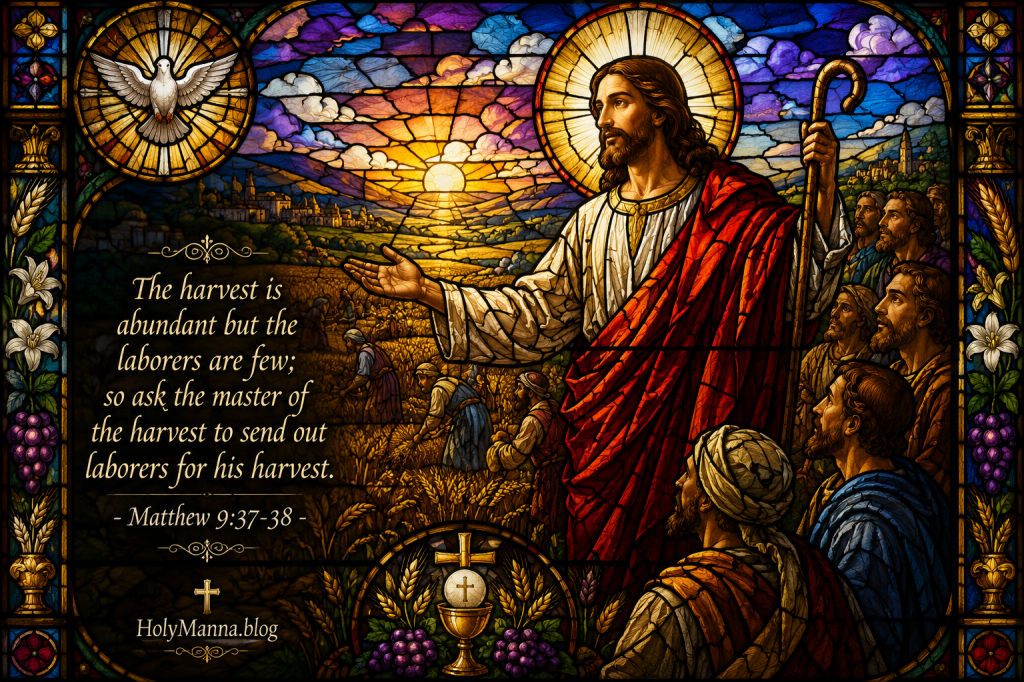
36 At the sight of the crowds, his heart was moved with pity for them because they were troubled and abandoned, like sheep without a shepherd. 37 Then he said to his disciples, “The harvest is abundant but the laborers are few; 38 so ask the master of the harvest to send out laborers for his harvest.”
The Mission of the Twelve. 10:1 Then he summoned his twelve disciples and gave them authority over unclean spirits to drive them out and to cure every disease and every illness. 2 The names of the twelve apostles are these: first, Simon called Peter, and his brother Andrew; James, the son of Zebedee, and his brother John; 3 Philip and Bartholomew, Thomas and Matthew the tax collector; James, the son of Alphaeus, and Thaddeus; 4 Simon the Cananean, and Judas Iscariot who betrayed him.
The Commissioning of the Twelve. 5 Jesus sent out these twelve after instructing them thus, “Do not go into pagan territory or enter a Samaritan town. 6 Go rather to the lost sheep of the house of Israel. 7 As you go, make this proclamation: ‘The kingdom of heaven is at hand.’ 8 Cure the sick, raise the dead, cleanse lepers, drive out demons. Without cost you have received; without cost you are to give.
Detailed Exegesis
Verse 36 – “At the sight of the crowds, his heart was moved with pity for them because they were troubled and abandoned, like sheep without a shepherd.”
This verse reveals the heart of Jesus. He sees the crowds, but He does not see them as a burden, interruption, or problem to manage. He sees their condition. They are “troubled and abandoned” (Matthew 9:36). The language suggests people worn down, harassed, scattered, and spiritually exposed.
The phrase “like sheep without a shepherd” (Matthew 9:36) connects this moment to the Old Testament. Israel needed faithful shepherds to teach, govern, protect, and lead the people back to God. When leaders failed, the flock became vulnerable. Jesus sees the people’s suffering and responds with compassion.
His pity is not weak emotion. It is divine mercy in motion. Christ’s compassion leads to prayer, authority, mission, healing, and deliverance. He does not merely feel sorry for the crowds. He begins to send shepherds.
Verse 37 – “Then he said to his disciples, ‘The harvest is abundant but the laborers are few;’”
Jesus changes the image from sheep to harvest. The people are wounded sheep, but they are also a field ready for gathering. This is an important shift. Jesus does not look at the brokenness of the world and conclude that everything is hopeless. He says, “The harvest is abundant” (Matthew 9:37).
That is a word of hope. Even where people seem confused, distant, or spiritually exhausted, grace may already be at work. God has already prepared hearts. The problem is not the absence of need or the absence of possibility. The problem is the shortage of laborers willing to serve the Lord’s harvest.
This verse challenges Catholics to see the world with the eyes of Christ. The harvest is not only in mission fields far away. It is in families, parishes, schools, workplaces, neighborhoods, nursing homes, confession lines, and quiet conversations with people who are searching without knowing what they are searching for.
Verse 38 – “So ask the master of the harvest to send out laborers for his harvest.”
Before Jesus sends the apostles, He commands prayer. That order matters. The mission does not begin with strategy, branding, activism, or panic. It begins with asking the Father.
The harvest belongs to God. The laborers belong to God. The mission belongs to God. The Church does not invent her purpose. She receives it. This verse is one of the great biblical foundations for praying for vocations, especially to the priesthood, religious life, missionary life, and holy marriages that become domestic churches.
It also warns against self-appointed ministry detached from prayer. Real mission begins on the knees. The laborer must be sent by the Lord of the harvest, not driven merely by ego, anxiety, or personal ambition.
Verse 1 – “Then he summoned his twelve disciples and gave them authority over unclean spirits to drive them out and to cure every disease and every illness.”
At the beginning of chapter 10, Jesus summons the Twelve. This is not accidental. The number twelve recalls the twelve tribes of Israel. Jesus is gathering and renewing the people of God around Himself.
He gives them authority. In Scripture, true authority comes from God and is meant for service. The apostles receive authority over unclean spirits and sickness because their mission is an extension of Christ’s own work. They do not act in their own name. They act by the authority of Jesus.
This verse also shows the wholeness of Christ’s mission. He comes to free people from evil, heal what is broken, and restore communion with God. The Church continues this mission sacramentally, especially through preaching, Baptism, Confession, the Eucharist, the Anointing of the Sick, and the ministry of ordained shepherds.
Verse 2 – “The names of the twelve apostles are these: first, Simon called Peter, and his brother Andrew; James, the son of Zebedee, and his brother John;”
Matthew now names the Twelve. They are not anonymous representatives. They are real men with names, families, personalities, weaknesses, and histories. Christ builds His Church through actual people, not idealized religious symbols.
Simon Peter is named first. For Catholics, this detail matters. Peter has a distinct role among the apostles. He is not separated from the Twelve, but he is given a primacy within the apostolic band that will become clearer throughout the Gospel, especially when Jesus says, “You are Peter, and upon this rock I will build my church” (Matthew 16:18).
Andrew, James, and John are also named here. These first apostles show that mission is relational. Brothers are called together. Fishermen become shepherds. Ordinary working men are drawn into the extraordinary mission of Christ.
Verse 3 – “Philip and Bartholomew, Thomas and Matthew the tax collector; James, the son of Alphaeus, and Thaddeus;”
The list continues with men from different backgrounds. Matthew is identified as “the tax collector” (Matthew 10:3), a reminder of his past. Tax collectors were often despised because they collaborated with Roman authority and were associated with greed or corruption.
Yet Jesus calls Matthew. This is mercy made visible. The apostolic Church is not founded on men who were sinless from the beginning. It is founded on men called, forgiven, formed, and sent by Christ.
Thomas will later struggle with doubt after the Resurrection. Matthew had a compromised past. Others remain less known. This should encourage every Catholic. Christ does not call only the polished and impressive. He calls real people and gives them real grace.
Verse 4 – “Simon the Cananean, and Judas Iscariot who betrayed him.”
Simon the Cananean, often understood as Simon the Zealot, may have been associated with intense nationalist hopes. Judas Iscariot is named with the tragic note: “who betrayed him” (Matthew 10:4).
The presence of Judas in the list is sobering. Jesus truly called him. Judas truly walked with the apostles. He heard the teaching, witnessed the miracles, and shared in the mission. Yet he betrayed the Lord.
This verse reminds the Church that proximity to holy things does not automatically equal holiness. A person can be near the sacraments, near ministry, near religious language, and still refuse conversion. The call must be answered daily with faithfulness.
It also reminds readers that Jesus was not surprised by human weakness. He built His Church knowing the reality of betrayal, sin, and failure. The holiness of the Church comes from Christ, not from the perfection of every member.
Verse 5 – “Jesus sent out these twelve after instructing them thus, ‘Do not go into pagan territory or enter a Samaritan town.’”
Jesus now sends the Twelve, but He gives them a specific initial boundary. They are not yet sent to the Gentiles or Samaritans. This does not mean Jesus rejects them. Later, after the Resurrection, He will command the apostles to make disciples of all nations.
Here, the mission begins with Israel because God is faithful to His covenant promises. Salvation history has an order. The promises were made to Abraham and his descendants. The Messiah comes to Israel first, and through Israel the blessing will reach the nations.
This verse helps Catholics understand mission through the lens of covenant faithfulness. God does not abandon His promises. He fulfills them in Christ and then expands the mission to the ends of the earth.
Verse 6 – “Go rather to the lost sheep of the house of Israel.”
This line connects directly to verse 36. Jesus saw the crowds “like sheep without a shepherd” (Matthew 9:36), and now He sends the Twelve to “the lost sheep of the house of Israel” (Matthew 10:6).
The apostles are sent first to gather what has been scattered. Their mission is not random religious activity. It is a shepherding mission rooted in the compassion of Jesus.
This also connects back to Psalm 100, where the people confess, “we are his people, the flock he shepherds” (Psalm 100:3). The lost sheep need to rediscover that they belong to God. They need the Shepherd who has come in Christ.
Verse 7 – “As you go, make this proclamation: ‘The kingdom of heaven is at hand.’”
The apostles’ message is simple and urgent: “The kingdom of heaven is at hand” (Matthew 10:7). The kingdom is not merely a future idea. In Jesus, God’s reign has drawn near.
This proclamation calls for conversion. If the kingdom is near, people cannot remain neutral. They must repent, believe, receive mercy, and reorder their lives under the reign of God.
For Catholics, the kingdom is present in Christ, proclaimed by the Church, and mysteriously at work through the sacraments. It will be fulfilled completely when Christ returns in glory. Until then, the Church continues to announce the kingdom with both words and works.
Verse 8 – “Cure the sick, raise the dead, cleanse lepers, drive out demons. Without cost you have received; without cost you are to give.”
Jesus commands the apostles to perform signs of the kingdom. The sick are cured. The dead are raised. Lepers are cleansed. Demons are driven out. These works reveal that the kingdom of heaven brings restoration, purity, freedom, and life.
Then Jesus gives the principle that should purify every Christian mission: “Without cost you have received; without cost you are to give” (Matthew 10:8).
The apostles did not buy their authority. They did not earn the Gospel. They did not invent grace. They received everything from Christ. Therefore, they must give freely.
This verse does not mean the Church can never support ministers or fund her mission. It means grace must never be treated as merchandise. The gifts of God are not tools for greed, pride, manipulation, or self-promotion. Ministry must remain rooted in gratitude, humility, and charity.
Teachings: Apostolic Mission, Sacred Authority, and the Compassion of Christ
This Gospel reveals the apostolic nature of the Church. Jesus does not merely inspire individuals. He summons the Twelve, gives them authority, and sends them in His name. Their mission flows directly from His compassion for the troubled and abandoned crowds.
The Catechism of the Catholic Church teaches: “Jesus is the Father’s Emissary. From the beginning of his ministry, he ‘called to him those whom he desired; … And he appointed twelve, whom also he named apostles, to be with him, and to be sent out to preach.’ From then on, they would also be his ‘emissaries’ (Greek apostoloi). In them, Christ continues his own mission: ‘As the Father has sent me, even so I send you.’ The apostles’ ministry is the continuation of his mission; Jesus said to the Twelve: ‘he who receives you receives me.’” (CCC 858)
This teaching helps explain why the sending of the Twelve is so important. The apostles are not volunteers starting a religious project. They are sent by Christ. In them, Christ continues His own mission.
The Catechism also teaches: “The Church is apostolic. She is built on a lasting foundation: ‘the twelve apostles of the Lamb.’ She is indestructible. She is upheld infallibly in the truth: Christ governs her through Peter and the other apostles, who are present in their successors, the Pope and the college of bishops.” (CCC 869)
This is a deeply Catholic point. The mission Jesus begins in Matthew 10 continues in the Church through apostolic succession. The bishops, in communion with the Pope, are not merely administrators. They are successors of the apostles, called to teach, sanctify, and govern the flock in Christ’s name.
The Gospel also speaks to the priesthood and vocations. Jesus says, “The harvest is abundant but the laborers are few” (Matthew 9:37). The Church has always heard in this a call to pray for holy laborers, especially priests who preach the Word, celebrate the sacraments, forgive sins in Christ’s name, and shepherd God’s people.
The Catechism teaches about the pastoral mission entrusted to ordained ministry:
“In the ecclesial service of the ordained minister, it is Christ himself who is present to his Church as Head of his Body, Shepherd of his flock, high priest of the redemptive sacrifice, Teacher of Truth.” (CCC 1548)
This matters because the crowds are “like sheep without a shepherd” (Matthew 9:36). Christ remains the true Shepherd, and He continues to shepherd His Church through ordained ministers, through the sacraments, through apostolic teaching, and through the charity of the whole Body of Christ.
Saint John Chrysostom, reflecting on Christ’s compassion, taught that Jesus does not blame the crowds for being scattered. He is moved by their misery. His compassion becomes the source of the mission. This is important for Catholics today. Evangelization must never begin with contempt for the lost. It must begin with the heart of Christ.
Saint Gregory the Great also gave a powerful warning about shepherds and responsibility. In Pastoral Rule, he wrote:
“No one presumes to teach an art till he has first, with intent meditation, learned it. What rashness is it, then, for the inexperienced to assume pastoral authority, since the government of souls is the art of arts.”
This quote reveals the seriousness of spiritual leadership. Souls are not projects. The flock belongs to Christ. Anyone entrusted with teaching, parenting, catechesis, preaching, leadership, or pastoral care must serve with humility, prayer, and fidelity to the truth.
Finally, this Gospel belongs to the larger mission of the Church. Jesus first sends the Twelve to the lost sheep of Israel. After His Resurrection, the mission expands to all nations. The Church remains apostolic and missionary because Christ’s compassion still reaches outward. The Good Shepherd still sees the abandoned, and He still sends laborers into the harvest.
Reflection: Become a Laborer With the Heart of the Shepherd
This Gospel begins with the way Jesus sees people. That is where Christian mission must begin too.
Jesus looks at the crowds and sees that they are “troubled and abandoned, like sheep without a shepherd” (Matthew 9:36). Many people today look busy, successful, opinionated, entertained, or self-sufficient. But beneath the surface, many are tired. Many are lonely. Many are morally confused. Many are spiritually hungry and do not know where to turn.
The disciple of Jesus must learn to see beneath the surface. Compassion does not mean pretending sin is harmless. It means seeing the wounded person and wanting their salvation. It means telling the truth with charity. It means refusing both harsh judgment and cowardly silence.
The first practical step is prayer. Jesus says, “Ask the master of the harvest to send out laborers for his harvest” (Matthew 9:38). Every Catholic can pray daily for holy priests, faithful bishops, courageous religious, good catechists, strong marriages, generous parents, and young people open to God’s call.
The second step is availability. Anyone who prays for laborers should be ready for God to ask something of them. Not everyone is called to ordained ministry or religious life, but every baptized Catholic is called to mission. A parent shepherds a home. A catechist shepherds students. A friend can help bring someone back to Confession. A coworker can witness to truth without being obnoxious. A parishioner can notice the lonely person who sits alone at Mass.
The third step is humility. Jesus says, “Without cost you have received; without cost you are to give” (Matthew 10:8). Every gift is received. Faith is received. Mercy is received. The sacraments are received. The truth is received. That means Catholics must evangelize as grateful beggars who found bread, not as proud critics who found a platform.
Who around you looks fine on the outside but may be troubled and abandoned within?
Do you pray for laborers in the harvest, or do you mostly complain that there are not enough of them?
Where might Christ be asking you to become part of the answer to your own prayer?
Are you giving freely what you have freely received, or are you keeping grace private?
This Gospel is a wake-up call, but it is also a consolation. The harvest belongs to God. The Church belongs to Christ. The mission begins in His compassion, not in our strength.
Jesus still sees the crowds. Jesus still loves the lost sheep. Jesus still sends apostles, priests, religious, parents, catechists, and ordinary Catholics into the harvest.
The world does not need Christians who are merely angry at the darkness. It needs disciples who have been carried by mercy, reconciled by the Blood of Christ, and sent with the heart of the Shepherd.
Carried, Reconciled, and Sent
Today’s readings tell one beautiful story of mercy becoming mission.
At Sinai, God reminds Israel that they did not rescue themselves. Before they were given the covenant, before they were called “a kingdom of priests, a holy nation” (Exodus 19:6), the Lord first said, “I bore you up on eagles’ wings and brought you to myself” (Exodus 19:4). That is where faith begins. God carries His people before He sends them.
The psalm gives the heart its proper response: “Know that the Lord is God, he made us, we belong to him, we are his people, the flock he shepherds” (Psalm 100:3). A world full of noise, pressure, and self-invention needs this truth again. We belong to God. We are not abandoned. We are not random. We are the flock of the Shepherd whose “mercy endures forever” (Psalm 100:5).
Then Saint Paul brings the story to the Cross. The Lord did not wait for humanity to become worthy. “While we were still sinners Christ died for us” (Romans 5:8). That is the heart of the Gospel. Mercy came first. Reconciliation was received before it could ever be shared. As The Catechism of the Catholic Church teaches, God’s saving love is “prior to any merit on our part” (CCC 604).
Finally, Jesus looks at the crowds and sees what so many people still carry today: exhaustion, confusion, loneliness, and spiritual hunger. His heart is moved because they are “troubled and abandoned, like sheep without a shepherd” (Matthew 9:36). So He sends the Twelve. He gives them authority. He tells them to proclaim, heal, cleanse, and drive out evil. Then He gives the rule of every Christian mission: “Without cost you have received; without cost you are to give” (Matthew 10:8).
That is the invitation of this Sunday. Remember how God has carried you. Return to Him if sin has pulled you away. Rejoice that you belong to the Shepherd. Pray for laborers in the harvest. Then become part of the answer to that prayer in your own home, parish, workplace, and friendships.
Where has God carried you when you had no strength left?
Who in your life needs to encounter the compassion of Christ through your words, patience, courage, or forgiveness?
What gift of mercy have you received that God is now asking you to give freely?
The harvest is abundant because grace has already gone ahead. The Church does not move into the world with fear, pride, or despair. She moves with the heart of Christ. She has been carried by mercy, reconciled by the Blood of the Son, and sent to gather the lost sheep home.
So this week, walk like someone who belongs to God. Serve like someone who has been forgiven. Speak like someone who believes the kingdom of heaven is truly at hand. And give freely, because everything worth having has first been received.
Engage with Us!
Share your reflections in the comments below. Today’s readings invite us to remember how God carries us, how Christ reconciles us, and how the Holy Spirit sends us into the harvest with compassion. These questions are meant to help deepen prayer, spark conversation, and encourage a more faithful response to the Word of God.
- First Reading – Exodus 19:2-6: God tells Israel, “I bore you up on eagles’ wings and brought you to myself” (Exodus 19:4). Where has God carried you in a season when you felt weak, uncertain, or unable to keep going on your own?
- Responsorial Psalm – Psalm 100:1-3, 5: The psalm reminds us, “We are his people, the flock he shepherds” (Psalm 100:3). How would your daily life change if you truly lived from the confidence that you belong to God before you belong to the expectations of the world?
- Second Reading – Romans 5:6-11: Saint Paul proclaims, “while we were still sinners Christ died for us” (Romans 5:8). What sin, fear, shame, or wound is Jesus inviting you to bring honestly into His mercy instead of hiding from Him?
- Holy Gospel – Matthew 9:36-10:8: Jesus sees the crowds as “troubled and abandoned, like sheep without a shepherd” (Matthew 9:36), and then sends the apostles into the harvest. Who in your life might need to experience the compassion of Christ through your patience, prayer, forgiveness, or witness this week?
- The Mission of the Day: Jesus says, “Without cost you have received; without cost you are to give” (Matthew 10:8). What gift has God freely given you that He may now be asking you to share with others?
May these readings stir up gratitude, courage, and holy compassion. God has carried His people, Christ has reconciled sinners, and the Church is still being sent into the harvest. Live this week with faith, speak with charity, serve with humility, and do everything with the love and mercy Jesus taught us.
Sacred Heart of Jesus, we trust in You!
Immaculate Heart of Mary, pray for us!
Saint Michael the Archangel, defend us in battle!
Follow us on YouTube, TikTok, Instagram and Facebook for more insights and reflections on living a faith-filled life.


Leave a Reply