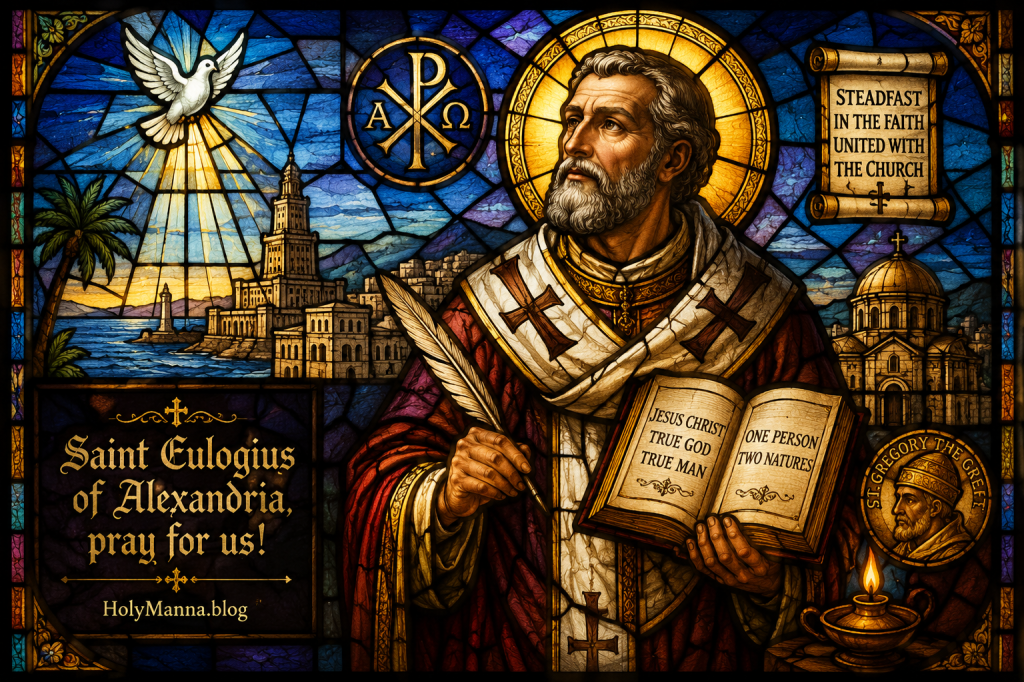
The Bishop Who Defended the Face of Christ
Saint Eulogius of Alexandria was not the kind of saint remembered for dramatic adventures, popular legends, or a long list of miracles. He was something quieter, but deeply needed. He was a monk, priest, abbot, theologian, and Patriarch of Alexandria during one of the most theologically turbulent periods in Christian history.
The Church remembers him as a bishop “celebrated for learning and sanctity,” as the traditional Roman Martyrology beautifully says. That short description says a lot. Eulogius was not only intelligent. He was holy. He was not only faithful in private devotion. He used his learning to protect the faithful from confusion about Jesus Christ.
Saint Eulogius is most known for defending the Catholic faith that Jesus Christ is true God and true man, one divine Person in two natures, divine and human. This was not some abstract theological debate for ivory tower scholars. It was a defense of the heart of Christianity. If Jesus is not truly God, He cannot save us. If Jesus is not truly man, He has not truly entered our suffering, our weakness, our obedience, and our death.
The Catechism of the Catholic Church teaches that the Church confesses Christ as “true God and true man” and that His divine and human natures are united in the one Person of the Son of God. CCC 464 and CCC 467 echo the ancient faith that Saint Eulogius spent his life defending.
A Syrian Monk Formed in the School of Truth
Saint Eulogius was born in Syria, likely in or near the Antiochene region. Not much is known about his family background, and no reliable Catholic source preserves a childhood story or dramatic conversion moment. What is known is that he embraced monastic life while still young.
That detail matters. Before Eulogius became a public defender of doctrine, he was first formed in prayer, discipline, study, and silence. He entered the life of a monk, where the soul learns that truth is not something to be used as a weapon of pride, but received as a gift from God.
Catholic tradition describes him as a man formed by Sacred Scripture, the Tradition of the Church, the councils, and the approved writings of holy teachers. He became connected to Antioch and eventually served as priest and abbot of the Deipara monastery, a monastery dedicated to the Mother of God.
That is a beautiful providence. A man who would spend his life defending the truth of the Incarnation was formed in a monastery named for Mary as Theotokos, the God-bearer. The title of Mary protects the truth about Jesus. If Mary is truly the Mother of God, then the child born of her is truly God in the flesh. That truth stands at the center of Catholic Christology, and it would become central to Eulogius’s mission.
Alexandria, Chalcedon, and the Battle for the Truth About Jesus
Eventually, Eulogius was raised to become the Chalcedonian Patriarch of Alexandria, likely in the early 580s. He served until around 607 or 608. Alexandria was one of the greatest Christian cities in history, the city associated with giants like Saint Athanasius and Saint Cyril of Alexandria. But by Eulogius’s time, it was also a city wounded by division.
The Council of Chalcedon had taught that Jesus Christ is one divine Person in two natures, divine and human. Yet many Christians in Egypt and the broader East remained divided over how to express this mystery. Older Catholic sources often describe the groups opposed by Eulogius under terms like Monophysite, Eutychian, Severian, Theodosian, Gaianite, Acephali, and Agnoetae. These movements varied, but they all touched the mystery of Christ in ways that Catholic teaching judged dangerous or incomplete.
From a Catholic perspective, Eulogius stood in continuity with the Council of Chalcedon, Pope Saint Leo the Great, and the Church’s confession that Jesus is fully divine and fully human. The Catechism teaches that in Christ, the human nature was assumed, not swallowed up. Jesus did not merely appear human. He truly became man.
This matters for every Catholic sitting in a pew today. The same Jesus who healed the sick, wept at the tomb of Lazarus, touched the leper, blessed children, sweat blood in Gethsemane, and died on the Cross is also the eternal Son of God. His humanity brings Him close. His divinity saves.
Saint Eulogius defended that truth with courage.
A Friend of Pope Saint Gregory the Great
One of the most moving parts of Saint Eulogius’s life is his friendship with Pope Saint Gregory the Great. Before Gregory became pope, he met Eulogius in Constantinople. Catholic tradition says the two became so closely united in charity and faith that they seemed to be of “one heart and one soul.”
That phrase sounds like the early Church in Acts of the Apostles, where believers were united in faith, prayer, and mission. It is a fitting image for Eulogius and Gregory. They were bishops in different parts of the Christian world, but they shared the same love for Christ and His Church.
Most of what survives from their friendship comes from Gregory’s letters to Eulogius. These letters reveal a relationship built on affection, trust, theology, and pastoral concern. Gregory praised Eulogius for defending the faith and strengthening the Church in Alexandria. Eulogius, for his part, showed deep respect for the Roman See and the Petrine office.
In one letter, Gregory refers to Eulogius’s statement about the chair of Saint Peter, saying that Peter “now sits on it” in the persons of his successors. This is one of the most striking details about Eulogius. He was the Patriarch of Alexandria, an ancient apostolic see of the East, yet he recognized the unique importance of Peter’s chair in Rome.
At the same time, Gregory responded with humility. He did not want personal flattery. He wanted the office of Peter to serve the unity and truth of the Church. That exchange gives Catholics a beautiful picture of authority purified by humility and communion strengthened by charity.
The Saint Who Heard About the Conversion of England
One surprising fact about Saint Eulogius is that he received news from Pope Gregory about the mission to the English people. Gregory told him about sending Augustine of Canterbury and his companions to preach the Gospel to the Angles.
That means Saint Eulogius of Alexandria, living in Egypt, was connected through the Church to one of the great missionary moments in early medieval Europe. This is the Catholic Church at her best: Rome, Alexandria, Antioch, and distant peoples not yet fully evangelized, all connected through prayer, mission, and communion.
Eulogius was not a missionary to England himself, but he was part of the same living Body of Christ. His friendship with Gregory reminds Catholics that no faithful work in the Church exists in isolation. The bishop defending doctrine in Alexandria and the missionary preaching in England were serving the same Lord.
The Catechism teaches that the Church is catholic because Christ is present in her and because she has been sent out by Him to the whole human race. CCC 830 and CCC 831 help us see why this matters. The Church is not a collection of disconnected religious communities. She is one Body, sent into the world with one Gospel.
A Defender Against Confusion and False Mercy
Saint Eulogius also wrote against the Novatians, a rigorist group that denied reconciliation to certain grave sinners after baptism, especially those who had fallen away during persecution. Their error was not that they took sin seriously. Catholics should take sin seriously. Their error was that they did not sufficiently trust the mercy Christ entrusted to His Church.
This part of Eulogius’s life shows something important. He was not merely strict. He was Catholic. That means he defended truth and mercy together.
Against errors about Christ, he defended sound doctrine. Against the Novatians, he defended the Church’s ministry of reconciliation. Against confusion, he offered clarity. Against despair, he upheld mercy.
The Church does not exist to water down sin, but she also does not exist to lock repentant sinners outside the door forever. Jesus gave His Church real authority to forgive sins. The Catechism teaches that Christ entrusted the ministry of reconciliation to the Church, especially through the sacrament of Penance. CCC 1441 and CCC 1442 help explain the mercy that Eulogius defended.
That is a lesson modern Catholics still need. Faithfulness is not harshness. Mercy is not compromise. Catholic truth holds both together because Jesus Himself is full of grace and truth.
The Agnoetae and the Mystery of Christ’s Knowledge
One of Eulogius’s most important theological battles was against the Agnoetae. This group was associated with the claim that Christ suffered ignorance in a way that threatened the fullness of His divine Person. Eulogius opposed this teaching, and Pope Gregory the Great approved his work against it.
This is a delicate mystery. The Catholic Church teaches that Jesus truly had a human mind and real human knowledge. He grew, learned, asked questions, and lived a real human life. At the same time, because His human nature belongs to the divine Person of the Son, His human knowledge was uniquely filled with the divine mission He came to reveal.
The Catechism teaches that Christ’s human knowledge expressed the divine life of His Person and that He showed divine insight into the secret thoughts of human hearts. CCC 472 to CCC 474 help Catholics approach this mystery with reverence.
Saint Eulogius was not trying to make Jesus less human. He was defending the truth that the man Jesus is the eternal Son of God. The baby in Bethlehem, the teacher in Galilee, the crucified Lord on Calvary, and the risen Christ are one and the same divine Person.
Stories, Legends, and the Quiet Miracle of Fidelity
There are not many popular legends about Saint Eulogius. No reliable Catholic source presents him as a wonderworker with a long list of dramatic miracles. His life is remembered more through doctrine, correspondence, and pastoral leadership than through folk tales.
There is, however, a beautiful story connected to his eyesight. Pope Gregory heard that Eulogius had been suffering from failing bodily sight. Later, Gregory rejoiced when he learned that Eulogius’s condition had improved or been cured. Gregory sent him a small cross containing a blessing from the chains of Saints Peter and Paul and encouraged him to apply it to his eyes, noting that many miracles had been associated with that blessing.
This story is not recorded as a miracle performed by Eulogius himself. It is better understood as a witness to Catholic devotion to relics, the intercession of the saints, and the affection between Gregory and Eulogius. It also gives a tender human glimpse of two holy bishops caring for one another.
The Catechism teaches that the saints in heaven “do not cease to intercede” for the Church. CCC 956 reminds Catholics that devotion to the saints is not competition with Christ. It is communion in Christ.
There is another notable story that shows Eulogius as a scholar-bishop. He once asked Gregory about records of the martyrs, believing that some had been collected in the time of Eusebius and Constantine. Gregory replied that he did not know of such a full collection in Rome beyond certain records of names, places, feast days, and martyrdom accounts.
This may sound like a small historical footnote, but it says something beautiful about Eulogius. He cared about memory. He wanted the witnesses of the martyrs preserved. He knew that the Church does not live only by arguments, but by the testimony of saints who loved Christ more than life.
Hardships Without Martyrdom
Saint Eulogius was not a martyr. He died as a confessor and bishop, not by execution for the faith. Yet his life was not easy.
He served in a divided Church. He faced theological controversy, pastoral disorder, competing factions, and the long shadow of post-Chalcedonian conflict. Gregory also wrote to him about concerns involving simony, the sinful buying or selling of sacred offices, in Alexandria. That detail shows the kind of messy ecclesial realities Eulogius had to face.
Saints do not serve imaginary churches filled with perfect people. They serve the real Church, filled with sinners being redeemed by grace. Eulogius’s holiness was shown not in escaping problems, but in remaining faithful amid them.
His hardships were intellectual, pastoral, and spiritual. He had to defend doctrine without becoming proud. He had to protect unity without betraying truth. He had to lead wounded Christians without surrendering to discouragement.
That kind of holiness is needed in every age.
A Legacy Written in Lost Books and Living Doctrine
Most of Saint Eulogius’s writings have been lost. Catholic sources say he wrote against the Novatians, against various anti-Chalcedonian groups, against the Agnoetae, and in defense of Pope Saint Leo the Great and the Council of Chalcedon. Later writers, especially Photius, preserved summaries and references to his work.
One Palm Sunday homily has sometimes been attributed to him, but scholars have questioned its authenticity because similar sermons were also attributed to other saints, including Saint Cyril of Alexandria and Saint Epiphanius. Because of that, it is best not to treat it as certainly his.
No widely verified famous quotations from Eulogius survive in the way famous sayings survive from Saint Augustine, Saint Athanasius, or Saint Gregory the Great. The closest preserved statement associated with him comes through Gregory’s letter about the chair of Peter, where Eulogius is said to have written that Peter “now sits on it” in his successors.
The most memorable words about Eulogius may actually come from Gregory, who described his life as “the health of many.” That is a remarkable tribute. It means Eulogius’s holiness was not private decoration. His life strengthened others. His fidelity helped heal the Church.
His Feast and Cultural Memory
Saint Eulogius is traditionally commemorated in the Catholic calendar tradition on September 13. In the Greek tradition, he is remembered on February 13. His cultural impact is not marked by major global festivals, famous shrines, or widespread popular customs. His memory lives more quietly in martyrologies, theological histories, patristic scholarship, iconographic tradition, and the letters of Pope Saint Gregory the Great.
That hidden legacy should not be underestimated. Some saints shape the Church through public miracles. Others shape the Church by guarding the truth so future generations can still know Christ clearly.
Saint Eulogius belongs to that second group. He is the saint of careful doctrine, faithful communion, and courageous teaching. He reminds Catholics that ideas matter because truth matters, and truth matters because Jesus Christ is Truth Himself.
A Saint for a Confused Age
Saint Eulogius speaks powerfully to the modern Catholic world. Today, many people want a Jesus who is inspirational but not divine, compassionate but not authoritative, human but not holy, loving but not demanding. Others want doctrine without tenderness, clarity without mercy, or truth without charity.
Eulogius points us back to the full Christ.
Jesus is not an idea to be adjusted to fit the mood of the age. He is the eternal Son of God made flesh. He is the Savior who took on a real human nature, suffered a real death, rose in a real body, and remains truly present to His Church.
The life of Saint Eulogius reminds Catholics that defending doctrine is not about winning arguments. It is about protecting souls. When the Church teaches rightly about Jesus, she helps people encounter the real Lord, not a lesser version of Him.
For daily life, his example is practical. Catholics can imitate Saint Eulogius by learning the faith seriously, reading the Catechism of the Catholic Church, staying close to the sacraments, refusing to spread confusion, speaking truth with charity, and remembering that unity in the Church must always be unity in Christ.
Where is Jesus asking for a deeper faith today?
Is there an area where truth has been avoided because it feels uncomfortable?
Can fidelity to Catholic teaching become an act of love rather than a source of pride?
Saint Eulogius shows that holiness can look like study, patience, correction, courage, and a heart anchored in Christ.
Engage with Us!
Share your thoughts and reflections in the comments below. Saint Eulogius may not be one of the most famous saints, but his life gives Catholics a powerful reminder that truth and holiness belong together.
- How does Saint Eulogius’s defense of Jesus as true God and true man deepen your understanding of the Catholic faith?
- Why do you think sound doctrine matters for ordinary daily life, not just for theologians and bishops?
- Where do you see confusion about Jesus today, and how can Catholics respond with both truth and charity?
- How can you become more rooted in the teachings of the Church through Scripture, the Catechism, prayer, and the sacraments?
- What is one practical way you can defend the truth this week without becoming harsh or prideful?
May the example of Saint Eulogius of Alexandria inspire Catholics to love Christ with the mind, heart, and soul. May his witness help the faithful speak truth with charity, defend the faith with humility, and live every day with the love and mercy Jesus taught us.
Saint Eulogius of Alexandria, pray for us!
Follow us on YouTube, TikTok, Instagram and Facebook for more insights and reflections on living a faith-filled life.

 Holy Manna!
Leave a comment