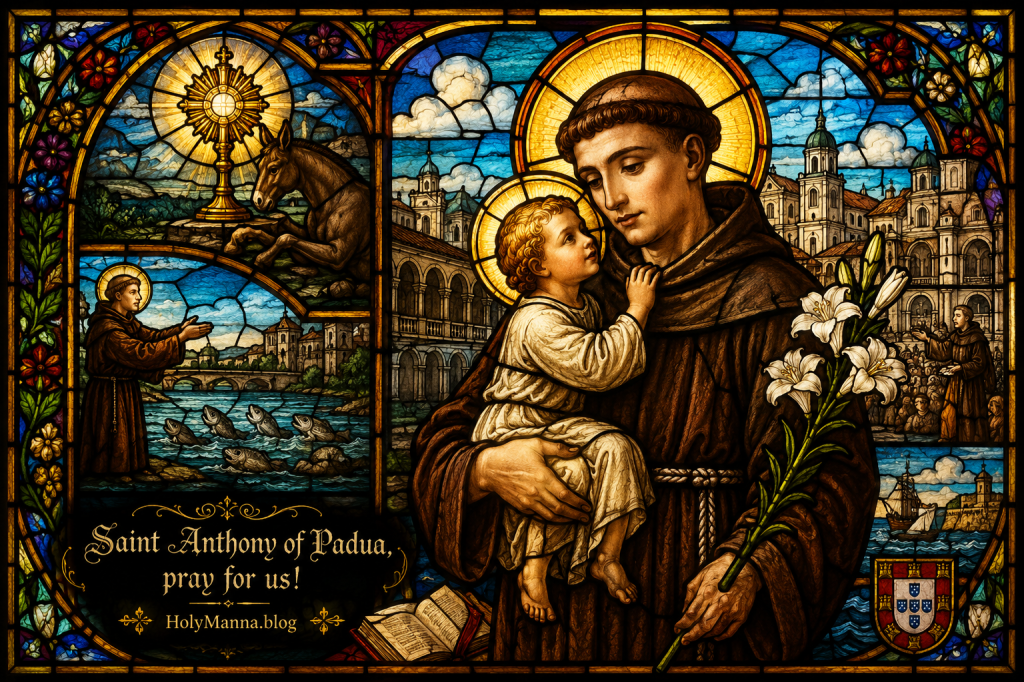
The Saint Who Helped the World Find God Again
Saint Anthony of Padua is one of the most beloved saints in the Catholic Church. Most people know him as the patron saint of lost things, and yes, Catholics have been asking his help for missing keys, wallets, wedding rings, and important papers for centuries. But Saint Anthony’s real gift was much deeper. He helped people find what they had truly lost: faith, repentance, mercy, truth, and the way back to Jesus Christ.
Born in Lisbon, Portugal, and later forever linked with Padua, Italy, Saint Anthony was a Franciscan friar, priest, theologian, preacher, miracle-worker, defender of the Eucharist, friend of the poor, and Doctor of the Church. Pope Pius XII gave him the title Doctor Evangelicus, meaning the “Evangelical Doctor,” because his preaching and writings were so deeply rooted in the Gospel.
He is the patron saint of lost and stolen items, the poor, travelers, sailors, fishermen, priests, and those seeking marriage. In some places, he is also invoked by expectant mothers, children, and those longing for protection against evil. But above all, Saint Anthony is remembered as a man whose words burned with Scripture and whose life proved that Catholic truth becomes most powerful when it is lived with charity.
One of his most famous teachings says it beautifully: “Charity is the soul of faith, it gives it life; without love, faith dies.”
That one line tells the whole story of Saint Anthony. He was brilliant, but not cold. He was bold, but not cruel. He preached truth, but always for the salvation of souls.
The Young Nobleman Who Chose the Cross
Saint Anthony was born around 1195 in Lisbon, Portugal, and was baptized Fernando. He came from a noble Christian family, though some details about his family background are uncertain. What is clear is that from a young age, Fernando had a serious love for God.
At about fifteen, he entered the Canons Regular of Saint Augustine. He first lived at the monastery of Saint Vincent in Lisbon, but because family and friends were close enough to distract him, he later moved to the monastery of Santa Cruz in Coimbra. That move shaped his future. In Coimbra, he studied Sacred Scripture, theology, philosophy, and the Church Fathers. He became a man of deep prayer and serious learning.
This part of his life matters because Saint Anthony was not simply a passionate public speaker. He was formed by silence, study, discipline, and prayer. He knew the Bible deeply. He loved the Church. His mind was filled with Scripture long before his mouth became famous for preaching it.
Then, in 1220, everything changed.
The relics of five Franciscan missionaries who had been martyred in Morocco were brought to Coimbra. Their witness moved Fernando deeply. The Catechism of the Catholic Church teaches that martyrdom is “the supreme witness given to the truth of the faith” in CCC 2473. Fernando saw that witness before him, and it awakened a holy desire in his heart.
He asked to leave the Augustinian canons and join the newly formed Franciscan Order. He took the name Anthony, after Saint Anthony of Egypt, the great Desert Father. His plan was simple and heroic. He wanted to go to Morocco, preach Christ, and, if God willed it, die as a martyr.
But God redirected him.
Anthony became seriously ill in Morocco and had to return home. On the way back, his ship was blown off course and landed in Sicily. From there, he eventually reached Assisi, where he attended the famous Franciscan gathering known as the Chapter of the Mats and met Saint Francis of Assisi.
What looked like failure became Providence. Anthony wanted martyrdom in Morocco, but God had prepared another mission for him. He would not shed his blood for Christ. He would spend his life pouring himself out through preaching, confession, poverty, and love for the poor.
How often does God redirect a holy desire, not because it was wrong, but because He has something even more fruitful in mind?
The Hidden Friar Who Was Suddenly Revealed
After arriving among the Franciscans, Anthony did not immediately become famous. He lived quietly in a hermitage at Montepaolo near Forlì. He prayed, served, celebrated Mass, and embraced humble Franciscan life. Many of the friars had no idea how learned he was.
Then came the moment that changed everything.
At an ordination ceremony in Forlì around 1222, no preacher had been prepared. Anthony was asked to speak. At first, he was humble and hesitant. Then Scripture began to pour out of him with power, clarity, and depth. The friars were stunned. This quiet brother, who had been living almost unnoticed, was one of the greatest biblical preachers of his age.
When Saint Francis heard about Anthony’s gifts, he approved him to teach theology to the friars. Saint Francis reportedly wrote to him, “It is my pleasure that thou teach theology to the brethren,” as long as study did not extinguish “the spirit of prayer and devotion.”
That sentence captures Saint Anthony perfectly. He shows the Catholic balance between the head and the heart. Study is good. Theology is good. Preaching is good. But if prayer dies, everything becomes hollow.
Anthony later wrote major sermon collections, including The Sunday Sermons and The Sermons on the Saints. His writings were filled with Scripture, moral teaching, spiritual insight, and the Catholic tradition of reading the Bible through its literal, Christological, moral, and heavenly meanings. He did not treat Scripture like a puzzle to solve. He treated it like the living Word of God meant to convert the soul.
The Hammer of Heretics and the Friend of Sinners
Saint Anthony became one of the most powerful preachers in Europe. He preached throughout northern Italy and southern France, especially in places troubled by heresy, moral confusion, greed, and corruption.
He became known as the “Hammer of Heretics.” That title can sound harsh today, but it does not mean Anthony hated people who were confused or in error. It means he struck falsehood with truth. He defended Catholic teaching with Scripture, reason, holiness, and charity. His goal was not to win arguments. His goal was to win souls.
Anthony preached especially against greed, luxury, injustice, and spiritual pride. He called sinners to confession. He challenged the powerful. He defended the poor. During his final Lenten preaching in Padua in 1231, so many people came to confession that priests struggled to keep up. Families reconciled. Stolen goods were returned. Enemies made peace. People changed their lives.
This is what real Catholic preaching does. It does not merely inspire people for a moment. It brings them to repentance, confession, reconciliation, and mercy.
Anthony’s love for the poor also had public consequences. Through his influence, the city of Padua passed a law helping debtors who could not pay their debts. That detail is powerful. Saint Anthony did not only preach compassion as an idea. He helped make mercy concrete.
The Catechism of the Catholic Church teaches, “The Eucharist commits us to the poor” in CCC 1397. Saint Anthony lived that truth. He defended the Real Presence of Christ in the Eucharist, and then he recognized Christ in the suffering, the indebted, the hungry, and the forgotten.
The Miracles That Pointed Back to Christ
Saint Anthony is surrounded by miracle stories. Some are strongly rooted in Catholic tradition, while others belong more clearly to devotional legend. A faithful Catholic approach can honor these stories while being honest about what cannot be verified with modern historical certainty.
One of his most famous miracles is the miracle of the mule. According to tradition, a man denied the Real Presence of Christ in the Eucharist and challenged Anthony. The man said he would believe if his hungry mule ignored food and knelt before the Blessed Sacrament. After three days of fasting, the mule was brought out. Food was placed nearby, but the animal turned away from it and knelt before the Eucharist held by Saint Anthony. This miracle became one of the great stories associated with Anthony’s defense of the Eucharist. It beautifully reflects the Catholic faith that the Eucharist is truly Jesus Christ, Body, Blood, Soul, and Divinity.
Another beloved story is the sermon to the fishes. In Rimini, when people refused to listen to Anthony preach, he turned toward the water and began preaching to the fish. According to tradition, the fish gathered in rows as if listening to the Word of God. The people, ashamed that even creatures seemed more attentive than they were, returned to hear him preach. This story cannot be verified with modern historical certainty, but its message is unforgettable. When human hearts become hard, creation itself still gives glory to God.
The lost psalter story explains why Saint Anthony became the patron saint of lost things. Anthony had a precious book of psalms that also contained notes for his teaching. Books were extremely valuable before the printing press. A novice who was leaving religious life took the psalter with him. Anthony prayed, and the novice returned both the book and himself to the community. Later legends added dramatic details, but the heart of the story is part of the devotional tradition around Anthony.
Another striking story is the miracle of the miser’s heart. At the funeral of a wealthy man known for greed, Anthony recalled the words of Christ in Matthew 6:21: “For where your treasure is, there also will your heart be.” According to the story, Anthony said the man’s heart would not be found in his body, but among his treasures. When people searched, they found his heart among his coins. This story cannot be verified with modern historical certainty, but it powerfully teaches a Catholic truth. Greed does not simply fill a bank account. It can possess the soul.
There is also the story of the reattached foot. A young man named Leonardo confessed that he had kicked his mother. Anthony used strong language to show him the seriousness of his sin, and the young man took it literally, cutting off his own foot. Anthony prayed over him and miraculously reattached it. This story comes through Catholic tradition, though it cannot be verified with modern historical certainty. Its lesson is not violence against oneself, which the Church would never encourage. Its lesson is the seriousness of sin, the mercy of repentance, and the power of God to heal what human brokenness has damaged.
Another dramatic story says that Anthony’s father in Lisbon was falsely accused of murder. By divine intervention, Anthony appeared there, questioned the dead man, and the corpse identified the true murderer, clearing Anthony’s father. This story belongs to devotional tradition and cannot be verified with modern historical certainty.
There is also a tradition that heretics once offered Anthony poisoned food. Anthony made the Sign of the Cross over it and ate without harm. This story cannot be verified with modern historical certainty, but it reflects the Catholic conviction that God can protect His servants when they act in faith and obedience.
Other stories tell of Anthony preserving listeners from rain, bilocating while preaching, and appearing in choir to fulfill his duty to pray the Divine Office. These belong to the wider miracle tradition around the saint and cannot all be verified with modern historical certainty, but they reveal how Catholics remembered Anthony as a man completely available to God.
Perhaps the most tender story from his lifetime is the vision of the Child Jesus. Near the end of Anthony’s life, he stayed near Camposampiero with Count Tiso, a man converted by his preaching. Anthony withdrew to pray, and according to tradition, Count Tiso saw a bright light coming from Anthony’s room. Looking inside, he saw Anthony holding the Child Jesus. Anthony asked him not to reveal the vision until after his death. This story is why Saint Anthony is so often shown holding the Infant Christ.
That image tells the whole story. Anthony preached with power because he held Jesus close.
The Hardships of a Saint Who Spent Himself Completely
Saint Anthony was not a martyr, but his life was filled with hardship. He gave up noble status, left his homeland, embraced poverty, endured sickness, faced rejection, preached in dangerous places, confronted error, challenged greed, and exhausted himself in service to souls.
His dream of martyrdom in Morocco ended in illness. His missionary journey seemed like a failure. His ship was blown off course. His learning remained hidden for a time. Later, his preaching placed him in conflict with heretics, corrupt leaders, and the powerful rich.
One especially important story involves Ezzelino da Romano, a violent ruler in northern Italy. Anthony reportedly went to Verona to plead for prisoners held by Ezzelino. Later versions say Ezzelino humbled himself before Anthony, but that detail is considered apocryphal. What matters is that Anthony risked himself on behalf of the oppressed. Even when the story is stripped of embellishment, his courage remains.
By the end of his life, Anthony’s body was worn down. His preaching, fasting, travel, sickness, and long hours hearing confessions had taken their toll. In 1231, after his intense Lenten preaching in Padua, he withdrew to rest near Camposampiero. When he realized death was near, he wanted to return to Padua, but he died at Arcella, just outside the city, on June 13, 1231.
His traditional last words were, “I see my Lord.”
He was only about thirty-six years old according to the traditional account, though some later research suggests he may have been slightly older. Either way, his life was short. His legacy was enormous.
The Saint Whose Tongue Still Preaches
After Saint Anthony died, devotion to him spread almost immediately. The friars reportedly tried to keep his death quiet at first because they feared disputes over his body, but tradition says children ran through Padua crying that the saint had died.
One of the first miracles at his tomb involved a woman named Cunizza, who had suffered from a serious swelling and needed crutches. She prayed at Anthony’s tomb and was healed. Stories of healing and intercession spread quickly.
Less than one year after his death, Pope Gregory IX canonized Anthony on May 30, 1232. That was an astonishingly fast canonization. Pope Gregory had heard Anthony preach and reportedly called him the “Ark of the Covenant” because his soul was so filled with Scripture.
In 1263, when Anthony’s remains were transferred to the great Basilica in Padua, Saint Bonaventure was present. Anthony’s body had mostly returned to dust, but his tongue was found incorrupt. Saint Bonaventure reportedly exclaimed, “O blessed tongue, you have always praised the Lord.”
That relic is still venerated today. For Catholics, the incorrupt tongue is not a superstition. It is a sign. Anthony’s tongue had preached Christ, defended the Eucharist, called sinners home, comforted the poor, and praised God. Even after death, his tongue seemed to say what his life had already proclaimed: the human voice is holy when it belongs to Jesus.
Padua still celebrates a special feast connected with the discovery of his incorrupt tongue, often called the Feast of the Tongue. His tomb in the Basilica of Saint Anthony in Padua remains one of the great pilgrimage sites of the Catholic world.
Bread, Lilies, Lost Things, and a Worldwide Devotion
Saint Anthony’s impact after death reached far beyond Padua. His feast day on June 13 is celebrated across the Catholic world.
In Padua, he is simply called “the Saint.” In Lisbon, he is honored as Saint Anthony of Lisbon, the city of his birth. In Brazil, devotion to Santo Antônio is deeply tied to the Festas Juninas, the joyful June celebrations that also honor Saint John the Baptist and Saint Peter. In some Catholic cultures, he is also known as a matchmaker saint, especially for those praying for marriage.
One of the most beloved devotions is Saint Anthony’s Bread. This custom is connected with miracle stories involving children restored to life and promises to give bread or grain to the poor. One story tells of a mother whose child drowned near the Basilica. She prayed through Anthony’s intercession and promised to give the child’s weight in grain to the poor if the child were restored. The child revived, and the devotion grew. This story belongs to devotional tradition and cannot be verified with modern historical certainty, but the practice itself beautifully reflects Anthony’s love for the poor.
Another devotion is the blessing of Saint Anthony’s lilies. The lily symbolizes purity, chastity, peace, and trust in God. It also reflects the way Anthony is often depicted in sacred art, holding both the Child Jesus and a lily.
The Thirteen Tuesdays devotion is also connected with Saint Anthony. Tuesday became associated with him because he was buried on a Tuesday, and many miracles were reported around that time. Catholics have long prayed thirteen Tuesdays in his honor, asking his intercession for needs of body and soul.
There is also the Brief of Saint Anthony, a prayer traditionally associated with protection against evil. Its words are: “Behold the Cross of the Lord! Be gone, you enemy powers! The lion of the tribe of Juda, the root of David has conquered! Alleluia!”
In some Catholic traditions, people have written “S.A.G.” on letters or envelopes, meaning “Saint Anthony Guide” or “Saint Anthony Guard,” asking his intercession for safe delivery. There is also a Chaplet of Saint Anthony, often prayed with thirteen sets of prayers in honor of the saint.
And of course, countless Catholics still pray the familiar rhyme, “Tony, Tony, turn around. Something’s lost and must be found.” That rhyme is not a quote from Saint Anthony himself, but it expresses the affectionate trust Catholics have placed in his intercession for generations.
The deeper meaning is this: Saint Anthony helps find lost things because his whole life was about finding lost souls.
A Saint for Anyone Who Feels Lost
Saint Anthony’s life is deeply comforting because he knew what it meant to be redirected. He wanted to be a martyr in Morocco, but sickness stopped him. He wanted hiddenness, but obedience made him preach. He wanted solitude, but charity sent him into crowded churches, public squares, confession lines, and the lives of the poor.
Nothing was wasted.
God used his study. God used his illness. God used his failed plans. God used his hidden years. God used his voice. God used his love for Scripture. God used even his death to continue drawing people to Christ.
That is why Saint Anthony is more than the saint of misplaced objects. He is a saint for anyone who has lost direction, lost peace, lost faith, lost courage, or lost hope.
The Catechism of the Catholic Church teaches that the saints “do not cease to intercede with the Father for us” in CCC 956. Saint Anthony’s intercession is part of that beautiful Catholic reality called the Communion of Saints. The Church is not divided by death. In Christ, the saints are alive, and they pray for us.
Saint Anthony’s life also reminds us that truth and charity belong together. He defended Catholic doctrine, but he also loved sinners. He preached against greed, but he served the poor. He knew Scripture, but he did not use knowledge to show off. He used it to bring people to Jesus.
His famous saying still challenges every Catholic today: “Actions speak louder than words. Let your words teach and your actions speak.”
That is a hard message in a loud world. It is easy to post faith. It is harder to live it. It is easy to speak about mercy. It is harder to forgive. It is easy to love Catholic truth. It is harder to let that truth purify habits, money, speech, relationships, and priorities.
Saint Anthony shows that holiness is not about being impressive. It is about being available to God.
Reflection
Saint Anthony of Padua teaches us that God can redirect a life without ruining it. Sometimes what feels like a failure is actually the road to a deeper mission. Anthony never became the martyr he hoped to become, but he became one of the greatest preachers the Church has ever known.
He also teaches us that Catholic faith must be lived with both truth and love. Faith without charity becomes hard and lifeless. Charity without truth becomes shallow. Anthony held them together. He preached the Gospel clearly, defended the Eucharist boldly, served the poor concretely, and called sinners back with urgency.
His life invites us to ask what has been lost in our own hearts. Maybe it is prayer. Maybe it is peace. Maybe it is trust in God. Maybe it is the habit of going to confession. Maybe it is courage to speak the truth. Maybe it is love for the poor. Maybe it is the simple willingness to let God interrupt our plans.
What is God asking you to find again?
Where has faith become words without action?
What part of your life needs to be brought back under the loving lordship of Jesus Christ?
A practical way to live Saint Anthony’s example is to begin with three simple choices. Return to Scripture. Make a good confession. Serve someone poor, lonely, indebted, forgotten, or spiritually lost. That is Anthony’s path. Word, mercy, and charity.
Saint Anthony did not simply help people find things. He helped them find Christ.
Engage With Us!
Share your thoughts and reflections in the comments below. Saint Anthony’s life speaks to anyone who has ever felt lost, redirected, humbled, or called to begin again with God.
- What part of Saint Anthony’s story speaks most deeply to your own faith journey?
- Have you ever experienced God redirecting your plans in a way that later made sense?
- What is something in your life that feels spiritually “lost” and needs to be brought back to Christ?
- How can Saint Anthony’s example help you let your actions speak louder than your words this week?
- Who in your life might need your prayers, encouragement, or practical help because they feel lost right now?
May Saint Anthony of Padua pray for us, especially when we lose our way. May his example help us seek Christ in Scripture, adore Him in the Eucharist, serve Him in the poor, and speak the truth with courage and charity. Let us live a life of faith and do everything with the love and mercy Jesus taught us.
Saint Anthony of Padua, pray for us!
Follow us on YouTube, TikTok, Instagram and Facebook for more insights and reflections on living a faith-filled life.


Leave a Reply