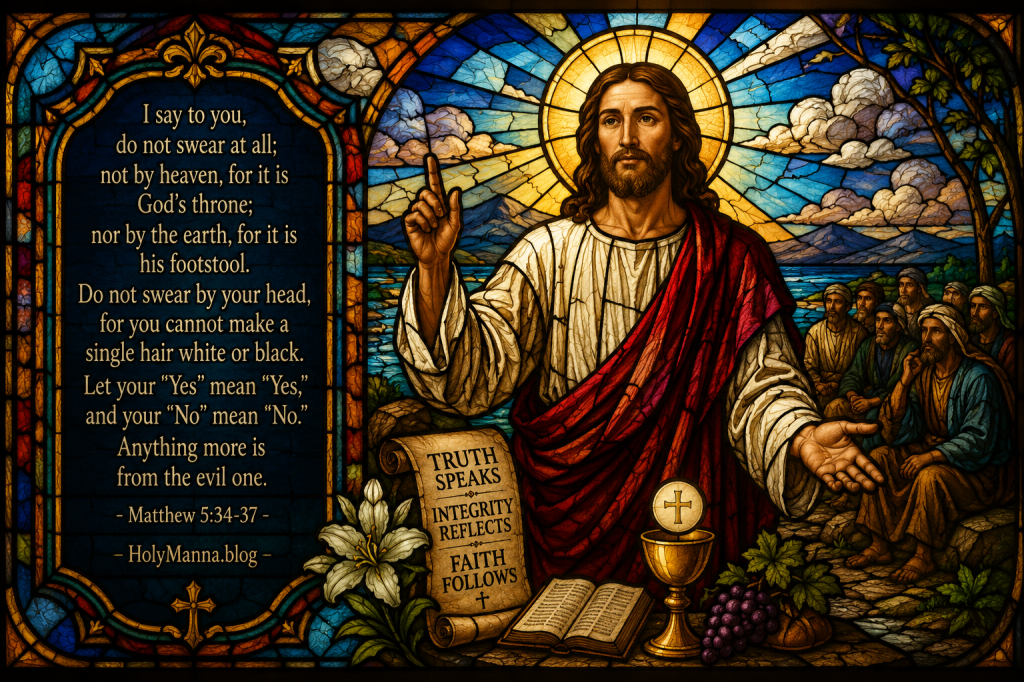
Saturday of the Tenth Week in Ordinary Time – Lectionary: 364
When Your Yes Becomes Your Life
God is not looking for impressive promises that never become obedience. He is looking for a heart that can say yes and mean it.
Today’s readings for Saturday of the Tenth Week in Ordinary Time draw us into the beauty and seriousness of an undivided life. In 1 Kings 19:19-21, Elisha is called while plowing in the field, and Elijah’s cloak becomes the sign that God is asking for everything. In Psalm 16:1-2, 5, 7-10, the soul learns to pray, “Lord, my allotted portion and my cup,” because only the person who trusts God as his inheritance can surrender the things that once gave him security. Then, in Matthew 5:33-37, Jesus brings that same wholeheartedness into our speech, teaching His disciples, “Let your ‘Yes’ mean ‘Yes,’ and your ‘No’ mean ‘No.’”
The central theme is integrity before God. Elisha’s actions, the psalmist’s trust, and Christ’s command all point to the same truth: the life of faith cannot be split between holy words and hesitant obedience. In the ancient world, a prophet’s cloak symbolized mission and authority, and Elisha’s decision to slaughter the oxen and burn the plowing equipment showed that his old life was truly being surrendered. In the Sermon on the Mount, Jesus speaks to a culture where oaths could be used to sound religious while leaving room for dishonesty. He calls His followers beyond clever wording and into truthful living.
The Catechism of the Catholic Church teaches that truthfulness is the virtue by which a person shows himself true in deeds and truthful in words, avoiding duplicity, hypocrisy, and dissimulation, as taught in CCC 2468. That is the heart of today’s readings. God wants disciples whose words can be trusted because their lives are being converted. He wants sons and daughters who can leave the plow behind, take refuge in Him, and speak with the simplicity of people who belong completely to the Lord.
Where is God asking for a yes that becomes visible in daily life?
First Reading – 1 Kings 19:19-21
The Call That Burns the Backup Plan
The first reading takes place during one of the most important transitions in the prophetic history of Israel. Elijah, the great prophet who confronted King Ahab, Queen Jezebel, and the prophets of Baal, has just encountered the Lord at Mount Horeb, not in the wind, earthquake, or fire, but in the quiet whisper of God’s presence. After that encounter, the Lord sends Elijah back with a mission, including the call of Elisha as his successor.
This scene from 1 Kings 19:19-21 is short, but it is packed with meaning. Elisha is not found in a temple, a palace, or a school of prophets. He is found in the field, working behind a team of oxen. God calls him in the middle of ordinary life. That is often how vocation works. The Lord interrupts the familiar, not because the familiar is evil, but because He is inviting the soul into something greater.
The central theme of today’s readings is integrity before God. Elisha’s response shows what it looks like when a person’s yes becomes visible. He does not simply say he will follow Elijah. He takes the tools of his former life, burns them, feeds the people, and leaves. His yes is not just emotional. It is concrete, public, and sacrificial.
1 Kings 19:19-21 – New American Bible (Revised Edition)
19 Elijah set out, and came upon Elisha, son of Shaphat, as he was plowing with twelve yoke of oxen; he was following the twelfth. Elijah went over to him and threw his cloak on him. 20 Elisha left the oxen, ran after Elijah, and said, “Please, let me kiss my father and mother good-bye, and I will follow you.” Elijah answered, “Go back! What have I done to you?” 21 Elisha left him and, taking the yoke of oxen, slaughtered them; he used the plowing equipment for fuel to boil their flesh, and gave it to the people to eat. Then he left and followed Elijah to serve him.
Detailed Exegesis
Verse 19 – “Elijah set out, and came upon Elisha, son of Shaphat, as he was plowing with twelve yoke of oxen; he was following the twelfth. Elijah went over to him and threw his cloak on him.”
Elijah finds Elisha plowing with twelve yoke of oxen, which suggests that Elisha came from a household of some means. Twelve teams of oxen would not have been a small farming operation. Elisha is not portrayed as desperate, idle, or disconnected from responsibility. He is working, rooted, and surrounded by the rhythms of family, land, and labor.
That makes the call even more striking. God does not call Elisha because he has nothing else going on. God calls him while he has a life that already seems full.
Elijah’s action is symbolic. He throws his cloak over Elisha. In the ancient world, a cloak could represent identity, authority, and mission. For a prophet, the mantle carried special significance. Elijah’s cloak becomes the visible sign that Elisha is being drawn into the prophetic mission. No long speech is recorded. No elaborate explanation is given. The gesture itself speaks.
This matters because God’s call is not always loud. Sometimes the Lord places a mantle on a person’s life through an invitation, a conviction, a need in the Church, a suffering that awakens compassion, or a quiet desire to serve. The question is whether the person recognizes the moment of grace.
Verse 20 – “Elisha left the oxen, ran after Elijah, and said, ‘Please, let me kiss my father and mother good-bye, and I will follow you.’ Elijah answered, ‘Go back! What have I done to you?’”
Elisha immediately leaves the oxen and runs after Elijah. His movement is important. He does not casually stroll after the prophet. He runs. Something in him has understood that the call is serious.
His request to kiss his father and mother goodbye is not presented as rebellion or delay. In Israelite culture, honoring one’s parents was a sacred duty rooted in the commandment, “Honor your father and your mother.” Elisha wants to respond to God, but he also wants to honor the family from which he comes.
Elijah’s answer, “Go back! What have I done to you?” may sound strange, but it highlights the freedom of the call. Elijah is not forcing Elisha. He is not manipulating him with religious pressure. The cloak has been thrown, but Elisha must freely respond. God’s call is powerful, but it does not crush human freedom.
This fits beautifully with Catholic teaching. The Catechism of the Catholic Church teaches in CCC 160, “To be human, ‘man’s response to God by faith must be free, and… therefore nobody is to be forced to embrace the faith against his will.’” Elisha’s vocation is not imposed like a chain. It is offered like a summons. He must choose whether to receive it.
This verse also shows the delicate relationship between family and vocation. Family is holy. Family love matters. Yet when God calls, even the most sacred earthly bonds must find their proper place under the Lord. The Catechism of the Catholic Church teaches in CCC 2232, “Family ties are important but not absolute. Just as the child grows to maturity and human and spiritual autonomy, so his unique vocation which comes from God asserts itself more clearly and forcefully. Parents should respect this call and encourage their children to follow it. They must be convinced that the first vocation of the Christian is to follow Jesus: ‘He who loves father or mother more than me is not worthy of me; and he who loves son or daughter more than me is not worthy of me.’”
Elisha’s farewell is not a rejection of his parents. It is the beginning of a life where God’s call becomes first.
Verse 21 – “Elisha left him and, taking the yoke of oxen, slaughtered them; he used the plowing equipment for fuel to boil their flesh, and gave it to the people to eat. Then he left and followed Elijah to serve him.”
This is the decisive moment. Elisha does not simply say goodbye. He slaughters the oxen and burns the plowing equipment. In other words, he gives up the very tools that made his former life possible.
This does not mean his old work was bad. Farming was honorable. Family life was good. Labor was meaningful. The point is not that Elisha is escaping something evil. The point is that God is calling him into something new, and Elisha refuses to keep a hidden escape route.
His act also becomes communal. He gives the meat to the people to eat. His farewell is not private drama. It becomes a meal of generosity. What once secured his livelihood now becomes a gift for others. That is one of the marks of true surrender. When a person gives something to God, it often becomes nourishment for someone else.
Then the reading ends simply: “Then he left and followed Elijah to serve him.” Elisha’s vocation begins with service. Before he becomes the prophet who will receive a double portion of Elijah’s spirit, he becomes the servant of Elijah. This is deeply Catholic. Mission is not self-promotion. Vocation is not a platform. God often forms His servants first through humility, apprenticeship, obedience, and hidden faithfulness.
Teachings
The call of Elisha teaches that vocation is both grace and response. God initiates. Man responds. Elijah throws the cloak, but Elisha must decide whether to leave the oxen. This is the mystery of Catholic discipleship. Grace comes first, but grace does not make human cooperation meaningless. It makes it possible.
The Church has always taught that every Christian has a vocation. Some are called to priesthood, some to consecrated life, some to marriage, some to generous single life, and all are called to holiness. Elisha’s call reminds us that vocation is not merely about personal fulfillment. It is about being claimed by God for service.
This reading also anticipates the radical demands of Christ. In The Gospel of Luke, Jesus says in Luke 9:62, “No one who sets a hand to the plow and looks to what was left behind is fit for the kingdom of God.” Elisha had his hand to the plow, and when God called, he did not look back in hesitation. He burned the plow and went forward.
There is also a deep connection to poverty of spirit. Elisha gives up the security of land, oxen, and family occupation because God has become the greater security. This does not mean every disciple must literally abandon his work or possessions in the same way, but every disciple must be interiorly free enough to obey God. Nothing created can be allowed to become the master of the heart.
The Catechism of the Catholic Church teaches in CCC 2544, “Jesus enjoins his disciples to prefer him to everything and everyone, and bids them ‘renounce all that [they have]’ for his sake and that of the Gospel. Shortly before his passion he gave them the example of the poor widow of Jerusalem who, out of her poverty, gave all that she had to live on. The precept of detachment from riches is obligatory for entrance into the Kingdom of heaven.”
Elisha’s burned plow is a living picture of that detachment. He does not follow God only after securing every worldly guarantee. He follows because God has called.
Saint Augustine’s famous prayer from Confessions speaks to the restless heart that can only be satisfied by God: “You have made us for yourself, O Lord, and our heart is restless until it rests in you.” Elisha’s heart could not finally rest behind the oxen once the prophetic mantle had touched his shoulders. When God reveals the path, the old life may still be familiar, but it can no longer be enough.
This reading is also a reminder that God often forms saints through ordinary work before He sends them into extraordinary mission. Elisha learns discipline in the field before he learns prophecy beside Elijah. The same pattern appears throughout salvation history. Moses is tending sheep when God calls him. David is watching the flock when Samuel anoints him. Peter and Andrew are casting nets when Jesus calls them. Matthew is at the tax booth when Christ says, “Follow me.”
God’s call does not despise ordinary life. He enters it.
Reflection
Elisha’s call forces every reader to ask whether faith has become a real yes or only a religious intention. Many people want to follow God in theory. They want peace, purpose, and blessing. They want the beauty of Catholic faith, the comfort of the sacraments, and the hope of heaven. But when God touches the actual plow, the habits, securities, routines, attachments, and backup plans, discipleship becomes much more concrete.
The question is not only whether someone believes in God. The question is whether God is allowed to interrupt the life that has already been built.
For some, the plow may be a sinful habit that needs to be burned through confession, accountability, and real boundaries. For others, it may be an old identity, a grudge, a relationship that keeps pulling the soul away from grace, or a fear of disappointing family expectations. For others, it may be comfort, control, career ambition, or the need to be admired.
Elisha teaches that surrender is not always dramatic, but it must become real. A person can burn the plow by deleting the app that leads to sin, making the phone call that restores peace, going back to confession, ending the dishonest pattern, returning to Sunday Mass, forgiving the person who caused pain, or finally saying yes to the ministry, vocation, or act of service God has been placing on the heart.
The beauty of this reading is that Elisha does not walk away empty. He walks away with a mission. Whatever he leaves behind becomes small compared to the God who calls him forward.
What plow is God asking you to surrender so your yes can become visible?
Where has God already placed a mantle over your life through a responsibility, invitation, desire, or holy restlessness?
Are there good things from a former season that God may now be asking you to release for the sake of a greater mission?
Does your faith include a real willingness to serve, or only a desire to feel inspired?
A practical way to live this reading is to name one concrete act of obedience today. Do not keep it vague. Choose one thing that makes the yes real. Go to confession. Apologize. Pray without rushing. Remove a temptation. Serve someone quietly. Say no to the compromise. Say yes to the duty. Ask God where He is calling next, and then listen with a heart ready to move.
Elisha’s story reminds us that God does not only call people away from something. He calls them toward Himself. The burned plow is not the end of Elisha’s life. It is the beginning of his mission.
Responsorial Psalm – Psalm 16:1-2, 5, 7-10
When God Becomes the Inheritance of the Heart
After Elisha burns the plow and follows Elijah, the responsorial psalm gives us the prayer that makes that kind of surrender possible. Psalm 16 is a psalm of trust, traditionally attributed to David, and it carries the heart of someone who has learned that God is not merely one blessing among many. God is the blessing.
In ancient Israel, inheritance meant land, family security, identity, future, and belonging. The tribes of Israel received portions of land, but the deepest biblical truth is that the Lord Himself is the true portion of His faithful ones. This is why the psalm fits today’s theme so beautifully. Elisha can leave behind his oxen because his life is being claimed by God. The disciple can speak with an honest yes and an honest no because his security is not in image, control, or worldly guarantees. His security is in the Lord.
This psalm teaches the interior side of integrity. A person can only give God an undivided yes when the heart believes that God is enough.
Psalm 16:1-2, 5, 7-10 – New American Bible (Revised Edition)
God the Supreme Good
1 A miktam of David.
Keep me safe, O God;
in you I take refuge.
2 I say to the Lord,
you are my Lord,
you are my only good.5 Lord, my allotted portion and my cup,
you have made my destiny secure.7 I bless the Lord who counsels me;
even at night my heart exhorts me.
8 I keep the Lord always before me;
with him at my right hand, I shall never be shaken.
9 Therefore my heart is glad, my soul rejoices;
my body also dwells secure,
10 For you will not abandon my soul to Sheol,
nor let your devout one see the pit.
Detailed Exegesis
Verse 1 – “Keep me safe, O God; in you I take refuge.”
The psalm begins with a simple cry of trust. The speaker does not first ask for wealth, revenge, comfort, or applause. He asks to be kept safe by God. Refuge in Scripture is not just a comforting image. It is a confession of dependence. The faithful soul knows that human strength cannot carry the full weight of life.
This verse prepares the heart for discipleship. A person who takes refuge in God can obey when obedience feels risky. Elisha’s surrender in the first reading is not the act of someone who trusts his own strength. It is the act of someone who has discovered that God is the only safe place.
Verse 2 – “I say to the Lord, you are my Lord, you are my only good.”
This is the heart of the psalm. The soul speaks directly to God and confesses, “you are my only good.” This does not mean created things are evil. Family, work, friendship, land, food, and ordinary joys are gifts from God. But none of them can become the final good of the human heart.
Catholic teaching helps clarify this. The heart was made for God, and every created good must be received in relation to Him. Saint Augustine famously wrote in Confessions, “You have made us for yourself, O Lord, and our heart is restless until it rests in you.” The psalmist already knows this restlessness. He knows that nothing beneath God can finally satisfy a soul made for God.
Verse 5 – “Lord, my allotted portion and my cup, you have made my destiny secure.”
This verse uses the language of inheritance and covenant. An allotted portion was what a person received as his share. A cup often symbolizes one’s assigned destiny, whether joy, suffering, blessing, or mission. To call the Lord “my allotted portion and my cup” is to say that God Himself is the believer’s inheritance and future.
This is the secret of holy detachment. Elisha can leave the field because God has become greater than the field. A Christian can surrender sin, pride, resentment, and fear because God is not asking him to step into emptiness. God is calling him into Himself.
The verse also speaks against the anxiety of a divided heart. If God makes the destiny secure, then the disciple does not need to cling desperately to every backup plan. Faith does not remove every trial, but it gives the soul a foundation deeper than circumstance.
Verse 7 – “I bless the Lord who counsels me; even at night my heart exhorts me.”
The psalmist blesses the Lord as counselor. This means God does not simply command from a distance. He guides, corrects, teaches, and forms the heart. Even at night, when distractions fade and fears often rise, the heart continues to be instructed.
In biblical spirituality, the night can be a place of testing, prayer, and hidden encounter. The person who belongs to God is not abandoned to confusion. The Lord speaks through conscience, Scripture, prayer, the teaching of the Church, wise spiritual counsel, and the quiet promptings of grace.
This verse is deeply connected to today’s theme of integrity. A truthful life begins with a teachable heart. The person who refuses God’s counsel will eventually learn to justify almost anything. The person who blesses the Lord as counselor becomes capable of a yes that is purified by truth.
Verse 8 – “I keep the Lord always before me; with him at my right hand, I shall never be shaken.”
To keep the Lord always before oneself is to live with holy awareness. It means that God is not pushed into one corner of life. He is not remembered only at Mass, during crisis, or when convenient. He stands before the heart as the constant reference point for decisions, words, desires, and priorities.
The right hand is a place of strength, defense, and support. The psalmist is not claiming that life will never hurt. He is saying that the person who stands with the Lord will not be ultimately overthrown.
This verse also prepares us for the Gospel command, “Let your ‘Yes’ mean ‘Yes,’ and your ‘No’ mean ‘No.’” A person who keeps the Lord always before him does not need to manipulate reality with dishonest speech. He can tell the truth because he lives before God.
Verse 9 – “Therefore my heart is glad, my soul rejoices; my body also dwells secure.”
The psalm now moves from trust to joy. The heart is glad, the soul rejoices, and even the body dwells secure. This is a beautiful picture of the whole person being held by God.
Catholic faith is not a rejection of the body. The body matters. Human life matters. The Resurrection matters. The psalmist’s confidence includes the body because salvation is not merely an idea floating above real life. God cares for the whole person.
This joy is not shallow optimism. It is the gladness of a soul anchored in the Lord. When God becomes the portion of the heart, joy can survive even uncertainty.
Verse 10 – “For you will not abandon my soul to Sheol, nor let your devout one see the pit.”
This verse brings the psalm to its deepest hope. Sheol was understood as the realm of the dead, the shadowy place of human mortality. The psalmist trusts that God will not abandon His faithful one to destruction.
The Church reads this verse in the light of Jesus Christ. In the preaching of the Apostles, Psalm 16 is connected to the Resurrection. Christ is the Holy One whom the Father does not abandon to corruption. Because Jesus rises from the dead, the hope of this psalm becomes more than poetic confidence. It becomes Christian faith.
This matters for today’s readings because the disciple’s yes is not based on a vague hope that everything will be easy. It is rooted in the victory of Christ over sin and death. The God who calls Elisha, the God who counsels the psalmist, and the God who commands truthfulness in the Gospel is the same God who raises His Son from the tomb.
Teachings
Psalm 16 teaches the soul how to trust God as its highest good. This is essential for Catholic discipleship because the human heart cannot remain faithful by willpower alone. It needs a rightly ordered love. When God is loved above all, everything else begins to find its proper place.
The Catechism of the Catholic Church teaches in CCC 1817, “Hope is the theological virtue by which we desire the kingdom of heaven and eternal life as our happiness.” This psalm is filled with that hope. The psalmist takes refuge in God, calls Him his only good, trusts Him as his portion, receives His counsel, and looks beyond death with confidence.
The psalm also points to the Christian understanding of eternal life. The Catechism of the Catholic Church teaches in CCC 1024, “This perfect life with the Most Holy Trinity… is called ‘heaven.’” The deepest inheritance of the faithful is not merely earthly peace or temporary security. It is communion with God.
The Apostolic preaching saw Psalm 16 fulfilled in Christ. Saint Peter, preaching at Pentecost, quotes this psalm to proclaim that Jesus was not abandoned to the realm of the dead and that His flesh did not see corruption. This is why the psalm belongs so naturally in Christian prayer. It speaks with David’s trust, but it shines fully in the Resurrection of Jesus.
Saint Augustine’s insight also helps unlock the psalm. In Confessions, he writes, “You have made us for yourself, O Lord, and our heart is restless until it rests in you.” That is the cry beneath “you are my only good.” The restless heart becomes whole when God becomes its portion.
This connects directly to today’s central theme of integrity. A divided heart produces divided speech, divided commitments, and divided discipleship. A heart that knows God as its inheritance can begin to live simply, speak honestly, and follow courageously.
Reflection
The psalm asks a very direct question of the soul: Is God truly enough?
That question can sound simple until life becomes uncertain. It becomes real when a career feels unstable, a relationship gets complicated, a prayer seems unanswered, a temptation keeps returning, or a future plan falls apart. In those moments, the heart discovers what it has really treated as its portion.
For some people, the portion is approval. For others, it is money, control, comfort, pleasure, success, reputation, romance, or being needed. None of these can carry the weight of the soul. They may be good in their proper place, but they cannot become God.
The psalmist invites the Christian to return to the center and pray, “you are my Lord, you are my only good.” That prayer is not a rejection of life. It is the only way to receive life properly.
A practical way to live this psalm is to begin the day by placing the Lord before every decision. Before checking messages, entering work, handling conflict, or making plans, pause and pray: “Lord, You are my portion today.” Let that prayer shape speech, choices, patience, and priorities.
Another way is to examine what creates the most fear. Fear often reveals where the heart has placed its security. If losing something would make life feel meaningless, that thing may have become too close to the throne. The Lord does not shame the heart for being attached. He invites it to be freed.
What has quietly become your portion besides God?
Where do you seek refuge when life feels uncertain?
Do you keep the Lord always before you, or only bring Him in after decisions have already been made?
What fear might be healed if you truly believed that God has made your destiny secure?
How would your words, choices, and commitments change if your heart rested more deeply in the Lord?
The beauty of Psalm 16 is that it does not ask the believer to pretend life is easy. It teaches the believer where to stand. The soul that takes refuge in God can surrender like Elisha, speak truthfully like a disciple of Christ, and face death itself with Christian hope.
When God becomes the inheritance of the heart, the heart can finally stop negotiating with Him and start trusting Him.
Holy Gospel – Matthew 5:33-37
When Truth No Longer Needs a Performance
The Holy Gospel brings us back to the Sermon on the Mount, where Jesus is not lowering the demands of the Law, but revealing its deepest meaning. He is teaching His disciples what righteousness looks like when it reaches the heart. This is why today’s Gospel fits so perfectly with the call of Elisha and the prayer of Psalm 16. God wants a disciple whose life is whole, whose heart is undivided, and whose words can be trusted.
In the ancient Jewish world, oaths were serious because they invoked God as witness. The Law warned Israel against false swearing and commanded the people to fulfill vows made to the Lord. Yet over time, some people treated oath formulas like religious loopholes. They could swear by heaven, earth, Jerusalem, or their own head, as if certain words were binding while others allowed room for evasion.
Jesus cuts through that spiritual wordplay. He calls His disciples to something deeper than technical honesty. He calls them to truthfulness so complete that their simple yes or no carries the weight of integrity.
Matthew 5:33-37 – New American Bible (Revised Edition)
Teaching About Oaths. 33 “Again you have heard that it was said to your ancestors, ‘Do not take a false oath, but make good to the Lord all that you vow.’ 34 But I say to you, do not swear at all; not by heaven, for it is God’s throne; 35 nor by the earth, for it is his footstool; nor by Jerusalem, for it is the city of the great King. 36 Do not swear by your head, for you cannot make a single hair white or black. 37 Let your ‘Yes’ mean ‘Yes,’ and your ‘No’ mean ‘No.’ Anything more is from the evil one.
Detailed Exegesis
Verse 33 – “Again you have heard that it was said to your ancestors, ‘Do not take a false oath, but make good to the Lord all that you vow.’”
Jesus begins by recalling the moral teaching Israel already knew. The command was not against truth, promises, or reverence. It was against false oaths and broken vows. To swear falsely was not merely to lie to another person. It was to drag the name of God into a lie.
In the Old Testament, vows and oaths were sacred because God is truth itself. A person who made a vow to the Lord was expected to fulfill it. This is why Jesus says, “make good to the Lord all that you vow.” Human speech matters because the human person is made for communion with God and neighbor. Words are not disposable. Promises are not casual. Speech can either build trust or break it.
This verse connects directly to today’s theme of integrity. Elisha’s yes becomes action. The psalmist’s trust becomes worship. The disciple’s words must become truthful.
Verse 34 – “But I say to you, do not swear at all; not by heaven, for it is God’s throne.”
Jesus now speaks with divine authority: “But I say to you.” He is not rejecting the Law. He is revealing the deeper righteousness to which the Law points. He begins by saying not to swear by heaven because heaven is God’s throne.
The issue is not that heaven is unholy. The issue is that people were trying to invoke holy realities while avoiding full responsibility for their words. Jesus reminds them that heaven belongs to God. A person cannot use God’s throne as decoration for dishonest speech.
Catholic teaching does not interpret this as an absolute ban on every solemn oath in every circumstance. Rather, the Church teaches that lawful oaths can be permitted when made in truth, justice, and judgment. Jesus is condemning the everyday habit of using inflated religious language to disguise an unreliable heart.
Verse 35 – “Nor by the earth, for it is his footstool; nor by Jerusalem, for it is the city of the great King.”
Jesus expands the point. Do not swear by the earth, because it is God’s footstool. Do not swear by Jerusalem, because it is the city of the great King. Every place people might use as a loophole is already under God’s dominion.
This is a powerful reminder that there is no secular corner of life where truth no longer matters. The earth belongs to God. The holy city belongs to God. The home, office, phone, parish hall, dinner table, and private conversation all belong to God.
Jesus is not allowing His disciples to divide life into compartments. A Catholic cannot be truthful at Mass and manipulative at work. A Catholic cannot be prayerful in public and deceptive in private. A Catholic cannot speak reverently about God while speaking carelessly about neighbor.
The whole world is God’s. Therefore, every word is spoken before Him.
Verse 36 – “Do not swear by your head, for you cannot make a single hair white or black.”
Jesus then brings the lesson even closer. Do not swear by your own head because even your body is not finally under your control. A person cannot make one hair white or black by sheer command. Human beings are not sovereign over themselves.
This is a humbling verse. It exposes the pride beneath manipulative speech. When people swear dramatically, exaggerate, spin the truth, or overpromise, they often act as if they control reality. Jesus reminds His disciples that they do not even control the smallest details of their own lives apart from God.
The Christian is called to humility in speech. Honest words come from people who know they are creatures, not masters of the universe. When someone remembers that life is received, not possessed, speech becomes less arrogant, less theatrical, and less dishonest.
Verse 37 – “Let your ‘Yes’ mean ‘Yes,’ and your ‘No’ mean ‘No.’ Anything more is from the evil one.”
This is the heart of the Gospel. Jesus commands simplicity, clarity, and integrity. A disciple should not need elaborate formulas to make his words believable. His yes should be trustworthy. His no should be firm. His speech should be rooted in truth rather than manipulation.
The phrase “Anything more is from the evil one” is serious. Lies, half-truths, false promises, and evasive speech do not come from God. They come from the father of lies. Christ wants His followers free from that slavery.
This verse also completes the movement of today’s readings. Elisha’s yes means yes when he burns the plow and follows Elijah. The psalmist’s yes means yes when he declares the Lord his portion. The Gospel disciple’s yes means yes when his words match his life.
Teachings
The Gospel teaches that truthfulness is not optional for the Christian life. It belongs to holiness. Jesus does not merely want disciples who avoid obvious lies. He wants disciples whose speech flows from a converted heart.
The Catechism of the Catholic Church teaches in CCC 2468, “Truth as uprightness in human action and speech is called truthfulness, sincerity, or candor. Truth or truthfulness is the virtue which consists in showing oneself true in deeds and truthful in words, and in guarding against duplicity, dissimulation, and hypocrisy.”
This is exactly what Jesus is forming in Matthew 5:33-37. The disciple must guard against duplicity, which says one thing while intending another. He must guard against dissimulation, which hides the truth in order to mislead. He must guard against hypocrisy, which performs righteousness without living it.
The Catechism of the Catholic Church also teaches in CCC 2150, “The second commandment forbids false oaths. Taking an oath or swearing is to take God as witness to what one affirms. It is to invoke the divine truthfulness as a pledge of one’s own truthfulness. An oath engages the Lord’s name. ‘You shall fear the Lord your God; you shall serve him, and swear by his name.’”
This helps explain why false oaths are so serious. An oath is not simply strong language. It invokes God’s truthfulness. To lie under oath is to involve God’s name in falsehood.
The Catechism of the Catholic Church continues in CCC 2151, “Rejection of false oaths is a duty toward God. As Creator and Lord, God is the norm of all truth. Human speech is either in accord with or in opposition to God who is Truth itself. When it is truthful and legitimate, an oath highlights the relationship of human speech with God’s truth. A false oath calls on God to be witness to a lie.”
This teaching brings the Gospel into daily life. Human speech is never neutral. It is either aligned with God who is Truth itself, or it is opposed to Him.
The Church also recognizes that some oaths may be legitimate when required for justice. The Catechism of the Catholic Church teaches in CCC 2154, “Following St. Paul, the tradition of the Church has understood Jesus’ words as not excluding oaths made for grave and right reasons, for example in court. ‘An oath, that is the invocation of the divine name as witness to truth, cannot be taken unless in truth, in judgment, and in justice.’”
This is an important Catholic distinction. Jesus is not asking Christians to reject truth in public life or refuse every solemn legal obligation. He is calling His disciples away from casual, manipulative, and unnecessary swearing. He is forming a people whose ordinary speech is honest enough to stand on its own.
Saint John Chrysostom, preaching on the Sermon on the Mount, understood that Christ is leading His disciples beyond the bare minimum. The old command restrained false oaths. Jesus heals the deeper disorder by calling the disciple to truthful simplicity. The problem is not merely the broken promise. The deeper problem is the divided heart that needs theatrical words because ordinary words have lost credibility.
Saint Augustine also connects truthfulness to the life of the soul. In Enchiridion, he writes, “Nor is it to be supposed that there is any lie that is not a sin.” This does not mean every lie carries the same gravity, but it does mean falsehood is always a wound against truth. The Christian cannot make peace with lying as a normal tool of life.
Pope Francis, reflecting on this section of the Sermon on the Mount, taught that Jesus calls His disciples beyond external formalism into the sincerity of the heart. He warned that swearing often arises from insecurity and duplicity in human relationships, while Christ calls families, communities, and disciples to clarity, simplicity, and mutual trust.
This is the Catholic vision of speech. Words should serve truth, charity, justice, and communion. They should not be weapons, masks, bait, performances, or escape routes.
Reflection
This Gospel is simple enough to understand and hard enough to examine for a lifetime. Jesus asks His disciples to become people whose words are clean, direct, and trustworthy.
That matters because dishonesty is not always dramatic. It often hides in small habits. It appears when someone exaggerates a story to look better. It appears when a person says yes to avoid conflict, even though he has no intention of following through. It appears when someone says no but secretly leaves the door open to temptation. It appears in gossip disguised as concern, flattery disguised as kindness, excuses disguised as explanations, and silence disguised as peace.
Jesus wants to free His disciples from all of it.
A practical way to live this Gospel is to make speech simpler. Say yes when the answer is yes. Say no when the answer is no. Do not overpromise. Do not use God’s name to sound sincere. Do not say “I’ll pray for you” unless prayer will actually follow. Do not say “I’m sorry” unless there is a real desire to change. Do not say “It’s fine” when resentment is being stored for later. Do not say “God is first” while giving Him the leftovers of time, attention, and obedience.
This Gospel also invites Catholics to examine sacramental words. At Baptism, the Christian renounces Satan and professes faith. At every Mass, the word “Amen” before Holy Communion means a real yes to the Body of Christ, the Church, and the life of grace. In Confession, the Act of Contrition includes a promise to avoid sin and the near occasions of sin. These words are not empty religious phrases. They are meant to form a life.
Does your yes usually become action, or does it stay at the level of intention?
Where have your words become more polished than your obedience?
Do people experience your speech as honest, steady, and charitable?
Are there any promises to God, family, spouse, parish, or neighbor that need to be renewed or repaired?
What would change today if every word were spoken with the Lord clearly before you?
The path forward does not require panic. It requires repentance, humility, and practice. Begin with one honest word. Admit one truth before God. Keep one promise. Refuse one exaggeration. Repair one broken commitment. Let prayer purify speech before speech tries to guide life.
Jesus is not calling His disciples into cold bluntness. He is calling them into holy integrity. Truth must always be joined to charity, but charity can never be built on falsehood.
The disciple who belongs to Christ does not need a performance. His life, slowly purified by grace, becomes the oath. His yes becomes yes. His no becomes no. His words become trustworthy because his heart is learning to belong completely to God.
The Yes That Sets the Soul Free
Today’s readings leave the heart with one clear invitation: let faith become whole.
Elisha hears the call of God through Elijah’s cloak, and his answer is not casual. He burns the plow, feeds the people, and follows. Psalm 16 shows the prayer that makes such surrender possible, as the faithful soul declares, “Lord, my allotted portion and my cup.” Then Jesus brings that same integrity into daily speech, teaching in Matthew 5:37, “Let your ‘Yes’ mean ‘Yes,’ and your ‘No’ mean ‘No.’”
Together, these readings reveal the shape of true discipleship. God does not want a divided heart that speaks holy words but keeps hidden escape routes. He wants a life where trust becomes obedience, prayer becomes surrender, and speech becomes truth. The Catechism of the Catholic Church teaches in CCC 2468 that truthfulness means showing oneself true in deeds and truthful in words. That is the quiet challenge of this day. The Christian life is not meant to be a performance. It is meant to become a witness.
So today, let the yes become visible. Choose one act of obedience. Keep one promise. Tell the truth with charity. Surrender one attachment that keeps the soul from freedom. Pray with the psalmist until the heart can honestly say, “you are my only good.”
Where is God asking for a yes that is no longer delayed?
What would change if your words, choices, and priorities all pointed in the same direction?
The Lord who called Elisha from the field still calls ordinary people in ordinary places. He calls at the kitchen table, in the car, at work, in prayer, in confession, and in the quiet ache for a holier life. His invitation is not meant to trap the heart. It is meant to free it.
Say yes to Him today. Mean it. Then let grace teach that yes how to become a life.
Engage with Us!
Share your reflections in the comments below. Today’s readings invite every heart to look honestly at the connection between faith, trust, and daily choices. God is not asking for a polished performance. He is asking for a sincere yes that becomes visible in real life.
- In the First Reading from 1 Kings 19:19-21, what “plow” might God be asking you to surrender so you can follow Him more freely?
- In Psalm 16:1-2, 5, 7-10, where do you most need to trust that the Lord is your portion, your refuge, and your only good?
- In the Holy Gospel from Matthew 5:33-37, how can you let your “yes” mean “yes” and your “no” mean “no” more faithfully in your family, work, friendships, and spiritual life?
- How do today’s readings challenge you to live with greater integrity between what you believe, what you say, and what you do?
As we go forward, may we become disciples whose words can be trusted, whose hearts belong to God, and whose lives quietly witness to the truth of the Gospel. Let us live our faith with courage, speak with honesty and charity, and do everything with the love and mercy Jesus taught us.
Sacred Heart of Jesus, we trust in You!
Immaculate Heart of Mary, pray for us!
Saint Michael the Archangel, defend us in battle!
Follow us on YouTube, TikTok, Instagram and Facebook for more insights and reflections on living a faith-filled life.


Leave a Reply