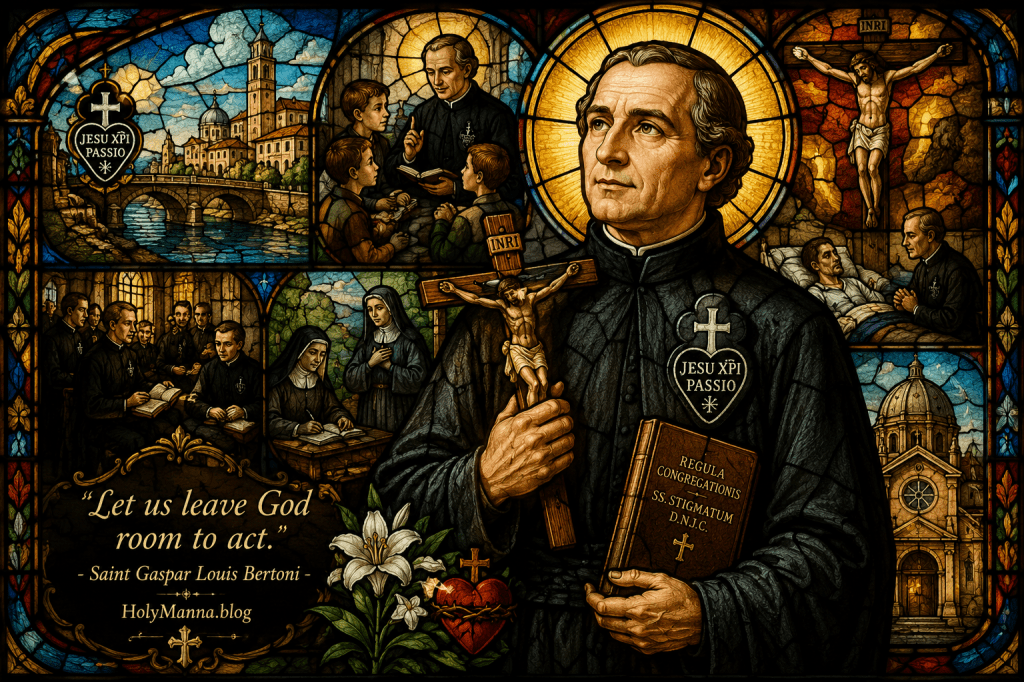
The Priest Who Pointed Souls to the Wounds of Christ
Saint Gaspar Louis Bertoni was born into a world that was about to be shaken by war, political revolution, poverty, and spiritual confusion. In other words, he lived in a world that may feel strangely familiar.
He was an Italian priest from Verona, born in 1777, and he became the founder of the Congregation of the Sacred Stigmata of Our Lord Jesus Christ, commonly known as the Stigmatines. His mission was simple, but demanding. He wanted to form souls, strengthen priests, educate young people, serve the Church, and lead wounded people back to the saving wounds of Jesus Christ.
Saint Gaspar is remembered as a priest of formation, mission, suffering, fidelity, and deep trust in God. He was not famous because he chased attention. He became holy by serving faithfully in a wounded Church, among wounded people, in a wounded society. That is what makes his story so powerful.
His life points straight to the heart of Catholic teaching on suffering and holiness. The Catechism of the Catholic Church teaches that Christ calls His disciples to take up their cross and be associated with His redemptive sacrifice, as seen in CCC 618. Saint Gaspar lived this truth in an extraordinary way. He did not simply preach the Cross. He carried it, quietly and faithfully, for most of his life.
A Child of Verona Formed by Faith
Gaspar Louis Bertoni was born in Verona, Italy, on October 9, 1777. He was baptized the next day in the parish church of Saint Paul. His parents, Francis Bertoni and Brunora Ravelli, raised him in a Catholic home. His family had some material comfort, but the deeper inheritance they gave him was faith.
After the death of his little sister, Gaspar became the only child in the family. He received his early education at home and later studied at Saint Sebastian’s school in Verona. Although the Jesuits had been suppressed at the time, several former Jesuits still taught there and helped shape his mind and soul. This mattered deeply, because his spirituality would carry a strong Ignatian influence throughout his life.
One of the most important priests in his formation was Father Luigi Fortis, who would later become the first Superior General of the restored Society of Jesus. Through teachers like him, young Gaspar learned discipline, prayer, discernment, and a deep love for the Church.
Catholic sources describe a special grace in his life beginning around the time of his First Holy Communion, which he received at the age of eleven. From that point forward, his soul seemed drawn into a deeper intimacy with Christ. His vocation matured, and by the age of eighteen he entered the seminary.
He was not a dramatic convert in the usual sense. His conversion was the quiet deepening of a Catholic heart. He moved from inherited faith to personal surrender. He allowed grace to take root until his whole life became an offering.
A Priest Ordained in a Time of Upheaval
Saint Gaspar’s formation took place during a stormy moment in European history. In 1796, French armies invaded northern Italy, and Verona was pulled into the violence and instability of the Napoleonic era. War, occupation, poverty, and political pressure disrupted everyday life and deeply affected the Church.
While still a seminarian, Gaspar joined the Gospel Fraternity for Hospitals and helped care for the sick and wounded. This is one of the first clear signs of the priest he would become. He did not run from suffering. He moved toward it with charity.
He was ordained a priest on September 20, 1800. His priesthood began at the dawn of a new century, but it was not a peaceful beginning. Verona had been wounded by war. Young people were spiritually neglected. Clergy needed renewal. Families were under pressure. The Church needed priests who could rebuild from the inside out.
Father Gaspar became one of those priests.
He was soon entrusted with the young people of his parish, and he gave himself completely to their formation. In 1802, he began a Marian oratory known as the Marian Cohort. It was designed to form young people in faith, discipline, friendship, prayer, and service. It gave them a Catholic community when the surrounding culture was unstable and often hostile to religious life.
This was one of his great gifts. Saint Gaspar understood that young people do not simply need rules. They need formation. They need beauty. They need belonging. They need adults who care about their souls.
The Marian Cohort eventually drew attention and opposition. Under Napoleon’s rule, religious associations like it were suppressed. Yet the work could not truly be killed. The seed had been planted. Later Catholic voices would see in Father Bertoni’s youth apostolate something prophetic, a kind of early model for organized Catholic youth formation.
The Founder Who Served from the Shadows
Saint Gaspar was not only a teacher of the young. He was also a spiritual director, and this part of his life is incredibly important.
In 1808, he became spiritual director for a community founded by Saint Magdalene of Canossa. Through this role, he helped guide holy women who would go on to found or strengthen religious communities. Among those he directed was Leopoldina Naudet, who later founded the Sisters of the Holy Family. He also helped Teodora Campostrini discern her vocation and found the Sorelle Minime of the Charity of the Sorrowful Mother.
This is one of the beautiful hidden fruits of Saint Gaspar’s life. He formed founders. He strengthened saints. He helped others listen to God.
Not every holy person is called to build something that carries only their own name. Some are called to form the people who build. Saint Gaspar was that kind of priest. His influence quietly spread through souls, communities, schools, parishes, and future missions.
In 1810, he was entrusted with the spiritual direction of seminarians in the diocesan seminary. This was another major part of his mission. He knew that the renewal of the Church required holy priests. He taught fidelity to Christ, fidelity to the Pope, and a serious commitment to priestly holiness.
At the time, Pope Pius VII was suffering under Napoleon’s power. Saint Gaspar remained deeply loyal to the Holy Father. He famously described the Pope as “the first and irremovable stone” of the Church. That image captures his Catholic heart. For Saint Gaspar, love for Christ could never be separated from love for the Church Christ founded.
This is deeply connected to Catholic teaching. The Catechism of the Catholic Church teaches in CCC 1536 that Holy Orders is the sacrament through which the mission entrusted by Christ to His apostles continues in the Church until the end of time. Saint Gaspar understood that forming priests was not simply an administrative task. It was part of Christ’s own mission continuing in the world.
The Birth of the Stigmatines
On November 4, 1816, Father Gaspar moved with two companions into a small house beside a suppressed church dedicated to the Sacred Stigmata of Saint Francis. From that church came the name of the religious family he would found: the Congregation of the Sacred Stigmata of Our Lord Jesus Christ, known as the Stigmatines.
The beginning was humble. They opened a tuition-free school and offered themselves in service to the Church. Their mission would eventually be summarized as being “apostolic missionaries in service of bishops.”
This phrase tells us so much about Saint Gaspar. He did not want a religious community built on personal ambition. He wanted men available for the needs of the Church. Preaching, education, retreats, missions, clergy formation, youth ministry, and service to bishops all became part of the Stigmatine charism.
At the center of it all was devotion to the Passion of Christ, especially the Sacred Wounds of Jesus. Saint Gaspar saw the wounds of Christ not merely as signs of suffering, but as signs of mercy. They were the open doors through which sinners could find forgiveness, healing, and peace.
This devotion is entirely Catholic. The wounds of Christ proclaim that love has entered suffering and transformed it from within. They remind the Church that salvation did not come through comfort, but through the Cross.
The Mystic Before the Crucifix
One of the most famous spiritual moments in Saint Gaspar’s life took place on May 30, 1812. While praying before a Crucifix, he experienced a profound ecstasy. In his spiritual writings, the words associated with this mystical moment are preserved as “Look at this my heart.”
This was not an empty emotional experience. It was a call deeper into the mystery of the Crucified Christ. Soon after this mystical grace, he became seriously ill with miliary fever and nearly died. Catholic sources describe his recovery as almost miraculous, though his health never fully returned.
From that point forward, suffering became a major part of his life. He endured chronic illness for decades. Most famously, he reportedly underwent nearly three hundred surgical procedures on his right leg. That number is almost difficult to imagine. Yet he endured it with remarkable patience.
He became a living image of Christ Crucified. Even from his sickbed, people came to him for counsel. Priests, bishops, religious, founders, and laypeople sought his wisdom. His room became a place of spiritual direction. His weakness became fruitful.
That is one of the most surprising parts of his life. The illness that seemed to limit him became one of the places where God used him most powerfully.
A Life of Miracles, Grace, and Hidden Strength
Saint Gaspar is not mainly remembered for public miracle-working during his lifetime in the way some saints are. There are no widely verified stories of him performing dramatic public healings during life. Instead, Catholic sources emphasize his mystical graces, his near-miraculous recovery from grave illness, his extraordinary patience in suffering, and his power as a spiritual father.
The stories connected to him are quieter, but no less striking. His deep grace at First Holy Communion, his ecstasy before the Crucifix, his survival after near-fatal illness, and his endurance through hundreds of painful operations all reveal a soul united to Christ.
One story preserved in Catholic tradition connects him with Saint Daniel Comboni, the great missionary bishop of Africa. As a young man, Comboni reportedly heard from Bertoni’s sickbed the demanding missionary saying, “No delicacy is granted to one who has put on Christ crucified.” This story shows how Saint Gaspar’s hidden suffering helped form missionary courage in others.
There is also the famous story from the end of his life. When his infirmarian asked if he needed anything, Saint Gaspar answered, “I need to suffer.”
To modern ears, that can sound intense. But he was not glorifying pain for its own sake. He was expressing the Catholic mystery of redemptive suffering. He wanted to remain united to Jesus Crucified until the end. He understood, as The Catechism of the Catholic Church teaches in CCC 618, that Christians are invited to share in the Cross of Christ, not because suffering is good by itself, but because love can transform suffering into an offering.
The Long Cross Without Martyrdom
Saint Gaspar was not a martyr in the sense of being killed for the faith. His martyrdom was different. It was the long martyrdom of illness, patience, perseverance, and hidden sacrifice.
He faced political instability, the suppression of Catholic works, the wounds left by war, and the heavy responsibility of rebuilding Catholic life in a troubled society. His youth apostolate was suppressed under Napoleon’s decree. The Church around him suffered. The Pope himself endured captivity. Yet Saint Gaspar remained faithful.
He also suffered physically for most of his adult life. The surgeries on his leg, the chronic pain, the weakness, and the restrictions of illness could have made him bitter. Instead, they made him more available to God.
His witness reminds us that holiness is not always dramatic. Sometimes it looks like waking up in pain and still choosing charity. Sometimes it looks like continuing to pray when the body is tired. Sometimes it looks like serving the Church from a sickbed, when the world assumes a person has become useless.
Saint Gaspar teaches that no suffering offered to Christ is wasted.
The Saint Who Kept Working After Death
Saint Gaspar died in Verona on June 12, 1853, at 3:30 in the afternoon. His feast day is celebrated on June 12.
After his death, his congregation continued to grow. The Stigmatines spread beyond Verona and eventually beyond Italy, serving in countries such as the United States, Brazil, Chile, the Philippines, South Africa, Ivory Coast, Tanzania, and Thailand. Their mission continued through preaching, parish work, youth formation, education, retreats, missions, and service to bishops.
His educational legacy also remained important in Verona, especially through the Stigmatine tradition of forming young people and providing schooling rooted in Catholic faith. His influence continued through the priests he formed, the founders he guided, the religious family he established, and the devotion to the Sacred Wounds of Jesus that he helped spread.
Because he was beatified and canonized through the Church’s process, miracles attributed to his intercession were examined and accepted by the Church. One Catholic account identifies the beatification miracle as the healing of Father Giuseppe Anselmi, a Stigmatine priest, from severe stomach complications in Brasília in 1937. Publicly accessible official summaries confirm his beatification and canonization but do not always provide detailed miracle narratives. For that reason, this particular miracle story should be presented with care as part of Catholic biographical tradition rather than as a fully detailed public narrative available in every official summary.
Saint Gaspar was beatified by Pope Paul VI on November 1, 1975, and canonized by Pope Saint John Paul II on November 1, 1989. Pope Paul VI praised him as an apostle of the young, and Pope Saint John Paul II emphasized his work of renewed evangelization, priestly formation, and the universal call to holiness.
That last point is essential. Long before the phrase became widely associated with the Second Vatican Council, Saint Gaspar was already living and teaching the truth that holiness is for everyone. The Catechism of the Catholic Church teaches in CCC 2013 that all Christians, in any state of life, are called to the fullness of Christian life and the perfection of charity.
Saint Gaspar believed that too. He formed priests, young people, founders, workers, families, and ordinary Catholics to become saints in their own state of life.
The Wisdom He Left Behind
Several short sayings are associated with Saint Gaspar’s spirituality. His most famous final words are “I need to suffer.”
Another saying attributed to him in Italian is “Fidiamoci di Dio che é un bel fidarsi.” In English, this means “Let us trust God, for He is worthy of trust.”
Another spiritual maxim attributed to him is “Lasciamo a Dio lo spazio per agire.” In English, this means “Let us leave God room to act.”
These sayings reveal the heart of his spirituality. He trusted God. He surrendered to God. He served the Church. He accepted the Cross. He believed that grace could work even when human strength failed.
That is the kind of holiness the modern world desperately needs.
The Wounds That Became a Mission
Saint Gaspar Bertoni’s life can be summarized in three words: formation, mission, and the Cross.
He formed young people when society was neglecting them. He formed priests when the Church needed renewal. He formed founders whose own communities would bless the Church. He founded the Stigmatines to serve bishops and preach the Gospel. He suffered for decades and united that suffering to Christ Crucified.
He did not waste his wounds. He placed them inside the wounds of Jesus.
That is why his life remains so relevant. Everyone carries wounds. Some are physical. Some are emotional. Some are spiritual. Some are hidden so deeply that nobody else sees them. Saint Gaspar reminds us that Jesus does not reject wounded people. He invites them to come close to His own wounds and discover mercy there.
The Sacred Wounds of Christ are not symbols of defeat. They are signs of love stronger than sin, stronger than suffering, and stronger than death.
What wounds in your life still need to be brought to the wounds of Jesus?
Where might God be asking you to stop running from suffering and begin offering it with love?
Who in your life needs formation, encouragement, and patient Catholic witness the way Saint Gaspar offered it to the young people of Verona?
Engage With Us!
Share your thoughts and reflections in the comments below. Saint Gaspar Bertoni’s life is a powerful reminder that God can use even suffering, weakness, and hidden service to renew the Church and heal souls.
- What part of Saint Gaspar’s life speaks most strongly to you: his work with young people, his devotion to the wounds of Christ, his priestly formation, or his patience in suffering?
- How can you bring your own wounds to Jesus instead of carrying them alone?
- Who is one young person, friend, family member, or coworker you can encourage in faith this week?
- What does Saint Gaspar’s trust in God teach you about surrendering control and leaving room for God to act?
- How can you live the universal call to holiness in your own state of life today?
May Saint Gaspar Louis Bertoni help us trust God more deeply, serve the Church more faithfully, and bring every wound of our lives to the merciful wounds of Jesus. Let us live with courage, form others with love, and do everything with the love and mercy Jesus taught us.
Saint Gaspar Louis Bertoni, pray for us!
Follow us on YouTube, TikTok, Instagram and Facebook for more insights and reflections on living a faith-filled life.

 Holy Manna!
Leave a comment